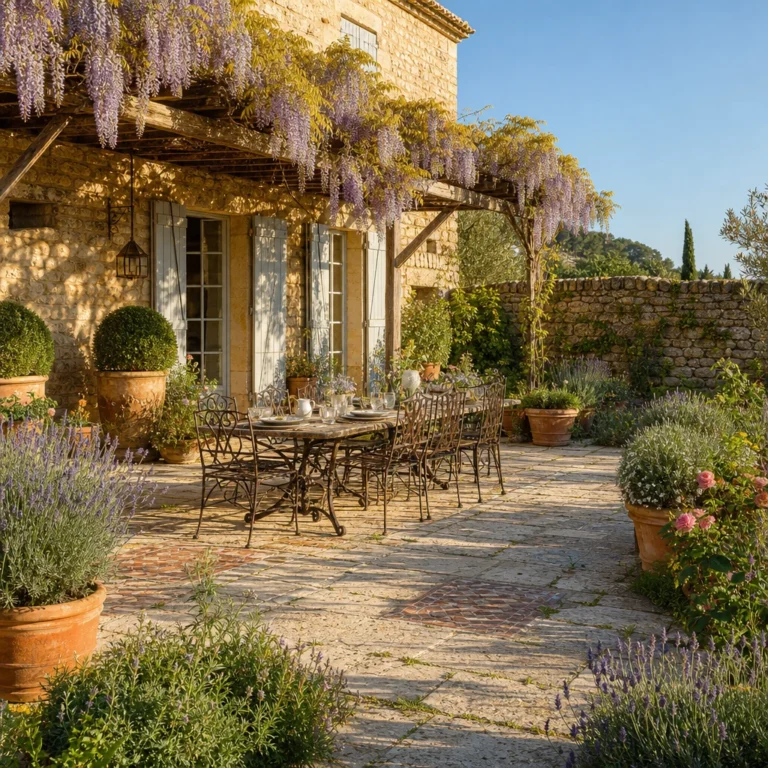
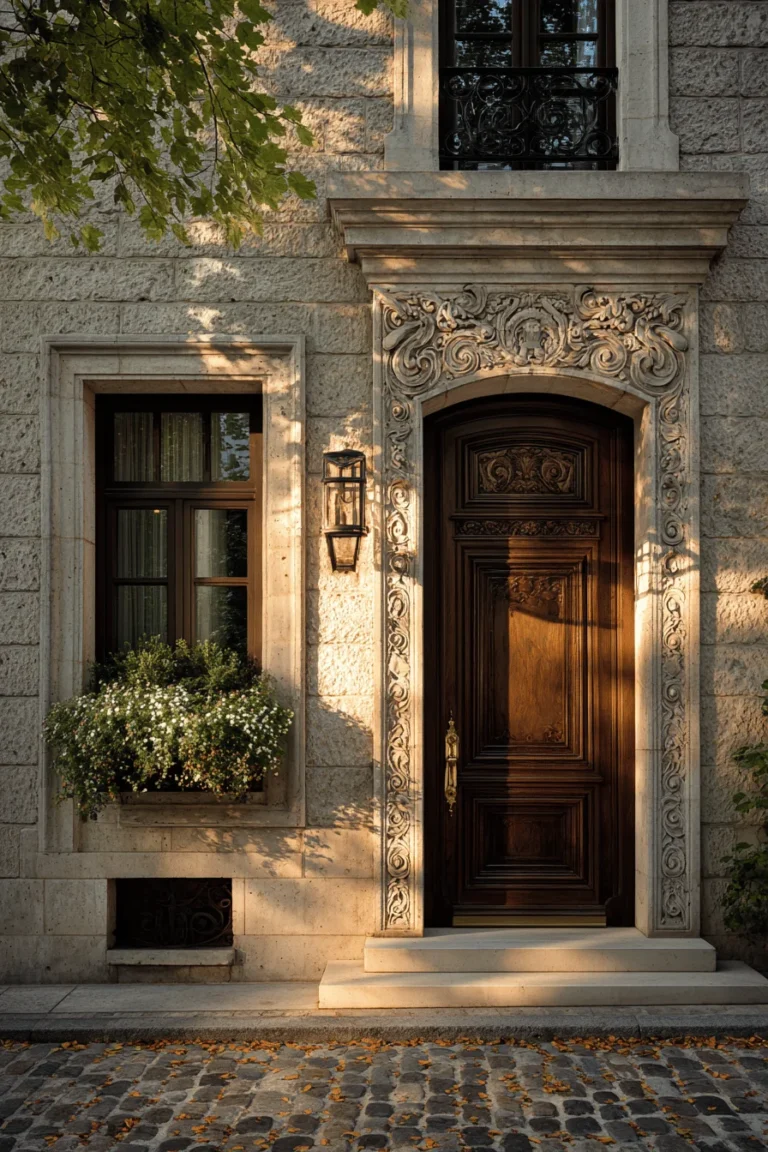
I’ve always believed the most romantic gardens in the world aren’t complicated, they’re just quietly confident about a handful of beautiful things. A Provence garden landscape gets its magic from lavender drifts, weathered stone, and gnarled olive trees working together in the afternoon light. In this piece I walk through the features that make these gardens so irresistible, from terraced hillsides to climbing roses and candlelit courtyards, and every single look is one you can borrow for your own outdoor space.
How a Sea of Lavender Sets the Whole Tone
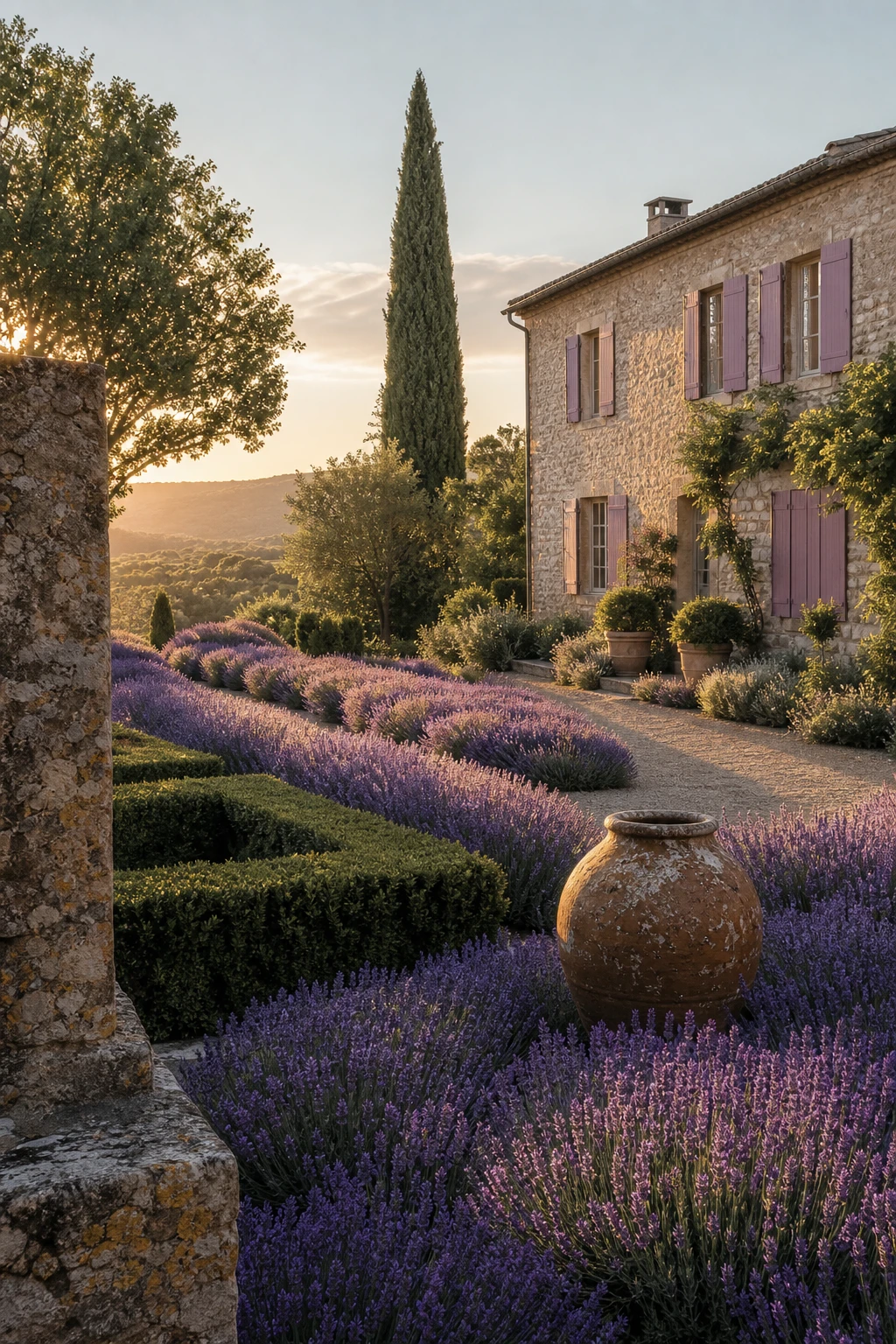
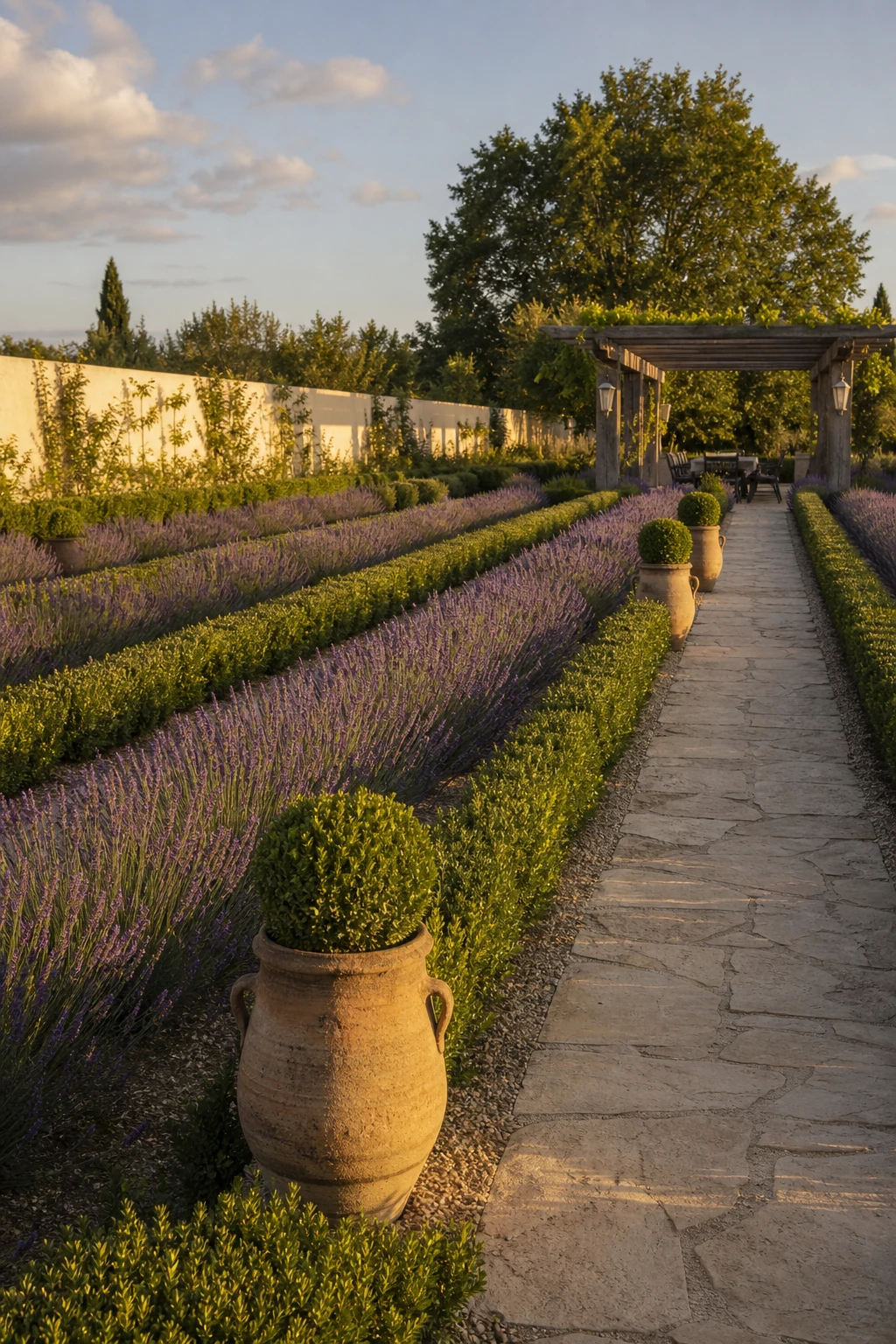
Planting lavender in generous, unbroken drifts is one of my favourite moves in a French garden because the repetition stops being botanical and starts being emotional. You get that hazy purple horizon that feels bigger than the space actually is. What I love most is the way a single variety, repeated confidently across a whole border, pulls every other element into harmony around it.
The Key Details
Mass planted lavender rows
Limestone garden wall
Clipped boxwood parterre
Aged terracotta urn
Gravel allée
Pro TipMix an early flowering variety like Hidcote with a later one like Phenomenal so you hold that purple haze from late spring right through to early autumn.
AvoidDotting individual lavender plants across a border at equal spacing produces a polka dot effect that reads as restless rather than serene, and the whole emotional weight of the drift is lost.
Cypress Spires Rising Above the Lavender for That Classic French Silhouette
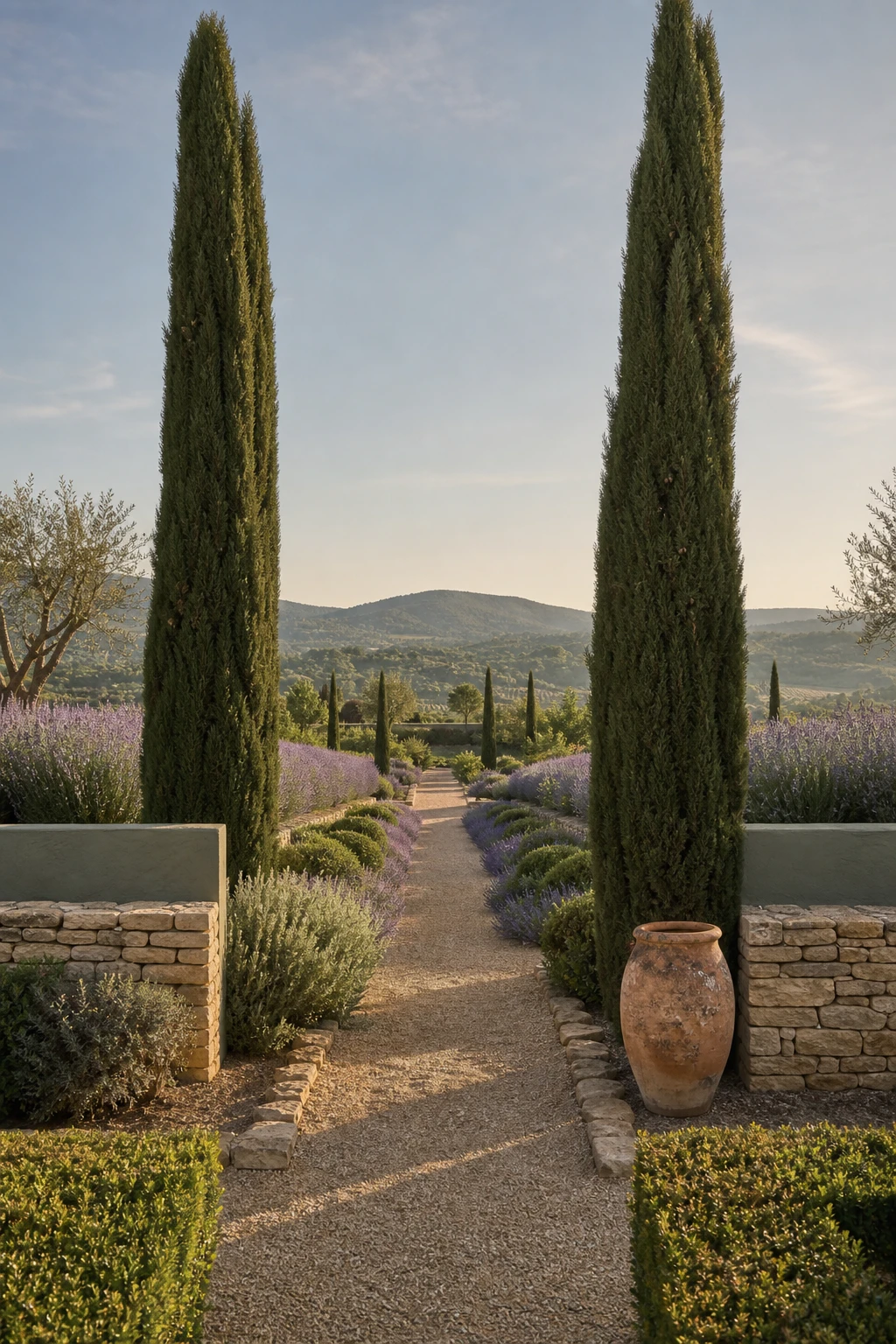
The contrast between dark vertical cypress and a soft purple lavender sweep does all the heavy lifting, and I never get tired of watching it work. You get a clear skyline, those narrow exclamation marks pulling the eye upward, while the haze at ground level keeps everything from feeling stiff. That restraint wins me over every time: two plants, almost no maintenance, and yet together they read as completely intentional.
The Key Details
Columnar cypress tree pairs
Lavender groundcover rows
Gravel stone path
Dry stone boundary wall
Weathered terracotta urn
Pro TipSpace your cypress pairs roughly four metres apart so they act as a windbreak along the prevailing side of the garden while still framing the view beyond them like a natural gateway.
AvoidPlanting cypress closer than a metre from a path or foundation traps moisture against the roots and, within a few seasons, you will find the base turning brown and the stonework quietly lifting.
An Olive Tree Lined Path That Feels Like the South of France
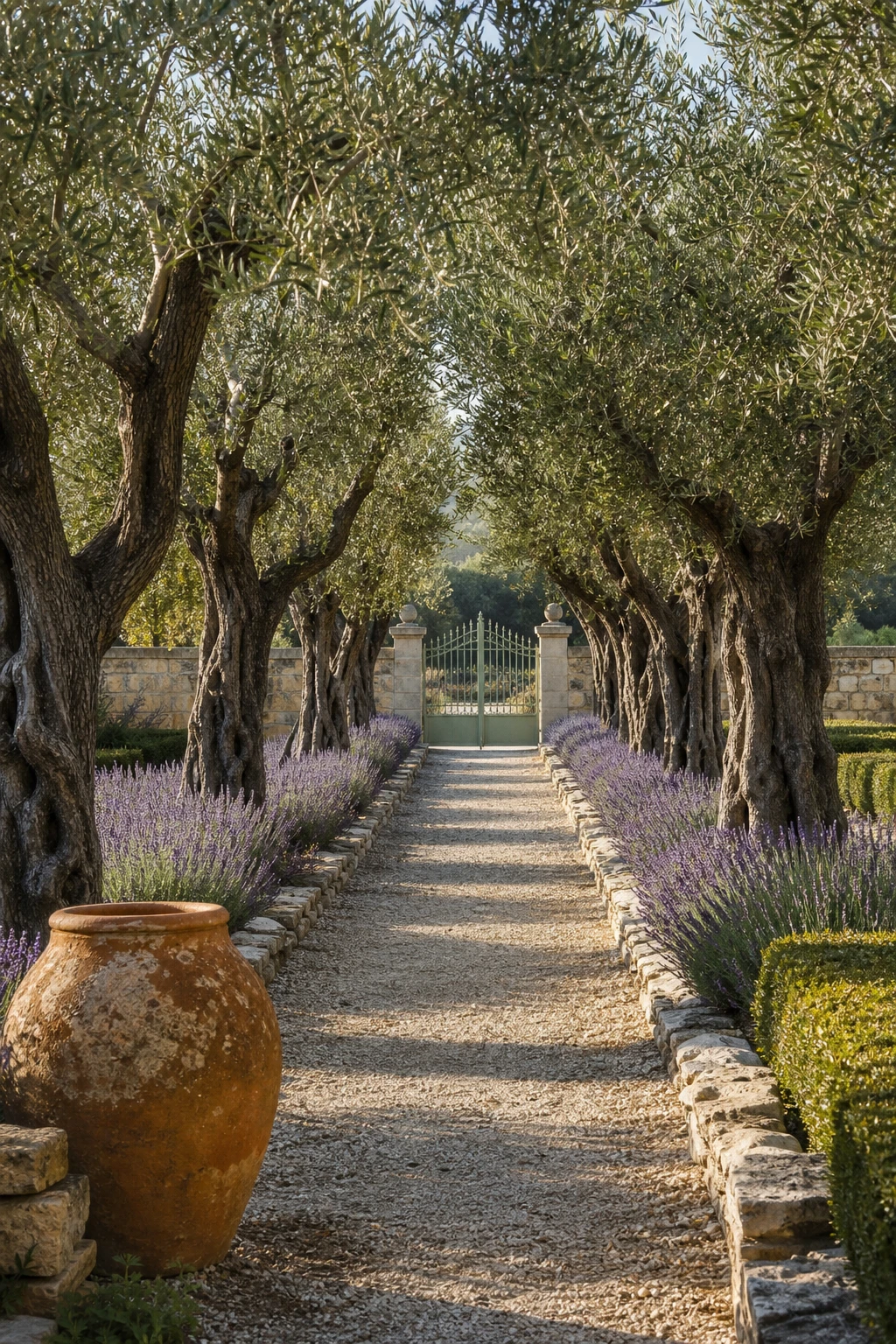
Line a path with a double row of olive trees and something almost ceremonial happens. The repeated trunks set a rhythm, and you feel it in your feet before you even reach the end. The gnarled silver bark catches the light differently at every hour, shifting the mood from cool and quiet in the morning to warm and golden by late afternoon. I find it hard to walk one of these paths slowly enough, because the sense of arrival it creates makes you want to reach whatever is waiting at the end.
The Key Details
Gnarled olive trees in formal double row
Pale compacted gravel path
Purple lavender border planting
Weathered terracotta urn
Clipped boxwood hedge edging
Pro TipTuck rosemary, thyme, or sage right into the root zone of each olive, as they share the same love of free draining soil and the combination smells extraordinary in warm weather.
AvoidGiving olive trees generous, frequent watering encourages shallow roots and soft growth that looks wrong against the ancient character you are trying to achieve.
Letting Poppies Run Wild for a Burst of Provencal Red
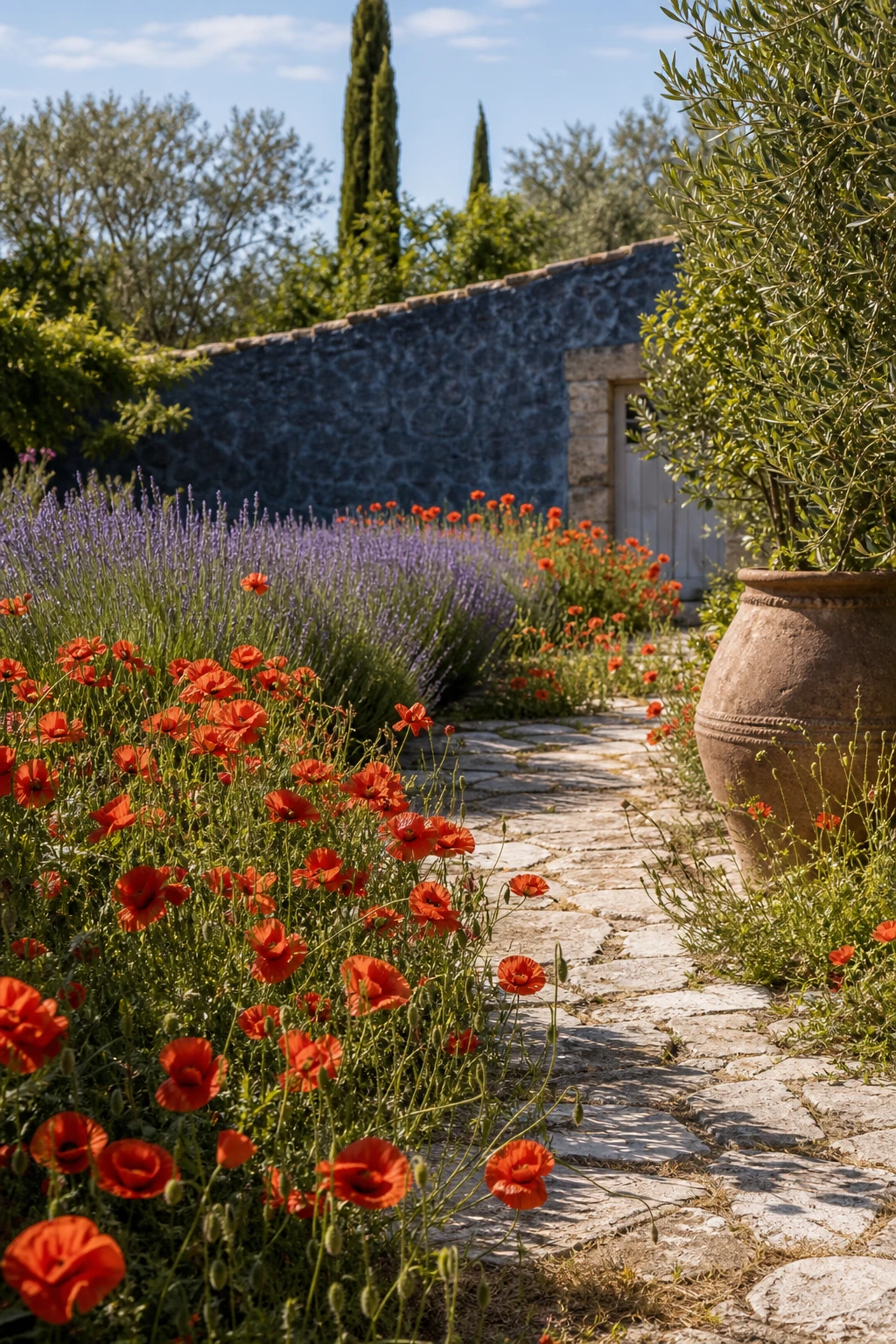
Scarlet poppies threading between lavender and worn limestone stop me every time I see them in a Provencal garden. The feeling is one of controlled wildness, as if the land decided for itself where the colour should land. Those self seeded drifts look completely unplanned, and yet the effect is richer than anything you could place by hand. I genuinely believe some of the most beautiful planting in the world comes from getting out of the way and letting a simple annual do its own thing.
The Key Details
Self seeded scarlet poppy drifts
Worn limestone path edging
Mature lavender border rows
Weathered stone boundary wall
Rustic terracotta urn
Pro TipScatter seed in early autumn directly onto bare soil so the cold winter months trigger germination and you get the strongest, most naturalised show come spring.
AvoidCutting spent poppy heads too soon means the seed never reaches the ground, and you lose next year’s drift entirely.
Why a Simple Gravel Path Feels So Beautifully Provencal
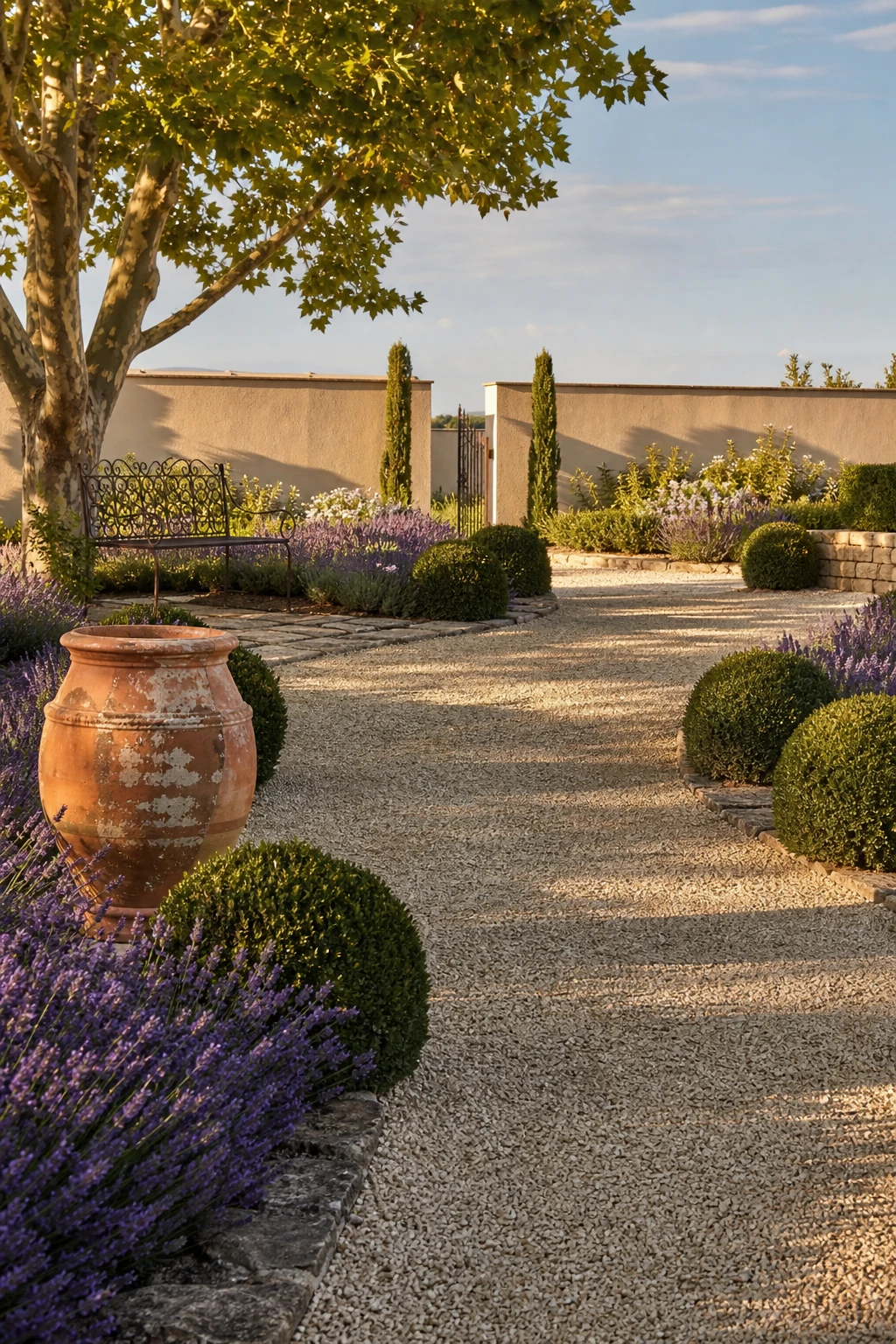
Gravel paths refuse to feel rigid, and that is exactly what I want from a Provencal garden. The surface yields slightly underfoot, blurring the line between planted border and walkway in a way paving slabs simply cannot. The loose texture soaks up sunlight and bounces it back warmly, making the whole garden feel hazy and sun baked rather than clipped and controlled. It is one of those details I recommend to almost everyone, because the cost is low and the atmosphere it creates is enormous.
The Key Details
Crushed limestone gravel path
Flowering lavender border
Clipped boxwood spheres
Weathered terracotta urn
Rustic wrought iron bench
Pro TipChoose a honey or golden limestone gravel rather than grey or white, so the path glows in afternoon light the way a real Provencal lane does.
AvoidLaying gravel directly onto bare soil without a weed membrane means you will be pulling weeds through the stones within a single season, and the path quickly looks neglected.
A Fragrant Garden Pathway You Actually Want to Walk Slowly Along
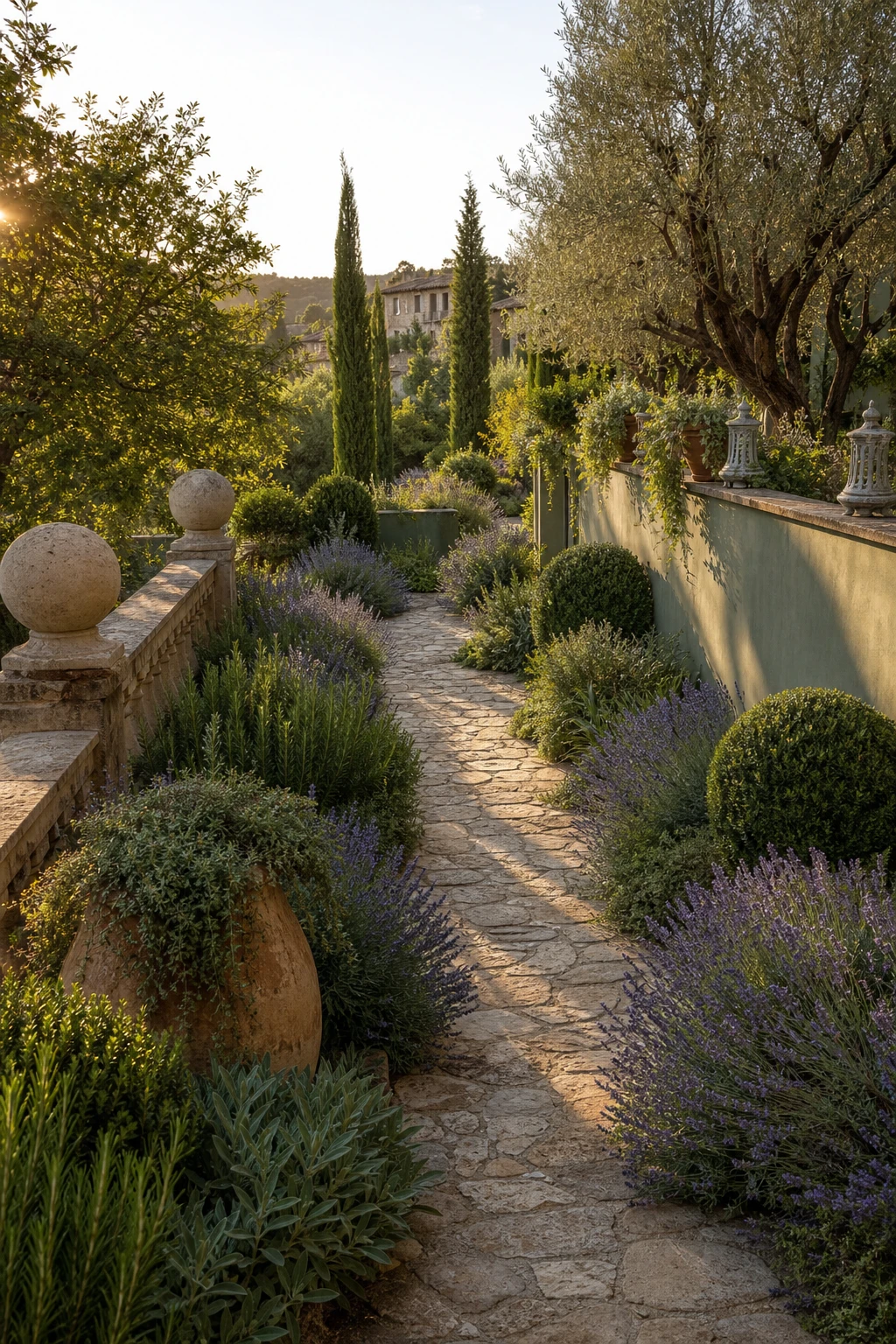
Rosemary and thyme along a path edge change what walking through a garden actually feels like. Every time a visitor brushes past, the whole experience shifts from visual to fully sensory, that warm herbal release at hand height slowing people down in the best possible way. You get tidiness and scent at the same time, which is a combination I find hard to beat. The herbs hold the edge neatly all season and then smell extraordinary the moment the sun warms them, so the path earns its keep morning to evening.
The Key Details
Irregular limestone paving
Billowing lavender border planting
Aged terracotta urns
Clipped boxwood spheres
Low rendered garden wall
Pro TipPlant rosemary and thyme directly into the path edge rather than in a border set back from it, so walkers naturally graze the leaves as they pass and release the scent without any effort.
AvoidLetting sprawling herbs like oregano creep across the paving surface creates a trip hazard and quickly makes even a beautiful limestone path look neglected and unloved.
Garden Steps That Make a Slope Look Like It Was Always Meant to Be There
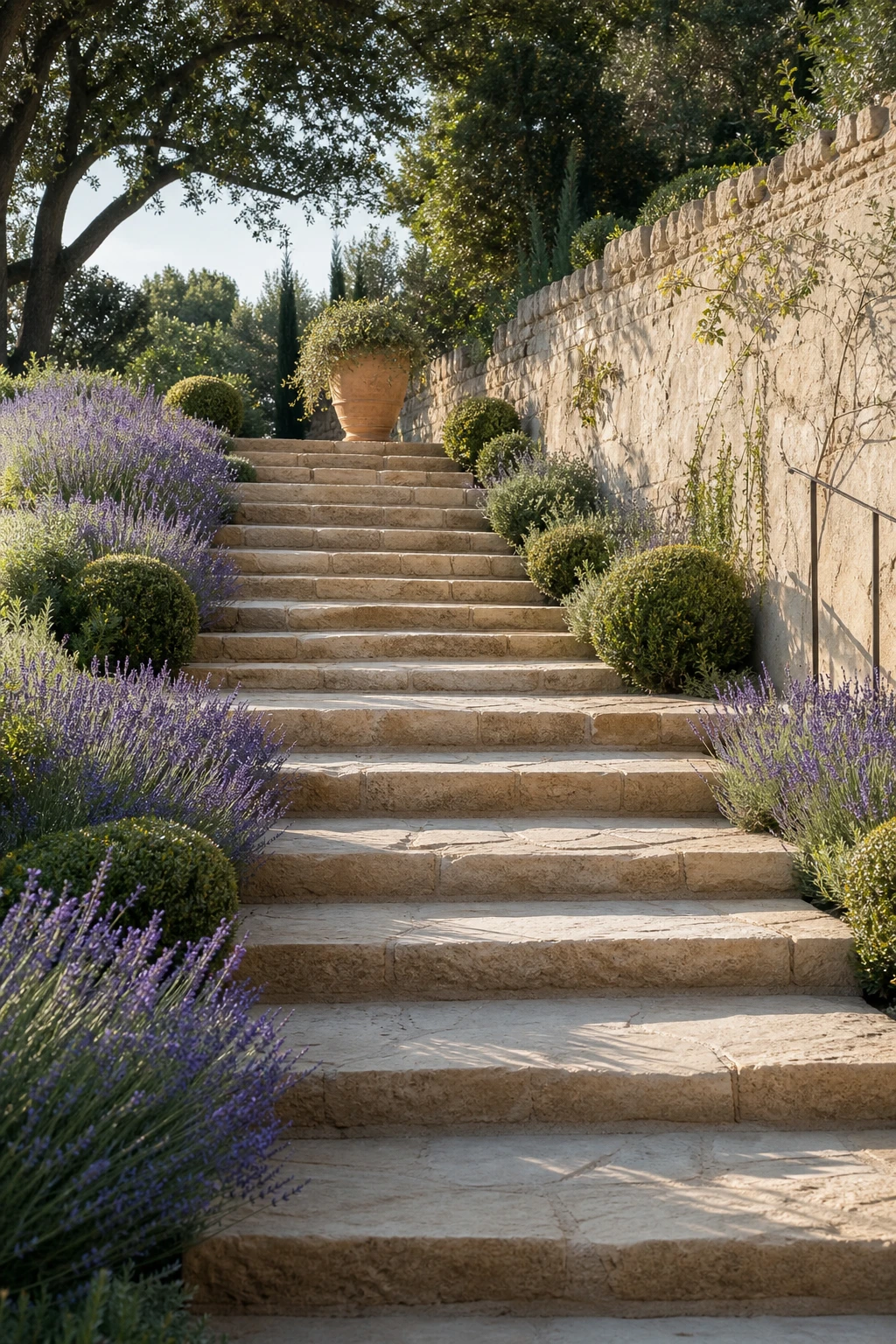
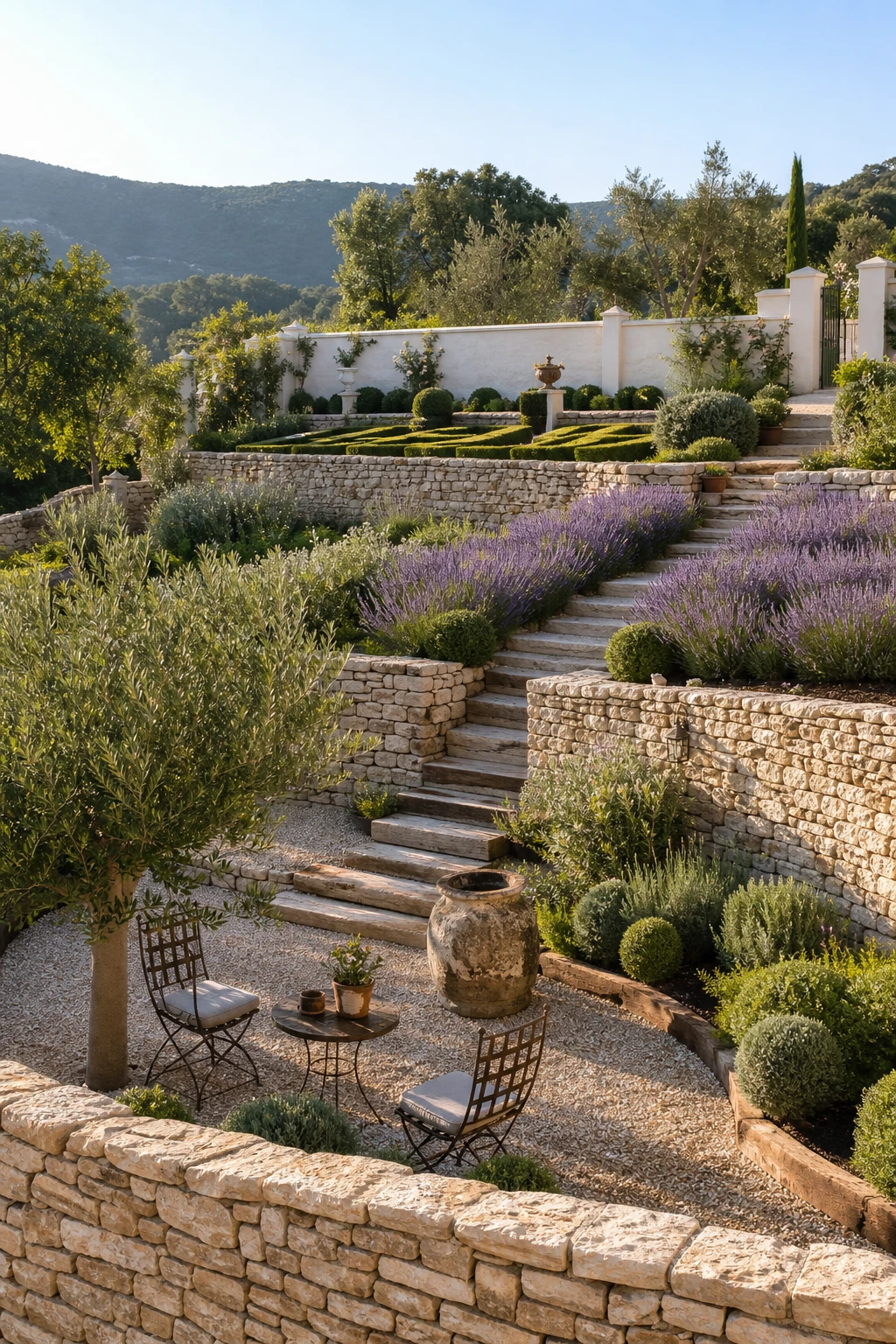
Wide shallow steps are one of my favourite moves on any slope because they shift the whole mood from effort to invitation. You feel it the moment you look at them: the eye slows down, the garden feels generous, and the gradient almost disappears. What I love about limestone treads in particular is how quickly they settle into a landscape, picking up a little weather and moss until they look as though the hill was always meant to have them.
The Key Details
Wide shallow limestone treads
Clipped boxwood spheres at landings
Lavender border plantings
Terracotta urn with trailing herbs
Weathered limestone retaining wall
Pro TipPress creeping thyme plugs into the gaps between risers so that by the second season the steps feel like they grew there rather than were built.
AvoidSteps that are only wide enough for one person create a bottleneck that makes even a gentle slope feel awkward and unwelcoming.
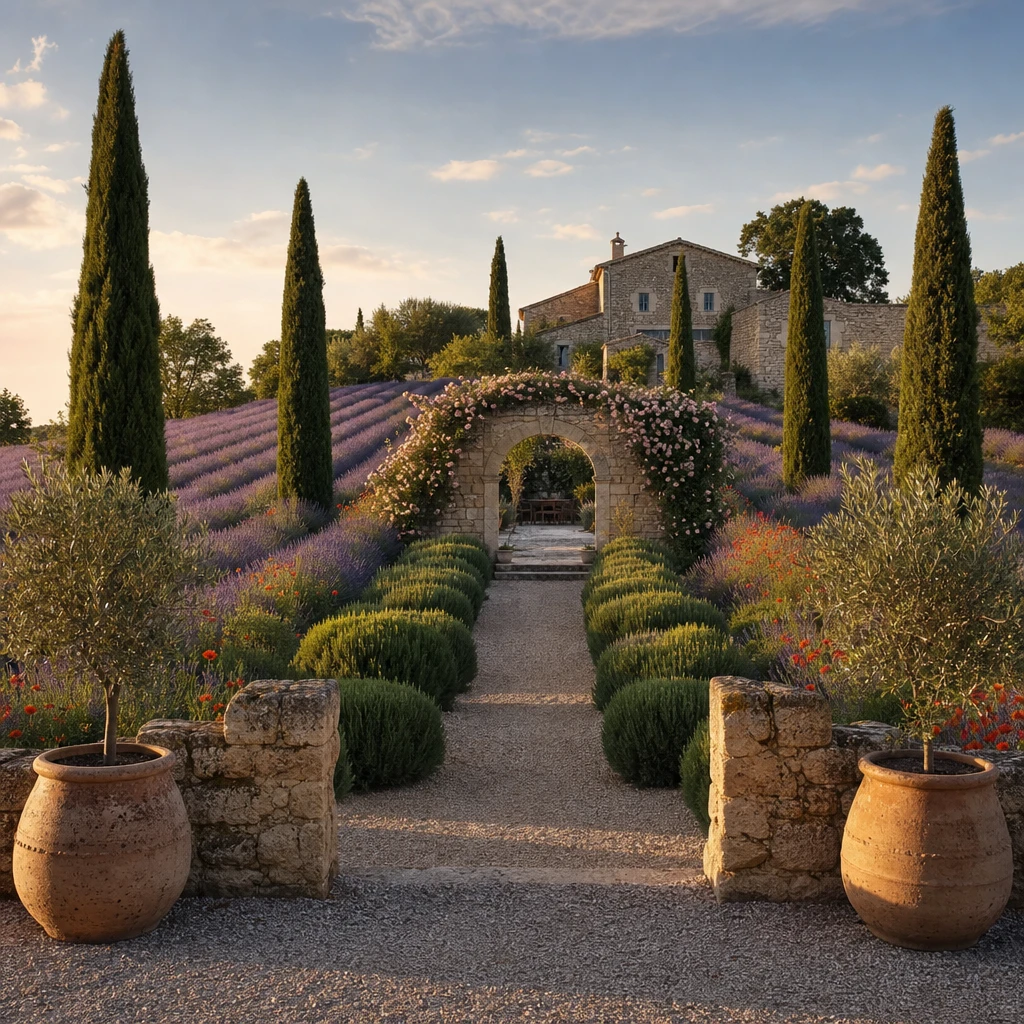
The Stone Arch That Makes Everything Beyond It Look Like a Secret Garden
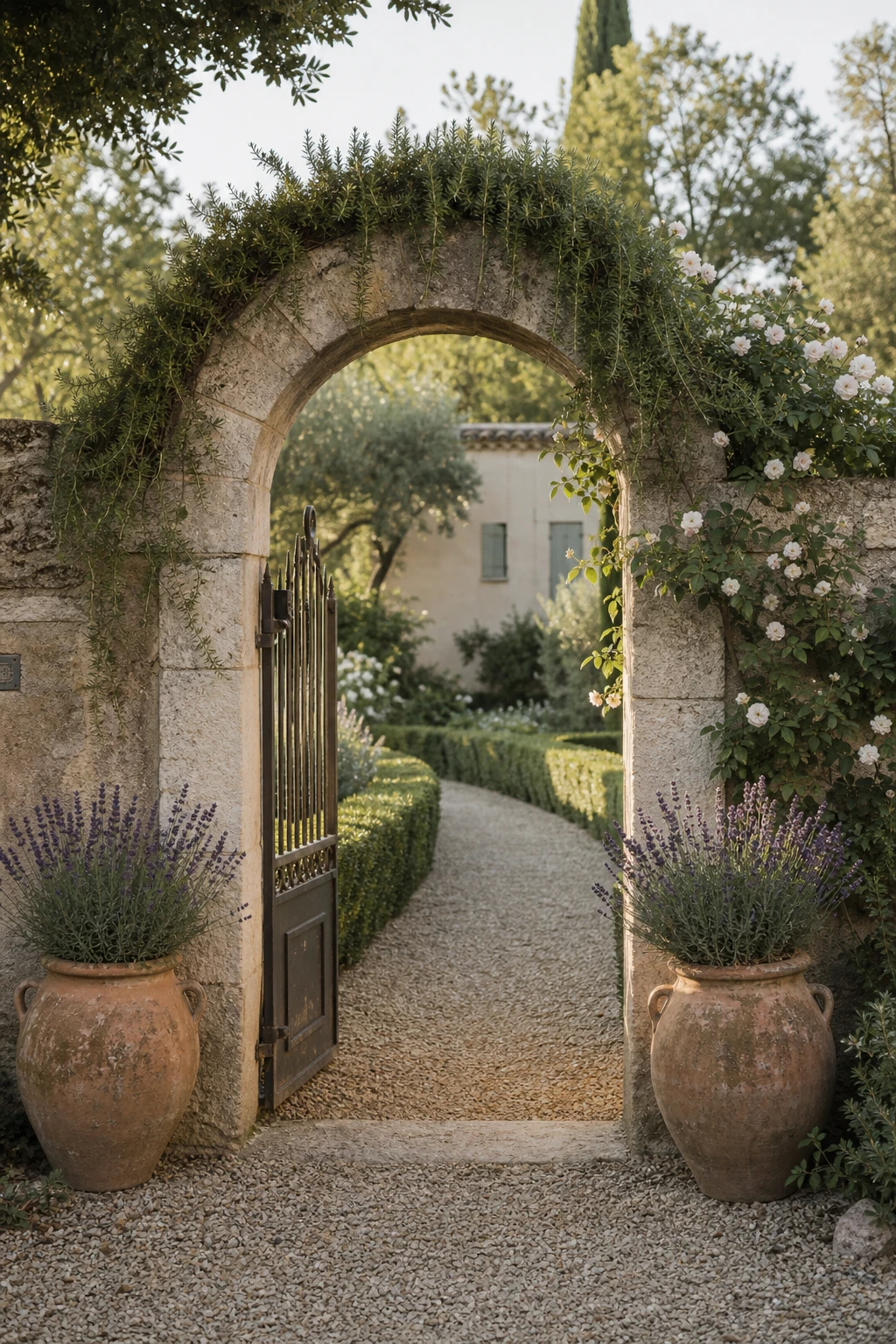
A stone arch does something almost theatrical to a garden: it turns whatever sits beyond it into a discovery. What I love is how the eye narrows through that opening and lands on a single focal point, a clipped hedge, a fountain, a lone urn, and suddenly it feels earned. You get depth, mystery, and a sense that the garden goes on further than it really does. That feeling of a secret waiting just beyond the frame is exactly what the Provençal style does so well.
The Key Details
Weathered limestone arch
Trailing climbing roses
Terracotta urns with lavender
Aged iron gate
Clipped box hedge border
Pro TipPosition the arch so it frames one clear focal point beyond it, a single urn, a sundial, or a clipped topiary, rather than letting the view scatter across open lawn.
AvoidLeaving the arch completely bare robs it of the soft, romantic quality that makes it feel like it belongs in the garden rather than standing in it as a hard architectural object.
Climbing Roses on a Trellis That Soften Every Hard Wall
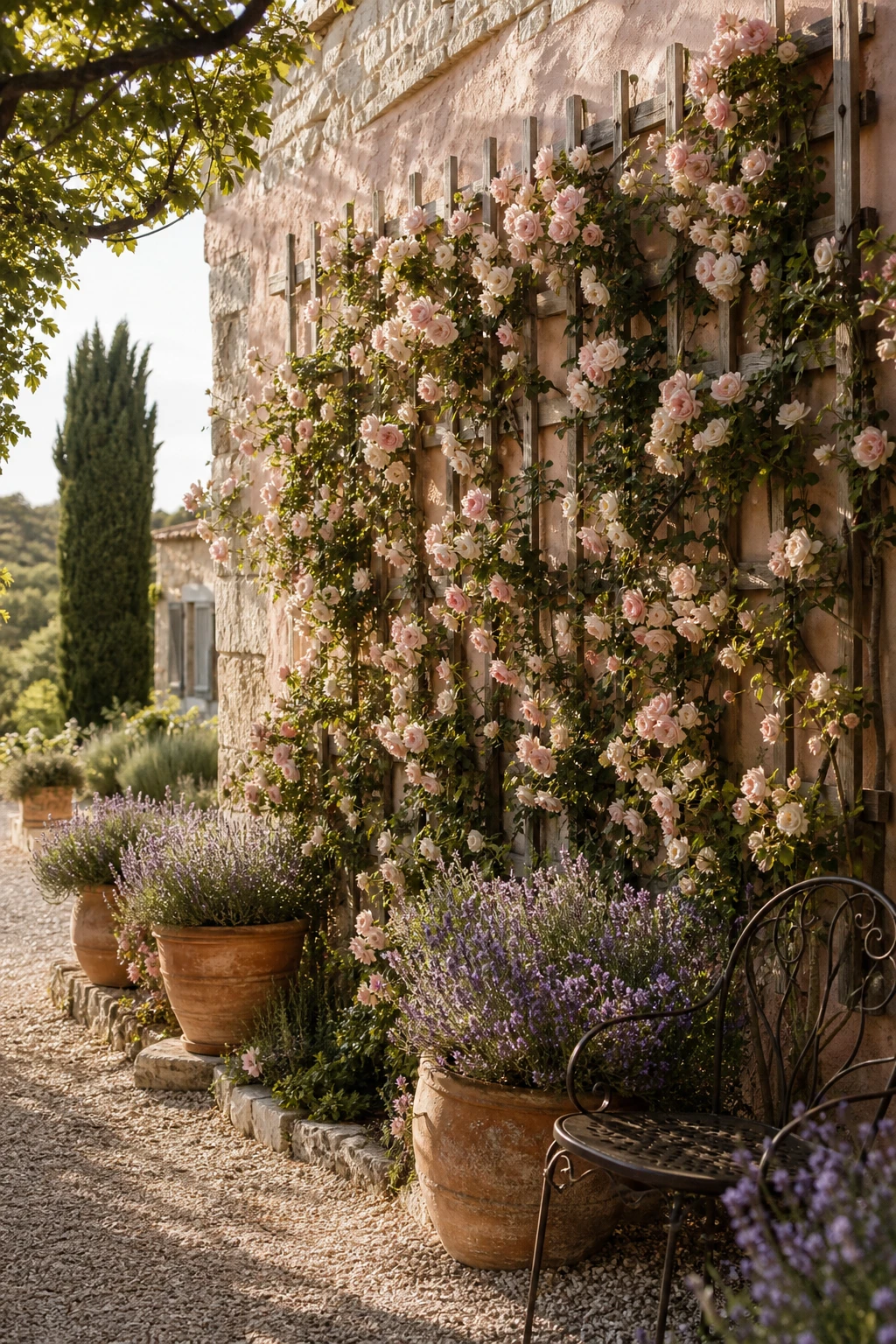
A bare stone wall can feel like a dead end in a garden, and covering it with climbing roses is one of my favourite fixes. Watch how the canes and blooms pull your eye upward, giving a flat surface real depth and movement. You get softness against all that hard material, and the scent alone makes the whole corner feel alive.
The Key Details
Timber lattice trellis
Weathered stone wall
Terracotta pots with lavender
Crushed gravel path
Wrought iron garden chair
Pro TipTrain the main canes horizontally along the trellis wires rather than straight up, because a horizontal stem tricks the plant into pushing out far more flowering side shoots.
AvoidFixing the trellis tight against the wall with no gap behind traps moisture, rots the timber faster than you would expect, and leaves the rose canes with no air circulation to resist mildew.
A Courtyard Dining Area That Turns Every Evening Meal into an Occasion
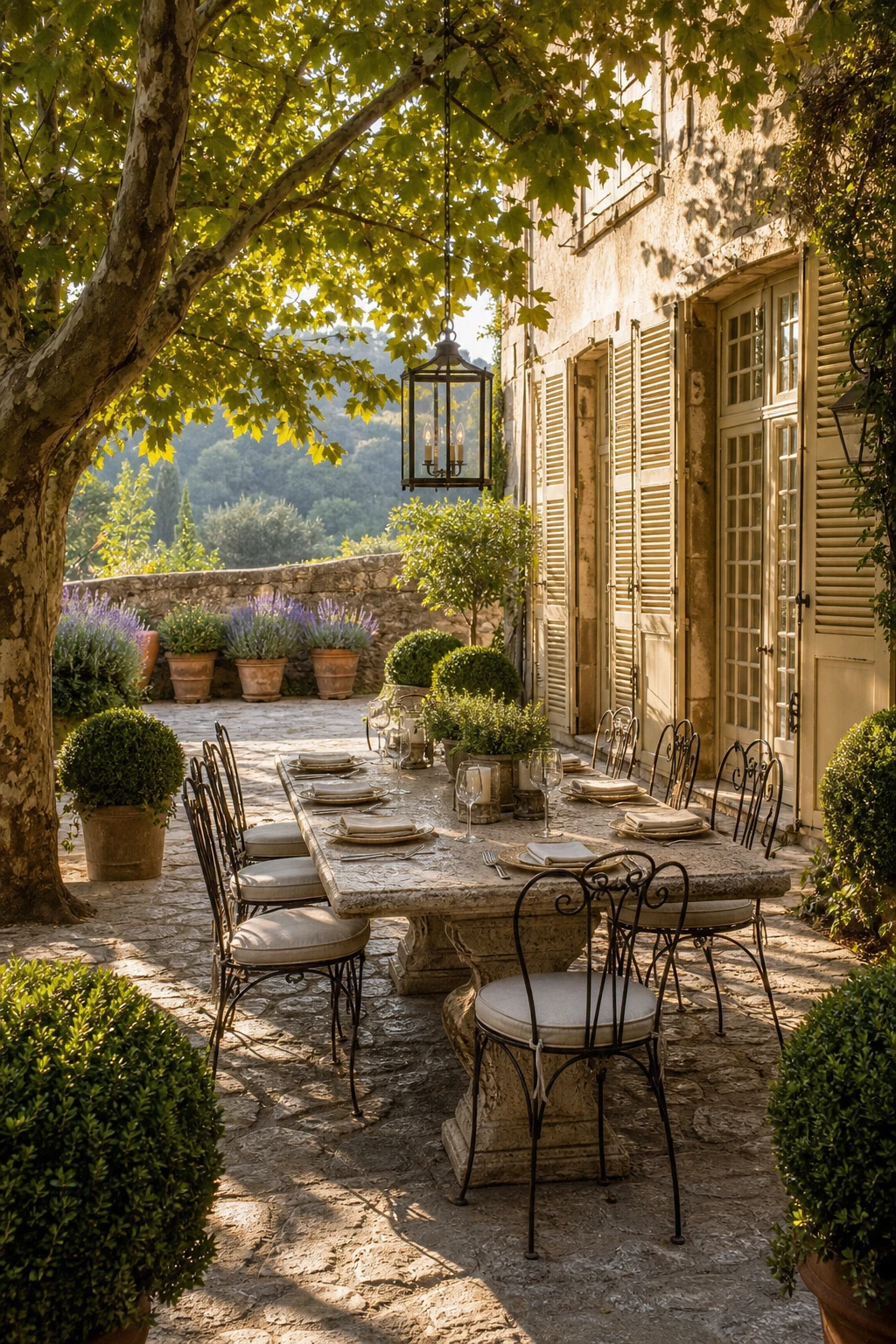
Enclosure is the secret ingredient here, and a courtyard delivers it better than almost any other outdoor space. The walls hold the candlelight, the conversation, and the scent of warm stone in a way an open lawn simply cannot. What I love most is how the cobblestone floor and the plane tree canopy work together to say ‘room’ rather than ‘garden’, so you get all the ease of dining outside with none of the feeling of floating in open air.
The Key Details
Weathered limestone dining table
Wrought iron chairs with linen cushions
Cobblestone courtyard floor
Clipped boxwood topiary in terracotta planters
Mature plane tree canopy overhead
Pro TipAnchor the centre of the courtyard with a potted lemon or orange tree and you instantly give the table something beautiful to sit around, the way a pendant light anchors a dining room indoors.
AvoidChoosing a dining table and chairs that are too large for the space leaves no room to pull a chair back comfortably, and the courtyard stops feeling like a retreat and starts feeling like a furniture showroom.
How Lavender Planted on a Slope Becomes Its Own Living Artwork
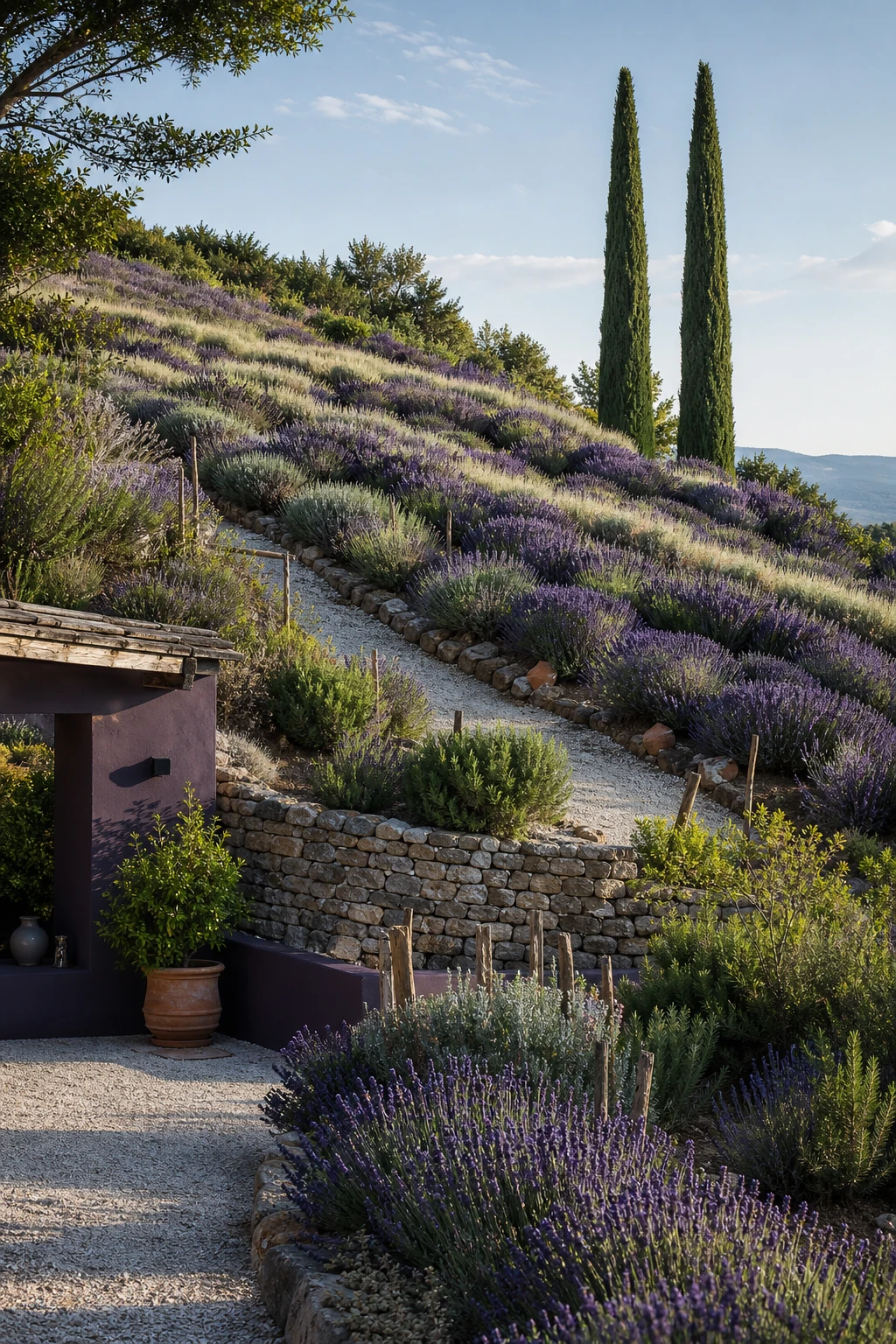
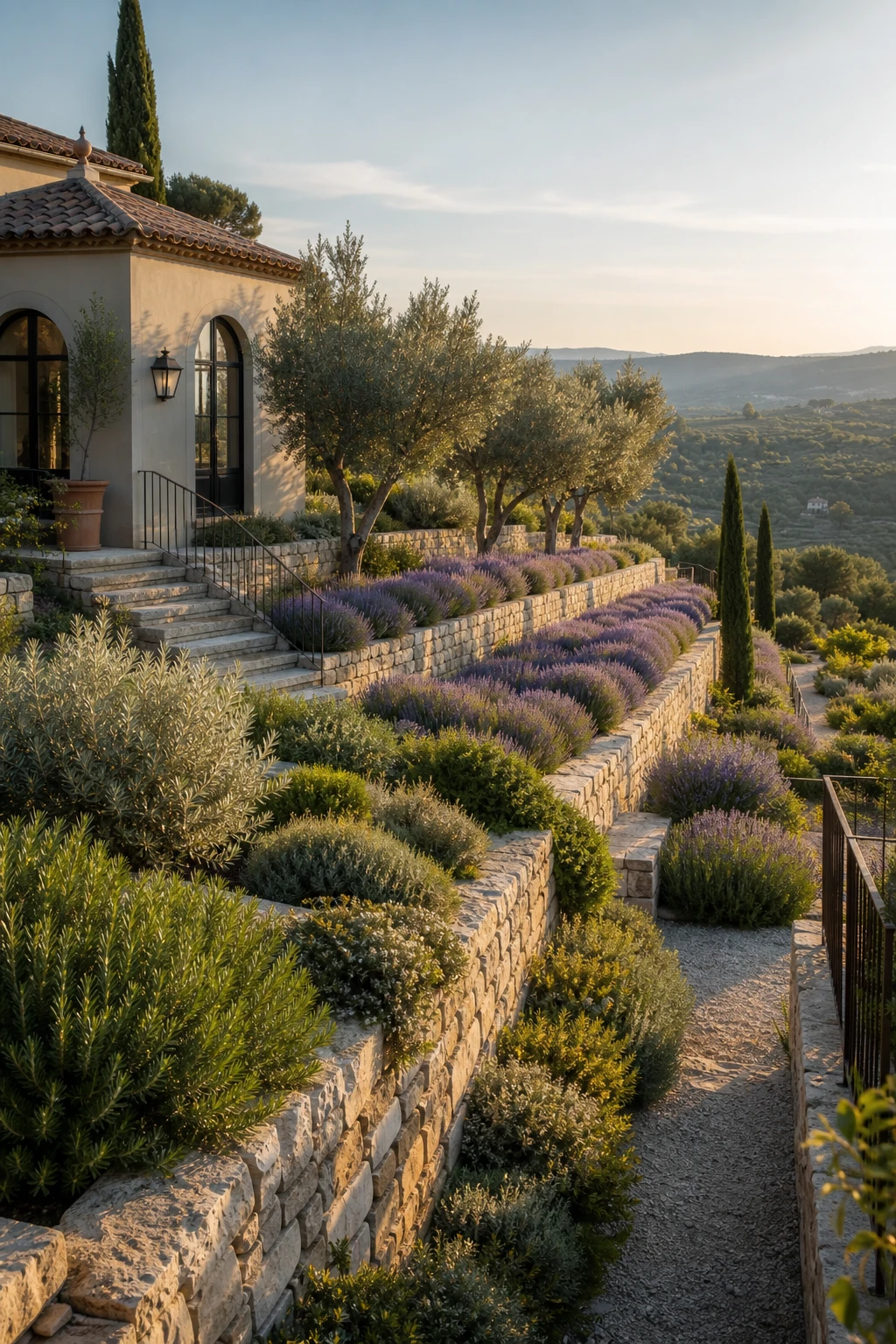
A hillside turns lavender from a border plant into a sweeping canvas, and that shift in scale is what wins me over every time. You get colour that reads from a distance, rippling down the slope in soft violet waves rather than sitting quietly at knee height. The gradient does the work, lifting each row above the one below so nothing is hidden, and you will notice the whole planting feels more generous for it.
The Key Details
Cascading lavender rows
Dry stone retaining wall
Narrow diagonal gravel path
Pencil cypress trees
Low garden pavilion wall
Pro TipSet each lavender plug at a slight backward angle into the slope so the roots point downhill, giving them both a firm grip and a clear drainage run.
AvoidPlanting standard flat bed varieties such as Hidcote on a steep incline leads to root rot at the crown because they sit in pooled water rather than shedding it.
Reading a Mediterranean Hillside Garden and Stealing Its Layered Look
A hillside planted in layers reads exactly the way nature intended, and the logic of it is something I keep returning to. Slow shrubs at the crown hold the eye first, mid height herbs spill down the middle, and creeping groundcover settles at the base. You get a slope that looks like it grew that way over centuries rather than one afternoon with a spade, and I find clients are always slightly surprised at how much structure those three simple tiers can carry.
The Key Details
Dry stack stone retaining walls
Tiered lavender rows
Silver leaved olive trees
Crushed gravel terrace paths
Hand forged iron railings
Pro TipAnchor the topmost tier with rosemary or cistus before you plant anything lower, because those slow growing shrubs set the scale that every layer beneath has to answer to.
AvoidPlanting moisture hungry species on a hot, exposed slope almost always ends in failure, and the gaps they leave behind undo the whole layered effect you worked so hard to build.
Terraced Backyard Ideas That Turn a Sloping Yard into Something Beautiful
A sloping yard can feel like a problem to solve, but terracing turns that gradient into something you actually want to spend time in. Each level becomes its own garden room, so you get structure and surprise at the same time. What I find most satisfying about this approach is how the retaining walls do double duty: they hold the earth and give the eye somewhere to rest between plantings, so the garden feels generous and considered rather than just tamed.
The Key Details
Dry limestone retaining walls
Clipped boxwood parterre
Lavender border planting
Crushed limestone gravel terrace
Weathered stone urn focal point
Pro TipCarry the same limestone through your retaining walls and steps so every tier reads as one connected composition rather than a patchwork of materials.
AvoidBuilding a retaining wall without drainage backfill traps water behind the stone, and the pressure will crack or topple even a well built wall within a few seasons.
Planting Through Gravel for a Garden That Looks After Itself
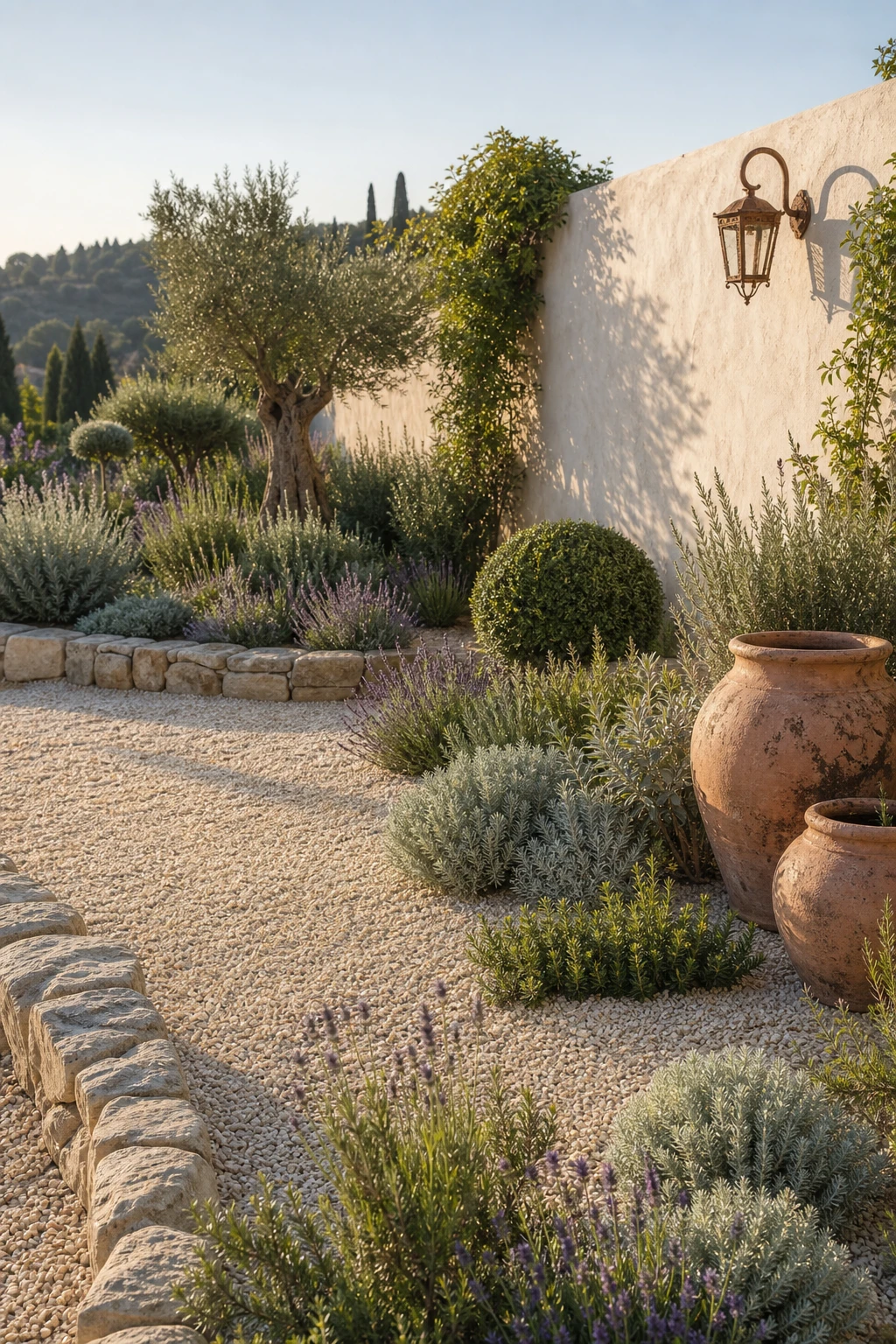
Planting straight through a pale gravel mulch is one of my favourite tricks for a garden that genuinely looks after itself. The stone holds warmth overnight, keeps moisture in the soil below, and smothers weeds before they get started. What I love most is how the pale limestone tones echo the dry garrigue of southern France, so lavender and rosemary suddenly look completely at home rather than just planted out.
The Key Details
Limestone gravel mulch
Dry stone bed edging
Terracotta pot cluster
Clipped box sphere
Lavender and rosemary drifts
Pro TipChoose silver and grey leaved plants like artemisia or stachys, because their foliage glows against pale gravel in a way green leaved plants simply never do.
AvoidDark or black gravel absorbs heat so aggressively in full sun that it can scorch shallow roots and bake the soil dry within days of watering.
A Sandstone Patio That Glows Warm Even on a Grey Afternoon
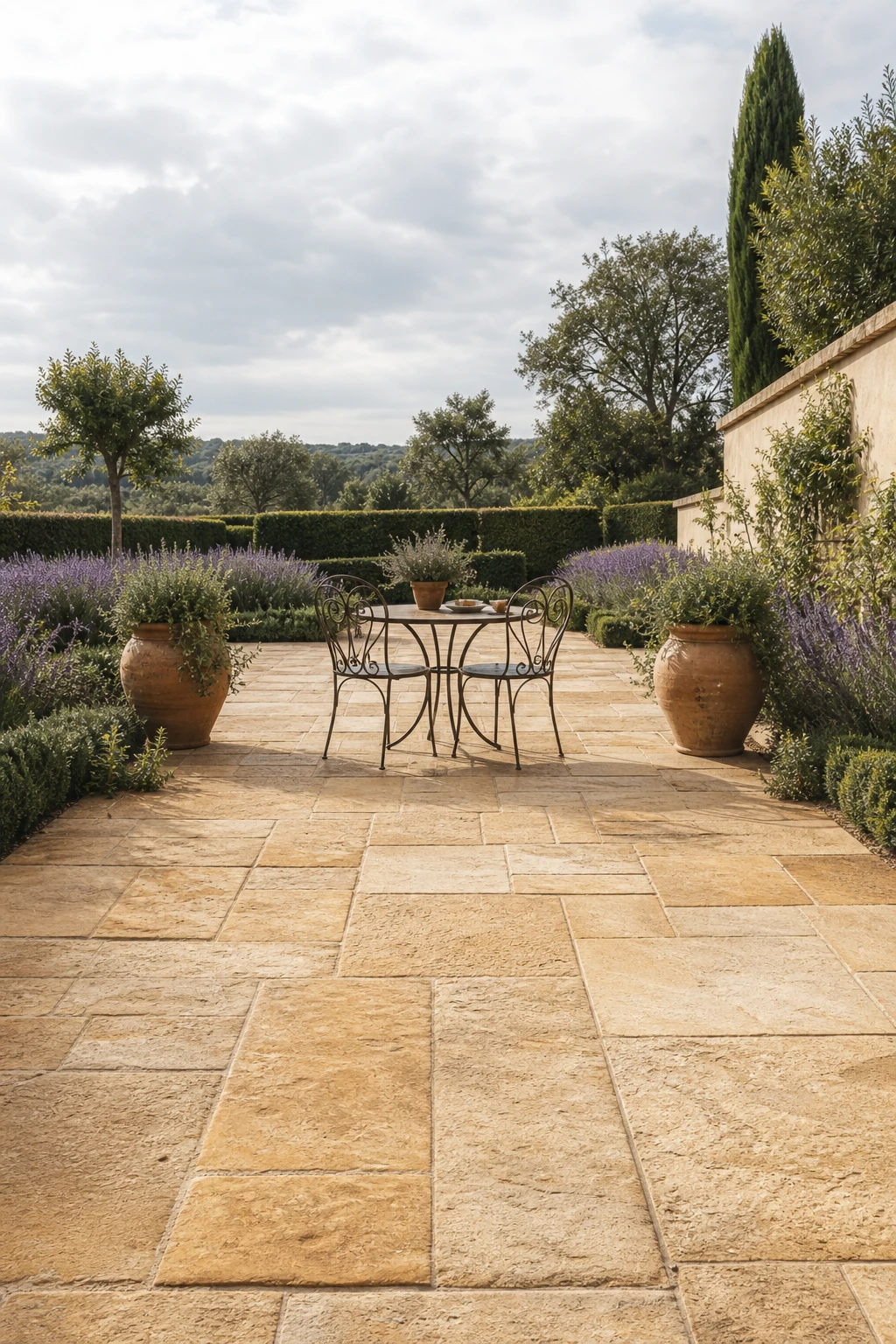
Sandstone carries warmth in its grain, so even on a flat grey morning you get that honey glow that makes the whole garden feel like somewhere the sun has just been. What I love about laying it in a staggered pattern is how the eye reads movement and generosity across the ground plane. Pair it with a lime rendered wall behind and wrought iron bistro chairs on top, and you will notice the stone ties every element together without trying.
The Key Details
Staggered sandstone slab paving
Wrought iron bistro table and chairs
Oversized terracotta urns
Lavender and box hedging border
Lime rendered garden wall
Pro TipSeal your sandstone within a week of laying, using a breathable impregnating sealer, to lock in that warm amber tone and stop wine, oil, and plant tannins from ghosting the surface permanently.
AvoidCutting the patio area too small leaves it looking like a doormat dropped in the garden, and no amount of good furniture or beautiful stone will rescue a space that simply has no room to breathe.
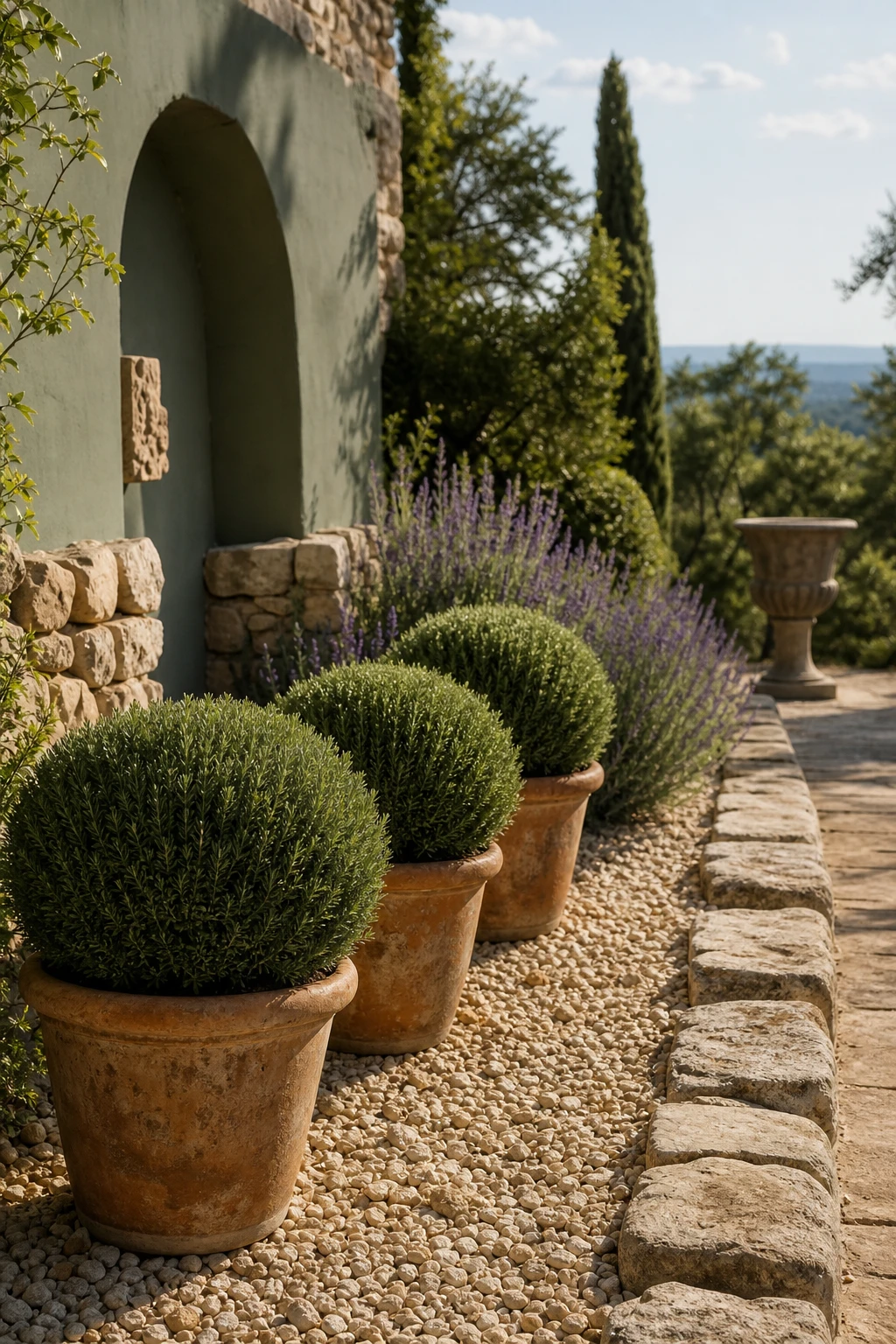
Rosemary Clipped into Topiary Balls That Smell as Good as They Look
Rosemary clipped into tight globe forms is one of my favourite ways to bring discipline to a Provence garden without losing its wild, aromatic soul. You get the clean geometry of formal topiary and the moment anyone brushes past, that rush of scent reminds you this is a living, breathing plant. What I love is the contradiction: the eye reads structure, the nose reads countryside. Watch how a pair of these flanking a pale gravel path immediately anchors the whole scene.
The Key Details
Clipped rosemary topiary balls in terracotta pots
Pale raked gravel path
Dry stone boundary wall
Limestone path edging
Rusticated stone urn focal point
Pro TipClip rosemary lightly just after the flowers fade in late spring, taking only the soft new growth to coax the globe tighter without shocking the plant.
AvoidCutting back hard into the old brown woody stems leaves bare patches that rosemary will almost never regrow from, ruining the globe shape permanently.
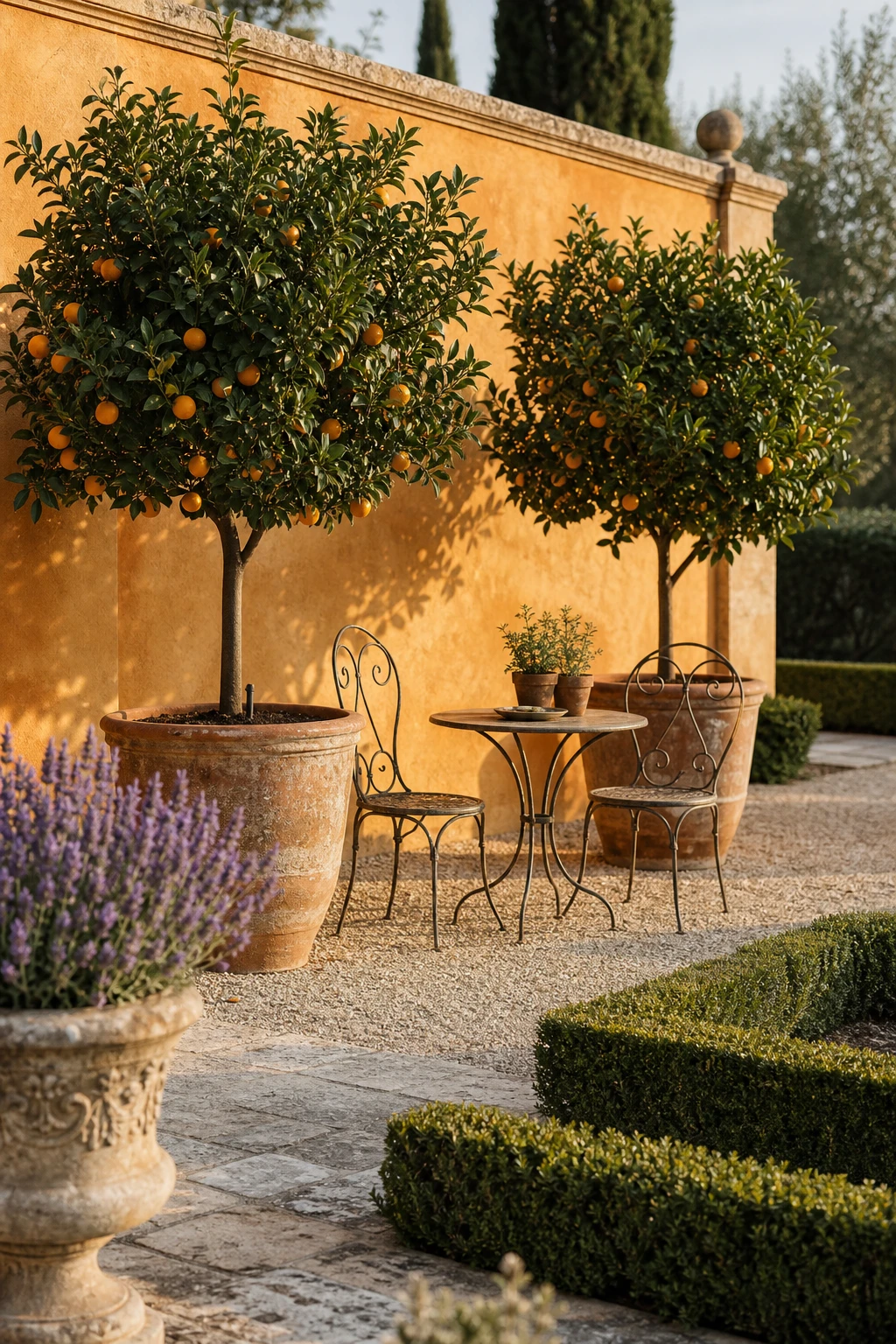
Orange Trees in Pots That Bring the French Orangerie Home
Potted orange trees are one of my favourite moves in a Provence inspired garden because they hand you complete control over where the scent and colour land. You can frame a doorway for a summer lunch, then pull them back under cover before the first frost arrives. What wins me over every time is the way aged terracotta hugs the trunk and root ball so naturally, the whole arrangement looks as though it has always belonged there.
The Key Details
Aged terracotta citrus pots
Wrought iron bistro table and chairs
Clipped box parterre edging
Limestone paving and gravel terrace
Stone urn with trailing lavender
Pro TipBefore the first frost, move your orange trees into an unheated garage or cool conservatory where temperatures stay above five degrees, and water only sparingly until spring growth begins.
AvoidLetting the compost dry out completely between waterings in summer stresses the roots and triggers leaf drop that can take a full season to recover from.
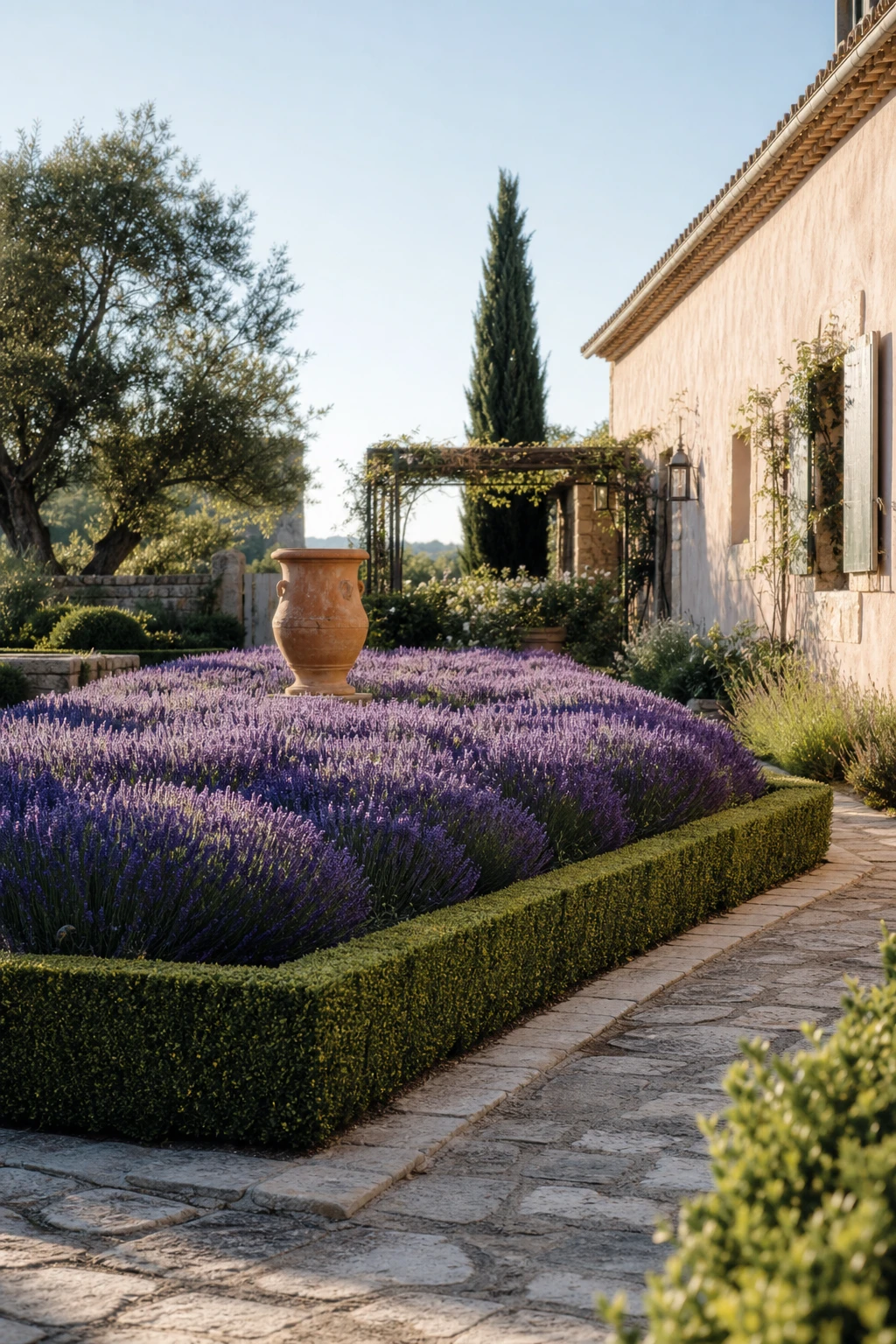
A Formal Lavender Bed That Looks Like It Has Always Been There
A lavender bed without an edge always reads as accidental, and that low clipped hedge is what changes everything. What I love about this pairing is the contrast: the soft purple haze of the lavender against the crisp green line of the boxwood gives the eye a clear frame to settle on. You get that sense the garden has always been here, that someone planted it with conviction decades ago and it simply grew into itself.
The Key Details
Low clipped boxwood edging hedge
Dense rowed lavender planting
Weathered limestone garden wall
Terracotta urn centrepiece
Stone paving border path
Pro TipChoose Hidcote or Munstead lavender for a compact variety that holds its shape through the season and rarely needs more than one hard cut in late summer.
AvoidPlanting lavender straight into heavy clay without improving drainage first will rot the roots within a season, and no amount of sun or attention will save it.
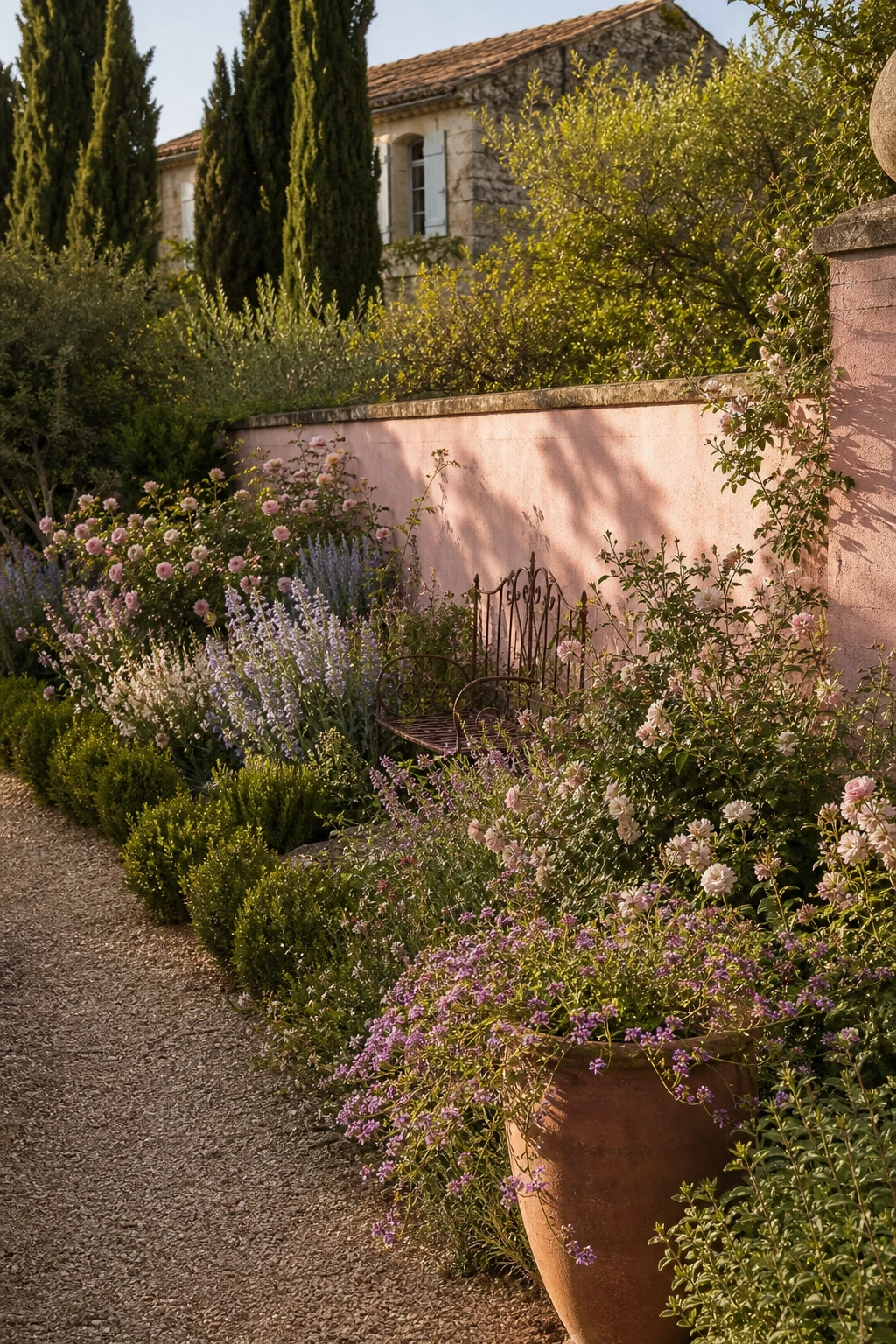
French Country Flower Beds That Look Relaxed Without Being Messy
Cottage beds look effortless when a single colour thread runs through every plant choice, and that is the quiet trick I use here. Soft mauves, dusty pinks, and pale creams repeat across the layers so your eye glides through the planting rather than jumping around. You get all the charm of an informal mix without it reading as chaotic.
The Key Details
Layered mixed herbaceous and shrub border
Gravel path with clipped box edging
Terracotta urn with trailing verbena
Weathered iron garden bench
Low rendered stone boundary wall
Pro TipPlant catmint (Nepeta) along the front of the bed as your anchor, because it blooms from early summer right through to autumn and knits every neighbouring colour together.
AvoidDropping in a bright red or orange accent because it feels bold in the moment will pull every glance straight to that one spot and break the gentle rhythm the rest of the planting is building.
The Rustic Details That Give a Mediterranean Garden Its Aged Character
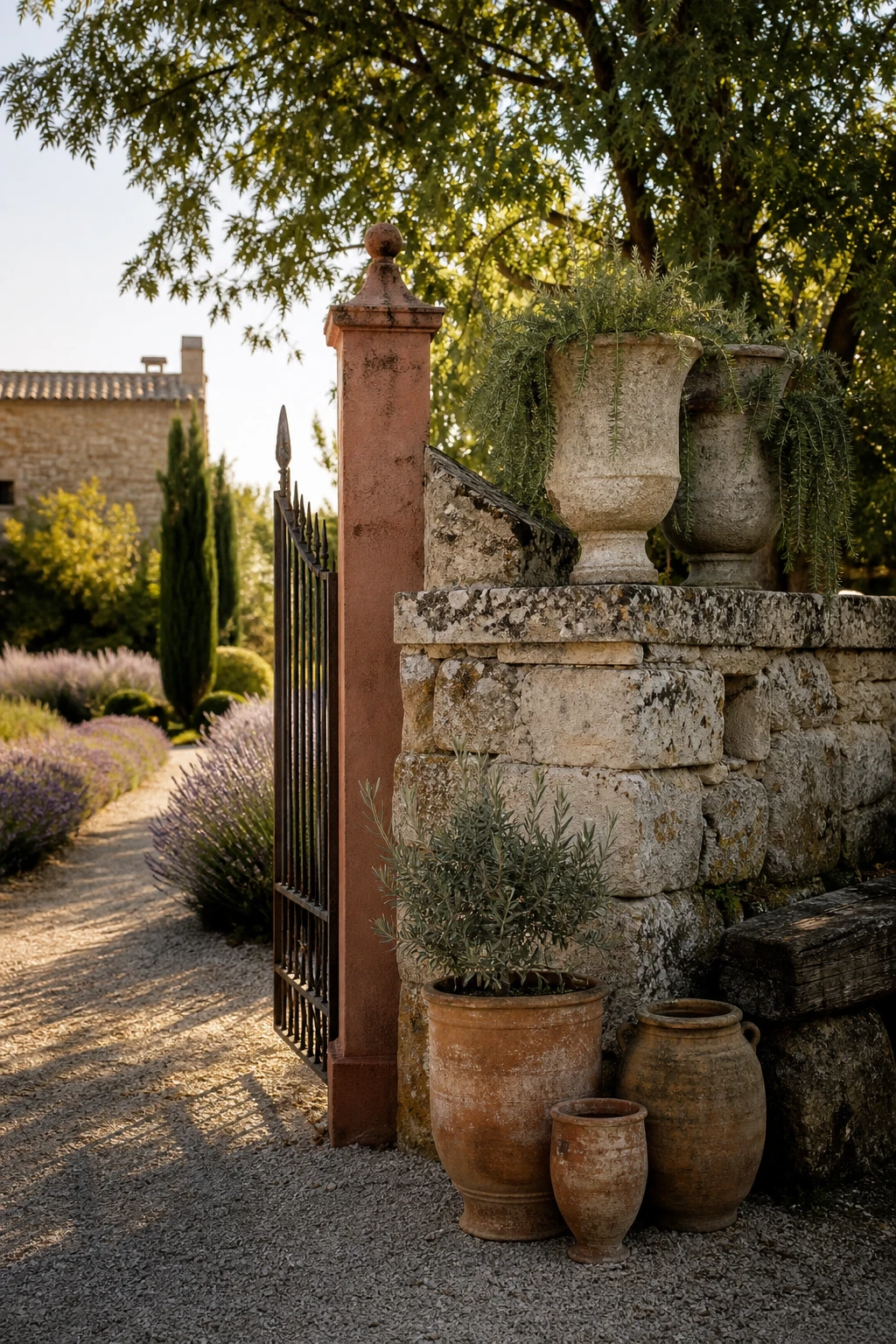
Weathered stone carries a quiet confidence that no new material can fake, and I find myself drawn to it on every project. The moss, the mineral bloom, the soft rounding of edges, you are reading decades of sun and rain in every surface. What I love is how a single aged urn or a crumbling wall cap shifts the whole mood from designed to discovered, making a garden feel genuinely rooted in its place rather than assembled last weekend.
The Key Details
Moss crusted limestone wall
Aged stone urns with trailing rosemary
Hand forged iron gate
Terracotta pots with mineral bloom
Raked gravel path edging
Pro TipWhen sourcing reclaimed stone troughs or urns, look for pieces with existing moss or lichen already established, because that living patina takes years to grow and cannot be hurried.
AvoidPressure washing old stone to make it look clean strips away the very moss and mineral bloom that give it its character, leaving you with a surface that looks brand new and slightly sad.
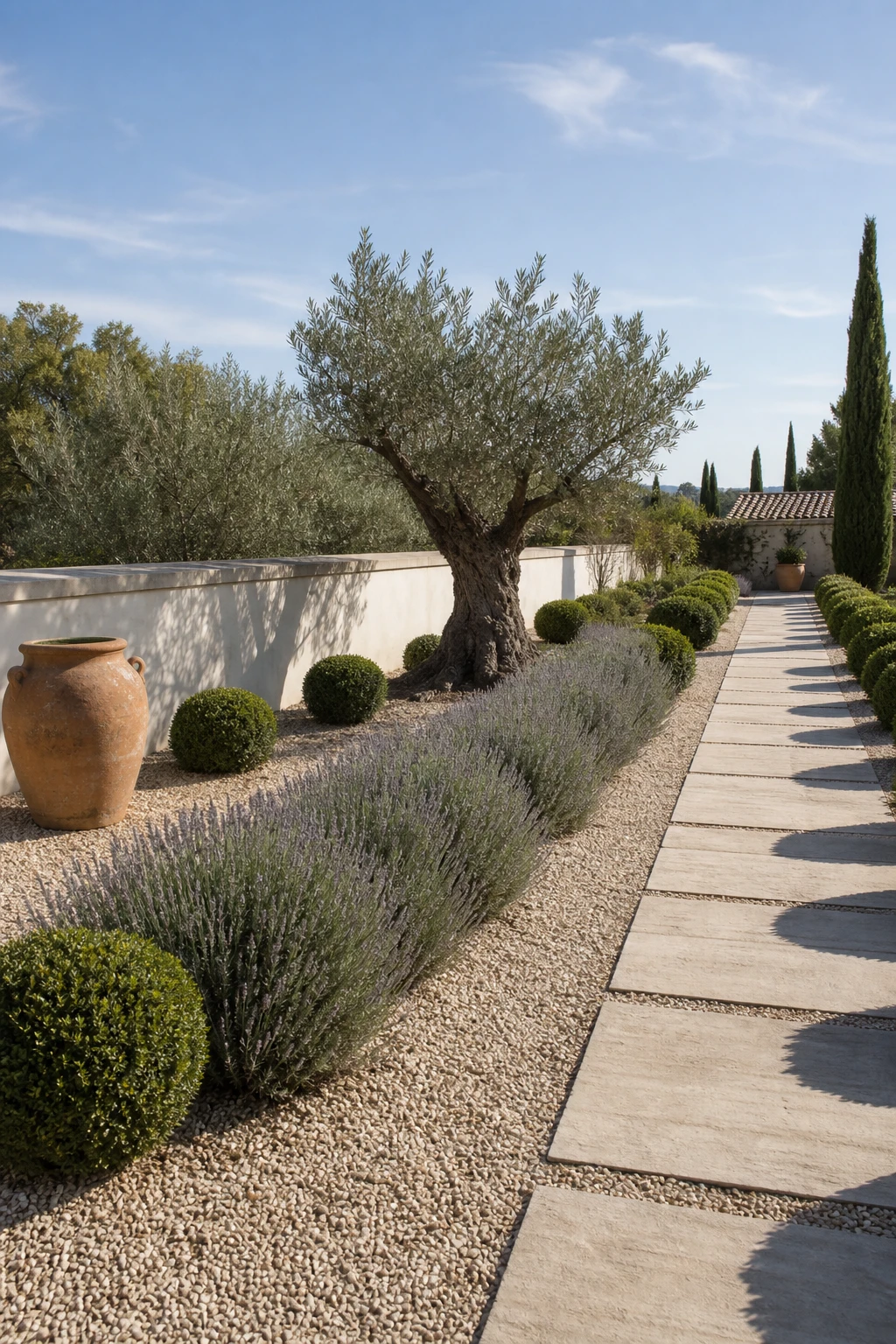
How a Contemporary Mediterranean Garden Keeps Things Calm and Uncluttered
Editing a planting scheme down to three species is one of my favourite discipline exercises, and the results always surprise people. You get this immediate sense of calm because the eye has nowhere to dart. What I love here is how repetition does all the heavy lifting: the same form, the same colour, the same texture carried across the space until the garden feels composed rather than collected.
The Key Details
Clipped box spheres
Ribbon lavender rows
Geometric limestone path
Weathered terracotta urn
Rendered low garden wall
Pro TipPlace a single large architectural succulent at each path junction to anchor the geometry and give the eye a natural resting point without crowding the scheme.
AvoidAdding too many decorative accessories, lanterns, ornaments, ceramic pieces, breaks the restful repetition you worked hard to build and turns a calm composition into a cluttered one.
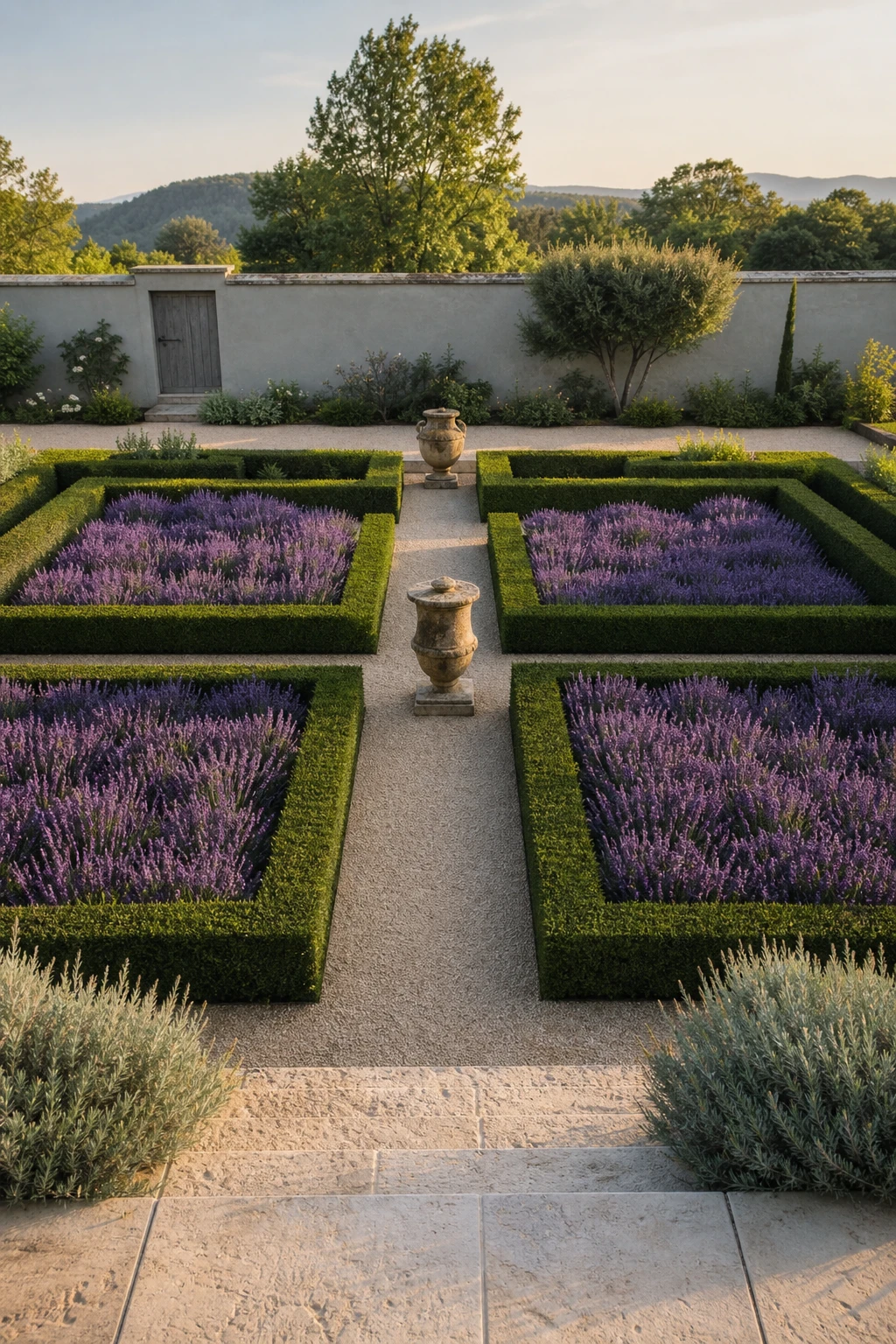
A Formal Mediterranean Garden Layout That Makes Order Feel Inviting
Clipped box parterre is one of my favourite ways to bring quiet authority to a garden without it ever feeling stiff. The repeated geometry does something almost meditative, you get a sense of order that settles the eye rather than demanding it. What I love is how the low hedging frames lavender and gravel so each compartment reads as its own small world, and the whole composition holds together beautifully from every angle.
The Key Details
Clipped Box Parterre Hedging
Limestone Gravel Paths
Lavender Infill Planting
Terracotta Stone Urns
Lime Rendered Garden Wall
Pro TipIn a hot, dry spot where box struggles, swap it for santolina, it clips just as crisply, handles drought without complaint, and adds a silvery tone that looks wonderful against limestone gravel.
AvoidStretching the parterre geometry across a small plot leaves no breathing room and makes the whole garden feel like a maze rather than a retreat.
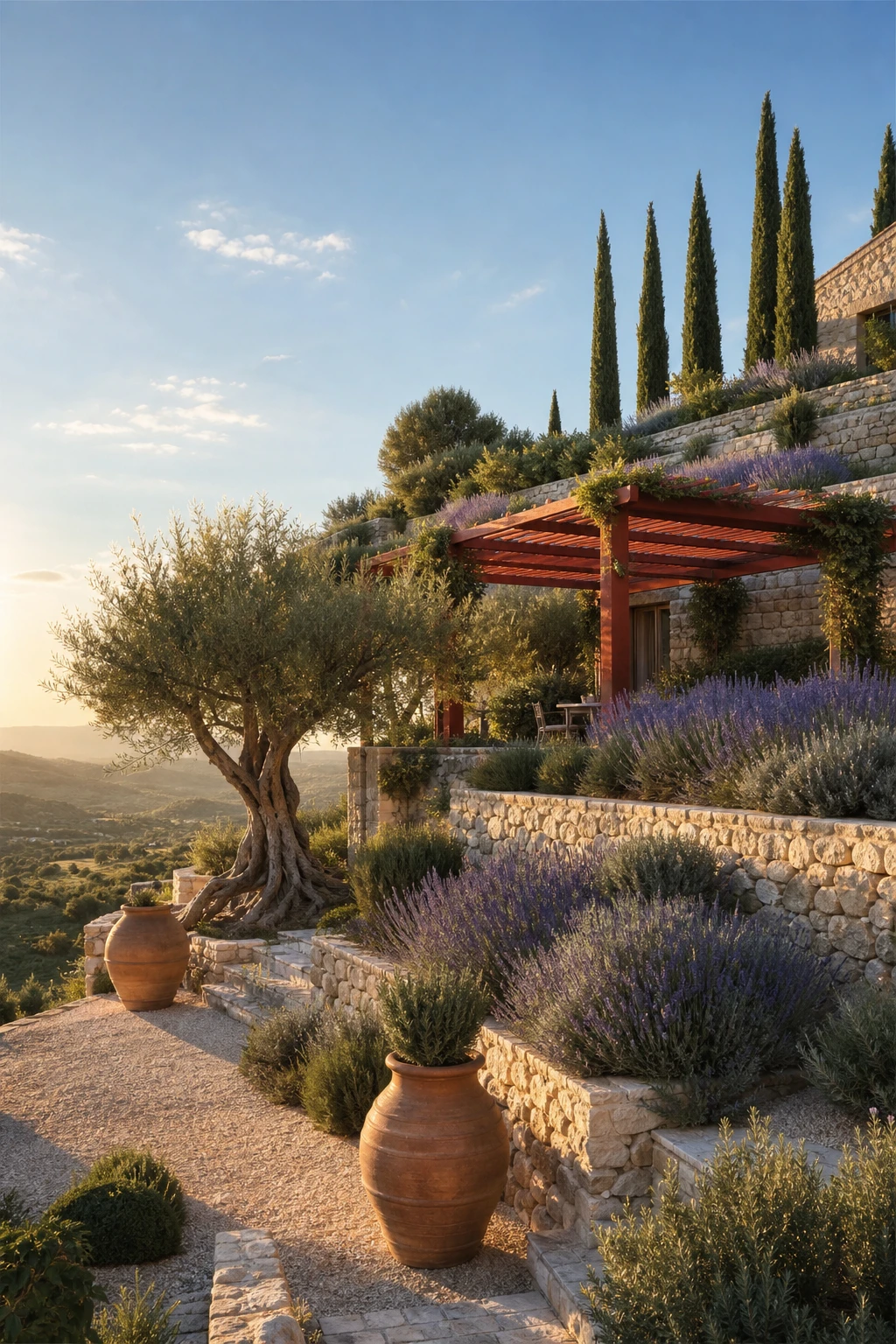
Tuscan Hillside Garden Inspiration You Can Translate to Any Size Slope
Terraced slopes done the Tuscan way win me over every time, because the whole scheme follows one honest rule: work with the heat, not against it. You get dry stacked limestone walls that hold the earth and reflect warmth back to drought happy lavender and cypress, so every plant you see actually wants to be there. That logic is what I keep coming back to when borrowing a regional style, and you will notice how the terracotta urns, the timber pergola, and the silvery planting all speak the same language of sun and stone.
The Key Details
Dry stacked limestone retaining walls
Columnar cypress trees
Lavender border plantings
Weathered timber pergola
Oversized terracotta urns
Pro TipSwap any plastic container for a genuine terracotta urn, because the porous clay breathes, dries quickly between waterings, and gives you that sun baked warmth no synthetic pot can fake.
AvoidSlipping a hydrangea or fern into the border because it looks pretty will leave you with a struggling, yellowing plant that pulls the whole scheme apart and demands constant watering the rest of the planting was designed to avoid.
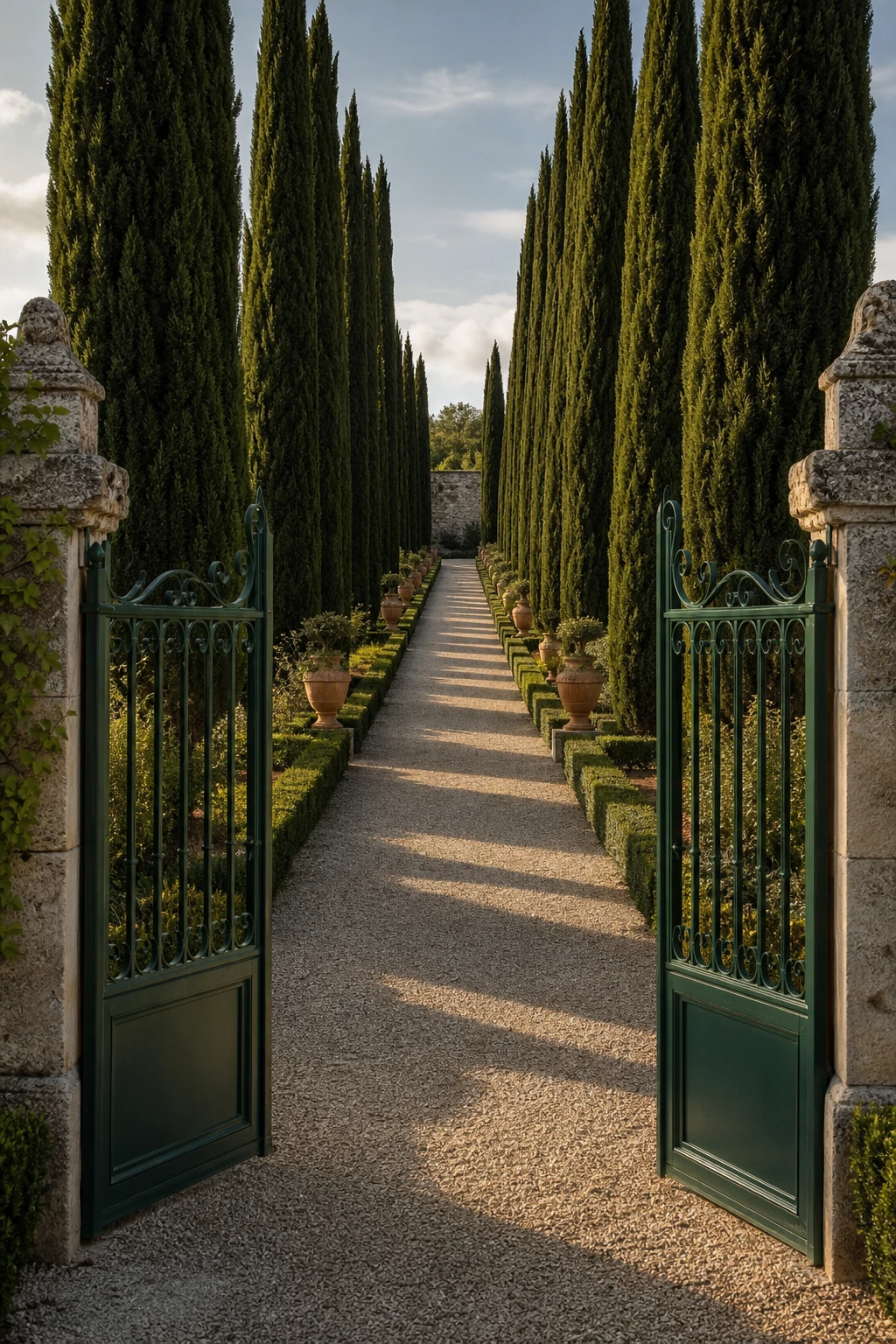
A Cypress Tree Avenue That Makes Even a Short Garden Path Feel Grand
A cypress avenue does something almost musical to a garden: the trees set a beat, and your eye follows it all the way to the end of the path. I love the economy of it, one repeated vertical, nothing else, and yet a modest path suddenly feels like an arrival. You get ceremony and forward pull at the same time, which is a combination that, in my experience of planning these, never loses its effect no matter how many times I use it.
The Key Details
Columnar cypress trees
Limestone paving
Clipped box hedging
Wrought iron gate
Terracotta urns
Pro TipKeep the gap between your two rows roughly equal to the mature height of the trees, so the avenue feels open and balanced rather than a narrow tunnel.
AvoidPlanting a cypress avenue on a path shorter than about eight metres leaves the rhythm with nowhere to develop, and the whole effect reads as two dots rather than a procession.
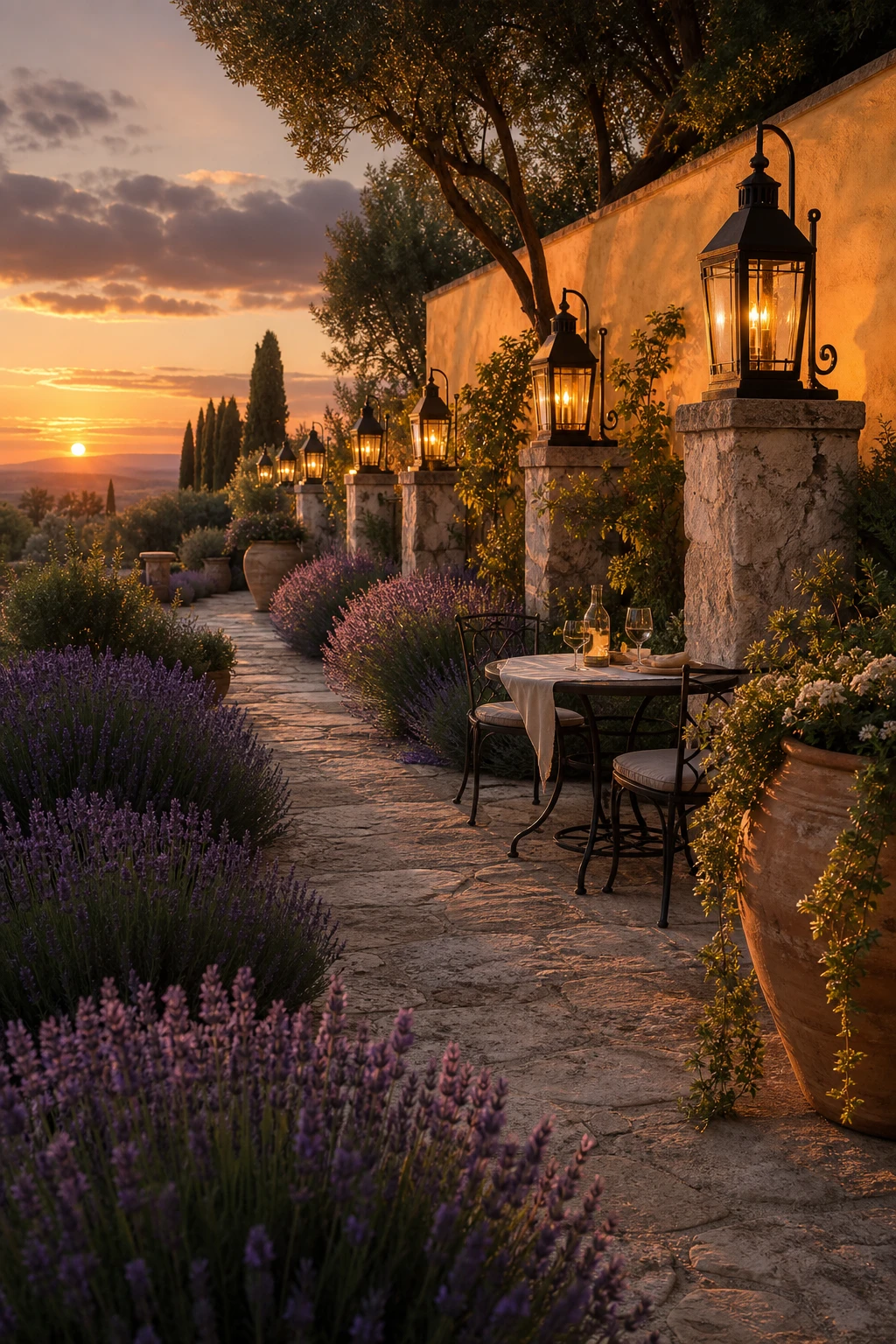
Mediterranean Garden Lighting That Turns Dusk into the Best Part of the Day
Garden lanterns placed low, at path height rather than overhead, do something I find quietly magical: they catch the faces of the people sitting nearby and the texture of lavender and stone equally well. You get that amber warmth pooling at ground level, which flatters a Provencal palette the way candlelight flatters a dining room. The aged iron and amber glass here hold that glow without ever feeling bright or harsh, and the limestone underfoot drinks it all in.
The Key Details
Aged iron and amber glass garden lanterns on limestone pillar posts
Mature lavender borders lining limestone pathway
Oversized terracotta urns with trailing herbs
Wrought iron garden table dressed with linen and a carafe
Hand cut stone pavers worn smooth with use
Pro TipSet lanterns right at the path edge so the light falls across the stone surface and guides the eye forward rather than lifting up into the branches above.
AvoidCool white LED bulbs drain every trace of honey and gold from the scene, leaving limestone looking grey and lavender looking flat.
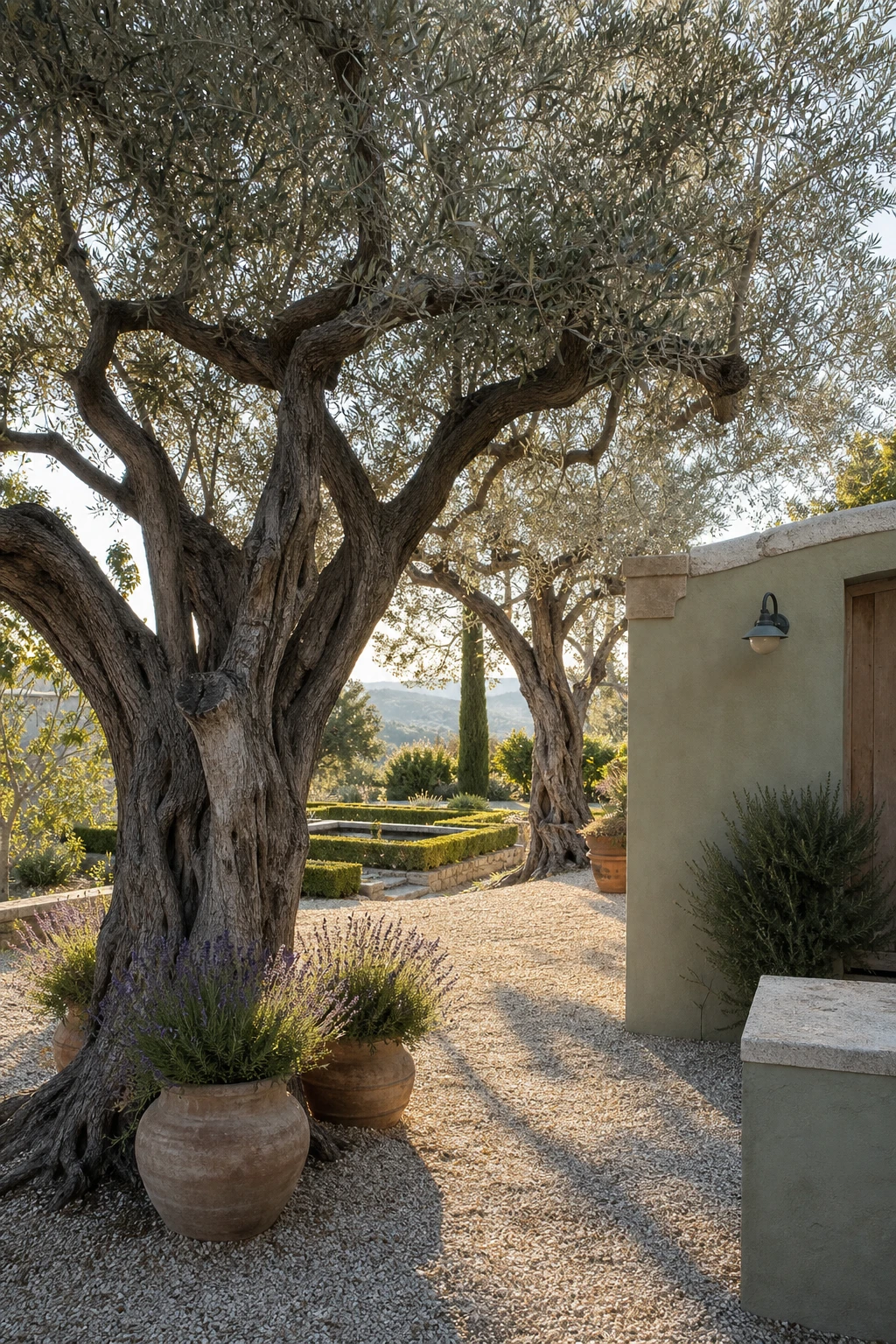
Planting Olive Trees as Living Sculpture That Never Goes Out of Style
A gnarled specimen olive is one of those rare plants that earns every centimetre it occupies, and what wins me over every time is the way that silver canopy holds light through all four seasons. You get sculptural presence on a grey January morning just as surely as you do in high summer. The twisted trunk carries centuries of character, so even a newly planted tree feels like it has always belonged to the garden.
The Key Details
Gnarled specimen olive trees
Pale limestone gravel terrace
Terracotta urns with lavender
Clipped box parterre
Low rendered garden wall
Pro TipPosition your specimen olive where afternoon sun hits the canopy from the west, and the silver leaves will shimmer like silk against a dark cypress or stone wall backdrop.
AvoidPlanting a young olive against a south facing wall that a building shades for more than half the day starves it of the light it needs and produces a thin, lopsided canopy that never develops the rounded sculptural form you are paying for.
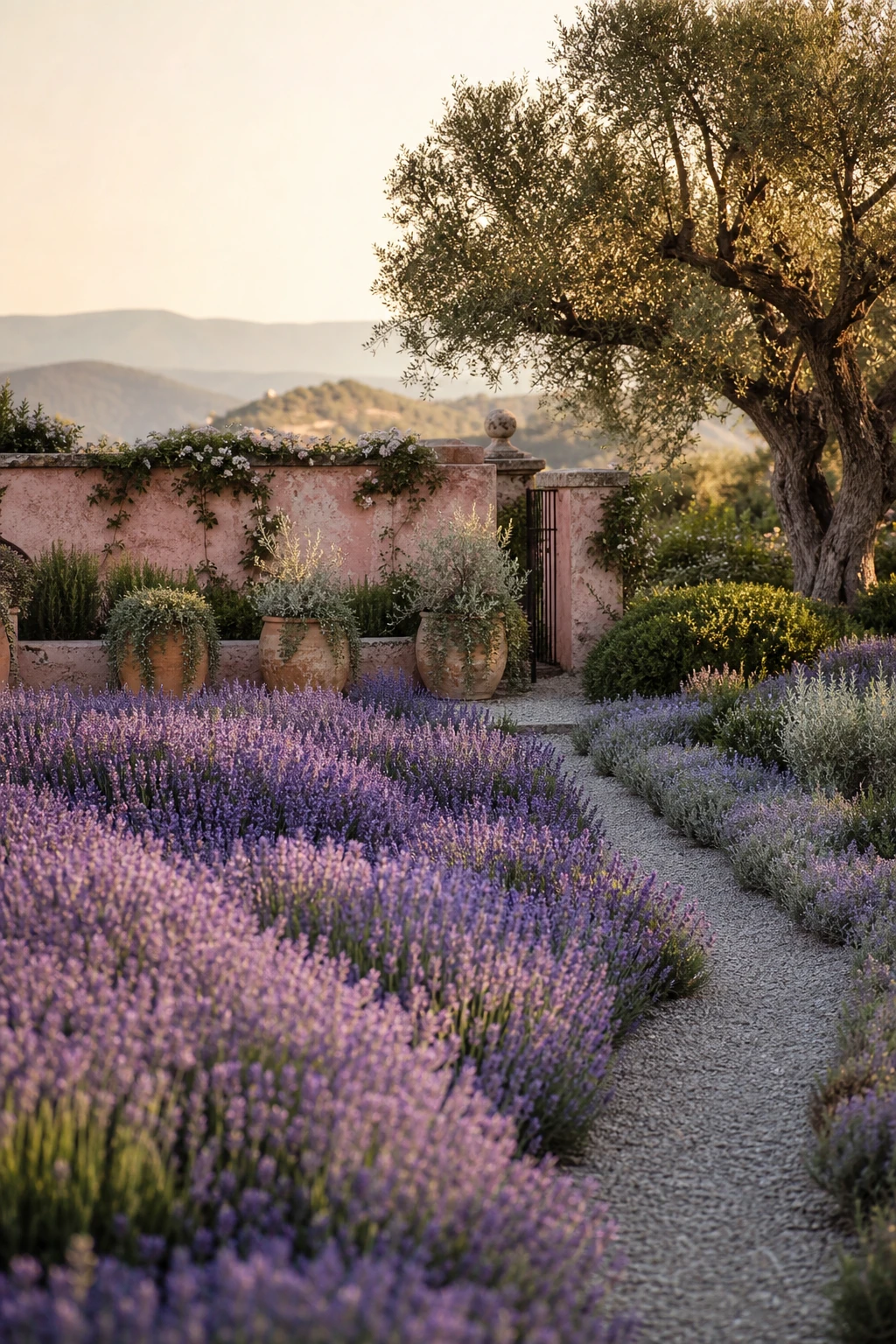
Taking Your Provence Garden Colour Palette From a Watercolour Painting
Pulling a colour palette straight from a watercolour painting is one of my favourite shortcuts in garden design, because the artist has already done the hard work of finding tones that sit beautifully together. You get that dreamy lavender purple against soft silver green, warm limestone white and dusty terracotta, all pre tested and pre harmonised. What I love is how nature already painted Provence this way, so matching your plant choices to those pigments feels completely effortless.
The Key Details
Flowering lavender rows
Weathered limestone garden wall
Terracotta urns with trailing herbs
Crushed gravel edged path
Gnarled olive tree
Pro TipHold a printed section of your chosen watercolour beside actual lavender stems and artemisia foliage at the nursery, and only buy the plants whose tones genuinely match what you see on the paper.
AvoidCopying every colour in the painting at equal weight flattens the whole scheme, because a real garden needs one dominant tone, a secondary and just a touch of contrast to read well at scale.
How a Vineyard Sketch Can Inspire Your Garden Layout From Scratch
Rows of low trained lavender and rosemary carry the same quiet authority as a working vineyard, and that graphic repetition is what gives a garden this confident. What I love is the way pale gravel between the rows separates each line cleanly, so your eye travels the full length without interruption. You get structure that reads beautifully from above, from a window or a terrace, and the terracotta urn markers punctuate each row end with just enough warmth to stop it feeling austere.
The Key Details
Low trained lavender and rosemary rows
Weathered limestone path
Rustic timber pergola
Terracotta urn row markers
Pale gravel infill between rows
Pro TipRun a single row of espalier fruit trees flat against a boundary wall and you echo the vineyard geometry without losing any planting space on the ground.
AvoidSqueezing vineyard row spacing into a plot that is too narrow leaves the rows feeling cramped and strips away the very sense of rhythmic breathing room that makes the layout work.
Alan launched Edward George London in 2017. Since completing his masters in Town & Regional Planning (MPlan) he has combined the skills he learned at the University of Sheffield with his passion for design, to help create a foundation for those looking to create a beautiful home.