I’ve always thought the hallway deserves far more love than it gets. It’s the very first thing you and your guests see, and in a small neutral hallway the right choices, a soft paint tone, a little panelling, a well placed lamp, can make the whole space feel calm and intentional rather than cramped and forgettable. Every idea in here is one you can genuinely borrow, whatever the size or light level of your own entrance.
How Warm Neutral Layers Turn a Plain Hallway into a Welcoming Space
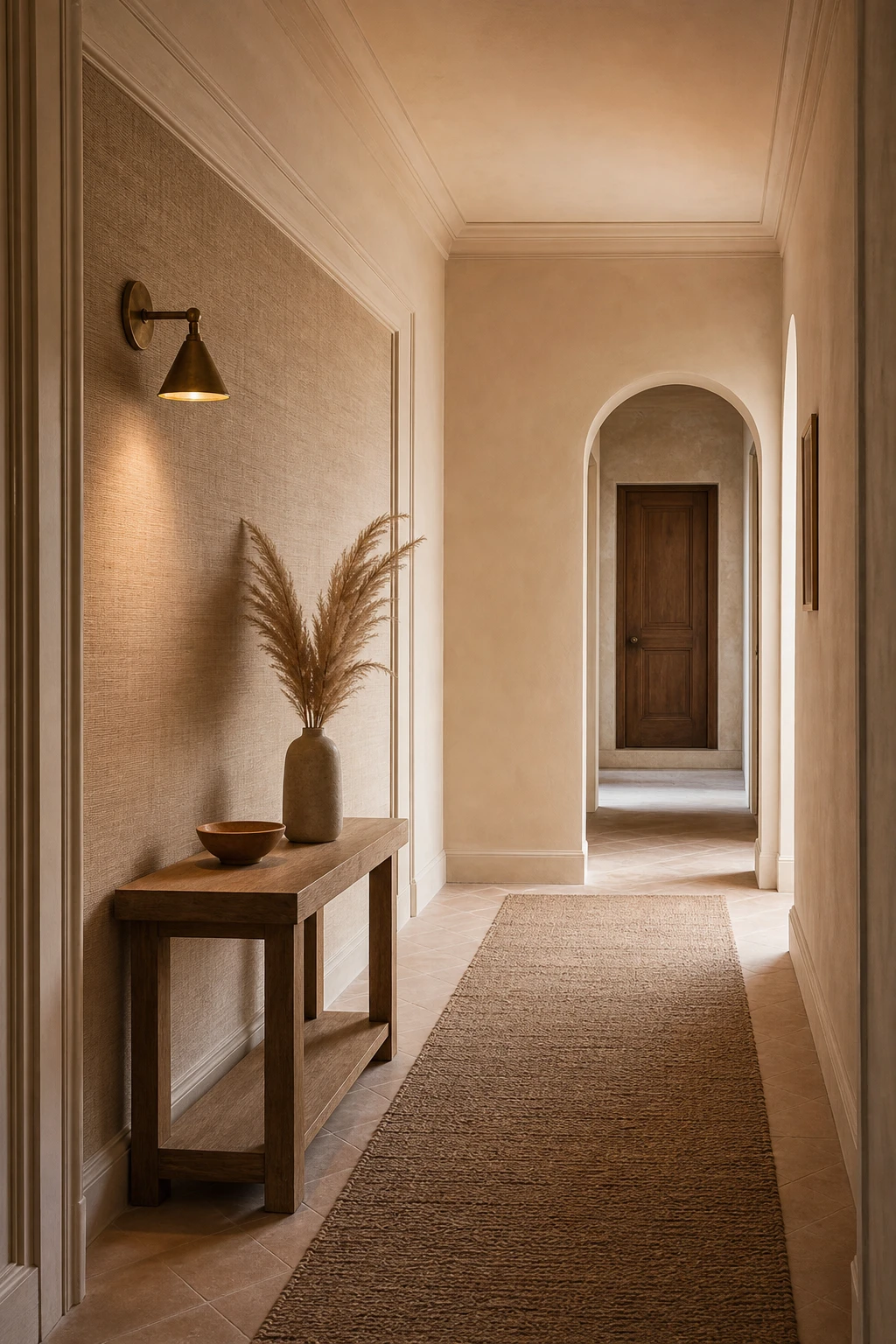
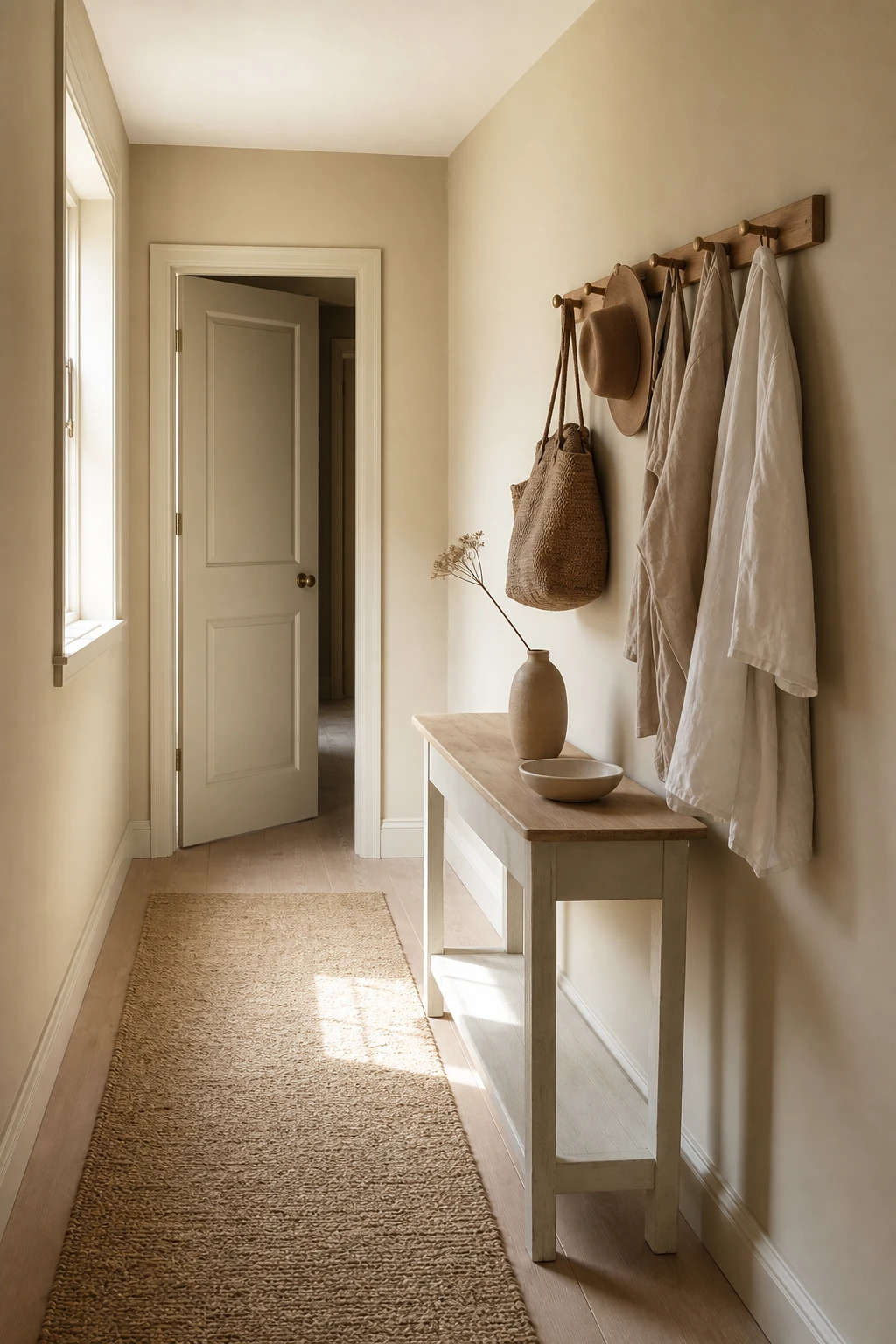
Layering textures in the same warm tone is one of my favourite moves in a small hallway. You get the richness of a collected, lived in space without any colour fighting for attention. The oak, linen, and terracotta all sit in the same toasty family, so the eye reads depth rather than contrast. What wins me over every time is how the rough and smooth surfaces do all the work a bold colour would otherwise do.
The Key Details
Natural oak console table
Aged brass wall sconce
Woven grasscloth wall panel
Hand knotted linen runner
Terracotta ceramic bowl
Pro TipStack three tones from the same neutral family, a light on the walls, a mid tone on the runner, and a deeper shade in your accessories, so the eye travels through the space rather than stopping dead.
AvoidSlipping one cool toned neutral into the mix, say a grey linen cushion against warm sand walls, flattens the whole effect and makes the scheme feel unfinished rather than considered.
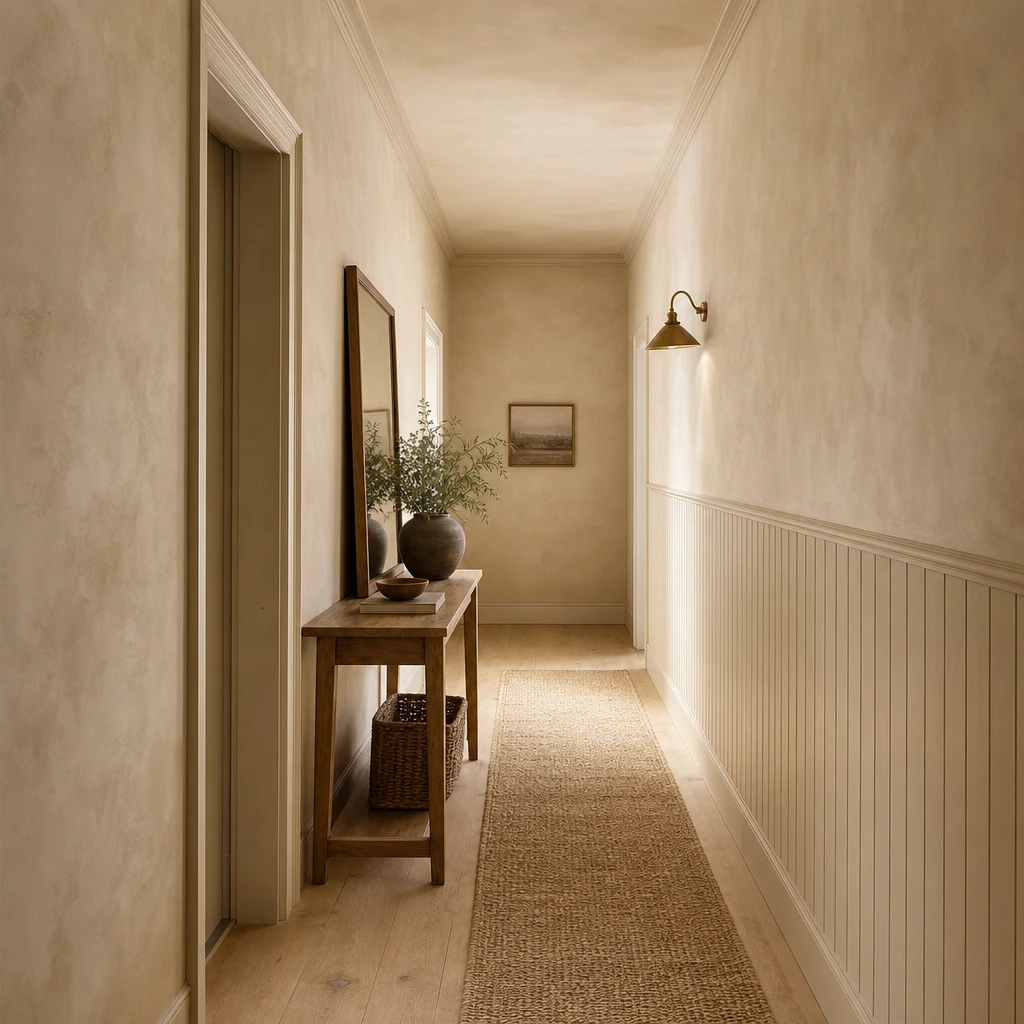
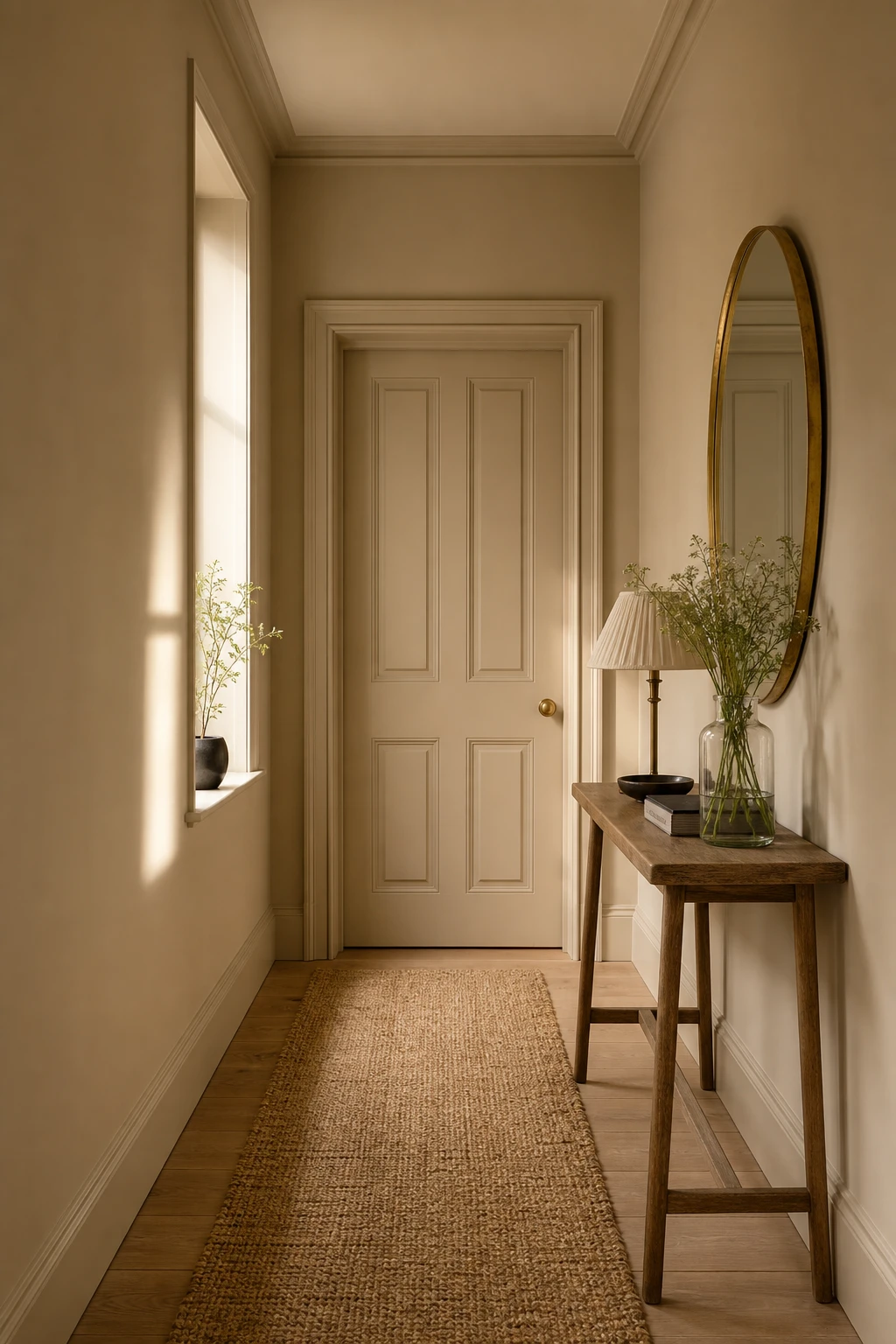
The Beige Hallway Paint Shade That Actually Feels Alive on the Wall
Beige is one of those colours that can go so right or so wrong depending on its undertone, and what I love about a warm, yellow leaning beige is that it holds light without tipping into yellow itself. You get a colour that feels alive at noon and just as inviting under a warm bulb in the evening. The undertone is doing all the heavy lifting here, keeping the hallway feeling fresh rather than flat or tired.
The Key Details
Slim oak console table
Round brass framed mirror
Woven jute runner
Tapered timber floor planks
Panelled far door
Pro TipPaint a large sheet of card with your chosen shade and move it from the front door to the darkest corner of the hallway at different times of day before you commit.
AvoidChoosing a beige with a pink or grey pull will make your hallway look cold in low light and muddy under artificial warmth, so always check the undertone on your actual walls before buying a full tin.
A Green Painted Hallway That Feels Fresh Without Feeling Bold
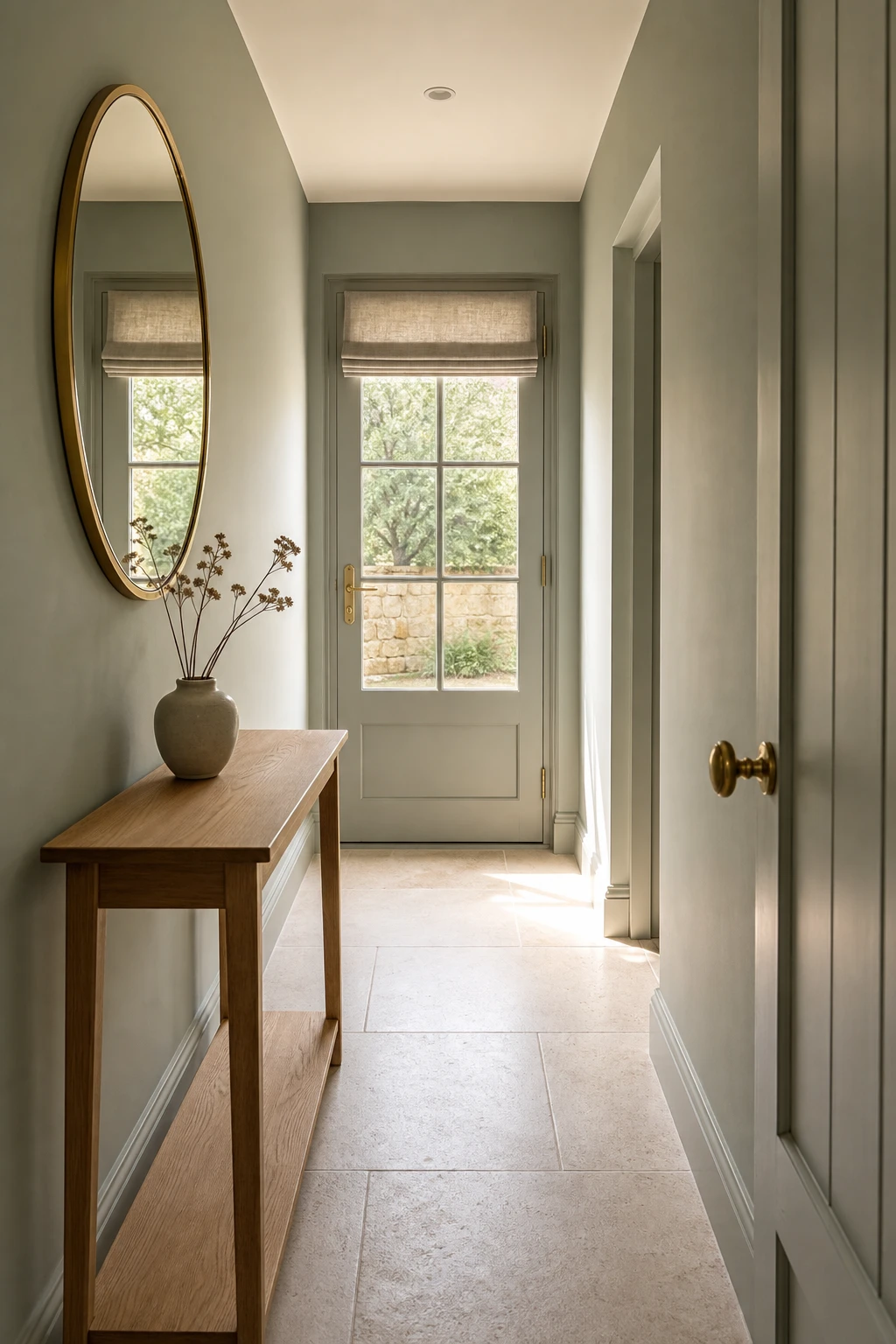
Muted green sits in that rare sweet spot where it reads as a colour but never shouts, and that quality is what I reach for in a small hallway. You get the lift of something living and organic without the walls closing in. The grey undertones in a sage or moss shade keep it anchored to your neutrals, so the whole scheme stays calm and connected rather than feeling like the hallway suddenly belongs to a different house.
The Key Details
Slim oak console table
Round brass wall mirror
Pale limestone floor tiles
Glazed panelled door
Ceramic vase with dried stems
Pro TipPair your muted green with a slim oak console and bare wood accessories, because warm timber pulls the green toward earthy rather than cool, and the two together feel genuinely natural.
AvoidChoosing a green with too much yellow or blue saturation turns a small hallway into a tunnel, and no amount of good lighting will fix that once the paint is on.
Dark Paint in a Small Hallway and Why It Works Better Than You Think
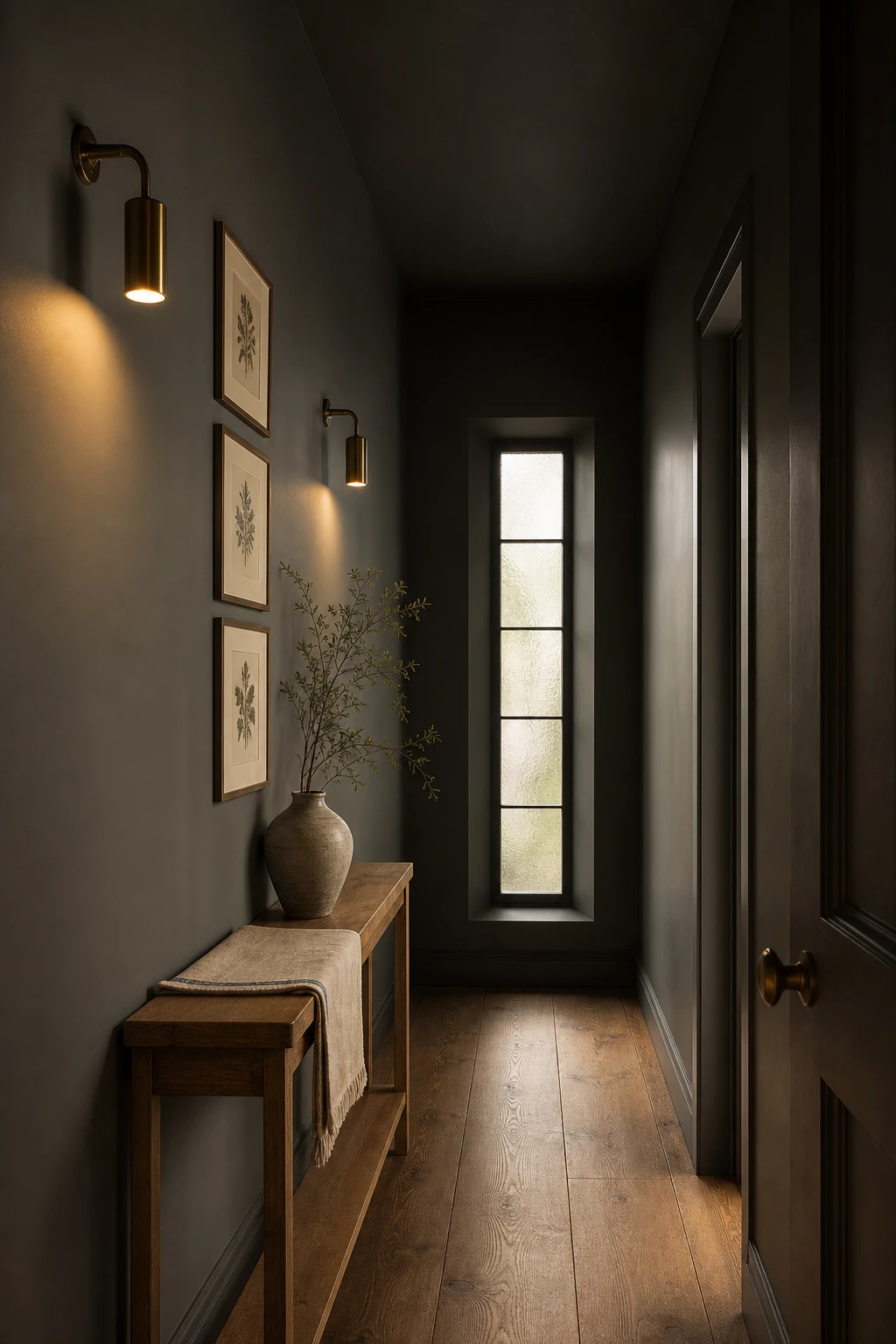
Dark walls in a narrow hall is the move most people talk themselves out of, and I always think that’s a shame. What I love about it is the way the colour wraps the space and makes it feel deliberate, like a proper room rather than a corridor you rush through. You get that cosy, enveloping quality that pale paint simply cannot give you, and the slim console and brass sconces sit against it beautifully.
The Key Details
Slim oak console table
Brushed brass wall sconces
Framed botanical prints
Wide plank timber flooring
Frosted end window
Pro TipChoose a satin or soft sheen finish rather than flat emulsion so the walls catch the light from your sconces and the space stays alive rather than flat.
AvoidPainting the ceiling the same dark shade pulls the eye down and squeezes every last centimetre of height out of the room, so keep it white or a shade lighter than the walls.
Two Tone Hallway Paint That Makes Ceilings Look Higher
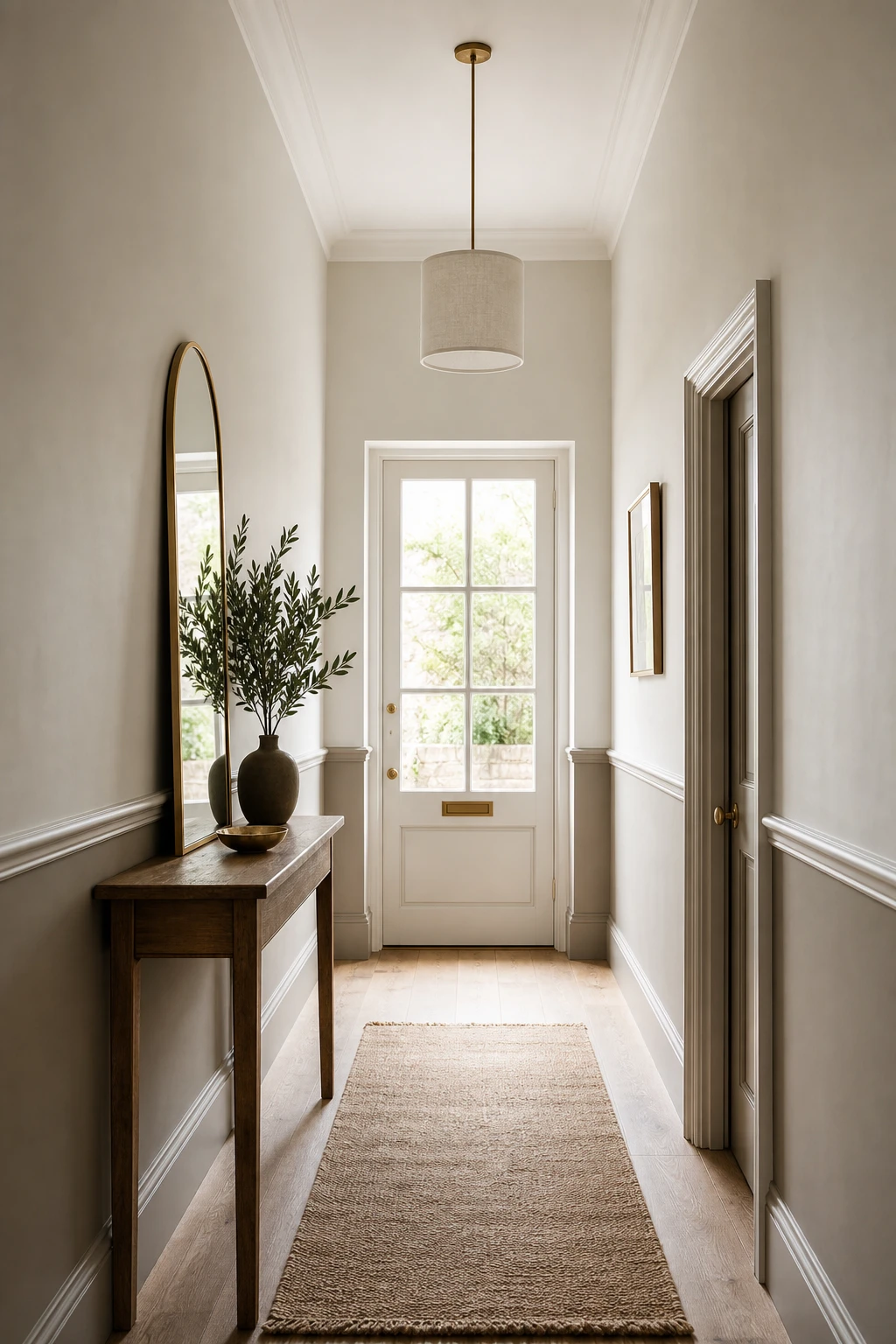
Splitting the wall at dado height is one of my favourite tricks in a narrow hallway. A deeper tone below the rail and a lighter shade above pulls your eye upward, and you get that lifted ceiling feeling without touching a single structural thing. That clean horizon line is what I find so satisfying about it: the contrast settles the eye rather than busying it, and the whole wall reads as calm and deliberate rather than split in two.
The Key Details
Painted timber dado rail
Slim console table
Narrow arched mirror
Long drop pendant light
Glazed end door
Pro TipPlace the colour break at around 90 to 100 cm from the floor, which sits just above hip height and gives the upper wall enough room to breathe and carry the eye up.
AvoidChoosing two tones that sit too close together on the same paint card means the split disappears into the wall and you lose the whole height effect you were after.
One Colour Carried Through Every Surface for a Hallway That Feels Curated
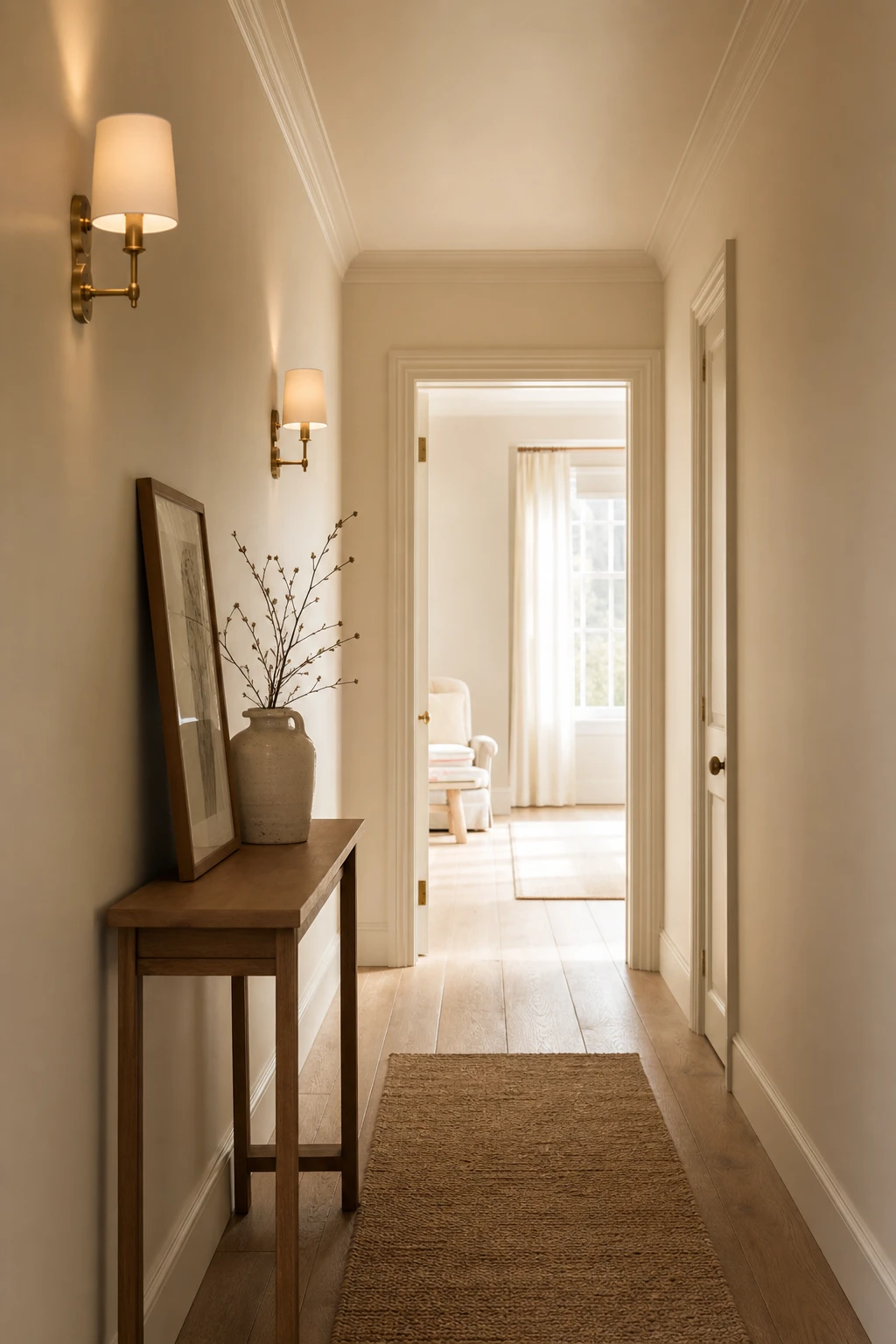
Carrying one colour across every surface is something I find endlessly satisfying in a small hallway. You get this seamless, almost gallery like calm because the eye has nowhere to snag. What I love is how the room reads as intentional rather than safe, and you will notice the space feels taller and longer the moment the trim stops fighting the walls.
The Key Details
Slender console table
Woven runner rug
Wall mounted sconces
Aged oak timber floor
Framed print leaning on console
Pro TipUse a flat emulsion on the walls, an eggshell on the trim, and a satin on the ceiling so each surface catches light differently without a second colour entering the room.
AvoidLeaving the floor as a stark contrast pulls your eye straight down and breaks the envelope you worked so hard to build, making the hall feel shorter and more cluttered than it is.
Warm Beige Walls With Wood Floors and the Tone Pairing That Ties It Together
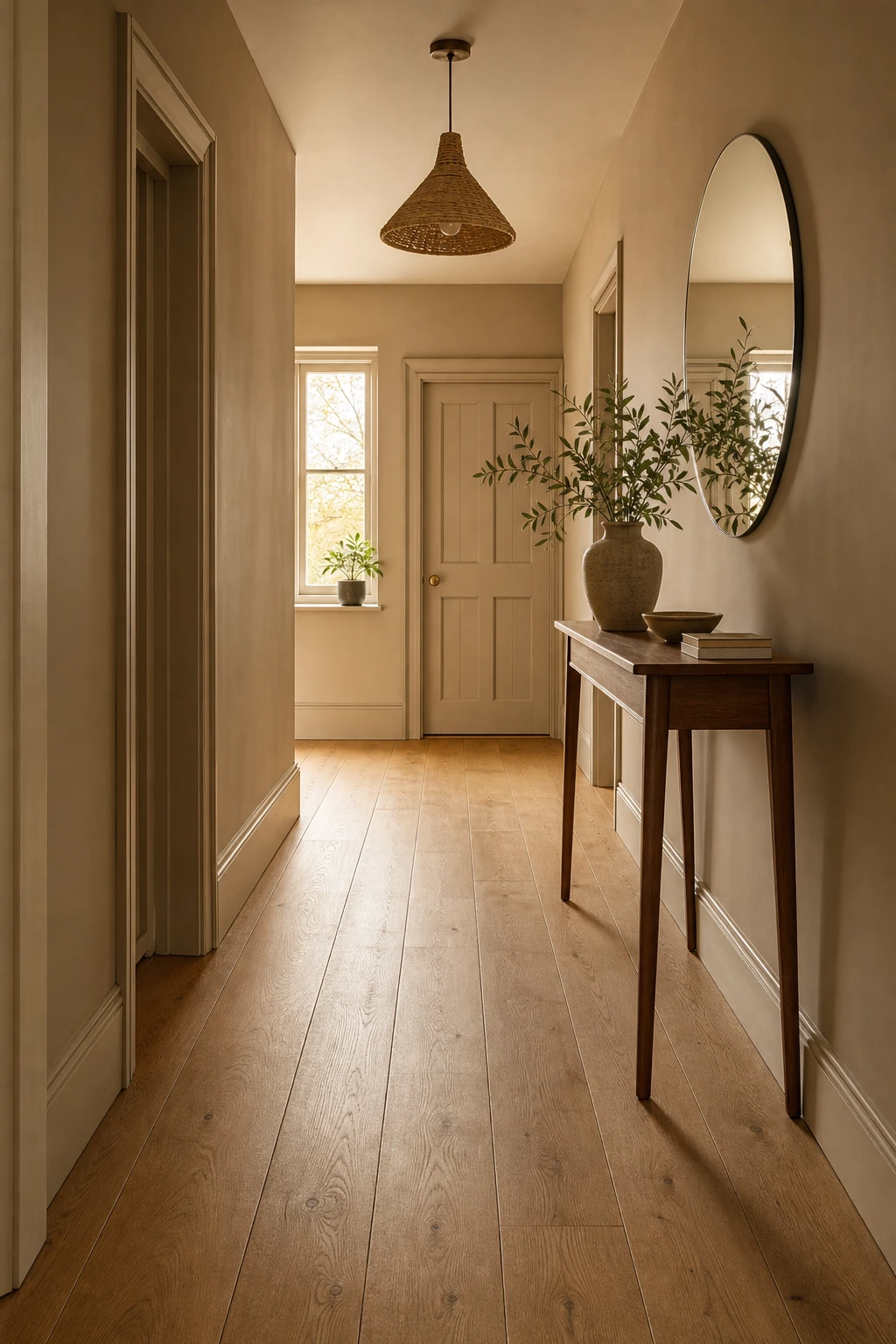
Beige and wood feel effortless together when the warmth in both is speaking the same language. What I love about this pairing is how a honey oak floor pulls the gold out of a warm beige wall, so each one makes the other look richer. You get a hallway that feels complete rather than assembled, and that sense of calm is exactly what a small space needs to feel generous.
The Key Details
Honey oak hardwood floorboards
Slim console table with tapered legs
Round frameless wall mirror
Woven pendant light shade
White painted timber panelled door
Pro TipBring a physical sample of your floorboard to the paint shop and hold it against swatches in natural light before you commit to anything.
AvoidPicking a cool or greyed beige against a honey toned floor creates an invisible tension that makes both materials look muddy and slightly off, even when you cannot quite name why.
Narrow Hallway Panelling That Adds Character Without Eating Any Space
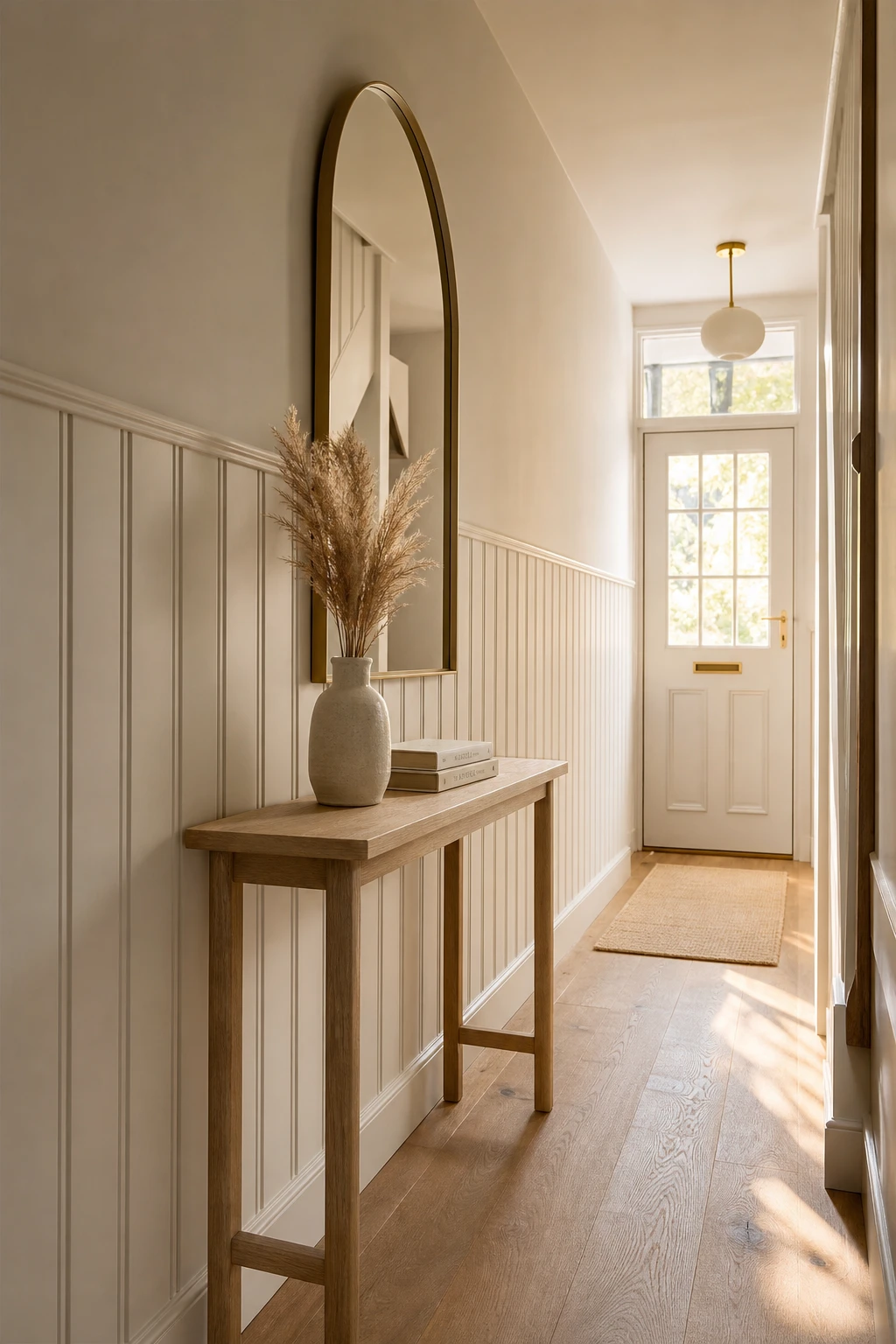
Slim vertical panelling is one of my favourite tricks for a narrow hallway because the eye follows the lines straight up, making the ceiling feel taller than it is. You get real texture and character on the wall without any of the bulk that closes a small space in. What I love most is that a simple panel kit costs very little yet transforms a plain corridor into something that looks considered and deliberate.
The Key Details
Slim vertical wall panelling from skirting to dado rail
Slender console table
Arched leaning mirror
Dried pampas stems in ceramic vase
Limed oak flooring
Pro TipIn a very narrow hallway, keep each panel strip no wider than 80mm so the rhythm stays light and the wall breathes.
AvoidChunky wide mouldings on a small wall make the hallway feel like a corridor that is shrinking around you, so the space ends up feeling darker and tighter than it did before.
Stair and Hall Panelling Treated as One to Make the Whole Run Feel Designed
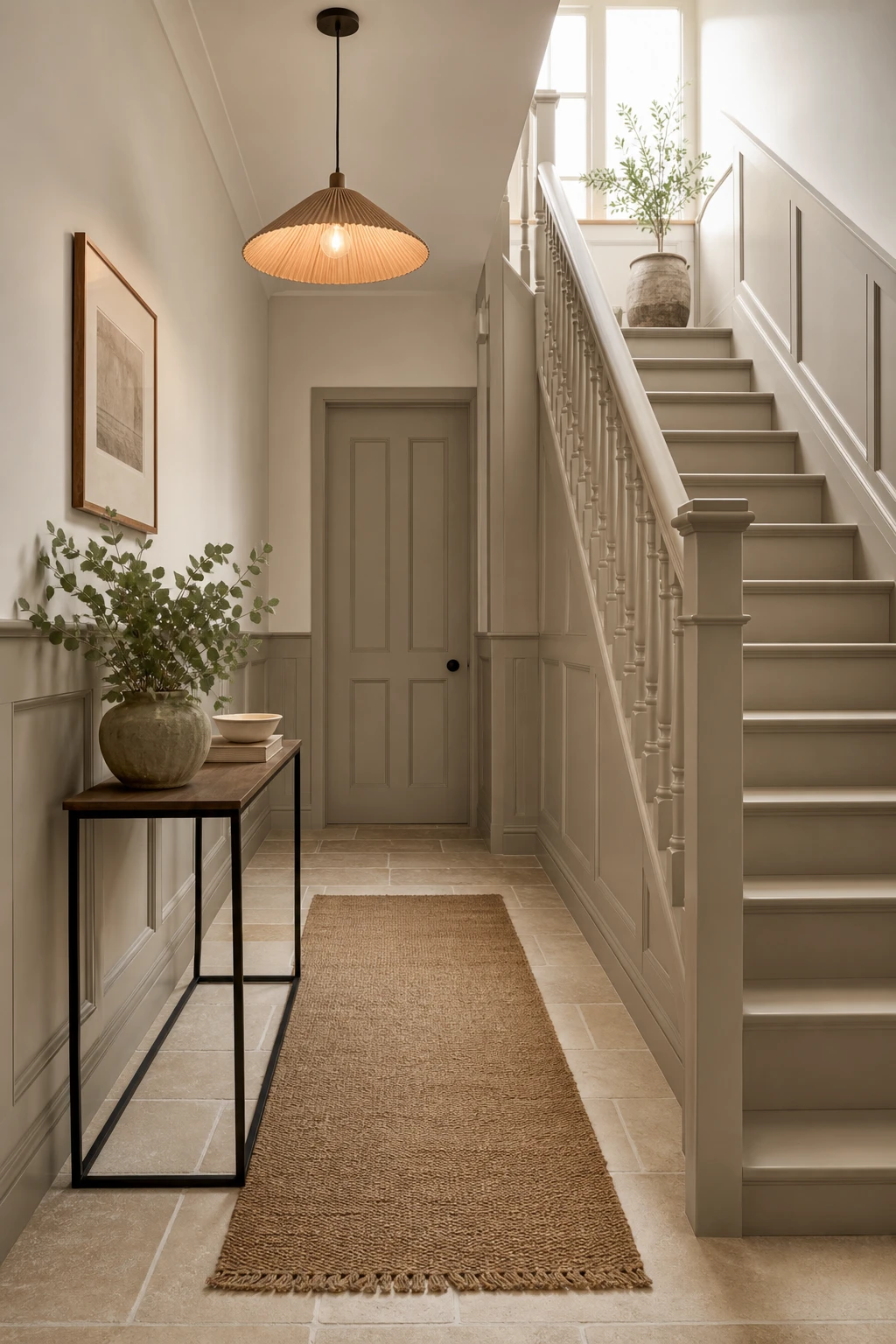
Carrying panelling from the flat hall wall up and along the stair string is one of my favourite moves in a neutral scheme. You get a single architectural line that the eye follows without interruption, and the whole run reads as one considered space rather than two separate areas joined by accident. What I love is how it adds real substance to a small hallway without taking up a centimetre of floor space.
The Key Details
Continuous dado and stair panel mouldings
Turned timber balustrade
Slim console table beneath stair rail
Pendant light over hallway
Natural jute runner rug
Pro TipSet your panel height on the flat hall wall first, then carry that same measurement up the stair at a consistent vertical so the tops form a clean parallel line with the slope above.
AvoidStopping the panelling at the foot of the first step leaves a hard, unfinished edge that draws the eye straight to it and undoes the whole effect.
The Wallpaper Style That Makes a Long Narrow Hallway Feel Like a Feature
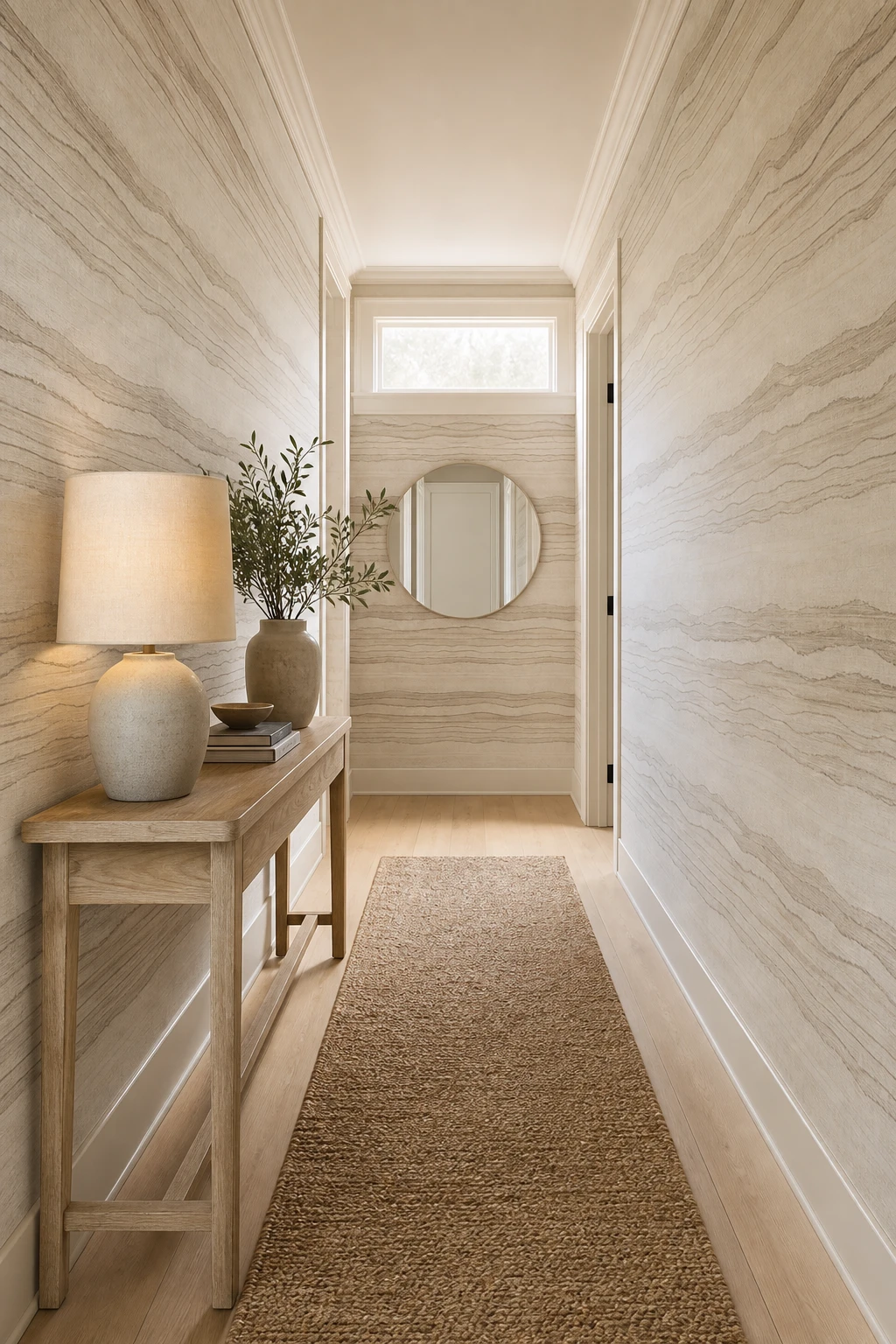
A large scale horizontal repeat is one of my favourite moves in a narrow hallway because the eye reads across the wall rather than racing straight down the corridor. You get a space that feels broader and more considered, even when the footprint has not changed by a single centimetre. The thing I find genuinely clever about pattern direction is that it does the heavy lifting paint simply cannot, turning an awkward corridor into something you actually want to pause in rather than hurry through.
The Key Details
Large scale horizontal repeat wallpaper
Slim console table
Woven jute runner
Round frameless mirror
Bleached timber floorboards
Pro TipRun a horizontal stripe or wide repeat pattern across the longest wall to pull the eye sideways and make the corridor feel wider, and save vertical patterns for low ceilinged rooms where height is the problem you are solving.
AvoidCovering every wall in a small busy all over print closes the space in fast, leaving the hallway feeling restless and cluttered before a single piece of furniture is added.
One Accent Wall in the Entryway That Gives Your Hallway a Real Focal Point
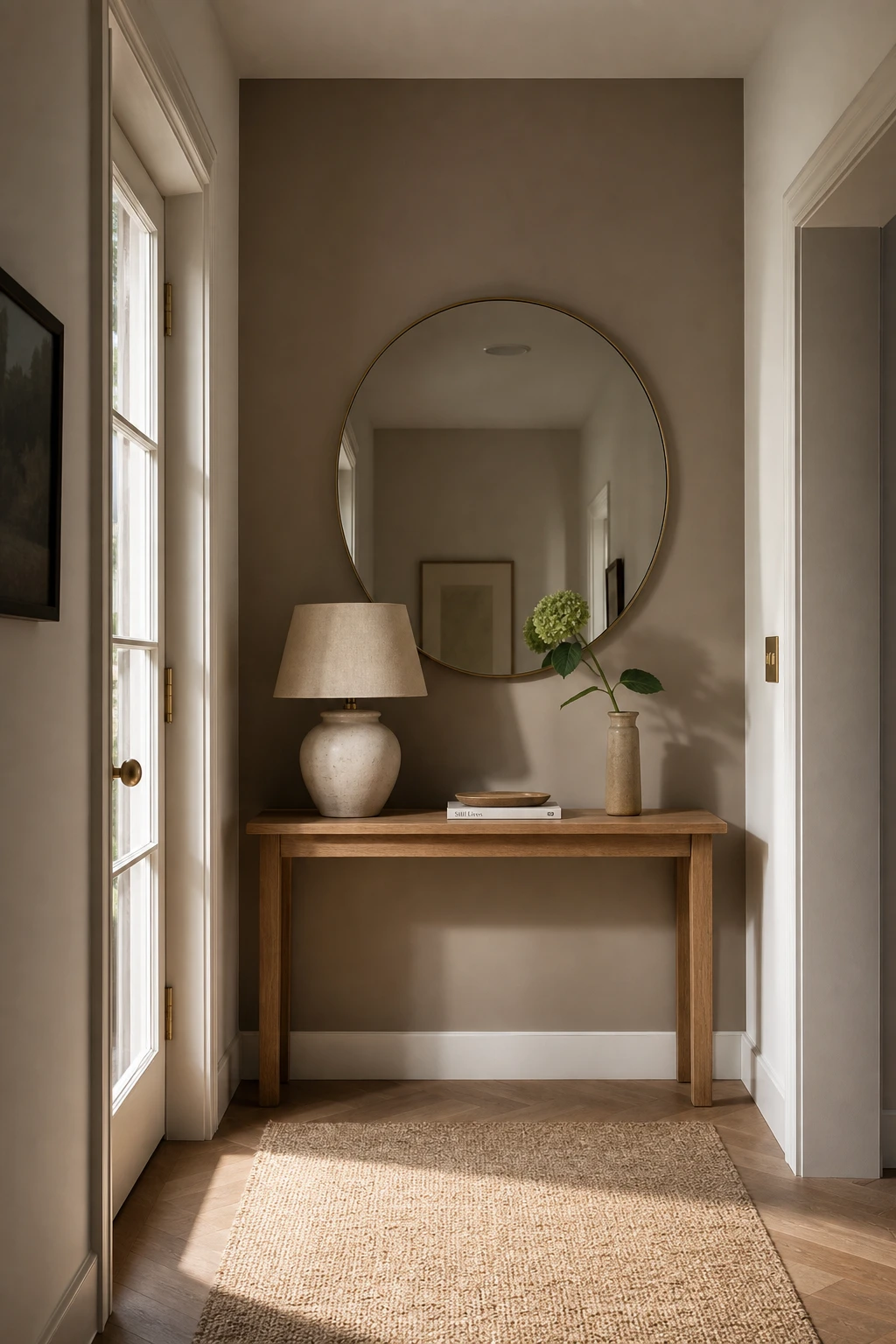
The wall your front door faces is the one your eye hits first, and giving it a reason to stop there changes the whole feel of a hallway. What I love about a single accent wall is the clarity it brings: one surface does the work and everything else settles around it. You get a real sense of arrival rather than a corridor you rush through.
The Key Details
Slim oak console table
Round brass framed mirror
Ceramic table lamp
Jute runner
Glazed door panel
Pro TipAlways treat the wall directly opposite the front door as your accent wall, because that is the view a visitor sees the moment they step inside.
AvoidPutting an accent wall behind an existing arch or dado rail creates two competing focal points and the space ends up feeling restless rather than considered.
A Tiled Hallway Floor That Sets the Tone Before You Even Look Up
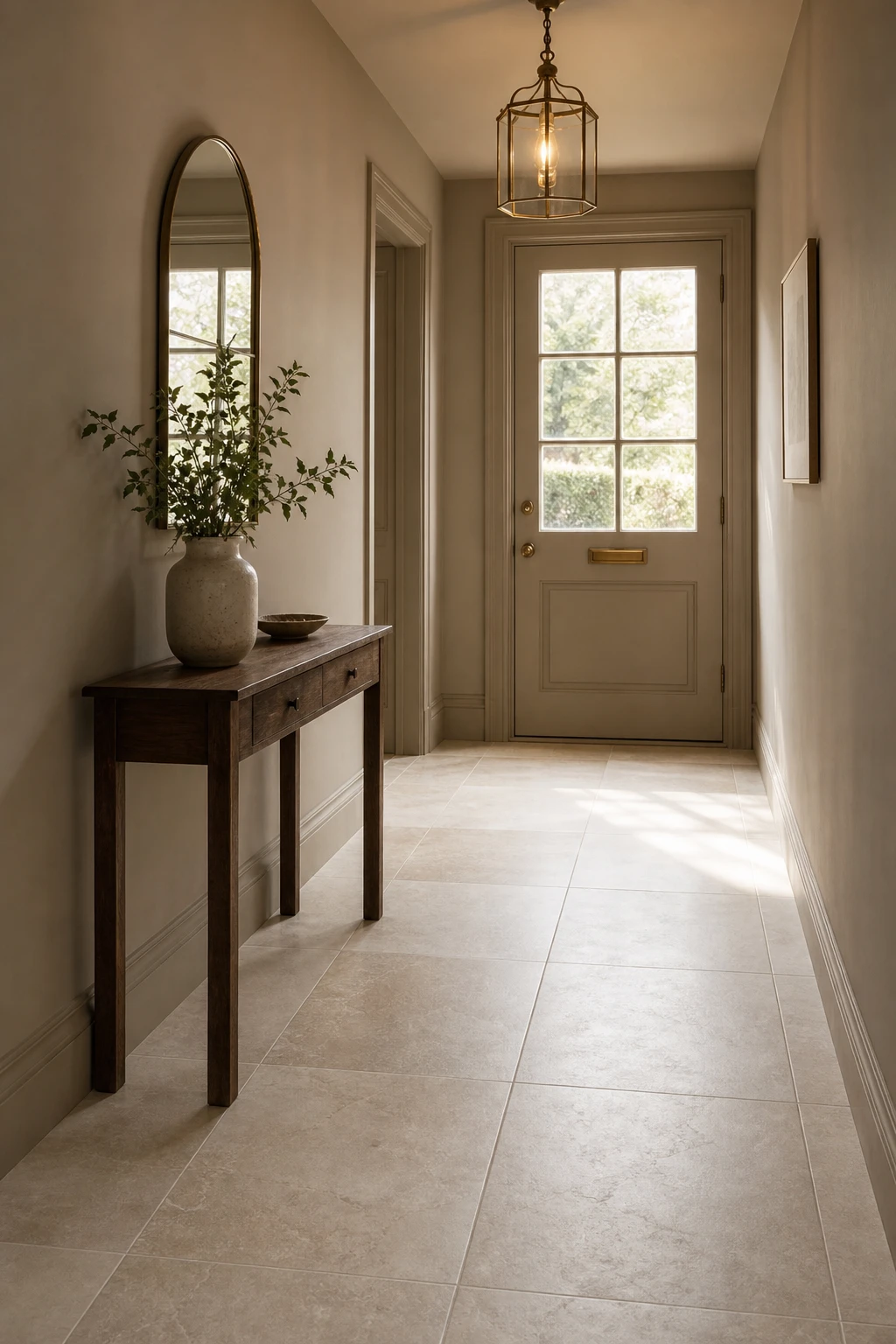
The floor is the first thing a guest reads before they even register the walls, so getting it right matters more than people realise. What I love about a well chosen tile is that it anchors the whole space in one move, setting a mood that every other element then plays off. You will notice how a stone effect ceramic in a warm neutral pulls the eye forward, making the hallway feel purposeful rather than forgotten.
The Key Details
Large format stone effect ceramic floor tiles
Slim dark oak console table
Arched wall mirror
Pendant lantern ceiling light
Glazed panelled front door
Pro TipLay rectangular tiles on a horizontal run across the width of the hall rather than along its length and you will visually push the walls apart.
AvoidA high gloss large format tile looks beautiful in the showroom but every scuff, footprint and muddy paw print will show the moment the front door opens, and you will spend more time cleaning than enjoying it.
A Patterned Rug on Wood Flooring and How to Pick One That Looks Intentional
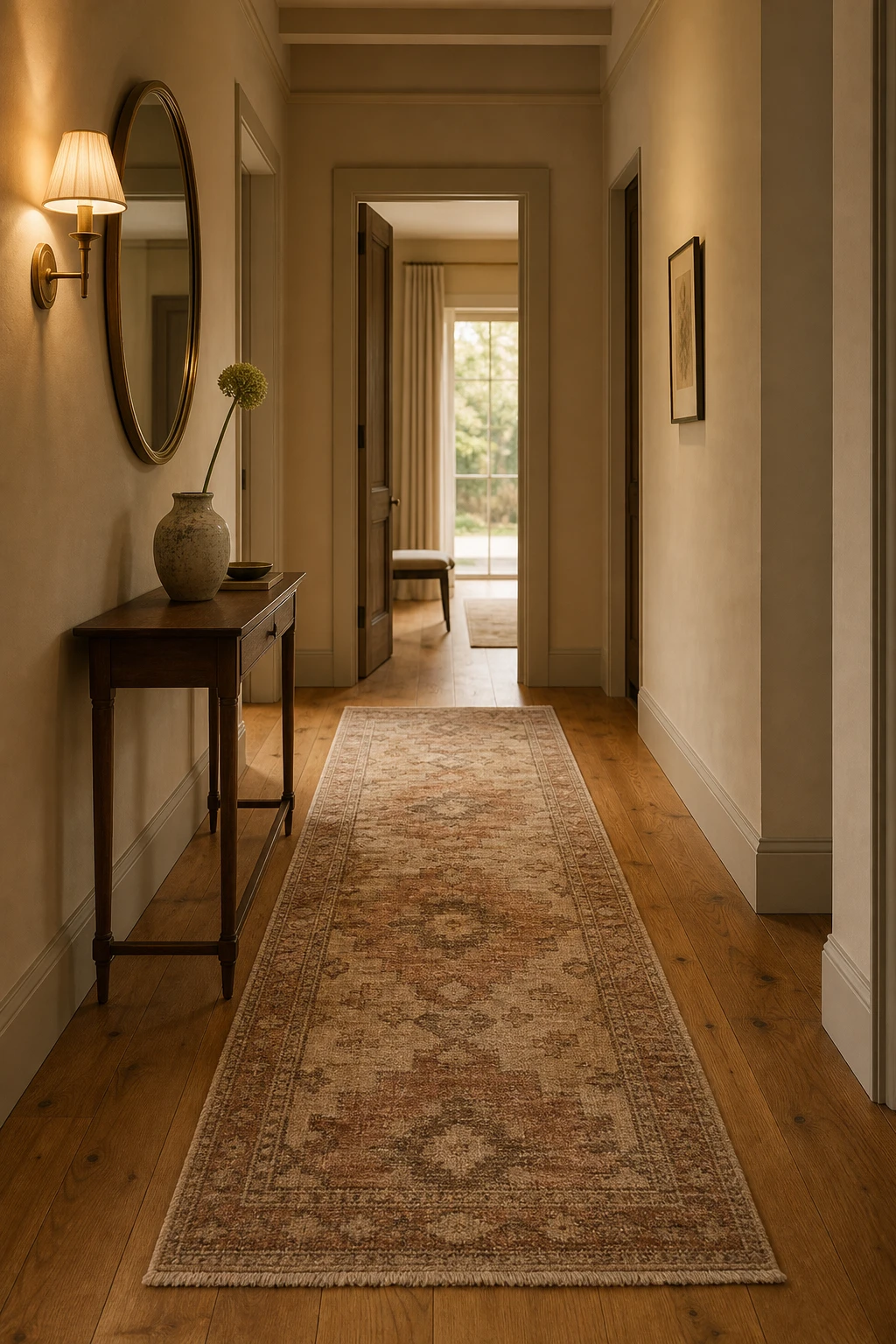
Laying a patterned runner over wide plank oak is one of my favourite moves in a narrow hall. The boards stay visible either side, so you get warmth and texture without losing that lovely sweep of natural wood. I always think the real magic is in the direction the pattern creates: your eye follows it straight down the corridor, and the space feels longer rather than boxed in.
The Key Details
Wide plank oak floorboards
Patterned wool runner rug
Slim console table
Brushed brass wall sconce
Round wall mirror
Pro TipSize your runner so at least six inches of bare board shows on each side, otherwise the rug looks like a mistake rather than a choice.
AvoidPicking a busy geometric runner when you already have bold panelling or patterned wallpaper creates a visual argument the hall will never win.
Why a Jute Runner Is the Easiest Way to Warm Up a Cold Hallway Floor
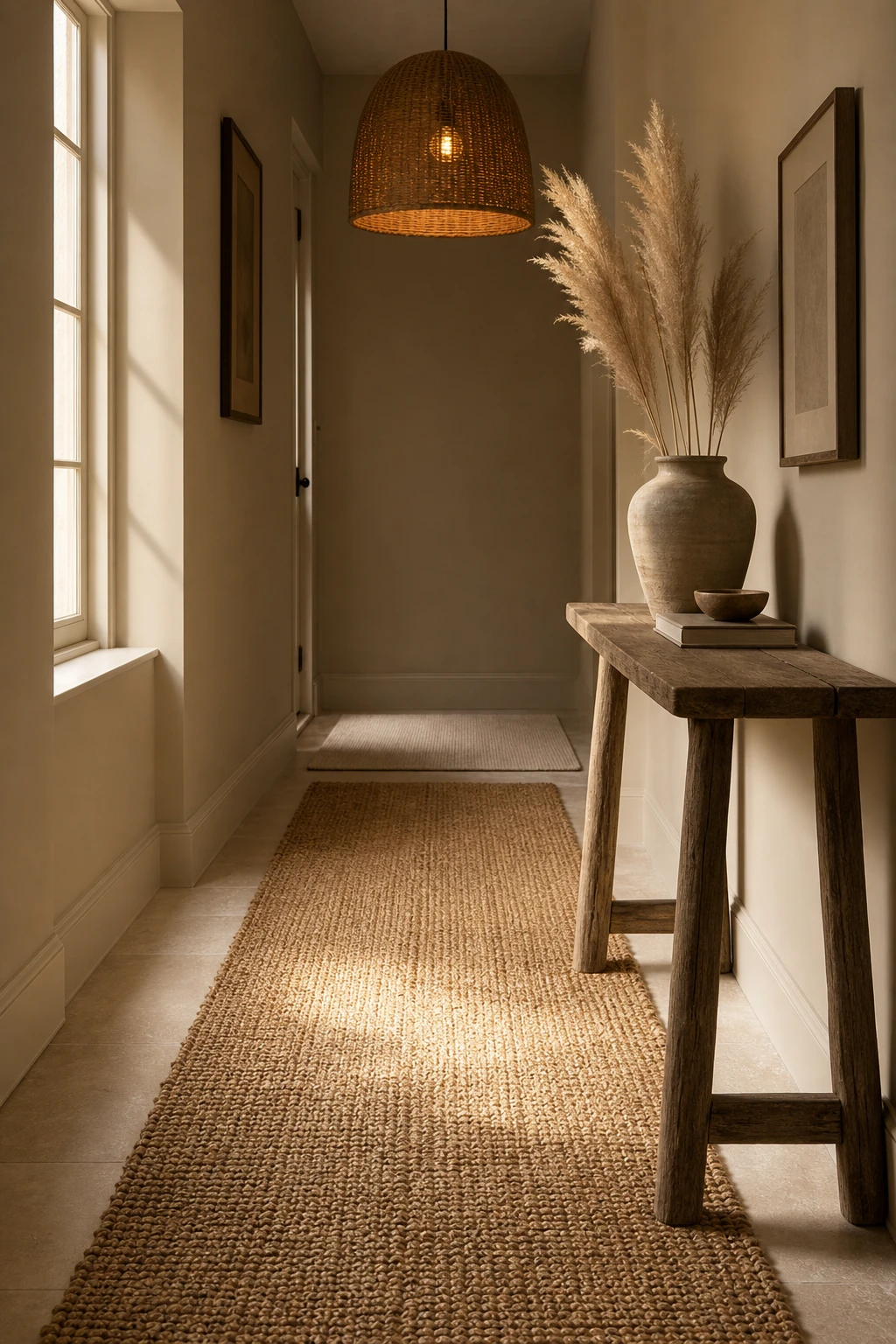
A jute runner is one of my favourite fixes for a hallway that feels cold and hard underfoot. The woven texture pulls the eye down and gives the floor real character, and what I love most is how it softens the space without adding colour. You get that quiet, organic warmth straight away, and the beauty is it only gets better with a little wear.
The Key Details
Woven jute runner
Slender oak console table
Rattan woven pendant light
Dried pampas stem ceramic vase
Honed limestone floor tiles
Pro TipAlways fit a good non slip underlay beneath a jute runner so it grips the floor and stays flat for anyone moving through in a hurry.
AvoidLaying a jute runner right at the front door means it takes the full brunt of wet boots and rain, and natural fibre holds moisture in a way that quickly leads to mould underneath.
Carpet on the Stairs With a Wood Landing and the Transition That Makes It Work
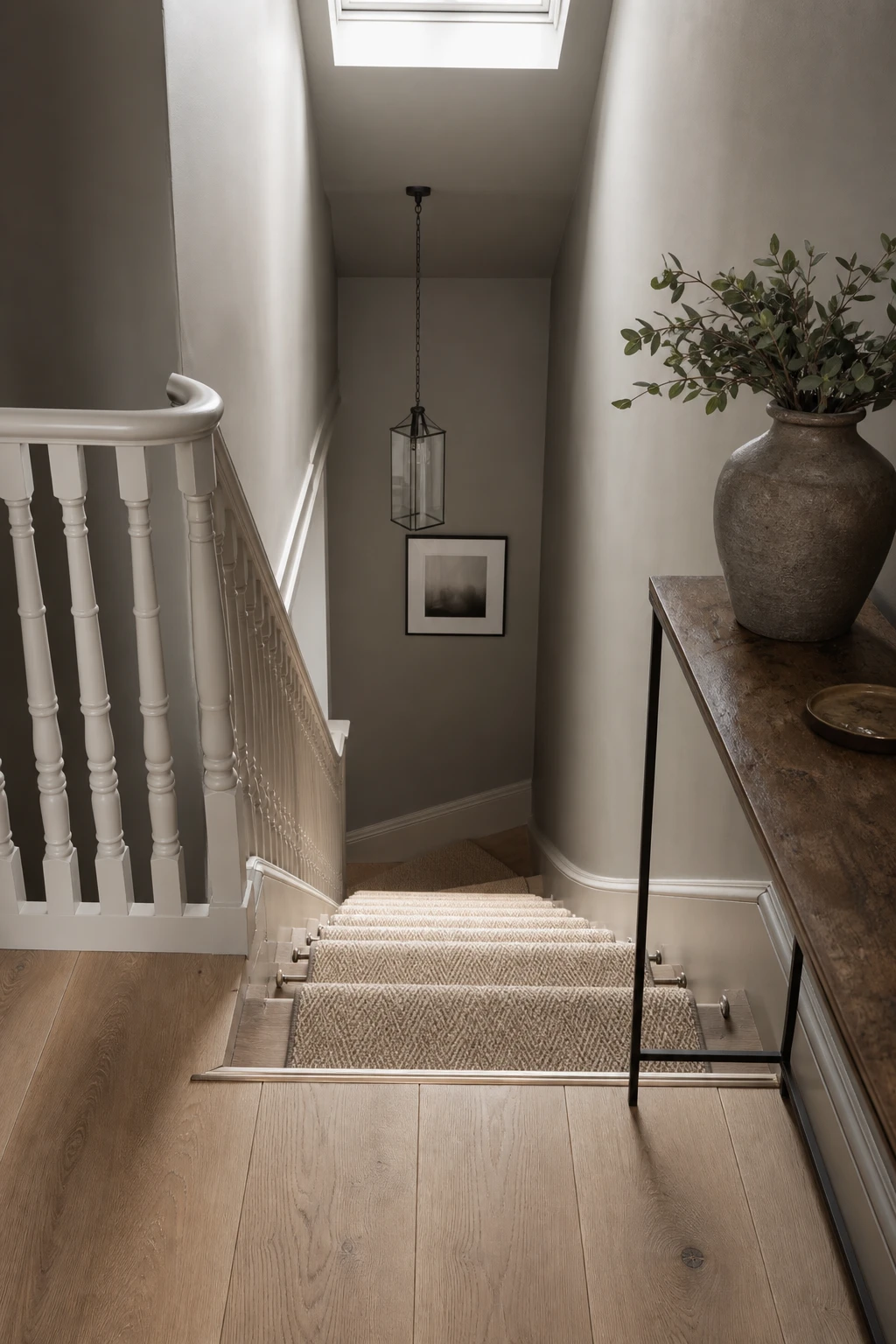
Carpet on the stairs meeting wood on the landing is one of my favourite combinations, but only when that join is treated as a feature rather than an afterthought. What wins me over here is the threshold bar: it draws a clean, intentional line between the two materials so the eye reads a considered choice, not a builder’s compromise. You get the warmth and quiet of wool on the treads where you feel it underfoot most, and then the landing opens out in pale oak, which makes the whole space feel wider and lighter.
The Key Details
Oatmeal wool carpet runner on treads
Brushed metal stair rods
Wide plank pale oak landing floor
Threshold bar carpet to timber join
White painted turned spindle banister
Pro TipFit a brushed metal threshold bar right at the nosing of the top tread so the carpet ends with a crisp, level edge and the wood landing reads as a deliberate frame.
AvoidLetting the carpet tuck loosely under the landing floor without a fixed bar means the edge lifts over time and the whole stair run starts to look tired and unfinished.
Styling a Hall Runner So It Looks Like It Was Always Meant to Be There
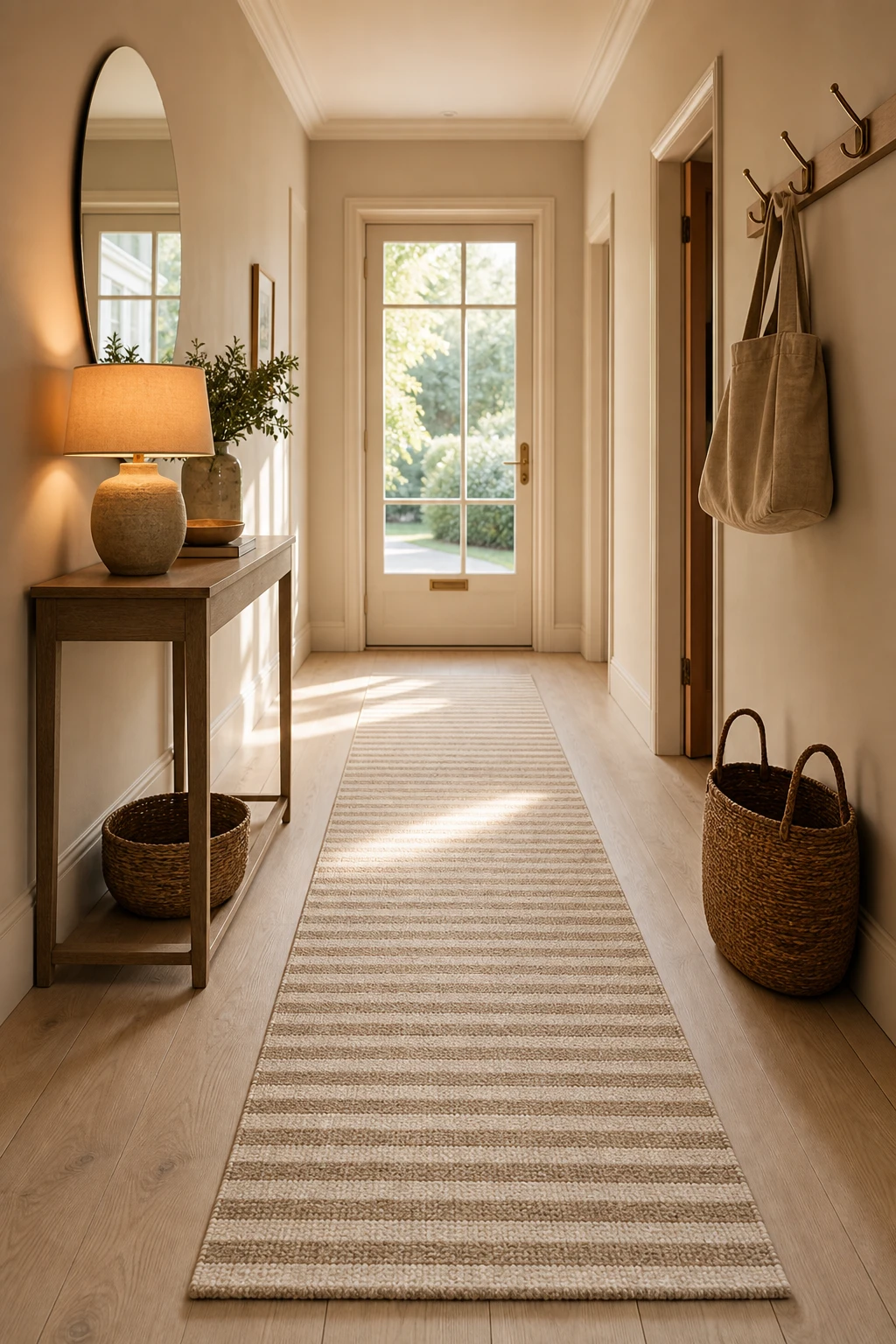
A well placed runner does something quietly clever: it draws the eye straight down the hall, and that long unbroken line makes the space feel taller and wider all at once. What I love about leaving equal bare board margins on both sides is that you get a visual frame, and the floor itself becomes part of the composition rather than something to hide. You will notice how the proportion suddenly feels considered, not accidental.
The Key Details
Wool stripe hall runner with equal bare board margins
Slim console table in pale oak
Round frameless mirror above console
Ceramic table lamp with linen shade
Wall mounted coat hook rail with woven basket below
Pro TipMeasure both ends before you buy and aim to leave roughly the same length of bare board at the door end as at the far wall, so the runner reads as a deliberate centrepiece rather than a leftover strip.
AvoidA runner that is too long will curl at doorways or bunch against the skirting, and once that happens the whole hall reads as cramped and careless no matter how nice everything else is.
A Hallway With No Natural Light and the Tricks That Make It Feel Bright Anyway
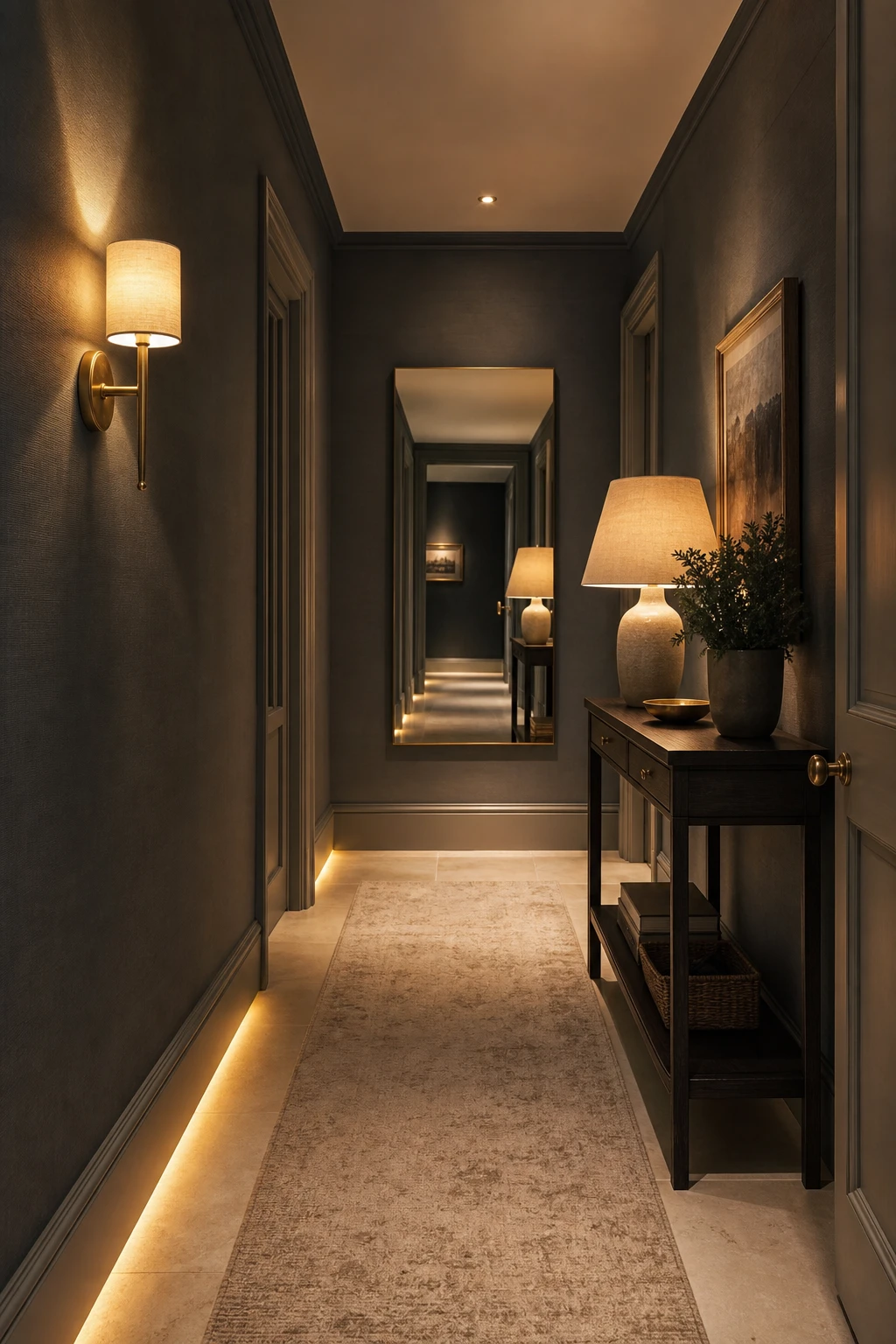
A hallway with no natural light is one of my favourite puzzles to solve, because the fix is almost always the same: layer light at different heights and the space wakes up completely. Wall sconces, a table lamp on the console, and a mirror bouncing it all back give you warmth from every angle, so you get that soft afternoon sun feeling without a single window. What I love most is that the layering hides the absence of daylight rather than fighting it.
The Key Details
Multi height wall sconces
Frameless rectangular mirror
Narrow console table with table lamp
Pale textured runner rug
Honed limestone floor tiles
Pro TipChoose bulbs rated 2700K for every fitting in a windowless hallway, as that temperature sits closest to afternoon sunlight and keeps the neutral walls from reading cold or grey.
AvoidA single ceiling bulb in a windowless hallway pushes hard shadows straight down the walls, which makes the space feel smaller and slightly gloomy rather than the warm welcome you are after.
The Combination of Paint and Surfaces That Gives a Hallway Its Airy Quality
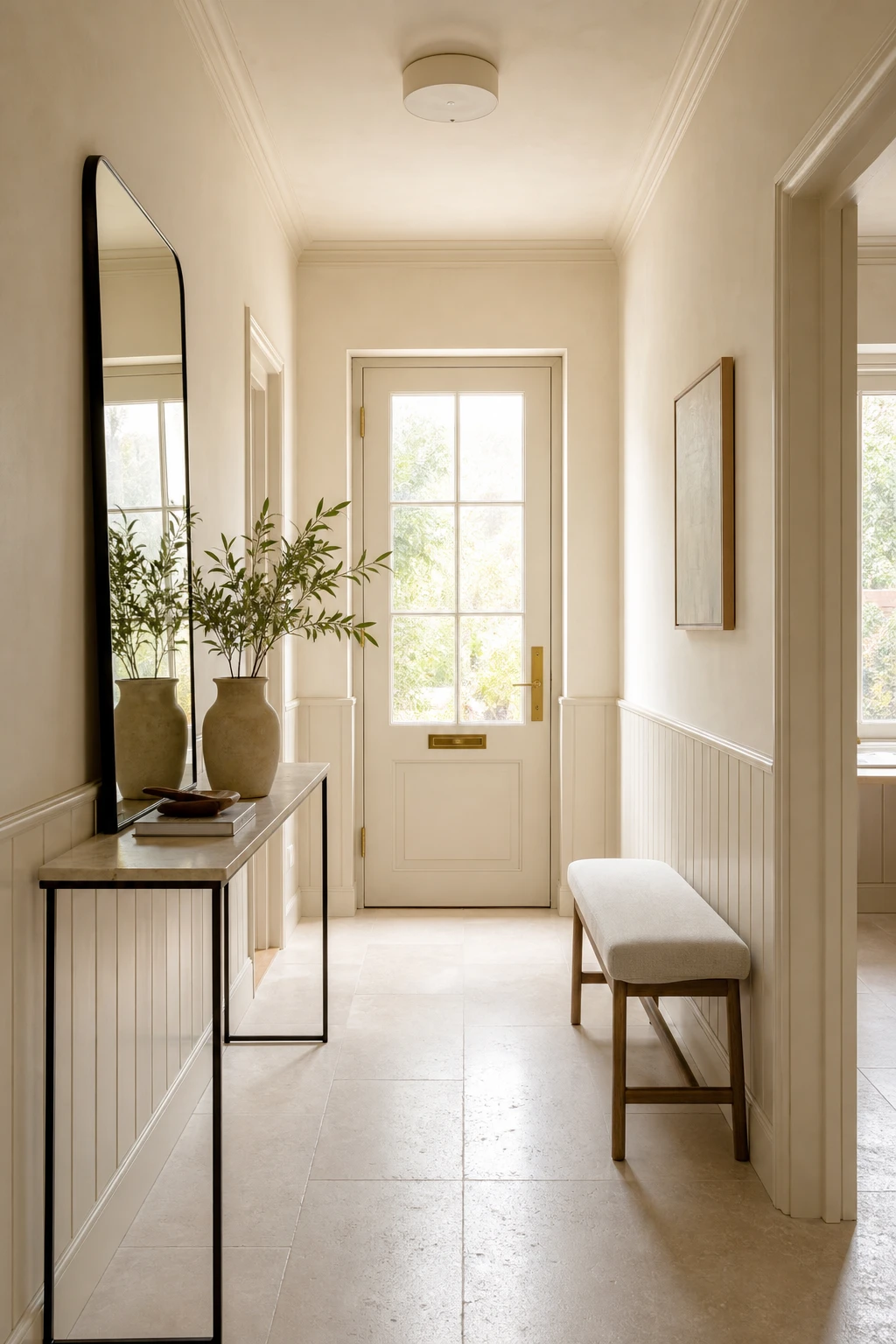
Pale reflective surfaces and clear walls do something quietly clever: they pass light from one plane to the next so the whole space feels bigger than it is. What I love here is how the limestone floor tiles, the mirror, and the half glazed door all work as a relay, each one catching and bouncing whatever light comes in. You will notice the wainscoting and console table earn their place precisely because neither one interrupts that flow.
The Key Details
Half glazed panelled front door
Frameless overmantel mirror
Large format honed limestone floor tiles
Slim console table
Tongue and groove wainscoting
Pro TipPaint the skirting, architrave, and walls in the same pale tone so your eye travels the full length of the hall without stopping at a contrast line.
AvoidA cluster of dark accessories near the floor pulls the visual weight downward and makes the ceiling feel lower, which undoes every bit of work the pale surfaces are doing.
Hallway Lamp Placement That Makes the Space Feel Lit Rather Than Just Bright
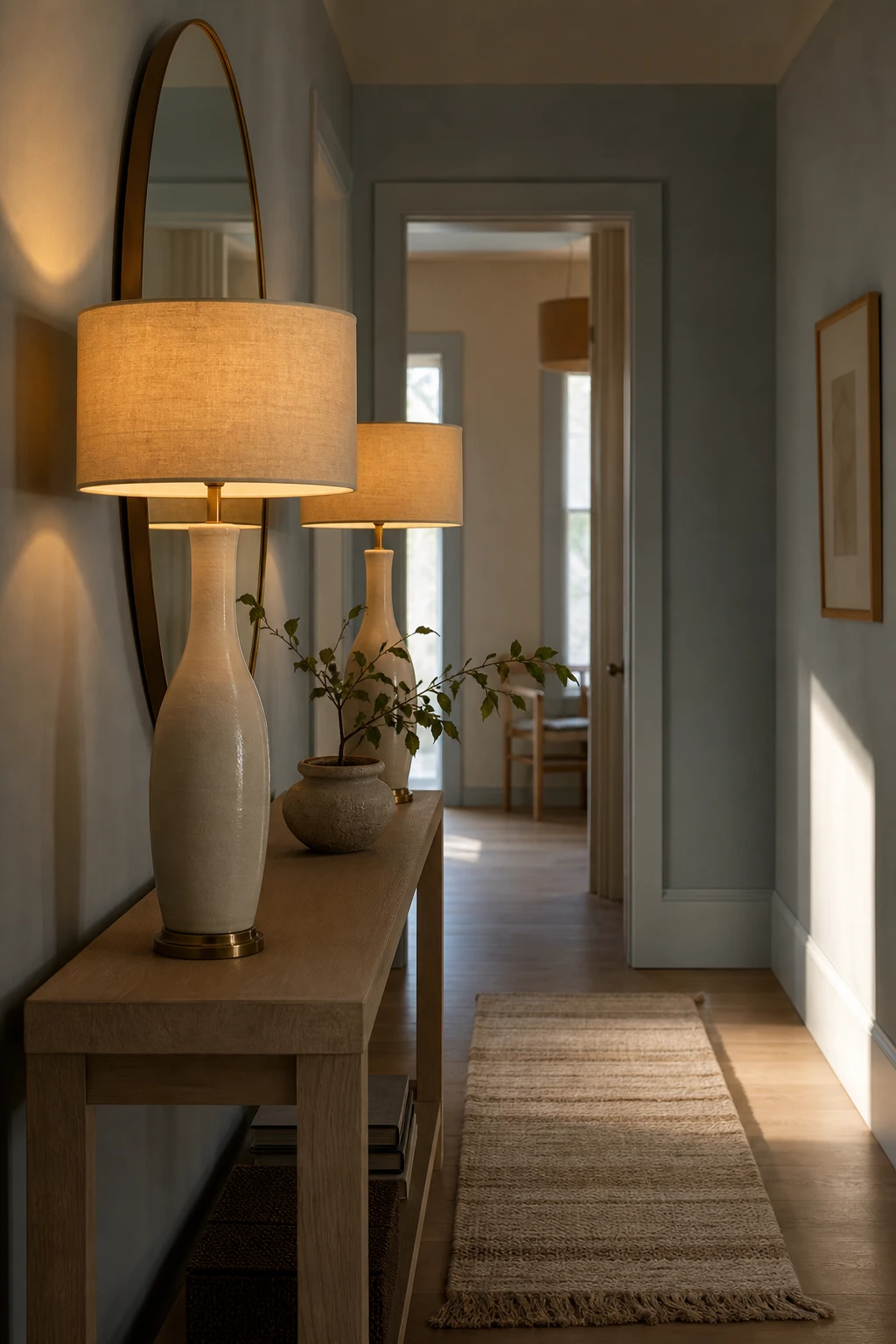
Overhead lights in a hallway flood the floor and leave the walls cold, and what I reach for instead is a lamp sitting right at eye level on a slim console. You get that warm pool of light that makes the space feel considered rather than just switched on. The shade does the work quietly, softening shadows and giving the hall a glow that pulls you through it.
The Key Details
Slender ceramic table lamps
Narrow console table
Oval leaning mirror
Woven ivory and flax runner
Stone vessel with branch arrangement
Pro TipPair your console lamp with a single wall sconce on the opposite side and you close off every dark corner without adding any floor clutter.
AvoidA floor lamp in a narrow hall eats the one thing you cannot spare, which is walking room, and the whole space starts to feel like an obstacle course.
Turning a Narrow Hallway Into a Mini Mudroom Without Losing Any Floor Space
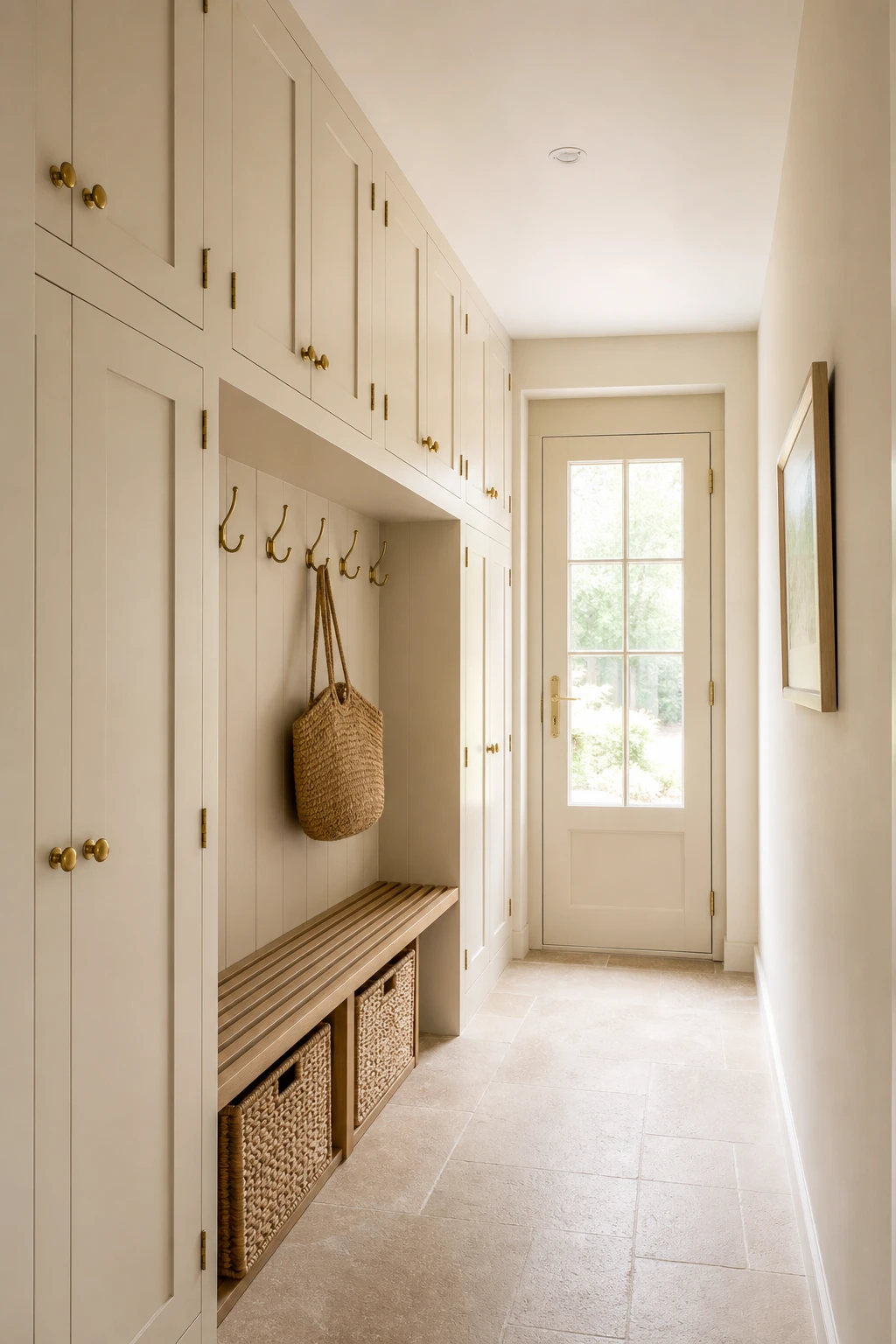
Tall shaker cabinetry running right to the ceiling is one of my favourite moves in a narrow hall. You get all the storage of a proper mudroom but the footprint stays razor thin. What wins me over every time is how the vertical line draws the eye up, making the space feel taller rather than squeezed. The slatted bench tucks neatly at the base so there is somewhere to sit without anything jutting out into your path.
The Key Details
Floor to ceiling shaker cabinetry
Slatted slim timber bench
Brushed brass wall hooks
Woven seagrass storage baskets
Honed limestone floor tiles
Pro TipFit your hooks inside a shallow cabinet with a magnetic catch so the door swings shut and the whole wall reads as one clean flat panel.
AvoidFreestanding coat stands and open console hooks placed in a narrow entry scatter the visual line and leave bags and coats on full show, which makes even a generous hall feel chaotic the moment anyone arrives home.
Slim Entryway Storage That Keeps a Small Hallway Tidy From the Moment You Walk In
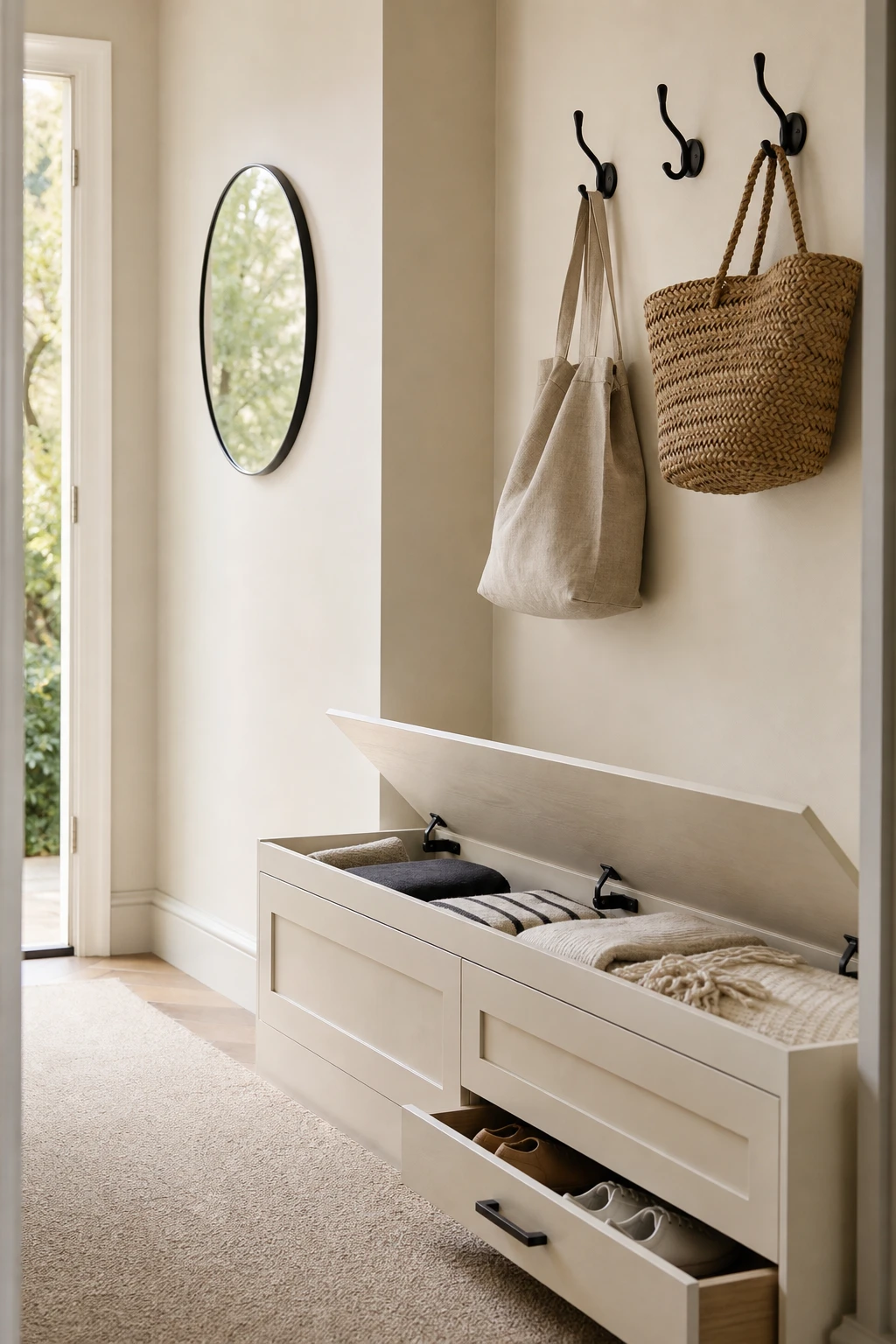
A shallow bench with a lift top lid is one of my favourite moves in a tight hallway because it swallows shoes, bags and scarves the moment you walk in, and you never see any of it. What I love is how it keeps the floor line clean, so the space reads wider than it actually is. You get all the function of a full storage unit in something that barely clears thirty centimetres of depth.
The Key Details
Lift top storage bench
Matte black wall hooks
Low profile shoe drawer
Round wall mirror
Woven seagrass basket
Pro TipMeasure your walkway first and make sure you keep at least ninety centimetres of clear passage between the bench and the opposite wall, even when the lid is open.
AvoidLow open shelves right by the door put every dropped shoe and stray bag on full display to anyone who knocks, which makes the hallway feel messier than before you added storage.
A Coat Rack That Earns Its Spot in a Hallway and Actually Looks Good Doing It
A wall mounted coat rack at the right height is one of those small wins that changes a hallway completely. What I love is how it lifts everything off the floor so you actually see the space rather than a pile of coats. You get a clear sightline straight to that panelled door, and the brushed brass hooks add just enough warmth to keep the neutral palette feeling alive rather than flat.
The Key Details
Wall mounted coat rack with brushed brass hooks
Slim painted console table
Undyed wool narrow runner
Pale timber floorboards
Panelled door at hallway end
Pro TipSpace your hooks at least 20 cm apart so each coat hangs freely and the rack looks considered rather than crammed.
AvoidMounting the rack too low means bags and long coats drag on the floor, which makes the hallway look just as cluttered as before you put it up.
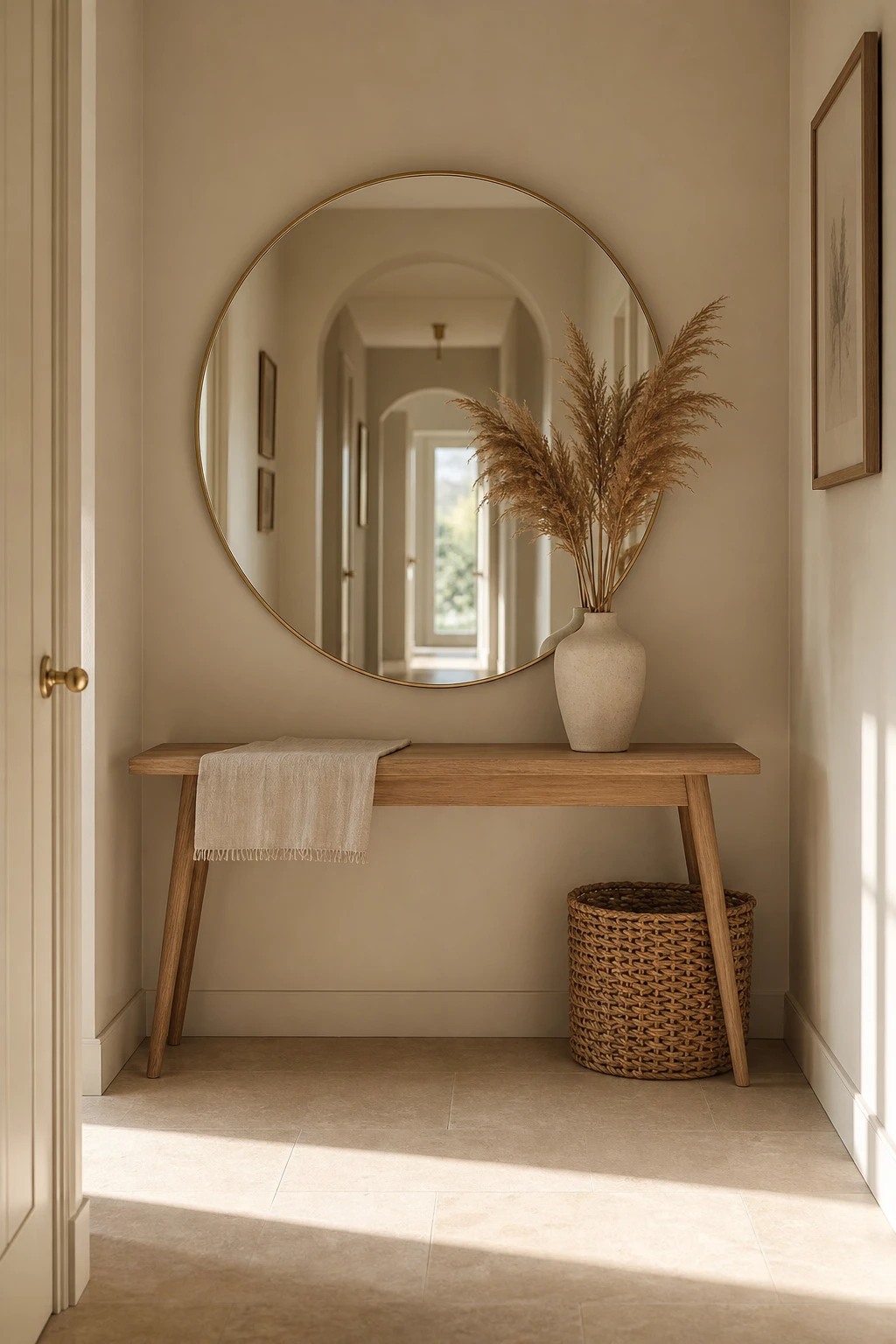
A Mirror and Console Table Pairing That Makes a Small Hall Feel Twice Its Size
A large mirror above a slim console is one of my favourite moves in a small hall. The mirror bounces light straight back into the space, and you get that lovely sense of depth, as though the room simply carries on. What wins me over every time is how the console holds just enough surface for a vase or a key dish without stealing floor space you actually need to walk through.
The Key Details
Large round leaning mirror
Slim natural oak console table
Dried pampas stem ceramic vase
Woven rattan floor basket
Honed limestone floor tiles
Pro TipHang the mirror so it faces your main light source, a window opposite or a pendant above, and watch how much brighter the whole hall feels.
AvoidA console table deeper than 30 cm will quietly eat into the walkway and turn every trip to the front door into a squeeze past the furniture.
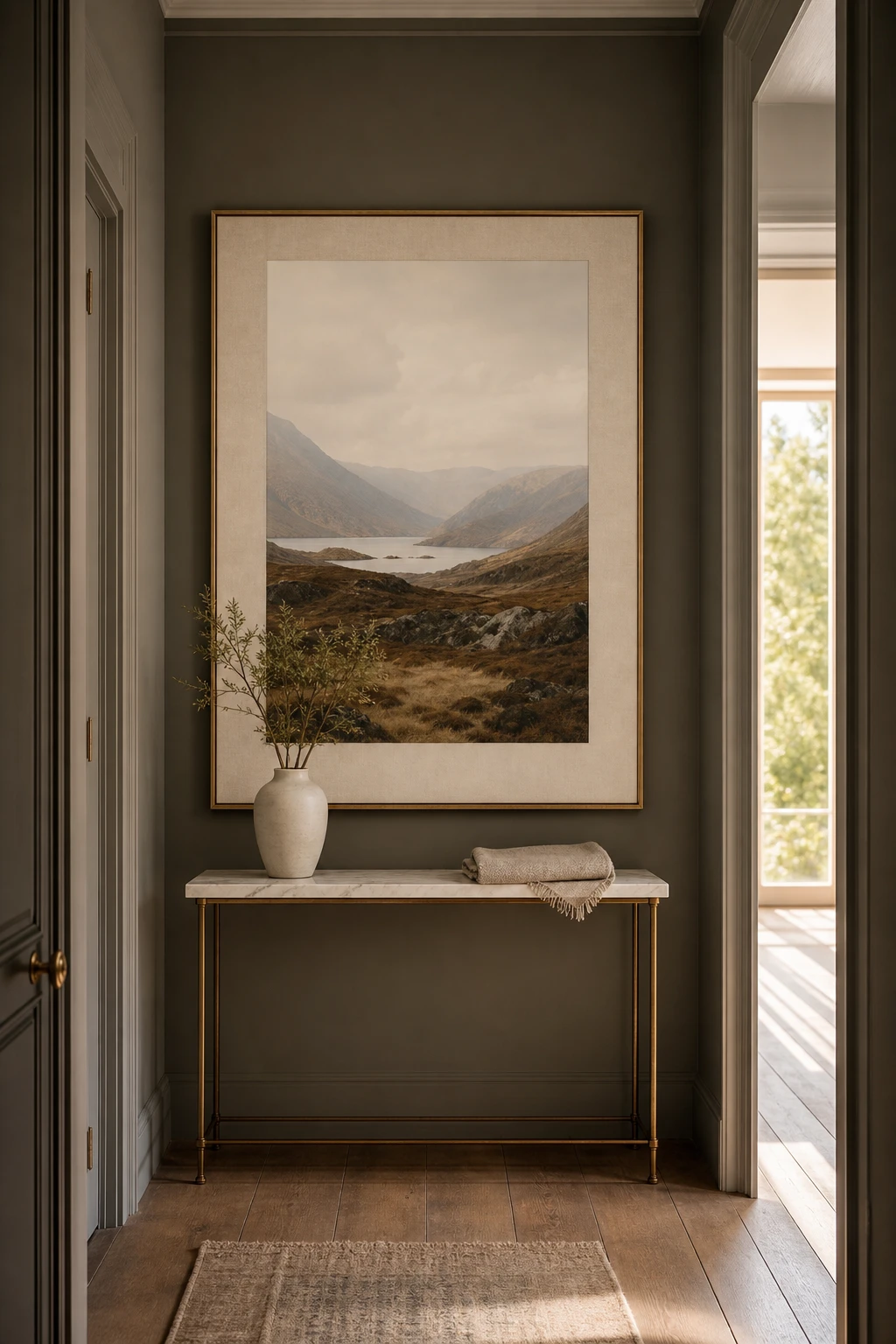
Hanging Hallway Art in a Small Space So It Looks Considered Not Cluttered
One oversized print in a small hallway is a move I come back to again and again, because the scale feels deliberate rather than tentative. You get a single strong focal point instead of a scatter of frames competing for attention across a narrow wall. What I love is how a generous linen mat around the image pushes it further, adding visual breathing room even when floor space is tight.
The Key Details
Oversized linen matted landscape print
Slim marble topped console table
Single ceramic vase
Aged brass picture rail hook
Folded textile console accent
Pro TipOn a straight hallway wall, hang the centre of your artwork at 145 to 150 cm from the floor so it sits at true eye level rather than drifting too high.
AvoidA frame that is too small for the wall will read as an afterthought, drawing attention to how much empty plaster surrounds it rather than to the art itself.
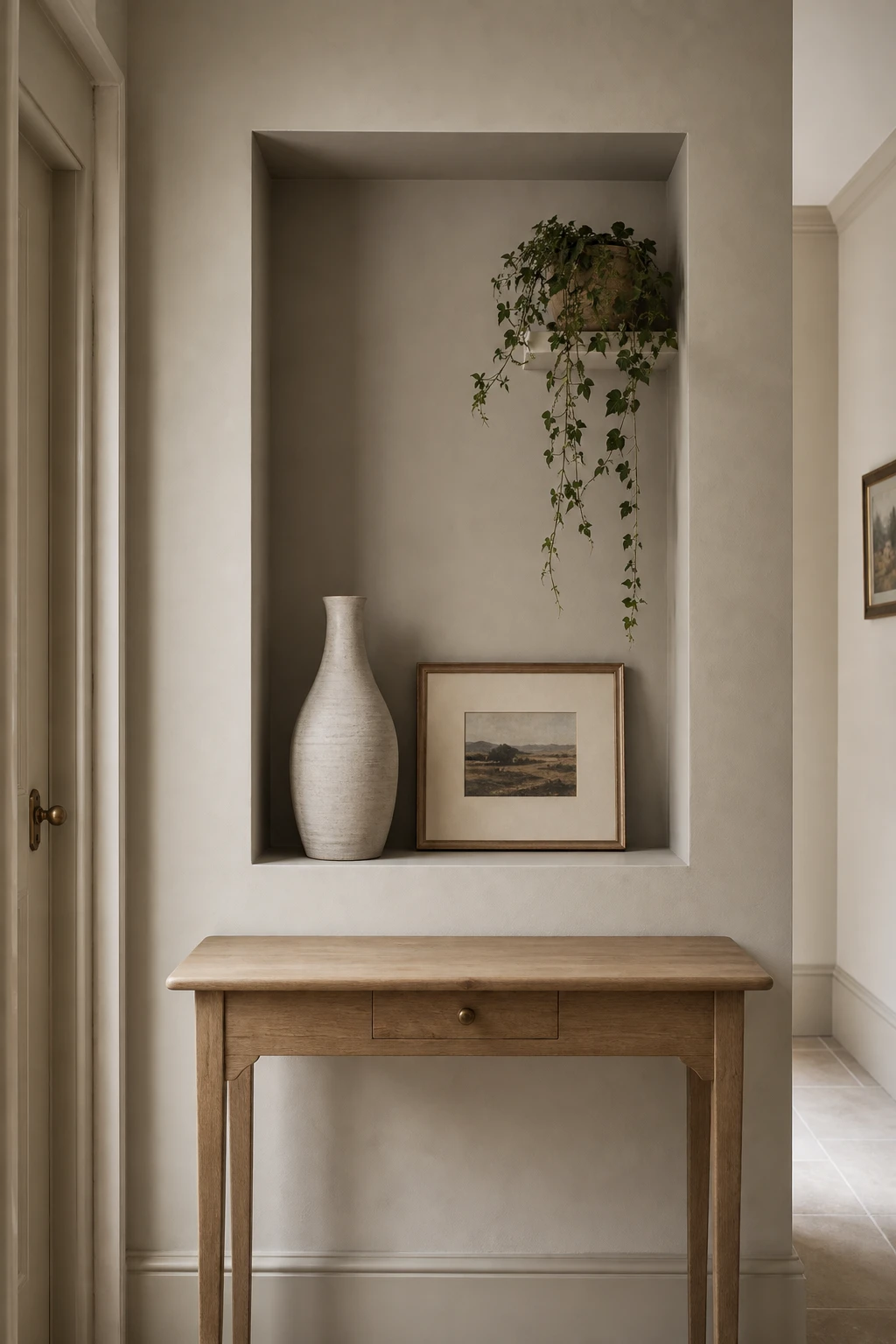
Styling an Entryway Niche So It Becomes the Nicest Detail in the Hall
A niche is one of those features I get genuinely excited about, because it gives you a proper display moment without stealing a single centimetre of floor space. The stepped interior walls add depth and shadow, so your eye is drawn straight into it. One tall stoneware vase, a leaning print, and a trailing plant is all you need, and you will notice how each object gets room to breathe and actually reads as something considered rather than something dumped.
The Key Details
Recessed plaster niche with stepped interior walls
Tall unglazed stoneware vase
Leaning framed landscape print
Trailing potted plant in terracotta pot
Narrow pale oak console table
Pro TipTuck a peel and stick strip light along the top inner edge of the niche and it will glow like a built in feature light at a fraction of the cost.
AvoidFilling every shelf and corner of a niche with objects flattens the whole thing into visual noise, and the careful curation you worked for disappears completely.
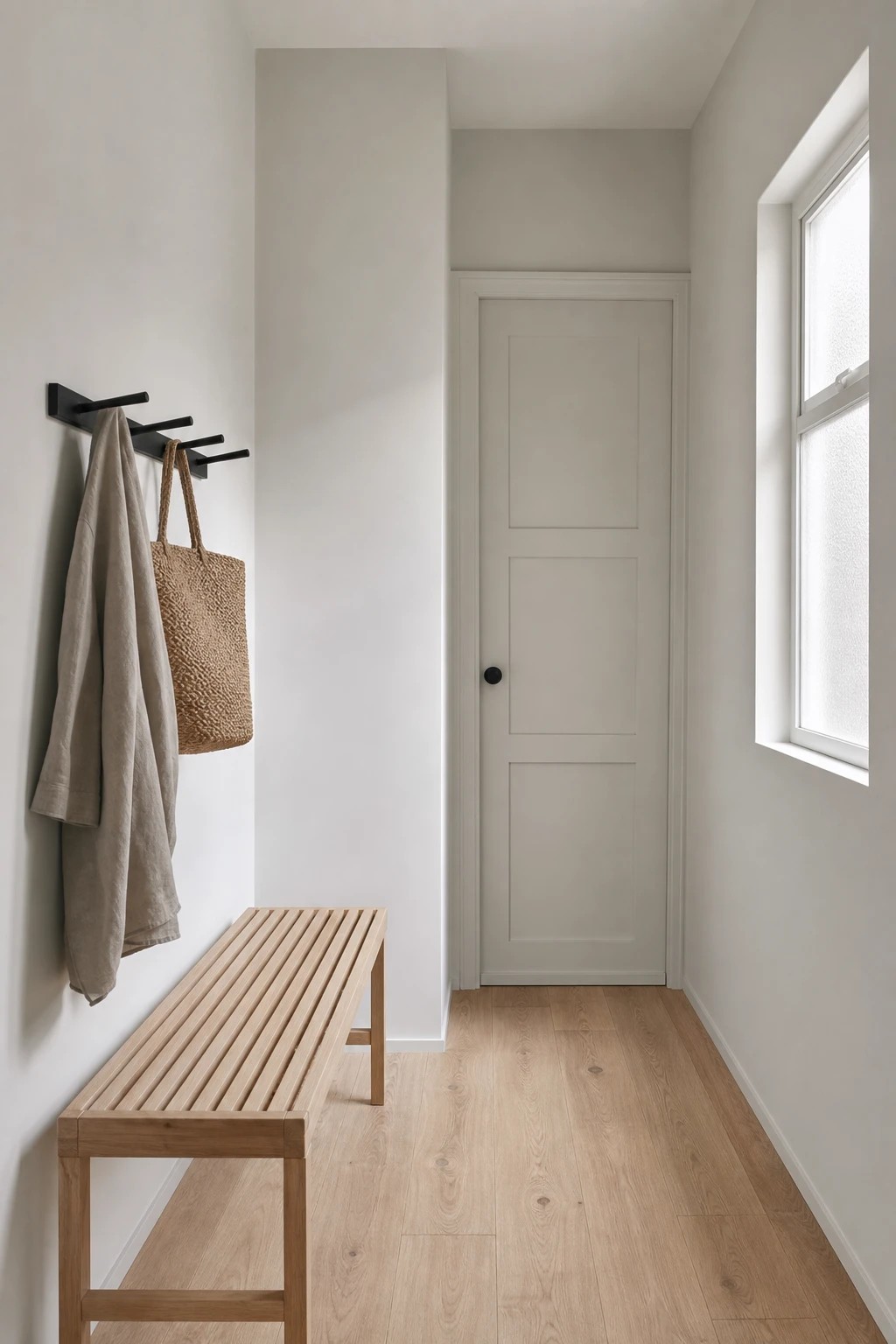
Scandinavian Hallway Styling and the Simple Formula Behind Its Effortless Calm
Scandinavian hallway styling asks so little of the space and gives back so much calm, which is exactly why I keep returning to it. A peg rail, a bench, a pale floor: each piece earns its spot without competing with the next. The restraint itself becomes the decoration here, and you will notice the hall feels genuinely settled rather than stripped bare.
The Key Details
Blackened steel Shaker peg rail
Raw pale oak plank floor
Slatted pine bench
White panelled end door
Frosted glass side window
Pro TipPick two materials, such as raw oak and blackened steel, then add one soft accent like a woven basket, and stop there for an honest Nordic feel.
AvoidDotting the shelf or floor with too many small objects pulls the eye in every direction and quietly kills the pared back quality that makes this style so restful.
Arts and Crafts Touches That Give a Hallway a Sense of Quiet Craftsmanship
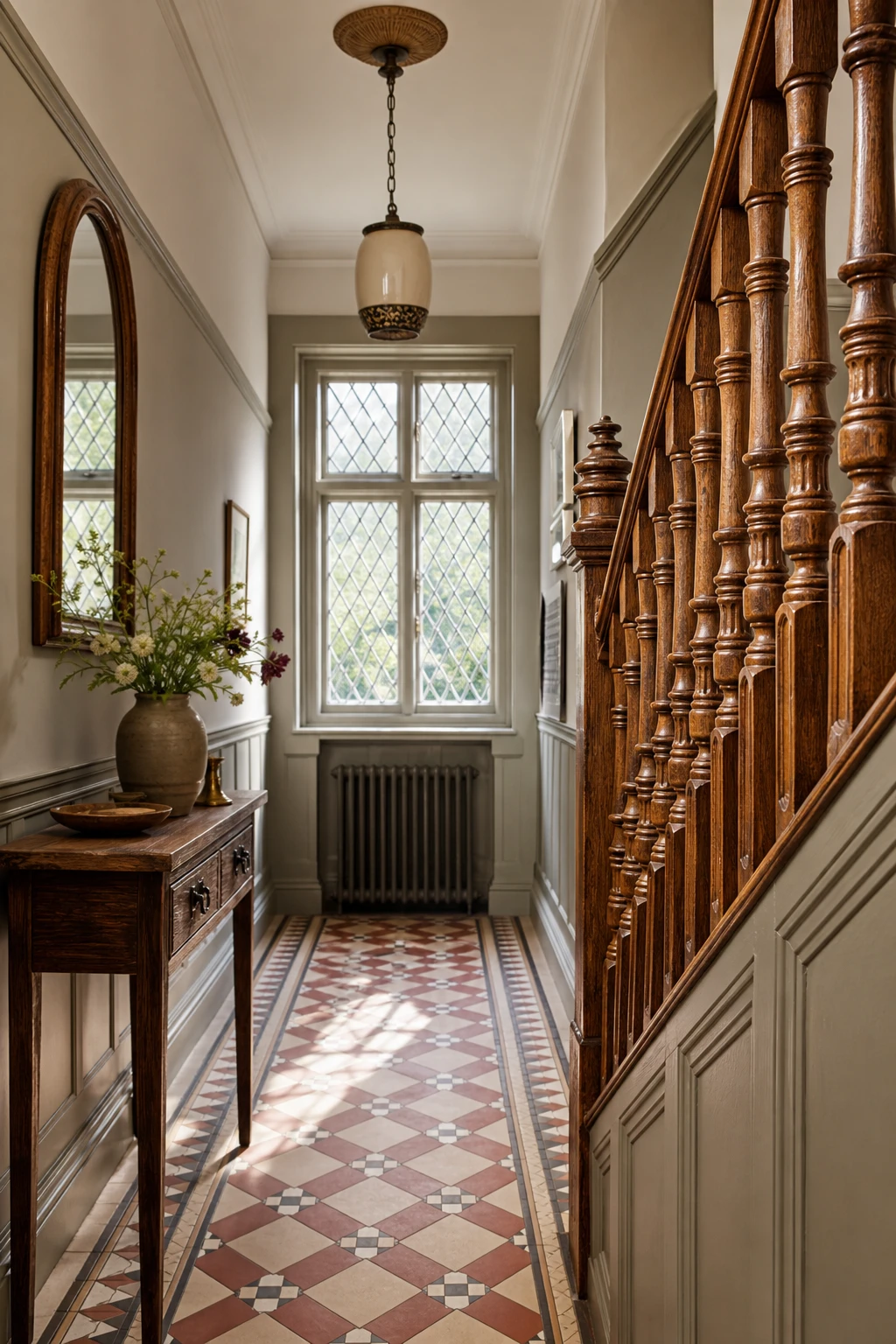
Hand crafted details like turned oak spindles and encaustic tiles bring a hallway to life in a way no flat, machined surface ever could. What I love here is how every element carries a small story: the geometry pressed into the tile, the bead of a ceiling rose, the weight of a forged iron pull. You get a space that feels genuinely made rather than assembled, and that quiet sense of craft is what gives a neutral entry its soul.
The Key Details
Hand turned oak stair spindles
Geometric encaustic floor tile runner
Oak console table with forged iron pulls
Ceramic pendant lantern on beaded ceiling rose
Leaded casement window with diamond glazing
Pro TipSource your door furniture and coat hooks from the same Arts and Crafts collection so the ironwork speaks one consistent language from the front door to the last hook on the wall.
AvoidPairing Arts and Crafts joinery with sleek, handle free minimalist furniture pulls the room in two opposite directions and both styles end up looking weaker for it.
A Japandi Hall Where Every Object Has a Purpose and Nothing Is Wasted
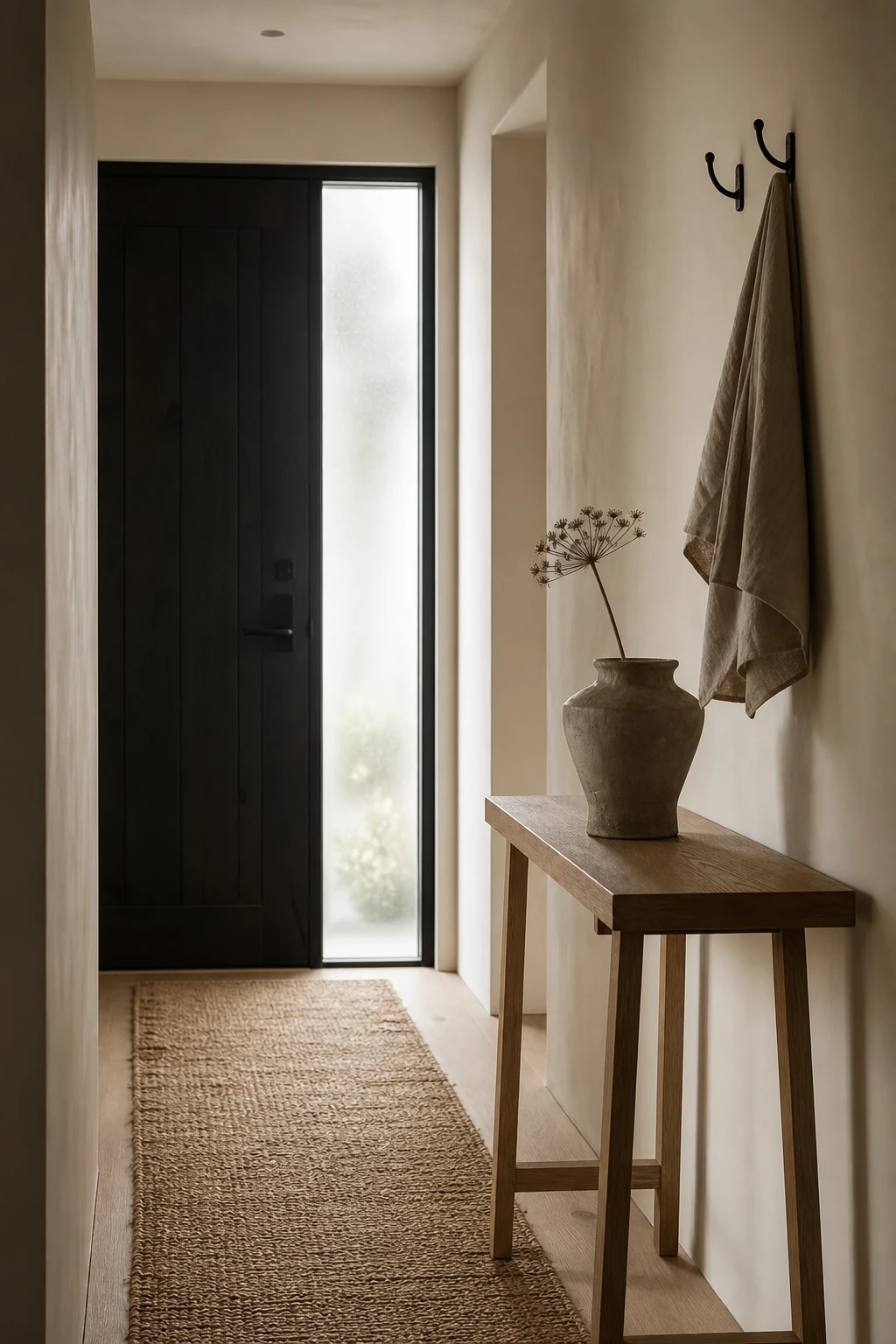
Restraint is the whole point of Japandi, not a compromise forced on you by limited space, and that is what I find so freeing about it in a small hall. Every object earns its place, so the room feels considered rather than bare. Watch how oak, iron, and jute each carry a different texture without competing: the eye moves quietly from one to the next, and one beautiful ceramic does more than a shelf of trinkets ever could.
The Key Details
Slim oak console table
Blackened iron wall hooks
Hand woven jute runner
Raw ceramic vase with dried stem
Dark stained timber entry door
Pro TipPick one natural material, rattan or linen, and let it repeat in at least two spots so the warmth reads as intentional rather than accidental.
AvoidHanging something on every blank wall because the space feels unfinished robs Japandi of its calm, and the negative space is actually doing the heavy lifting.
Alan launched Edward George London in 2017. Since completing his masters in Town & Regional Planning (MPlan) he has combined the skills he learned at the University of Sheffield with his passion for design, to help create a foundation for those looking to create a beautiful home.