I’ve always thought brick has a quiet magic that most exteriors never quite unlock. What I love about boho brick house exteriors is how a single bold door color, a sweep of climbing ivy, or a limewashed finish can turn a plain facade into something you genuinely stop to look at. This piece walks through all the angles, from painted finishes and arched details to woodland settings and tropical palms, and every look is one you can borrow for your own home.
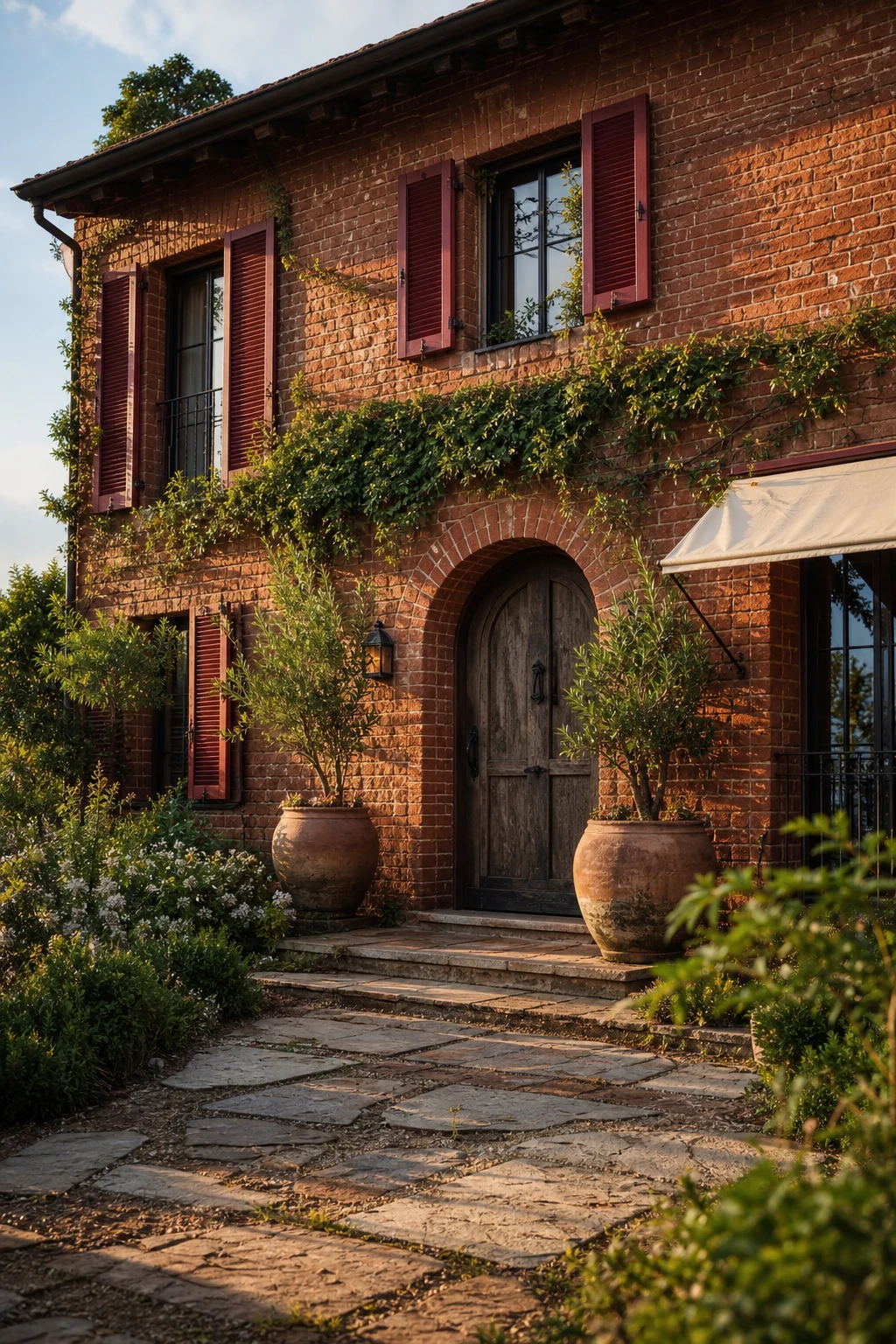
How to Let Natural Red Brick Carry the Whole Exterior
Classic red brick has so much personality already that the best thing you can do is step back and let it breathe. What I love about this approach is that the texture, the warmth, and the slight variation in each handmade clay brick do all the visual heavy lifting for you. You get a facade that feels rich and layered without a single bold design decision, because the material itself is the decision. Watch how the climbing greenery and those fat terracotta planters simply echo what the brick is already saying rather than competing with it.
The Key Details
Handmade textured clay brick facade
Rounded arched front doorway
Climbing greenery on upper brickwork
Oversized terracotta entry planters
Reclaimed stone pathway
Pro TipChoose a warm buff mortar rather than a stark white or grey, and the whole facade will glow golden in afternoon light instead of feeling patchy or cold.
AvoidLayering too many colourful accessories onto a strong brick colour splits the eye in every direction and leaves the facade looking restless rather than grounded.
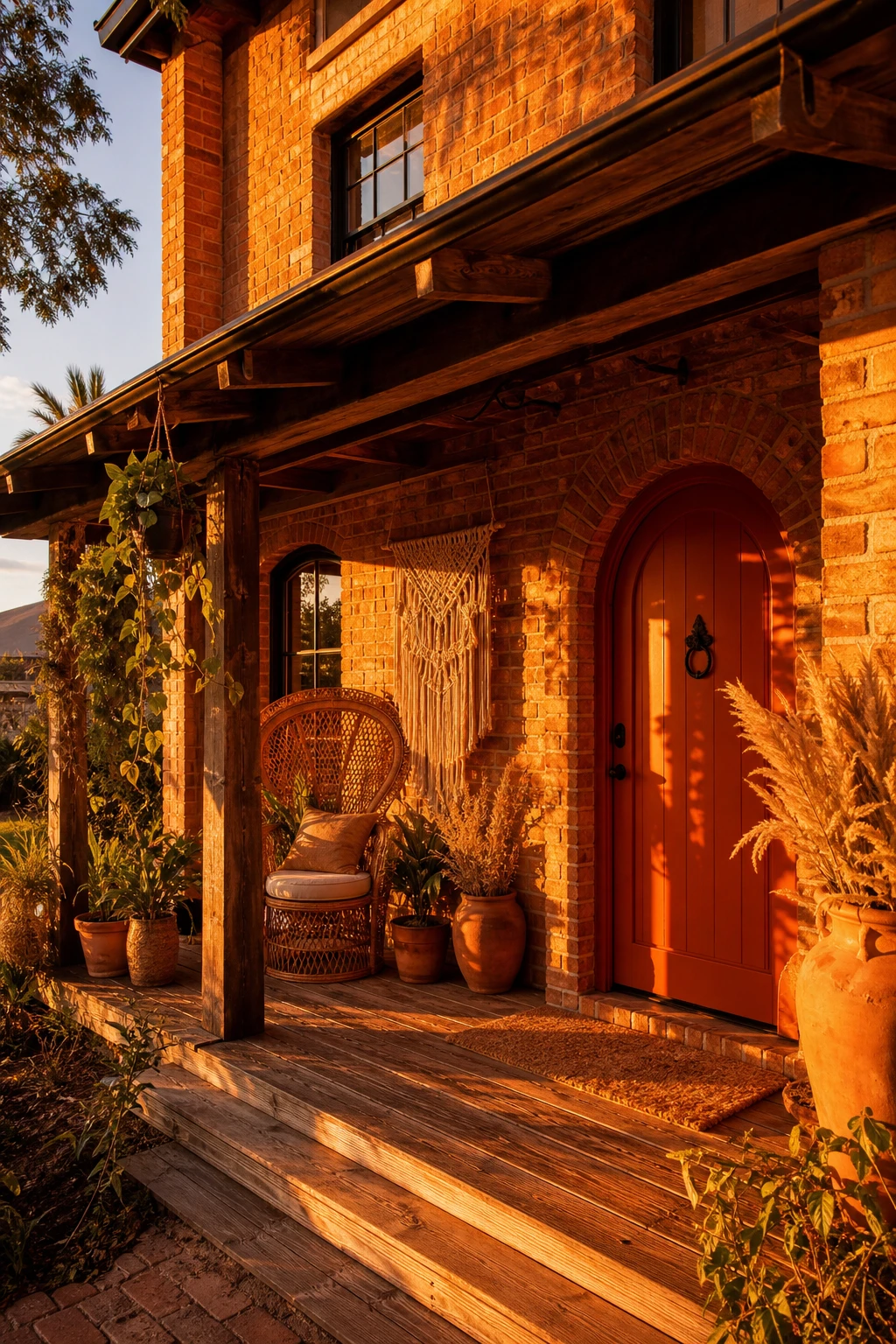
The Warm Glow an Orange Brick Facade Gives at Golden Hour
Orange brick at golden hour practically glows, and that warmth is something I always lean into rather than fight. The amber tones in the brick pull heat from the late light so the whole facade looks sun soaked even on a flat afternoon. What I love is how that glow gives a boho exterior its lived in, earthy soul without a single accessory in sight. You get a richness that cool materials simply cannot match.
The Key Details
Arched front door
Rattan peacock chair
Macrame wall hanging
Terracotta planters
Worn timber porch boards
Pro TipPick a trim shade with a brown or ochre undertone, like a warm stone or soft clay, and it will echo the amber in the brick rather than compete with it.
AvoidChoosing a cool gray trim against orange brick creates a colour clash that drains the warmth from both surfaces and leaves the facade looking unfinished.
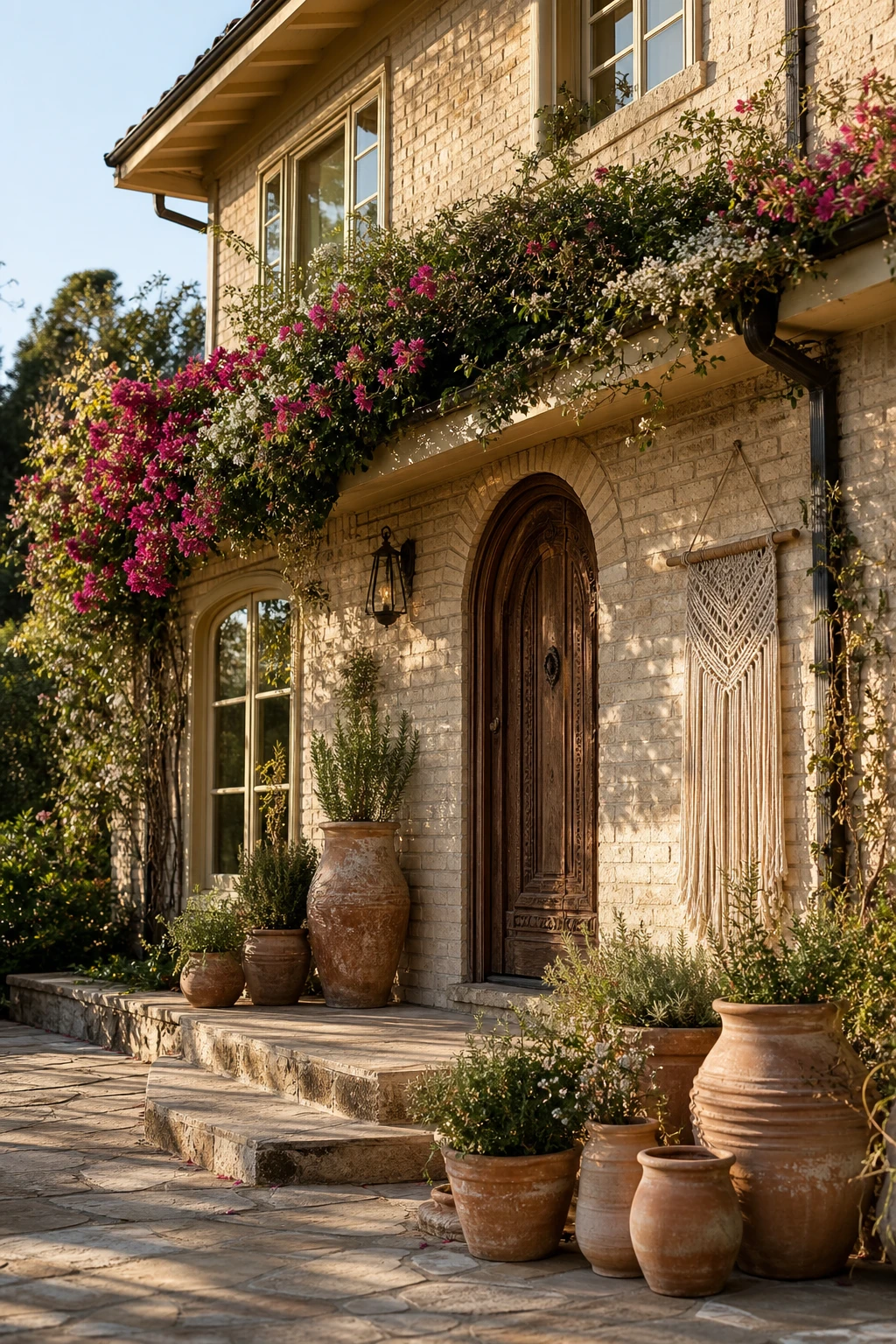
Why Blond Brick Gives a Boho Home Its Brightest Natural Canvas
Blond brick has this quiet generosity I find myself returning to again and again. It bounces light without shouting, so every bold accent you layer in front of it, terracotta, carved timber, trailing bougainvillea, reads with real clarity. You get all the warmth of natural stone but none of the heaviness, and that is exactly what a boho exterior needs to feel sun soaked rather than muddy.
The Key Details
Arched carved timber front door
Graduating terracotta planters
Macrame wall hanging
Trailing bougainvillea and jasmine
Worn sandstone path
Pro TipFit steel or charcoal painted window frames against the pale brick and you give the whole facade a crisp anchor that stops it drifting into washed out.
AvoidPale brick with no contrast element reads as unfinished and flat, draining all the warmth the stone naturally offers.
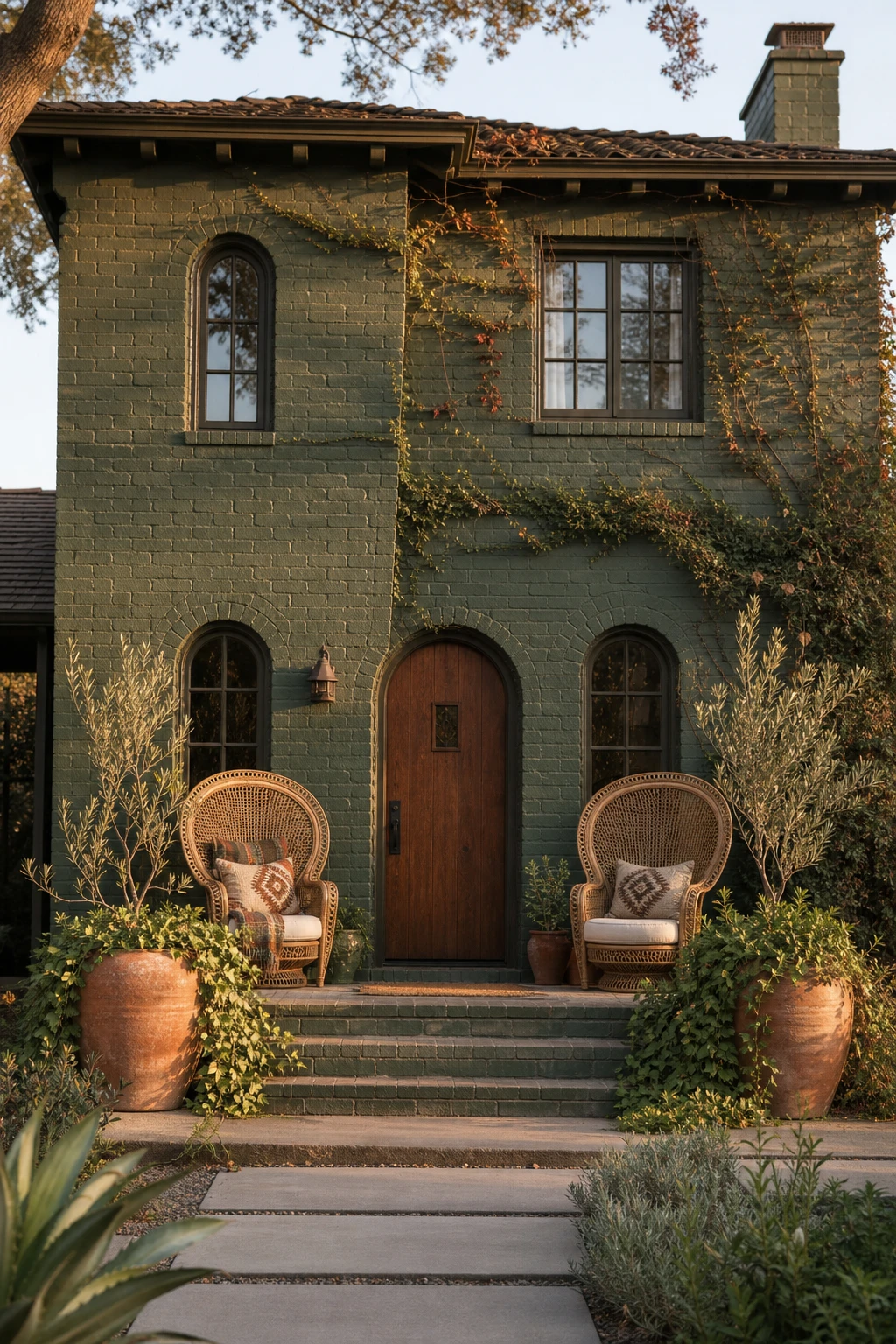
Going Green on the Outside Is Bolder and Lovelier Than You Think
Painting brick a deep, earthy green is one of my favourite moves on a boho exterior because it pulls the house right into its surroundings rather than standing apart from them. You get this grounded, almost mossy quality that feels like the building has always belonged there. What I love is how it turns every planter, every trailing vine, and every warm timber detail into something that pops without trying.
The Key Details
Rattan peacock chairs with kilim cushions
Rounded arched solid wood front door
Oversized terracotta planters with trailing greenery
Climbing vines across upper brickwork
Aged iron door hardware
Pro TipTest your chosen green on a large patch of north facing and south facing wall on the same day, because the same colour can read rich and sage in morning light and almost khaki by afternoon.
AvoidA green with too much yellow or neon lift will fight the landscape rather than settle into it, making the whole facade look restless and out of place.
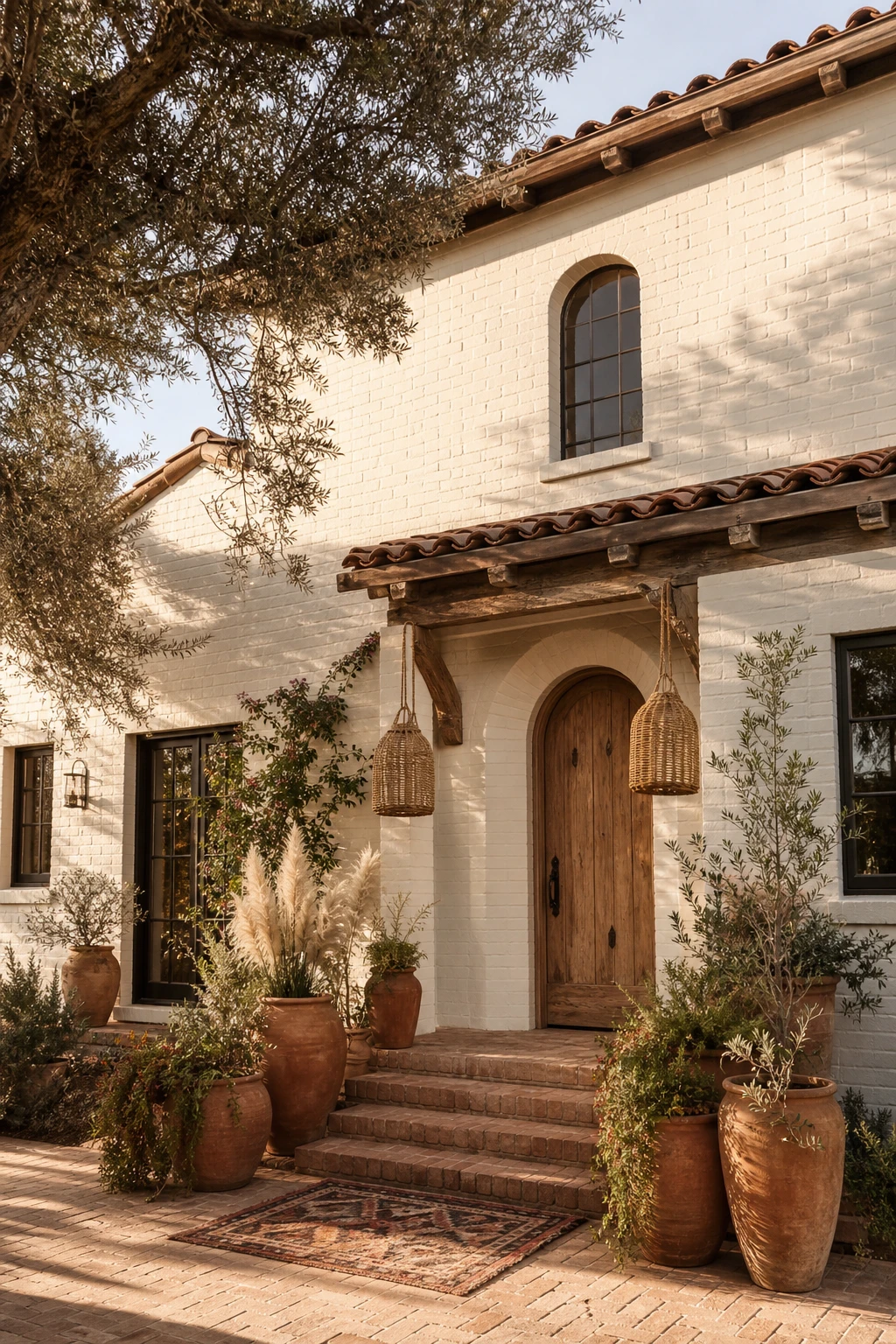
A Fresh Coat of Paint Gives Any Brick House a Completely New Personality
Painting brick is one of those moves that completely resets a house, and the secret is reading the undertone already sitting in your brick before you choose a colour. Warm buff brick pulls terracotta and dusty clay tones forward beautifully, while cooler grey brick loves a sage or chalky white. What I love most is watching a solid painted finish tie every element together: the arched wood door, the trailing vines, the woven lanterns suddenly all belong to one cohesive story.
The Key Details
Arched weathered wood front door
Oversized terracotta planters
Woven rope pendant porch lanterns
Trailing vines and pampas grass planting
Vintage kilim doormat
Pro TipRoll a generous test patch at least 30 cm square in two or three candidate colours and live with them for a full week, checking morning light and evening shade before you commit to the whole facade.
AvoidUsing interior grade paint on a brick exterior traps moisture inside the masonry, which causes the paint to bubble and peel within a single season and can damage the brick beneath.
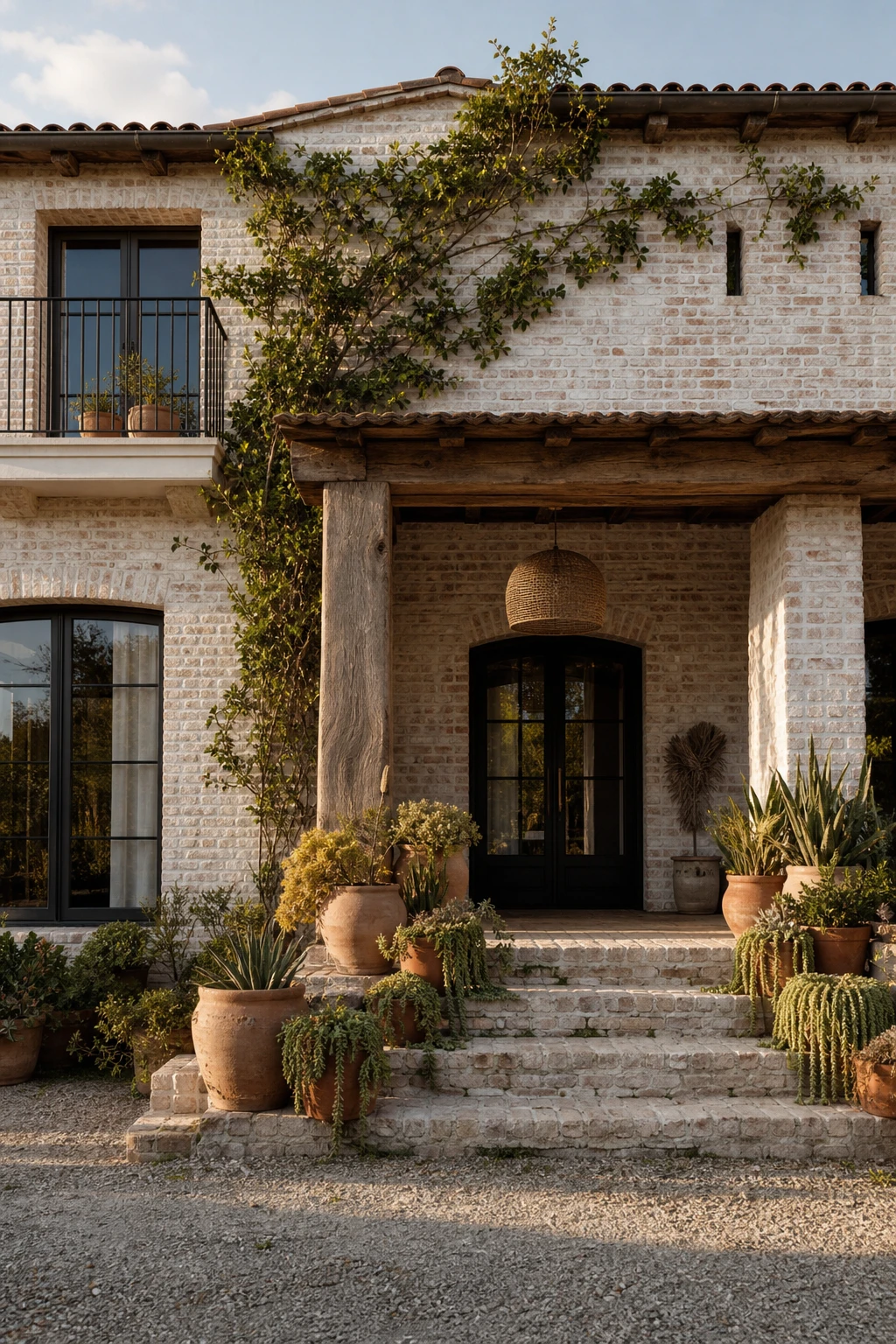
Whitewashed Brick Softens a Facade Without Hiding Its Texture
Whitewash wins me over every time because it softens a brick facade without swallowing what makes it interesting. You still see the mortar lines, the small colour shifts between individual bricks, all that honest texture the wall has built up over the years. What I love is how the diluted finish lets the surface breathe rather than sealing it under a solid coat, and you get something that reads as calm and sun bleached rather than painted.
The Key Details
Whitewashed brick facade with visible mortar joints
Woven rattan pendant on shaded porch
Clustered terracotta and clay pots with trailing succulents
Mature climbing vine across upper brickwork
Rough sawn timber porch beams with weathered iron hardware
Pro TipMix one part paint to two parts water, brush it on in small sections, and wipe back with a damp cloth while it is still wet so the brick grain stays visible.
AvoidApplying the mix too thickly fills the mortar joints and flattens the texture completely, leaving a finish that looks no different from ordinary masonry paint.
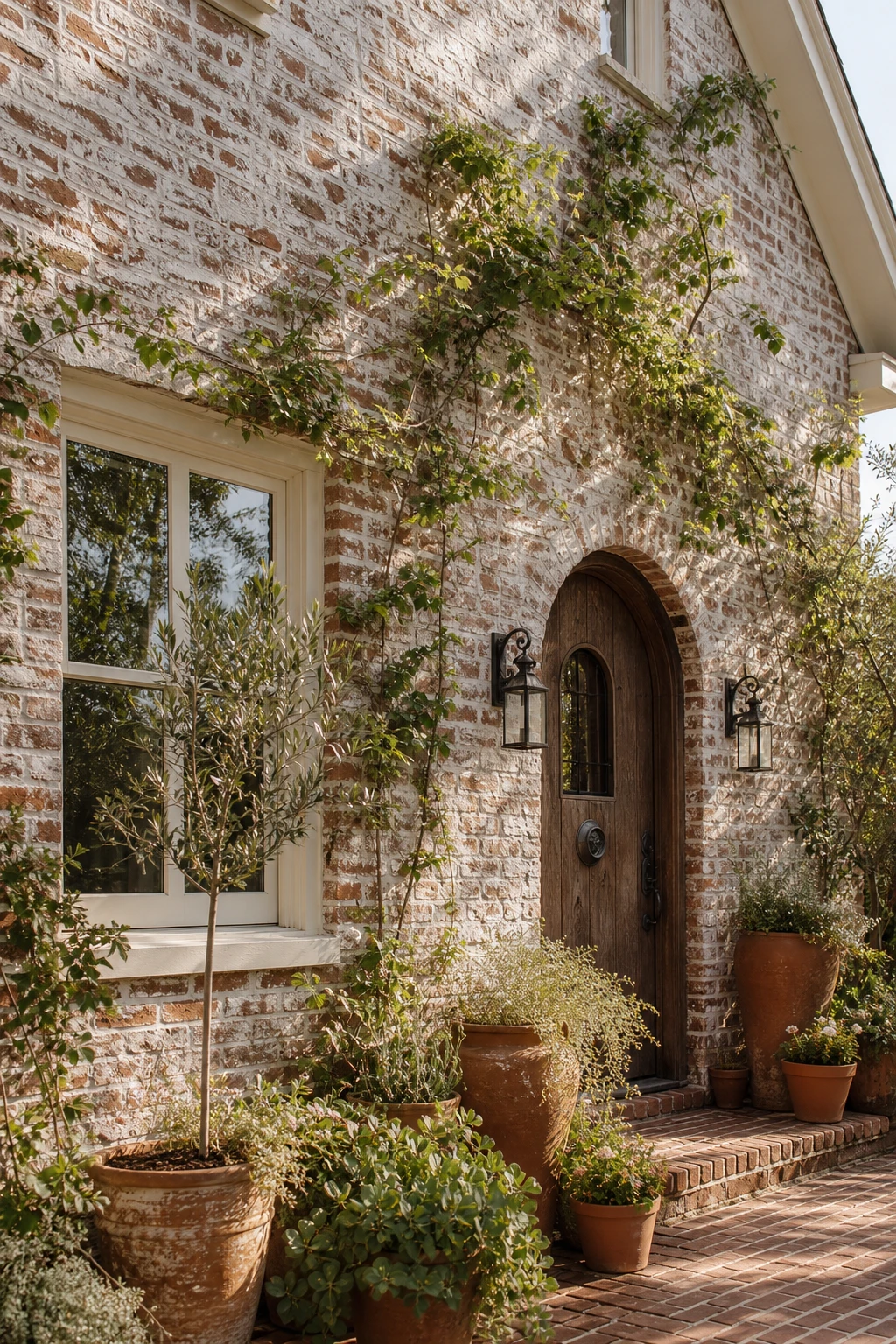
German Schmear Adds That Rustic Cottage Look in Just One Afternoon
German schmear is one of my favourite tricks for giving a plain brick exterior that thick, storybook quality you usually only find on very old buildings. You spread a thin coat of mortar across the face, then wipe it back while it is still wet, and the result is this beautiful patchy surface where the original brick peeks through in just the right places. What wins me over every time is how organic it looks, no two walls ever come out the same.
The Key Details
Arched weathered timber front door
Terracotta entry planters
Climbing vines on mortar joints
Wrought iron door hardware
Exposed aged red brick beneath mortar wash
Pro TipWipe back the mortar with a damp cloth in short, circular strokes so you lift more in some patches than others, because that uneven coverage is exactly what gives the finish its handmade character.
AvoidSpreading mortar across too large an area in one go means the edges start to set before you can wipe them back, leaving hard lines that break the soft, blended look you are after.
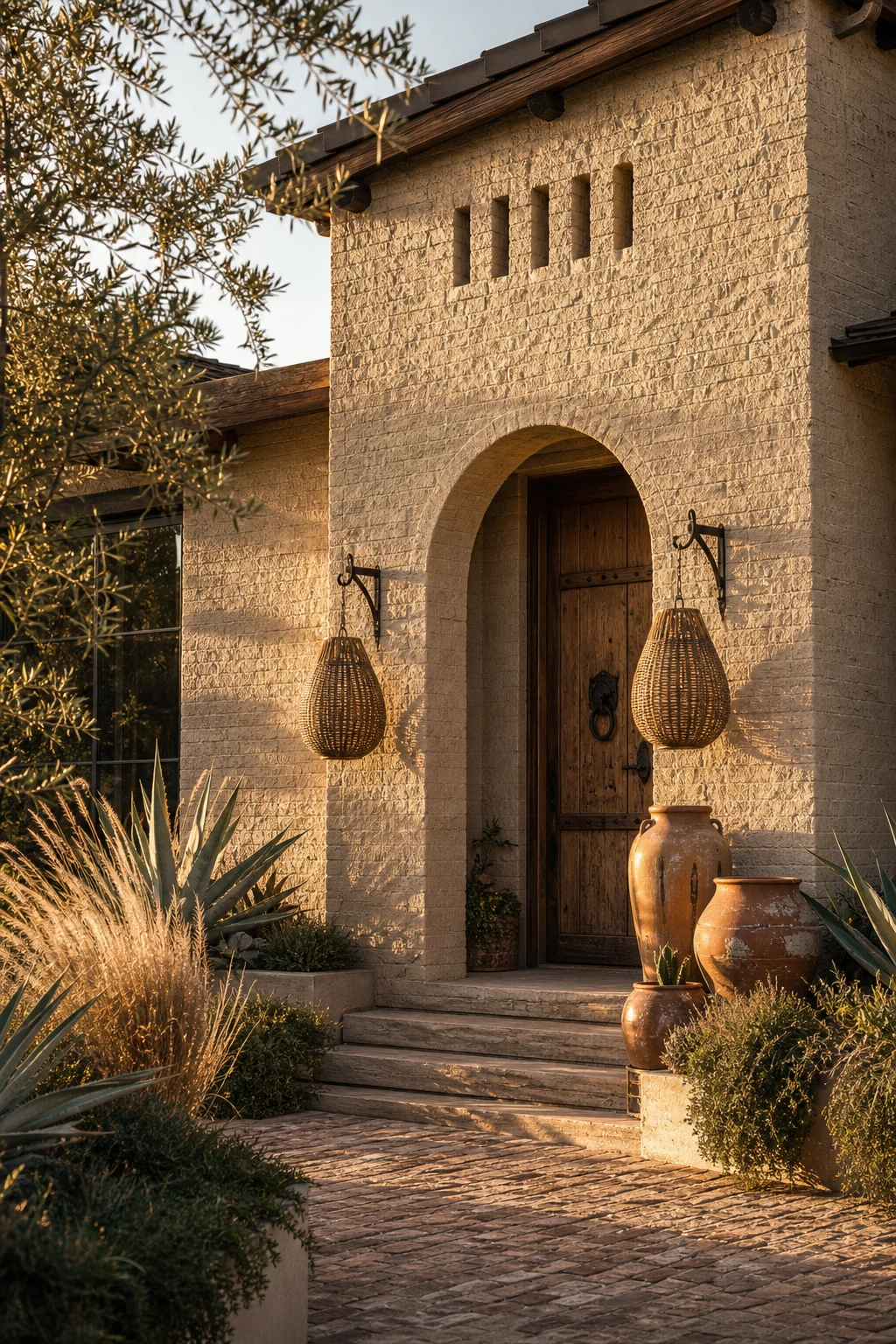
Bagged Brick Has the Roughest Most Beautiful Texture of All the Finishes
Bagged render is the one finish that still lets the brick breathe through, and that textural honesty is exactly what draws me to it. You get all the softness of render with this beautiful roughness underneath, like the wall has a story to tell. Smooth render covers everything and sits flat, but bagging drags the mix lightly across the surface so the brick joints stay slightly visible and the texture stays alive. Watch how the light moves across a bagged wall at different times of day and you will see exactly why boho exteriors love it.
The Key Details
Bagged render brick facade
Reclaimed timber front door
Rattan pendant entry lanterns
Oversized terracotta urns
Raised garden beds with wild grasses and agave
Pro TipAsk your renderer to add a small amount of raw umber or yellow oxide pigment directly into the bag mix so the wall reads warm and earthy before you ever touch a paintbrush.
AvoidPainting over a freshly bagged wall before it has fully cured traps moisture inside the render, and that moisture has nowhere to go but back through the surface, lifting the paint and leaving you with a patchy, uneven finish.
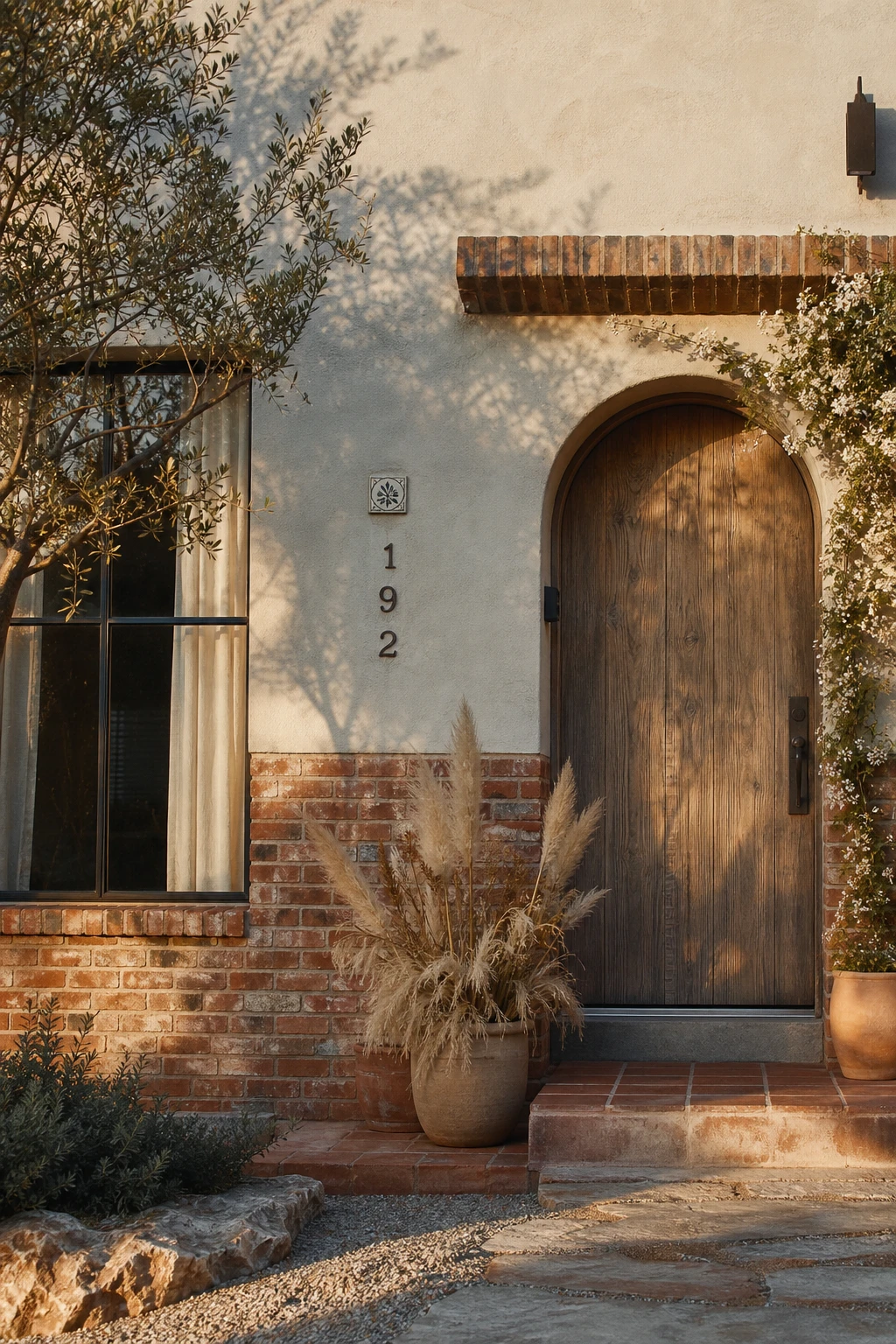
Two Colors on One Facade Is the Trick That Makes the Whole House Pop
Splitting a facade into two tones is one of my favourite moves for a brick house because it gives the eye a clear story to follow. You get an instant sense of structure without adding a single architectural element. That shift from a grounded lower brick to a lifted upper colour is the thing I keep coming back to: the roofline suddenly feels taller and more intentional, and the whole composition clicks into place without any fuss.
The Key Details
Exposed red brick lower facade
Arched weathered teak front door
Projecting brick lintel
Handmade ceramic house numbers
Pampas grass and jasmine entry planting
Pro TipLine your colour change up with an existing horizontal detail, a window sill band, a course of projecting brick, or a lintel, so the split looks deliberate rather than decorative.
AvoidChoosing a mid point with no connection to the architecture leaves the split looking like an unfinished paint job rather than a design decision.
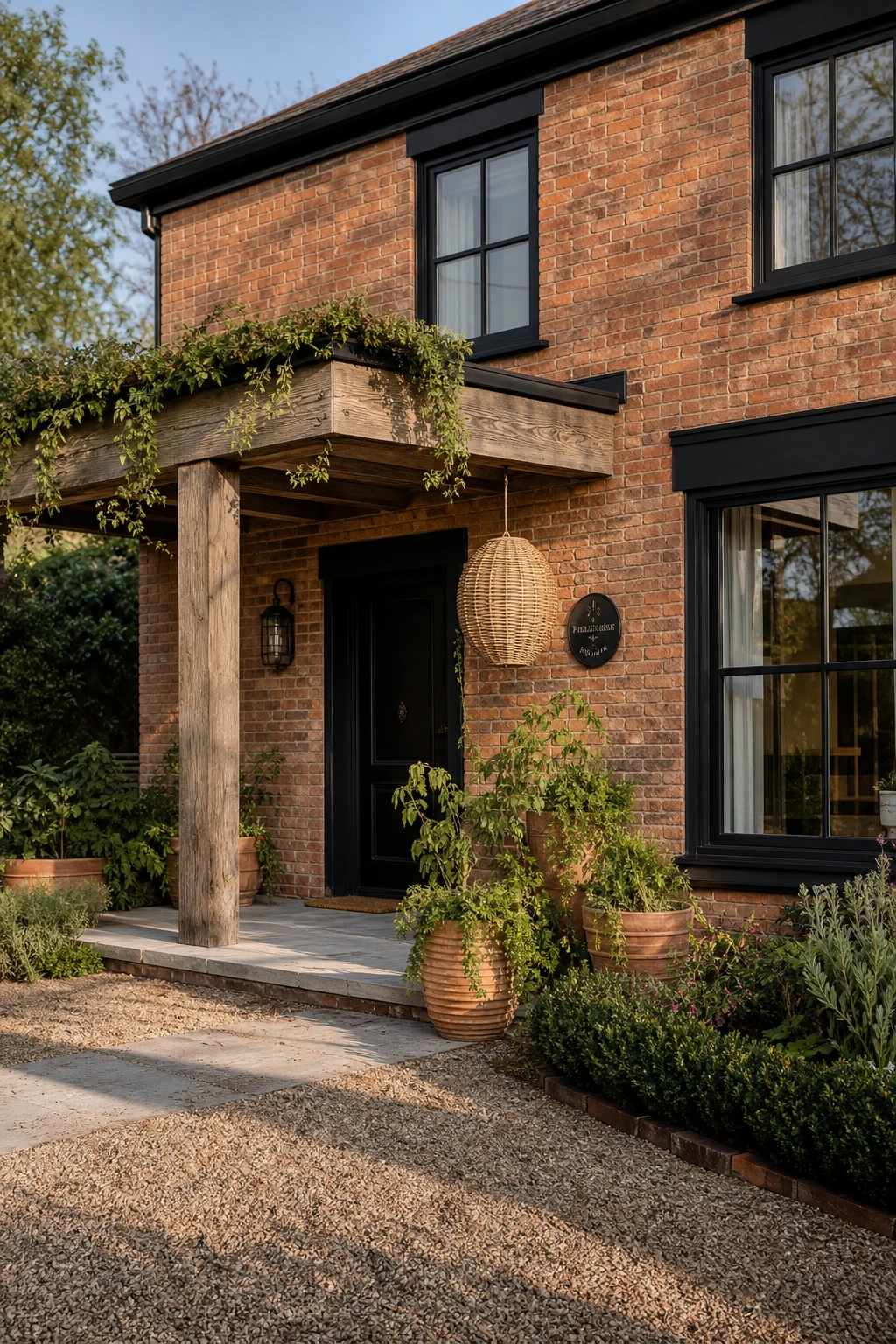
Black Trim on Brick Is the Sharpest Way to Make Every Edge Count
Black trim on warm brick is one of my favourite moves because the contrast is so clean and immediate. You get every window, door and roofline suddenly looking intentional, like the house has been drawn in ink. What I love most is how the dark edges make the amber and terracotta tones in the brick glow warmer by comparison. Watch how the whole facade reads as sharper and more considered without a single structural change.
The Key Details
Dark painted window frames
Handmade amber brick facade
Raw timber entry pergola
Oversized rattan hanging lantern
Terracotta planters with trailing greenery
Pro TipPaint your gutters and downpipes the same black as the window frames so the trim reads as one continuous line around the whole house rather than a collection of separate details.
AvoidUsing matte black on a very dark or heavily shadowed brick means the contrast disappears entirely and you lose the crisp definition you were aiming for.
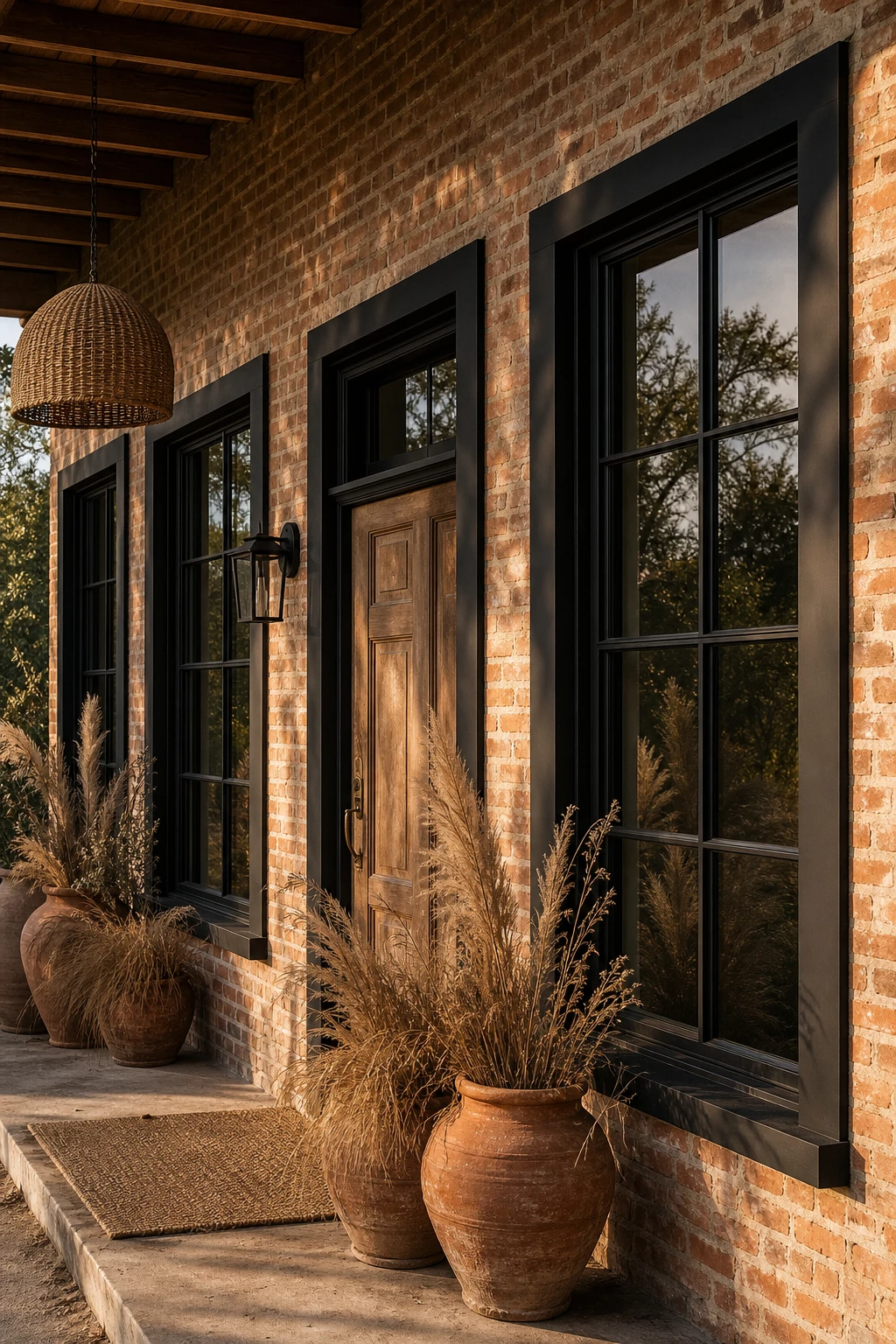
Black Window Frames Are the One Detail That Quietly Elevates Every Brick Front
Black window frames on a brick front are the quiet full stop that pulls everything together, and you will notice the difference the moment they go on. What I love is how the dark surround draws your eye to each window as its own frame, so the facade reads as considered rather than accidental. Against handmade amber clay brick, that contrast does real work, sharpening the whole face of the house without shouting.
The Key Details
Oversized casement windows
Raw timber front door with aged brass hardware
Terracotta planters with dried pampas grass
Woven rattan porch pendant light
Handmade amber clay brick facade
Pro TipIf a full window replacement is out of budget, painting existing timber frames in a flat black exterior paint gives you almost the same punch for a fraction of the cost.
AvoidPairing black frames with a very dark or heavily weathered brick flattens the contrast you are paying for, and the frames simply disappear into the wall.
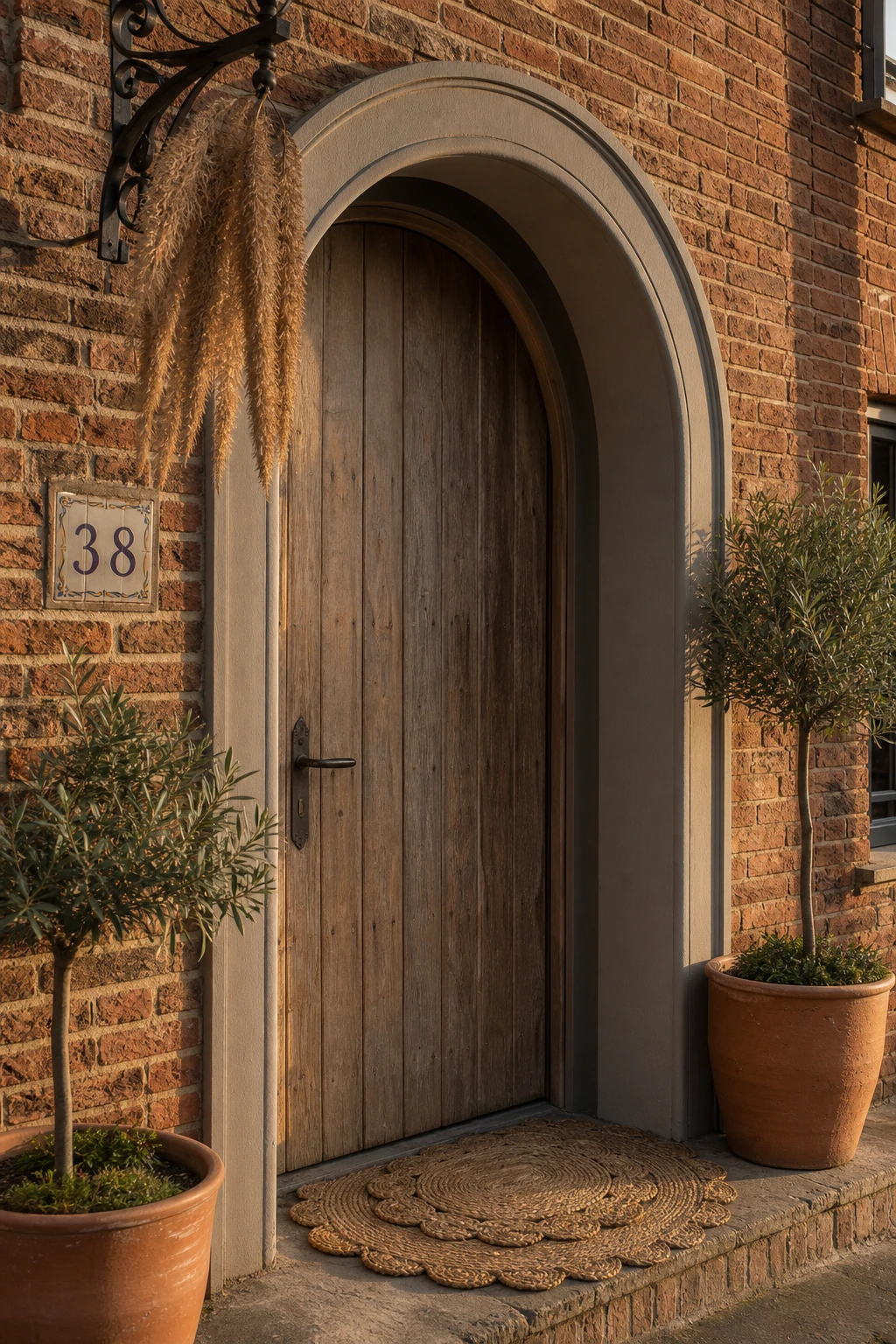
An Arched Opening Brings a Romantic Softness No Square Frame Ever Could
Brick is honest and solid, but all those straight lines and right angles can make a facade feel a little unforgiving. Dropping a rounded arch above the front door is one of my favourite moves for softening that rigidity without touching a single other thing. What I love most is how the curve draws your eye upward, giving the entrance a quiet grandeur that a square frame simply cannot match. You get warmth, romance and a sense of arrival all at once.
The Key Details
Rounded brick arch surround
Weathered timber plank door
Layered woven rattan door mat
Terracotta potted olive trees
Wall mounted iron bracket with dried pampas plumes
Pro TipPlant low mounding shrubs like lavender or box balls on either side of the arch so their rounded silhouettes repeat the curve and anchor the door beautifully into the garden.
AvoidFitting a standard square door inside a true arched opening wastes the whole gesture, leaving a flat timber panel marooned in a curve and making the arch feel like an afterthought rather than a feature.
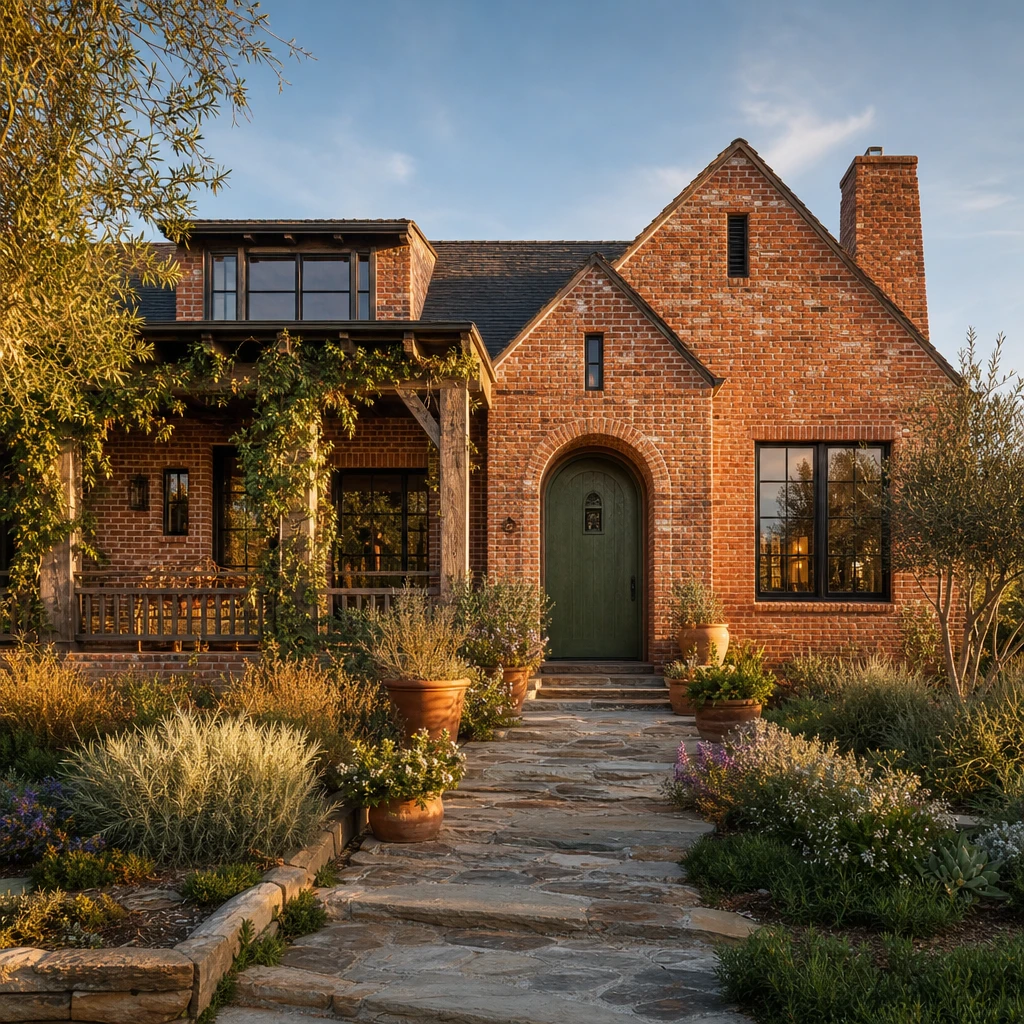
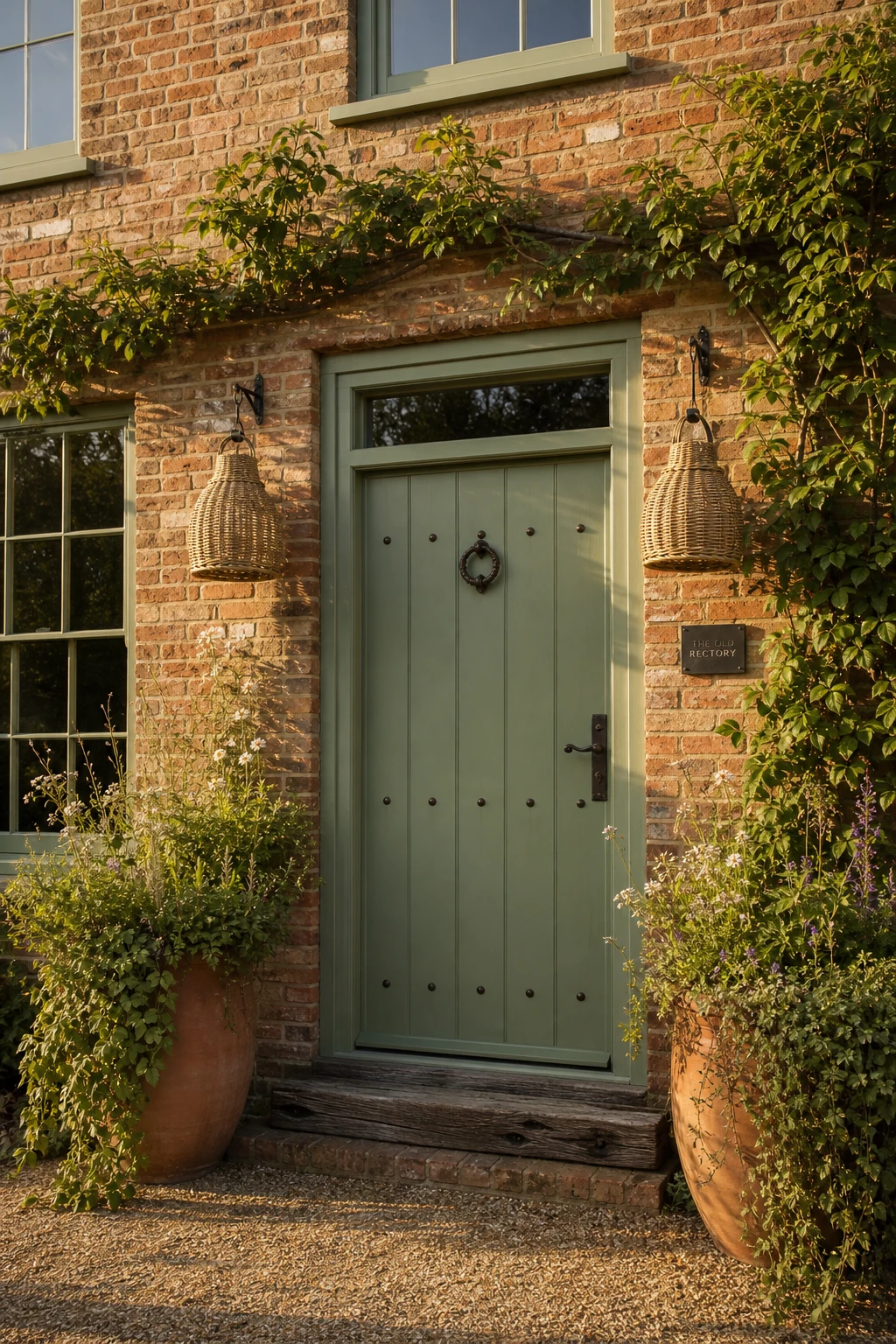
A Green Front Door Is the Warmest Welcome a Brick House Can Give
A green front door is the anchor the whole facade waits for, and the thing I always check first when a brick exterior feels unresolved. Brick already carries warm ochres and reds, so a sage or forest green sits right opposite those tones on the colour wheel and gives you an instant, settled balance. You get a point of arrival that pulls the eye straight to the door before anything else registers. What I love most is how that one decision then makes every other choice, the pots, the hardware, the climbing vine, feel like it belongs.
The Key Details
Sage green painted front door
Oversized terracotta entry pots
Woven rattan pendant lanterns
Climbing vine over brick lintel
Hand forged iron door hardware
Pro TipReach for a deeper, more saturated green rather than a pale sage, because richness holds its own against the visual weight of brick and still looks intentional at dusk.
AvoidChoosing a green with a blue or grey undertone against warm red brick creates a cold clash that makes the whole front of the house feel muddy rather than considered.
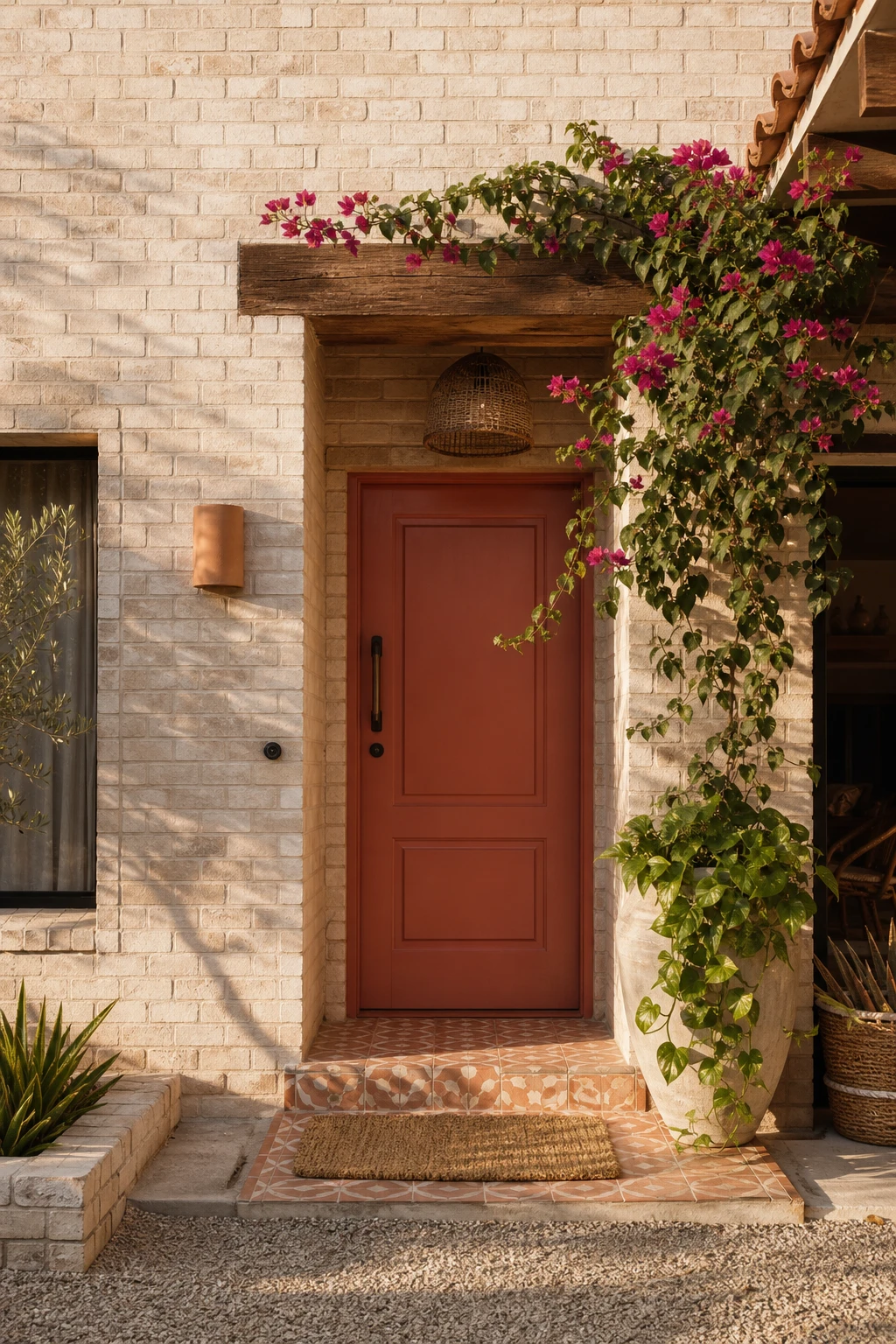
Light Brick Is the Best Background for a Front Door That Really Sings
Pale blond brick is like a quiet canvas, and what I love about it is how a warm, saturated door color jumps forward without any fight. You get that sweet spot where the door sings because the brick never competes. Watch how a burnt orange or deep terracotta reads so richly against those soft, low contrast tones, the whole facade suddenly has a heartbeat.
The Key Details
Rattan pendant porch lantern
Trailing bougainvillea and pothos doorframe planting
Layered jute doormat over encaustic entry tiles
Raw timber lintel beam
Matte iron door hardware
Pro TipReach for a terracotta or burnt orange with a matte finish on blond brick, the earthy pigment warms the stone and gives the door real presence without feeling loud.
AvoidPicking a door color only a shade or two deeper than pale brick means the two surfaces blur together and all that lovely front door energy quietly disappears.
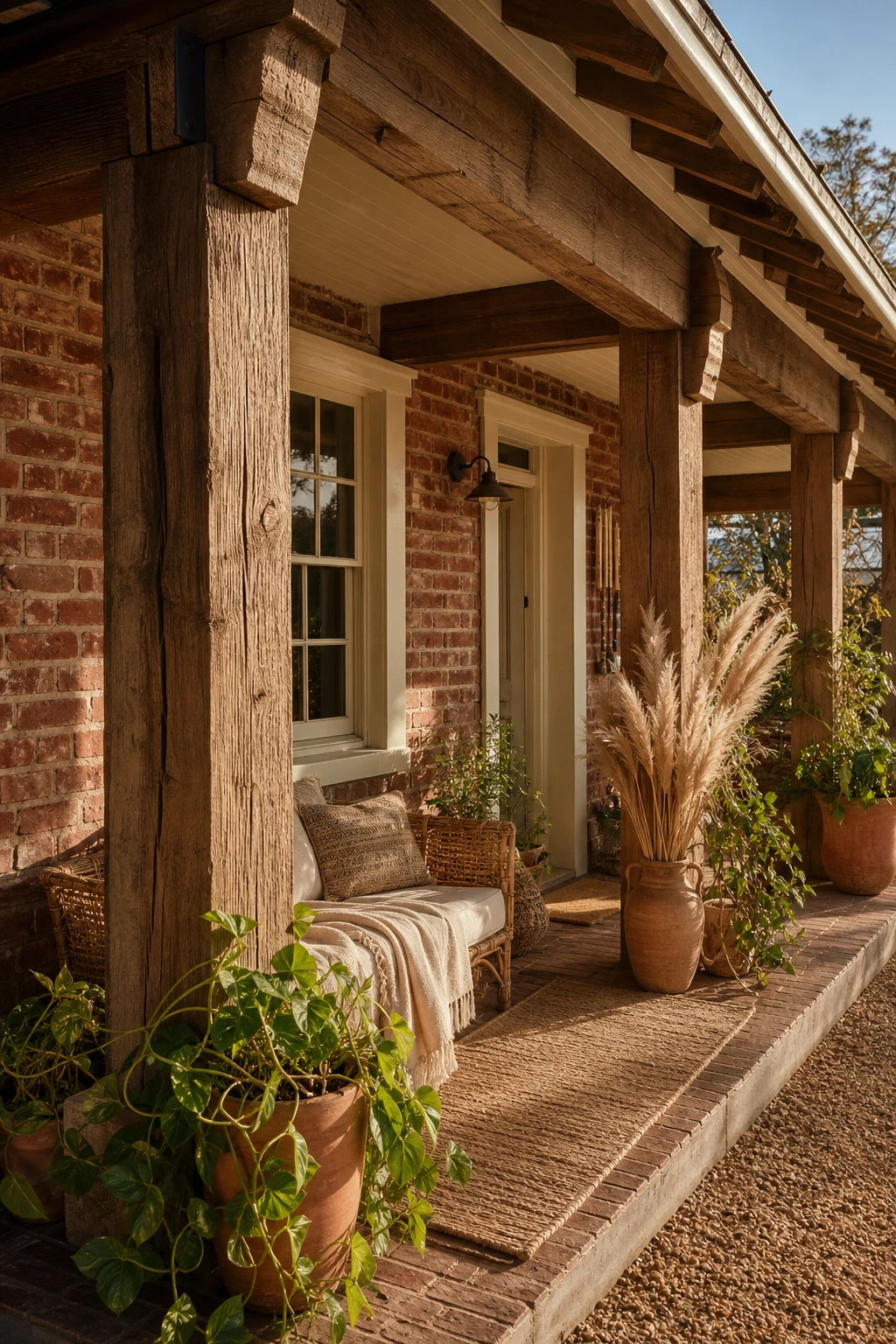
A Wooden Porch Turns the Front of a Brick House Into Its Coziest Feature
Timber and brick together is one of my favourite pairings because both materials carry warmth in their grain and texture, and you get this layered, almost ancient feeling that no painted surface can fake. The rough sawn wood pulls out the honey tones already sitting in the brick, so watch how the two seem to deepen each other rather than compete. What I love most is how the porch becomes a room in its own right, a threshold that feels genuinely welcoming before anyone even steps inside.
The Key Details
Rough sawn timber porch beams
Rattan loveseat with woven throw
Terracotta planters with trailing foliage
Dried pampas grass arrangement
Jute threshold runner
Pro TipChoose reclaimed porch boards over new timber and you bring in instant knots, colour variation, and a patina that looks like the house has always had that porch sitting there.
AvoidStaining porch timber a cool gray creates a clash with warm brick tones that makes the whole front elevation feel unsettled and disconnected.
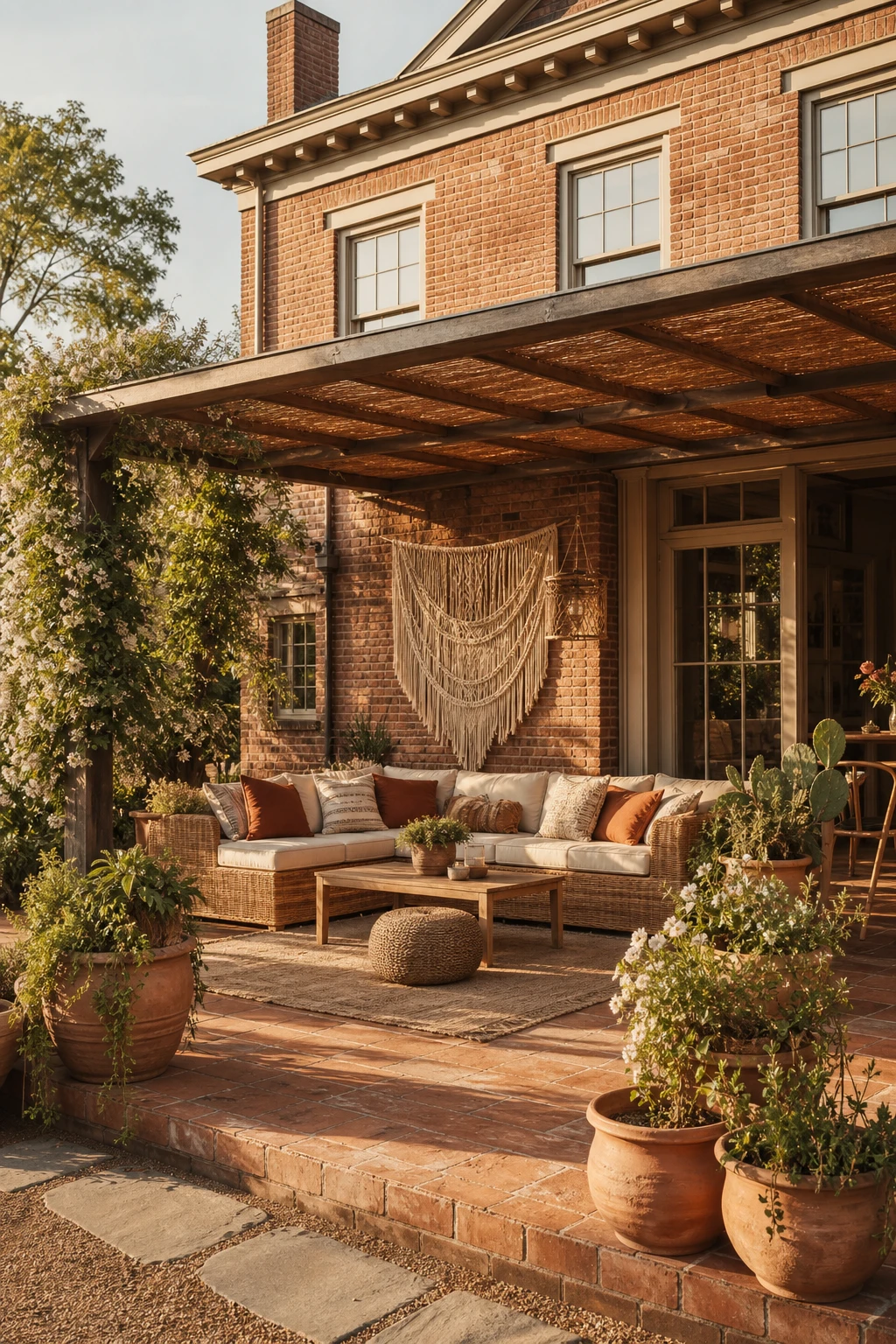
A Patio Off a Brick House Blurs the Line Between Inside and Out Beautifully
A patio that borrows its palette straight from the brick behind it feels like the house simply exhaled outward, and that quiet connection is what I love most about this approach. You get a space that reads as deliberate rather than tacked on, because the warm terracotta tones in the planters and the rust threading through the cushions all echo what the wall is already saying. Watch how the rattan and handmade clay tile add texture without competition, keeping the eye moving gently from inside to out.
The Key Details
Low slung rattan sectional sofa
Handmade clay tile patio floor
Macrame wall hanging on brick
Oversized terracotta planters with trailing greenery
Woven rust and cream scatter cushions
Pro TipBuild one small planter or low patio wall using the same brick as the house and the whole space locks together instantly.
AvoidChoosing cool grey slate or pale concrete pavers against warm red brick pulls the two zones apart and makes the patio feel like it belongs to a different house entirely.
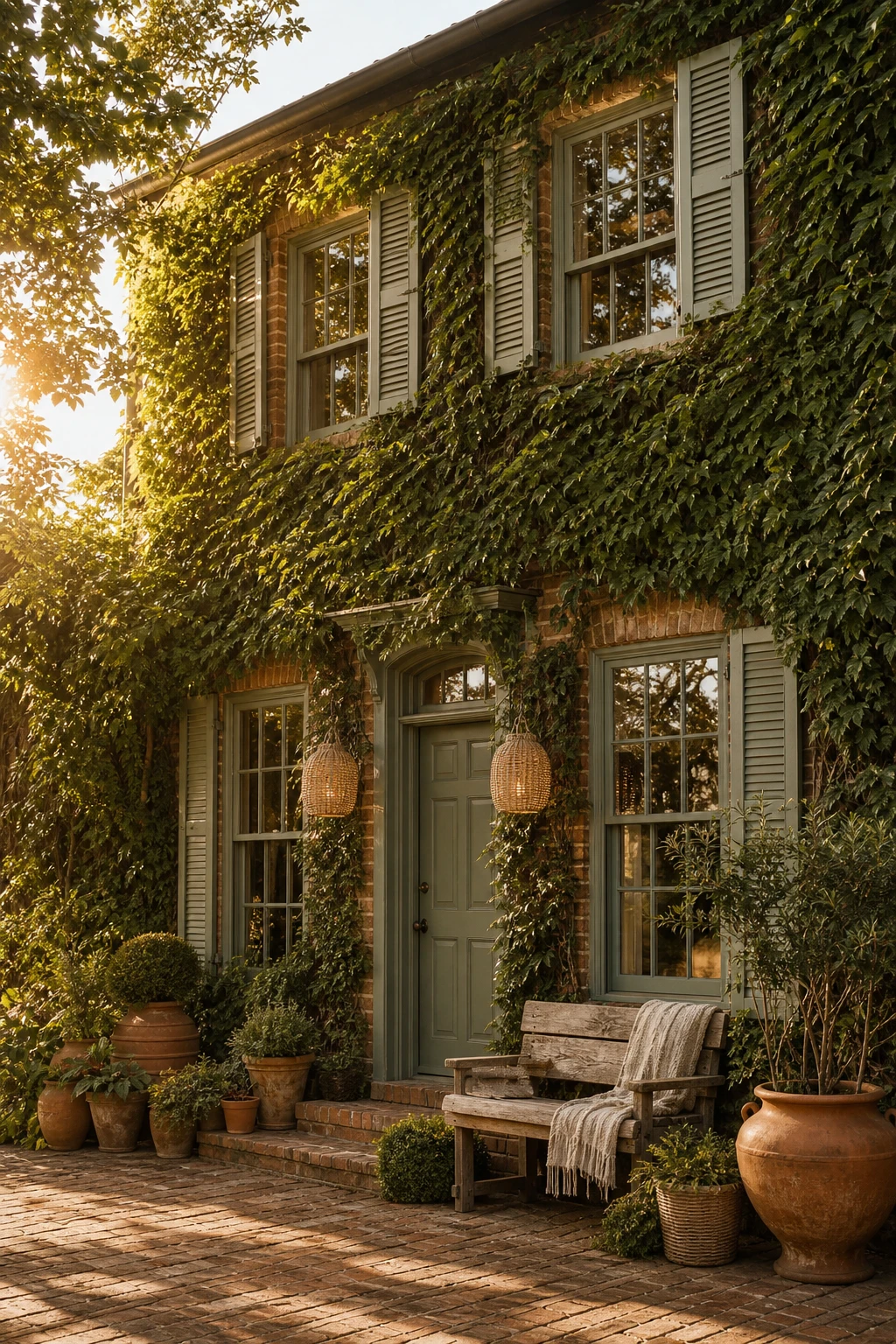
Ivy on Brick Is the Oldest Most Romantic Trick and It Still Works Every Time
Ivy creeping across a brick facade is one of my favourite moves because it does something no paint colour can: it blurs the line between the house and the garden, so the whole front elevation feels alive. What I love is the way the soft, layered leaves break up those long flat stretches of brick and pull your eye across the wall rather than straight to the door. You get texture, depth, and a quiet wildness that is the heart of boho style.
The Key Details
Climbing ivy wall cover
Weathered terracotta planters
Rattan hanging lanterns
Salvaged timber porch bench
Woven linen throw blanket
Pro TipWhile the ivy is young, fix guide wires horizontally across the brick so you can steer new growth left and right and keep it well clear of gutters, soffits, and window frames from the very start.
AvoidLeaving ivy to scramble where it wants means within a couple of seasons the stems will find their way into mortar joints, slowly widening any existing cracks and making repairs far more costly later.
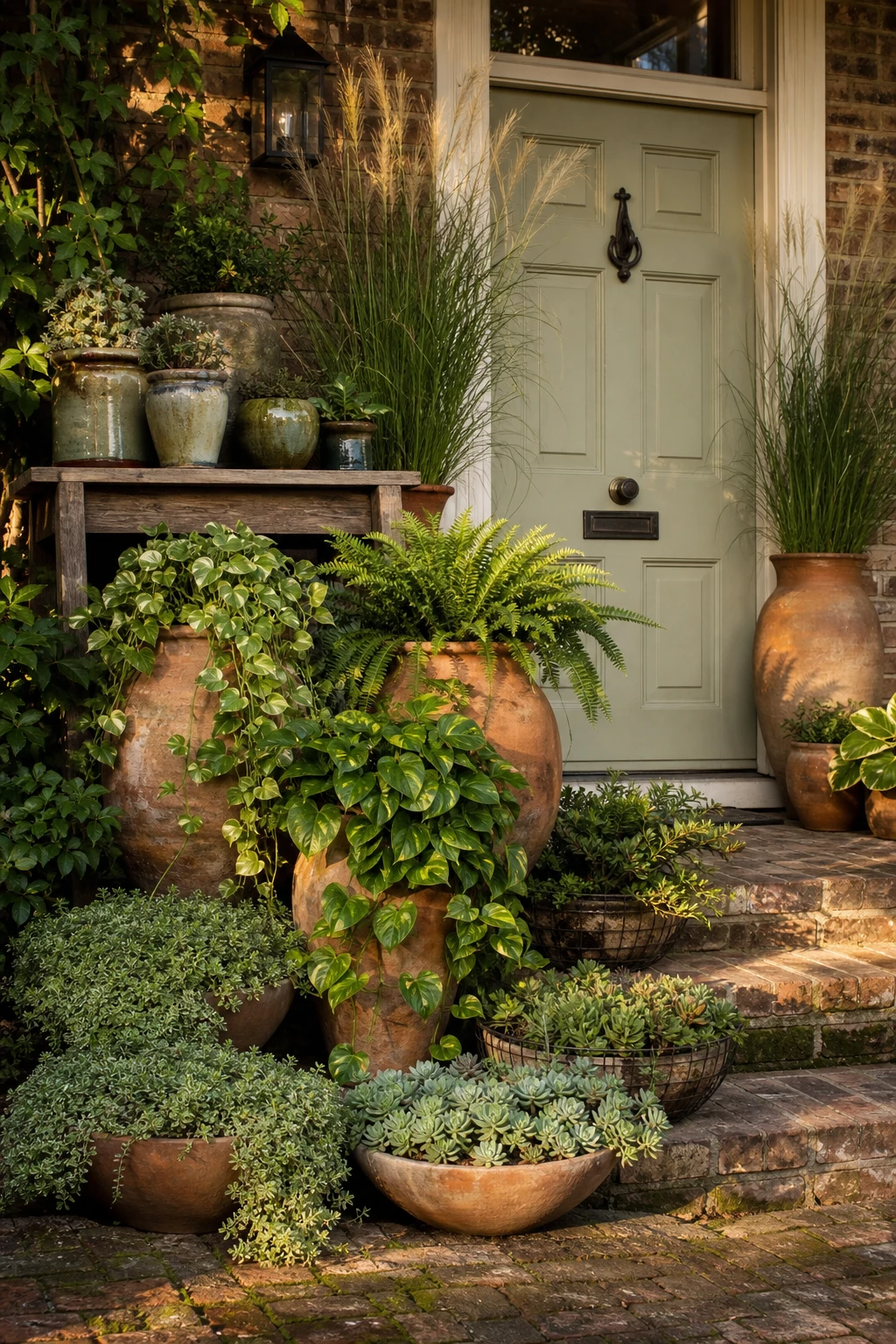
Stacking Plants at Different Heights Transforms a Brick Porch Overnight
Stacking plants at different heights is one of my favourite porch tricks because your eye travels upward, forward and down all at once, and that movement is what reads as depth. Aged terracotta urns anchoring the base, a tiered wooden stand lifting the mid layer, and trailing pothos spilling over the edges give you a scene that feels grown in rather than staged. You will notice the textured mossy brick underneath ties it all together, making the whole display feel like it belongs to the house.
The Key Details
Tiered wooden plant stand
Mismatched glazed ceramic pots
Aged terracotta urns
Trailing pothos and cascading ferns
Textured mossy brick flooring
Pro TipArrange your pots in groups of three or five, pulling the tallest slightly forward from the wall so each tier catches the light from a different angle.
AvoidSpacing identical pots in a neat straight line flattens all that lovely height variation into something that reads more like a garden centre shelf than a boho porch.
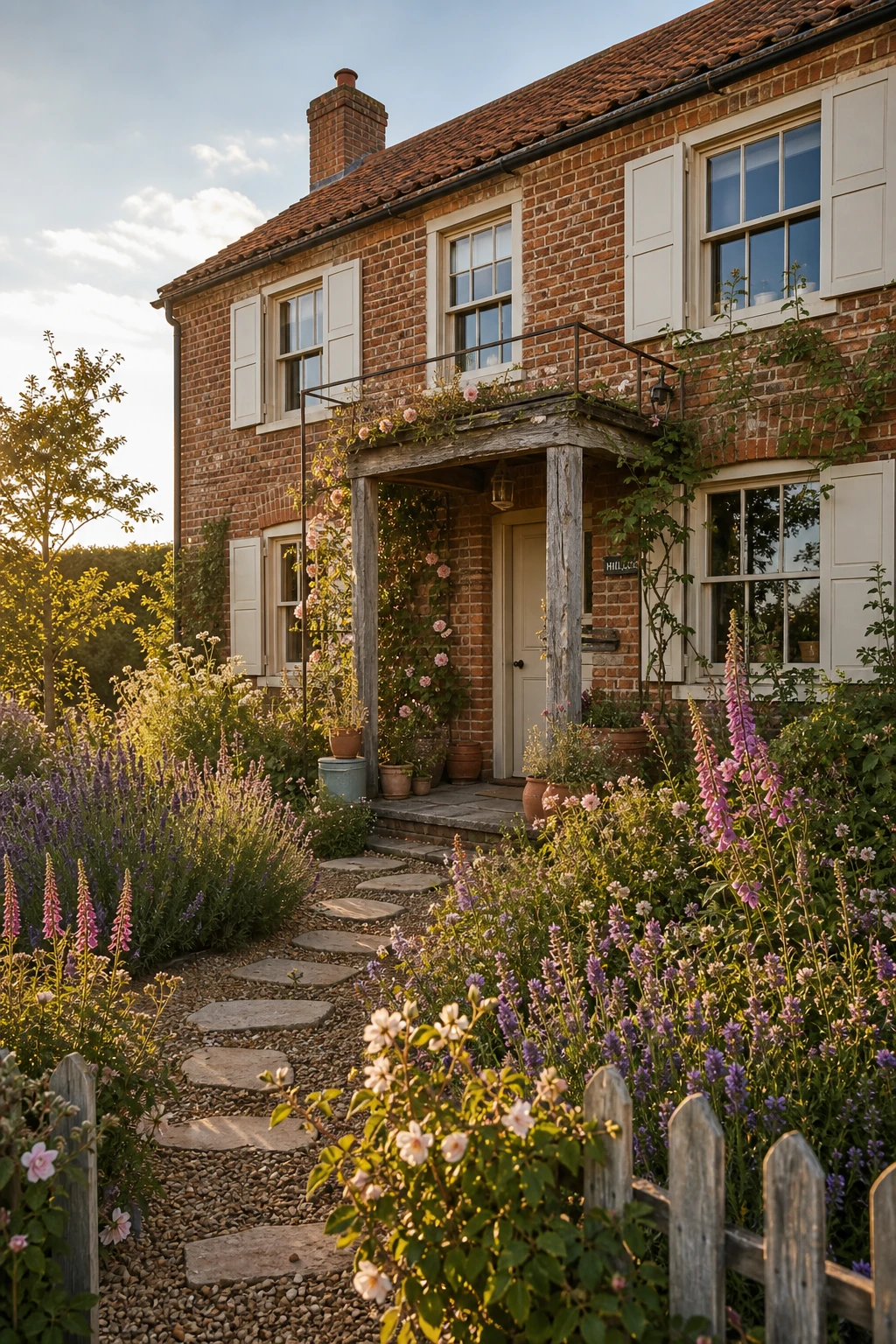
A Cottage Garden Out Front Makes a Brick Farmhouse Look Like It Grew There
A cottage garden at the front of a brick farmhouse does something no paint colour or new door can quite pull off: it makes the whole house feel like it simply grew up out of the ground. What I love is how the loose, tumbling planting softens every hard edge, so the brick stops reading as a wall and starts reading as a backdrop. You get that layered, lived in quality where roses, lavender, and foxgloves all lean into each other, and the house behind them feels rooted and real.
The Key Details
Weathered timber porch with climbing roses
Rusted iron trellis
Mismatched terracotta pots at threshold
Low picket fence with tumbling lavender and foxgloves
Gravel stepping stone path
Pro TipTuck a row of chives or creeping thyme between the stepping stones along your path so the garden smells wonderful as well as looks it.
AvoidClipping your hedges into neat balls or planting in symmetrical rows creates a formal tension that makes the rustic brick look unfinished rather than charming.
Ranch Proportions and Brick Are a Match That Feels Natural and Grounded
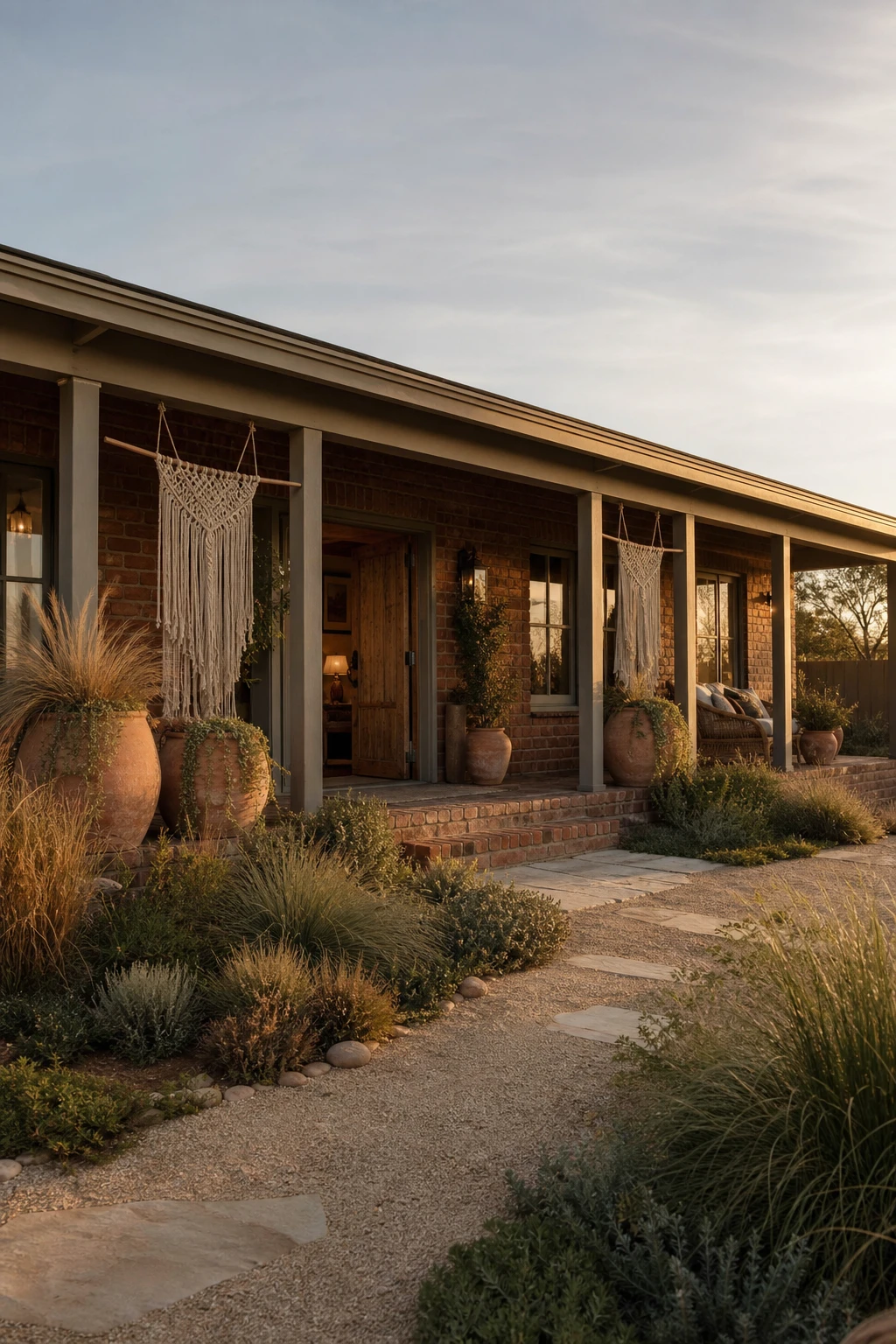
Bending a ranch into its landscape is one of my favourite moves because the long, low roofline already wants to hug the ground. You get this wonderful horizontal pull across the whole facade, and everything I add, the wide covered porch, the aged red brick, the oversized terracotta planters, just deepens that settled, earthy feeling. Watch how the weathered oak door and macrame panels keep the eye moving sideways rather than reaching up.
The Key Details
Wide covered front porch
Aged red brick facade
Macrame hanging panels
Oversized terracotta planters
Weathered oak front door
Pro TipPlant long, low beds of ornamental grasses or lavender directly beneath the porch line so the planting mirrors the roofline and the whole front reads as one calm, connected stripe.
AvoidTall columnar shrubs or skinny topiaries placed at the corners pull the eye upward and snap that lovely grounded tension the ranch silhouette naturally creates.
Small Scale and Red Brick Together Make the Most Storybook Cottage Front
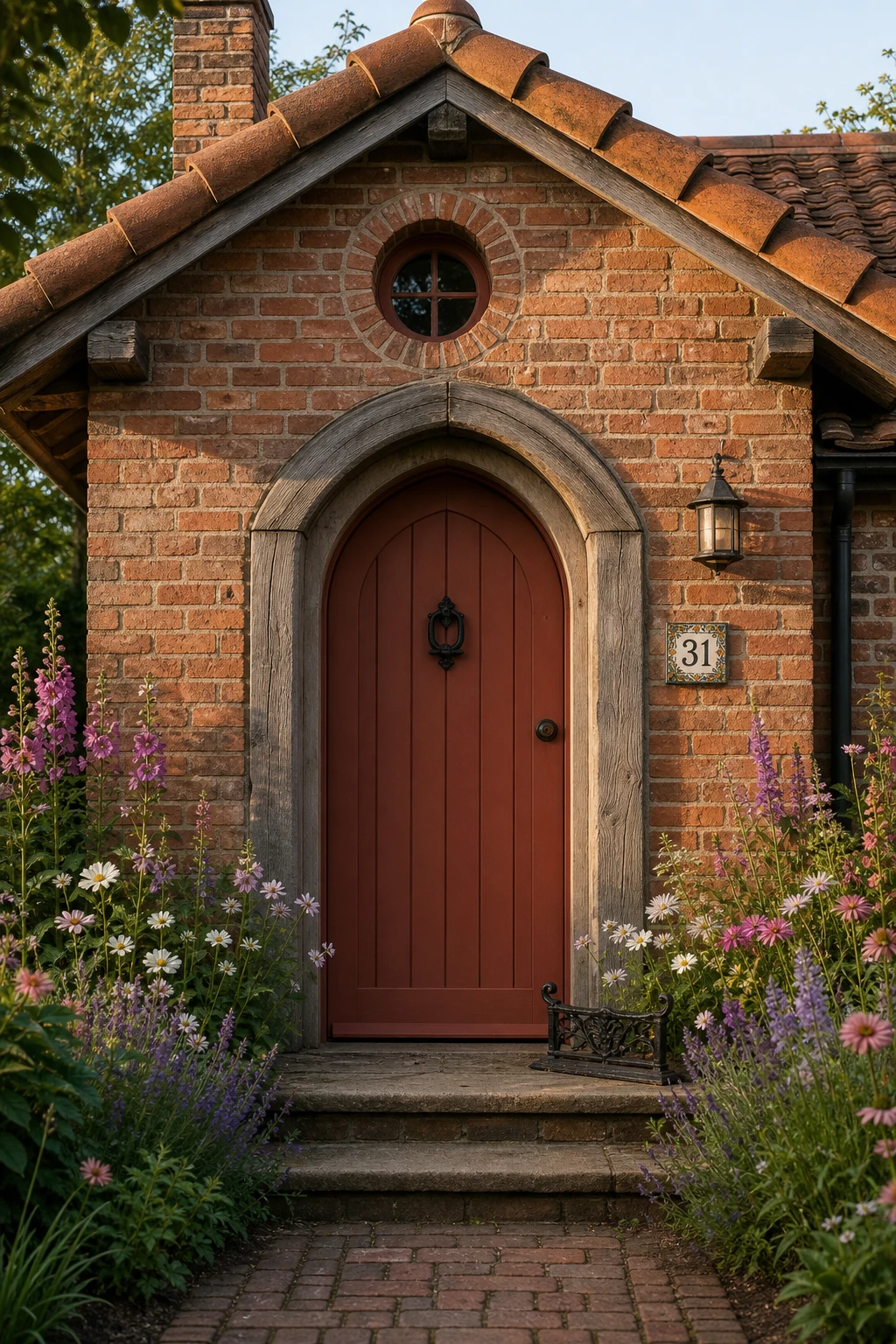
A small red brick cottage face wins me over every time when everything on it is sized to match its modest bones. You get this lovely compressed charm, where a low roofline, a narrow door, and soft wildflower planting all feel like they belong to the same quiet world. What I love is how right sized details, a little ceramic number tile, a round porthole window, make the facade read as intentional rather than just small.
The Key Details
Arched reclaimed timber front door
Round porthole window
Clay ridge tile roof
Wildflower border planting
Handmade ceramic house number tile
Pro TipFit a stable door and leave the top half open during the day, because that split instantly reads as storybook cottage and adds character no paint colour can match.
AvoidA large lantern or coach light scaled for a full sized townhouse will dwarf a small cottage facade and flatten all that quiet charm you worked to build.
A Boho Bungalow Exterior Is Where Laid Back Style Feels Most at Home
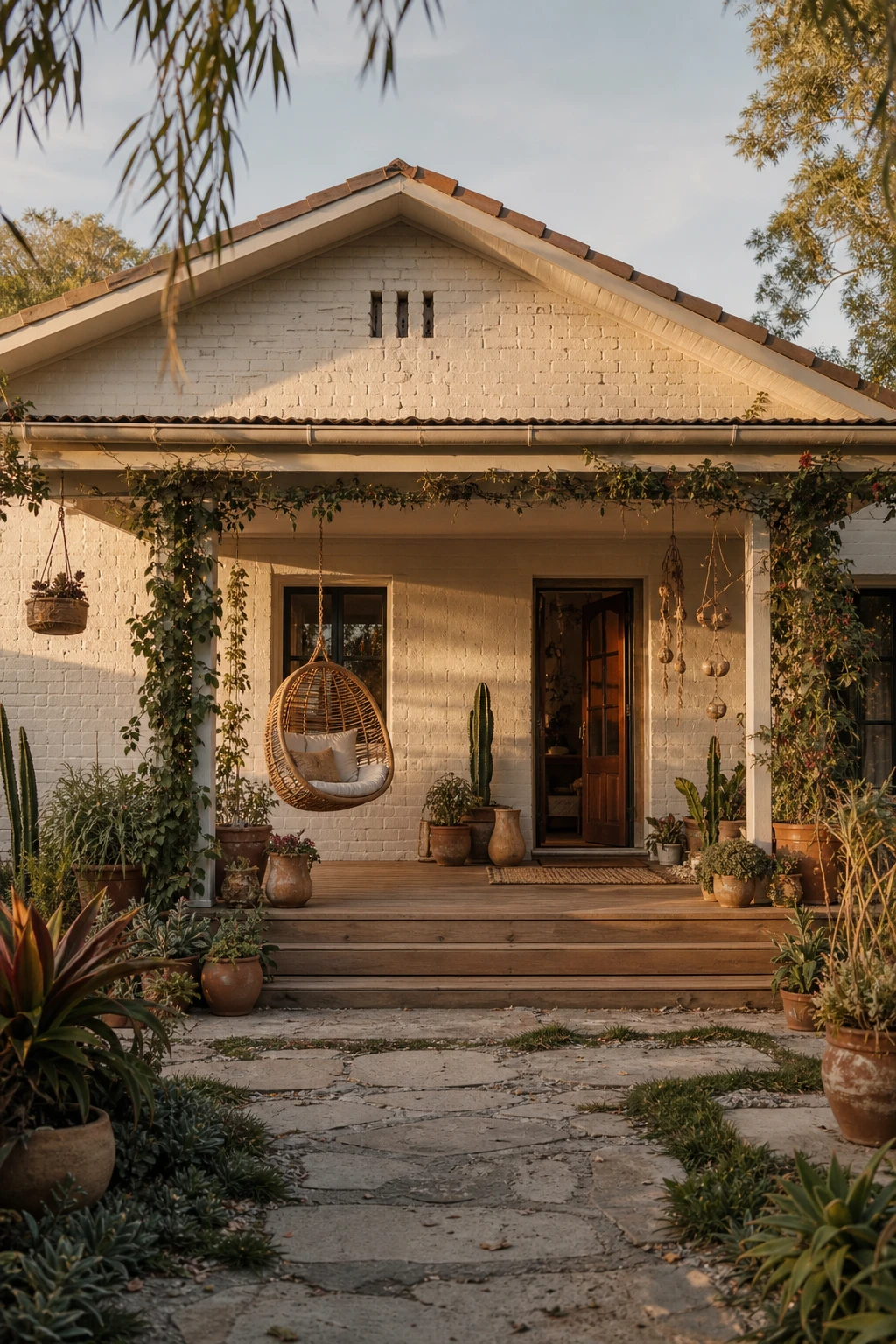
Bungalows have this natural ease about them, and what I love is how little it takes to push that into full boho territory. A deep covered porch gives you a sheltered stage for woven chairs, trailing terracotta pots and wind chimes without any of it feeling forced. You get a home that looks gathered slowly over time, which is exactly the spirit boho is after.
The Key Details
Deep covered front porch
Woven rattan hanging chair
Terracotta pot collection with trailing vines
Sun bleached timber porch boards
Hand thrown ceramic wind chimes
Pro TipHang a single woven piece, a macrame panel or a small fiber wall hanging, just beside the front door to anchor the whole porch with texture before you add anything else.
AvoidFilling every corner of a small bungalow porch at once makes the space feel busy and tired rather than relaxed, so add one piece at a time and let each one breathe.
When Trees Surround a Brick House the Light Changes Everything
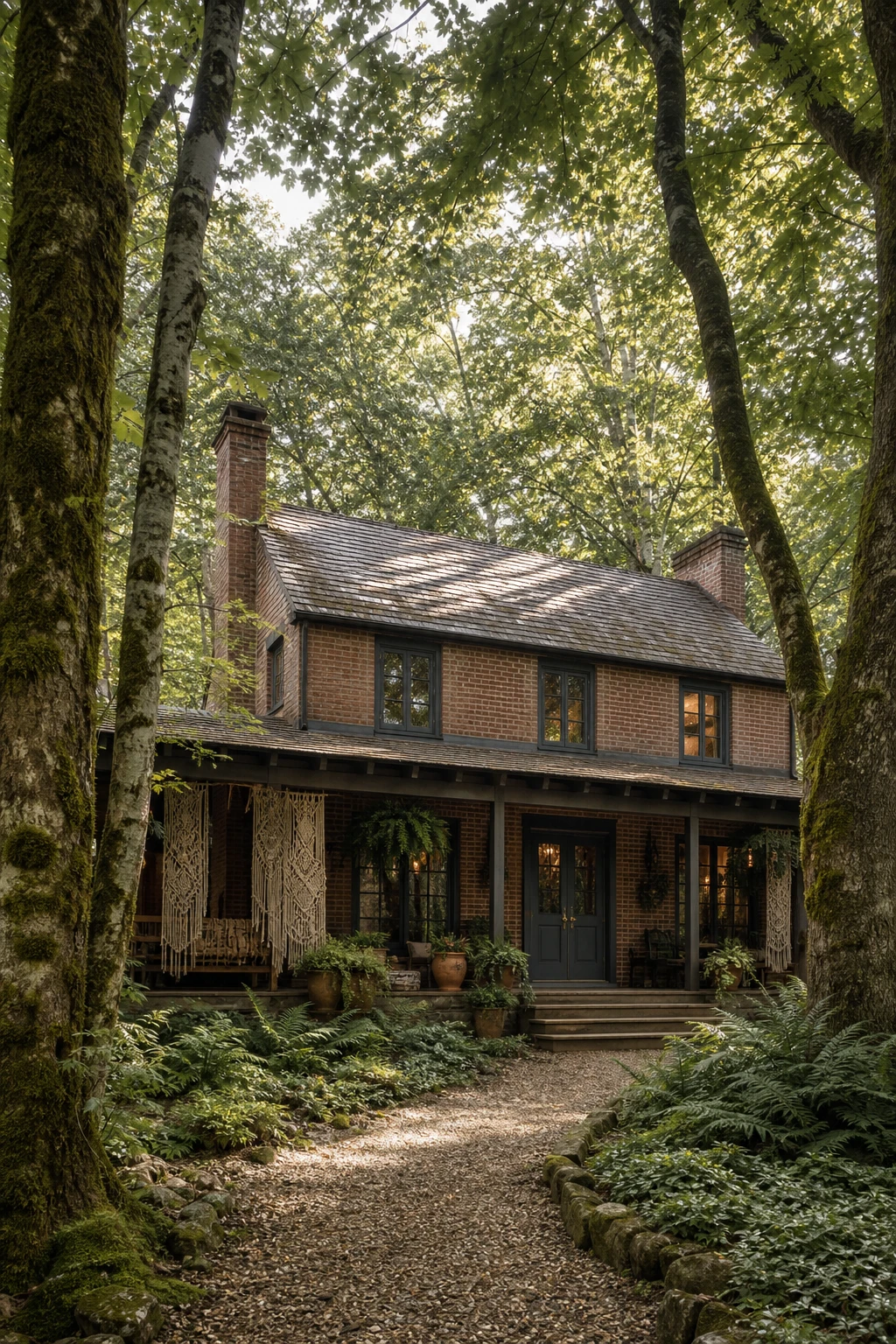
Brick surrounded by tall trees sits in a completely different kind of light, filtered, green tinted, and soft, and what I always check first is whether the colour on the house fights that light or leans into it. The tones I reach for here are mossy greens, warm ochres, and dusty clay reds that feel like they grew out of the ground alongside everything else. You get this lovely sense that the house has always been there, settled quietly among the roots.
The Key Details
Covered porch with rough sawn timber beams
Macrame panel screens
Terracotta planters with trailing ferns
Gravel path edged with wild woodland groundcover
Iron door and window hardware
Pro TipPaint render details, sills, or porch beams in a mossy sage or deep olive so every shadow the canopy throws becomes part of the palette rather than something working against it.
AvoidBright white trim in a forested setting reads as stark and cold because the green filtered light has no warmth to bounce back off it, leaving the whole exterior looking flat and out of place.
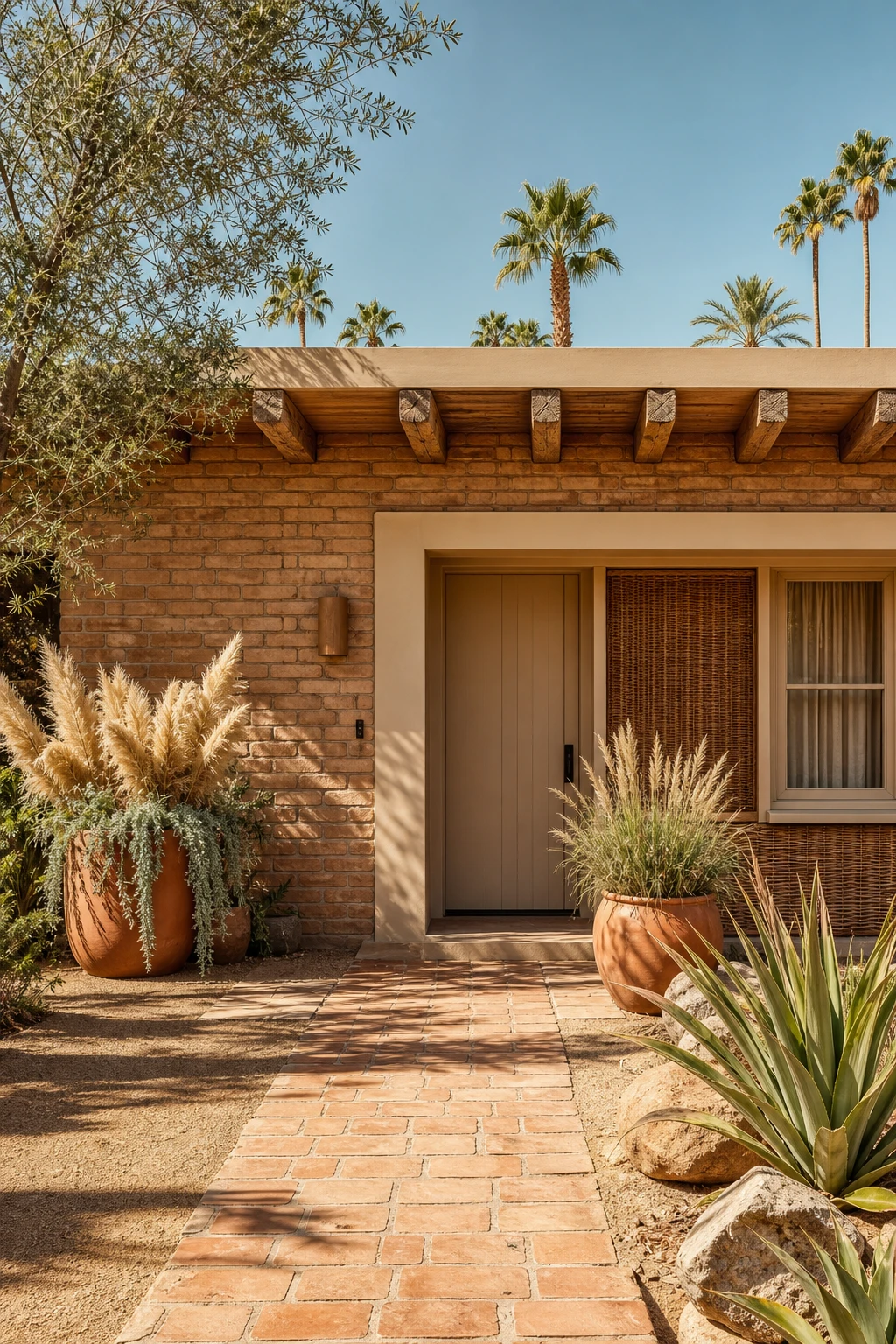
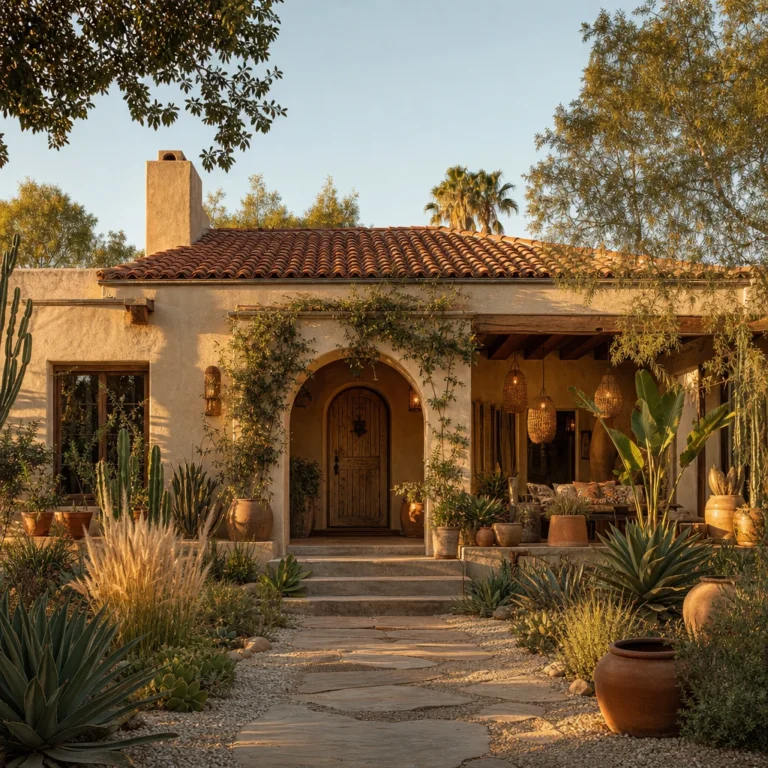
Palm Springs Color and Brick Together Make the Sunniest Boho Exterior
Palm Springs taught me that warm brick and bold desert color were always meant to find each other. You get that sun baked glow when wire cut clay sits beside dusty pink or burnt terracotta trim, and the flat roofline keeps it grounded and modern rather than fussy. The detail I always come back to is the handmade tile path pulling the palette down to ground level so the whole exterior reads as one warm, considered thing rather than a collection of separate choices.
The Key Details
Wire cut clay brick facade
Exposed rough hewn timber beams
Oversized terracotta planters
Handmade clay tile pathway
Flat roofline with matte stucco trim
Pro TipPaint your front door or window reveals in a dusty terracotta or muted pink, then pull that same tone into your planter glaze so the color feels intentional rather than accidental.
AvoidStripping back every plant and leaving only hard surfaces might feel clean, but on a boho brick exterior it reads as cold and unfinished, and the whole desert modern warmth disappears with it.
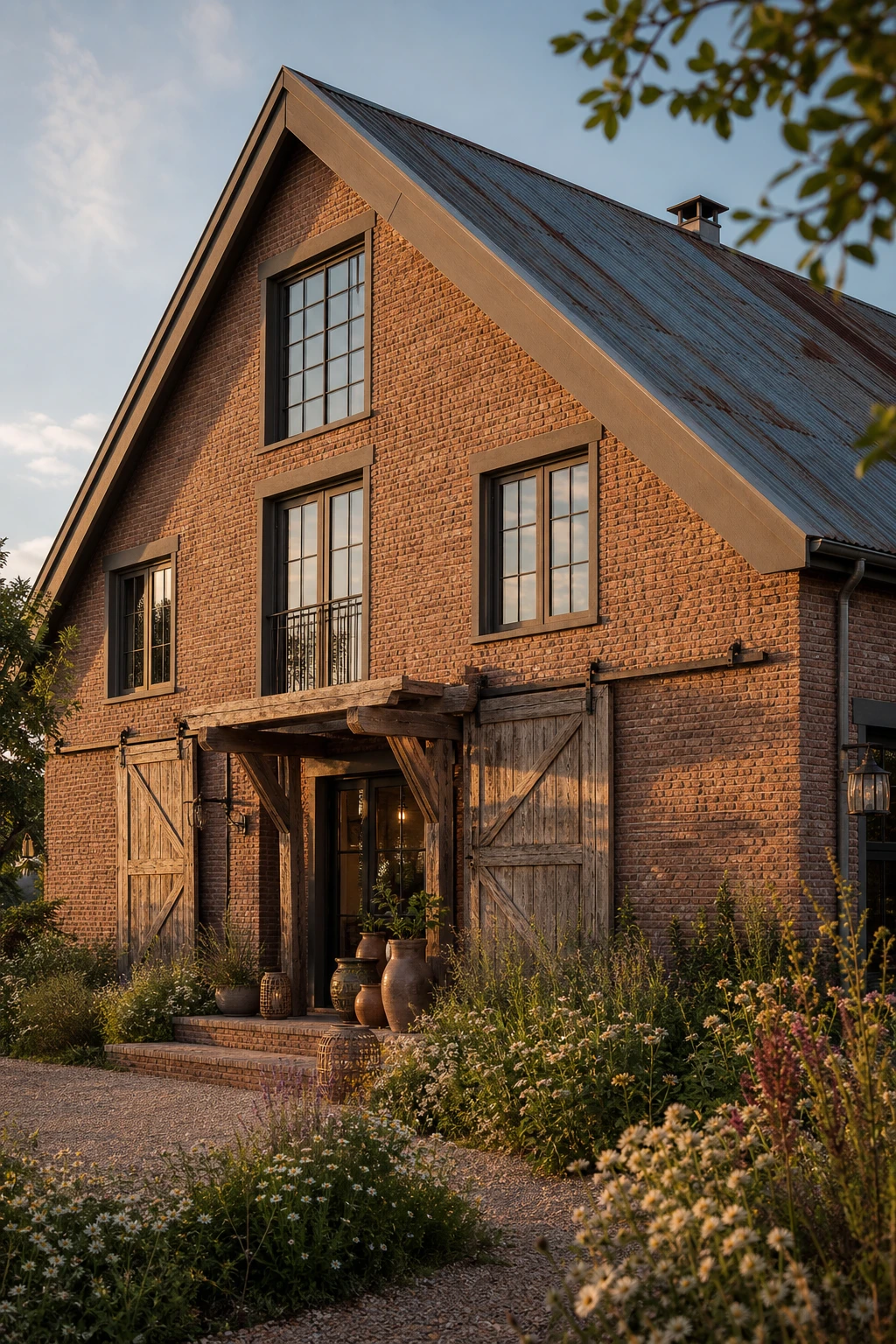
Barn Proportions Give a Brick Home Its Most Dramatic Roofline
Barn proportions do something almost no other form can: they make a brick house feel truly monumental without a single ornament. What I love is how that steep gabled roofline pulls the eye upward and holds it there, so you get a sense of raw industrial scale that feels earned rather than performed. Pair it with corrugated metal and reclaimed timber and the whole thing reads honest and bold, the exact spirit boho exteriors are after.
The Key Details
Steep gabled barn roofline
Corrugated metal roof cladding
Oversized sliding barn doors
Reclaimed timber entry canopy
Wildflower meadow base planting
Pro TipLet the planting stay loose and meadow wild right to the base of the walls so the big silhouette reads clean against something soft rather than something clipped.
AvoidBracket lights, decorative shutters, or fussy trim details placed on a barn form break the bold geometry you paid for and make the whole facade feel confused.
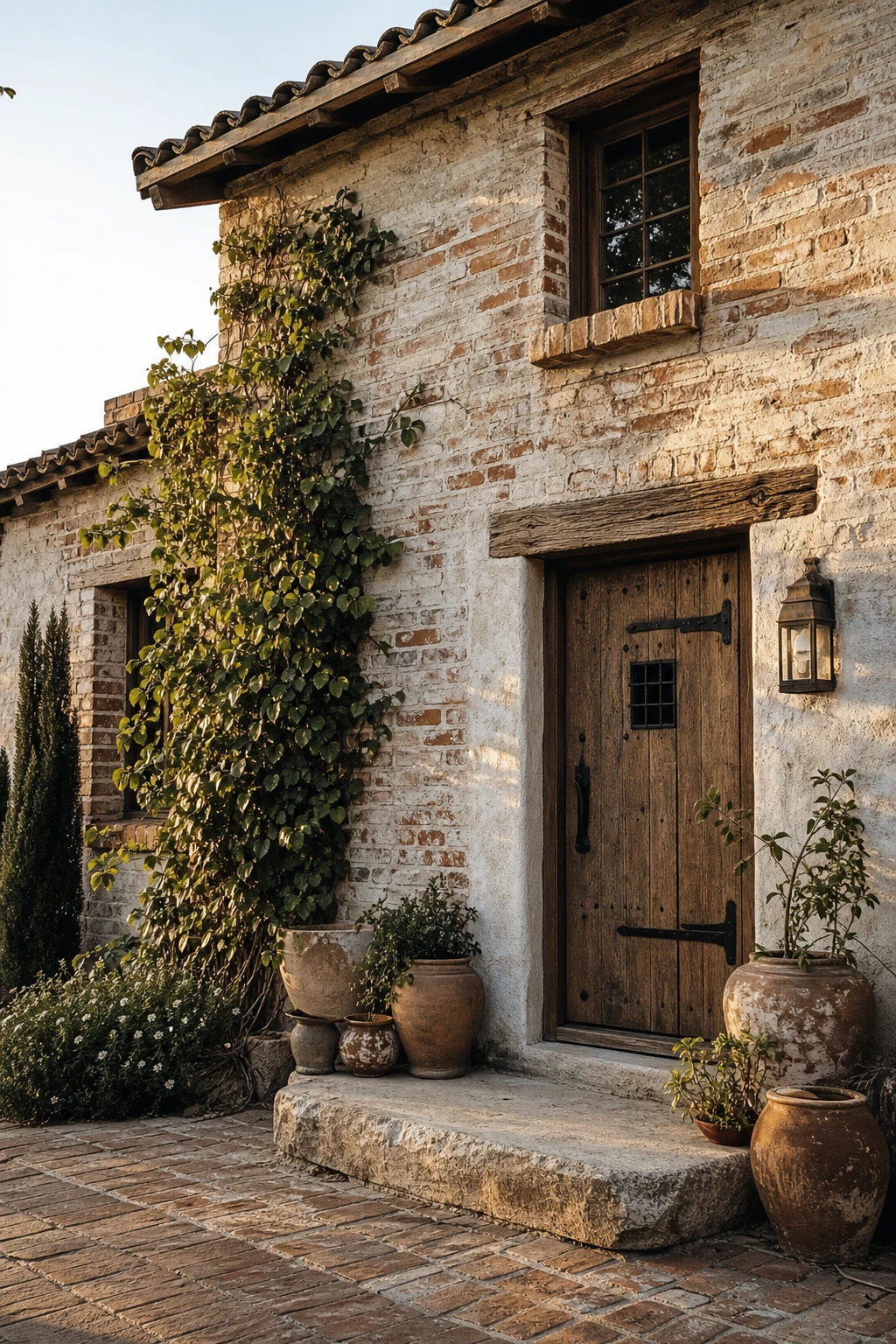
Limewash Gives Brick a Centuries Old Patina You Simply Cannot Fake Any Other Way
Limewash pulls something out of brick that no solid paint ever could, and that is genuine visual age. Each thin coat settles into the surface at a slightly different depth, so you get patches of pale chalky white sitting beside moments where the raw brick breathes through. The result reads as centuries of weathering rather than an afternoon’s work, and I find that layered quality is what gives a boho exterior its sense of quiet history.
The Key Details
Limewash layered brick facade
Weathered timber front door with hand forged iron straps
Trailing fig vine on corner wall
Salvaged stone threshold step
Mismatched ceramic planter cluster
Pro TipLet each coat dry fully to a powdery finish before you add the next, because wet on wet flattens the variation and you lose that beautiful uneven depth.
AvoidUsing standard whitewash or masonry paint in place of true limewash produces a flat, sealed surface that blocks the brick and looks like a mistake rather than a patina.
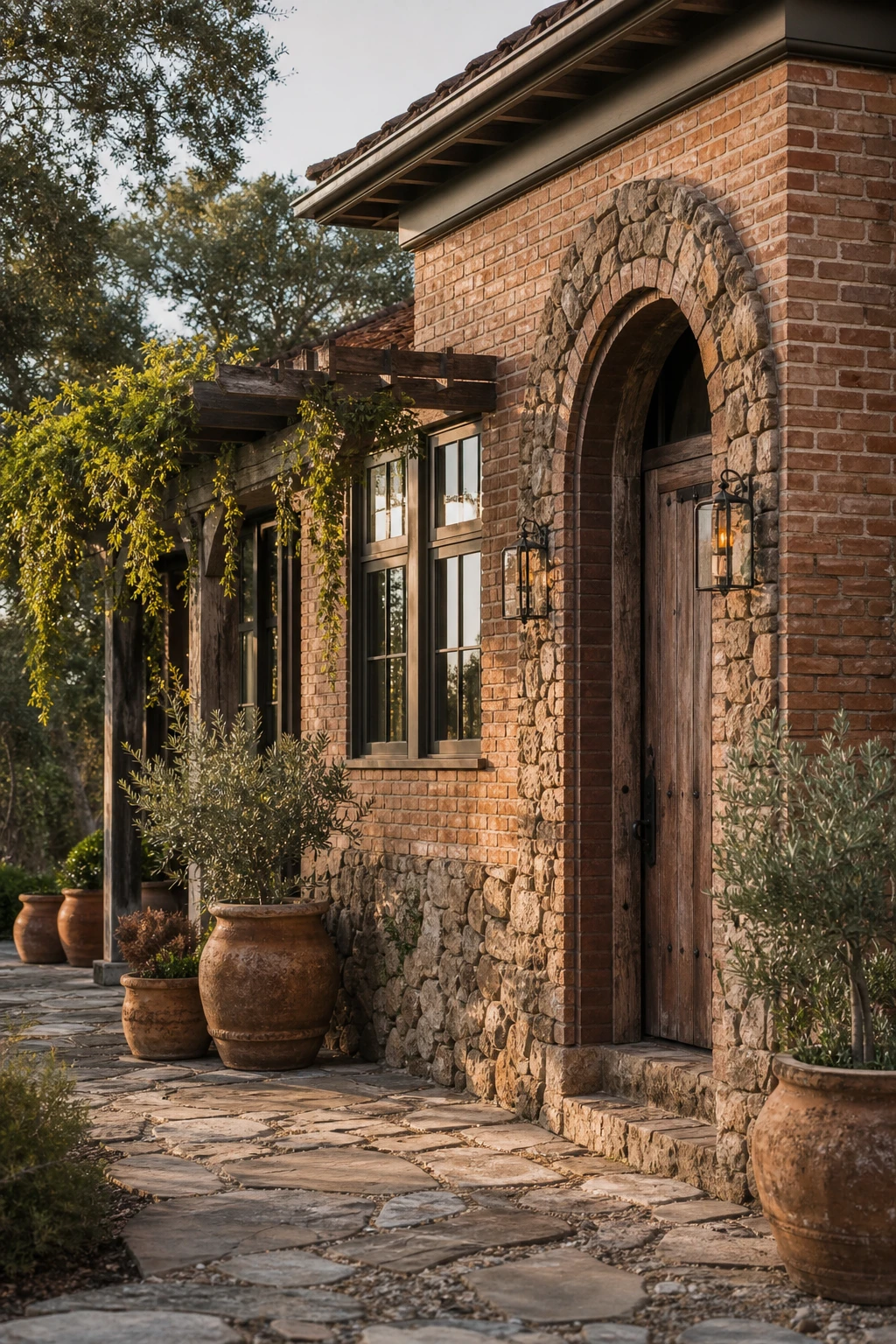
Pairing Brick With Natural Stone Adds the Richest Texture Story to Any Exterior
Brick and stone together create the kind of layered texture you simply cannot fake with paint or cladding alone. What I love is how each material does a different job: the stone grounds the base with weight and solidity, and the brick carries the eye upward with its smaller, rhythmic pattern. You get warmth and wildness in one facade, which is exactly the boho spirit. The trick is letting one material lead so the two never compete.
The Key Details
Handmade brick and stacked fieldstone facade
Arched stone entry surround
Weathered timber pergola with trailing greenery
Reclaimed wood front door
Flagstone entry path with terracotta planters
Pro TipUse stone only as a low plinth or a single accent panel around a doorway so it anchors the facade without splitting it into two equal halves that fight each other.
AvoidReaching for three different stone colours alongside a variegated brick leaves the eye nowhere to rest and turns a rich texture story into pure chaos.
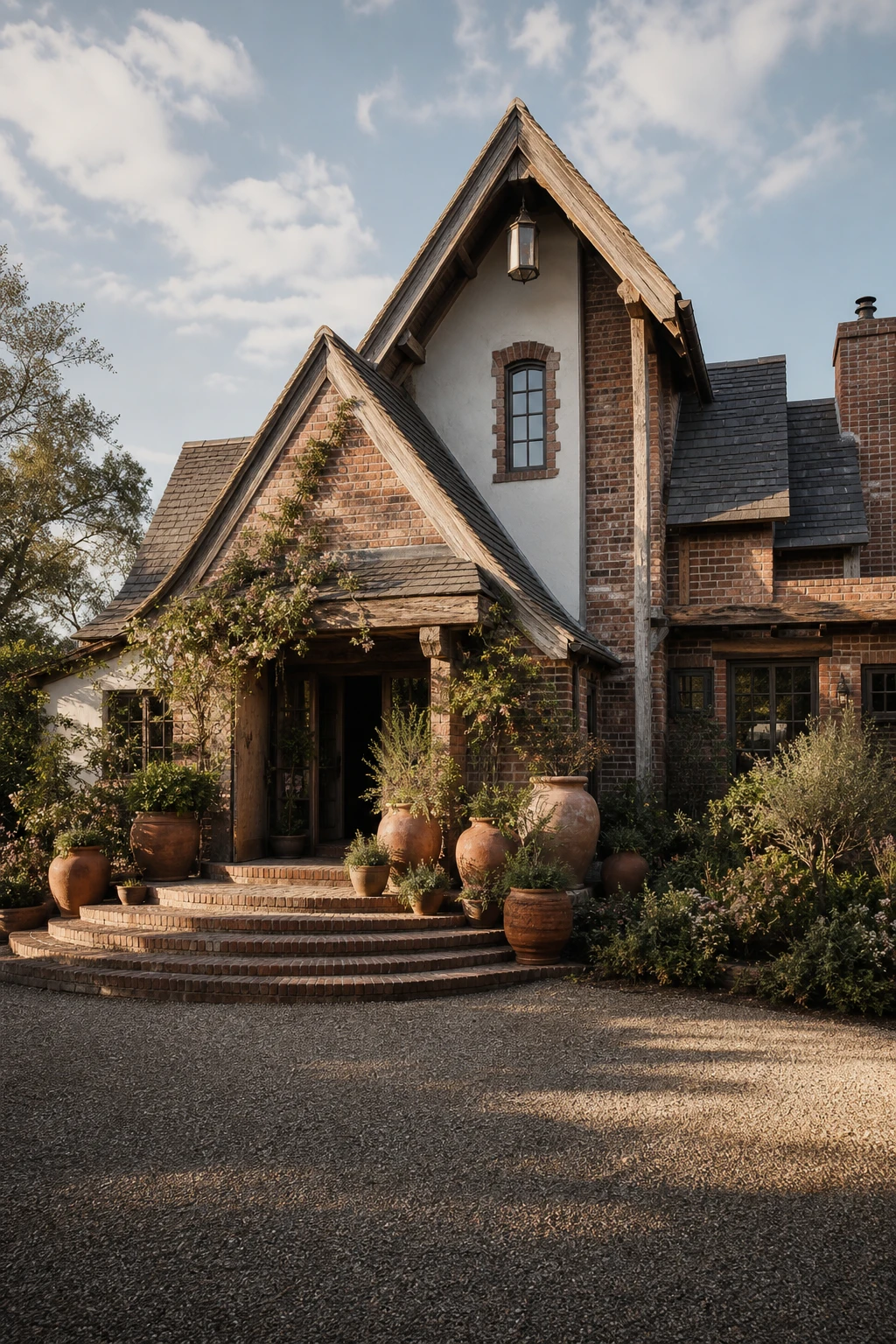
An Uneven Roofline Is the Architectural Quirk That Makes a Brick Home Unforgettable
An asymmetrical roofline is one of my favourite things to find on a brick house because it gives the whole facade a restless, handmade energy that no perfectly balanced frontage can match. You get this layered silhouette that pulls the eye across the building rather than straight to a central point, and that movement is pure boho. The detail that really gets me is how the varying gable heights invite vines, timber details, and lanterns to each claim their own corner, so the house feels collected rather than designed.
The Key Details
Staggered multi gable roofline
Weathered timber fascia boards
Climbing vine along lower eave
Oversized terracotta entry planters
Vintage lantern pendant under gable peak
Pro TipPlant a tall olive or eucalyptus on the lower roof side so its canopy rises to meet the upper gable and the whole silhouette reads as intentionally balanced.
AvoidPlanting identical topiaries either side of the front door pulls every eye to a forced central axis and flattens the very asymmetry that makes the roofline so special.
Alan launched Edward George London in 2017. Since completing his masters in Town & Regional Planning (MPlan) he has combined the skills he learned at the University of Sheffield with his passion for design, to help create a foundation for those looking to create a beautiful home.