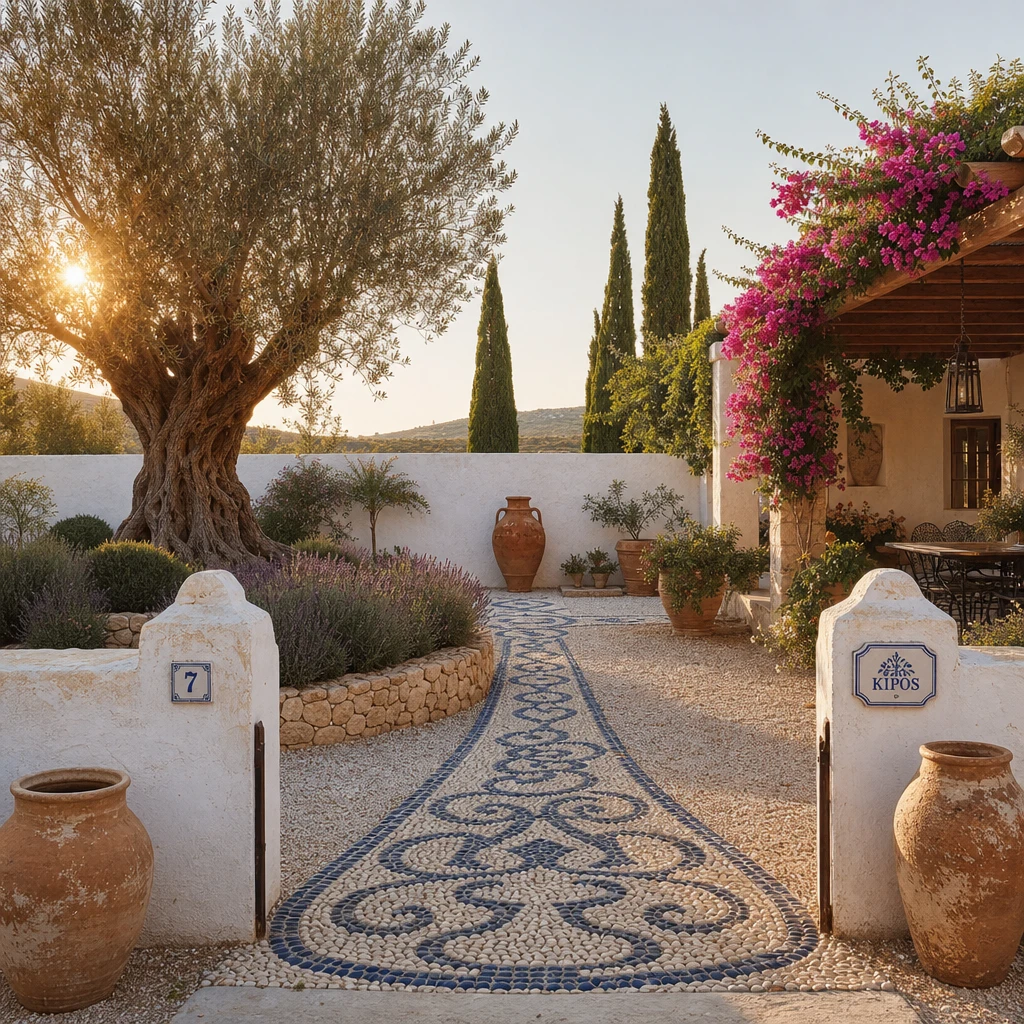
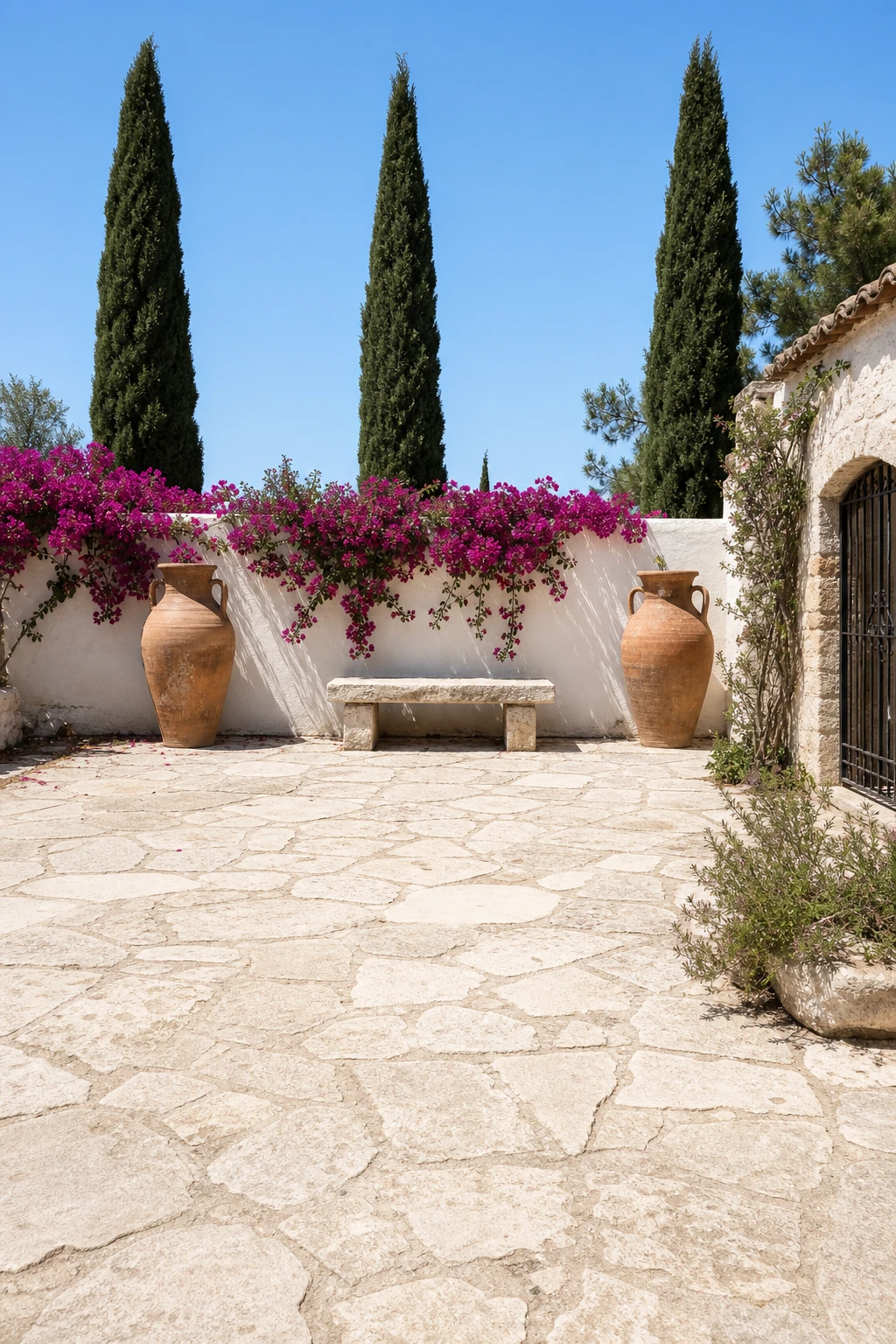
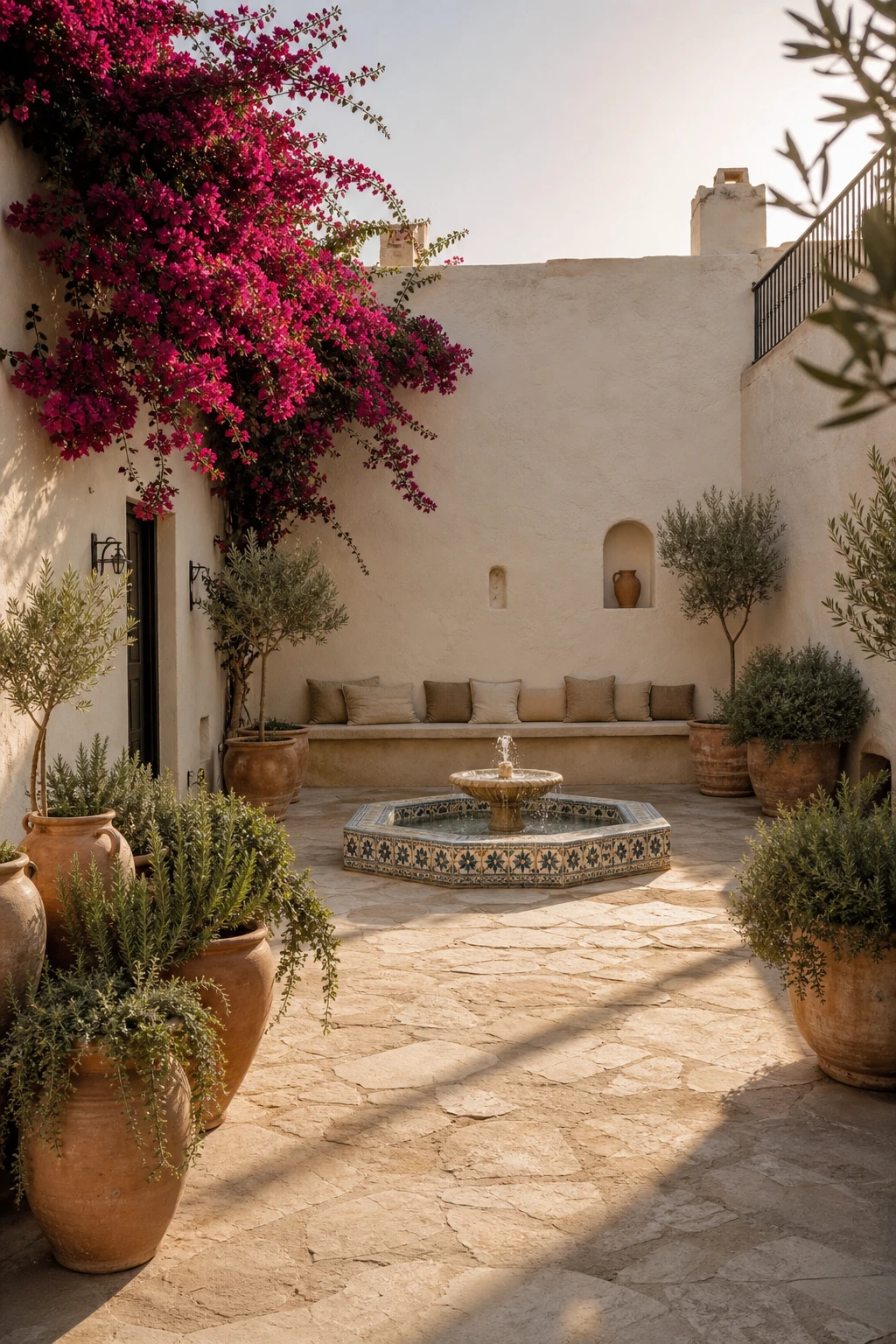
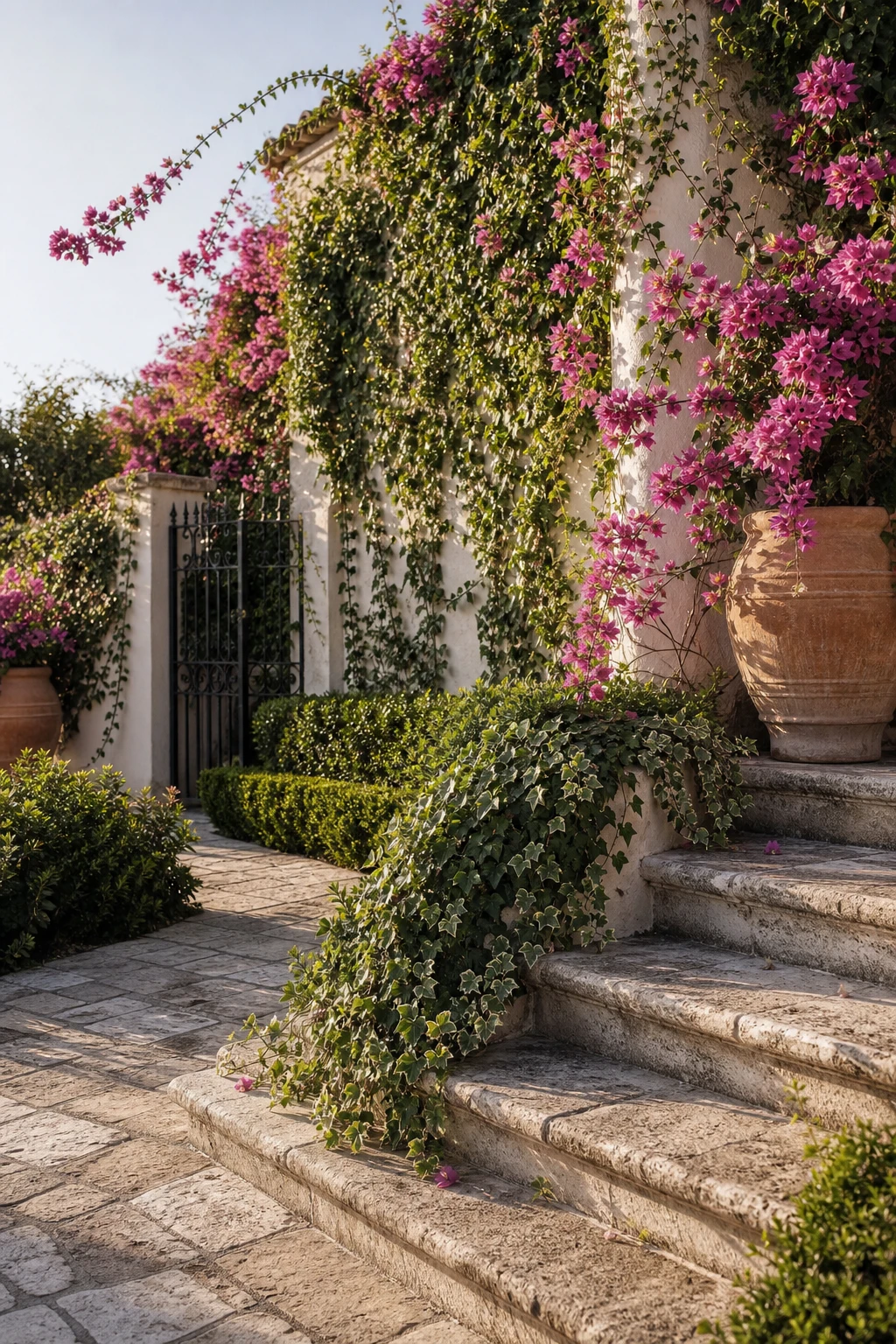
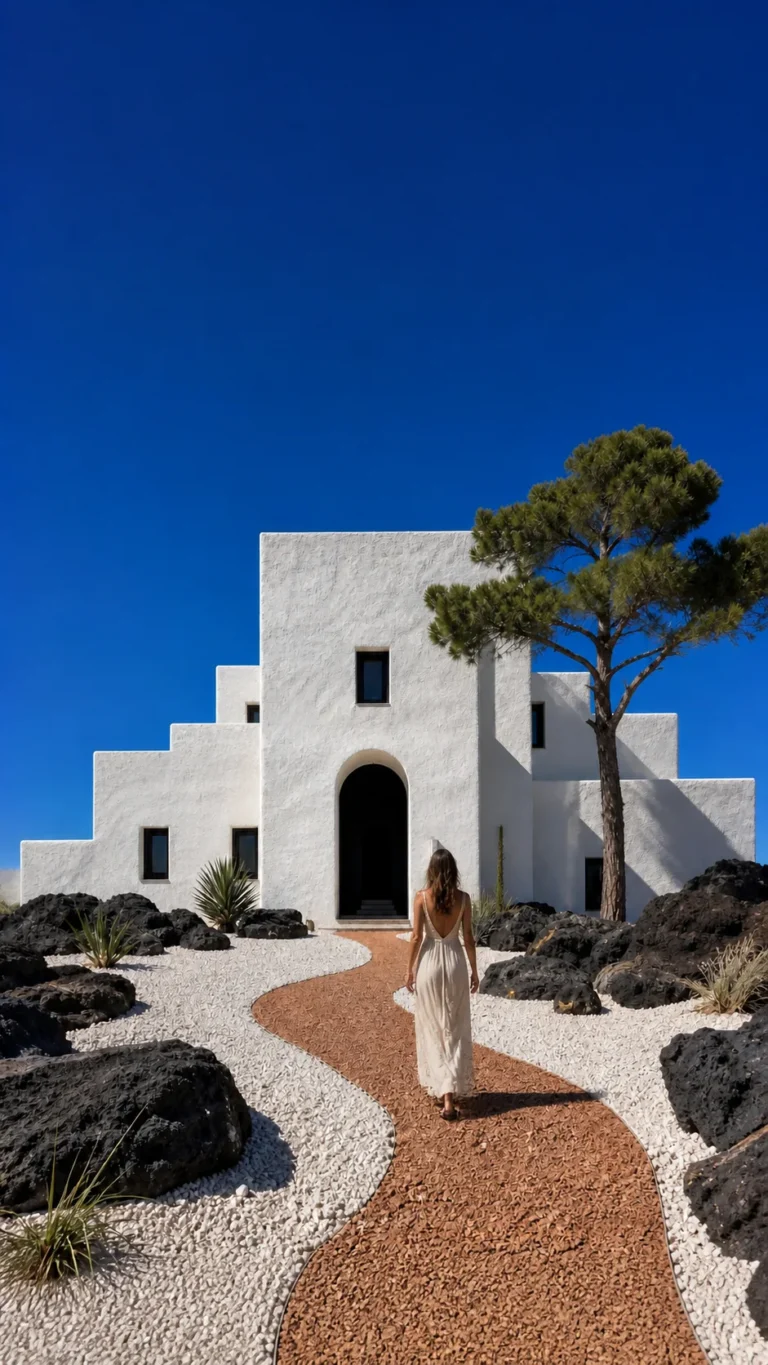
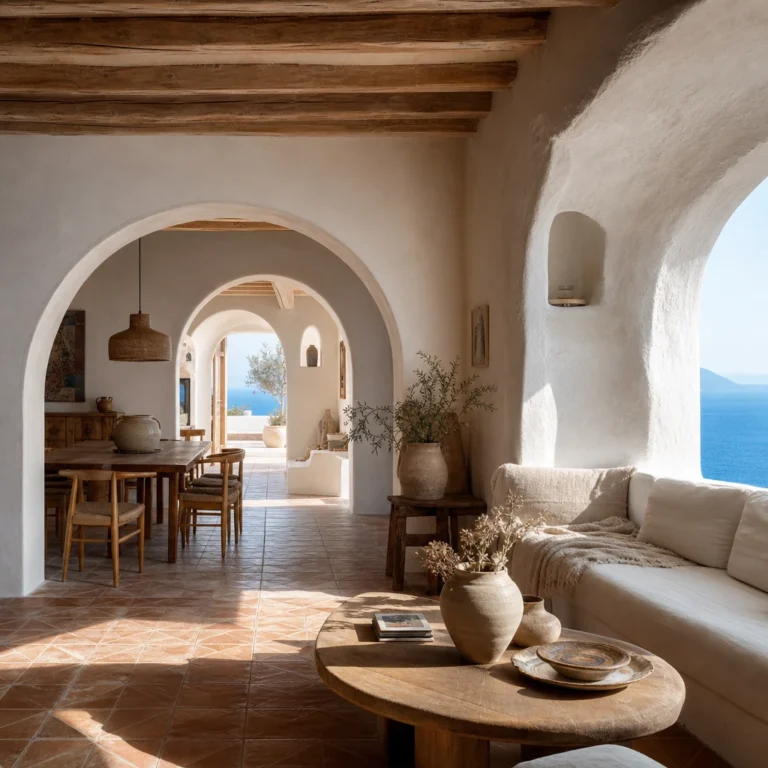
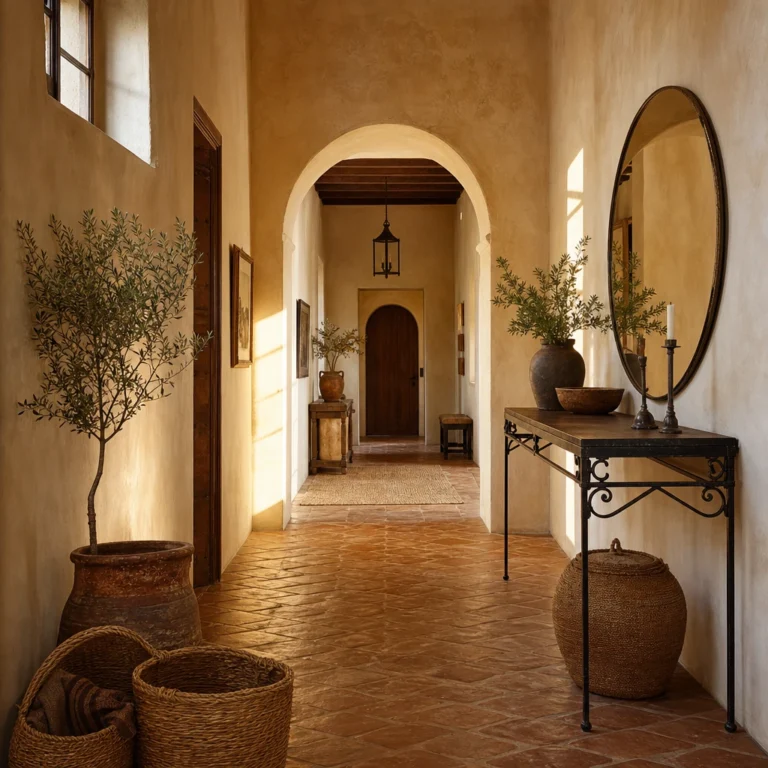
I’ve always thought a Greek Style Garden has a kind of magic that’s hard to pin down until you start looking closely at the details. What I love is how much of it comes down to simple things: rough white walls, a terracotta pot in the right corner, a pergola draped in climbing flowers. This piece walks you through the features that make these gardens so beautiful, from gravel courtyards and mosaic paths to lemon trees and blue painted seating, and every single one is a look you can borrow for your own space.
How a Stone Courtyard Sets the Ancient Greek Mood
Stone underfoot is the decision that anchors everything else in a Greek garden, and what I love about it is how quickly it sets the mood before a single plant goes in. Irregular limestone slabs with their natural colour shifts and uneven edges tell you this space has been here forever. You get that calm, unhurried feeling the moment you step onto it, which is exactly what the Mediterranean style is reaching for.
The Key Details
Irregular limestone slab paving
Oversized terracotta amphora urns
Trailing bougainvillea wall cascade
Tall cypress tree vertical accents
Carved stone garden bench
Pro TipChoose a limestone or sandstone with a naturally riven or brushed surface so it stays grippy when wet and reads as genuinely aged rather than freshly laid.
AvoidPolishing courtyard stone to a high shine kills the ancient mood completely, leaving you with something that looks more like a hotel lobby than a sun warmed Greek terrace.
The Walled Courtyard Garden Look That Feels Instantly Greek
Enclosure is the secret the Greeks have always understood: a walled courtyard turns a garden into a room, and the moment you step inside, the world shrinks to something personal and still. What I love is how the walls do the heavy lifting, holding bougainvillea, absorbing heat, and bouncing soft light back across the limestone underfoot. You get intimacy without darkness, because the sky is still open above you.
The Key Details
Mosaic tile fountain
Climbing bougainvillea
Terracotta statement pots
Limestone flagstone paving
Low stone bench with linen cushions
Pro TipFrame your courtyard entry with a simple rendered arch or a pair of tall terracotta urns so the transition from outside to inside feels deliberate and considered.
AvoidLeaving courtyard walls bare and flat strips the space of warmth and turns what should feel like a sun soaked retreat into something closer to a yard.
Ivy and Climbing Flowers That Soften Every Hard Surface
Climbing plants are the thing I always reach for when a garden wall feels too hard or too bare. Bougainvillea spilling over whitewashed render, or ivy tracing the lines of a wrought iron gate, pulls the whole scene together in a way no paint colour ever could. You get this lovely tension between the solid limestone and the soft, living layer growing across it, and that contrast is exactly what gives a Greek garden its warmth.
The Key Details
Climbing bougainvillea
Aged terracotta urns
Wrought iron gate
Worn limestone pathway
Whitewashed rendered garden wall
Pro TipFix a simple trellis panel a few centimetres proud of the wall so air can circulate behind the stems and the roots stay healthy as the plant matures.
AvoidPlanting three or four different flower colours along the same wall breaks the calm, unified look that makes Mediterranean gardens feel so restful.
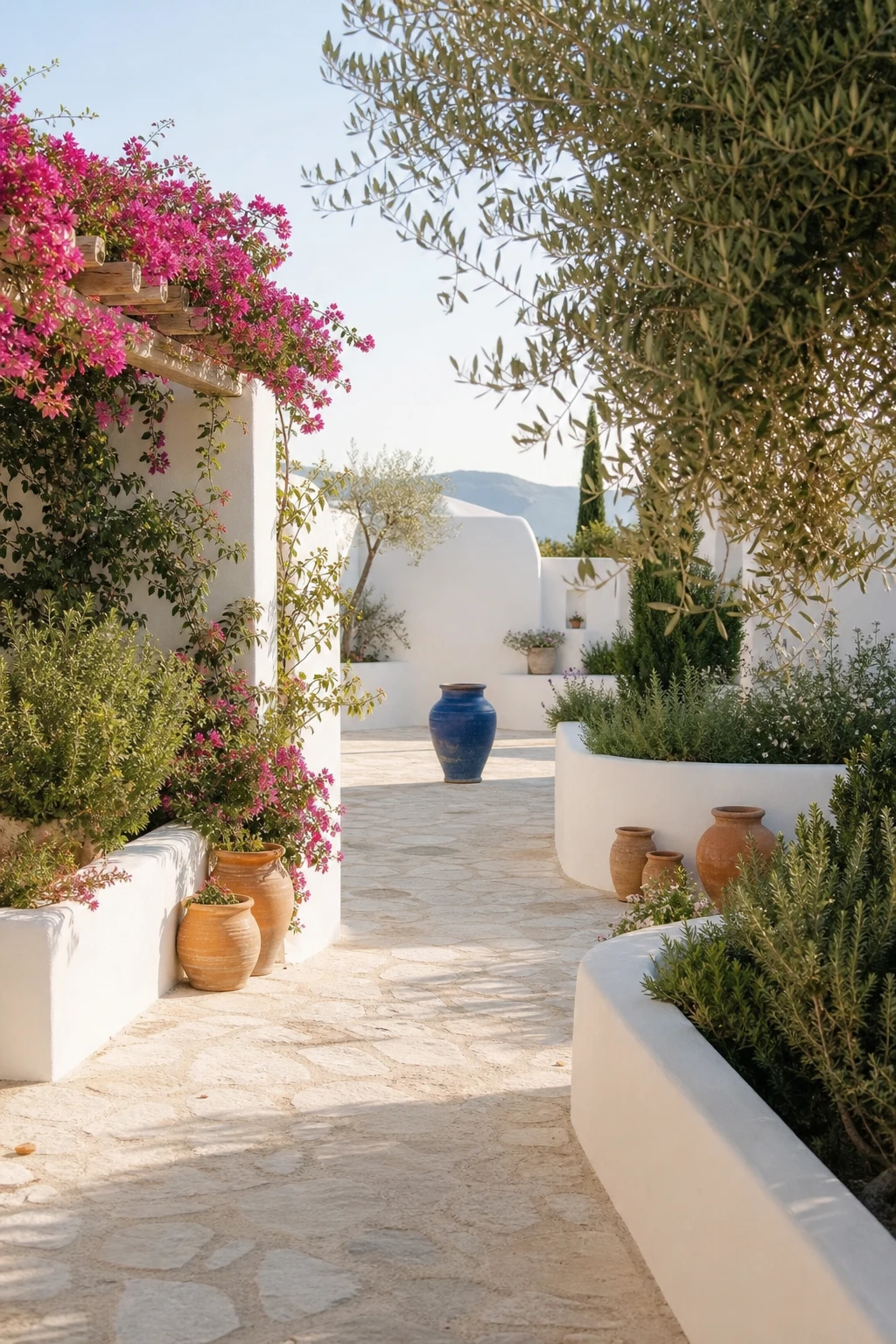
Why Whitewash Is the Secret Behind That Santorini Calm
Whitewash is the great unifier, and the thing I always check before anything else is whether the walls, pots, and paving all share one quiet base tone. When they do, your eye stops jumping between objects and the whole space settles into something that feels genuinely restful. You get that Santorini calm not from any single piece but from the repetition of that warm chalky white holding everything together.
The Key Details
Cobalt blue ceramic urn
Terracotta clustered pots
Trailing bougainvillea wall planting
Worn limestone pathway
Lime rendered enclosing walls
Pro TipAdd cobalt blue in odd numbers, one large urn flanked by two smaller ones, so the colour punctuates the white without competing with it.
AvoidReaching for a stark, blue toned white drains the warmth out of the render and leaves the garden feeling cold and clinical rather than sun baked and welcoming.
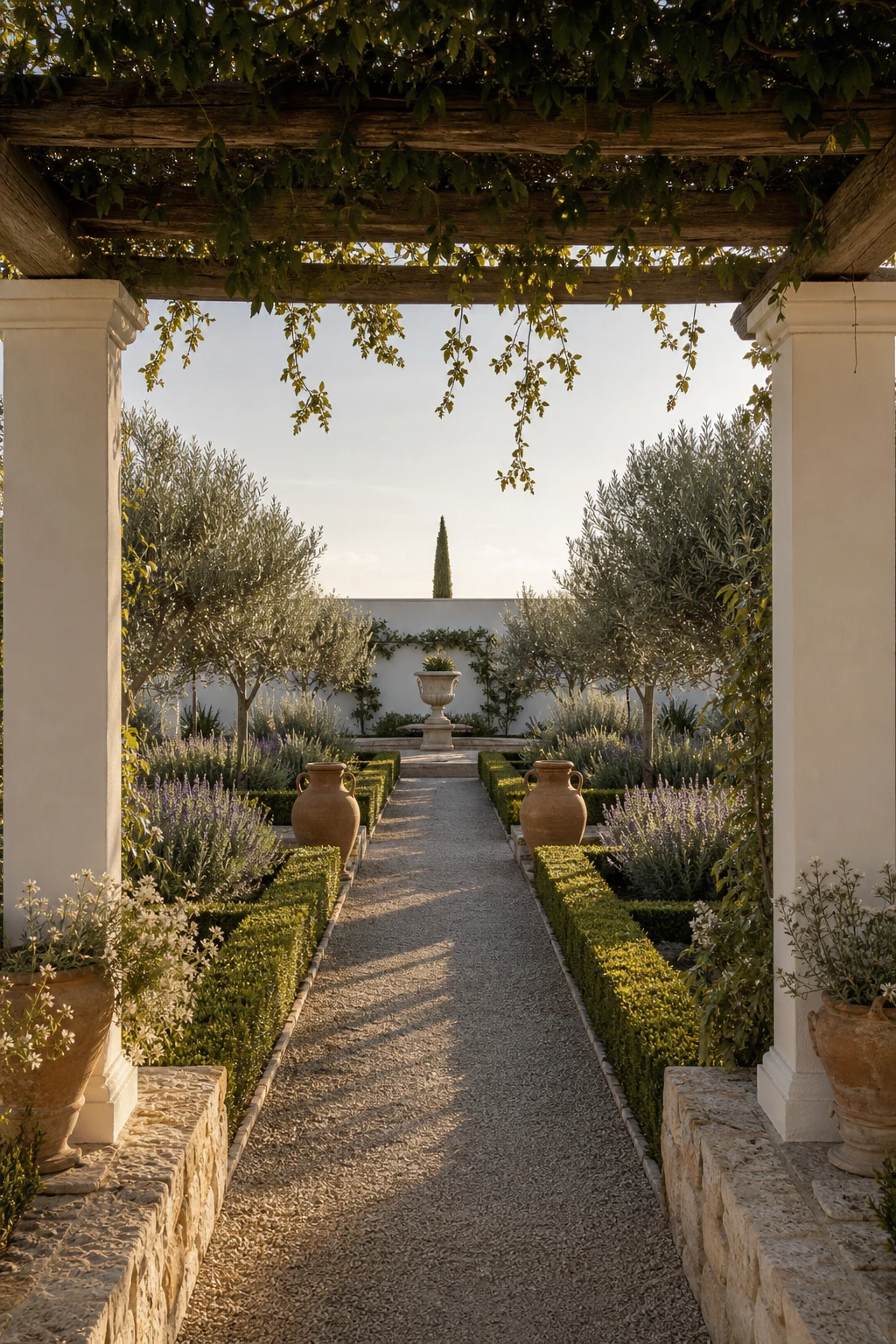
Garden Layout Principles Borrowed From Ancient Greek Design
Symmetry is the quiet engine behind every great Greek garden, and planning your axis path first is the move I always come back to. You get a clear line of sight from the entrance to a single focal point, and every planting decision falls naturally into place around it. Watch how a central gravel path flanked by clipped box hedges pulls the eye forward and makes even a modest plot feel considered and calm.
The Key Details
Central gravel axis path
Clipped box hedges
Stone urn focal point
Whitewashed timber pergola
Terracotta amphora pair
Pro TipPlace your stone urn or amphora pair at the far end of the axis before you plant anything, so every other element frames that point rather than competing with it.
AvoidPositioning plants or pots at irregular intervals along the central path breaks the symmetry and leaves the whole layout feeling restless rather than composed.
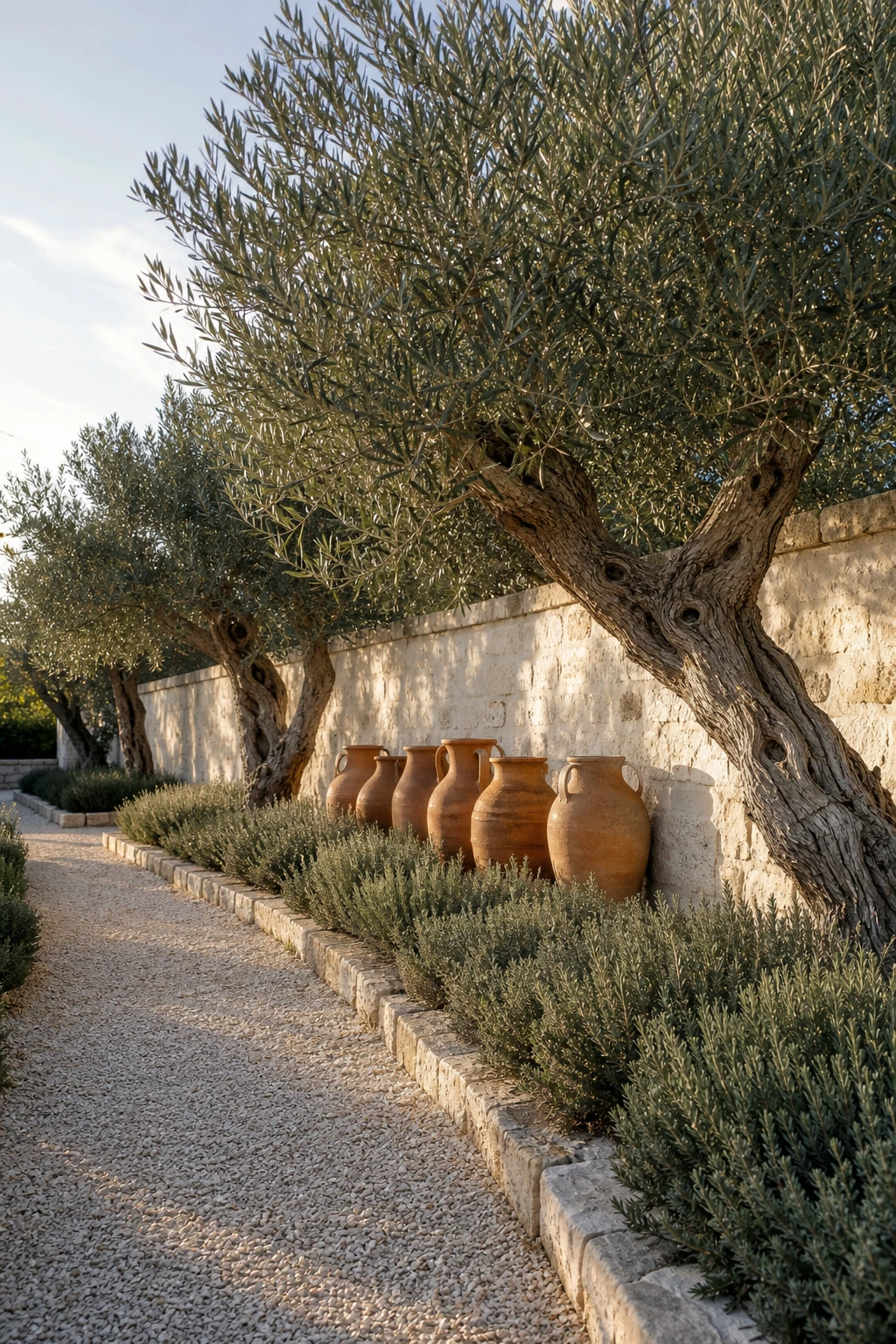
Olive Trees Against a Stone Wall: the Pairing That Never Gets Old
Olive trees against rough stone are one of those pairings that just makes sense: the silver grey foliage picks up the cool tones in the limestone, and the gnarled trunks echo the texture of the wall behind them. What I love is how little effort the combination asks of you. You get something that reads as ancient and considered without trying too hard, and that low key confidence is exactly the Mediterranean scale I am always chasing.
The Key Details
Gnarled olive trees with silver bark
Rough hewn limestone boundary wall
Terracotta amphorae cluster
Crushed pale limestone gravel path
Clipped rosemary border edging
Pro TipPlant your olives in large terracotta or stone planters rather than directly in the ground, so you can rotate them for even light and move them under cover if a sharp frost is forecast.
AvoidPlanting an olive tree flush against the wall traps moisture against both the roots and the stonework, which leads to rot in the tree and spalling in the stone over time.
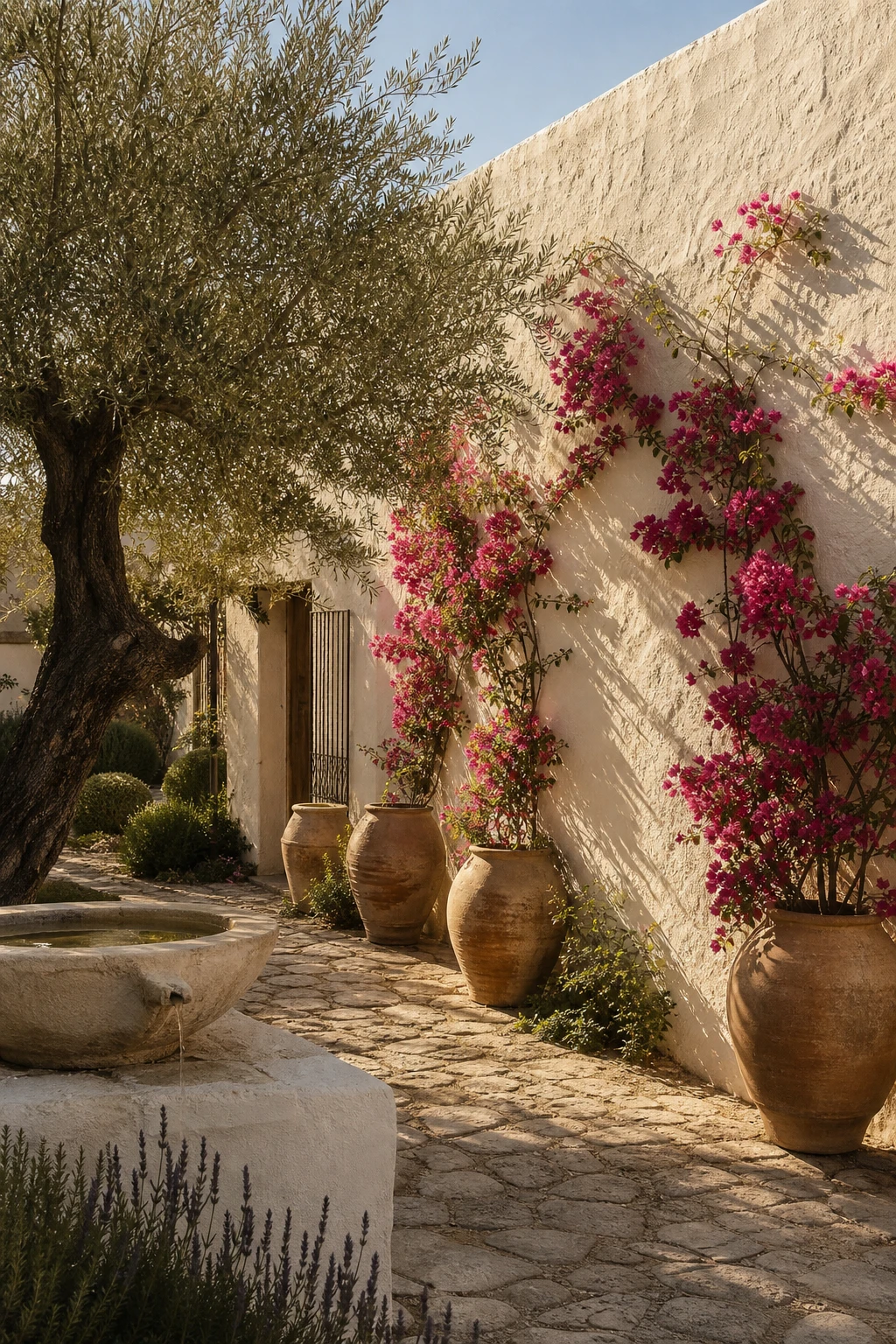
Stucco Walls: the Rough Texture That Makes a Garden Feel Authentically Greek
Rough stucco is the quiet backbone of every Greek garden I admire, and the thing that keeps drawing me back to it is how the surface earns its keep around the clock. That pitted, uneven finish catches the light differently from one hour to the next, giving you depth and warmth that flat painted masonry simply cannot match. Run your hand across it and you understand immediately why the garden feels old and rooted rather than freshly assembled.
The Key Details
Rough lime plaster stucco wall finish
Oversized terracotta urns
Trailing bougainvillea climber
Cobblestone garden path
Gnarled olive tree
Pro TipBrush a diluted limewash coat over dried stucco to lift the natural chalky tone and deepen every pit and ridge in the surface.
AvoidTrowelling the stucco to a smooth, polished finish strips away the very texture that makes the wall feel authentically Greek, leaving you with something that looks more like a suburban render than a sun baked Aegean courtyard.
An Ancient Mosaic Path and How It Changes the Whole Feel Underfoot
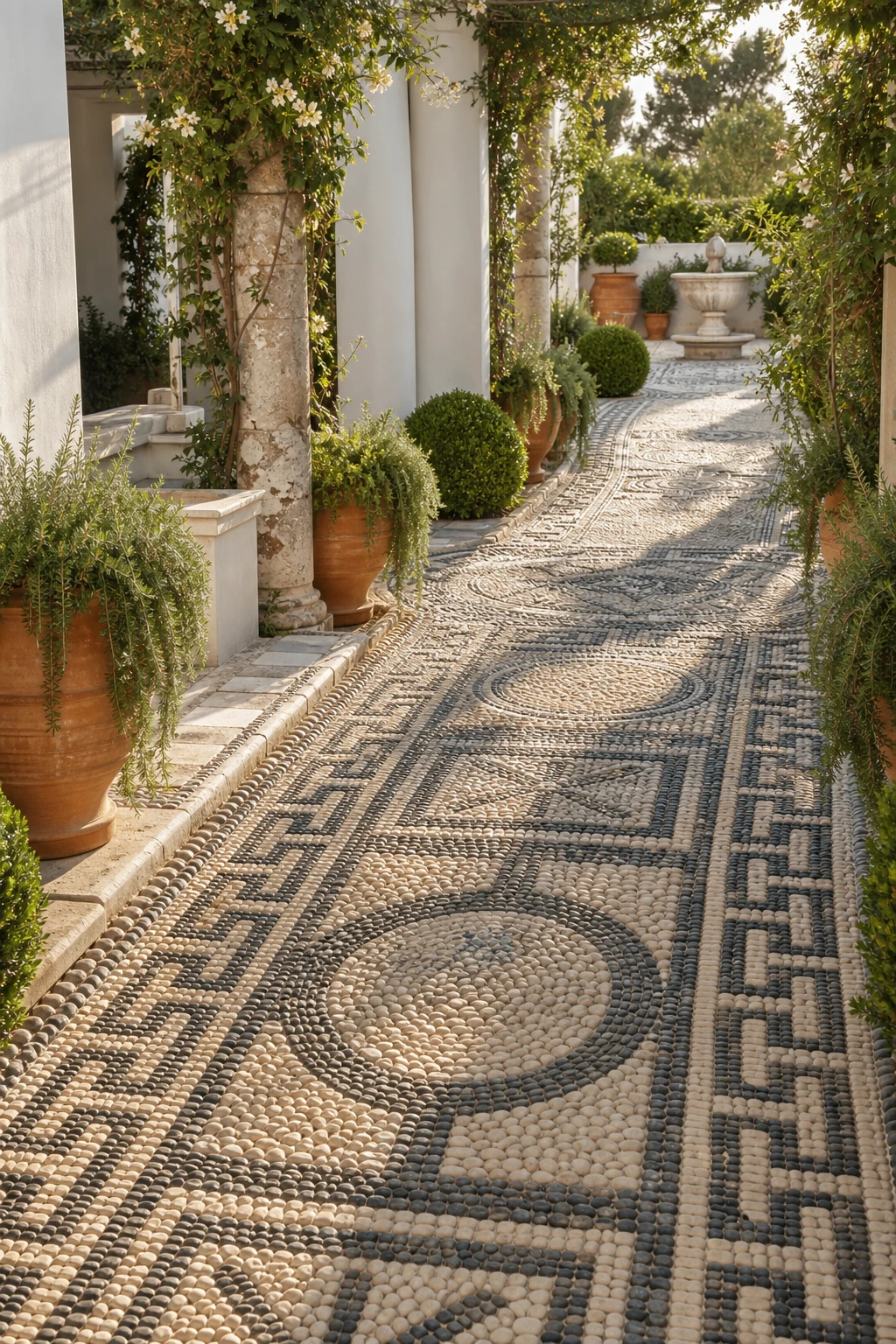
Pattern on the ground plane is one of the most underused moves in garden design, and a mosaic path is where I always start when a space feels flat. The moment you lay it down, you get a sense of journey, something pulling you forward and making the garden feel curated rather than accidental. What wins me over every time is how the irregular pieces catch the light differently through the day, so the floor feels alive.
The Key Details
Pebble and limestone mosaic floor
Weathered stone columns with jasmine
Terracotta urns with trailing rosemary
Clipped box sphere planting
Rendered cool white garden wall
Pro TipKeep your mosaic to two or three tones pulled from the same earthy family, like off white, warm grey, and soft terracotta, so the pattern reads clearly without fighting the planting.
AvoidReaching for uniform modern floor tiles as a shortcut gives you something that reads as a bathroom rather than an ancient Greek courtyard, and the whole character of the path is lost.
Mediterranean Tiles: Where One Small Panel Does All the Work
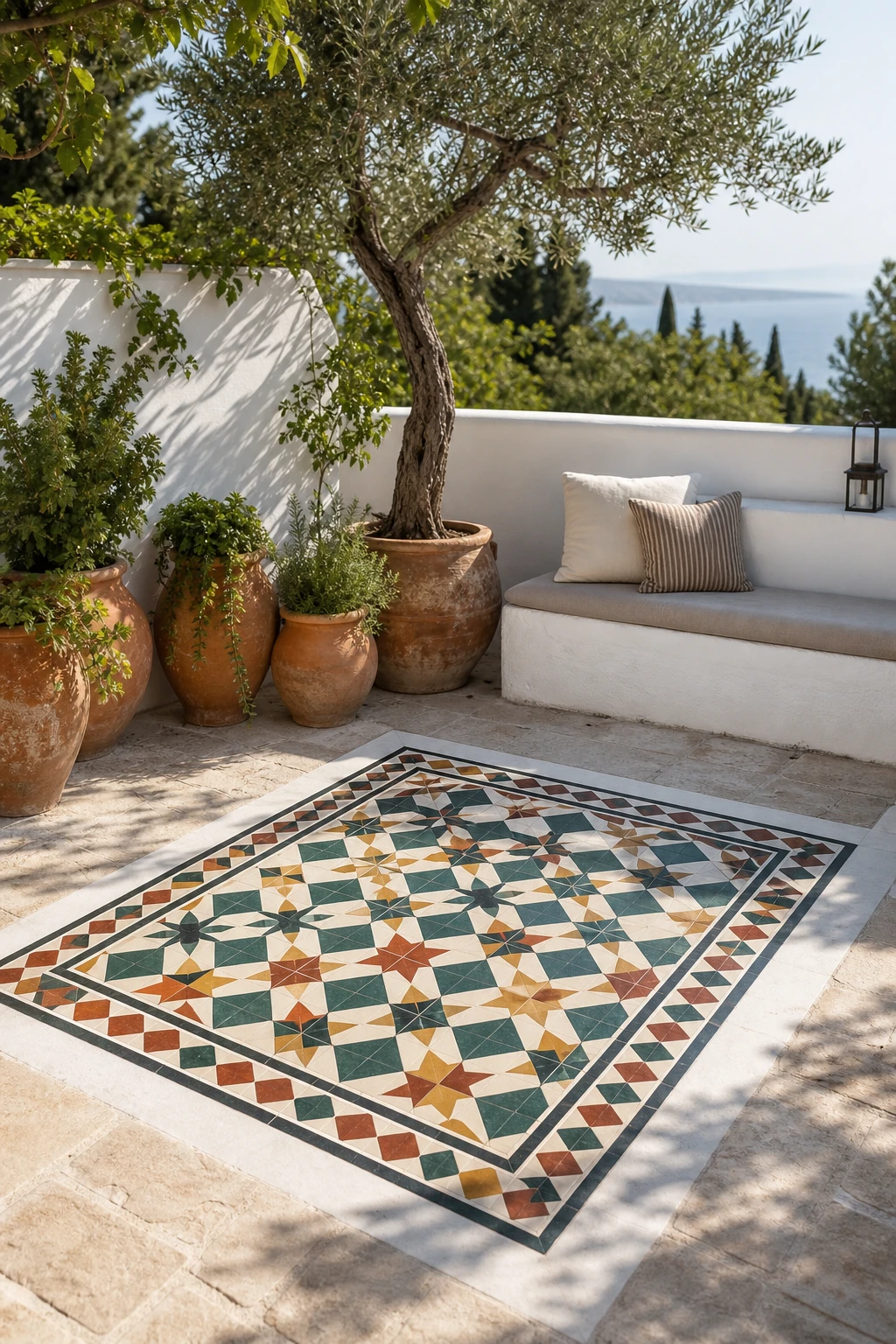
One well placed tile panel punches well above its weight, and the restraint of using just one is what wins me over about this approach. You get all the richness of a geometric encaustic pattern without the space feeling like a museum floor. Set it against the plain render of a built in bench or rough tumbled limestone and the contrast does the work for you, giving the pattern room to breathe and actually be seen rather than competing with everything around it.
The Key Details
Geometric encaustic tile panel
Tumbled limestone paving
Built in rendered garden bench
Hand thrown terracotta urns
Potted olive tree
Pro TipSet your tile panel at eye level on a rendered wall rather than underfoot, so it reads as art and draws the gaze without competing with furniture or planting.
AvoidRepeating the same encaustic pattern across every surface flattens the whole effect, because the eye has nothing plain to rest on and the design loses all its impact.
A Terracotta Amphora on Stone: the Pot That Feels Like a Ruin in the Best Way
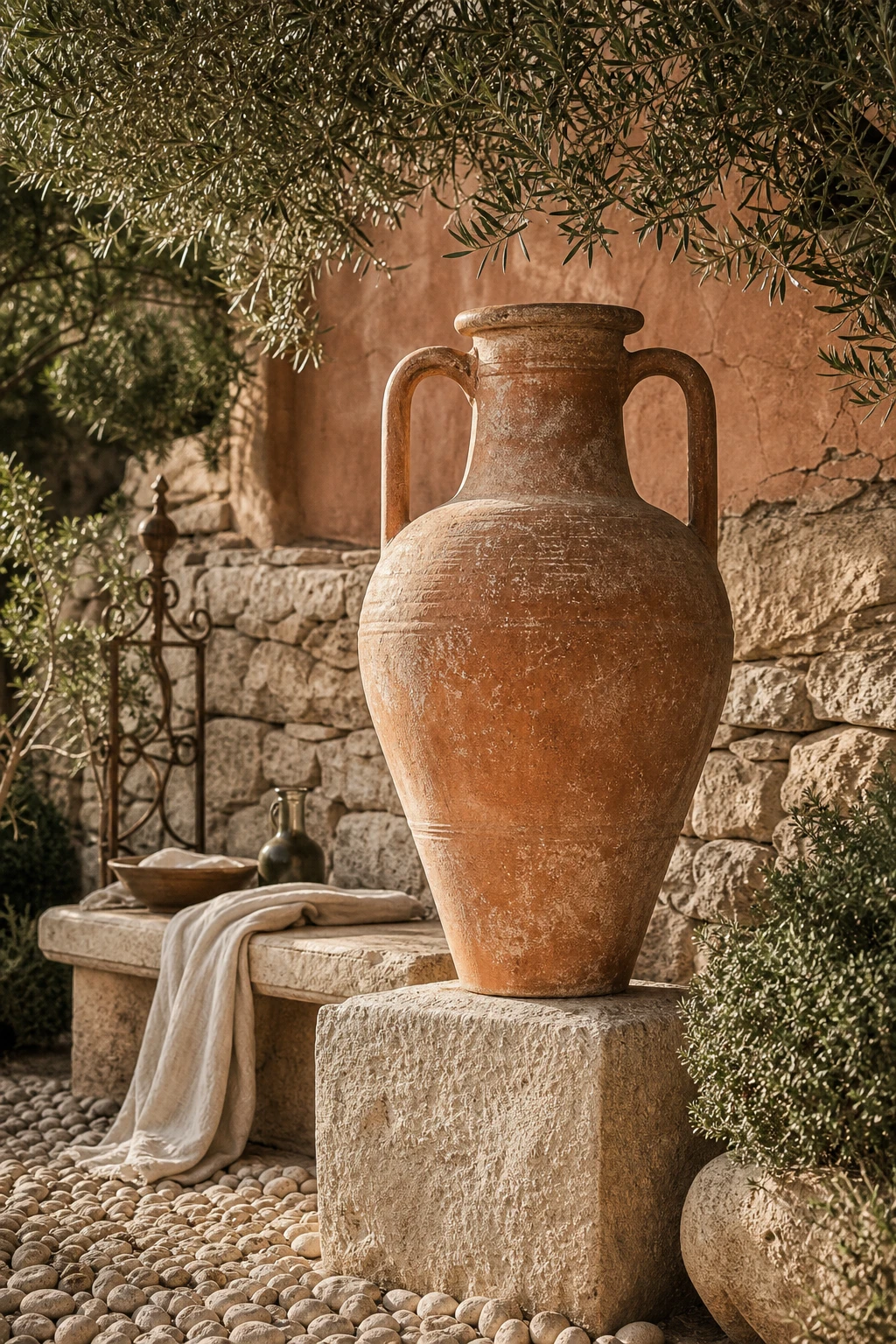
A single oversized amphora does something no cluster of pots can: it reads as sculpture, not gardening. What I love is the way the tall form against a low stone wall gives your eye one clear place to land, and the silence around it makes it feel found rather than placed. You get that ruin like quality, as if the vessel has simply always stood there.
The Key Details
Oversized terracotta amphora vase
Weathered limestone plinth
Dry stone garden wall
Olive tree with arching branches
River pebble ground covering
Pro TipPosition the amphora so its widest point sits just above the top of the wall or plinth behind it, keeping the silhouette clean against the sky.
AvoidSurrounding an amphora with smaller pots breaks the spell completely, turning a sculptural moment into a crowded shelf.
Garden Statues That Look Like They Have Always Been There
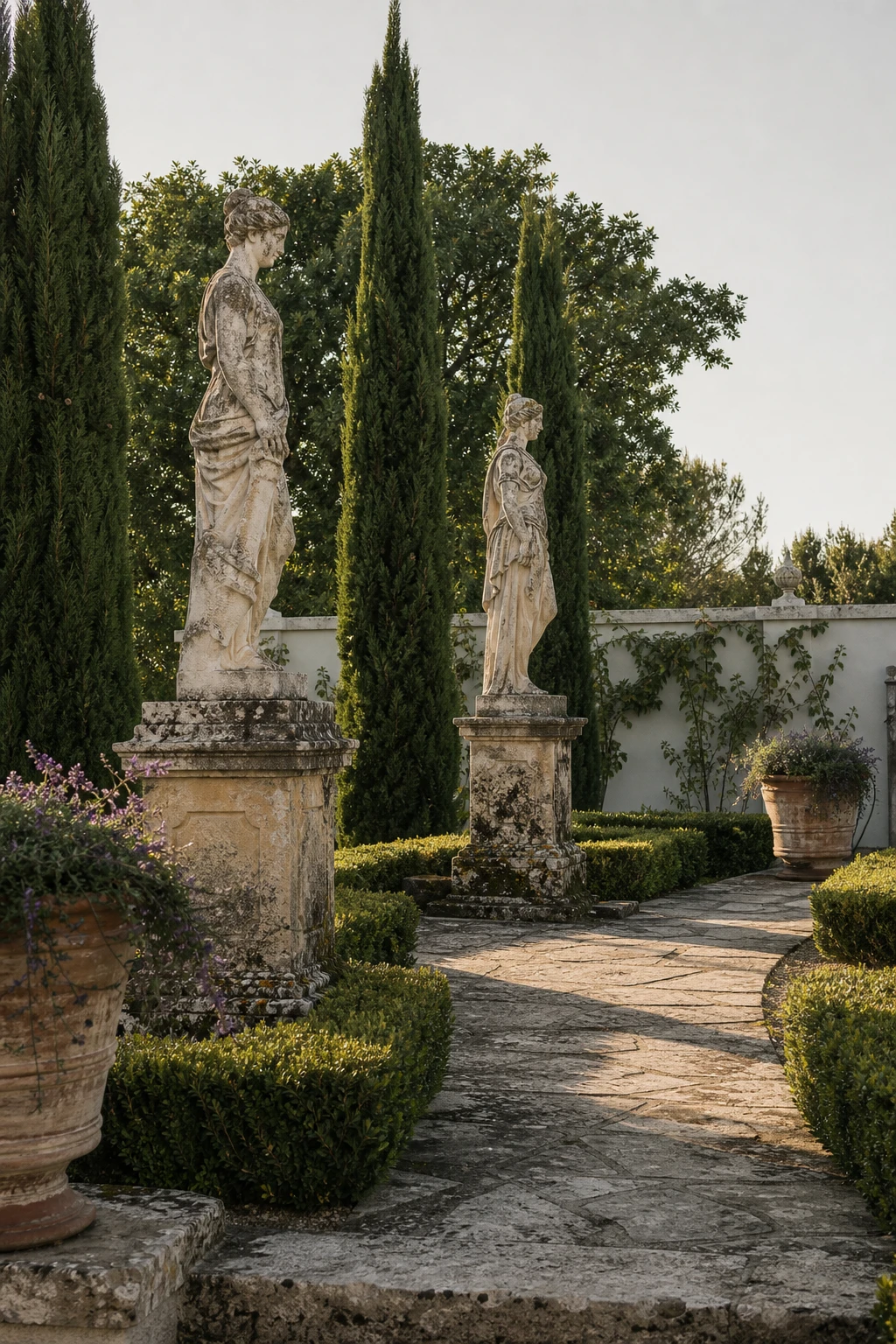
A statue that looks rooted to its spot is one of my favourite things to pull off in a garden. You get that feeling when the sculpture sits at the end of a path, half shadowed by cypress trees, with clipped box holding it in on either side. The lichen creeping across the stone is what wins me over every time, because that soft grey bloom is what tells your eye this piece belongs here rather than arrived yesterday.
The Key Details
Weathered marble classical statues on stone plinths
Tall dark cypress trees
Clipped box hedges
Terracotta urns with trailing lavender
Worn limestone pathway
Pro TipLet rain and shade do their work on new stone rather than scrubbing it clean, because that natural weathering is exactly what gives a statue its sense of age.
AvoidPlacing a statue dead centre in open ground with nothing around it leaves it looking like a shop display rather than something the garden grew around.
Vintage Garden Pots and Why a Little Chip Adds More Than Polish Does
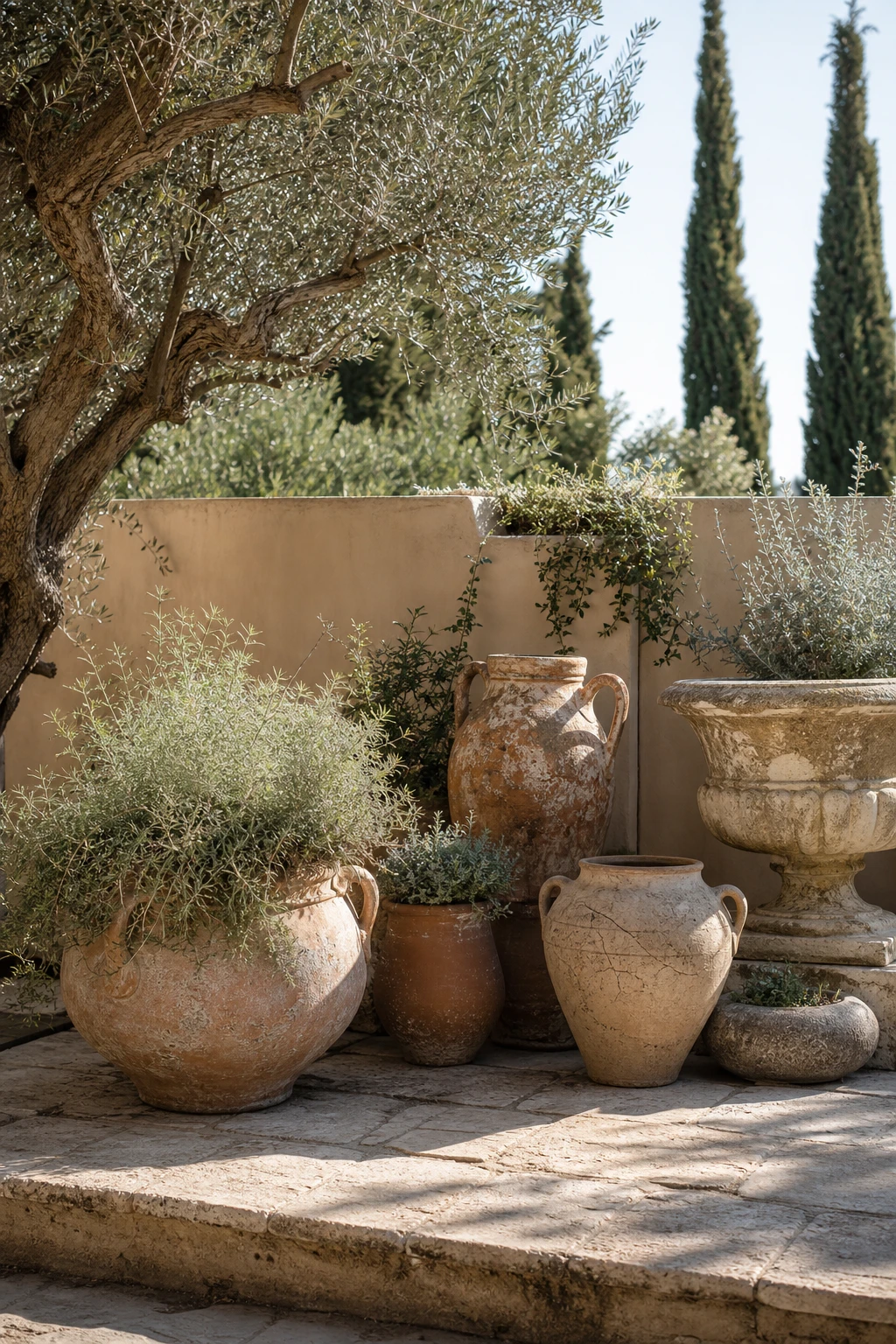
A chipped rim or a mossy streak on old terracotta tells a story no brand new pot ever can, and that story is exactly what gives a Greek garden its soul. What I love about mixing aged vessels is the way the eye travels across a group of them, reading the differences rather than landing on one perfect object. You get warmth, depth, and the sense that this garden has been lived in for decades.
The Key Details
Clustered aged terracotta amphora pots
Worn limestone paving slabs
Trailing oregano and silver artemisia plantings
Chalky rendered garden wall
Gnarled olive tree with dappled canopy
Pro TipArrange pots in groups of three or five, stepping each one to a different height so the cluster reads as a single composed moment rather than a scattered collection.
AvoidBuying six matching pots in the same size and glaze strips the arrangement of any tension, leaving a display that feels more like a garden centre shelf than a sun worn Greek courtyard.
A Greek Style Pergola: the Structure That Turns a Corner Into a Room
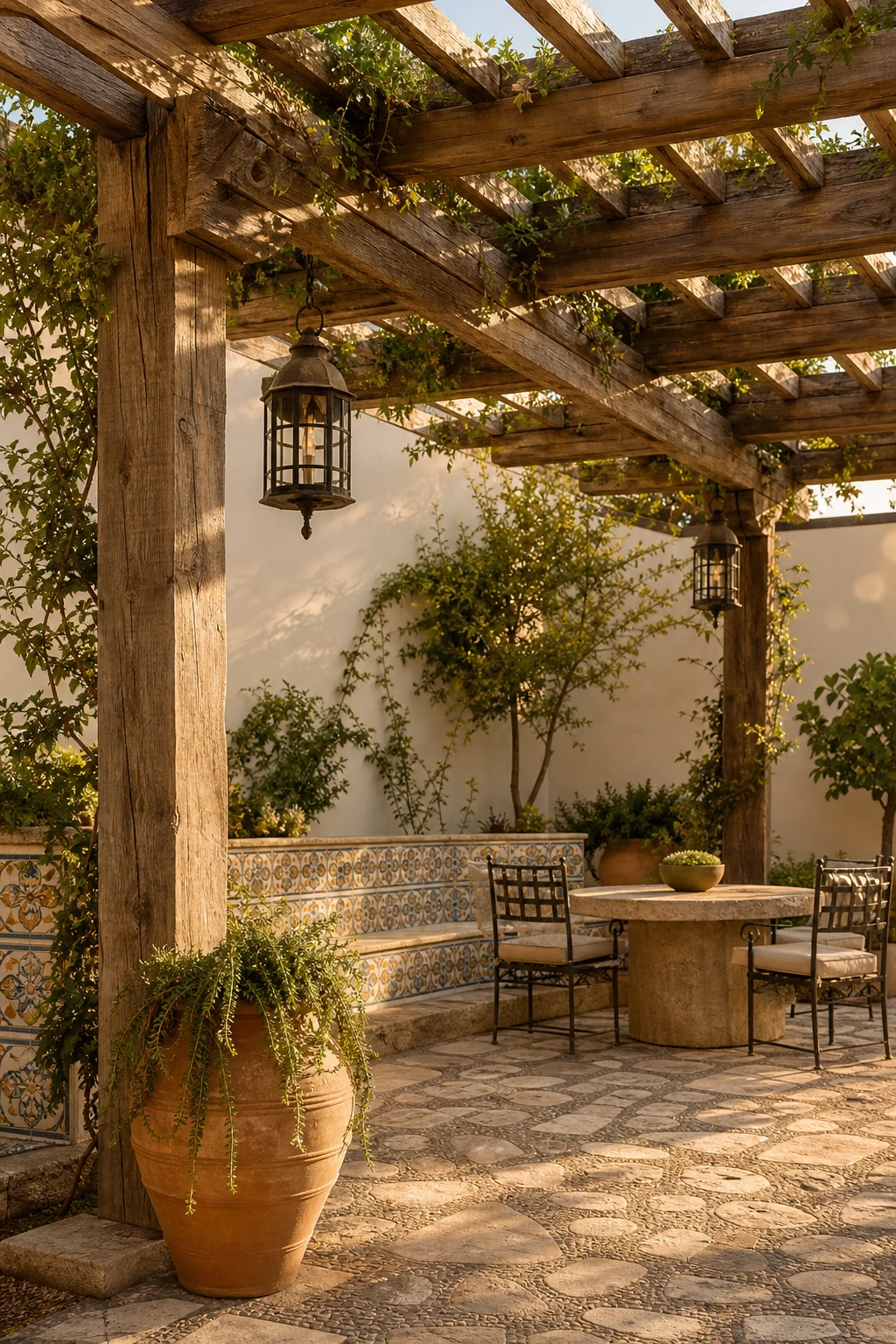
A pergola is the move I reach for when a garden needs a room but not a roof. Open beams let the sky stay part of the picture, so you get shelter and light at the same time. Rough sawn oak keeps the whole thing feeling earthy and rooted, which is exactly what Greek style asks for. Watch how the lattice overhead casts soft lines across the floor below and the space instantly reads as somewhere to sit and stay.
The Key Details
Rough sawn oak pergola beams with open lattice roof
Stone mosaic floor in sand and grey
Terracotta urns with trailing rosemary
Aged iron hanging lanterns
Hand painted ceramic tile low boundary wall
Pro TipSpace your pergola beams roughly 30 to 40 centimetres apart so the shade falls in strips rather than pooling into one flat shadow.
AvoidGoing up without a climbing plant plan leaves the structure looking bare for years, and bare timber without greenery loses the whole Mediterranean softness you are building toward.
The Mediterranean Pool That Looks Like It Was Carved From the Hillside
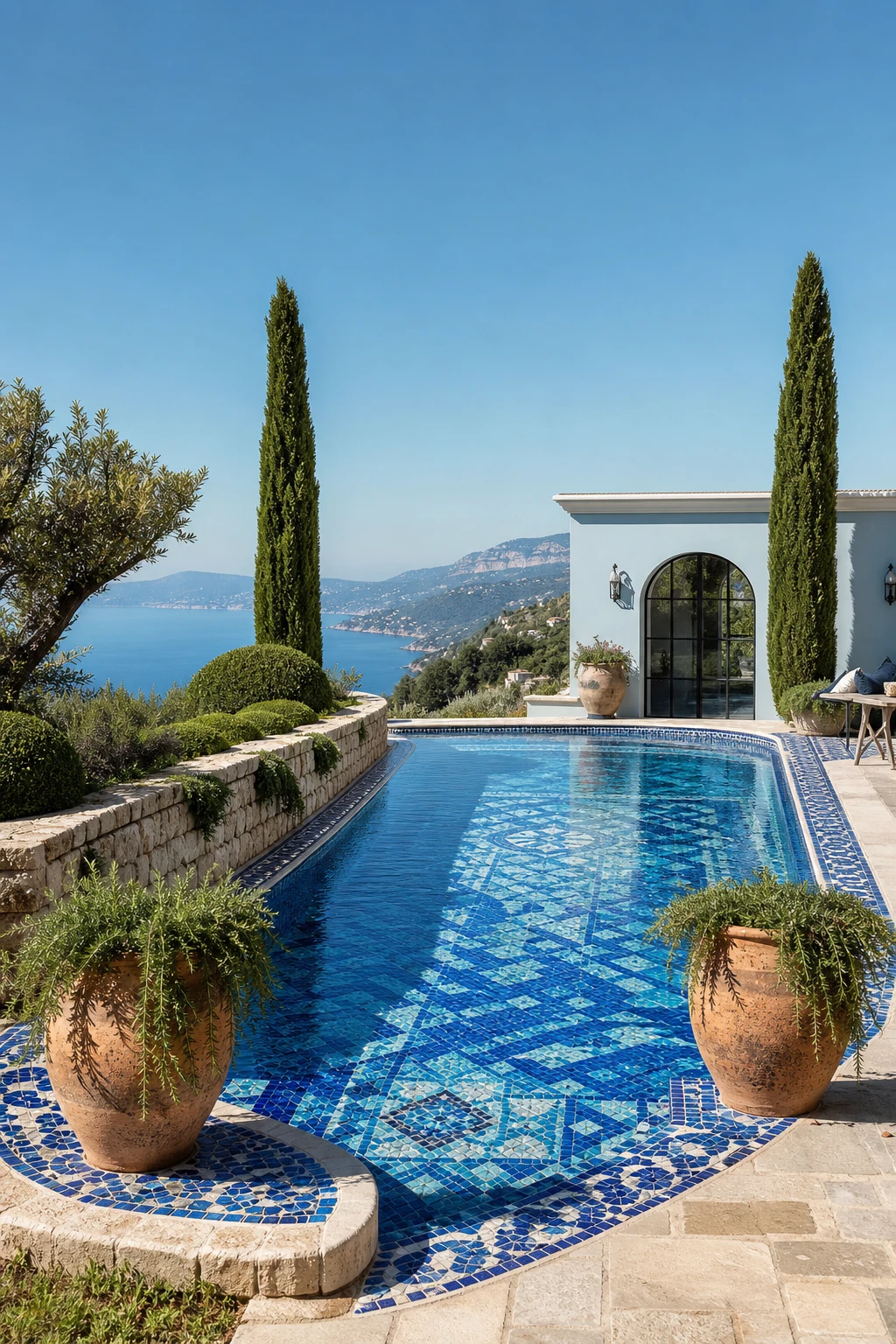
A pool that looks carved from the hillside wins me over every time, because it stops feeling like a feature and starts feeling like it belongs. The rough hewn limestone coping blurs the line between water and land, and you get that deep jewel colour when a hand cut mosaic floor catches the light from below. Watch how the curved retaining wall and the sentinel cypress trees frame the water rather than just standing near it.
The Key Details
Hand cut ceramic mosaic pool floor
Rough hewn limestone coping and terrace
Weathered terracotta urns with trailing rosemary
Tall sentinel cypress trees
Low curved stone retaining wall with creeping thyme
Pro TipChoose a deep cobalt or sea green mosaic tile for the pool floor, as the colour intensifies when light refracts through the water and gives you that Aegean depth even on overcast days.
AvoidLeaving large expanses of bare concrete around a pool drains the warmth from the whole garden and makes even the most beautiful water feel like a municipal leisure centre.
Outdoor Stairs That Make a Sloping Garden Feel Purposeful and Beautiful
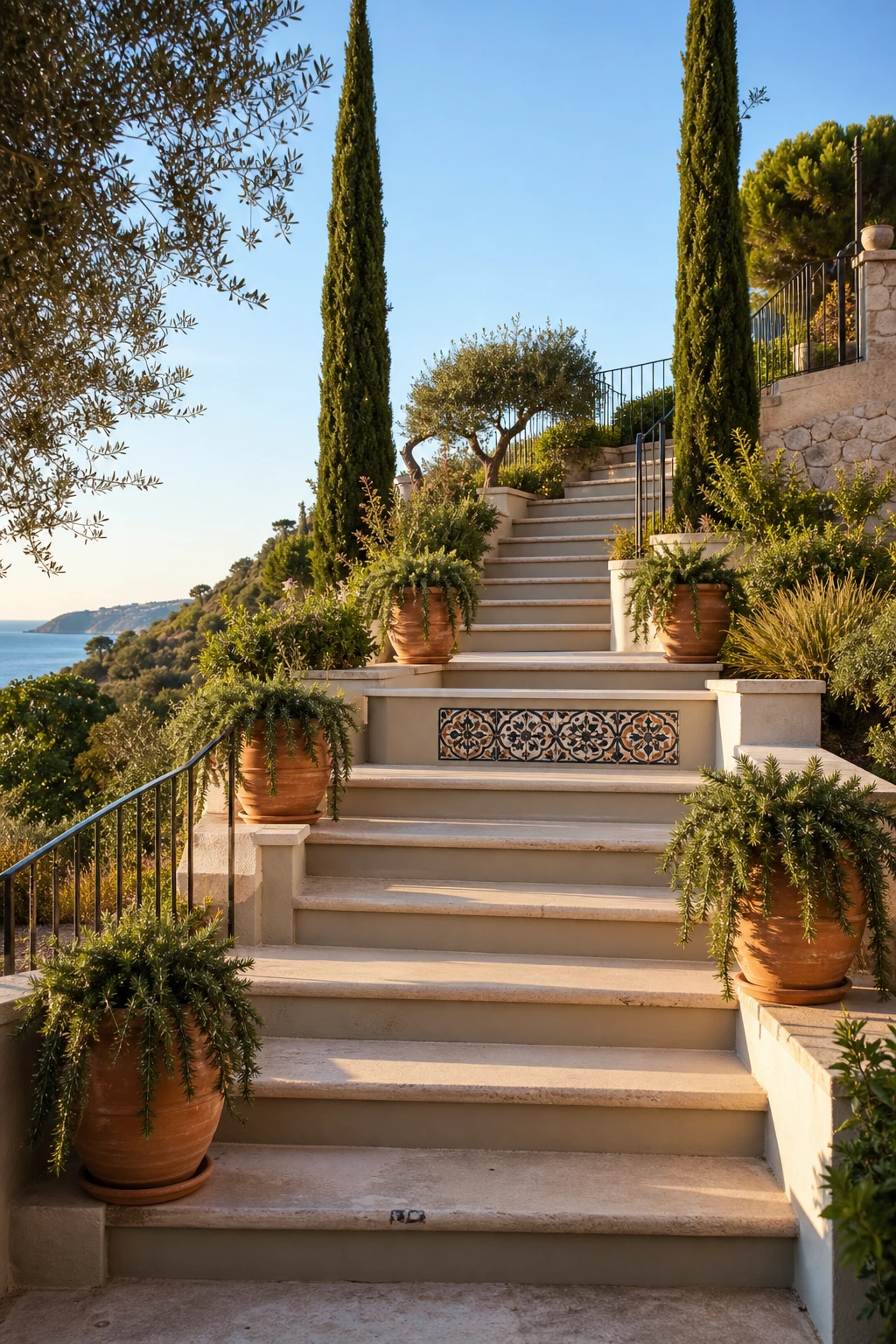
A sloping garden is one of those challenges I actually get excited about, because the moment you add stairs you turn a problem into a procession. Each tread draws the eye downward and gives the whole space a sense of arrival. What I love here is how limestone, terracotta and a mosaic riser inset make every step feel like a destination rather than just a way of getting somewhere. You notice the garden unfolding as you descend, which is far more satisfying than a flat lawn ever manages.
The Key Details
Limestone step treads
Terracotta planted urns
Italian cypress trees
Mosaic ceramic riser inset
Weathered iron balustrade
Pro TipTuck low trailing herbs like thyme or oregano into the soil at each stair edge so the planting spills softly over the stone and breaks that hard line between tread and border.
AvoidKeeping every riser and tread the same plain colour turns the staircase into a ladder, and the whole feature loses the layered warmth that makes Mediterranean steps so compelling.
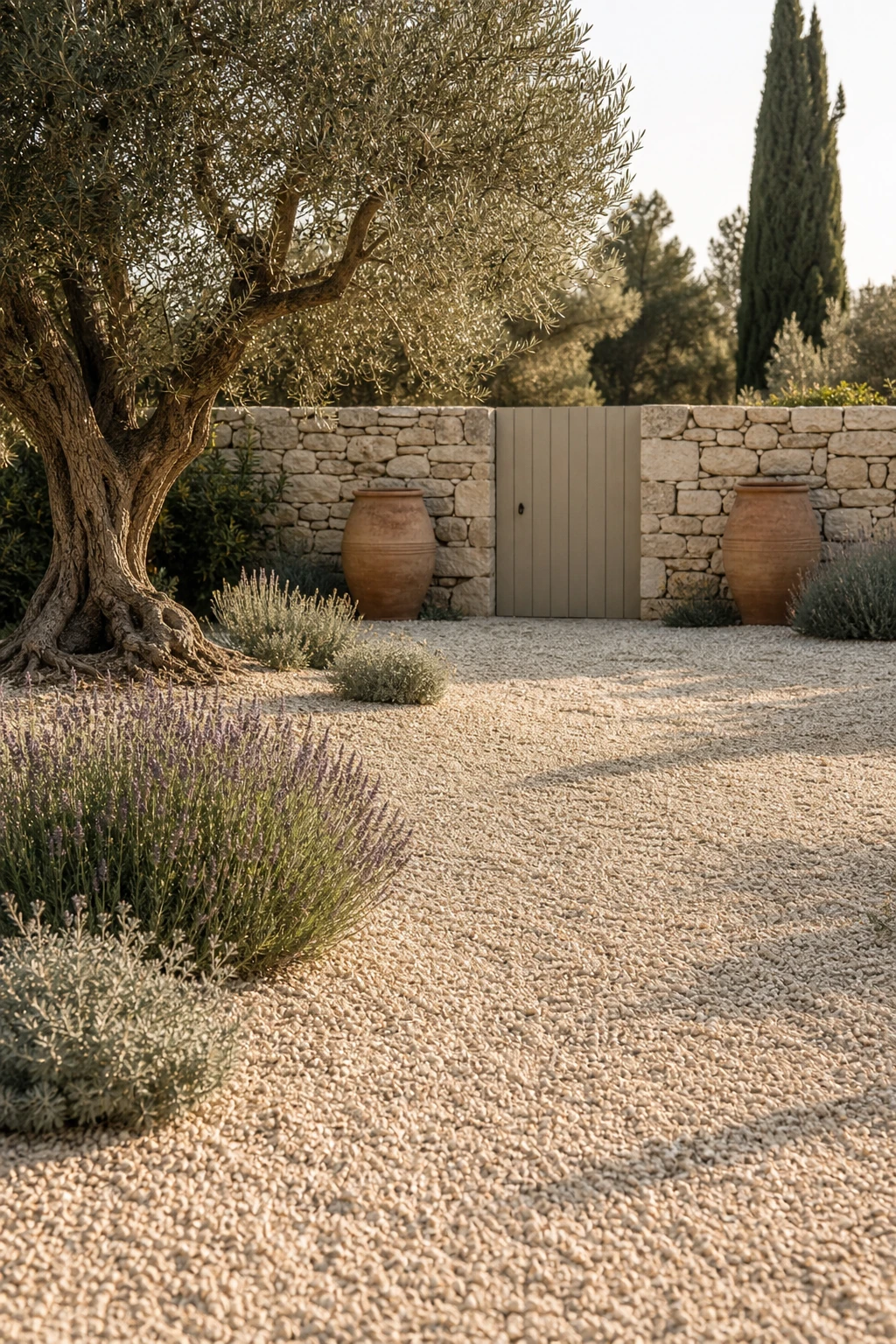
A Gravel Garden That Gives You the Greek Countryside With Almost No Upkeep
Gravel is one of my favourite moves in a Mediterranean garden because it does two jobs at once: it locks in that sun baked, dusty Greek countryside feeling and almost eliminates weeding in one go. You get a warm, textured ground plane that shifts colour through the day as the light changes, and the loose surface lets rain drain straight through so your plants stay happy. Watch how it ties everything together, pulling the urns, the olive tree and the dry stone wall into one cohesive scene.
The Key Details
Pale limestone gravel ground cover
Aged terracotta urns
Dry stone limestone boundary wall
Gnarled olive tree specimen
Drought tolerant lavender and thyme planting
Pro TipLay a permeable landscape fabric underneath the gravel before you spread it, and you will cut weeding time down to almost nothing while still letting water through to the roots below.
AvoidChoosing a very pale, bright white gravel creates harsh glare on sunny days and actually makes the space feel cold rather than warm and Mediterranean.
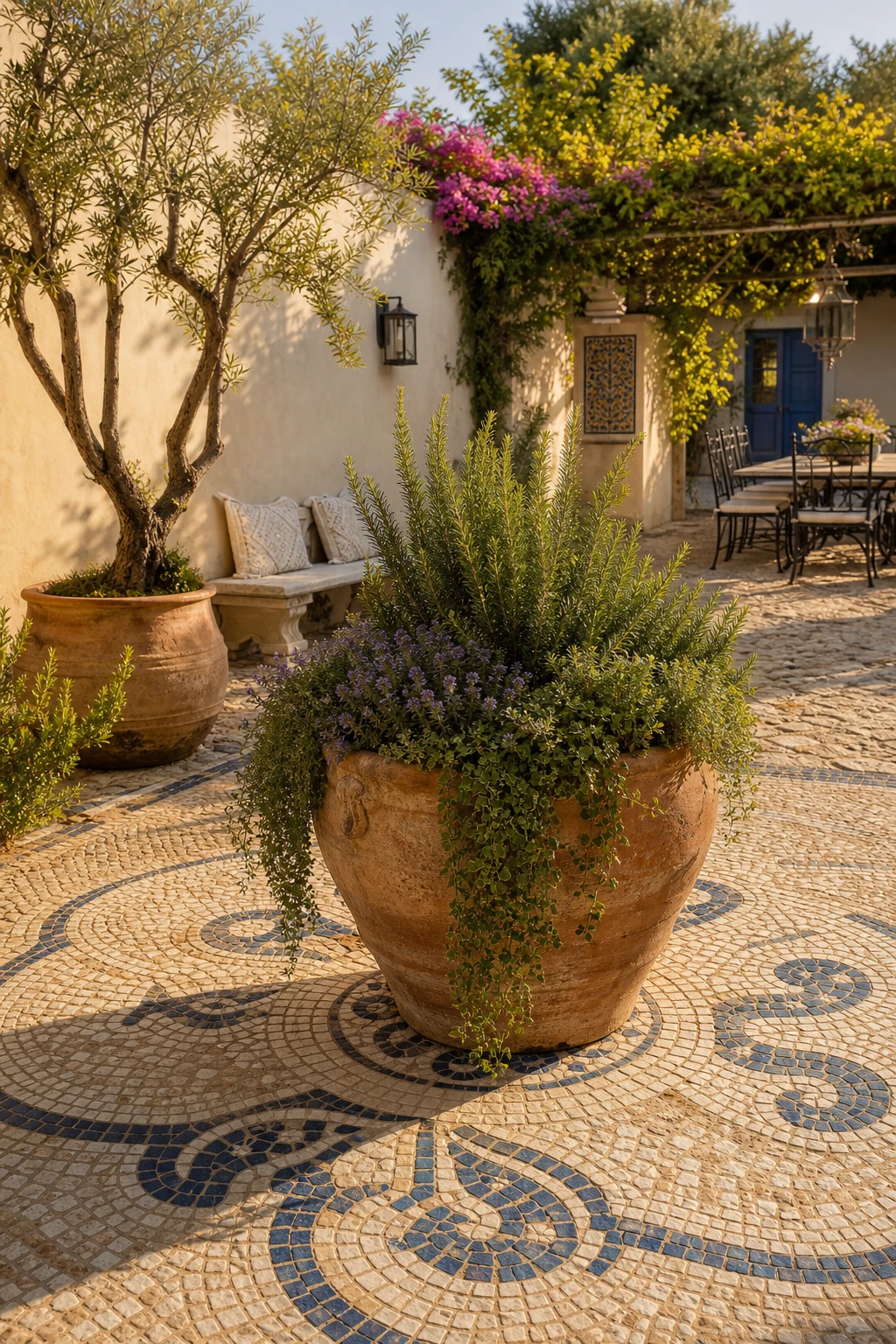
The Courtyard Planter That Does More Work Than You Might Expect
Planted containers are one of my favourite tools for shaping a courtyard without laying a single new stone. You get soft, movable boundaries that read as zones rather than walls, and the aged terracotta against cobalt mosaic tiles gives that warm, sun bleached quality I always chase in Mediterranean work. Watch how the olive tree anchors the centre while trailing lavender and rosemary soften the edges, the whole space breathes and feels deliberate.
The Key Details
Aged terracotta urn planter
Hand cut cobalt and cream mosaic floor tiles
Potted olive tree in matching terracotta vessel
Rough hewn limestone perimeter wall bench
Trailing herb planting of lavender rosemary and oregano
Pro TipFill your courtyard pots with lavender, rosemary or oregano, all three thrive in full sun with very little water and release scent every time someone brushes past them.
AvoidWatering on a fixed daily schedule in full sun will waterlog the roots long before the compost surface looks wet, and most Mediterranean plants will rot quietly before you notice anything is wrong.
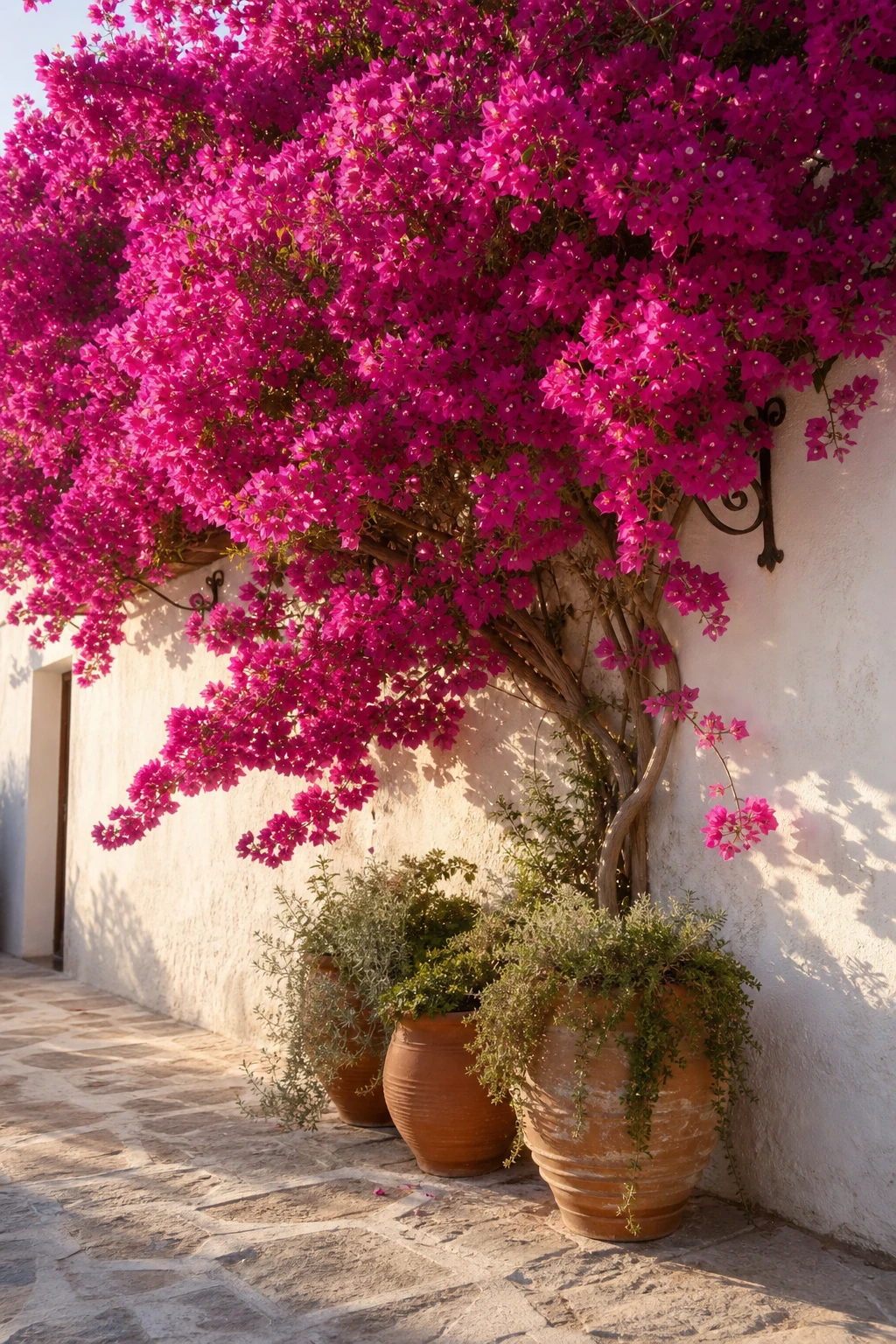
Bougainvillea on a White Wall: the One Plant That Does It All
Bougainvillea against a white wall is one of those combinations that stops you in your tracks, and what wins me over every time is how one plant carries the entire colour story. You get this fierce, saturated magenta or coral pushed against that flat, brilliant white, and the contrast is so clean nothing else needs to compete. The woody stems add age and structure, so even out of flower the wall has something to say.
The Key Details
Lime rendered masonry wall
Wrought iron climber bracket
Terracotta pot cluster
Sun bleached stone paving
Woody bougainvillea vine stems
Pro TipCut back watering in June and July to stress the plant slightly, because bougainvillea flowers hardest when its roots are kept on the dry side.
AvoidPlanting bougainvillea in a sheltered frost pocket or against a north facing wall will exhaust the plant trying to survive rather than flower, and you will likely lose it in the first hard winter.
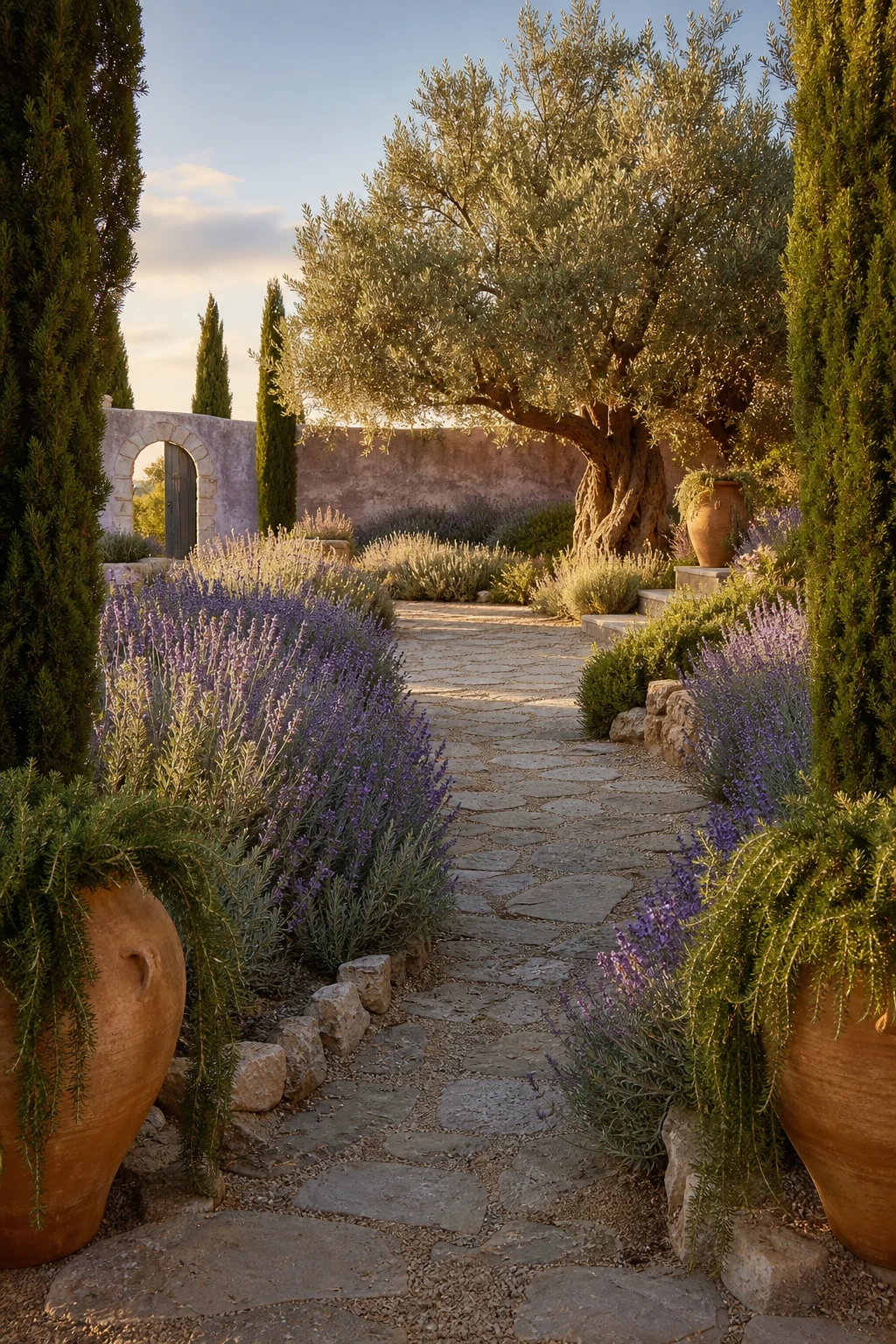
Lavender Borders That Make a Mediterranean Garden Smell Like Summer
Lavender borders do something no painted wall or patterned tile can quite manage: they pull you in through scent before you even register the colour. What I love about running them along a path is that every brush of a hand or passing shoulder releases that warm, herbal hit and suddenly the garden feels fully alive. You get a silvery purple haze that softens hard limestone edges beautifully, and the bees that follow make the whole thing feel genuinely abundant.
The Key Details
Billowing lavender border rows
Weathered limestone path
Terracotta urns with trailing rosemary
Clipped cypress columns
Gnarled olive tree specimen
Pro TipCut each plant back by about a third right after the flowers fade, taking stems down to where you can see fresh green shoots, and you will get a tighter, bushier plant that flowers generously again the following year.
AvoidPlanting lavender straight into heavy clay without first digging in grit or raising the bed traps moisture around the roots and the plant will rot over winter rather than thrive.
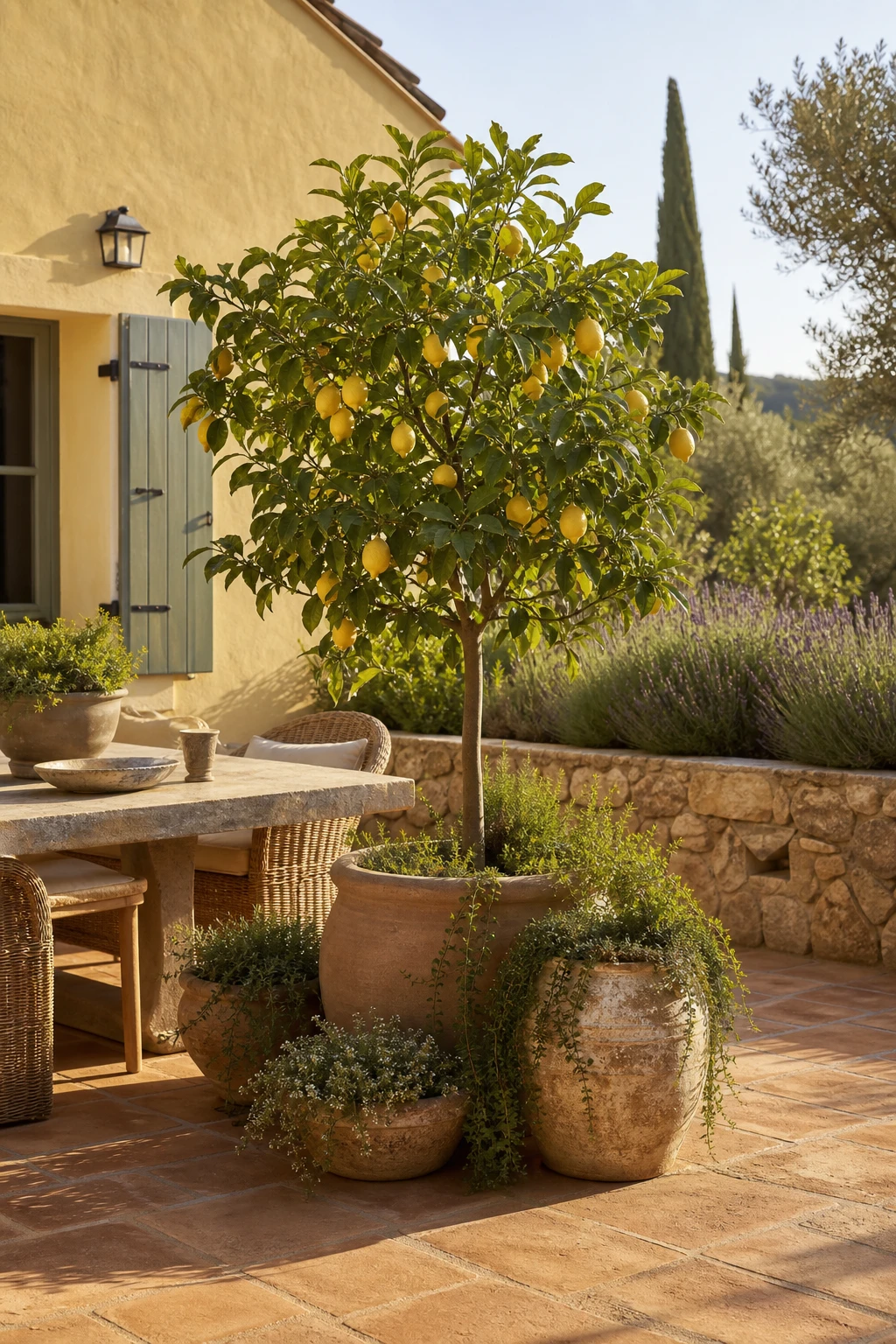
A Lemon Tree on the Patio and the Way It Makes Every Morning Feel Different
A lemon tree on the patio does something no purely decorative plant can match: it earns its place twice over, once with those glossy leaves catching the morning light, and again when you actually pick the fruit. What I love about combining edible and ornamental planting is how grounded it feels, real and useful rather than just pretty. You get fragrance, texture, and colour all at once, and the tree anchors the whole space so everything else, the stone table, the rattan chairs, the herb pots, orbits it naturally.
The Key Details
Mature potted lemon tree
Terracotta floor tiles
Woven rattan chairs with linen cushions
Hand thrown ceramic herb pots
Rustic stone topped garden table
Pro TipMove your container lemon tree inside before the first frost arrives, placing it in the brightest window you have and misting the leaves every few days to compensate for dry indoor air.
AvoidSkipping the specialist citrus feed through spring and summer leaves the tree starved of the magnesium and iron it needs, which shows up fast as yellowing leaves and almost no fruit the following season.
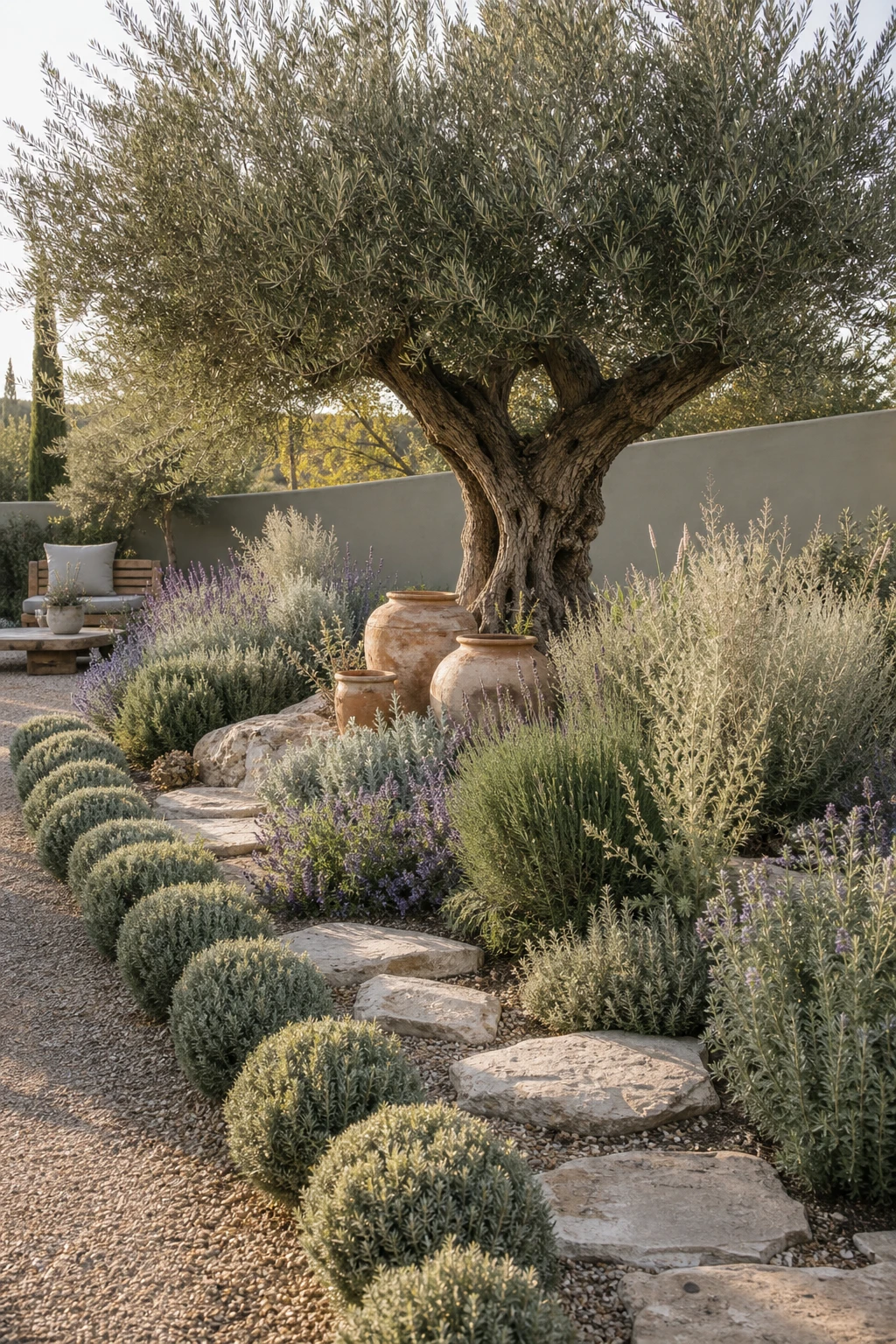
Plants That Look Beautiful Growing Beside an Olive Tree
Planting around an olive tree is one of my favourite things to get right, because the tree itself sets such a strong mood and the companions either lift it or kill it. What I reach for are plants in that same silvery, dusty palette: lavender, rosemary, and Russian sage all echo the olive’s grey green leaves so you get a soft, layered canvas rather than a jumble. Varying the heights, low mounds at the front, taller spikes behind, gives the whole grouping a natural rhythm you will notice immediately.
The Key Details
Gnarled olive tree canopy
Layered silvery companion planting
Weathered terracotta urns
Flat limestone stepping stones
Fine gravel garden path
Pro TipChoose companions that thrive in the same free draining, full sun conditions as the olive, so the whole planting needs identical watering and you never have to compromise.
AvoidPlanting moisture loving shade plants beneath an olive tree creates a watering conflict that stresses both plants and slowly ruins the look you worked hard to build.
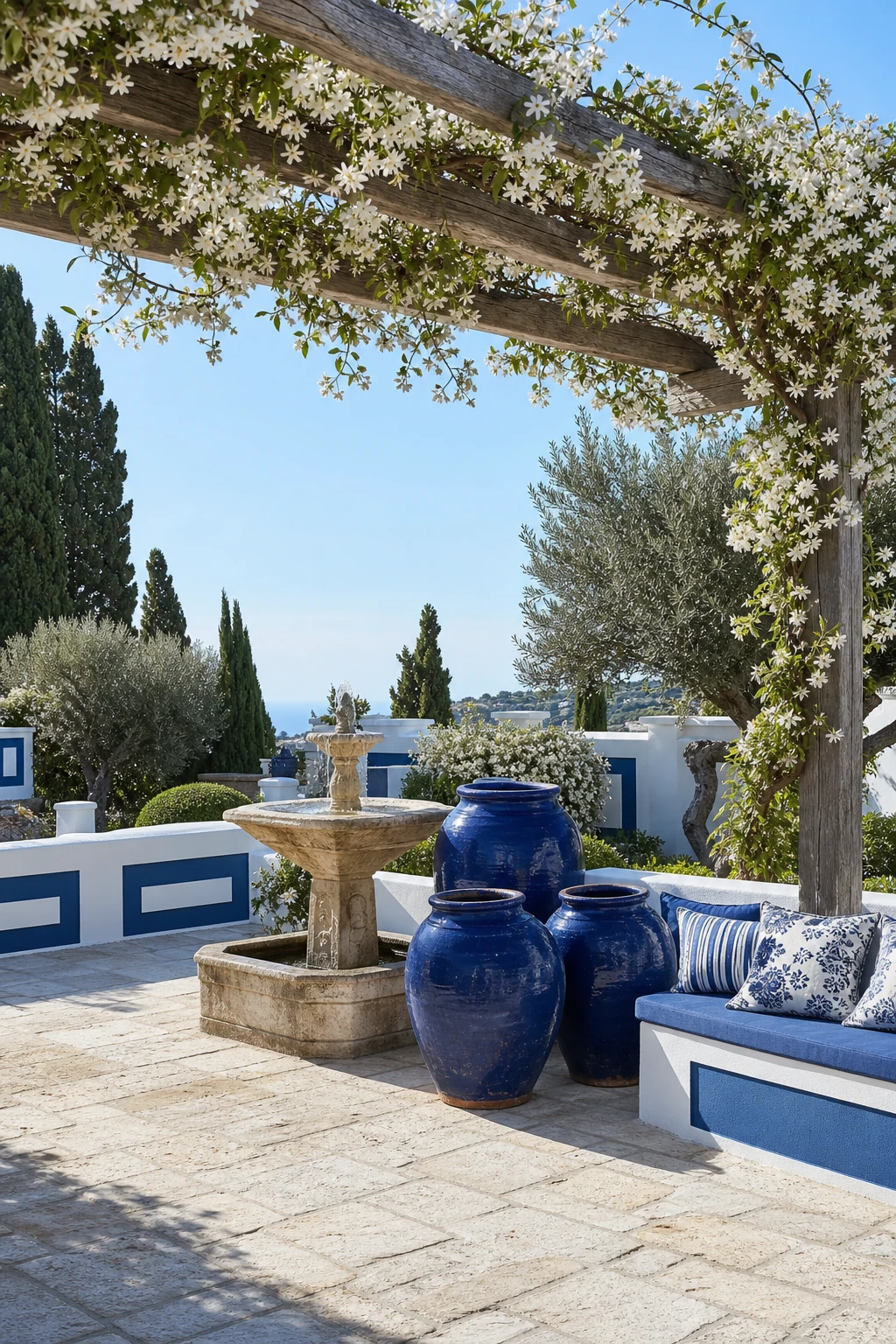
Blue and White in a Greek Garden and the Ratio That Makes It Work
Blue and white is the soul of Greek style, but the ratio is everything. What I love here is the way white carries the space, washing across walls, paving and pergola beams, while cobalt arrives in concentrated hits on the urns and fountain. You get that instant Aegean feeling without the scheme tipping into a nautical costume. Watch how the eye travels between the blue accents and finds calm, not competition.
The Key Details
Cobalt glazed terracotta urns
Whitewashed rendered boundary walls
Rough hewn timber pergola
Hand cut limestone pavers
Carved stone fountain
Pro TipTreat white as your base canvas at roughly 80 percent of the surfaces and keep blue to the remaining 20 percent in moveable pieces like urns and cushions, so you can adjust the balance without repainting a wall.
AvoidSplitting the two colours evenly across the garden flattens both of them, leaving the scheme looking restless and unresolved rather than crisp and intentional.
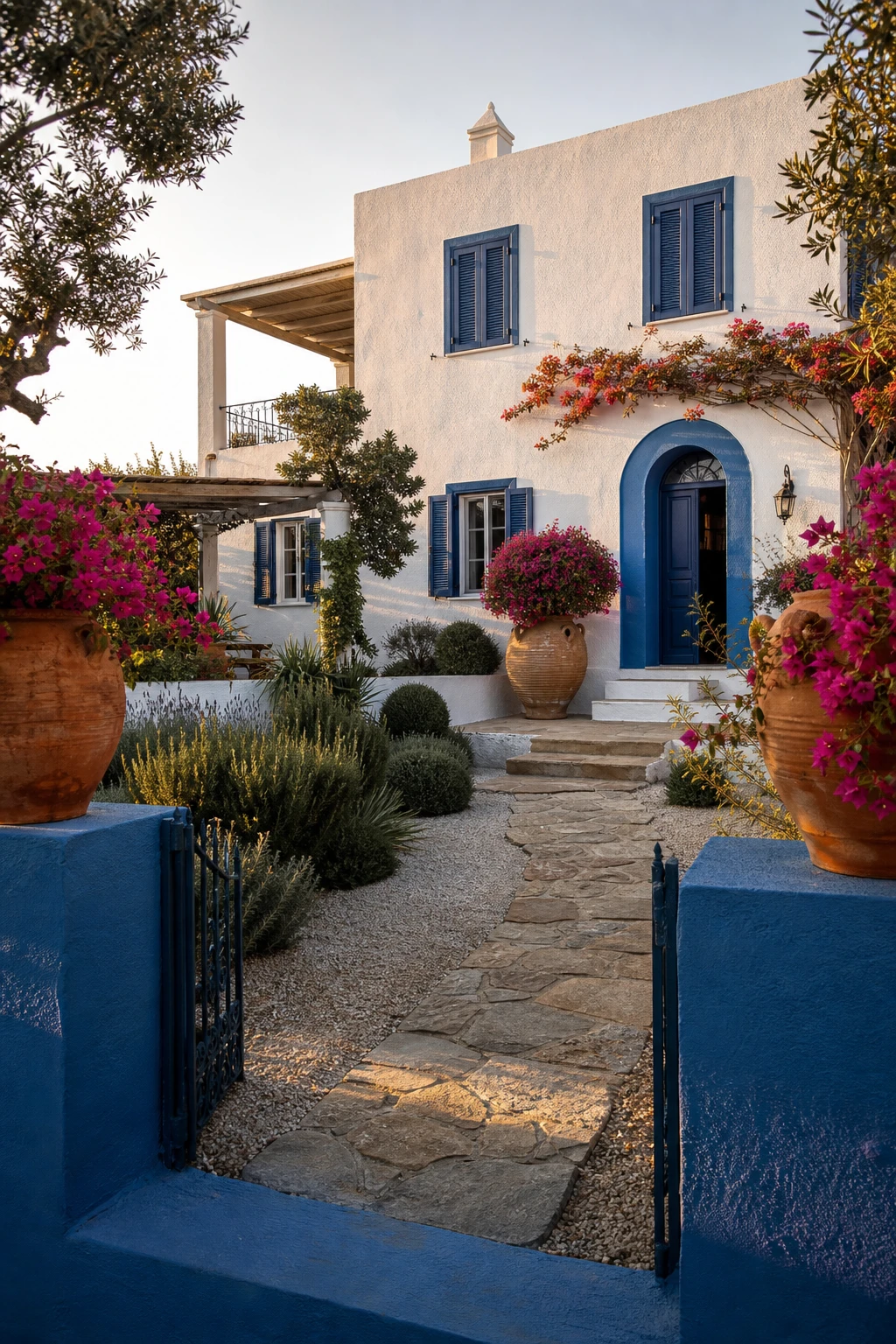
Blue Accents on a White House: the Detail That Gives a Greek Garden Its Identity
That clean snap of cobalt against white is something I keep returning to, and on a house facade it does more work than almost any other single decision. Painted shutters, a door surround, and a handful of matching pots create a rhythm that reads as deliberate from the street, tying the whole front of the house together without anything feeling overdone. The white stays in charge, the blue punctuates, and the result is that unmistakable Mediterranean crispness even on the most ordinary terrace.
The Key Details
Cobalt blue painted timber shutters
Blue painted arched doorway surround
Terracotta amphora pots
Gravel courtyard with clipped lavender edging
Weathered stone pathway
Pro TipPick one blue and use that exact same tin on every painted surface outside, from the shutters to the door surround to the terracotta pots, so the colour repeats like a thread running through the space.
AvoidMixing two or three similar but slightly different shades of blue across the same facade creates a restless, unfinished feeling that undercuts all the crispness you are working so hard to achieve.
How to Add Colour to a Mediterranean Courtyard Without Losing the Calm
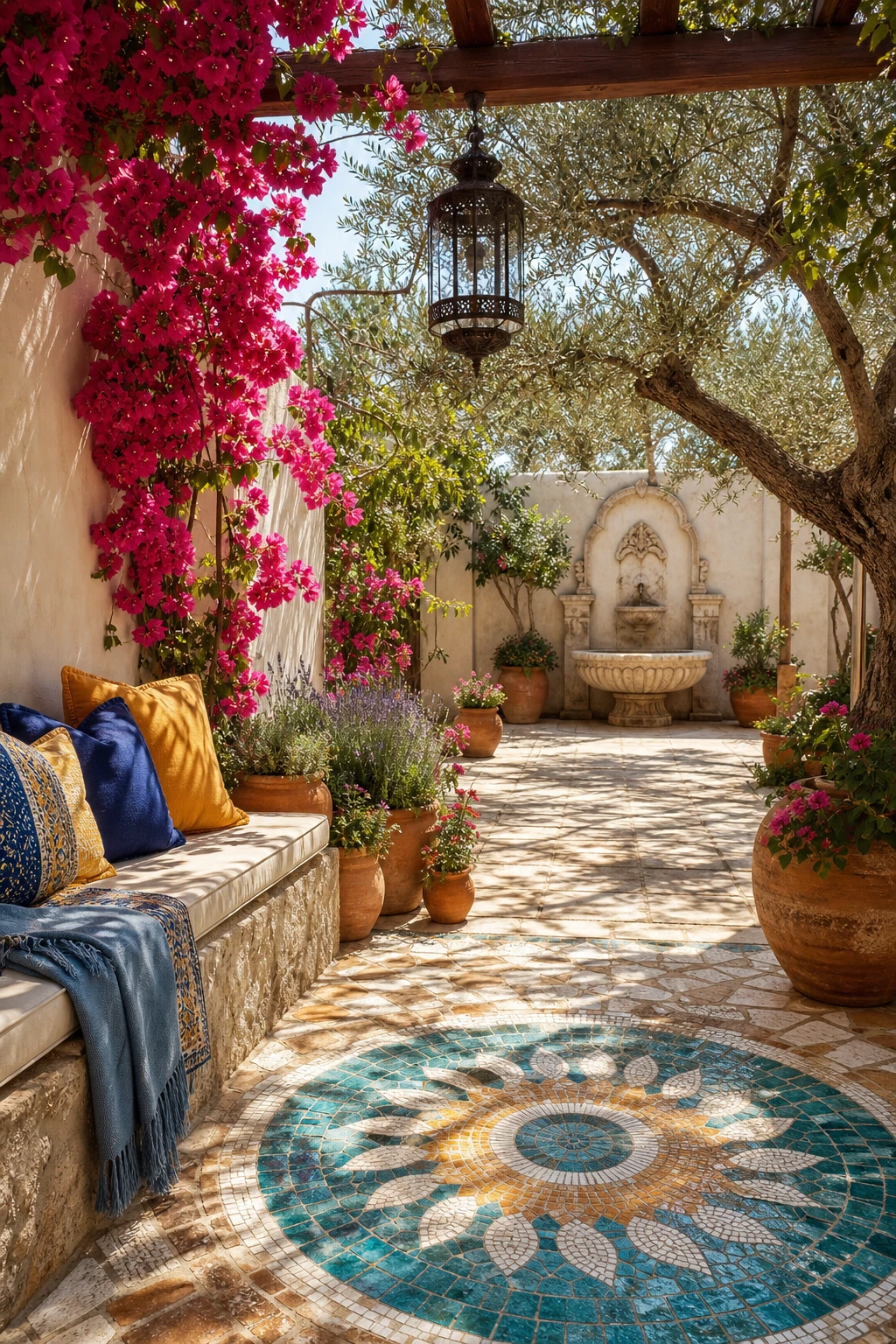
Colour in a Mediterranean courtyard hits differently when it comes from living things rather than paint. What I love about this approach is that bougainvillea, terracotta, and woven textiles give you richness that breathes and shifts with the light, so you get warmth without the space feeling heavy. The stone and render stay pale and quiet, and that neutrality is exactly what lets the plants do the talking.
The Key Details
Cascading bougainvillea wall planting
Mosaic tiled floor medallion
Graduated terracotta pot cluster
Woven textile cushions on stone bench
Wrought iron pergola lantern
Pro TipKeep every paved and rendered surface in a warm off white or sand tone so the moment a single pot cluster or textile arrives, the colour reads immediately rather than fighting the background.
AvoidPainting two or three courtyard walls in saturated terracotta or ochre leaves the plants with nothing to contrast against, and the whole space ends up looking muddy rather than vibrant.
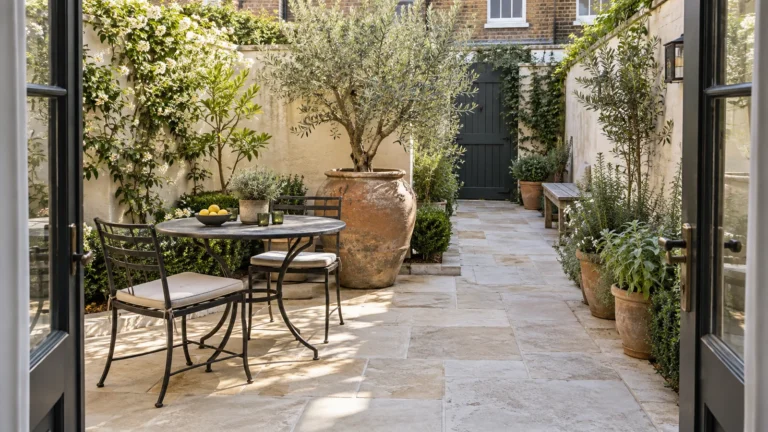
Patio Furniture That Feels Genuinely Mediterranean Rather Than Generic
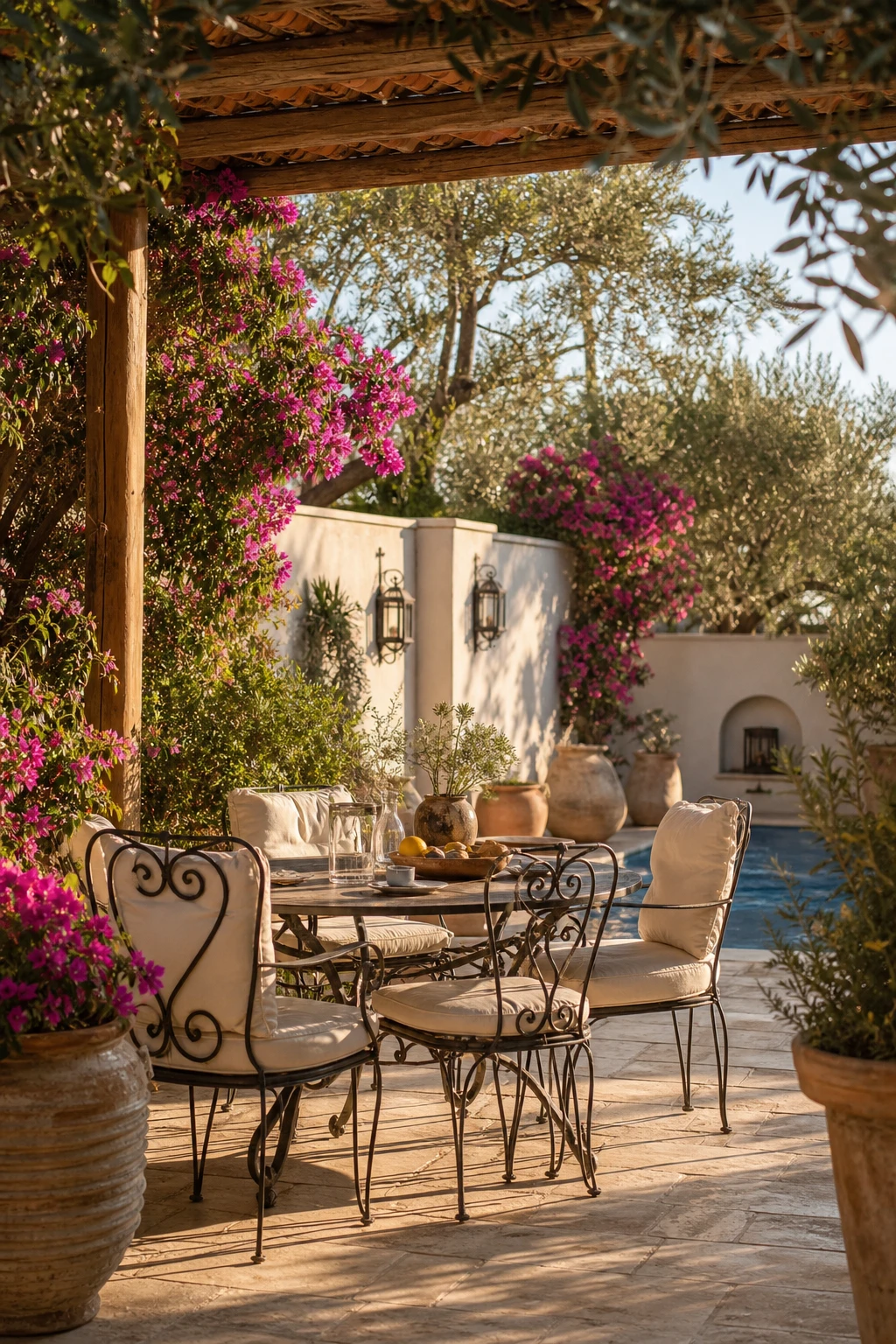
Wrought iron and woven rattan are the materials I reach for when a patio needs to feel genuinely rooted in the Mediterranean rather than just loosely themed. The weight of iron gives you that sense of permanence, and you will notice how it anchors the space against pale limestone or a rendered wall in a way that lighter materials simply cannot. Rattan softens the arrangement so it never tips into cold or formal, and together the two textures read as warm, considered, and completely at home outdoors.
The Key Details
Wrought iron dining set
Limestone paving
Terracotta urns
Timber and clay tile pergola
Rendered garden wall
Pro TipPair a wrought iron table base with rattan or woven seat backs so the furniture reads as layered and collected rather than matching and ordered.
AvoidPlastic furniture, even good quality plastic, shrinks the whole patio down and strips out the crafted, sun bleached quality that makes a Mediterranean space feel real.
Blue Garden Seating: the One Painted Piece That Pulls a Greek Garden Together
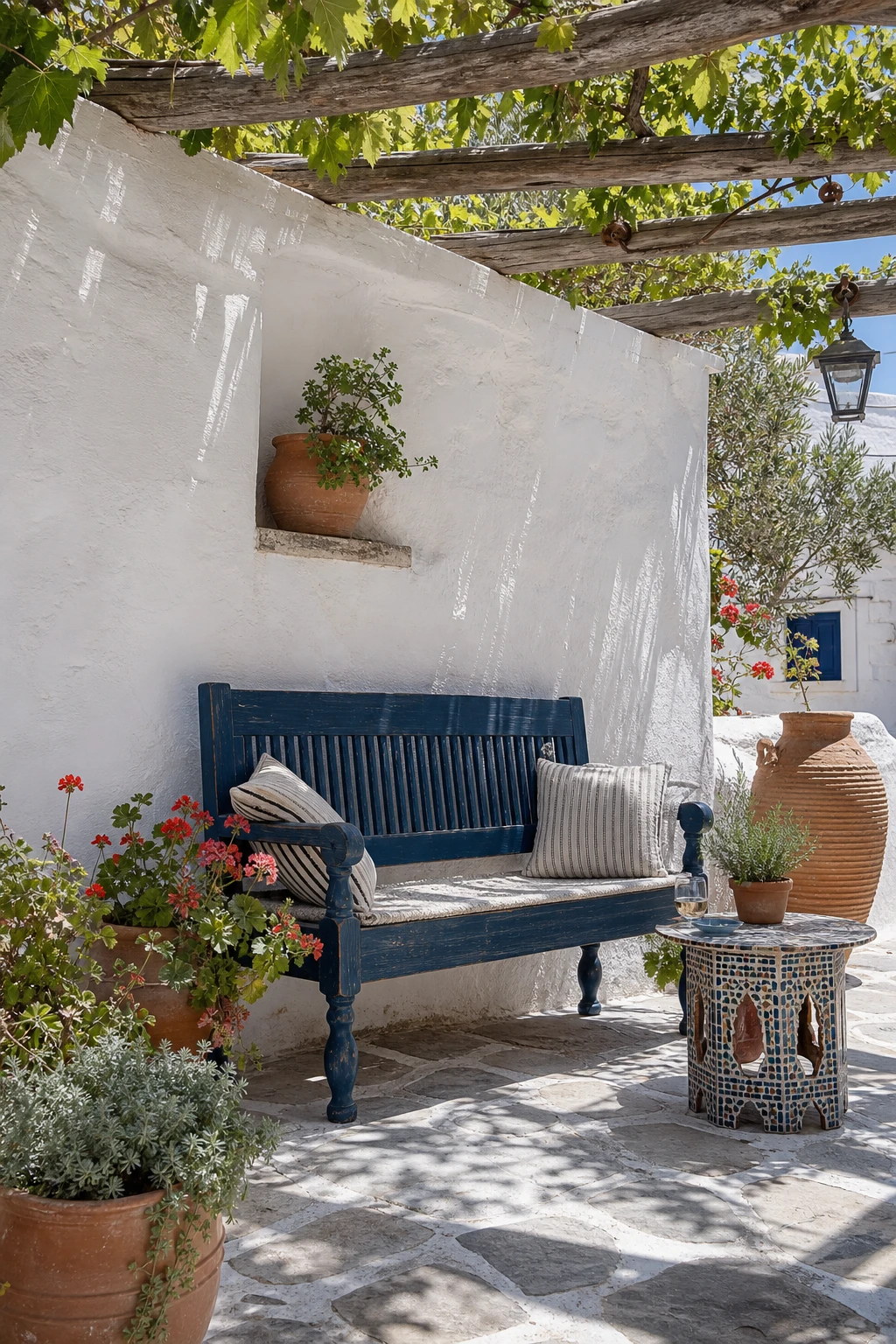
A single painted bench or chair does something no cushion or pot can quite manage: it locks the whole colour story in place. What I love about going blue here is that the eye lands on it immediately, then travels outward and suddenly the stone, the terracotta, the timber all feel chosen rather than collected. You get that instantly recognisable Greek island mood without a complete overhaul.
The Key Details
Weathered timber bench
Mosaic tile side table
Hand laid stone flag paving
Timber pergola overhead
Terracotta amphora floor accent
Pro TipOnce the paint is dry, seal the piece with a UV resistant topcoat so the blue stays vivid through a full season of sun rather than chalking out by August.
AvoidPainting every chair, table and planter the same shade turns a bold accent into wallpaper, and the whole point of a colour anchor is that it stands out from everything around it.
A Greek Balcony Look That Works Even When Your Outdoor Space Is Tiny
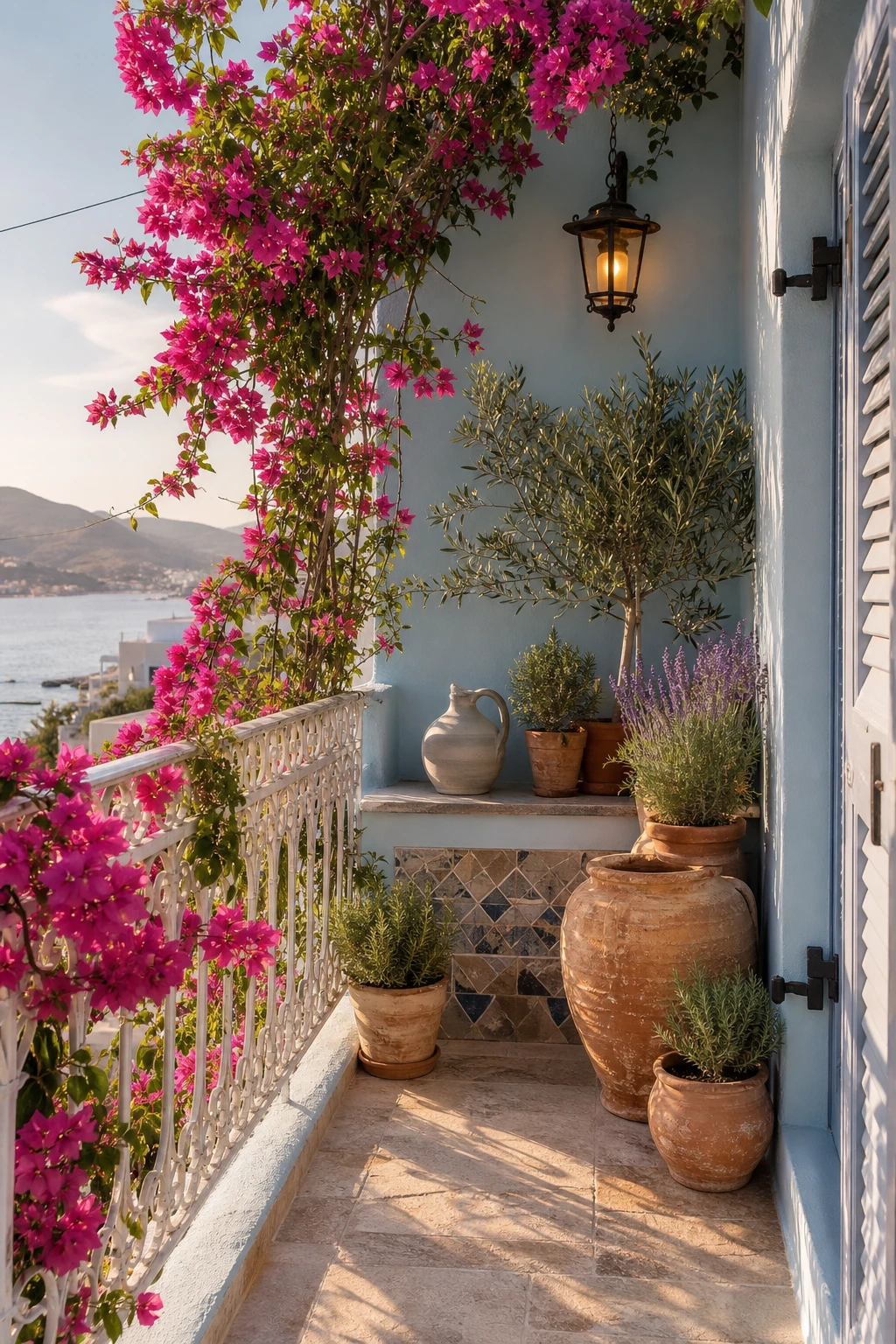
Tiny balconies come alive the moment you stop thinking about the floor and start working the vertical space, and Greek style gives you the perfect playbook for that. Whitewashed railings, trailing bougainvillea, and a mosaic tiled ledge stack so much character upward that you barely notice the square footage. What wins me over every time is how the eye travels up and out rather than around, so even a narrow strip of balcony feels like a proper garden room.
The Key Details
Whitewashed rendered iron railings
Trailing bougainvillea and climbing vines
Aged terracotta herb pots
Hand cut mosaic tiled ledge
Wrought iron wall lantern
Pro TipClip railing planters along the inside edge of your balcony rail to keep the floor completely clear for a small bistro chair and still get that tumbling green effect.
AvoidPushing a full size lounger or wide dining set onto a small balcony eats every usable inch and leaves the space feeling like a corridor rather than a retreat.
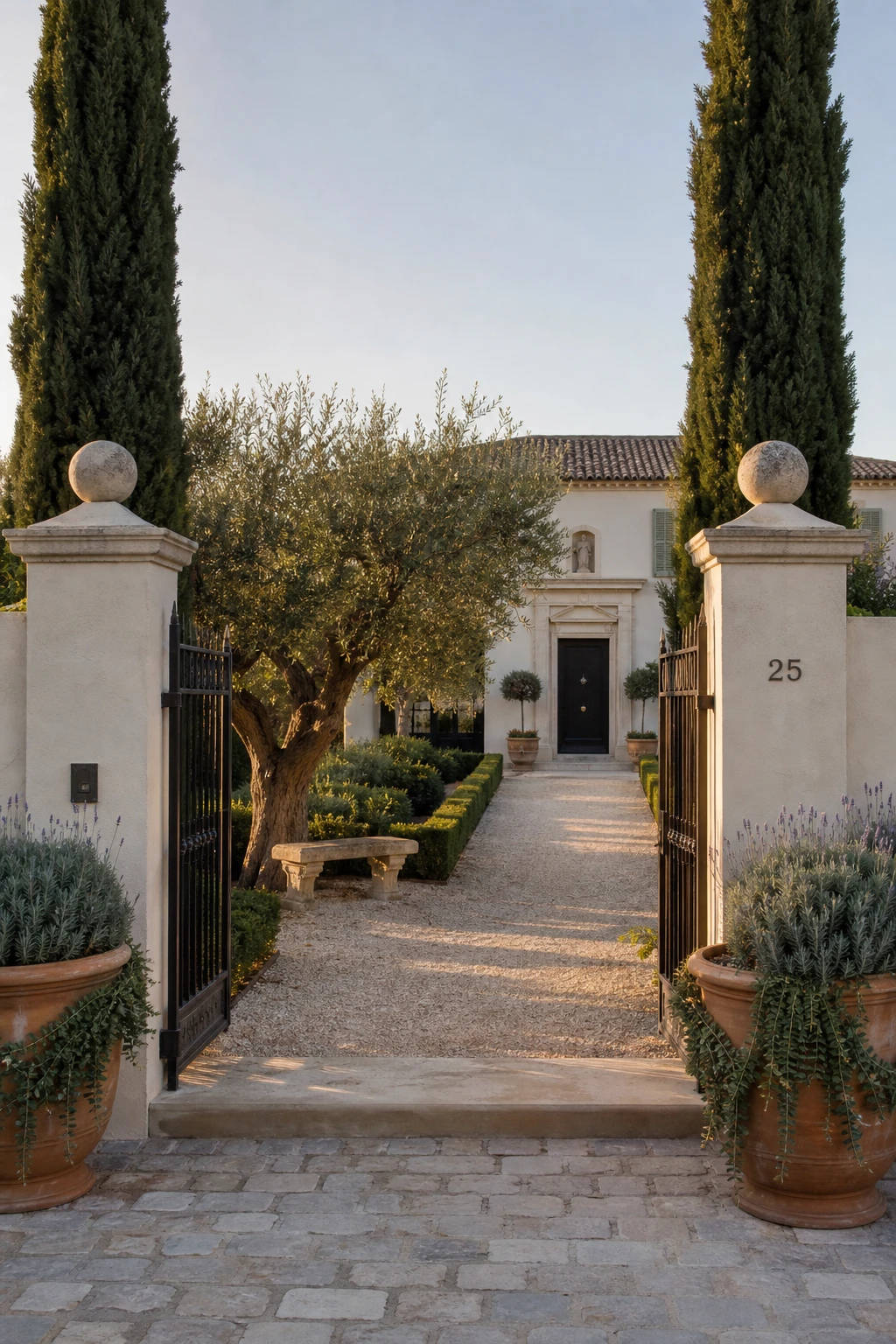
A Mediterranean Front Yard That Makes the Street Stop and Look Twice
A front yard sets the tone before anyone reaches the door, and the Mediterranean approach gets that right by layering height, scent, and texture all at once. Tall cypress trees pull the eye upward while terracotta urns at ground level anchor the space and invite you closer. What I love most is how the gravel path and limestone edging give the whole scene a settled, sun baked feeling, as though the garden has always been here.
The Key Details
Tall Italian cypress trees flanking the gateway
Terracotta urns with trailing rosemary and lavender
Broad gravel path with limestone cobble edging
Low clipped box hedge border
Weathered stone bench beneath an olive tree
Pro TipPlace matching urns with lavender on both sides of the front door at equal height so the entrance reads as intentional and balanced from the street.
AvoidLeaving the original concrete path in place while updating everything around it splits the character of the scheme and makes even the best planting look like an afterthought.
Alan launched Edward George London in 2017. Since completing his masters in Town & Regional Planning (MPlan) he has combined the skills he learned at the University of Sheffield with his passion for design, to help create a foundation for those looking to create a beautiful home.