Newsletter Subscribe
Enter your email address below and subscribe to our newsletter

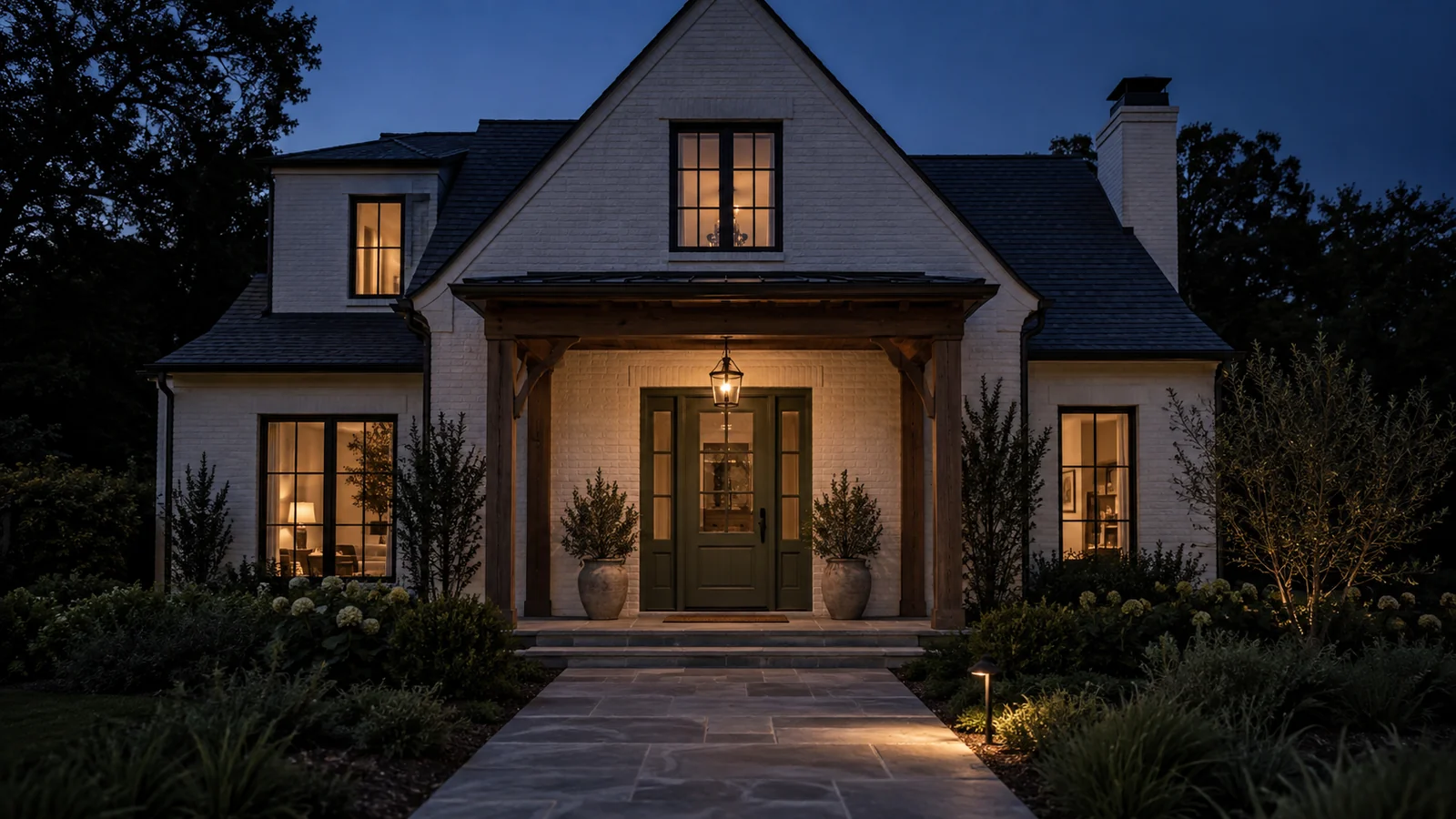
Modern farmhouse exterior lighting works best when it helps someone arrive, find the door and move through the approach comfortably. A lovely lantern is only one part of that job. The porch may need a gentle pool of light, steps need to be legible, and a side door can need a separate cue. If every surface glows at once, the house loses the depth that makes a farmhouse facade so appealing. This guide starts with the tasks you actually do after dark, then shows how to relate the front door, covered porch, path and garage without visual clutter. You can use it whether the frontage is chalk white brick, painted siding or a darker contemporary interpretation. The aim is a useful plan that feels warm from the street and calm when you stand at the threshold.
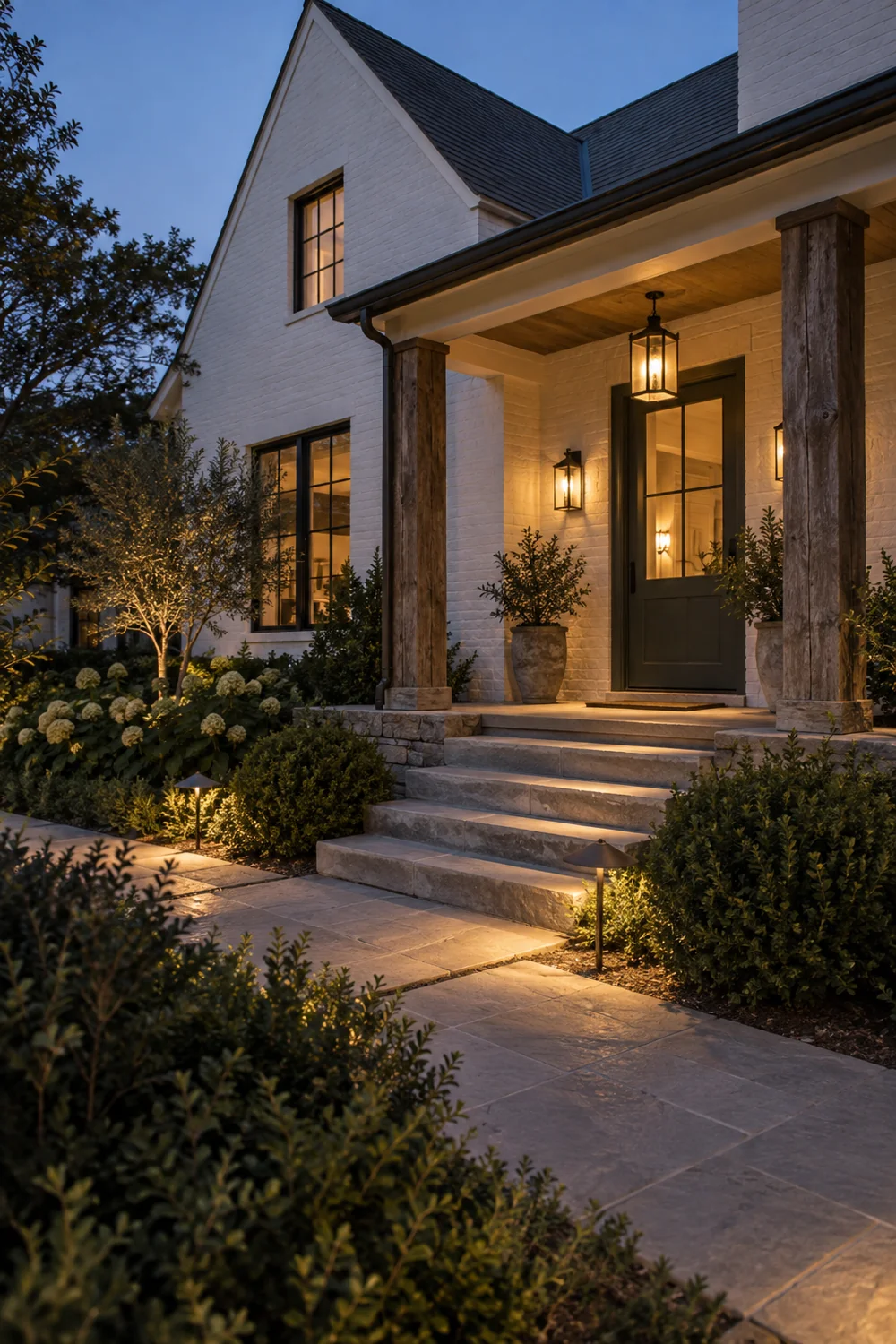
Before choosing a fixture, walk the approach at dusk and pay attention to what disappears first. Can you see where the path changes direction? Is the edge of each step clear? Does the door handle catch enough light to find it easily? Can a visitor tell which door is the main entrance? These questions are more useful than counting how many lamps appear in a photograph. They turn a vague wish for curb appeal into a short list of light tasks.
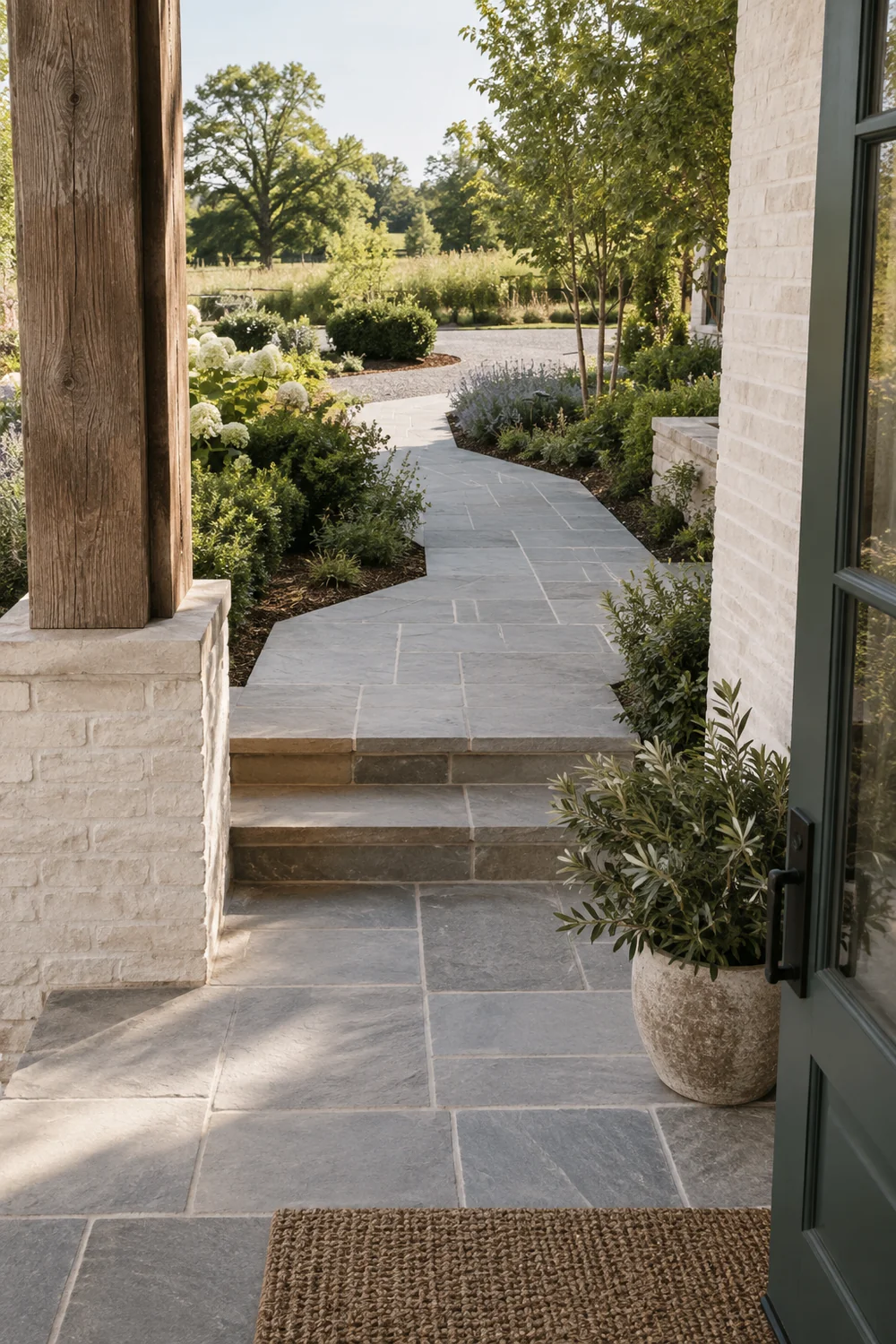
Sketch the front of the house and mark the route from the street or parking place to the entrance. Circle the door, any level change and the point where someone has to choose a direction. Then mark a second route to a garage or side door if it is used regularly. This simple drawing reveals whether one light can serve two tasks. A shielded porch fixture, for example, may brighten the entry landing and show the first step. A brighter lamp further out might make the same area harsh without improving the route.
Look at the house in daylight as well. The general farmhouse guide shows how a strong roofline, porch and cladding relationships set the wider house character. The fixtures should have a reason to sit on that architecture. A wall light beside a door has a clear task; a row of identical lights under every eave usually reads as decoration first. Treat the facade as a composition with a few useful points of emphasis.
The purpose led approach also keeps the night scene restrained. DarkSky International’s outdoor lighting principles recommend useful, targeted, low level, controlled and warm light. Those are good questions for a home design brief too. A farmhouse entrance feels more inviting when the door and route are readable against some darkness than when the entire building is evenly washed in light.
The front door is where the lighting plan becomes personal. Someone pauses to put down a bag, find a key, look at a lock, greet a visitor or check the threshold. The light should help with those small actions while leaving the person’s eyes comfortable. Start by standing where those actions happen. A fixture that looks perfectly centred in an elevation may cast a shadow across the lock or shine directly into a visitor’s face.
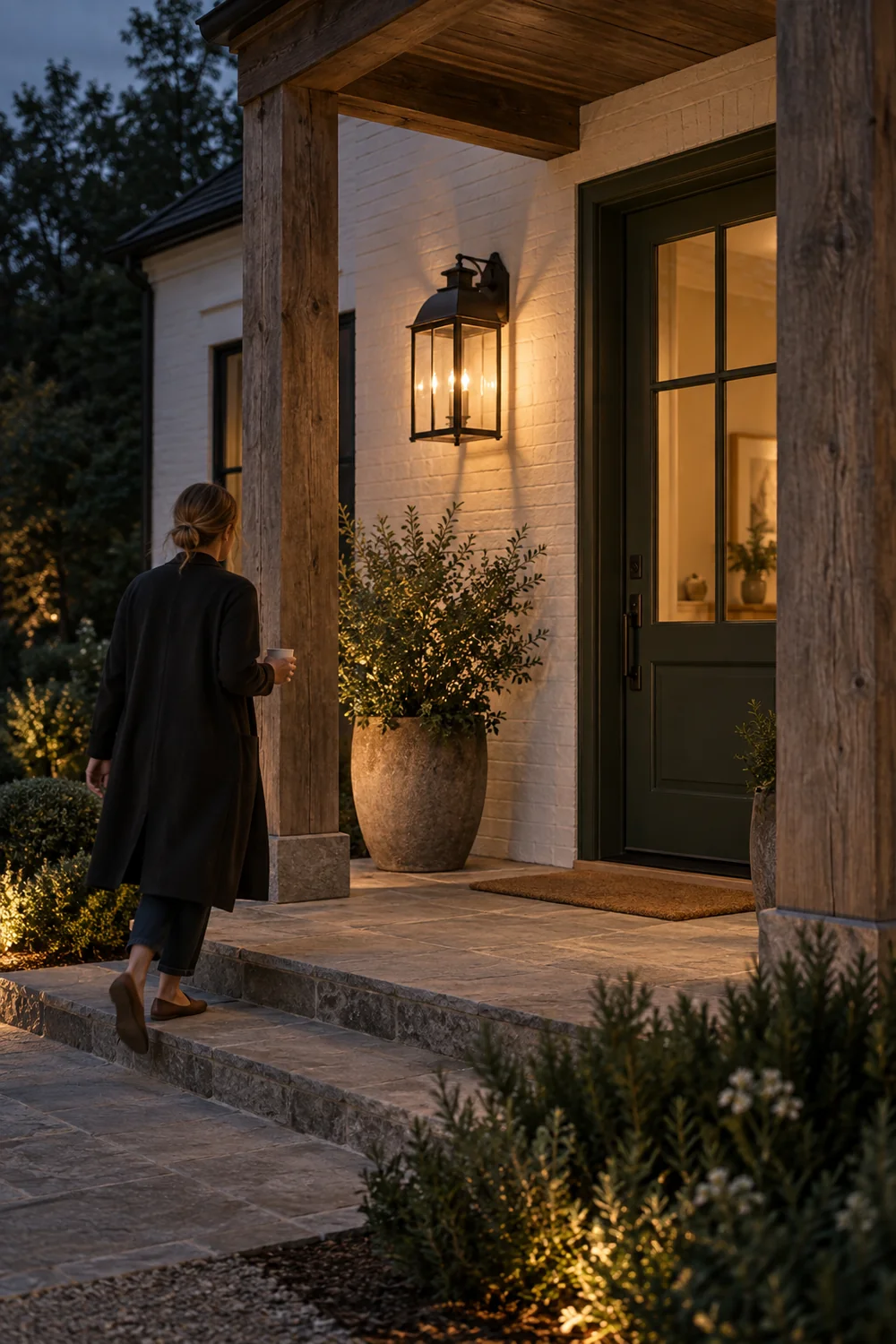
If the door has enough wall space, one well placed sconce can define the entrance. On a wider doorway, a pair can make the composition feel settled, provided neither crowds the trim or porch posts. Look at the actual door swing, glazing and hardware before deciding. If a fixture lands too close to the open door or a deep porch column, its light may be blocked. The goal is a useful pool across the handle and landing, not a rule that every door must have symmetrical lanterns.
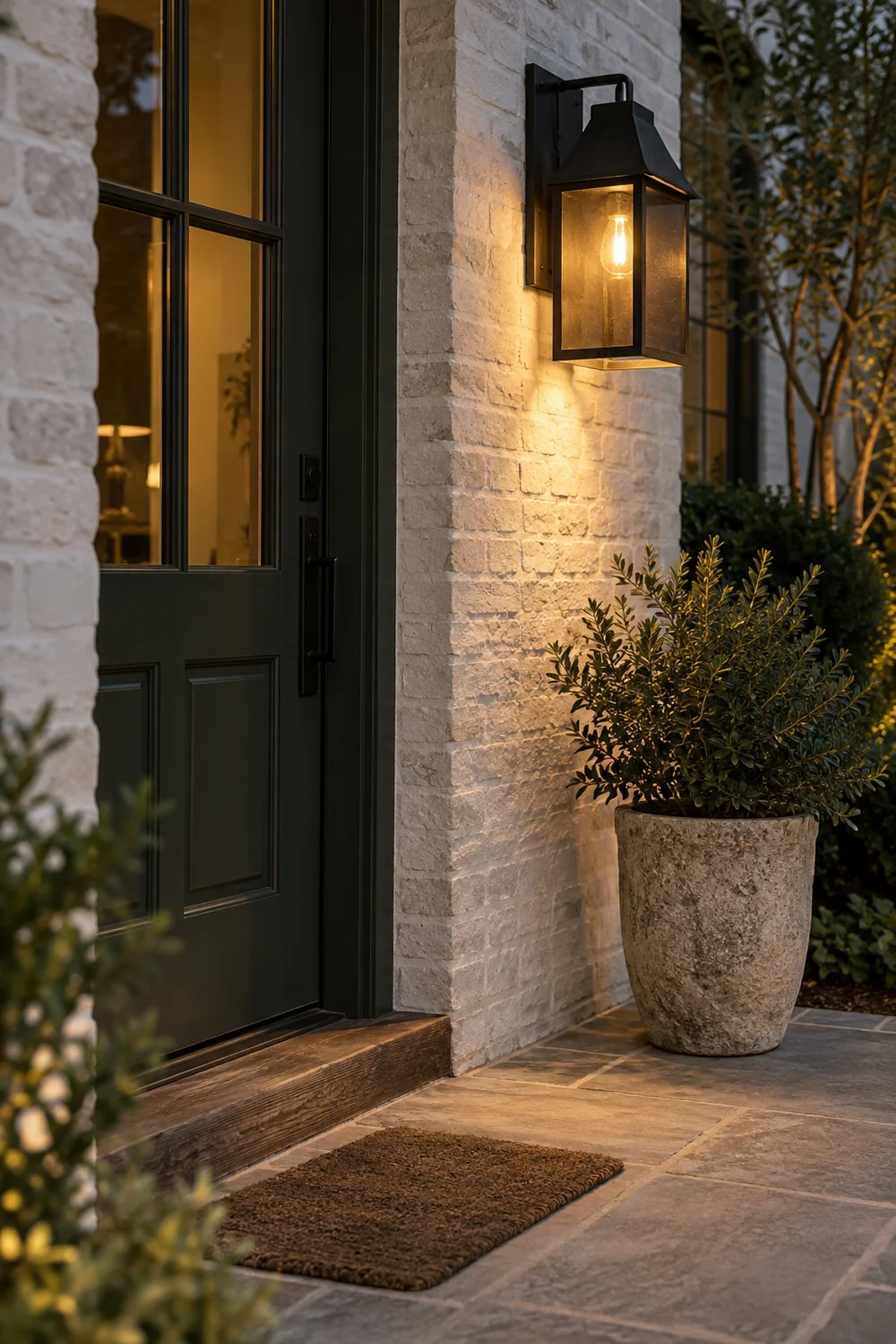
Aged black iron can give a clean outline against chalk masonry, while a softer dark finish can sit comfortably beside stained timber. If the door is a smoked green, the fixture need not repeat that colour; a quiet iron silhouette allows the door to remain the visual centre. A black facade needs a little more care. A black light on black siding may disappear in daylight, which can be desirable, but the illuminated shape and wall texture still need to make sense at night. The existing black farmhouse exterior examples are useful visual context for that relationship.
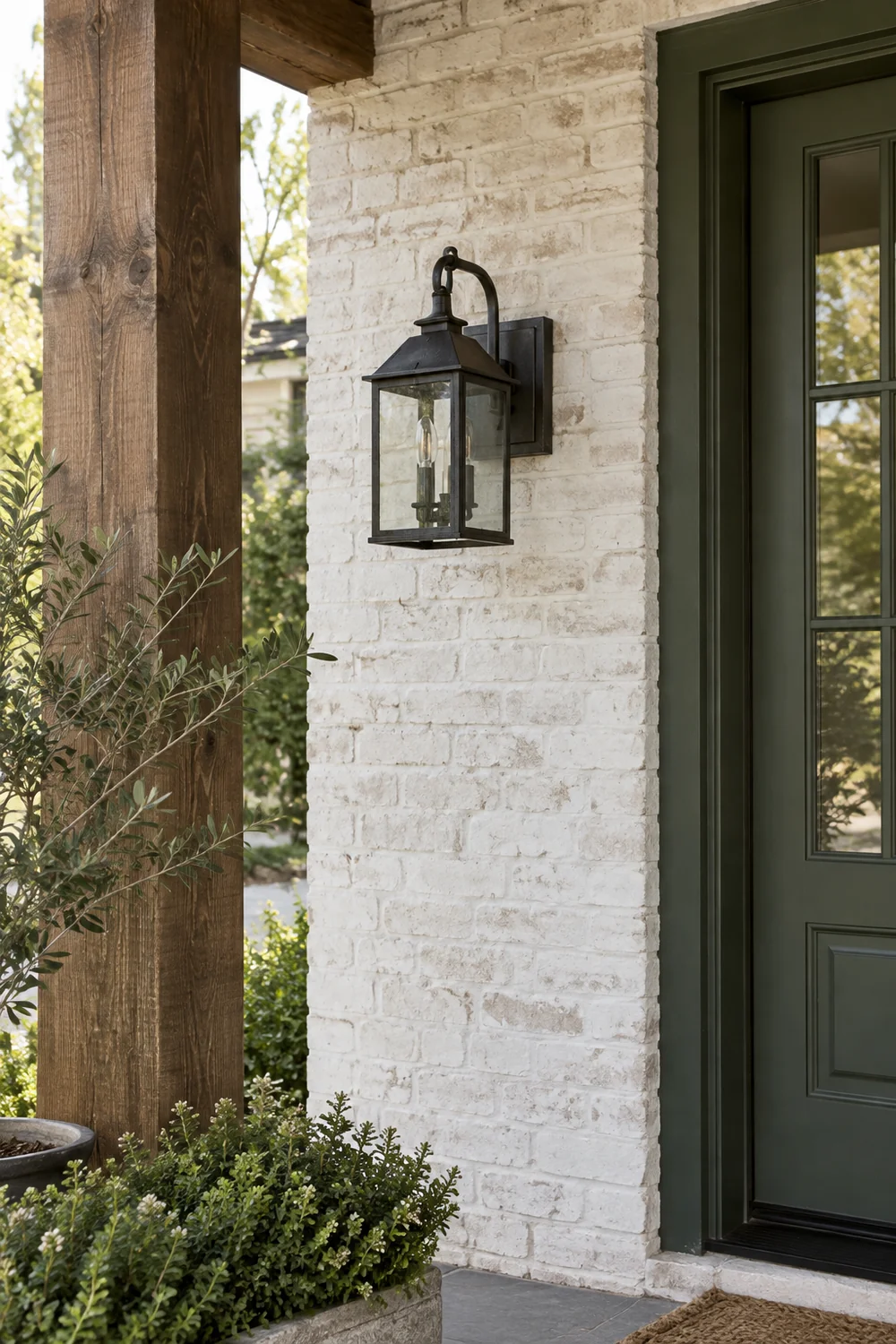
Choose a form that belongs to the house rather than one that merely carries the word farmhouse in a product listing. A simple lantern can soften a contemporary facade. A restrained barn shade can suit a working side entrance, but a large industrial gooseneck over a finely detailed front door may dominate it. Check the fixture against the door and surrounding wall at full size, even with a paper outline taped in place. The daylight silhouette matters because the light is visible as an object far longer than it is switched on.
Finally, consider what the beam does. A shielded or carefully aimed fitting that lights the threshold is usually more useful than bare bulbs facing outward. Stand at both the door and the approach to check for glare. If the light is harsh from either position, change the fitting, aim or output before adding another lamp. An entry should feel like a calm destination rather than a spotlight.
A covered porch changes the lighting problem because the roof creates a darker pocket even when the rest of the frontage is visible. This is where layers can help, but the layers must have different jobs. A pendant or ceiling fixture can give a general glow to the sheltered area. A wall light can mark the door and handle. Light reaching a nearby step can connect the porch to the approach. Those three functions are easier to understand than three decorative fixture families competing for attention.
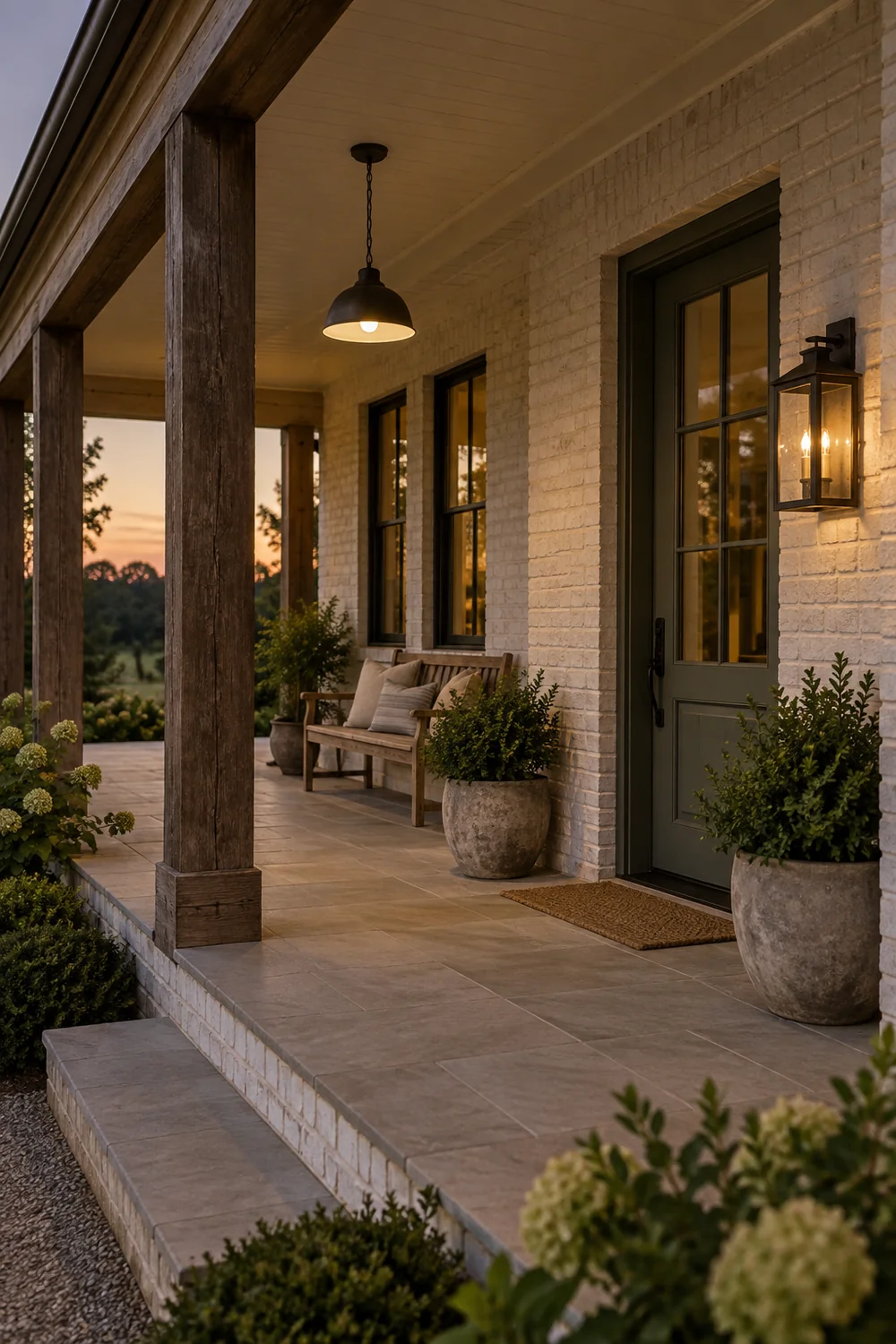
First decide whether the porch is a place to pause or simply a passage. A bench and deep roof may need a soft overall glow so a guest can see the seating. A shallow porch often needs only clear door and landing light. The architecture, not a standard count, decides the combination. If the porch ceiling is low, a large pendant can feel visually heavy and physically awkward. A compact ceiling fitting or wall lantern can preserve the openness of the entrance.
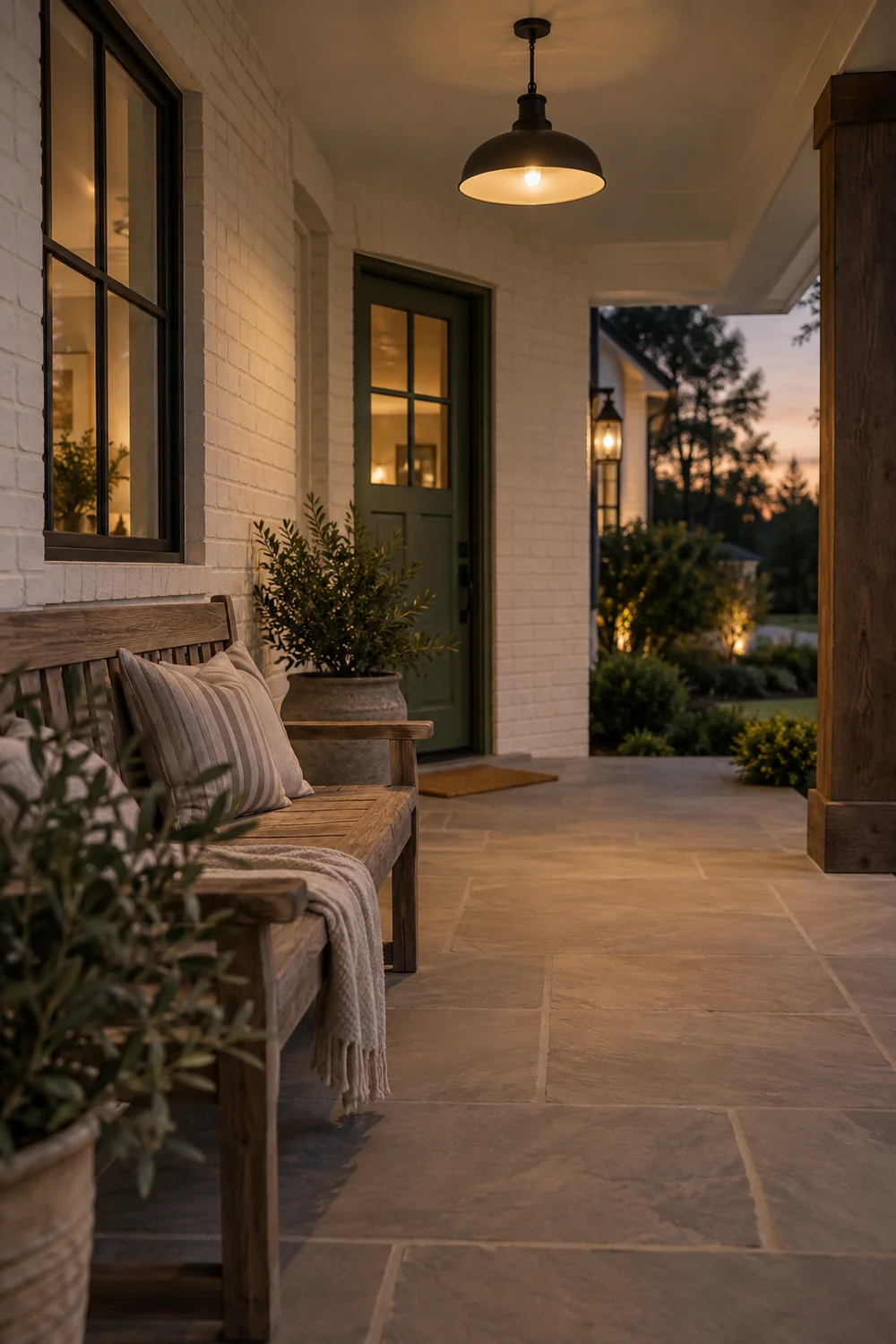
Make the porch posts and beam part of the scene without lighting every timber surface. Weathered chestnut can look beautiful under warm light, but too much upward light removes the shadows that give the porch depth. Try lighting the route and allowing the timber to catch a little reflected glow. From the street, the sheltered entrance then reads as a destination inside the wider facade. From the door, the fitting does its practical work.
Test the porch with the lights on and off in stages. Turn on only the doorway light, then only the general porch light, then both. Notice whether the second layer fills a real dark area or simply adds brightness. This is also a useful way to decide controls. A light used for evening arrival need not stay at full output all night. A timer or sensor can make it available when the porch is in use while preserving a quieter view later.
A path does not need to become a glowing runway. It needs to show where to walk, where to turn and where the ground changes height. Look first at the beginning and end of the route, then at any bend, step or uneven landing. Those are decision points. A low light aimed down at each relevant area can give more useful information than a regular row installed for visual rhythm alone.
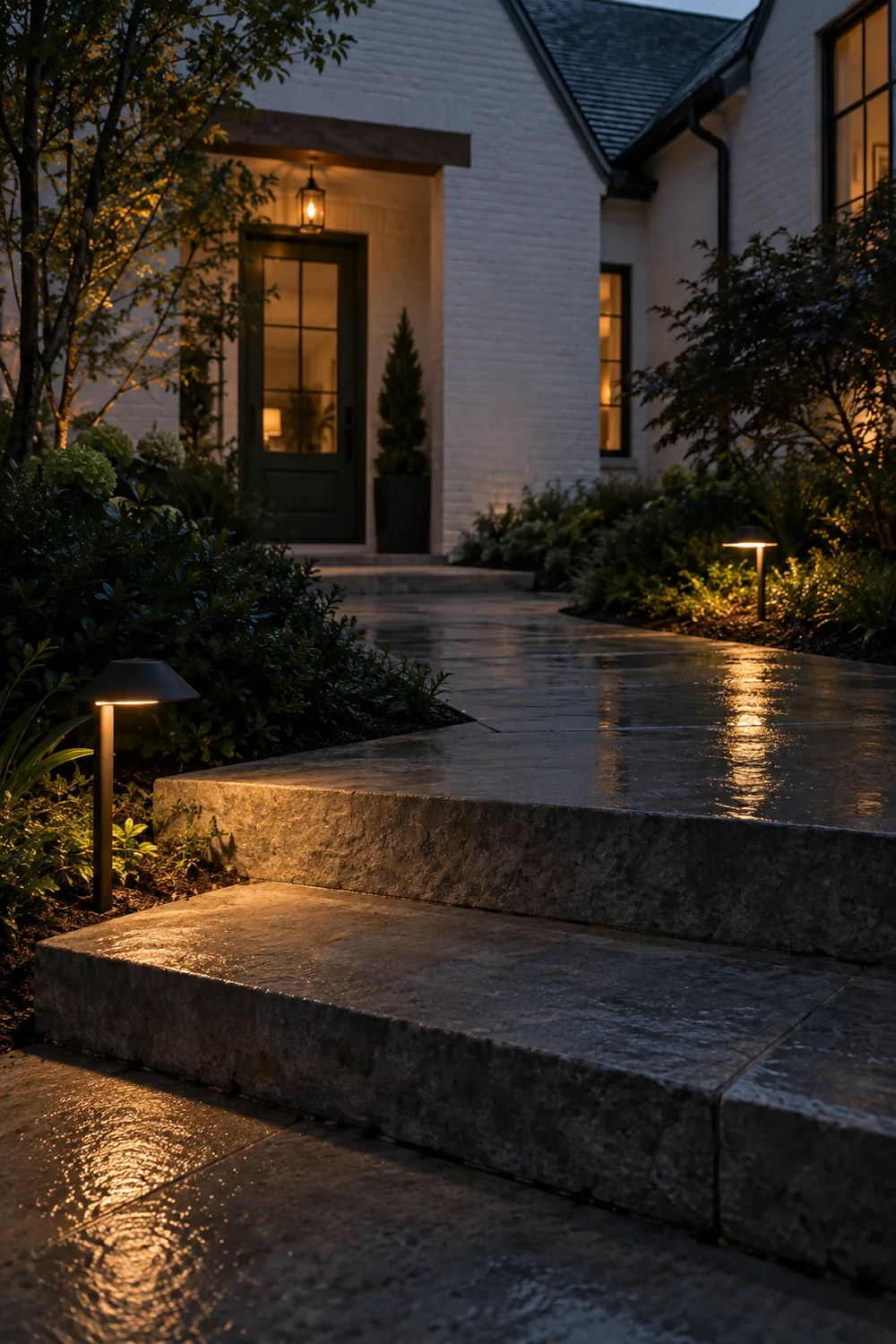
Material colour matters. Pale limestone paving can reflect more light than dark gravel, so the same fitting can feel much brighter on one surface. Wet paving may change the effect again. Review the route under the conditions in which it is used, especially if the approach is exposed to rain. Keep the beam away from eye level and neighbouring windows. Let planting remain mostly dark unless one tree or border has a clear role in orientation.
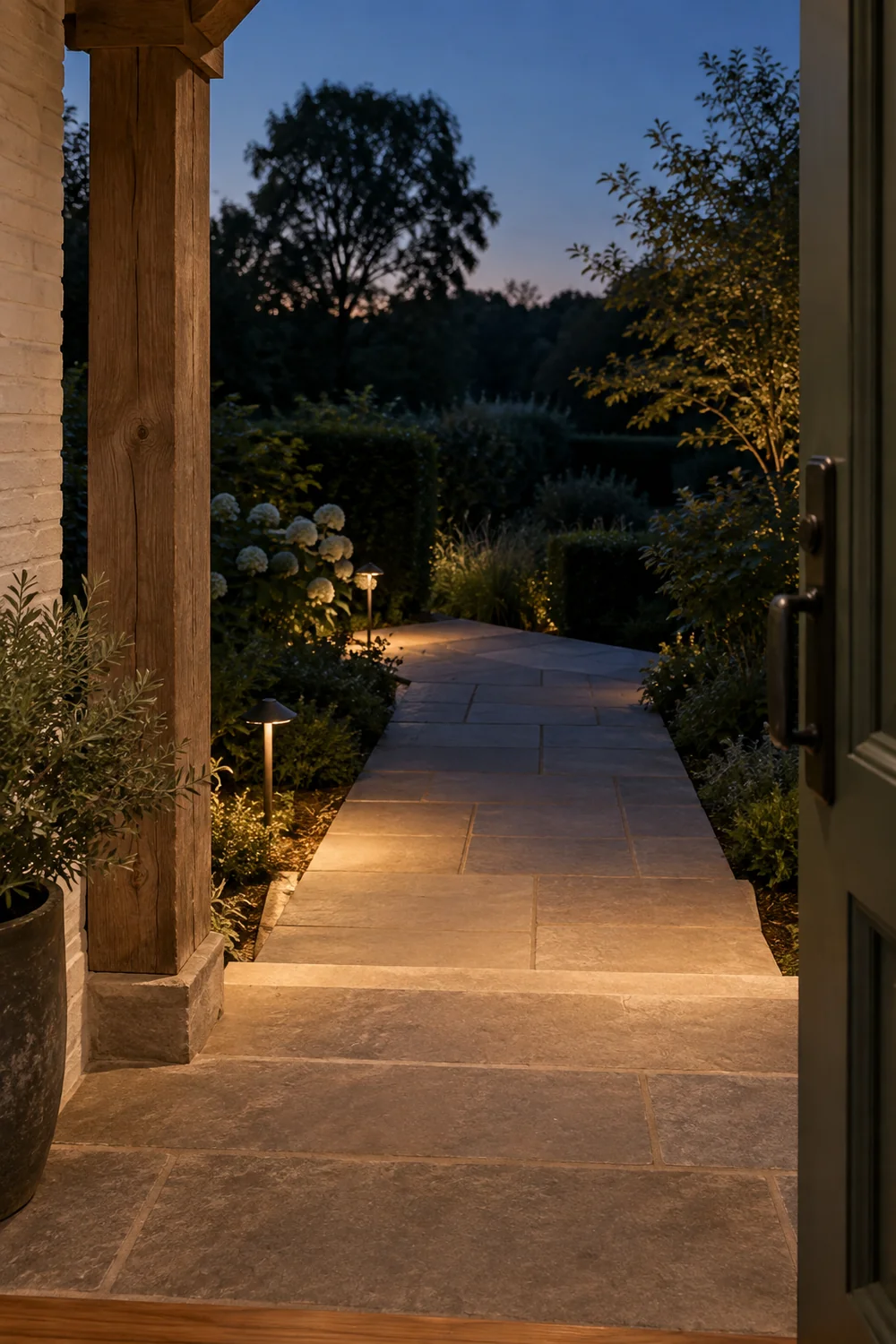
Steps deserve a separate check. Walk toward them from both directions. Can you see the first edge before reaching it? Does a landing light reveal the last edge as you leave? A fitting that lights the middle of a path beautifully can still leave a short flight difficult to read. The solution might be one carefully positioned wall light, a small low fitting or better light spilling from the porch. Add only what fills the gap.
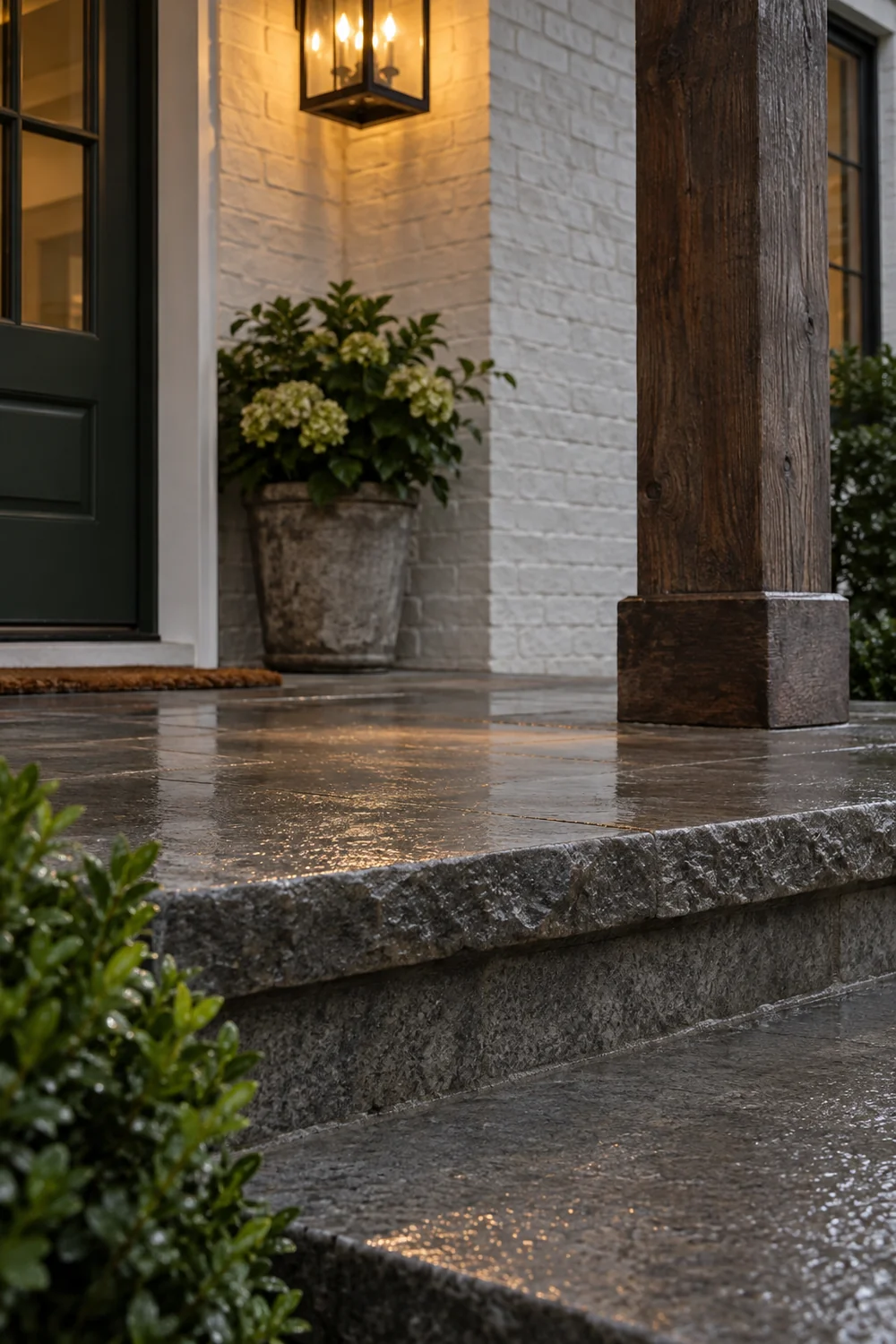
The path also needs to look connected to the front door. A very cool path light next to a warm porch lantern can make the facade feel disjointed. Keep the colour character compatible, though exact product specifications depend on the fittings and site. DarkSky’s home assessment favours warm or amber toned light, downward shielding and controls. Its guidance offers a responsible starting point, while the real route and surface finish decide what you need.
Avoid using light as a substitute for repairing a poor approach. Loose paving, hidden cables, damaged steps or blocked circulation need their own practical attention. The lighting sketch should make those issues visible, then the physical route can be corrected before a final fixture position is chosen. A lovely dusk photograph is no proof that the path works underfoot.
A garage or side door is often used more frequently than the formal entrance. Give it a task based assessment rather than letting the front porch consume the whole lighting budget. A person may need to move from a vehicle to a door, sort keys or carry something along a short side route. The light should show that movement without bleaching the garage doors or spilling into a neighbour’s garden.
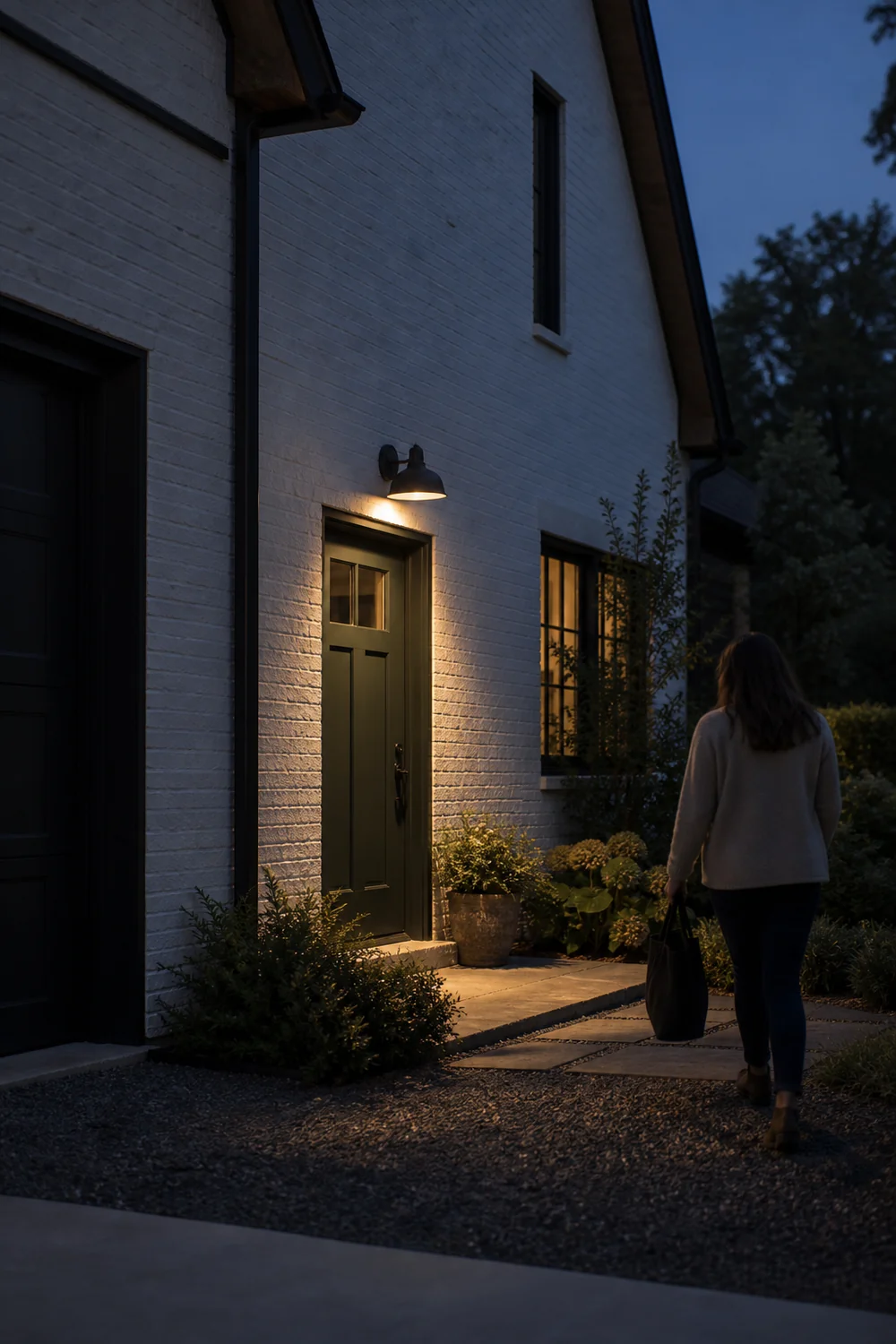
A compact barn style fitting can make sense above a service door when its shade directs light onto the landing. That is a different job from a decorative pair of lanterns flanking a wide garage opening. If the garage elevation faces the street, check the daytime proportion as carefully as the night beam. A fixture that is too small looks accidental against broad doors; one that is too large can turn a quiet facade into an industrial display.
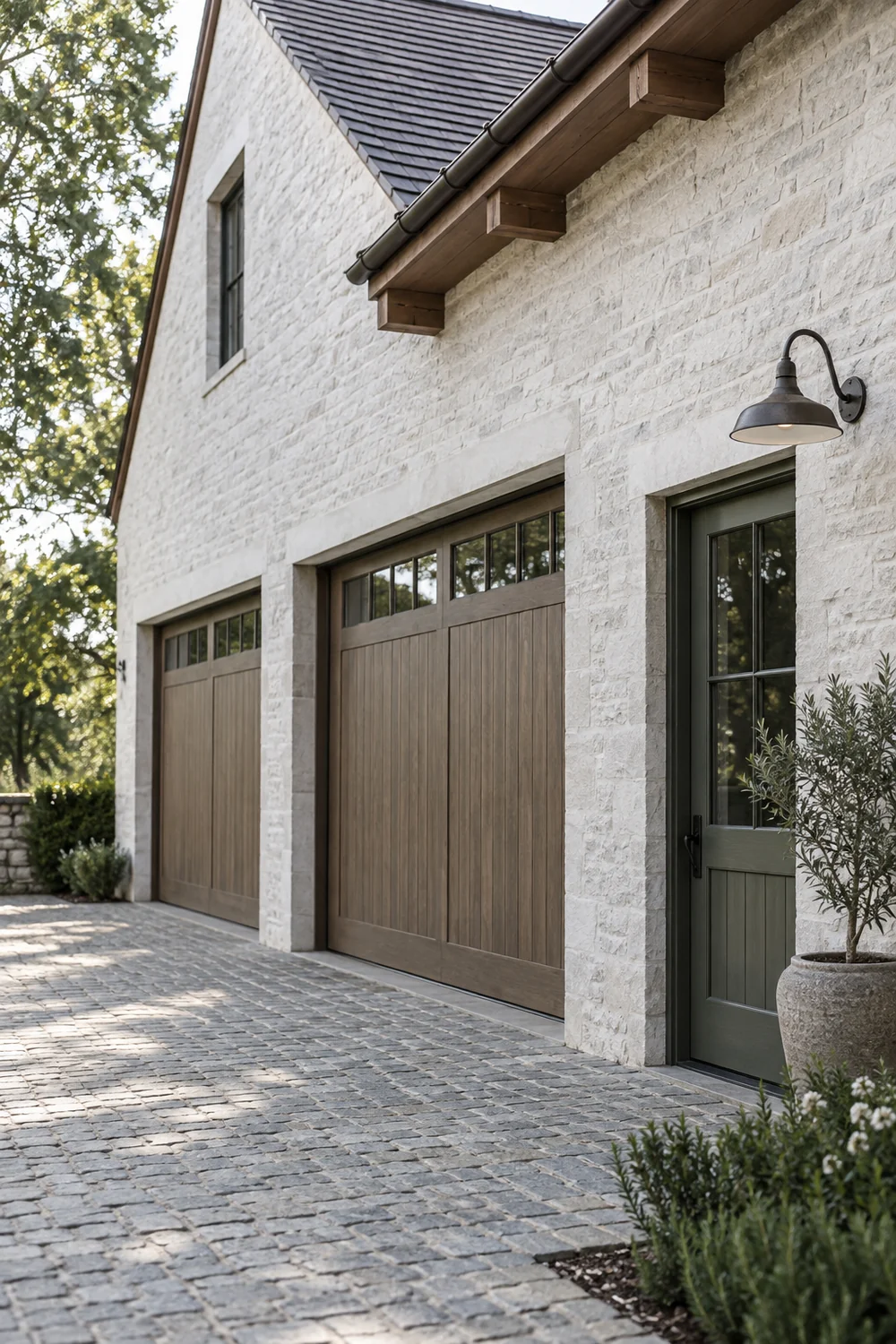
Try to keep the side task visually subordinate to the main entrance from the street. A house with a chalk brick facade and green front door can have aged iron fittings in both places, yet the side door may need a simpler shape. Related finish is enough to make the scheme coherent. The front door remains the focus because its lighting and architectural setting have a distinct purpose.
Motion controls are worth considering at a side or garage route that is used intermittently. The goal is useful light when someone arrives, with darkness or a lower state when no one is there. Check where a sensor would respond and whether it might trigger constantly from a road or moving branches. Ask the installer to review the actual site and product behaviour. A control strategy is part of the composition, not a last minute gadget added after the fixtures are selected.
Scale is easier to judge in the real frontage than from an isolated product image. Measure the width of the door surround, the height beneath the porch roof and the clear wall beside the opening. Draw or print the proposed fixture at full size and hold it against the elevation. Photograph it from the street, the approach and the landing. You will quickly see whether it respects the door, trim and posts or interrupts them.
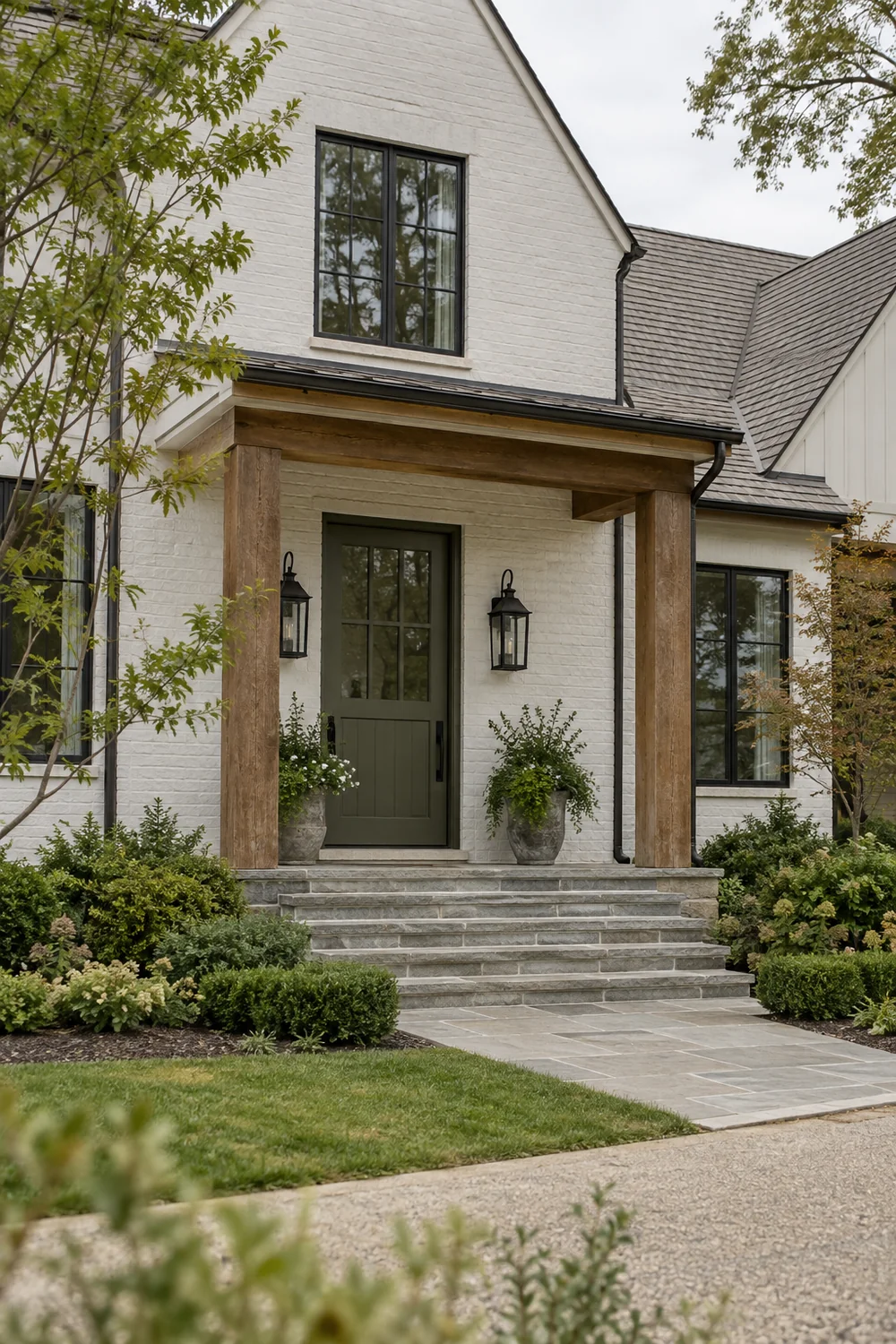
Think in relationships rather than matching sets. A modern farmhouse can combine one clear lantern at the entry, a quieter porch fitting and a service light at the garage. The shared finish and beam character link them. If every piece has the same oversized shade, the repetition can flatten the house. If each is a completely different statement, the entrance becomes noisy. Choose one lead shape and let the others support it.
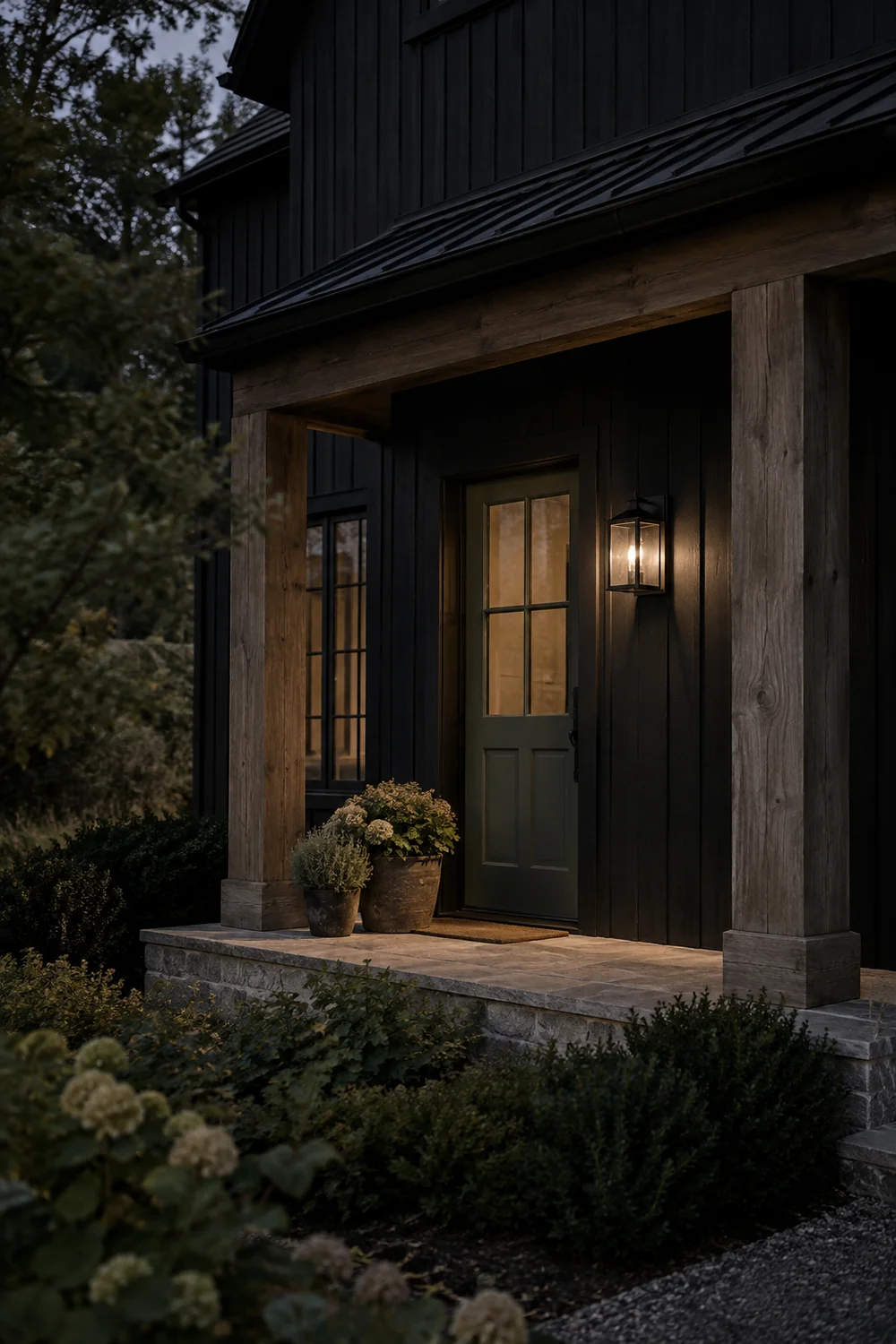
Finish should also relate to the building in daylight. Aged black iron reads as an outline against chalk brick. Weathered chestnut posts bring warmth, so the lights need not imitate timber. A smoked green door can provide the colour accent while the fixtures stay restrained. On black siding, a dark fixture may disappear into the facade; this can be elegant if the porch and doorway have enough contrast. On white siding, the same fixture becomes a prominent graphic mark. Decide which effect you want rather than assuming one finish behaves the same everywhere.
Weather exposure and maintenance belong in the selection conversation. A sheltered porch, open wall and low path position face different conditions. Read the actual manufacturer’s suitability and mounting instructions for each fitting and ask the installer to confirm the proposed use. The design drawing cannot tell you whether a product belongs at a particular exposed point. Materials that look right in a photograph still need to work outside over time.
The most useful review happens after dark, from the viewpoints where someone actually moves. Stand at the street or parking point, then walk the path, pause at the step and stop at the door. Next look back toward the street. Is any bare lamp glaring from one of those positions? Do the route and door remain legible? Is the garage brighter than the entrance for no reason? Does light escape through a neighbour’s window or up into the sky?
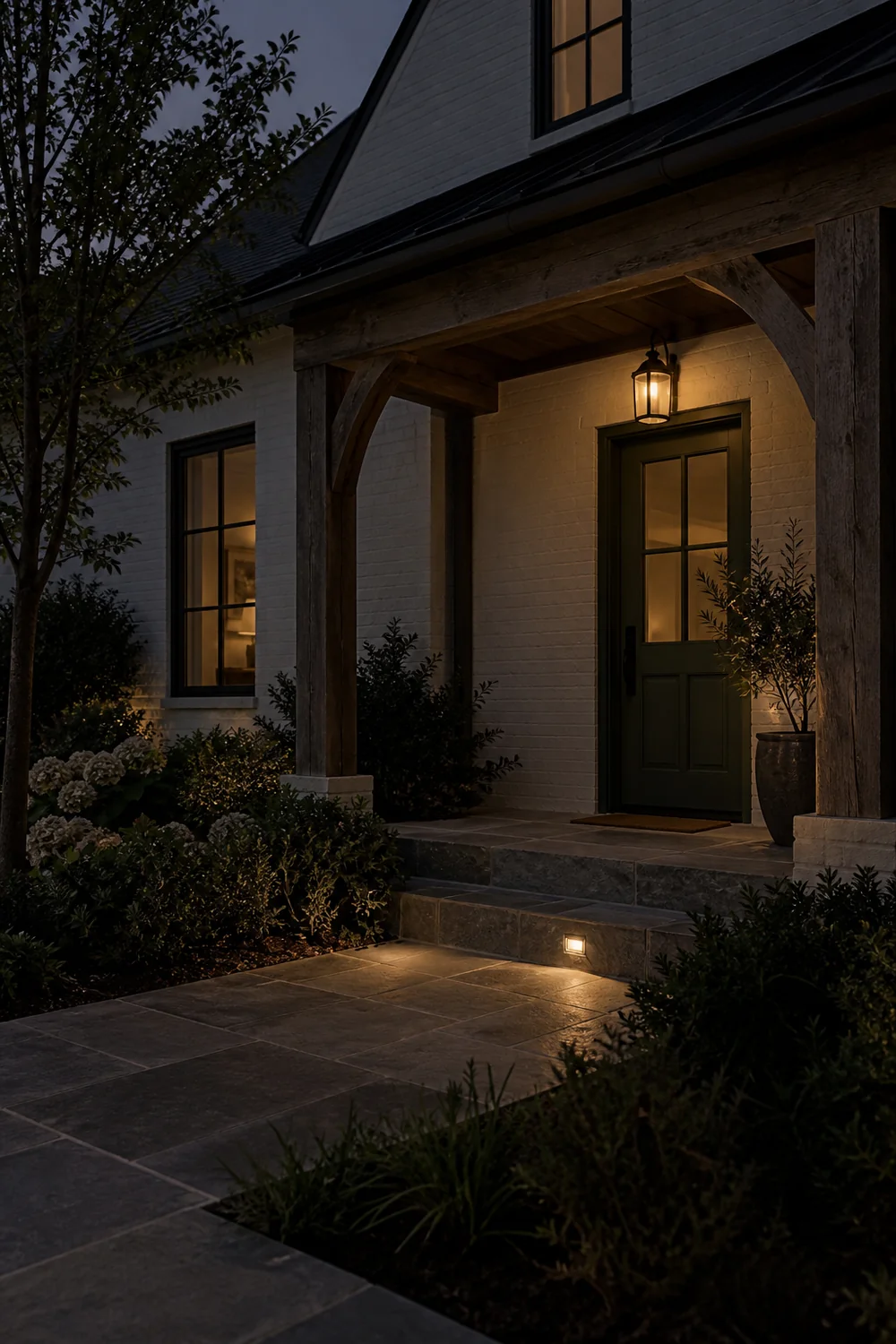
Try a few states rather than only the brightest one. Door light alone may be enough for a small frontage. Porch plus door may support a gathering. The path may need help only when someone is moving through it. The five responsible outdoor lighting principles from DarkSky and the Illuminating Engineering Society offer a good test: useful, targeted, low level, controlled and warm. Their point is to place light where and when it helps, in the amount needed. That restraint often improves the visual depth of a farmhouse at night.
Look at the facade as a whole too. Does the porch feel sheltered, or has bright lighting removed its sense of enclosure? Do the path lights guide your eye to the door, or pull attention into planting with no arrival role? The answer can be a smaller fitting, a different aim or an adjusted control. Adding one more lamp is not always the fix.
This review is a design step, not a claim of universal brightness or security. Each site has its own materials, route, neighbouring context and installed products. Record what you see with photographs from several positions and make a short list of changes. A photograph taken only straight on can hide a glaring bulb or missed step that is obvious when you move through the approach.
Once the positions and visual relationships are clear, turn the sketch into a practical brief. Mark every proposed light, the task it serves, the preferred finish, the desired warm character and when it should switch on or off. Note any existing wiring, exposed walls, sheltered ceilings, steps or nearby planting. Include the dusk photographs so the installer can see why a position matters.
Ask a qualified electrician to assess the actual circuit, outdoor suitability, controls and installation method. Do not treat a decorative rendering as electrical guidance. Electrical Safety First’s garden advice highlights the risks of moisture, damaged outdoor leads and buried services and recommends residual current device protection for outdoor electrical equipment. A professional can translate the design intent into a safe installation for the house and location.
Agree on a review after installation, ideally at dusk. Switch each group on separately and walk the route again. Check the door handle, first and last step, porch seating if there is any, and the side access. If something is too bright or pointed poorly, discuss adjustment before declaring the project finished. A lighting scheme is complete when it helps arrival and looks settled from the house’s real viewpoints.
Modern farmhouse exterior lighting should feel like part of the architecture, not a string of unrelated purchases. Start with a clear route and a few necessary tasks. Let the front door be easy to use, the porch hold a soft glow, and the steps reveal themselves without turning the garden into a stage. Choose fixture shapes that respect the facade in daylight, then review their beams where people actually stand after dark. A calm, useful result can come from fewer lights when each one has a job. With the positions and controls marked, an electrician can help turn that plan into an installation suited to the real house.