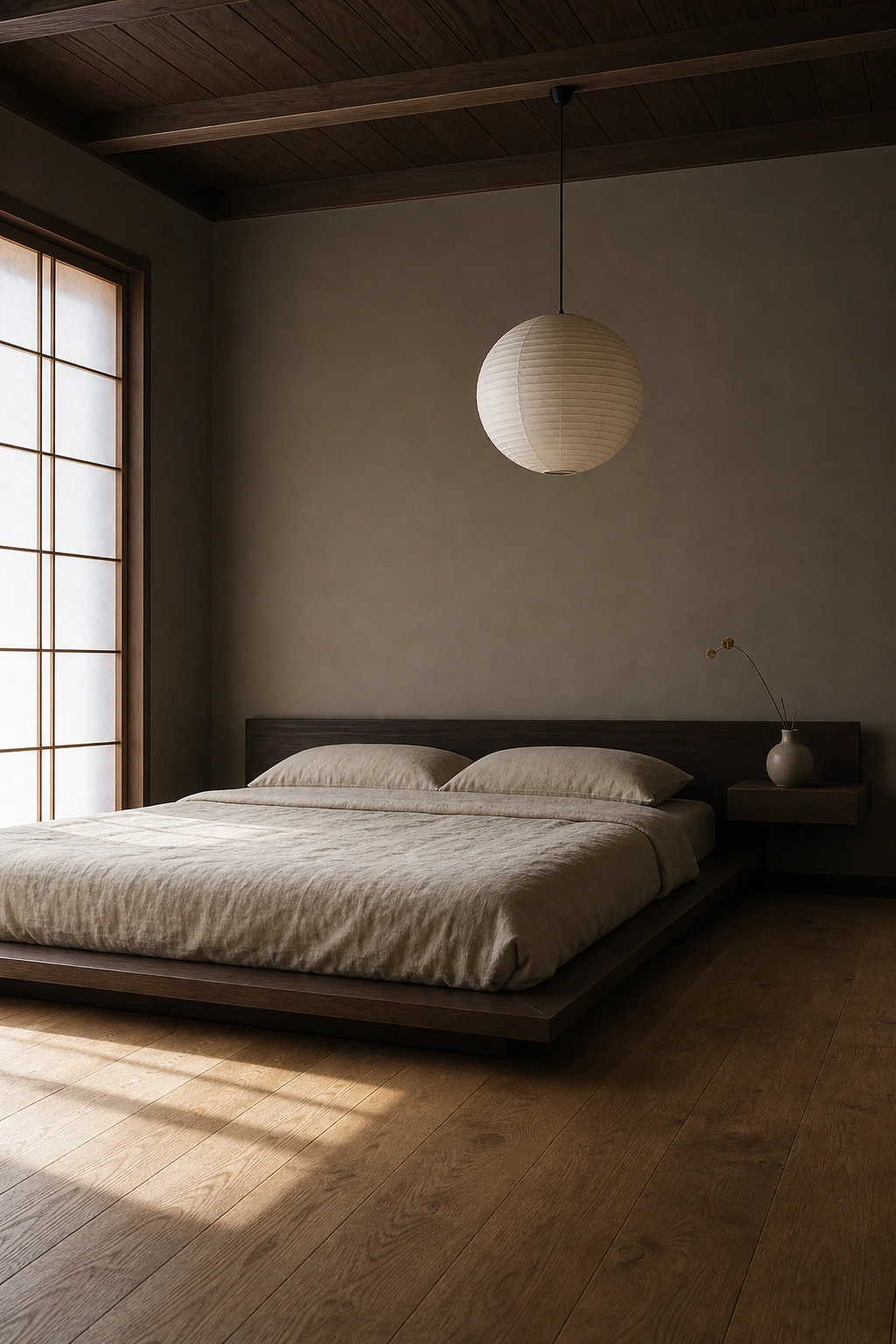
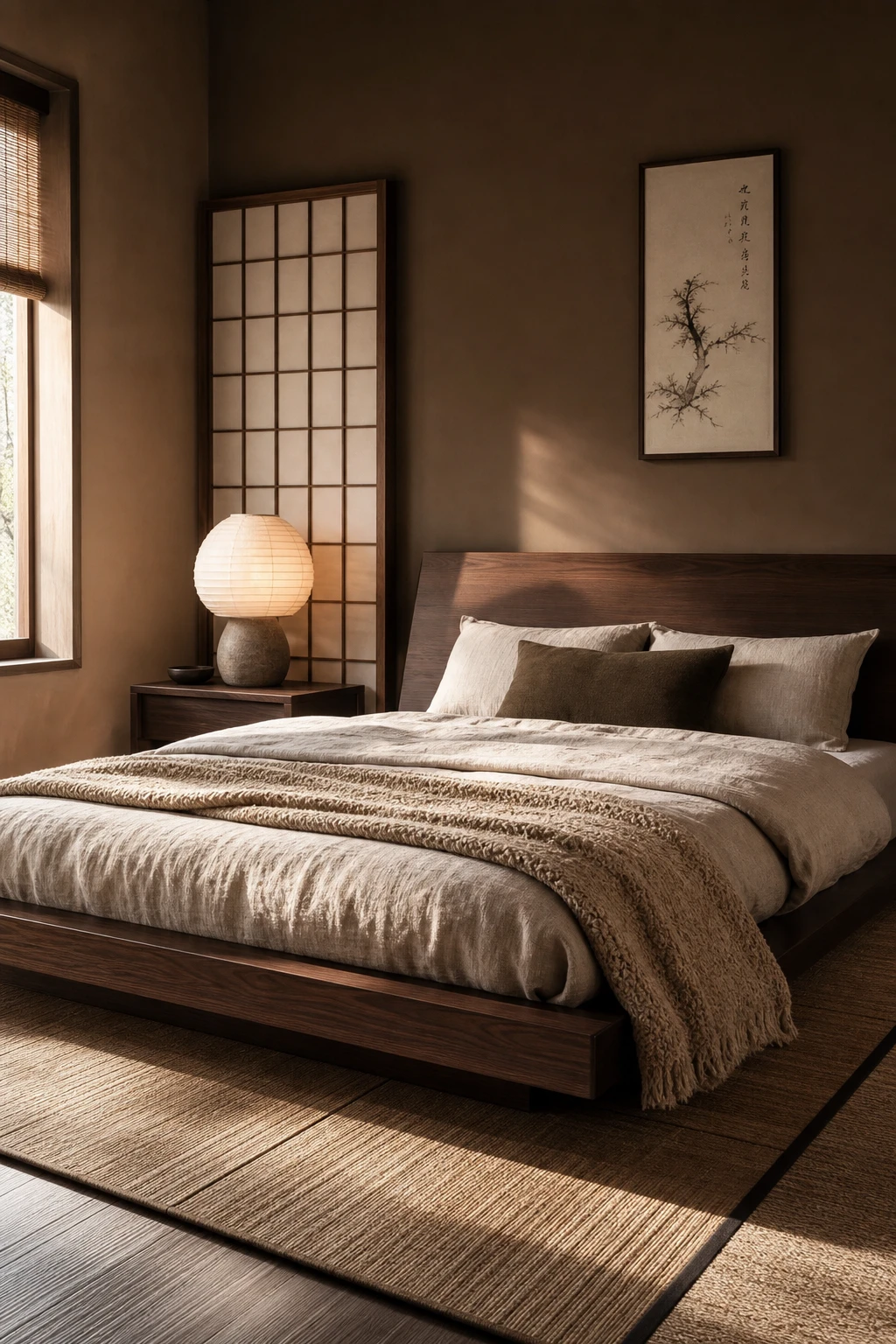
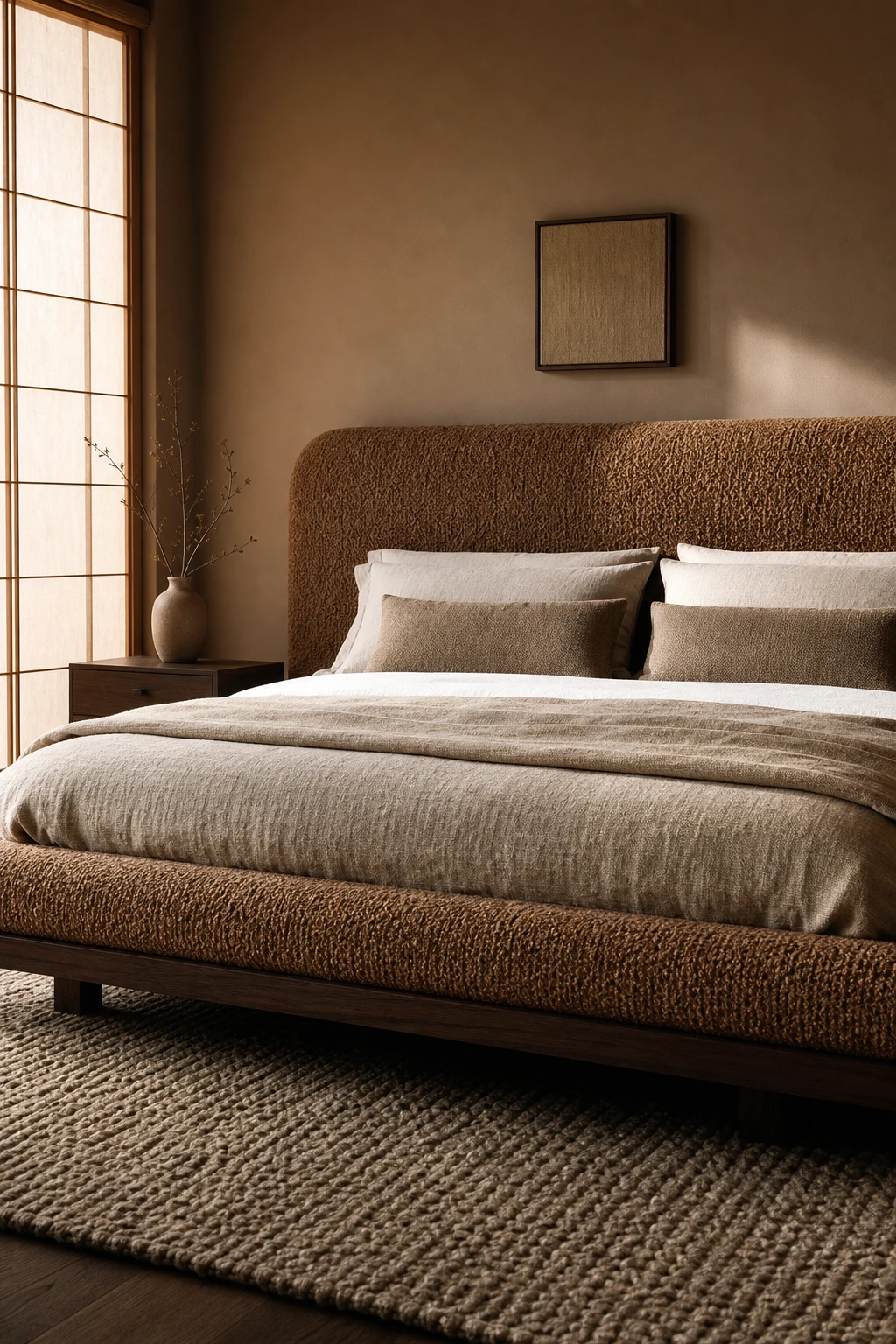
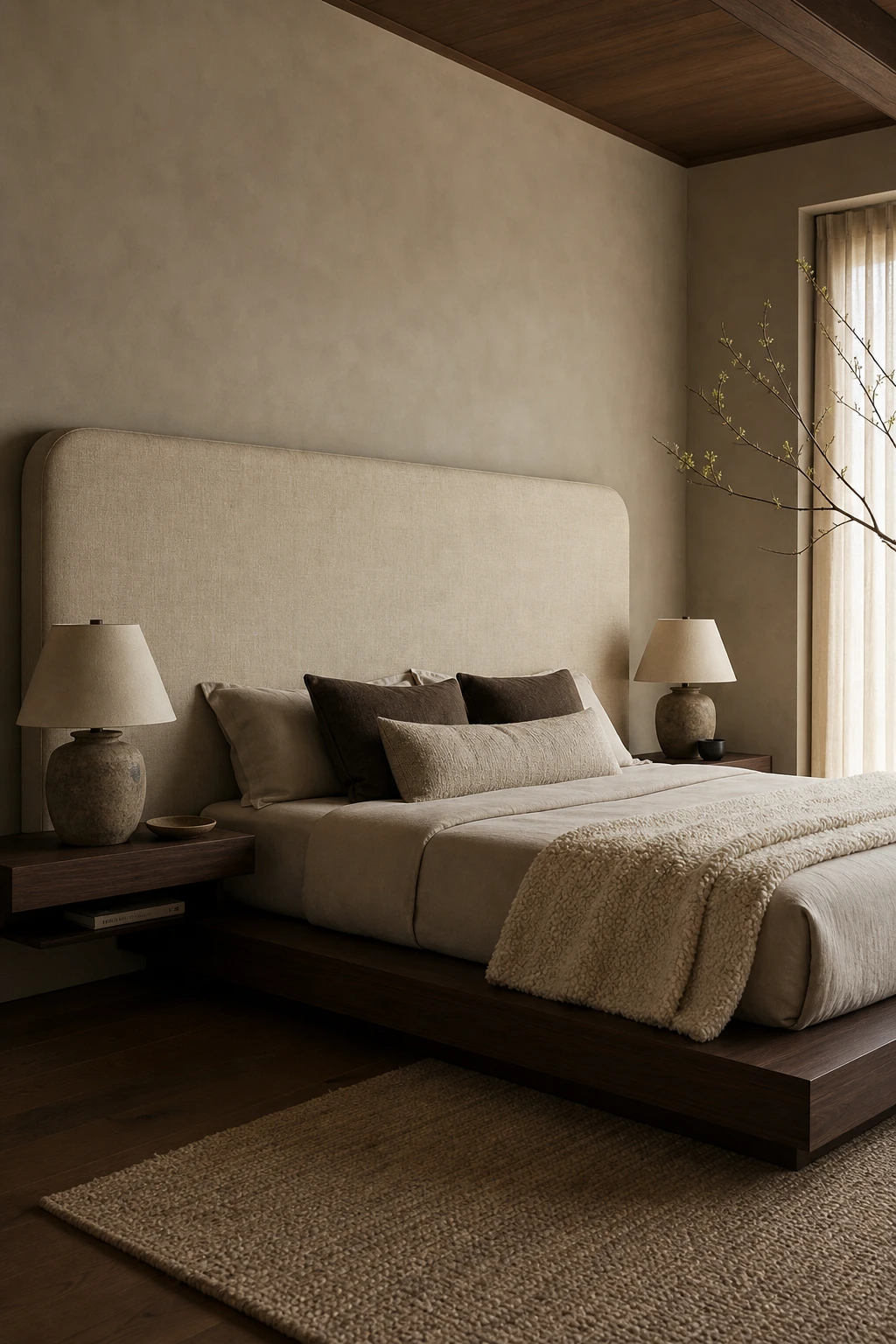
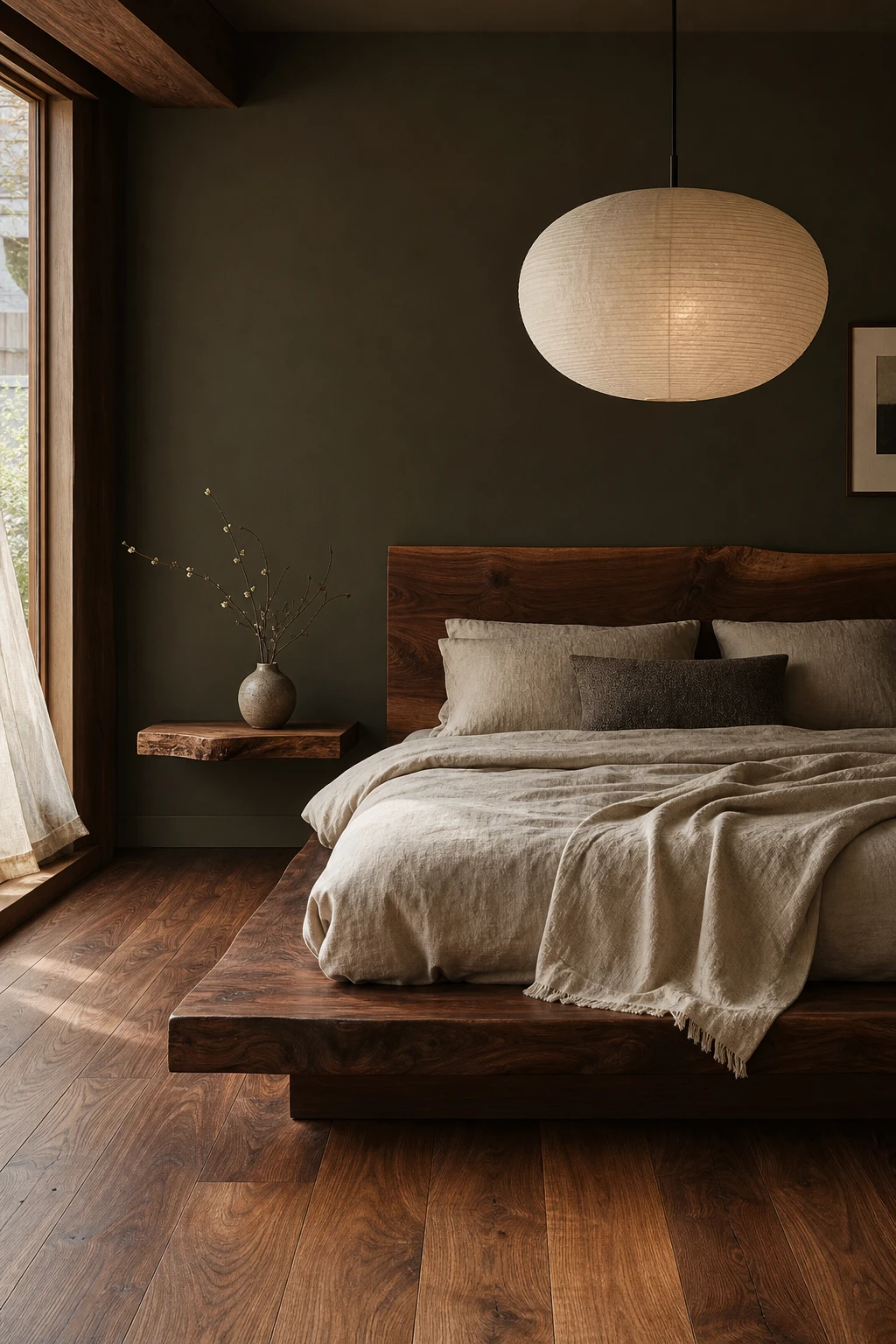
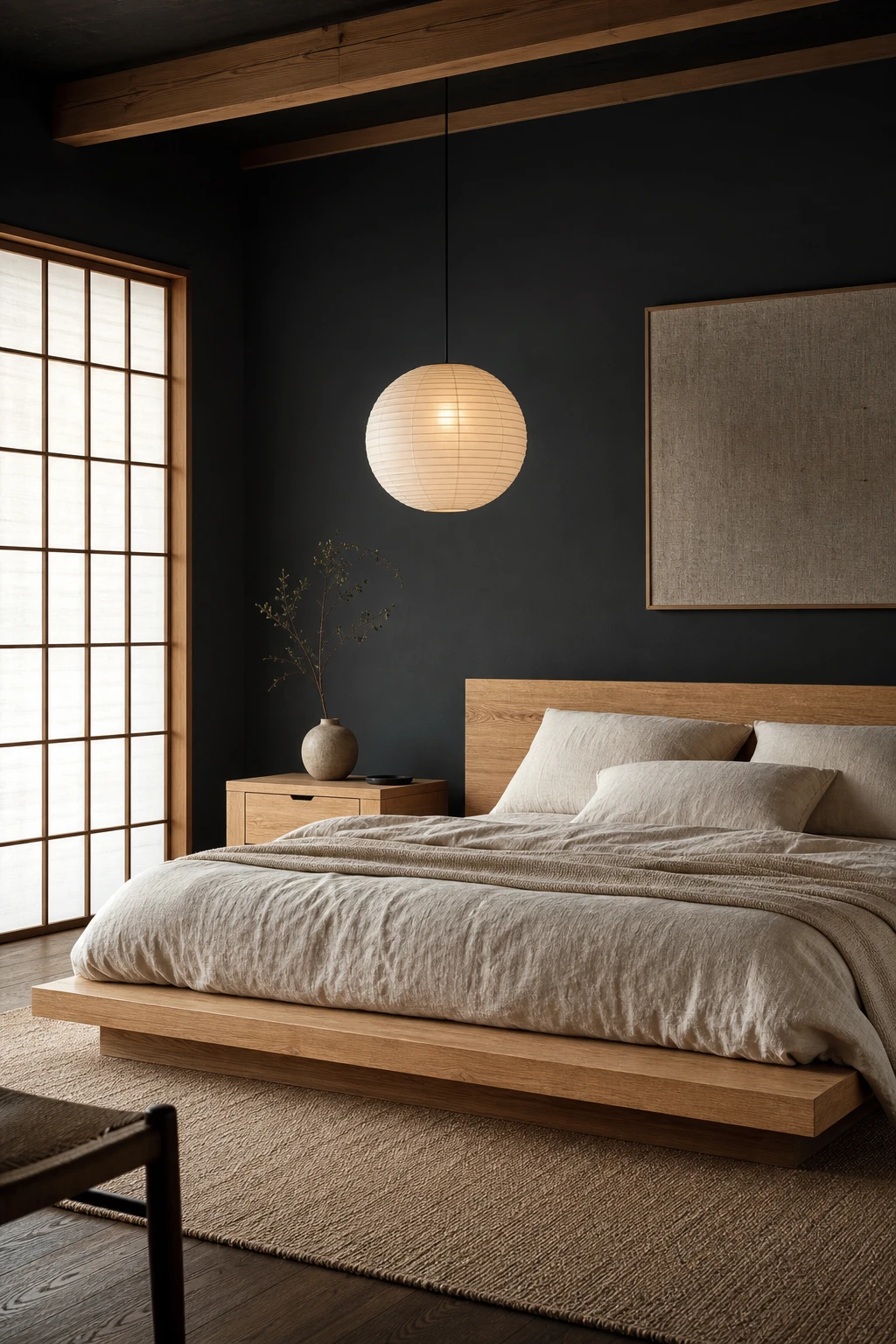
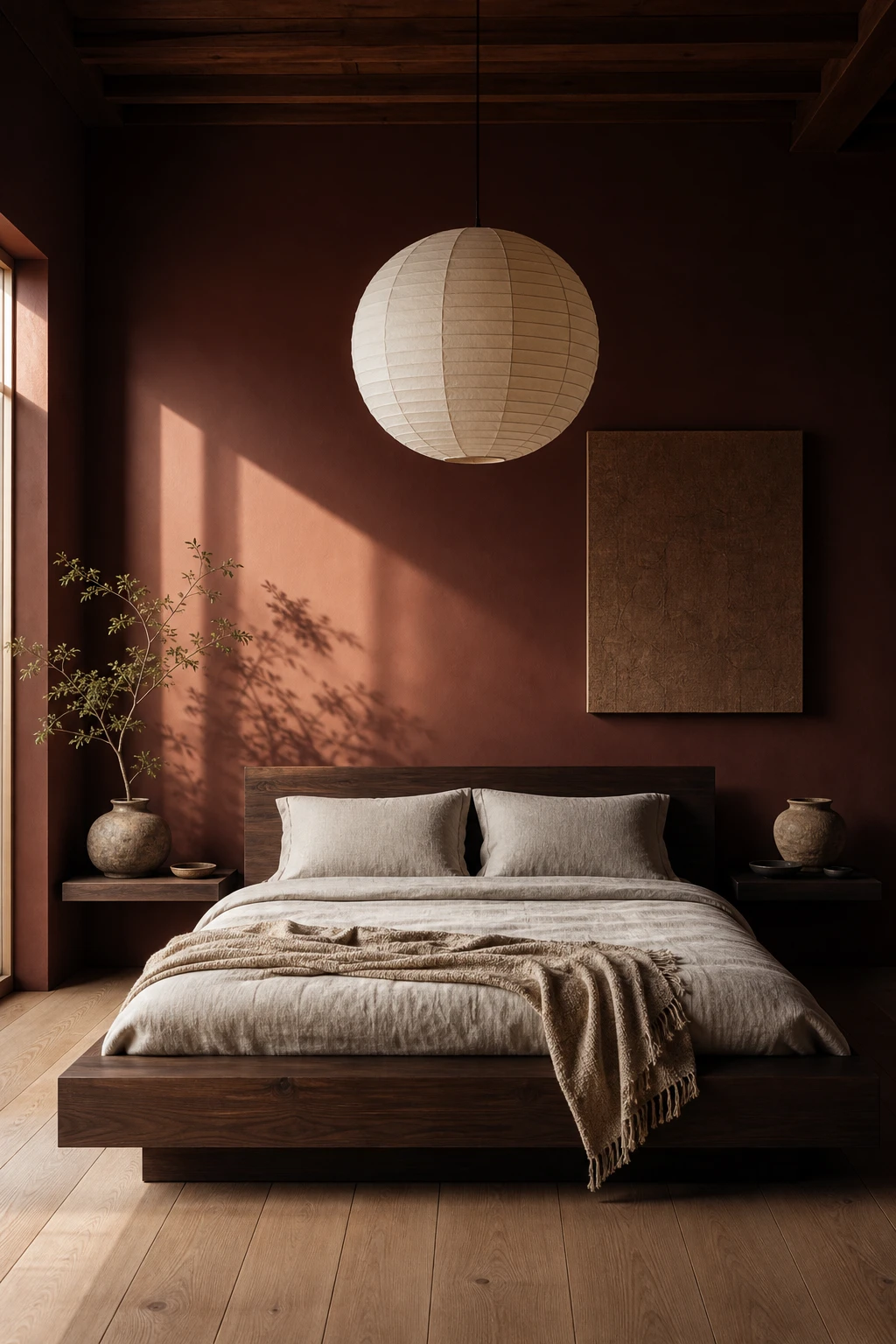
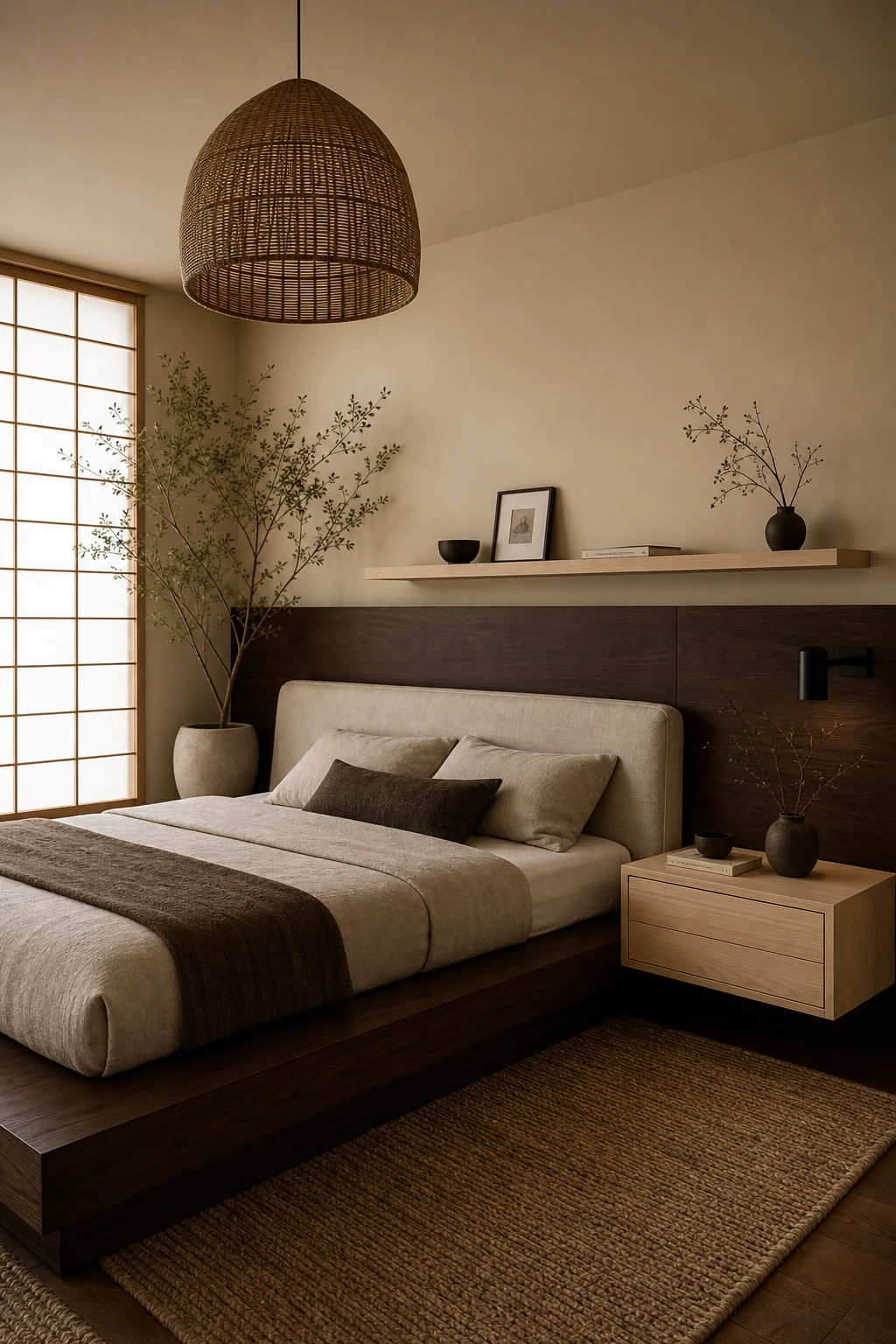
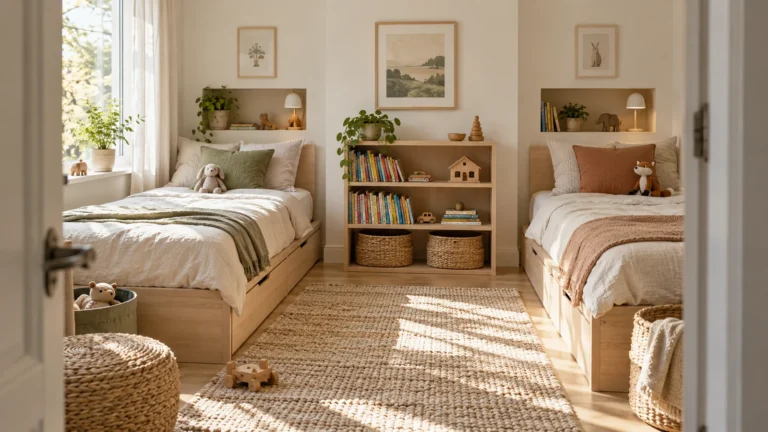
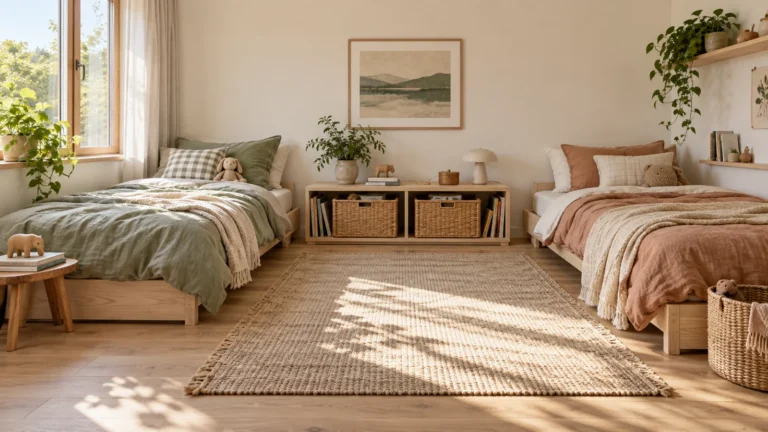
I have always thought dark wood and calm belong together, and Japandi bedrooms prove it better than almost any other style. What I love most is how a low walnut bed frame, the right wall colour, and a single paper lantern can make a room feel both grounded and light at once. This piece walks through every layer of that look, from charcoal walls and boucle beds to wood panel feature walls and soft pendant lighting, and every idea is one you can take straight into your own room.
How to Pull Off a Dark Japandi Bedroom Without It Feeling Heavy
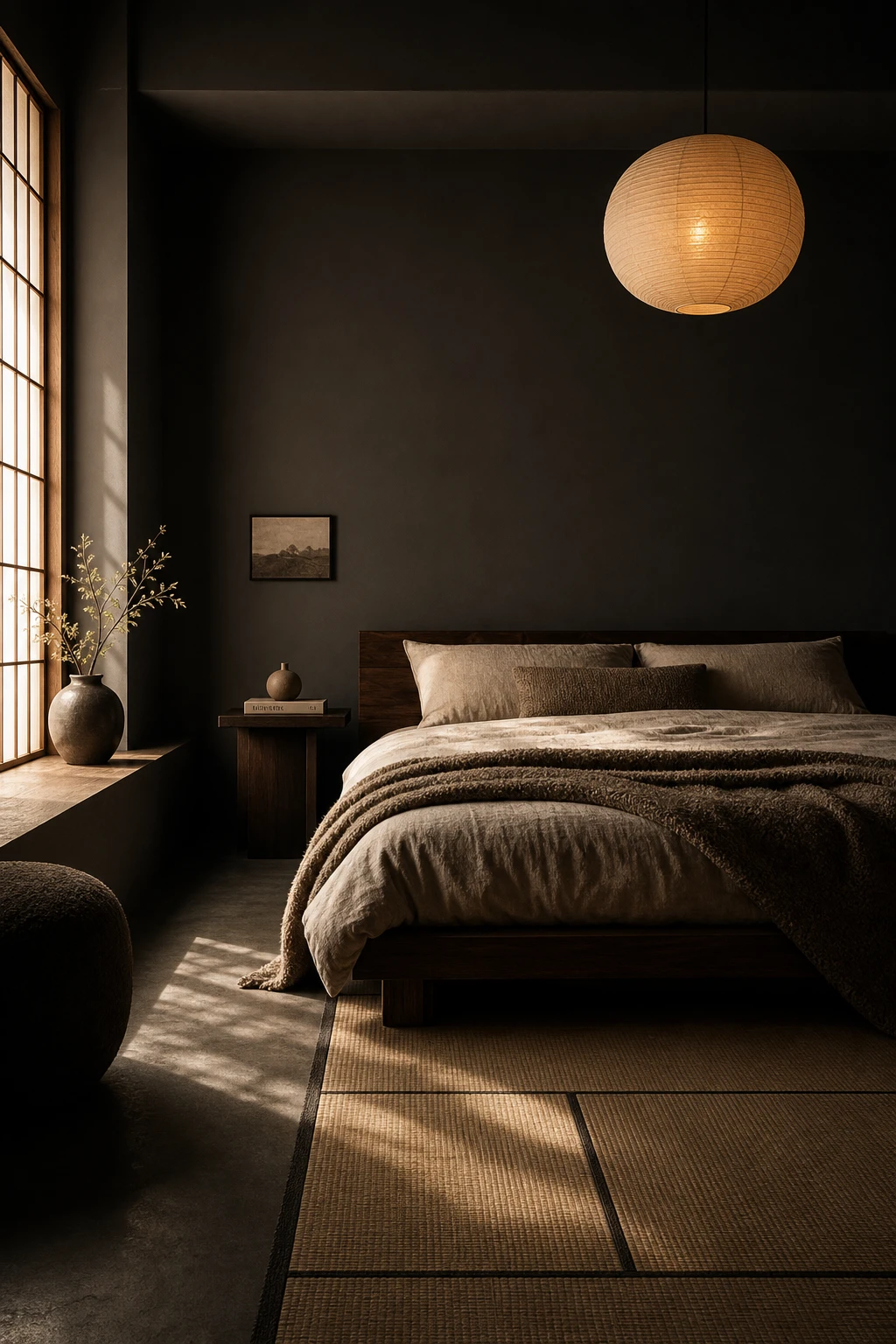
Dark Japandi is the combination that wins me over every time, because the depth of tone does something calm and enveloping rather than heavy. You get that effect by letting the darkness shift across the room: a near black wall, a warmer walnut bed frame, a softer charcoal textile. Each plane reads slightly differently, so your eye keeps moving and the space never closes in.
The Key Details
Low profile dark walnut bed frame
Washi paper pendant light
Shoji screen window panel
Tatami style woven area rug
Minimal dark oak bedside table
Pro TipChoose at least three distinct depths of dark, from near black to a warm mid tone wood, so the room has quiet contrast without breaking the mood.
AvoidPainting every surface, buying every textile, and choosing every piece of furniture in the same flat dark tone, because without any variation the room will feel like a cave rather than a retreat.
The Small Choices That Give a Japandi Room Its Moody, Lived In Feel
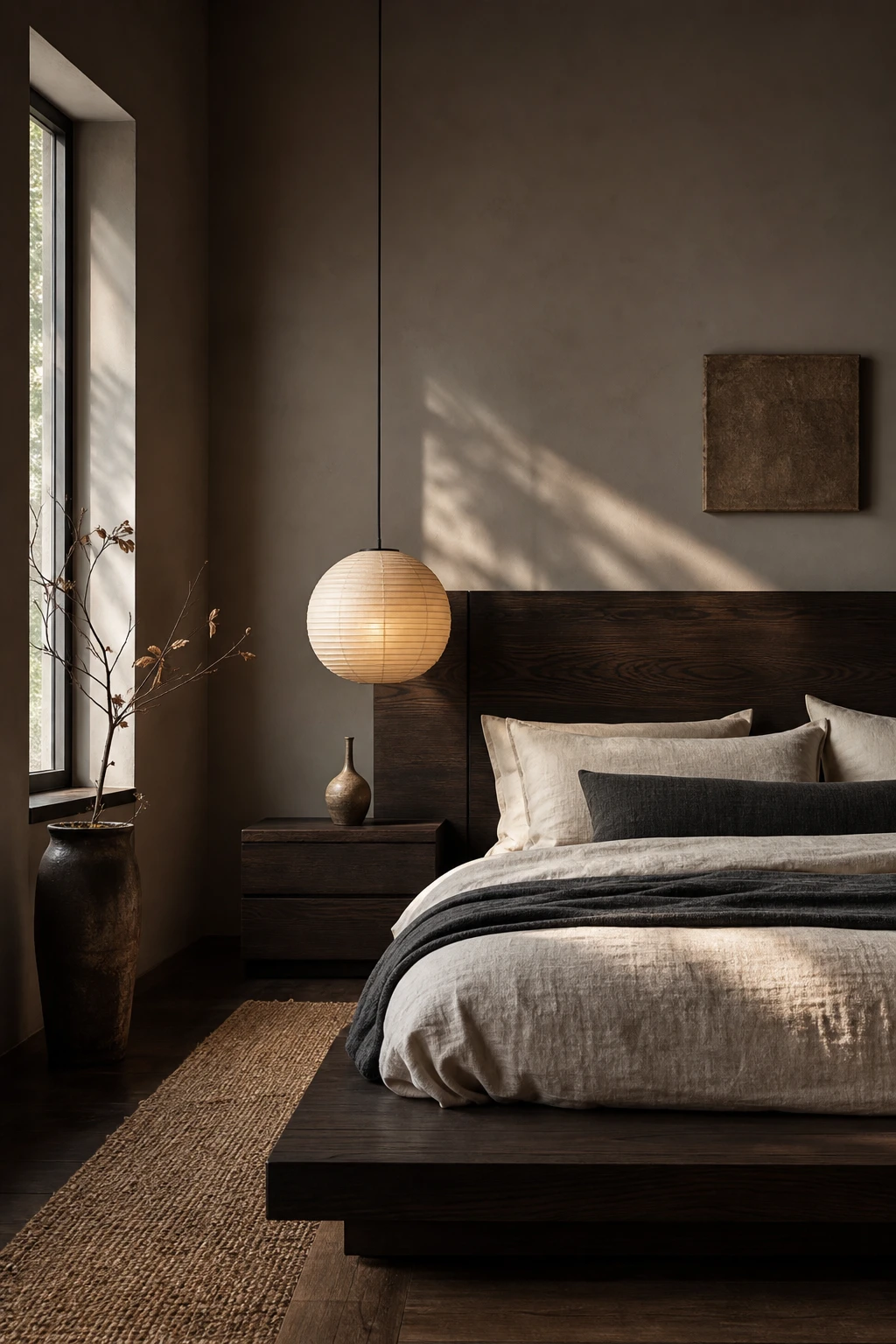
Mood in a Japandi room comes from how surfaces absorb light, not just how dark they are. Rough linen bedding, a matte clay vase, a woven jute runner, you will notice each one pulls the eye gently rather than bouncing light back at you. That quiet absorption is what I reach for when a room needs weight and warmth without feeling heavy. Layer enough of those soft, light drinking textures together and the atmosphere almost builds itself.
The Key Details
Low dark wood platform bed
Washi paper globe pendant
Layered linen and charcoal bedding
Woven jute floor runner
Hand thrown ceramic bud vase
Pro TipSwap any shiny or smooth bedding for a stonewashed linen duvet cover and the room will feel noticeably moodier overnight without touching a single wall.
Avoid reaching for black accessories every time you want more depth, as too many hard black edges push the room from moody into stark and unwelcoming.
Why the Cleanest Japandi Rooms Always Have Fewer Things Than You Think
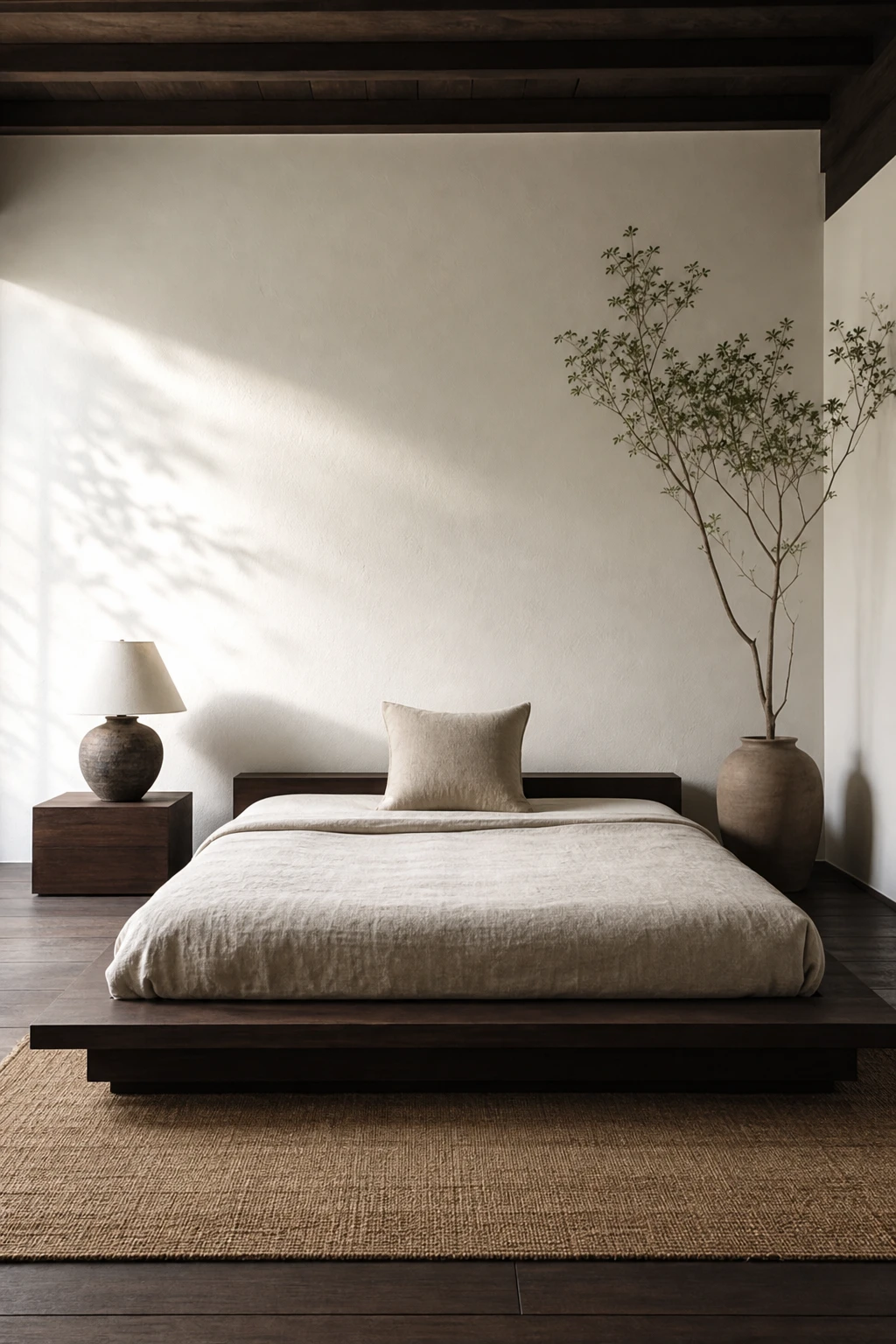
Editing a room down to only what earns its place is the move that separates Japandi from plain sparse. What I love about this approach is that every object you keep starts to carry more visual weight, so a single ceramic lamp or a bare clay vessel reads almost like sculpture. You notice the quiet more. The dark walnut bed pulls the eye low and anchors the room, and with almost nothing around it, you feel the floor space open up in a way that genuinely makes the room feel larger.
The Key Details
Low dark walnut platform bed frame
Hand thrown ceramic table lamp
Undyed natural linen bedding
Square low profile nightstand
Slender branch in matte clay vessel
Pro TipKeep at least one surface completely clear, even if it is just a small nightstand top, because that breathing room is what lets the rest of the room settle.
Avoid removing so many layers of warmth, textiles, objects, small signs of life, that the room starts to feel like a showroom nobody sleeps in.
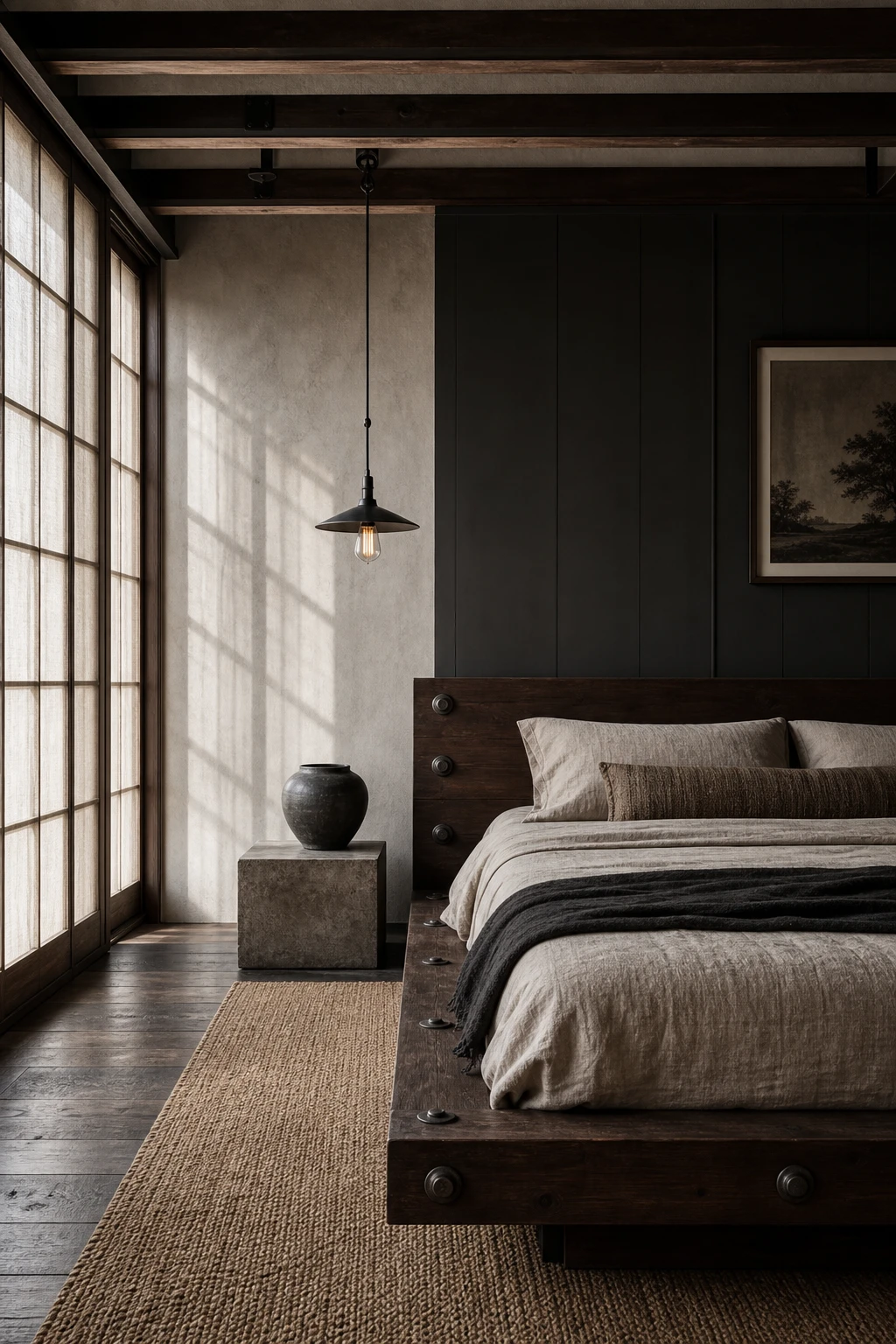
Mixing Raw Industrial Details Into a Japandi Bedroom So They Belong
Dropping one or two industrial details into a Japandi bedroom is a move I find quietly thrilling, because the contrast earns its place without shouting. The forged iron pendant and that bolt head hardware on the walnut bed share a raw honesty that actually rhymes with wabi sabi’s love of imperfect materials. You still get the calm, you just get a little backbone with it.
The Key Details
Forged iron pendant lamp with bare Edison bulb
Low oiled walnut platform bed with bolt head hardware
Raw concrete bedside table
Exposed ceiling beam
Woven jute floor runner over dark stained oak
Pro TipLimit brushed steel or iron to a single zone, like the light fitting above the bed, so it reads as a deliberate accent rather than a competing theme.
Avoid pairing bright polished metal with dark wood, because the high shine fights the warmth of the timber and the whole serene mood collapses.
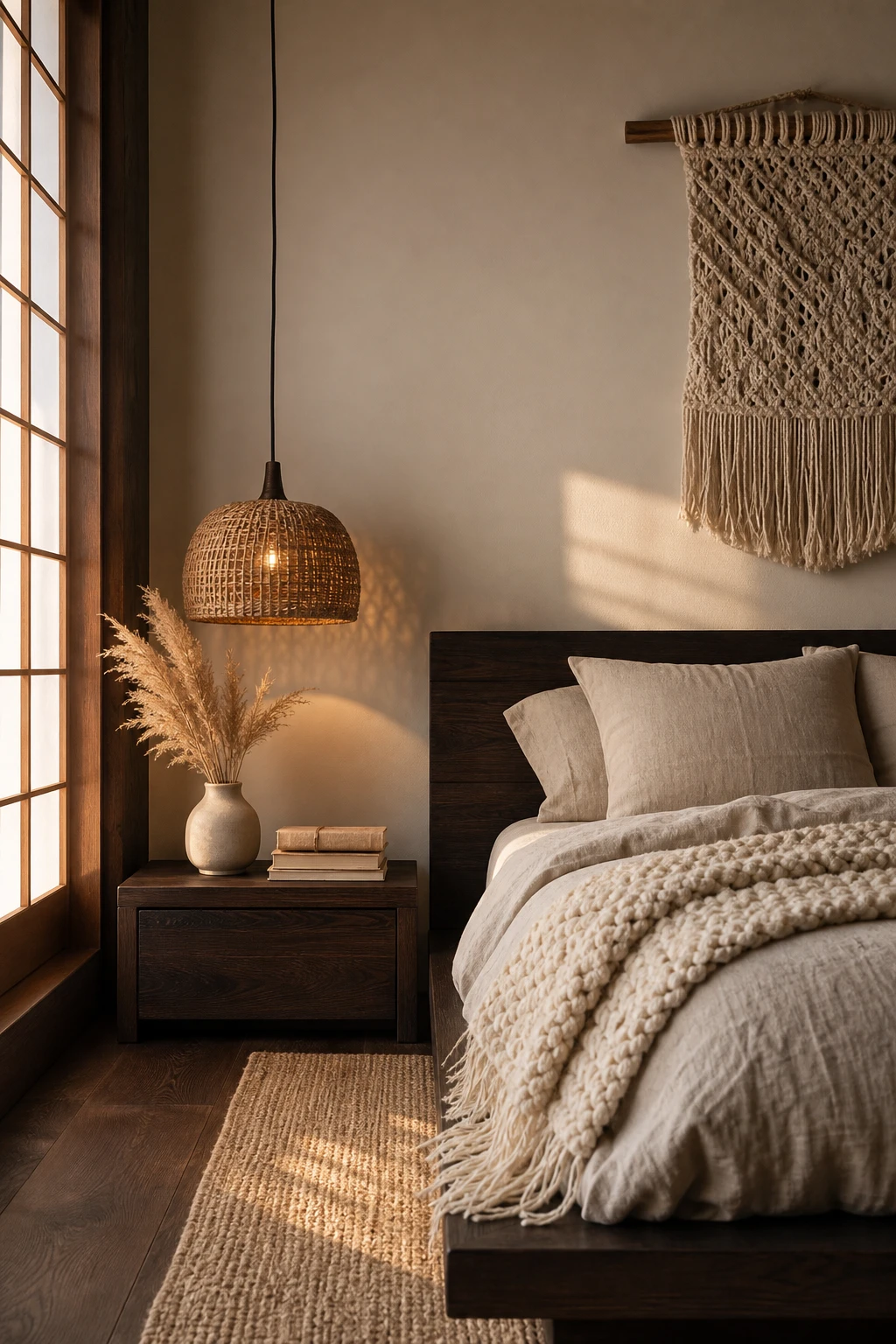
Boho Textures That Actually Work Inside a Japandi Dark Wood Bedroom
Boho softness and Japandi restraint are closer friends than most people expect. What I love here is the way handmade pieces, a knotted wall hanging, a woven pendant, dried stems in raw ceramic, add warmth without noise. You get that lived in, organic feeling while the dark walnut keeps everything grounded and still. The trick I always check is that every soft layer has an honest material: jute, wool, linen, nothing synthetic trying to fake it.
The Key Details
Low dark walnut platform bed
Woven rattan pendant light
Hand knotted macrame wall hanging
Chunky wool throw layered over linen bedding
Dried pampas stems in unglazed ceramic vase
Pro TipReach for natural fibres like jute, rattan, and undyed wool, because their muted tones sit quietly against dark wood rather than competing with it.
AvoidLayering too many boho textures at once will tip the room into busy, and that easy Japandi calm you worked so hard to build will vanish.
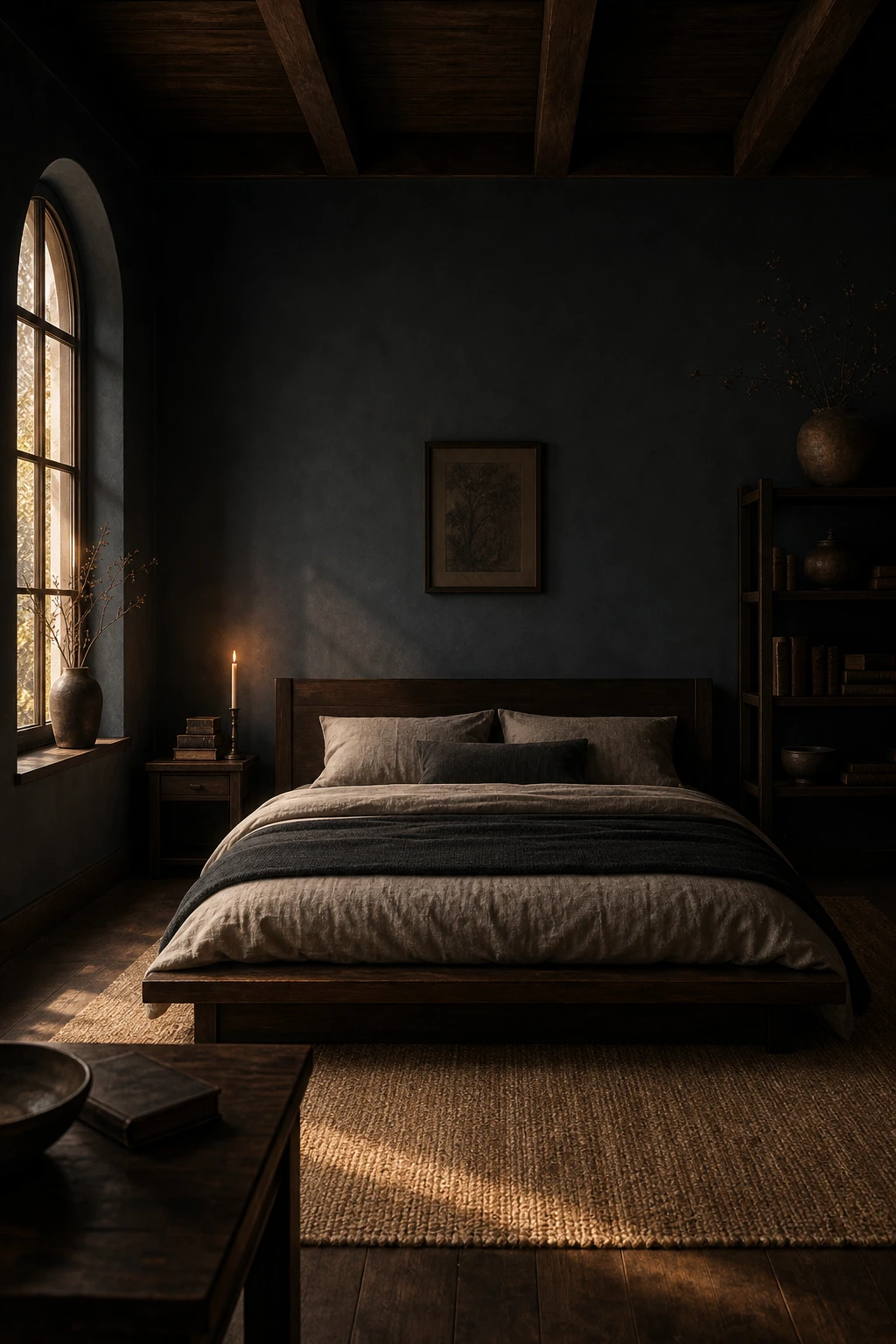
Steal the Dark Academia Feeling for Your Japandi Bedroom on a Small Budget
Dark Academia and Japandi feel like opposites until you put them in the same room, and then something clicks. The literary moodiness comes from one or two weighted objects, a stack of leather bound books, a dark framed print, and the rest stays bare. You get that brooding atmosphere without the clutter that usually kills a Japandi space. What wins me over every time is how little it takes.
The Key Details
Low profile dark walnut bed frame
Arched window with amber afternoon light
Stacked leather bound books on nightstand
Oat and charcoal linen bedding
Woven jute floor rug
Pro TipStack three books on your nightstand with a single dark framed print above and you have all the scholarly mood you need without touching anything else.
Avoid letting objects creep onto every surface. The moment the room feels busy you lose the quiet that makes Japandi work, and all that scholarly atmosphere tips into clutter rather than character.
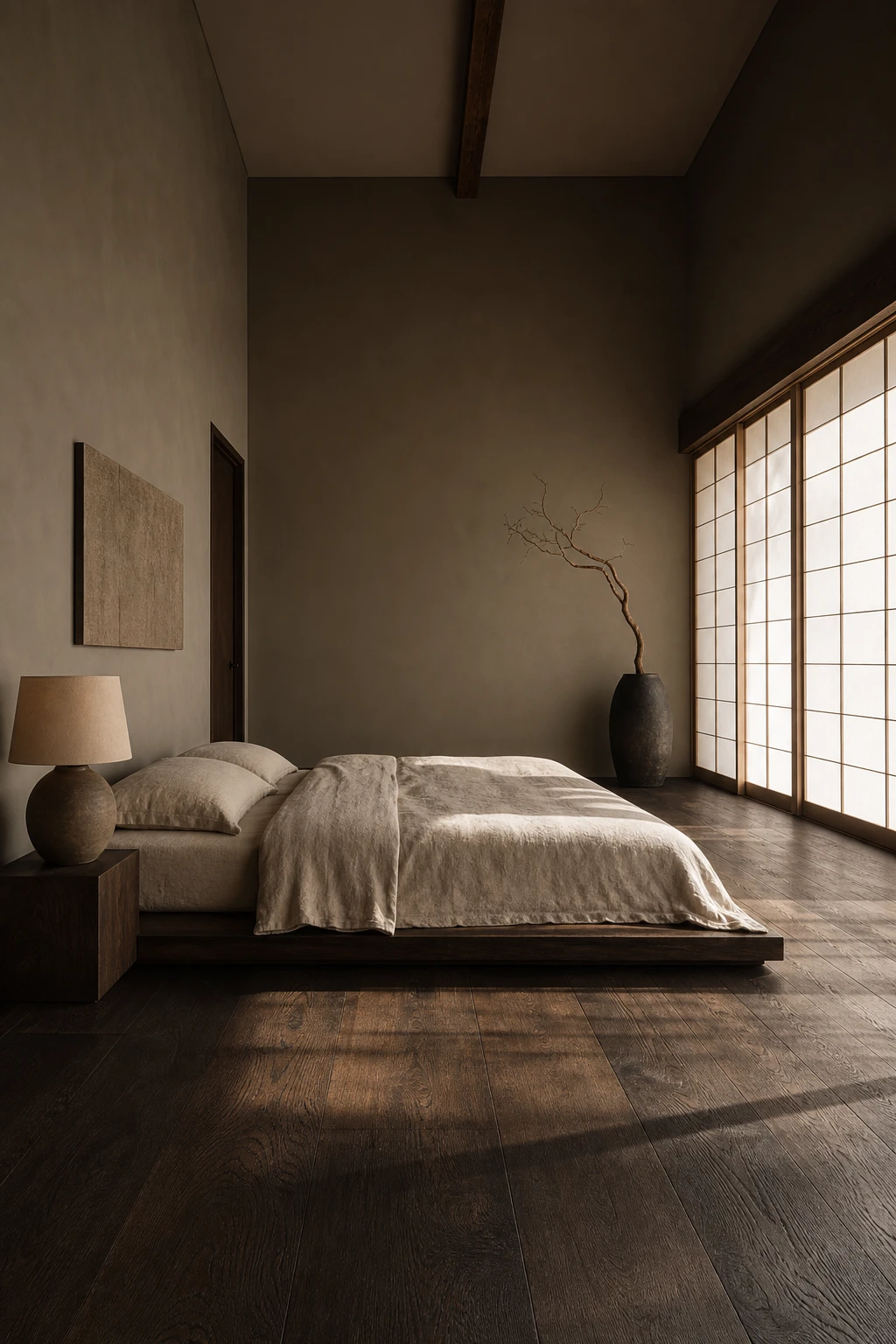
Floor Beds Make a Japandi Bedroom Feel Twice as Spacious and Here Is Why
Dropping the bed to floor level is one of my favourite moves in a Japandi room because it hands the walls back all that vertical breathing space you never knew you were losing. You will notice how your eye travels upward naturally, making even a modest bedroom feel generous and unhurried. The low silhouette slows everything down, and that calm is exactly the point.
The Key Details
Low dark wood platform bed frame
Full height shoji rice paper screen
Hand thrown ceramic bedside lamp
Oiled dark oak plank flooring
Tall matte stoneware branch vase
Pro TipSlip a thin tatami style mat between your platform base and mattress to lift the bed just enough for proportion without losing that ground hugging quietness.
AvoidLaying a mattress straight onto bare floorboards traps moisture underneath and ruins both the mattress and your floor within months.
The One Furniture Choice That Instantly Makes Any Bedroom Look More Japandi
The single biggest shift you can make in a bedroom that feels busy or boxed in is dropping the bed silhouette close to the floor. That one move opens up a wide band of wall above the frame, and the breathing space it creates is what makes the room read as calm and considered. What wins me over about Japandi proportion is this quiet paradox: you get a genuine sense of height without adding anything tall. Watch how the eye settles rather than darts once the bed sits low and the wall above it stays clear.
The Key Details
Dark walnut platform bed frame
Washi paper globe pendant
Oak hardwood plank floor
Shoji frosted window panel
Matte ceramic bud vase on bedside shelf
Pro TipKeep the top of your headboard below window sill height so the walls behind and beside it read as generous and unbroken.
Avoid placing tall, chunky bedside tables next to a low platform bed as the height mismatch cuts across the horizontal line the whole look depends on.
What Makes a Bed Frame Truly Japandi Rather Than Just Minimalist
A truly Japandi bed earns its place through the small things you almost miss at first glance. What I love is visible joinery, a slightly tapered headboard, or a base that floats just clear of the floor, details that tell you a craftsperson made choices here. You get a sense of quiet intention rather than something that just happens to be low and plain. That gap between minimalist and Japandi lives entirely in the warmth of the material and the honesty of how it is put together.
The Key Details
Low platform dark walnut bed frame with tapered headboard
Shoji inspired timber screen panel
Matte ceramic lamp with rice paper shade
Tatami style woven jute rug
Chunky boucle throw over linen bedding
Pro TipLook for a bed with a floating base or exposed peg joinery, because those small construction details are what give the frame its handcrafted, Japandi character.
AvoidBuying a plain rectangular box bed in any wood tone and calling it Japandi will fall flat if the timber has no grain character and the form has no considered detail to hold the eye.
Brown Boucle Beds Are Having a Moment and They Suit Dark Wood Perfectly
Boucle upholstery against dark wood is one of those pairings that just settles a room. The looped texture catches light in a way smooth linen never does, and what I love is how it adds depth without a single drop of colour. A caramel or warm brown boucle sits in the same tonal family as walnut or wenge, so you get richness layered on richness rather than contrast fighting contrast. The whole bed feels grounded, tactile, almost like the room is asking you to slow down.
The Key Details
Brown boucle upholstered platform bed
Low dark walnut bedside table
Hand knotted wool rug
Shoji inspired window shade
Single stem unglazed ceramic vase
Pro TipChoose a boucle with a warm caramel or toasted wheat tone rather than a cool cream, so the fabric and the timber read as one continuous tonal family.
Avoid a bright white or cool toned boucle, as it will cut across the warmth of the dark timber and make the bed feel like two separate decisions rather than one.
How an Upholstered Headboard Softens a Dark Wood Bedroom Without Losing the Look
A wide linen headboard does something quiet and clever in a room built almost entirely from hard, cool surfaces. You get one soft panel that the eye can rest on, and that pause is what stops the space from feeling stark. What I love about this move is how the upholstery holds its own without competing, the fabric texture reads as warmth against the walnut grain rather than a clash. Watch how the whole bed suddenly looks more considered because of it.
The Key Details
Low dark walnut platform bed frame
Wide curved linen upholstered headboard
Floating dark wood bedside shelves
Hand thrown ceramic table lamps
Chunky boucle throw at bed foot
Pro TipFix the headboard a few centimetres clear of the wall so it casts a thin shadow line and reads as a piece in its own right rather than something just leaning there.
AvoidA headboard that towers above a low platform bed will snap the proportions immediately, so keep the height modest and let the horizontal spread do the work instead.
Walnut Beds Bring a Richness to Japandi Bedrooms That Oak Simply Cannot Match
Walnut has a depth that oak just cannot replicate, and that depth is exactly what anchors a Japandi bedroom so it feels considered rather than sparse. The grain moves in warm chocolate and amber tones that pull light into the room rather than bounce it back at you. You will notice how the low platform frame keeps the whole composition close to the floor, which is very much in the Japanese spirit of rest and stillness. That combination of rich colour and low proportion is what gives walnut its grounded, almost meditative presence.
The Key Details
Low platform walnut bed frame
Washi paper pendant light
Undyed layered linen bedding
Live edge wall mounted bedside shelf
Continuous plank hardwood floor
Pro TipLeave walnut oiled rather than lacquered so the grain stays alive and the surface develops a gentle honey tone as it ages.
AvoidPlacing a walnut bed frame next to an ash or pine nightstand in the same eyeline muddies the warmth and makes both woods look like mistakes.
Light Oak Beds Work in a Dark Japandi Bedroom When You Follow This One Rule
Light oak against a deep charcoal wall is one of my favourite contrasts in a Japandi bedroom. The dark backdrop pulls the warm grain forward so you actually see every detail in the wood, and you get that quiet drama without a single loud gesture. Watch how the low platform silhouette keeps everything grounded, the whole room feels intentional rather than accidental.
The Key Details
Light oak platform bed frame
Low oak nightstand with ceramic bud vase
Washi paper globe pendant light
Layered undyed linen bedding
Shoji inspired rice paper window panel
Pro TipPaint the wall directly behind the bed head in a deep charcoal or slate tone so the oak grain catches the light and glows against it.
Avoid placing a light oak bed against pale walls on a pale floor, as nothing anchors it and the wood loses all its warmth and presence.
A Dark Brown Bed Frame Is the Anchor Every Japandi Bedroom Needs
A deep brown bed frame does something no pale wood can quite manage: it pulls the whole room down into the floor and gives everything above it a place to land. What I love about using it as the tonal foundation is how every other element, the linen, the ceramics, the soft wall colour, starts responding to that anchor rather than floating. You get a room that feels considered and still, not assembled from separate pieces. The frame earns its place by doing the heavy work quietly.
The Key Details
Low profile dark brown solid wood bed frame
Floating dark wood bedside shelves
Oversized shoji inspired paper pendant light
Wide plank light oak flooring
Unglazed ceramic bedside vessels
Pro TipMatch your frame tone as closely as you can to the floor stain so the two merge into one grounded layer and the bed feels rooted rather than dropped in.
Avoid placing a dark brown frame directly on a very pale or white floor without a rug to bridge them, because the contrast reads as an oversight rather than a deliberate choice.
Bringing Light Wood Into a Dark Japandi Bedroom to Stop It Feeling Cave Like
Pale ash against deep walnut is one of my favourite moves in a dark Japandi room. The contrast gives your eye somewhere to land, so the space reads as considered rather than heavy. You will notice how just one lighter piece lifts the whole room without breaking the calm. That quiet tonal shift is what keeps it feeling grounded and breathable at once.
The Key Details
Low walnut platform bed
Pale ash bedside table
Floating light oak shelf
Woven rattan pendant light
Shoji paper screen panel
Pro TipPlace a single light wood stool or small tray at the foot of the bed and let it do all the lifting work on its own.
Avoid scattering light wood pieces across every corner of the room, because too many breaks the dark palette’s stillness and the whole thing starts to feel restless.
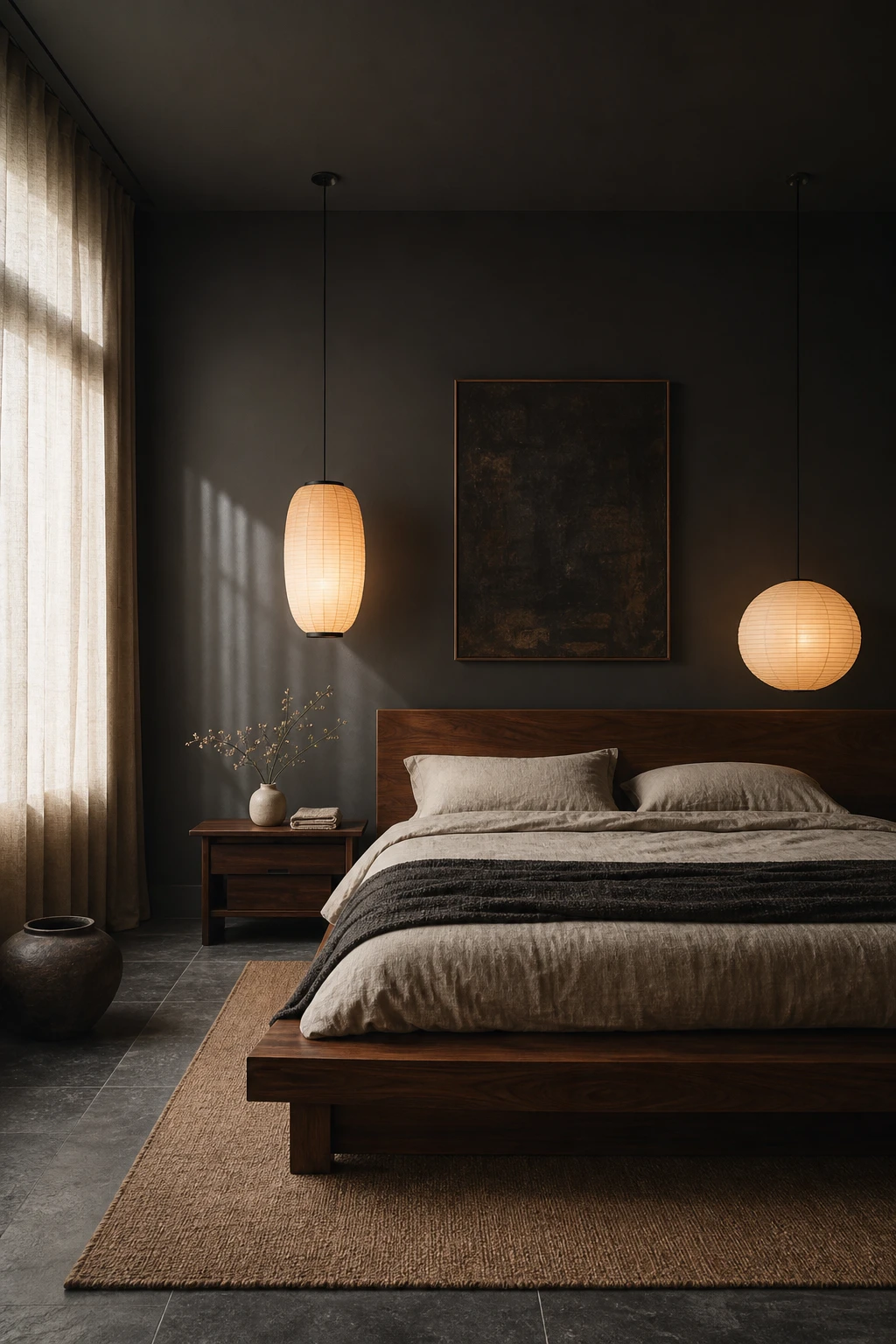
Charcoal Walls Make Dark Wood Bedroom Furniture Look Its Absolute Best
Charcoal walls are one of my favourite moves with dark timber because the cool grey tone pulls the warm red undertones right out of walnut grain, and you get this quiet glow that a white room simply cannot give you. What I love is how the contrast makes each piece of furniture feel considered rather than heavy. Watch how the washi pendants and sheer oat curtains hold the light and stop the whole room from sinking into darkness.
The Key Details
Low walnut platform bed
Washi paper pendant lights
Slim dark wood nightstand
Sheer oat linen curtains
Honed stone floor
Pro TipChoose a charcoal with a blue or green base rather than a brown one, so warm walnut furniture sits against it with real contrast and does not blend into the wall.
Avoid painting all four walls charcoal without at least one large mirror or a run of sheer curtains, because in a smaller room the space will feel like a box with no air in it.
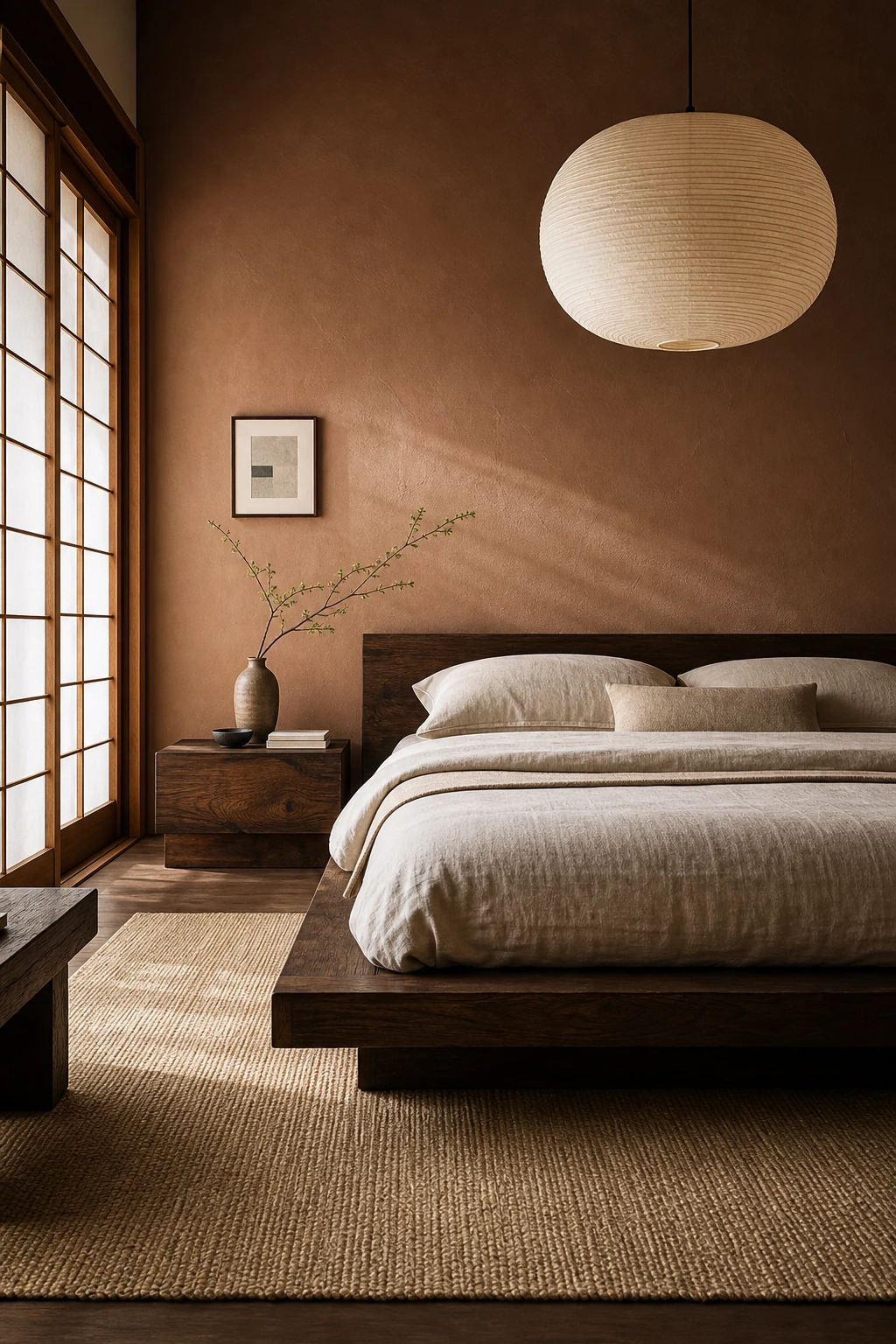
Brown Walls Are the Japandi Trend That Makes a Dark Wood Bedroom Feel Truly Cosy
Brown walls and dark wood furniture share the same quiet, earthy language, and when you match them carefully the room stops feeling like separate pieces and starts feeling like one settled whole. What I love here is the tonal pull between the clay wall and the walnut grain. You get depth without drama, warmth without weight. The brown wall is not competing for attention, it is simply holding everything together.
The Key Details
Low dark walnut platform bed
Washi paper drum pendant
Sliding shoji screen
Tatami weave floor rug
Ceramic bud vase on teak plinth
Pro TipReach for a clay or earth brown with a grey undertone rather than a red one, and the wall will sit peacefully beside dark wood instead of clashing with it.
Avoid a satin or gloss finish on a brown feature wall, because the sheen will catch the light and fight the natural matte texture of the wood furniture beside it.
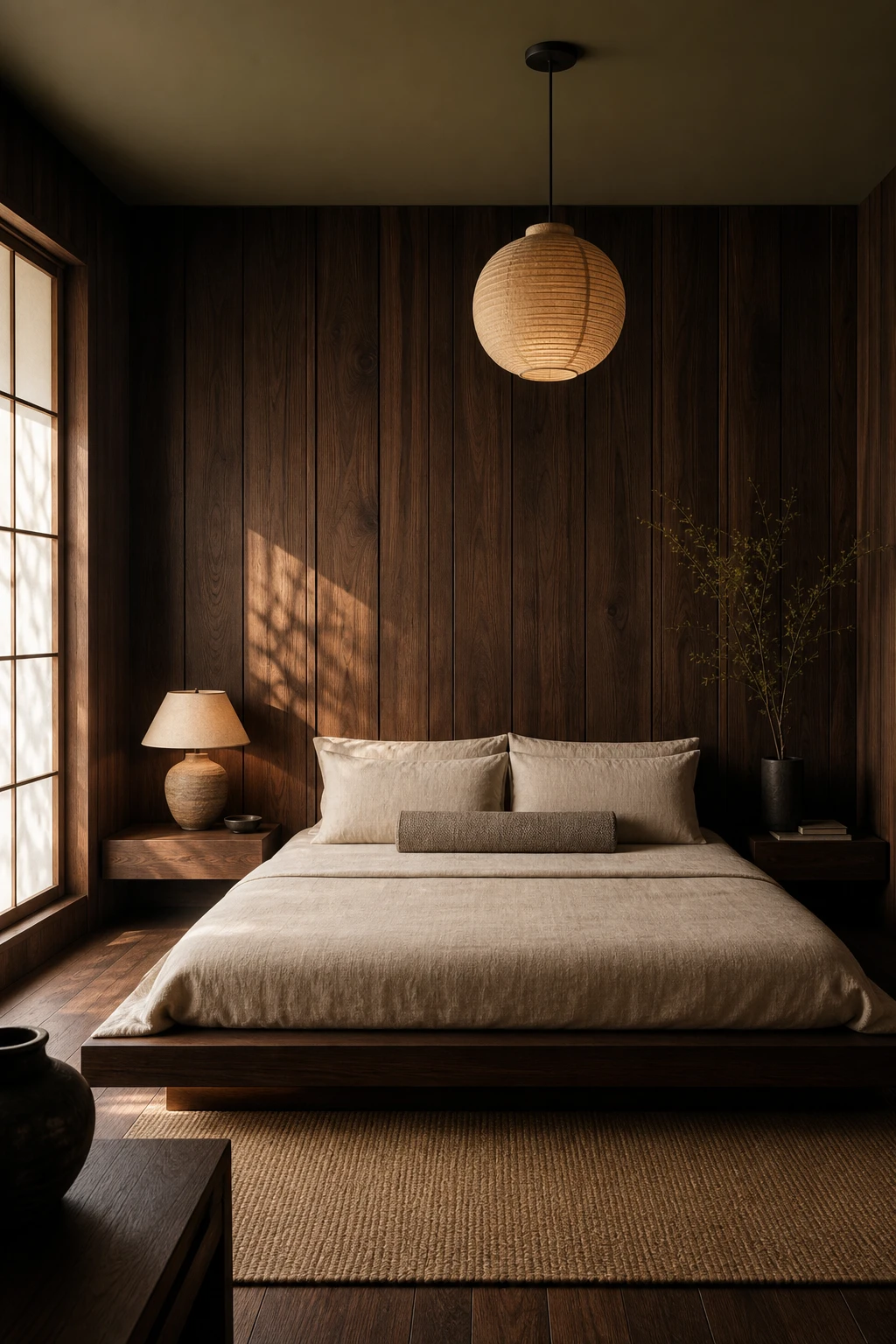
Wood Panel Walls Are the Quickest Way to Wrap a Japandi Bedroom in Warmth
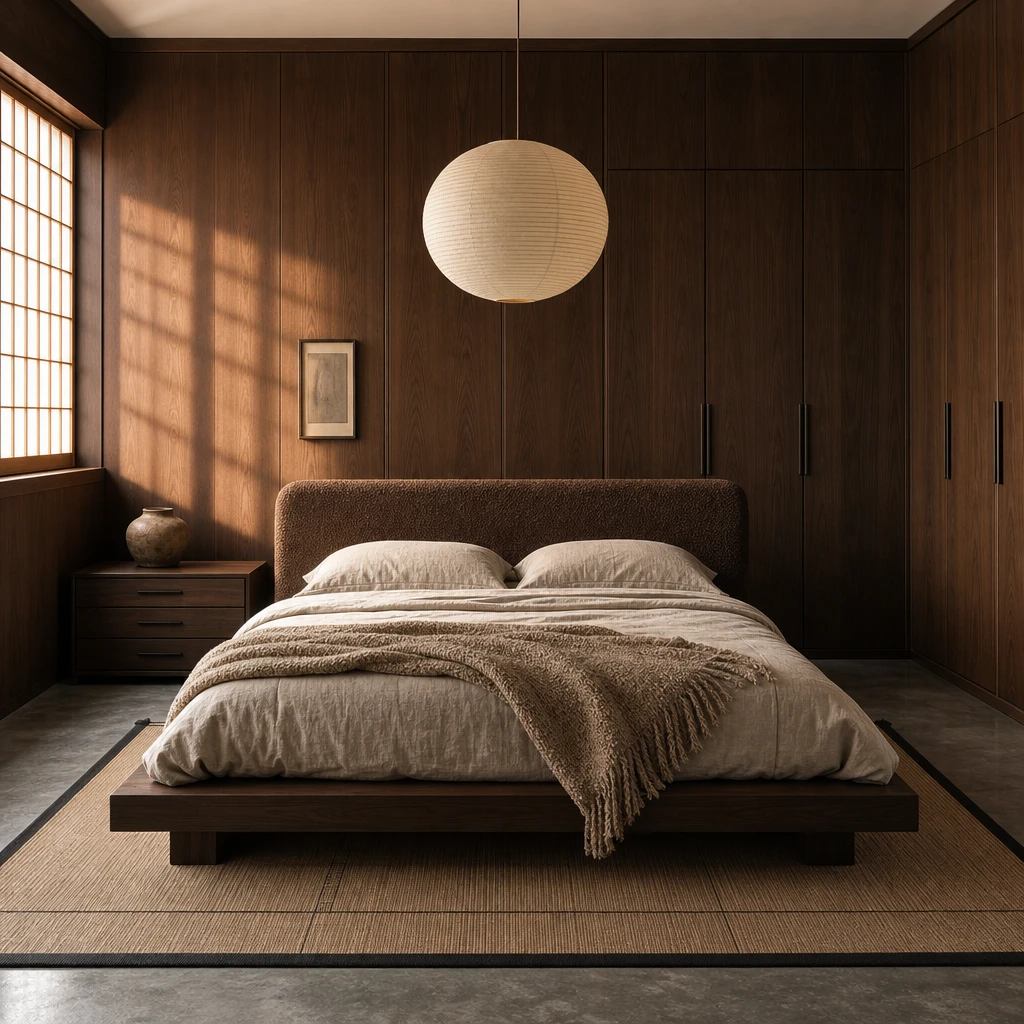
Vertical dark walnut panels on a single wall do something I find endlessly satisfying: they pull the eye upward while wrapping the room in a texture that feels almost alive. You get depth that paint alone simply cannot give, and the grain carries enough warmth to balance the cool restraint Japandi demands. What wins me over every time is how the wood reads as both bold and calm at once, grounding the low platform bed in front of it without ever feeling heavy.
The Key Details
Vertical dark walnut panel walls
Low platform bed frame
Washi paper pendant light
Floating minimal nightstand
Shoji inspired frosted window
Pro TipRun your panels floor to ceiling on the wall directly behind the bed so the headboard wall becomes the natural anchor and the rest of the room stays light and open.
AvoidCladding all four walls in dark panelling traps the light and turns what should feel like a serene retreat into something closer to a dimly lit box.
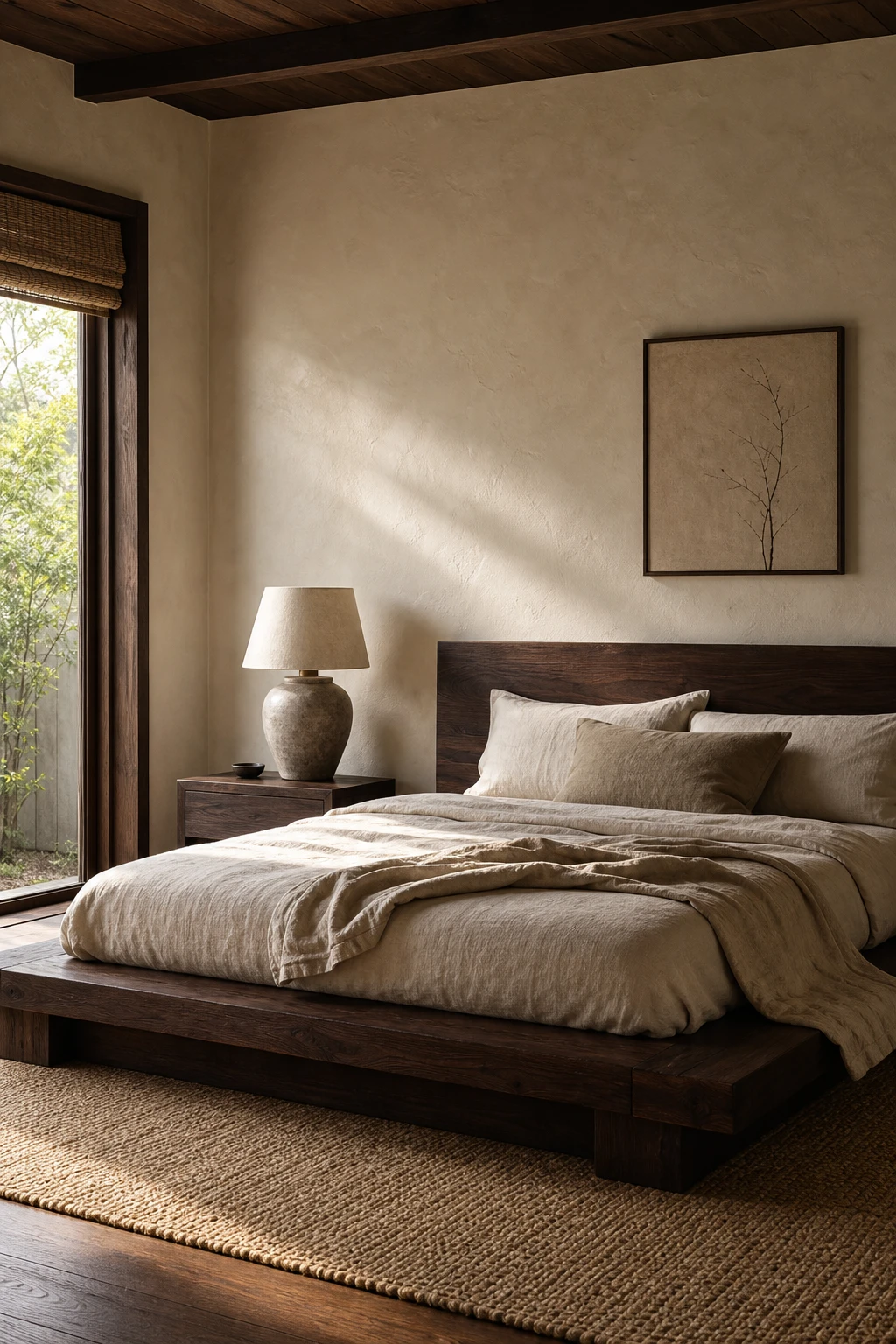
Beige and Dark Wood Is the Understated Pairing That Keeps Japandi Bedrooms Timeless
Beige and dark wood is one of those pairings I keep coming back to, because the contrast does quiet but meaningful work. The walnut pulls the soft neutrals down to earth so you get warmth without drift, and the whole room reads as considered rather than simply pale. What wins me over is how the wood grain gives the eye something real to rest on, so the beige never tips into emptiness or feels like an afterthought.
The Key Details
Low platform bed in solid walnut timber
Undyed linen bedding in layered ivory and oat
Chunky woven jute area rug
Sculptural ceramic table lamp
Dark wood bedside nightstand
Pro TipLayer at least three beige textures, linen, jute and a chunky knit for example, so the palette has enough visual movement to hold attention without adding colour.
Avoid beige with a yellow or pink undertone, as either one pulls the palette warm and you lose the cool, composed quality that makes Japandi feel so distinct.
The Only Plants That Look Right in a Japandi Bedroom With Dark Wood
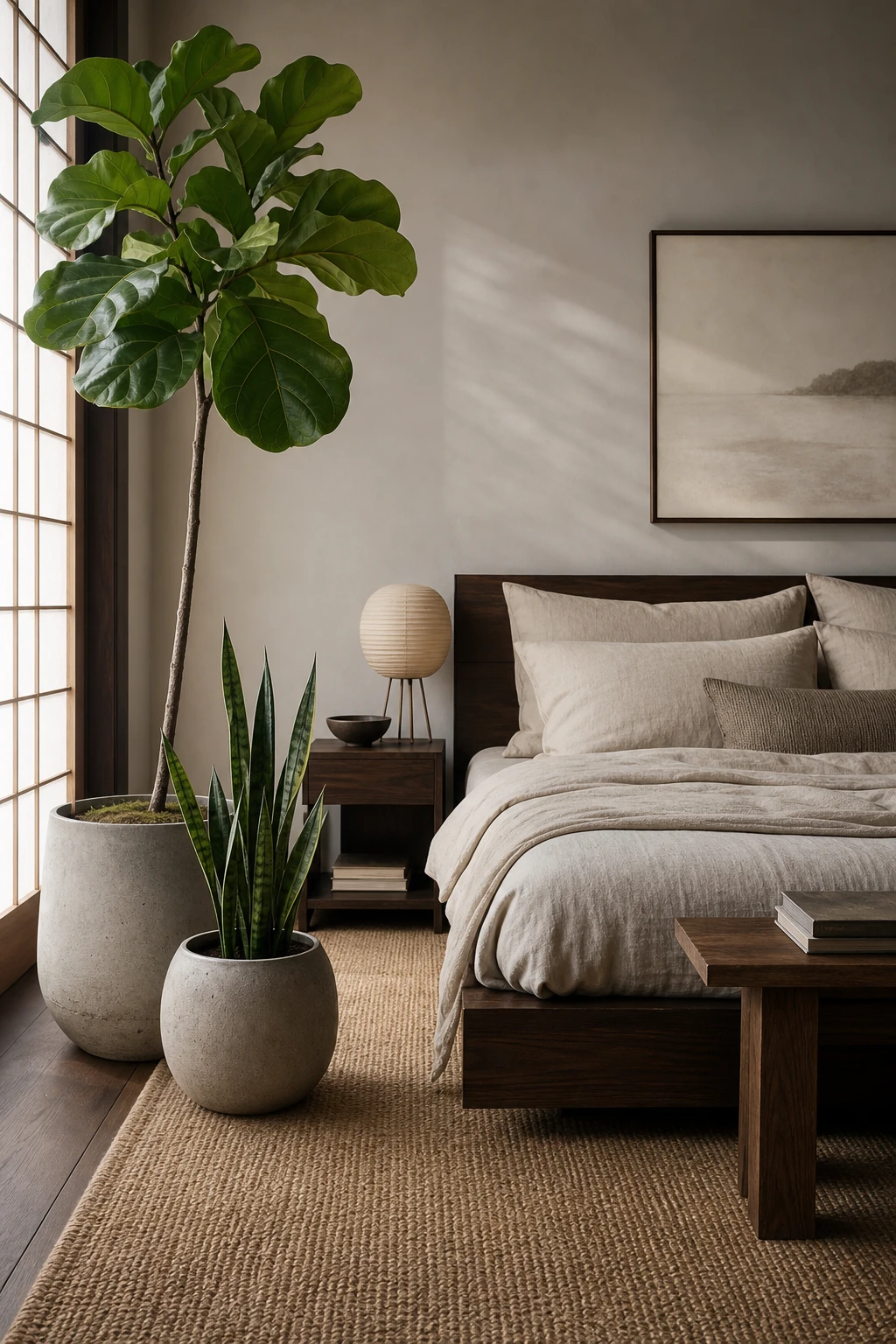
Greenery earns its place in a Japandi bedroom only when the plant itself holds a strong, quiet shape. What I love about a fiddle leaf fig or a tall snake plant is that each one reads as a single sculptural object rather than a busy tangle, so you get life in the room without noise. Against dark wood, the deep green feels grounded and intentional. The pot matters just as much: unglazed stoneware keeps the whole moment earthy and still.
The Key Details
Large leaf fiddle leaf fig in unglazed stoneware vessel
Slender snake plant in low ceramic planter
Dark oiled walnut bed frame
Sheer rice paper window panels
Woven seagrass floor mat
Pro TipChoose one plant that reaches at least half your ceiling height and let it stand alone, because a single bold form creates far more calm than a cluster of smaller pots ever will.
Avoid trailing plants on shelves or windowsills because the cascading tendrils break the clean horizontal lines that hold a Japandi room together.
Paper Lanterns Earn Their Place in a Japandi Bedroom More Than Any Other Light Shade
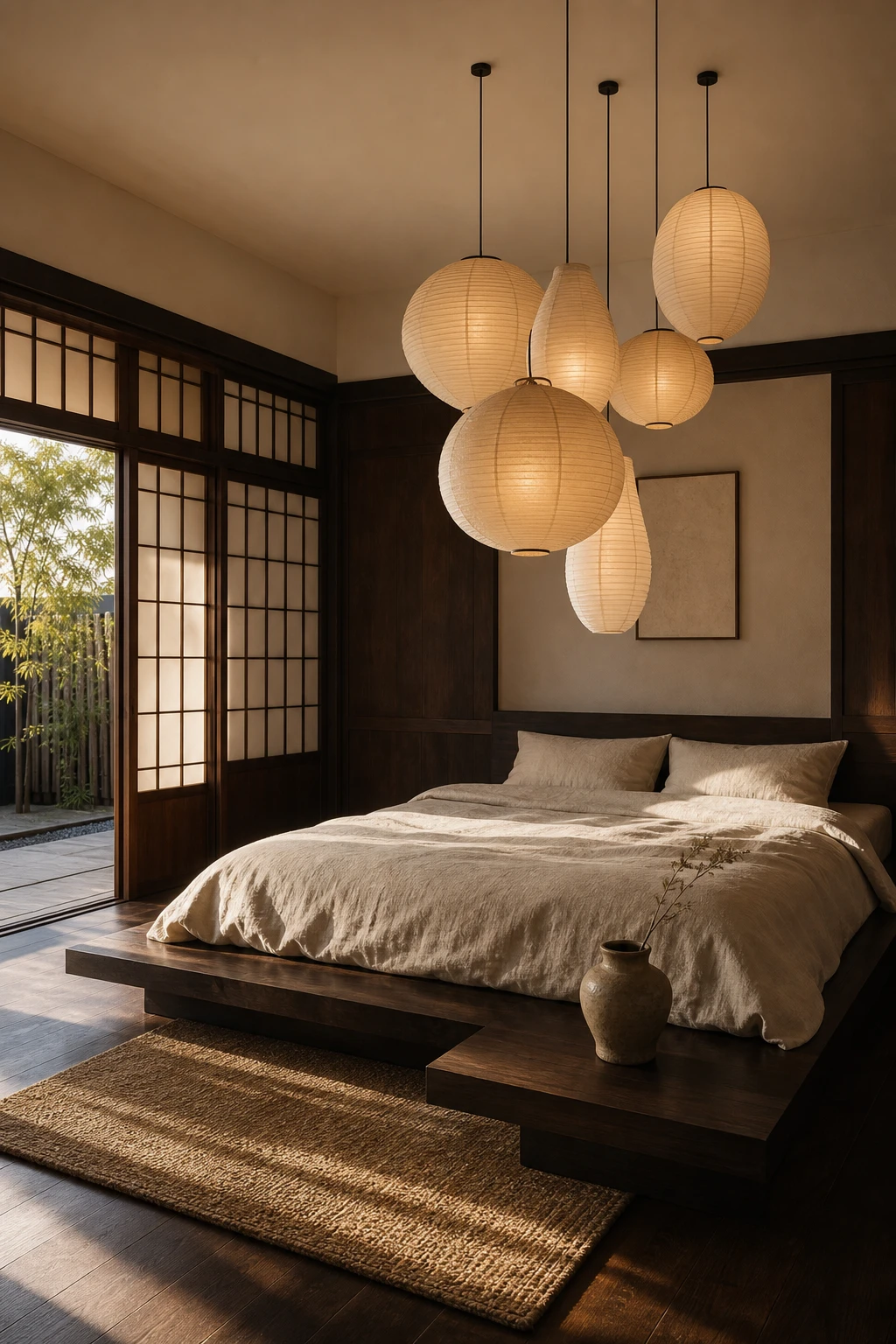
Paper lanterns win me over every single time I use them in a Japandi bedroom, because the washi paper does something no glass or fabric shade can: it drinks the light in and breathes it back out as a warm, living glow that wraps around the dark wood and makes the whole room feel exhaled rather than lit. You will notice how the warmth pulls the walnut grain forward and softens everything around it, which is exactly the quiet, grounded atmosphere Japandi is reaching for.
The Key Details
Washi paper pendant lanterns
Low dark walnut platform bed
Undyed linen bedding
Woven grass floor mat
Shoji inspired sliding window panels
Pro TipHang your lantern at bedside lamp height rather than from the ceiling so the glow lands at eye level when you are lying down, which is where you feel it most.
Avoid cheap synthetic paper lanterns with a bright white inner surface, because that cold, flat light fights the warm wood tones and strips the room of everything that makes Japandi feel calm.
Wabi Sabi Decor Gives a Japandi Dark Wood Bedroom Its Soul Not Just Its Style
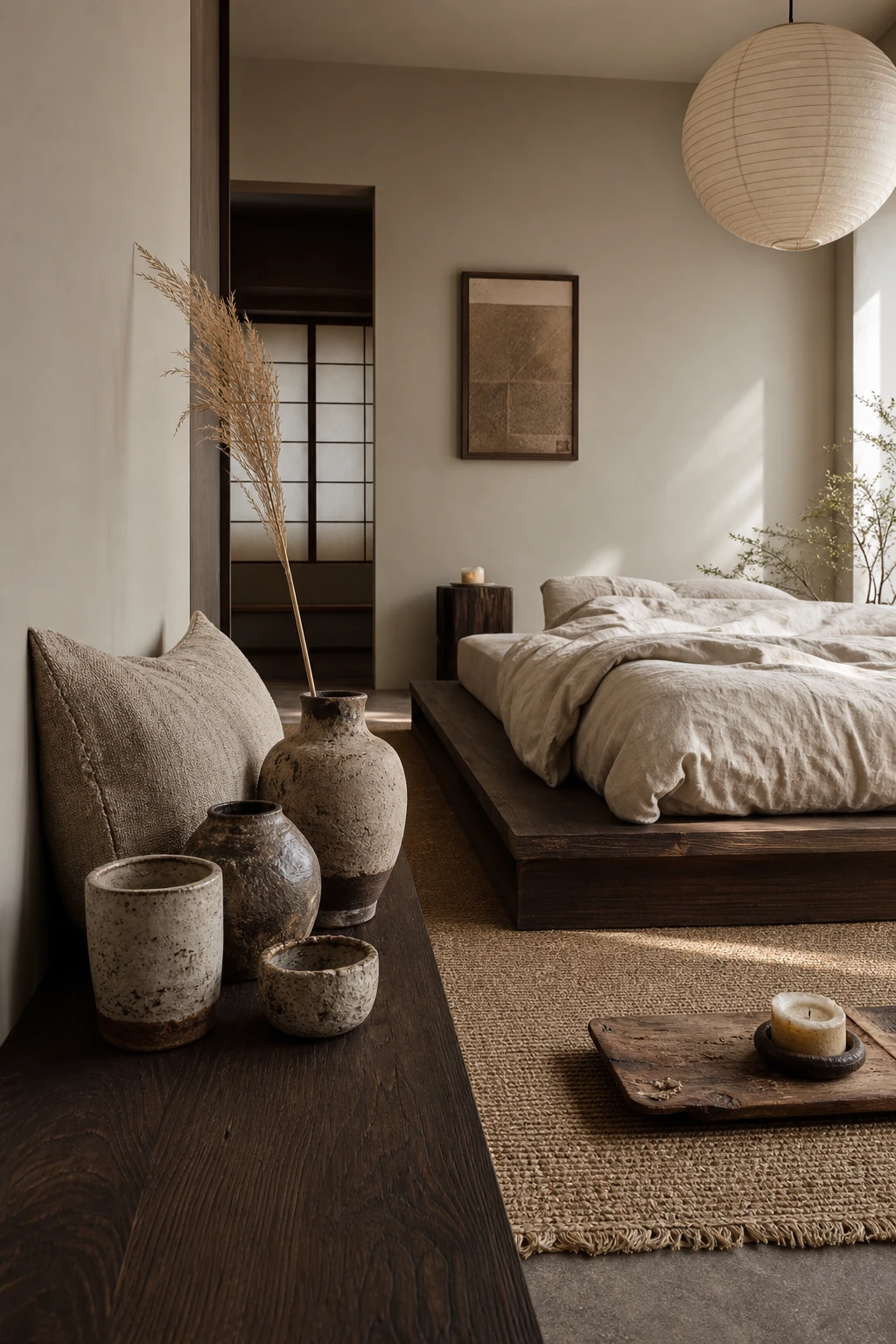
Wabi sabi details are what stop a Japandi bedroom feeling like a showroom. A thumb print in a glaze, a linen cushion that puckers slightly at the seam, a candle holder worn smooth at one edge: these small signs of a human hand are what I reach for when a room needs warmth. You will notice how one imperfect object pulls the whole space into focus, giving dark walnut somewhere to breathe and the eye somewhere to rest.
The Key Details
Hand thrown ceramic vessels with uneven glaze
Low dark walnut platform bed with hand stitched linen duvet
Woven rush floor mat with irregular edges
Shoji inspired rice paper pendant light
Reclaimed wood tray with beeswax candle
Pro TipPlace a single hand thrown vessel on your bedside tray before adding anything else, because one genuine piece quietly lifts every object around it.
Avoid buying sets labelled wabi sabi in matching sizes and finishes, because uniform imperfection is just pattern and the warmth you are looking for disappears completely.
Hanging Pendants Over a Japandi Bed Free Up Space and Look Far More Considered
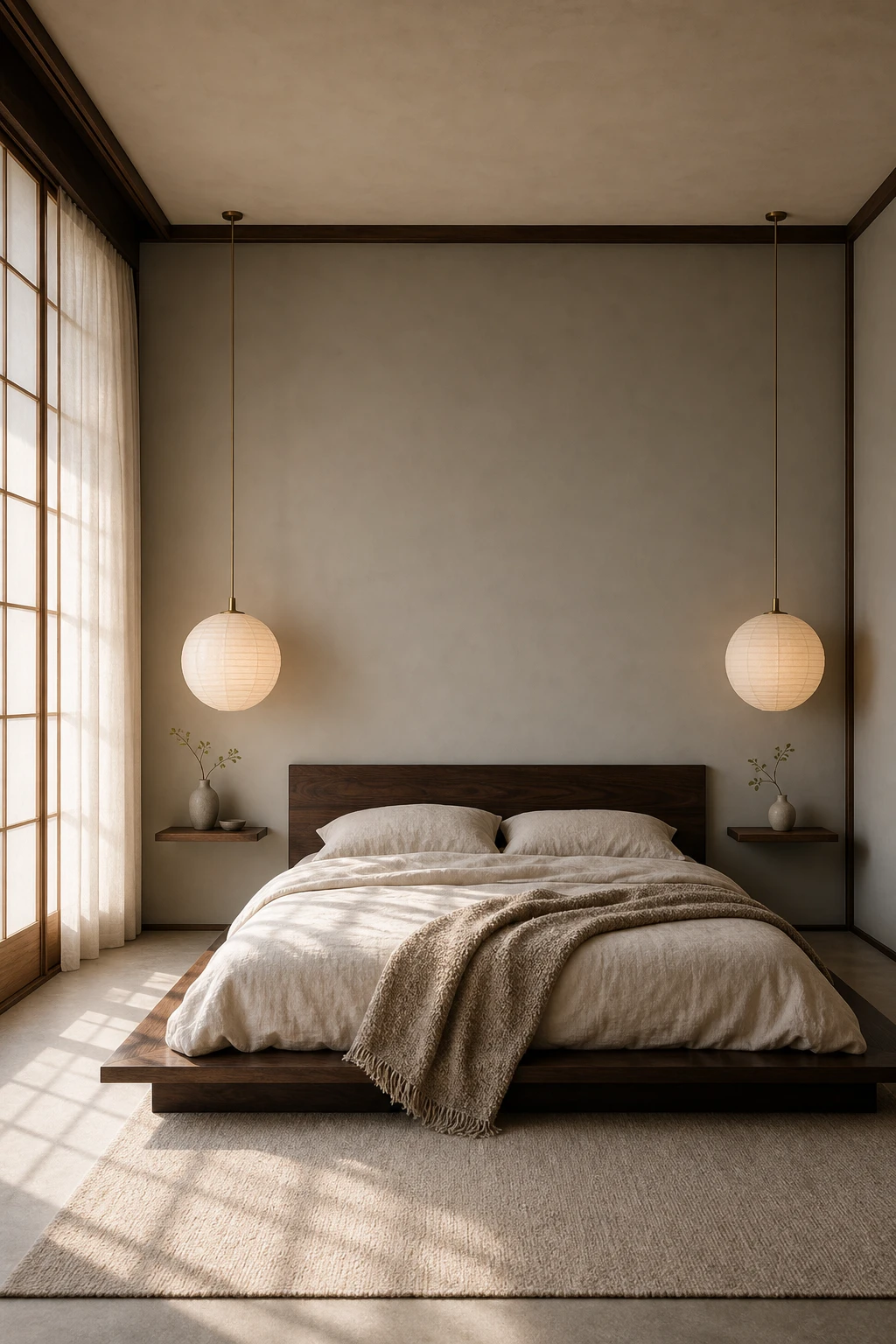
Swapping out table lamps for pendants is one of my favourite moves in a Japandi bedroom because the moment those bedside surfaces clear, the whole room exhales. You get a cleaner sightline to the bed and the pendants do something table lamps simply cannot: they frame the sleeping space from above, drawing the eye in and making the bed feel intentional. What I love most is how a pair of washi paper globes casts the softest warm glow, never harsh, always calm.
The Key Details
Washi paper globe pendants
Low dark walnut platform bed
Wall mounted oak bedside shelves
Shoji style sheer curtains
Boucle throw and undyed linen bedding
Pro TipHang the two pendants at slightly different drop heights, a few inches between them, so the arrangement feels natural and handmade rather than showroom symmetrical.
AvoidResist any pendant wider than roughly a third of the bed’s headboard span, because an oversized shade will visually crush the low platform bed beneath it and kill the sense of calm you are working toward.
Soft Warm Lighting Is the Invisible Ingredient That Makes Dark Wood Glow at Night
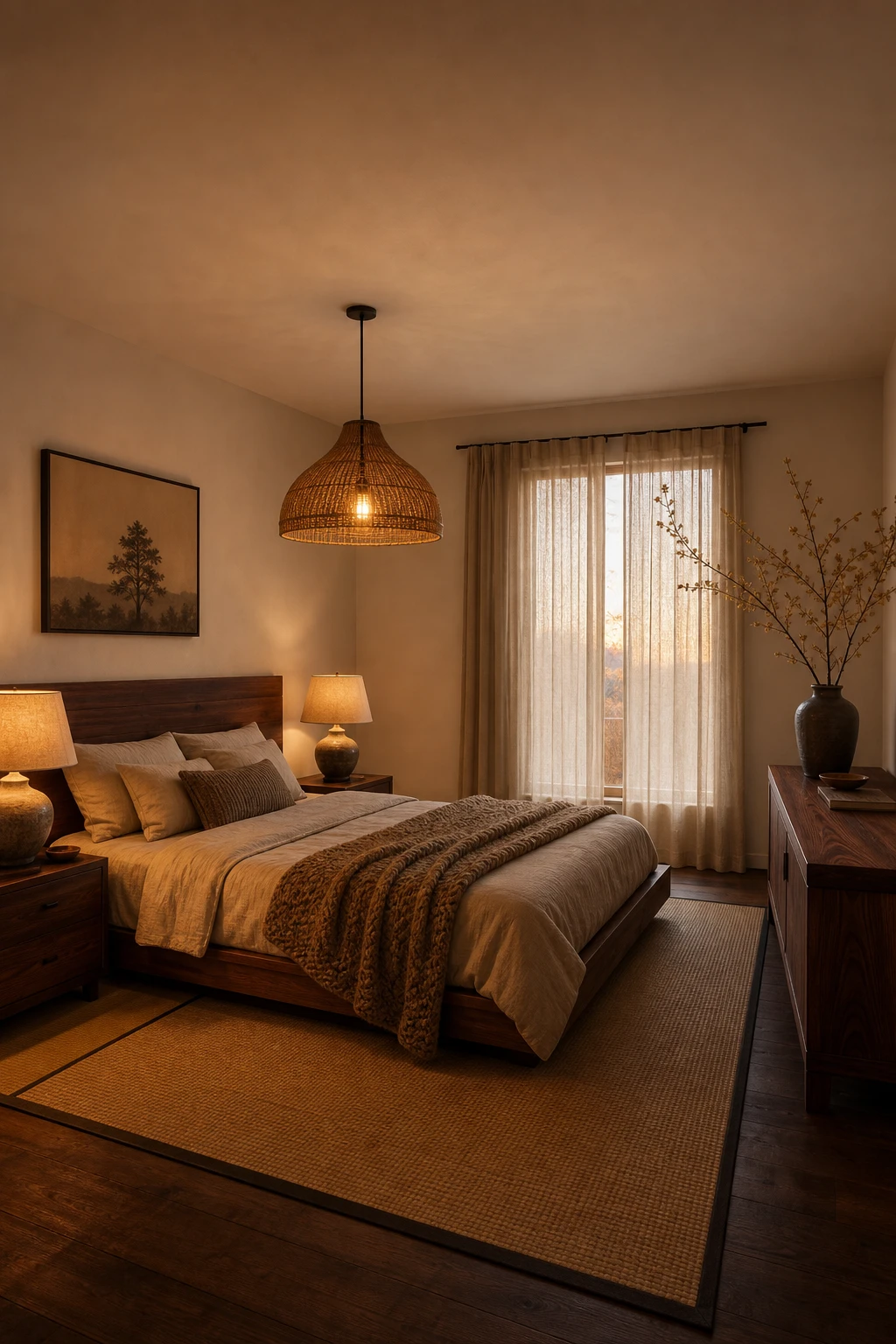
Warm light does something almost magical to dark timber: it pulls the red and amber tones right up to the surface, so the wood looks alive rather than flat. The low hung rattan pendant and twin ceramic bedside lamps keep the light source close to the bed, pooling softness exactly where you feel it most. You get that honeyed glow across the walnut grain that no amount of styling can fake with the wrong bulb.
The Key Details
Low hung rattan pendant light
Ceramic twin bedside lamps
Oiled walnut low bed frame
Woven tatami floor mat
Sheer linen curtains
Pro TipChoose bulbs rated 2700K or below and your dark wood will shift from cool and heavy to warm and deeply inviting the moment the lights come on.
AvoidA single bright cool overhead fitting will strip every trace of warmth from the grain and leave the room feeling more like a waiting room than a bedroom.
Dark Wood Fitted Wardrobes Turn a Whole Bedroom Wall Into a Calm Statement
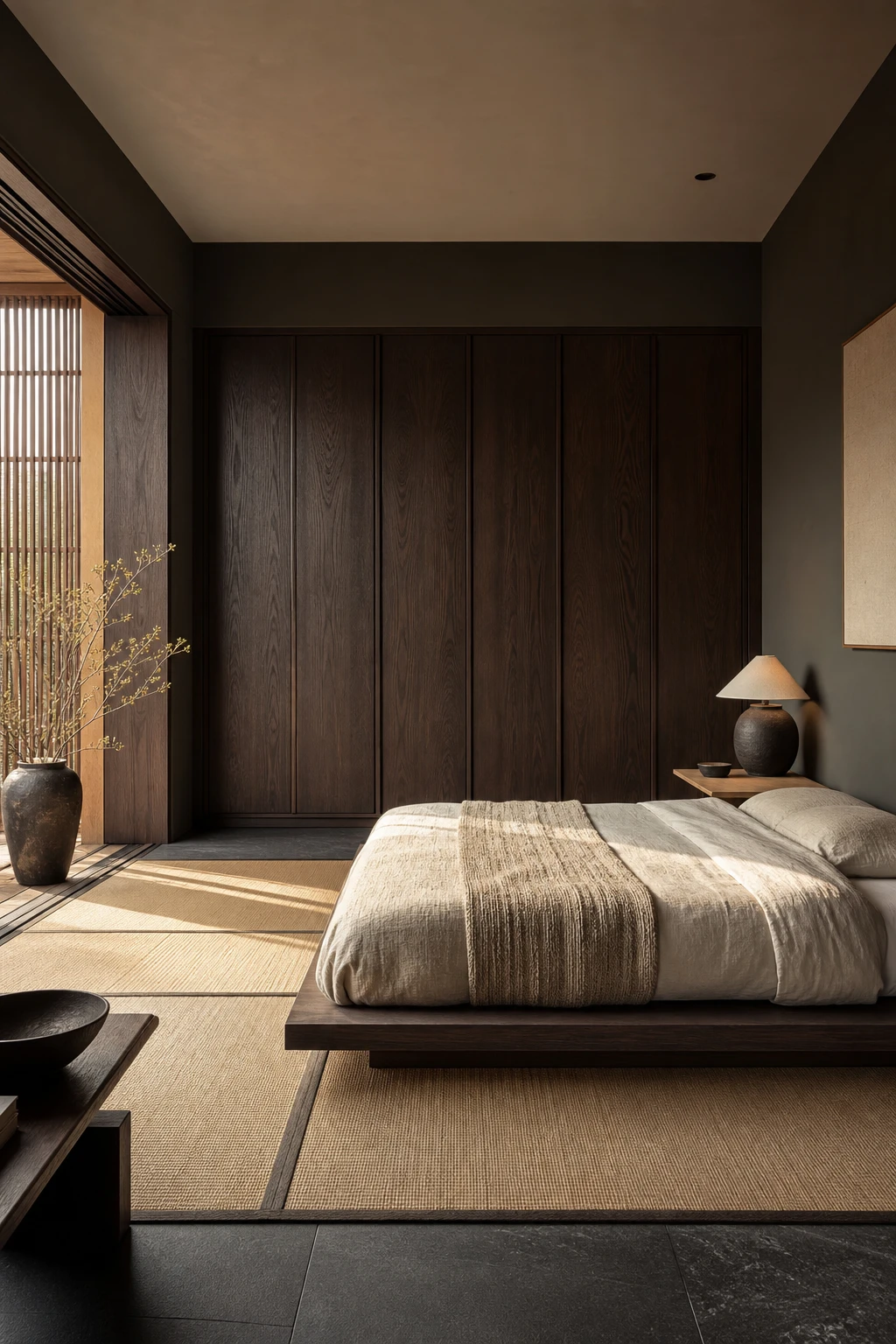
Floor to ceiling fitted wardrobes that run wall to wall do something I find genuinely satisfying: the room stops having furniture in it and starts feeling like the furniture IS the room. You get a seamless plane of dark wood grain with no gaps, no skirting breaks, no visual clutter pulling the eye sideways. The storage disappears into the architecture completely, and once it does, the only thing left to notice is the calm. That is a trade I will make every single time.
The Key Details
Handleless floor to ceiling fitted wardrobes
Low platform bed frame
Floating slatted oak bedside shelf
Hand thrown ceramic table lamp
Tatami style woven floor matting
Pro TipSpecify push to open doors or a recessed finger pull routed directly into the panel so the facade stays completely flat and unbroken from floor to ceiling.
AvoidFitting decorative knobs or chunky bar handles onto Japandi wardrobes immediately fragments that seamless wall and pulls the whole look apart.
Using a Chest of Drawers as a Bedside Table Is the Japandi Swap Worth Making
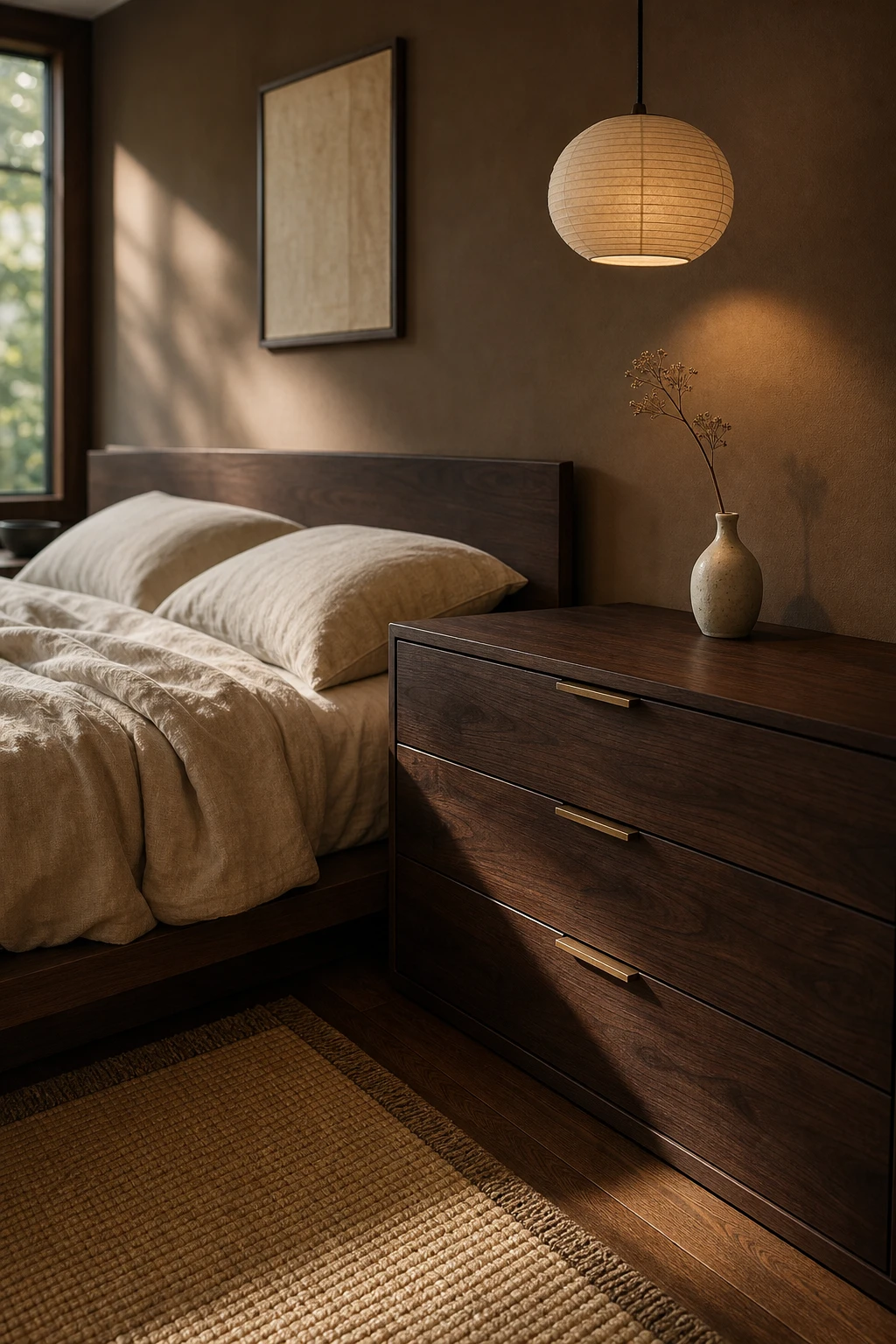
Swapping a nightstand for a low chest is one of my favourite moves in a Japandi room because you gain four or five drawers of storage and the surface still reads as calm and uncluttered. What I love is how a wide, flat top gives you proper room for a lamp, a book, and a small object without anything feeling crowded. You also get a grounded, horizontal line that pulls the whole bed wall together in a way a spindly side table never quite manages.
The Key Details
Low dark walnut chest of drawers
Slim brass drawer pulls
Washi paper pendant lamp
Low platform bed frame
Hand knotted natural fibre rug
Pro TipMatch the chest height as closely as you can to the top of your mattress so your arm drops naturally to it without stretching or bending.
Avoid choosing a chest so tall that its surface sits noticeably above your eyeline when you are lying down, because it will feel like a wall rather than a bedside.
A Dark Wood Floor Pulls the Whole Japandi Bedroom Together From the Ground Up
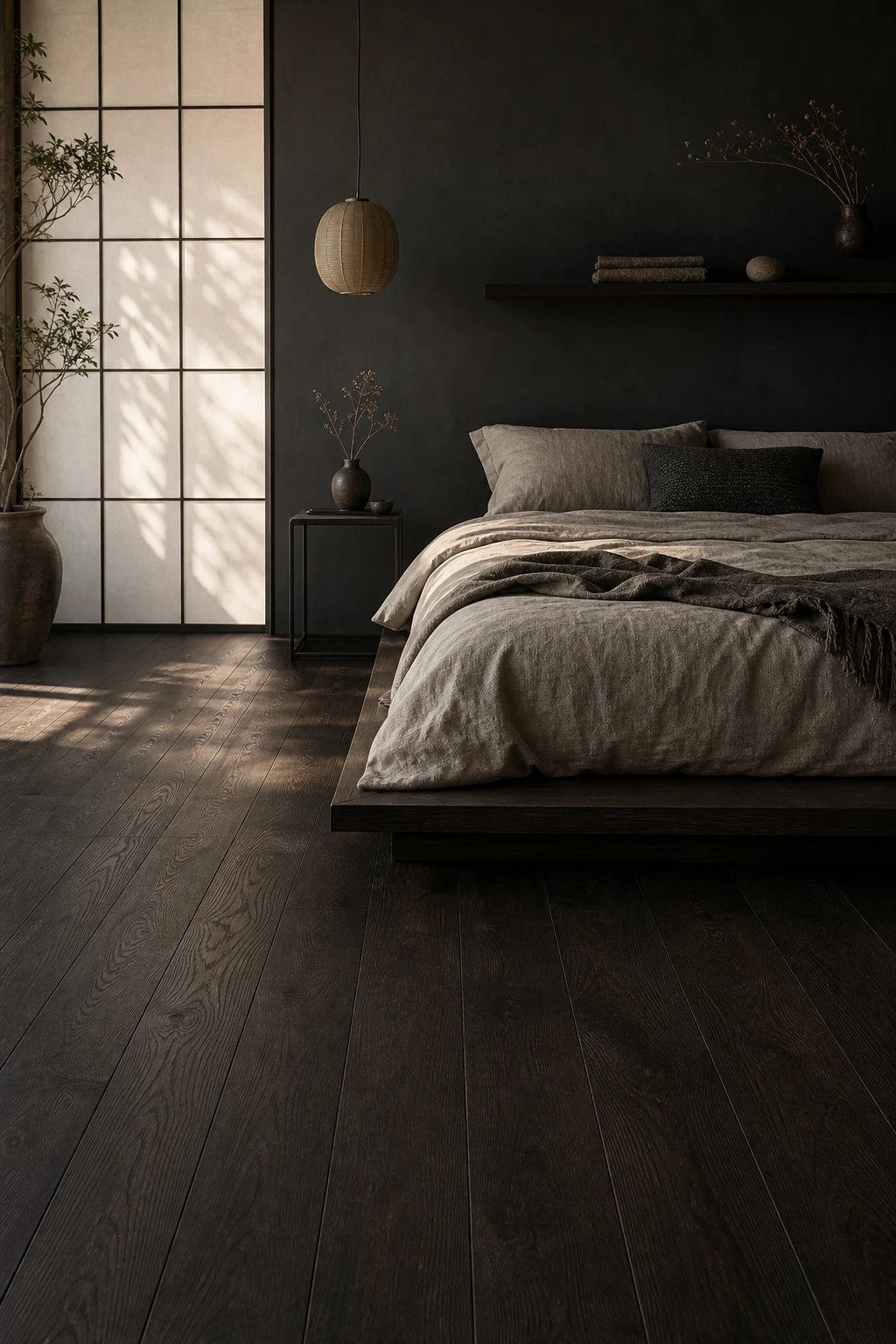
A dark wood floor is the quiet anchor I keep coming back to in Japandi bedrooms. You get this grounding effect where the furniture, walls, and textiles all feel connected rather than floating loose. What I love is how the deep tone draws the eye downward and settles the whole room, doing the work that a dozen accessories never quite manage. The natural grain adds warmth without any fuss, and that combination of richness and restraint is very much the Japandi spirit at floor level.
The Key Details
Wide plank dark oiled oak floor
Low platform bed frame
Shoji screen room divider
Blackened steel bedside table
Floating minimal display shelf
Pro TipChoose a matte or satin finish so the floor absorbs light softly and holds that moody, grounded quality rather than bouncing glare around the room.
Avoid laying a large pale rug over most of the floor, because you lose the dark base that ties everything together and the whole composition goes flat.
Dark Wood and Japandi Together Create a Bedroom That Feels Quietly Confident
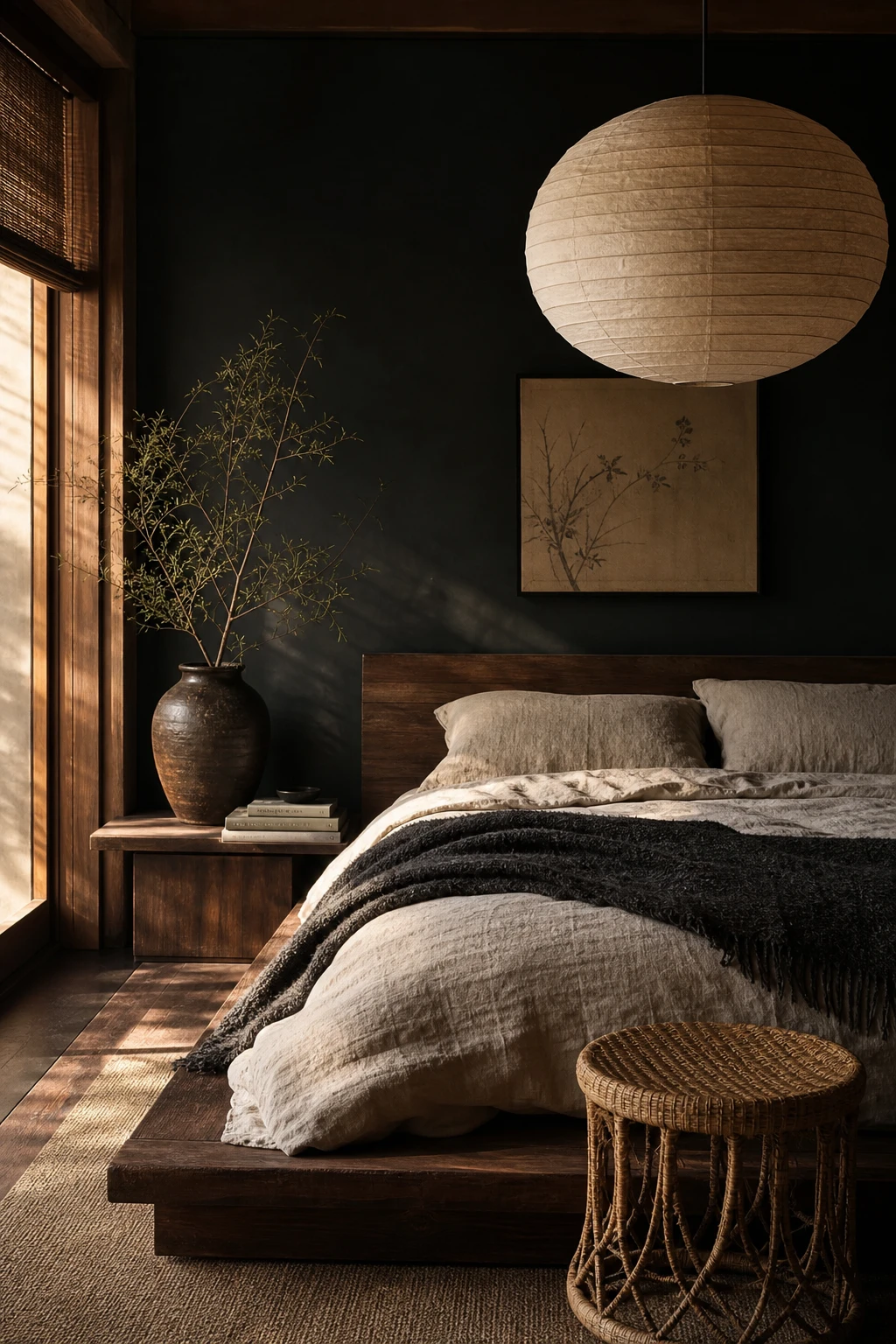
Dark walnut and restrained linen do something I find genuinely rare: they build a room with weight and calm at the same time. The low platform bed pulls the eye down, and you get an immediate sense of groundedness before you notice anything else. What wins me over here is how every material earns its place through texture and tone rather than pattern or ornament. That combination of deep wood, undyed fabric, and one soft pendant light is exactly how you give a bedroom real character without it ever feeling dressed.
The Key Details
Low platform dark walnut bed frame
Undyed heavyweight linen bedding with wool throw
Washi paper pendant light
Chunky rattan bedside stool
Matte ceramic table lamp
Pro TipChoose one piece in the highest quality you can afford, a solid walnut bed frame or a proper wool throw, and let that single honest material set the standard for everything else in the room.
AvoidDon’t strip out every textile and soft layer in the name of a clean masculine look, because a room without warmth reads as unfinished rather than confident.
Alan launched Edward George London in 2017. Since completing his masters in Town & Regional Planning (MPlan) he has combined the skills he learned at the University of Sheffield with his passion for design, to help create a foundation for those looking to create a beautiful home.