I have always loved the way a Spanish living room feels less decorated and more lived in, like the warmth has been slowly baked into the walls over many years. What I find most beautiful about rustic Spanish decor is how honest the materials are: rough plaster, fired clay, dark timber, and hand thrown pottery all doing their quiet work together. In the looks ahead I will walk you through everything from Saltillo tile floors and limewash finishes to arched fireplaces and rattan pendants, and every single one is a look you can bring home.
Where to Start With a Rustic Spanish Living Room
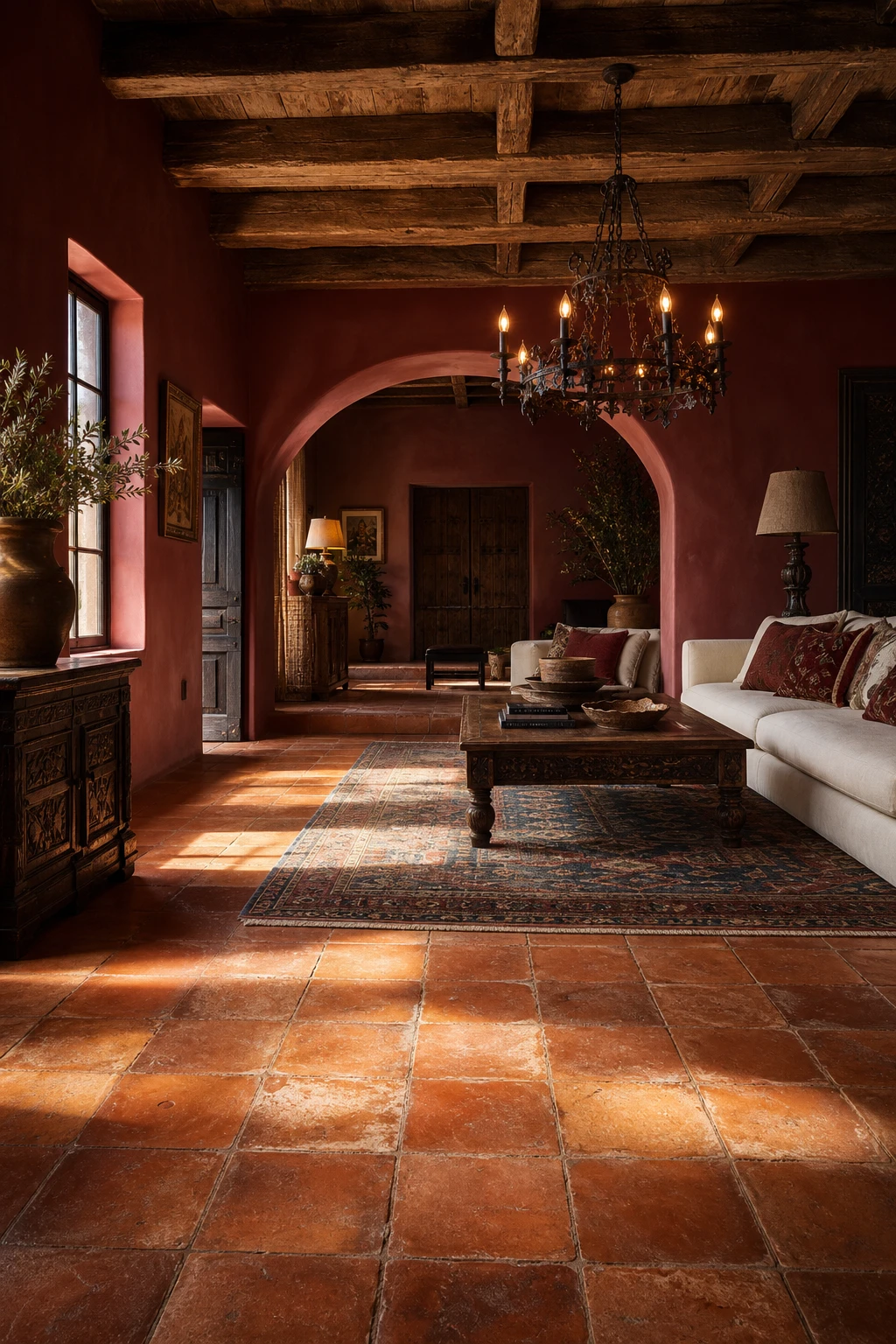
Rustic Spanish style has a handful of core ingredients, and once you know them, everything clicks into place. Timber beams, wrought iron, terracotta and carved wood all carry that same honest, handmade weight, so the room feels cohesive before you have added a single cushion. What I love about this style is how grounded it feels, nothing is precious, nothing is fussy, and you get a warmth that newer trends simply cannot fake.
The Key Details
Hand hewn timber ceiling beams
Wrought iron chandelier
Terracotta tile flooring
Carved wooden coffee table
Arched doorway
Pro TipLayer your warm materials in threes, pick one for the ceiling, one for the floor and one for a key furniture piece, and the room will feel intentional rather than accidental.
AvoidBlending Spanish elements with Moroccan lanterns or Mexican Talavera in the same room muddies the story and the whole look loses its conviction.
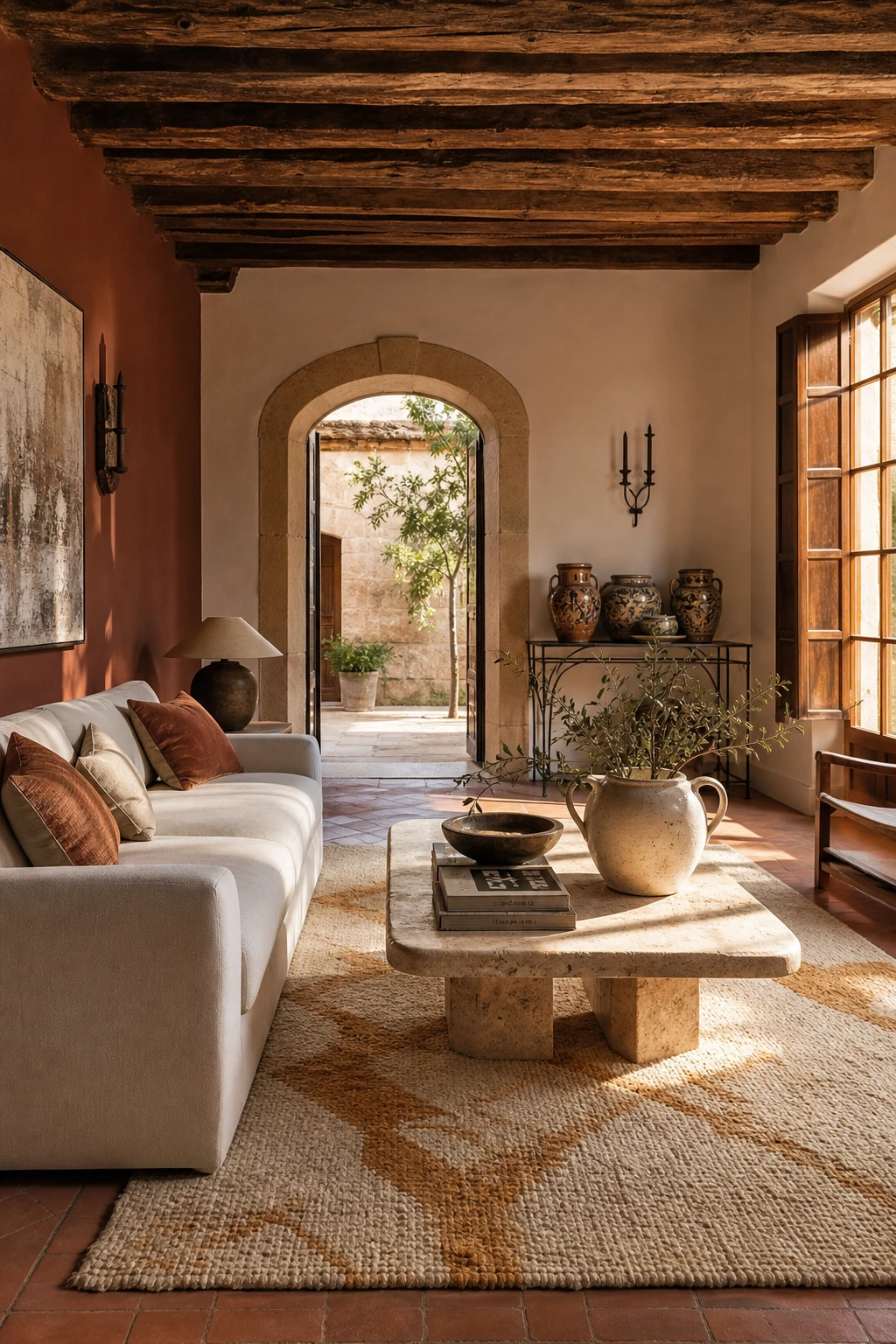
How Modern Furniture Sits Beautifully in a Spanish Room
Pairing a low profile linen sofa against terracotta tiles and exposed timber beams is one of my favourite moves in a Spanish room. The clean sofa silhouette gives your eye somewhere to rest, while the rough ceiling and warm floor do all the heavy lifting around it. You get that rare balance where the space feels edited and relaxed at the same time, never cold, never cluttered.
The Key Details
Low profile linen sofa
Travertine coffee table
Exposed timber ceiling beams
Terracotta floor tiles
Arched doorway
Pro TipPlace a linen or cotton covered chair with simple, straight legs directly beside a rough plaster wall so the contrast between smooth and raw does the decorating work for you.
AvoidFilling the room with too many sleek, hard edged pieces strips out the warmth and leaves you with a space that could be anywhere, with no trace of the character that makes Spanish interiors so special.
The Spanish Colonial Look and Its Most Loveable Details
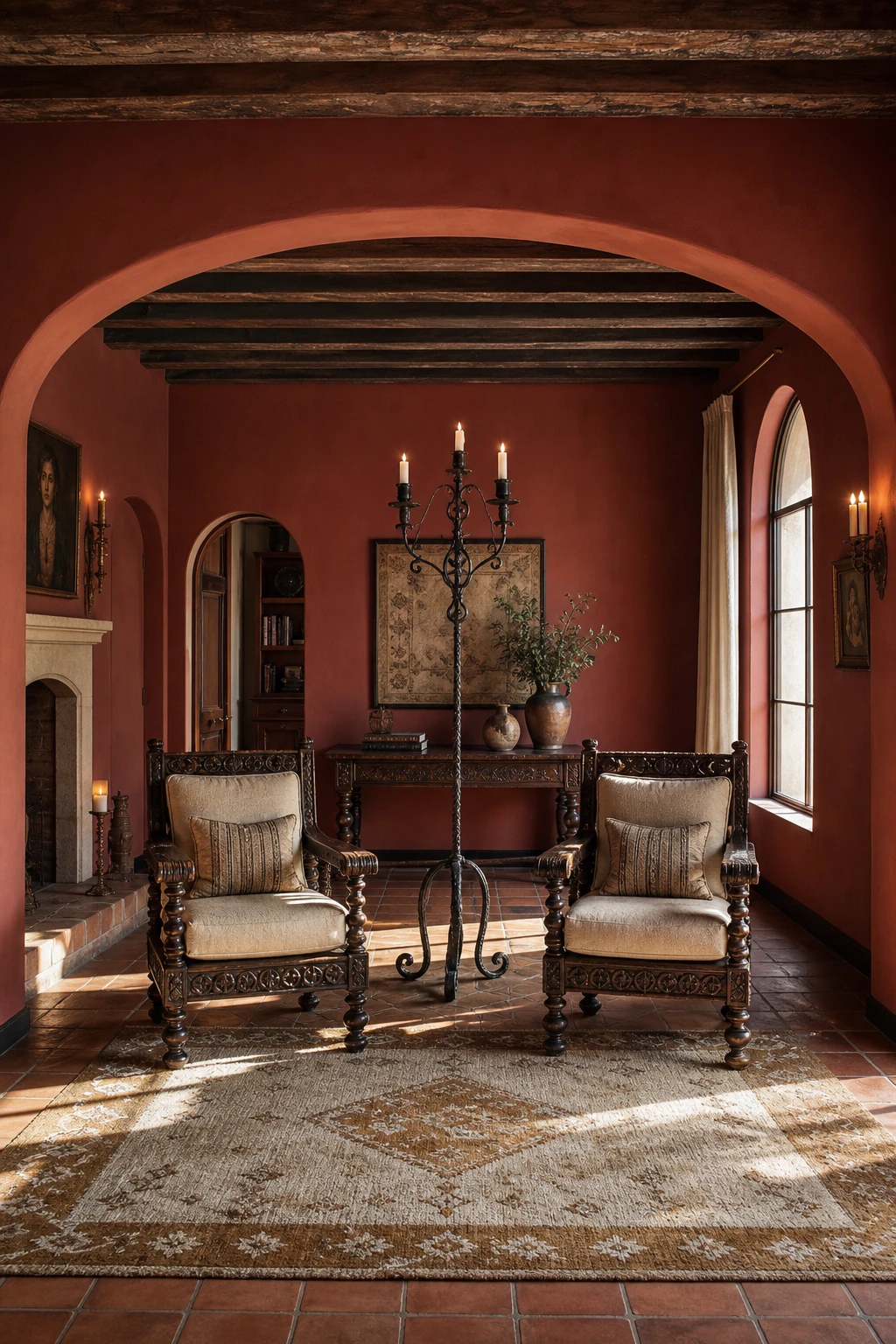
Symmetry and dark wood are the two things I reach for when a room needs to feel like it has always been there. Pair carved walnut chairs either side of a console, let rough hewn beams cross the ceiling above, and you get an instant sense of age and weight. Terracotta floors and a wrought iron candelabra pull the eye downward and upward, so the whole room feels balanced rather than busy.
The Key Details
Carved dark walnut armchairs
Exposed rough hewn ceiling beams
Recessed arched doorway
Terracotta clay tile floors
Wrought iron candelabra floor lamp
Pro TipAnchor the space with one substantial dark wood console on the longest wall, then build your symmetry outward from that single fixed point.
AvoidFilling every corner with furniture crowds out the generous breathing room that gives the colonial style its quiet authority.
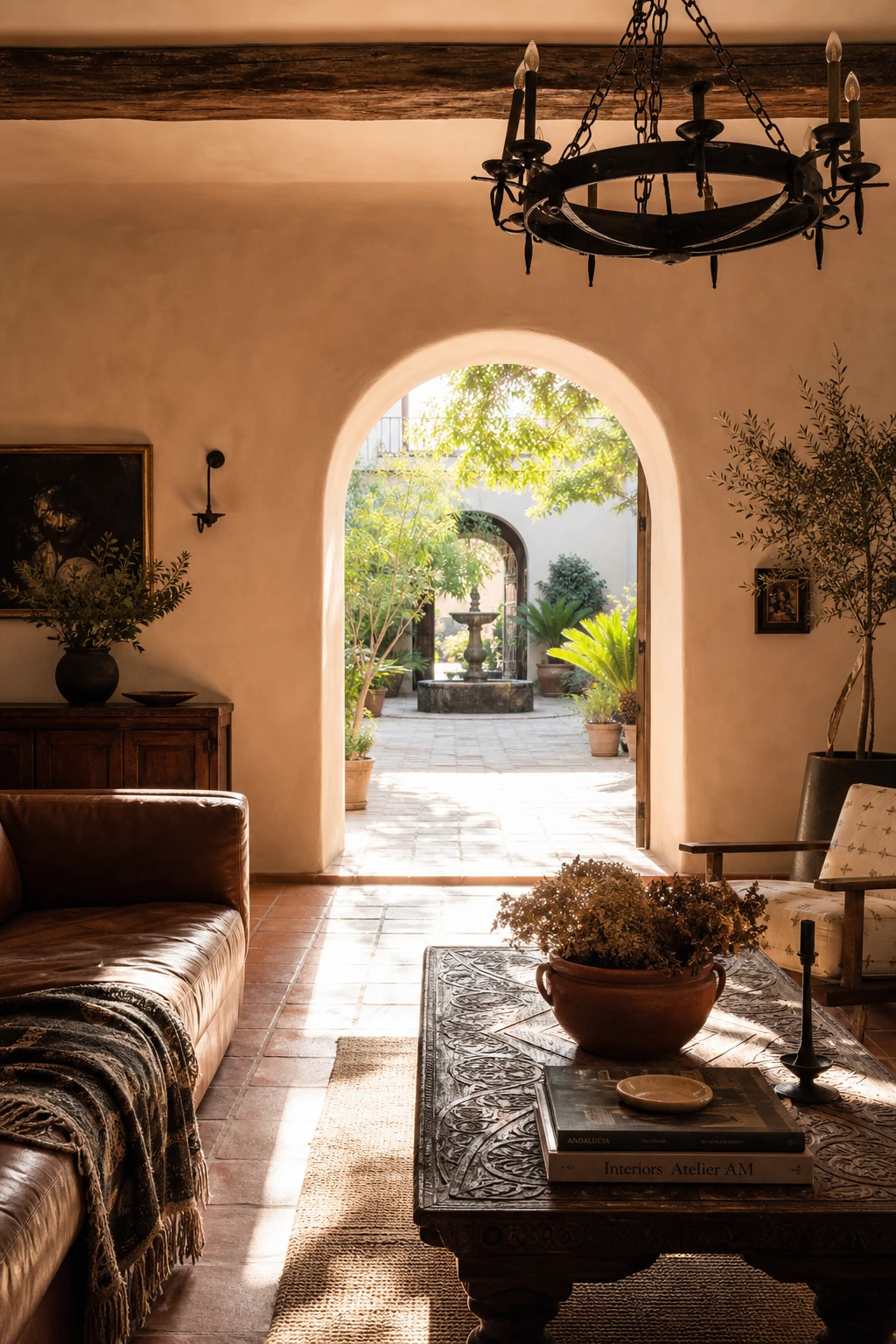
Hacienda style wins me over every time because it blurs the line between inside and out, and you feel that the moment you walk through an arched doorway into a room flooded with warm light. Terracotta floors carry the heat of the earth underfoot, timber beams pull your eye upward, and a wrought iron chandelier ties the whole volume together without fuss. What I love most is how earthy tones do the heavy lifting, making even a modern room feel rooted and unhurried.
The Key Details
Arched plastered doorway opening to courtyard
Hand hewn exposed timber ceiling beams
Terracotta tile floor
Wrought iron chandelier
Low slung leather sofa with woven blanket throw
Pro TipHang a tall arched mirror on a plain wall and it reads almost like a doorway, borrowing the hacienda’s open spirit without a single structural change.
AvoidSleek, low profile furniture sits too flat against the scale of this setting and strips away the warmth and substance the style depends on.
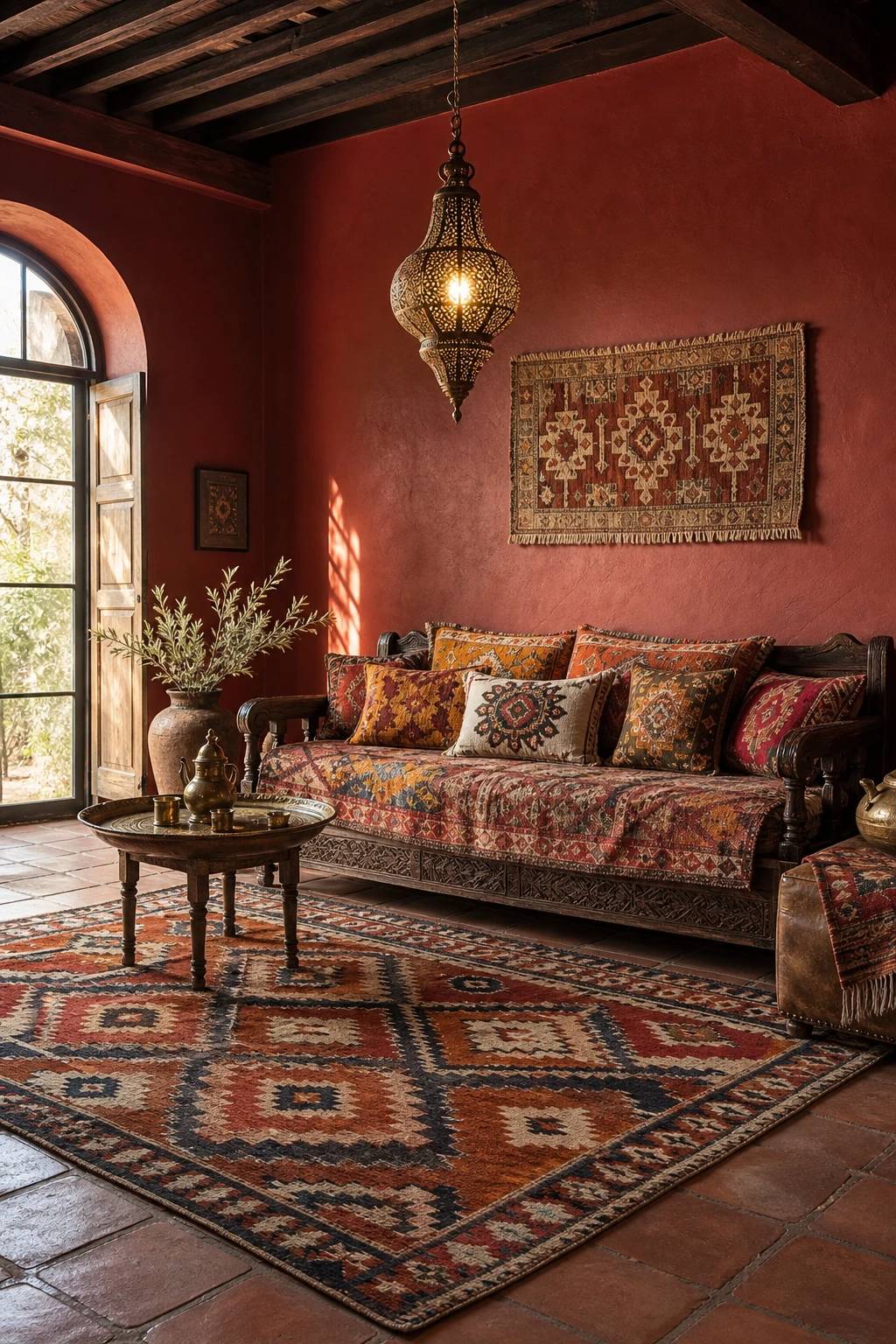
Layering kilims, suzanis and geometric wool rugs sounds like a recipe for chaos, but the thing I always check is whether every pattern shares at least one colour. That shared thread is what holds the room together and lets you pile on texture freely. You get richness without noise, and the carved walnut and hammered brass ground it all in something warm and solid.
The Key Details
Low carved walnut sofa
Vintage kilim runner and suzani cushions
Wrought iron hanging lantern
Geometric Moorish wool area rug
Hammered brass tray table
Pro TipAnchor your boho layers with one large neutral linen or undyed cotton throw draped over the sofa arm, so the eye has somewhere to rest between all the pattern.
AvoidCovering every surface with competing prints pushes the plasterwork, arched openings and carved details into the background, and those are the very bones that make Spanish style worth celebrating.
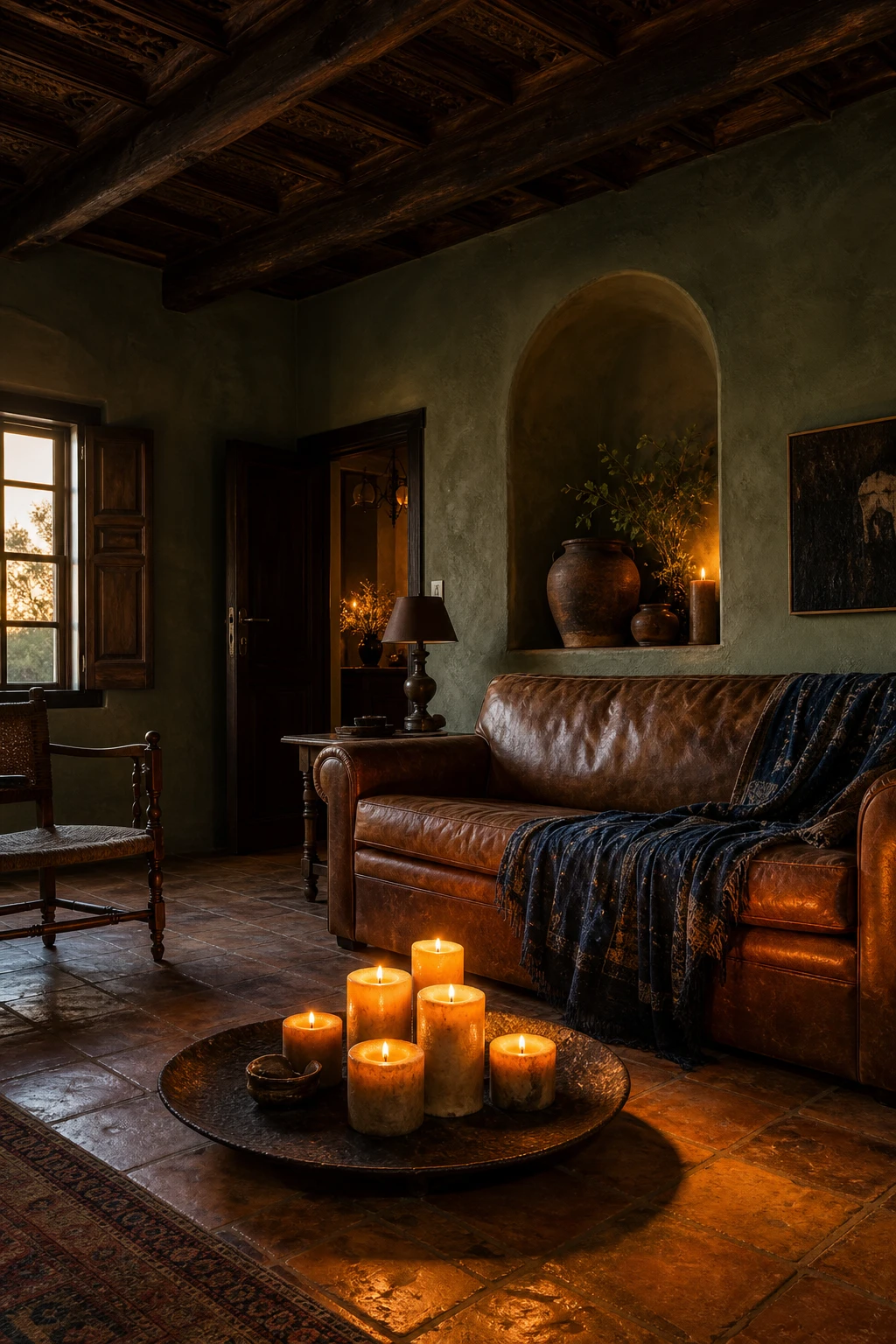
Shadow is an ingredient, and Spanish rooms have always understood that. What I love about going dark and moody is that the room stops trying to show you everything at once, and the candlelight does the editing. You get pools of warm glow around the leather sofa and the terracotta niche, while the beams above simply disappear into the dark, which actually makes the ceiling feel taller. The faded indigo throw and hammered iron tray keep it grounded so the drama never tips into heavy.
The Key Details
Hammered iron candle tray with pillar candles
Worn tobacco leather sofa
Exposed dark timber ceiling beams
Arched recessed niche with terracotta vessels
Faded indigo textile throw
Pro TipTuck a tall floor lamp into each back corner of the room so the light bounces off the walls and lifts the whole space from the ground up rather than pressing down from overhead.
AvoidPainting walls a deep shade without adding enough warm light sources first leaves the room feeling flat and cold rather than dramatic and alive.
Saltillo Tile on the Floor and Why It Changes Everything
Saltillo tile is the one material I reach for when a room needs warmth baked right into the bones of it. Each piece comes out of the kiln slightly different, so the floor reads as one living, breathing surface rather than a grid of identical squares. You get this amber glow that pulls every other warm tone in the room, the timber beams, the wool rug, the ironwork, into one easy conversation.
The Key Details
Handmade Saltillo terracotta floor tiles
Exposed rough sawn timber ceiling beam
Arched interior doorway
Hand knotted wool area rug in indigo and ochre
Aged hand hammered iron chandelier
Pro TipSeal Saltillo with a penetrating linseed or tung oil sealer before grouting, then top with a matte topcoat, and the colour deepens without that plasticky shine that kills the handmade feel.
AvoidChoosing a pale or white grout creates a sharp contrast that breaks the floor into a checkerboard pattern and fights every warm tone the tile is working so hard to give you.
Spanish Patterned Tile Floors That Turn the Ground Into Art
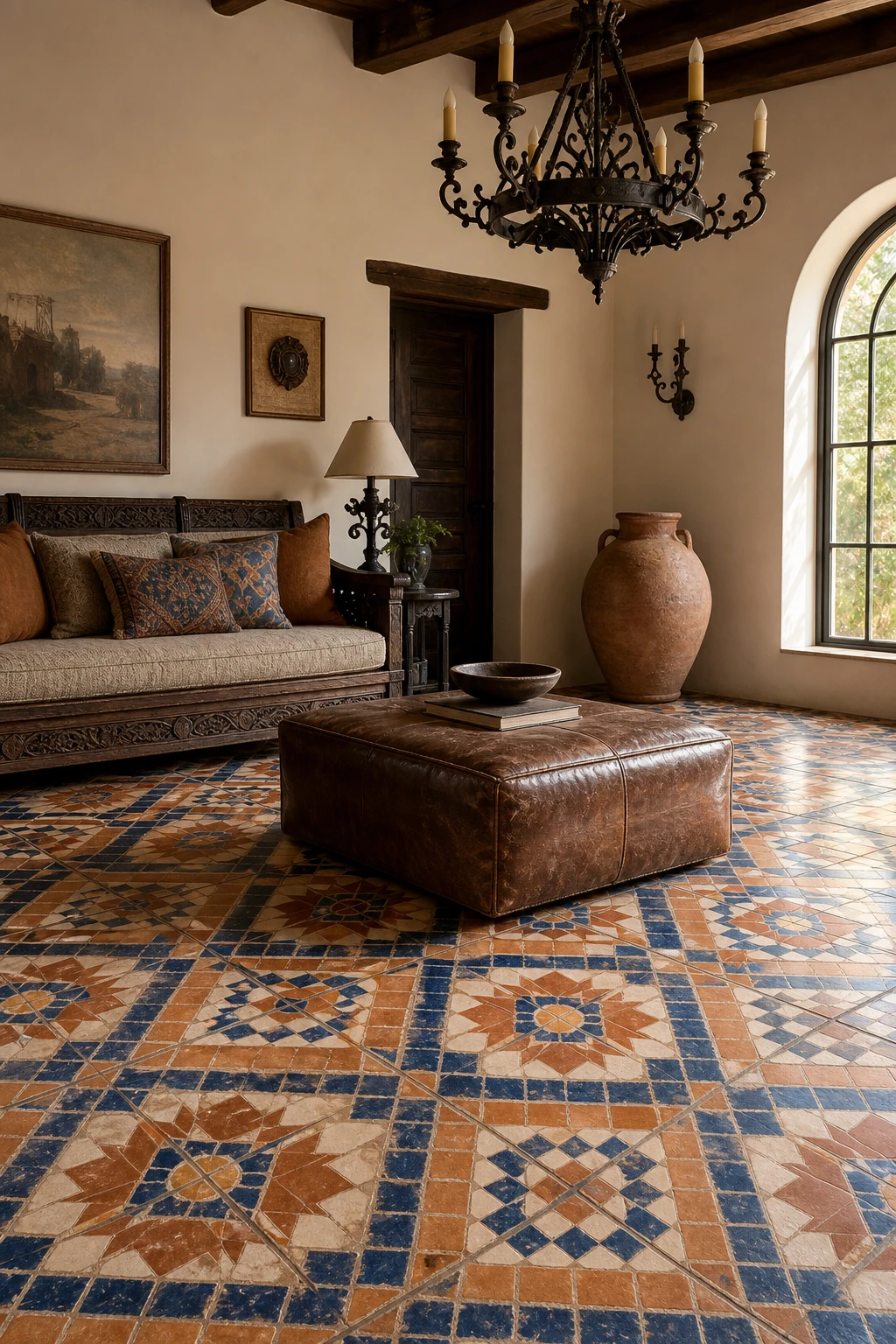
A geometric encaustic floor with terracotta and cobalt pulls every eye straight down, and that is exactly where it belongs. What I love about this move is how it frees the walls: keep them calm and plastered, and the floor does all the talking for you. You get a room that feels richly decorated without a single fussy accessory competing for attention. The low slung wooden sofa and the wrought iron chandelier simply frame the tile rather than fight it.
The Key Details
Geometric encaustic tile floor with terracotta and cobalt medallion pattern
Carved low slung wooden sofa frame with woven textile cushion
Wrought iron chandelier with taper candle sleeves
Hand thrown ceramic corner urn
Arched window with deep plaster reveal
Pro TipPick the cobalt in your tile and echo it in one small accent, a cushion or a glazed pot, so the floor and the furniture feel like a planned conversation rather than happy coincidence.
AvoidLaying a patterned rug over encaustic tile covers the very thing you paid for and creates a visual argument the room cannot win.
Dark Hardwood Floors in a Spanish Room and How to Style Them
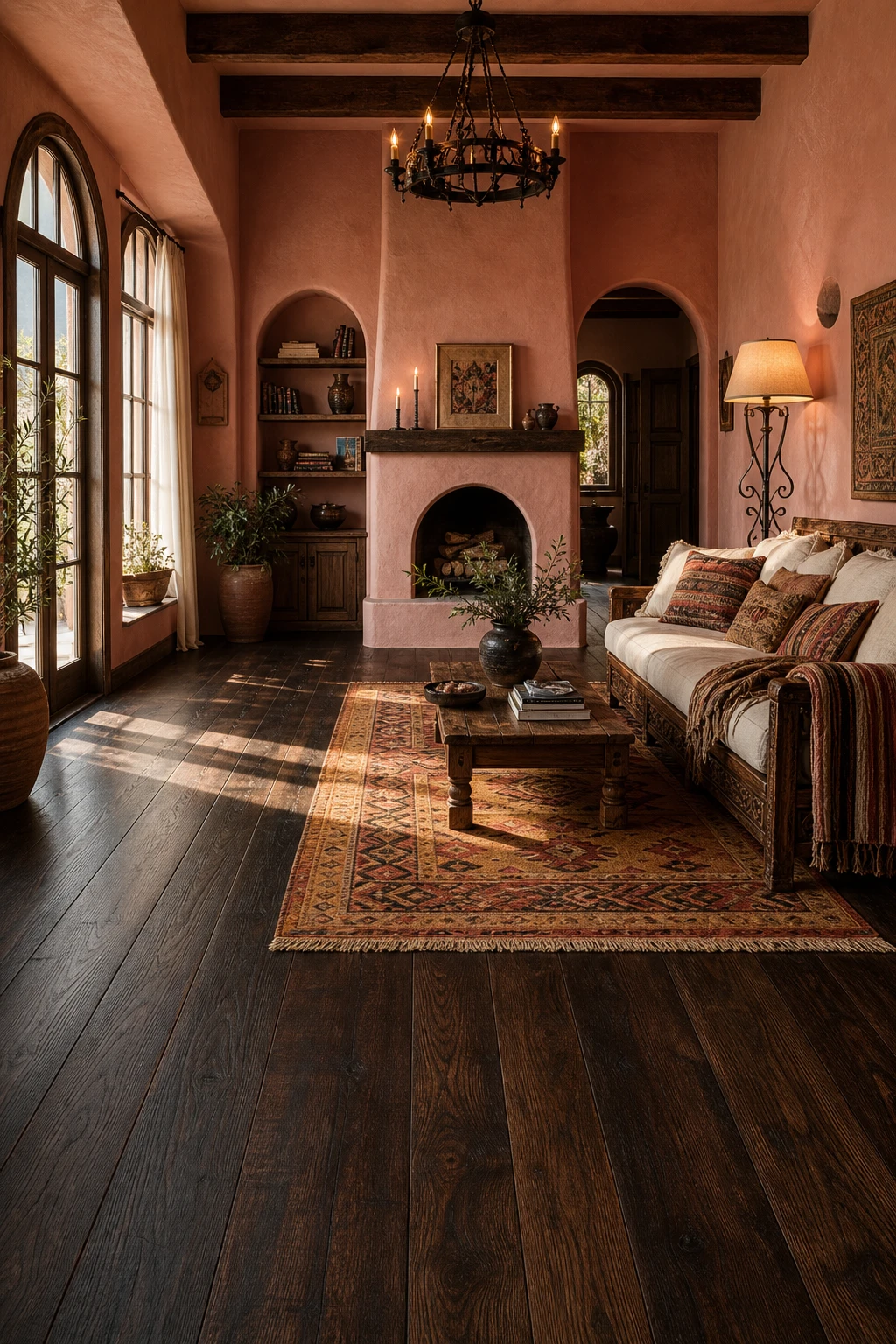
Dark hardwood floors are one of my favourite anchors in a Spanish room because they pull every warm tone in the space downward, giving the whole room a sense of weight and calm without feeling closed in. What I love is how espresso stained boards make the saffron and rust in a kilim rug absolutely sing, and you get that layered, lived in quality that feels genuinely old world. The carved walnut furniture and hammered iron overhead sit naturally against a dark floor in a way they never quite manage on pale timber.
The Key Details
Espresso stained hardwood floorboards
Handwoven kilim rug in saffron and rust
Carved walnut sofa with embroidered cushions
Hammered iron chandelier
Arched timber casement windows
Pro TipLay a handwoven jute or wool rug over at least two thirds of the floor area so the dark boards frame the room rather than dominate it.
AvoidA high gloss lacquer finish on Spanish style hardwood reads as modern and cold, and it immediately flattens the rustic character you are trying to build.
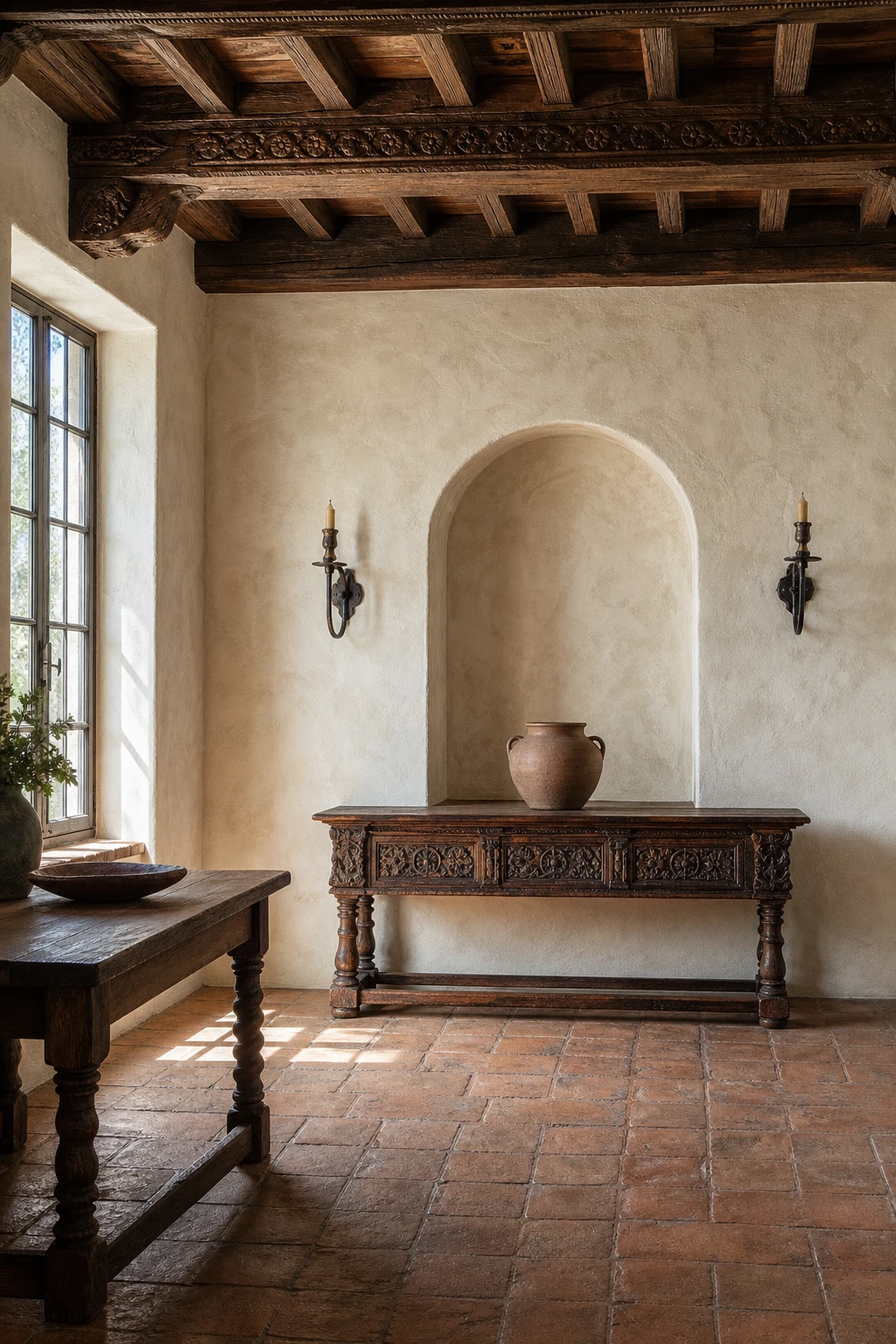
Limewash wins me over every time because it gives a flat wall genuine history without a single antique in sight. You get this soft, cloudy depth where the colour shifts as the light moves across it, lighter here, darker there, alive in a way that painted plaster never is. What I love about it in a Spanish room is how naturally it sits alongside rough timber and iron, like the wall has always been there.
The Key Details
Carved wooden ceiling beams
Hand forged iron wall sconces
Arched plaster wall niche
Terracotta tile floor
Carved wooden console table
Pro TipBrush on a slightly darker tone first, let it dry, then work a paler wash over the top in loose, circular strokes so the two tones show through each other and read as natural stone.
AvoidThinning the mix with too much water strips the chalk solids right out of it, and you end up with a flat, washed out stain that has none of the cloudy texture you were after.
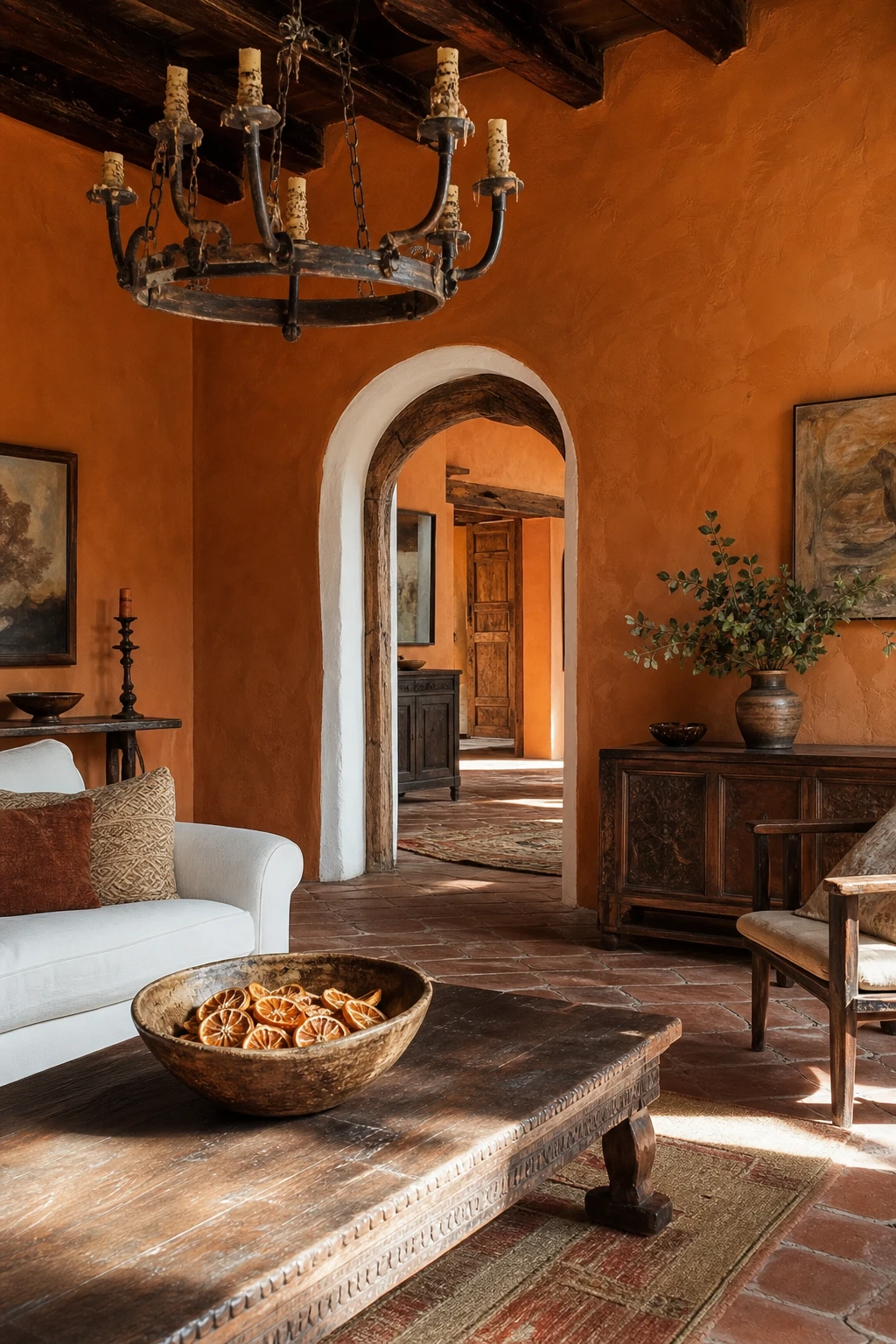
That shift from gold in the morning to something closer to amber by evening is exactly why orange plaster keeps pulling me back to it. The trick is restraint: a lightly tinted lime or Venetian plaster lets the texture carry the warmth, so you get depth and glow without the wall overpowering everything else in the room. Watch how it plays against walnut and terracotta, each surface warm in its own way, and the whole room settles into something that feels genuinely old and completely at ease.
The Key Details
Carved walnut coffee table
Wrought iron chandelier
Terracotta tile floor
Whitewashed arched doorway
Hand thrown ceramic bowl
Pro TipMix your pigment into the final coat at no more than a quarter of the strength you think you need, because plaster always dries warmer and richer than it looks wet.
AvoidPainting a flat orange wall instead of using a true plaster or wash technique flattens the whole effect and leaves you with something that looks closer to a children’s bedroom than a Spanish cortijo.
Clay Walls That Make a Room Feel Alive and Grounded
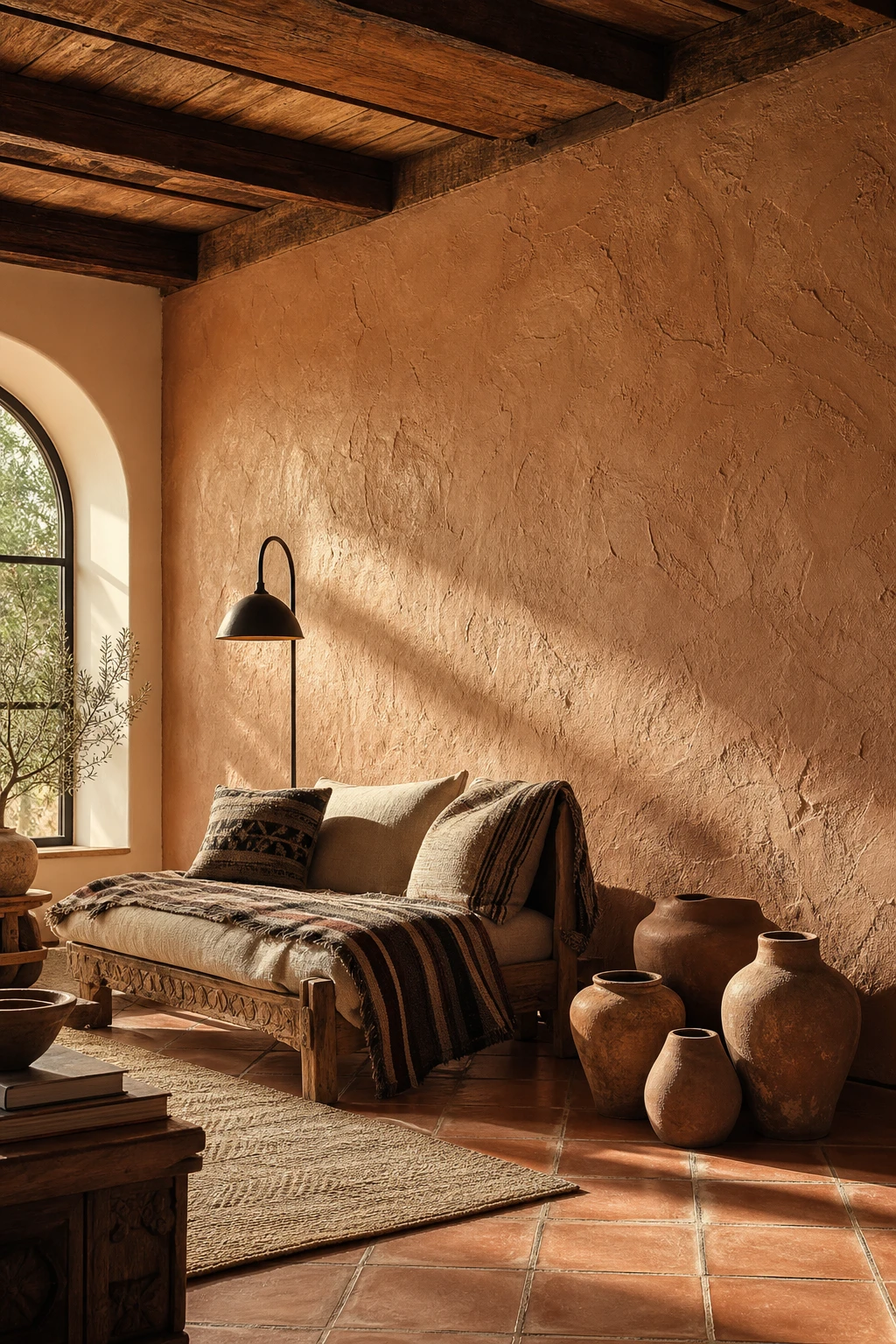
Clay walls earn their place in a way paint simply cannot. The texture catches shadow in tiny valleys across the surface, so the wall becomes part of the room’s mood rather than just a backdrop, and I find that quality almost impossible to walk away from once you have seen it in a real space. Run your hand across it and you feel the grain; stand back and you get a grounded, earthy calm that reads as genuinely old without a single antique to support it.
The Key Details
Hand troweled clay plaster accent wall
Carved mesquite wood sofa frame
Saltillo terracotta tile floor in diagonal grid
Hammered iron floor lamp
Unglazed earthenware vessel grouping
Pro TipWork a small handful of fine sand or dried straw fibres into your clay mix before applying, and the finished wall picks up that extra grain and depth that takes it from smooth plaster to something that looks centuries old.
AvoidSealing a clay wall with any plastic based topcoat traps moisture inside the plaster, which leads to cracking and strips away the very breathability that makes clay worth using in the first place.
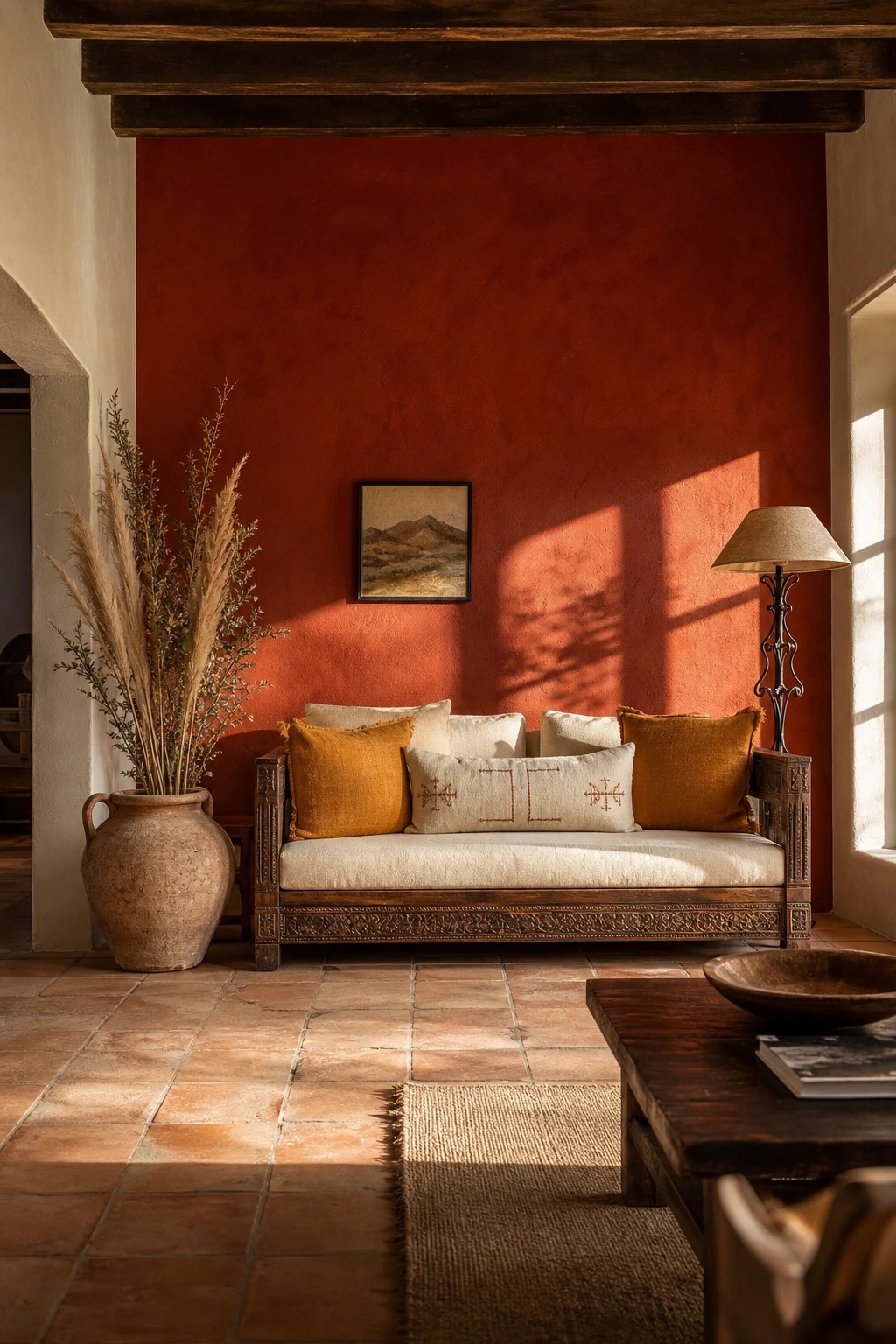
A single rust wall does something no gallery of art can fully match: it gives the whole room a place to land. What I love is how that warm, earthy tone pulls every other element, the carved walnut, the woven wool, the terracotta floor, into one quiet agreement. You get a focal point with real weight, and the rest of the room suddenly feels considered rather than collected.
The Key Details
Carved walnut low sofa
Hand woven wool cushions
Wrought iron floor lamp
Terracotta tile flooring
Dried pampas and olive branch arrangement
Pro TipCarry the rust into at least two small accessories, a cushion and a bowl will do it, so the feature wall reads as part of the room rather than a statement stuck on its own.
AvoidChoosing a high sheen finish on the feature wall flattens the earthy quality completely, and you end up with something that looks more like a showroom than a Spanish farmhouse.
Built In Stucco Shelves That Look Like They Grew With the House
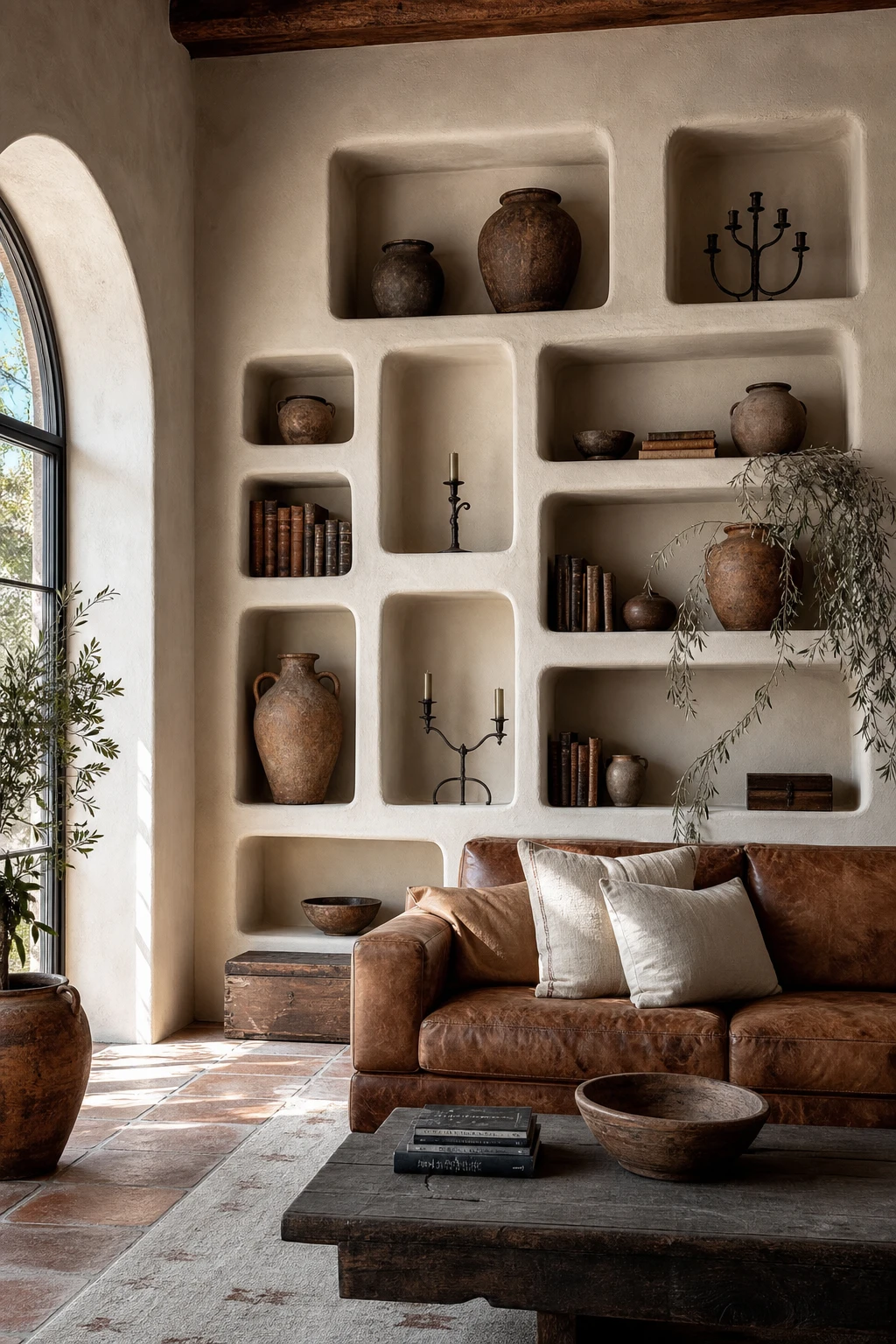
Built in stucco shelves are one of my favourite moves in a Spanish living room because the wall and the storage become one thing, and you get that settled feeling that the house has always looked this way. What wins me over every time is the texture: that soft, slightly uneven surface catches the light and adds depth before you even place a single object on it. You will notice how the eye reads the whole wall as architecture first and storage second, which is exactly the effect I am after.
The Key Details
Floor to ceiling stucco shelving
Hand thrown ceramic pottery
Aged tobacco leather sofa
Wrought iron candle holders
Terracotta floor tiles
Pro TipStyle each shelf with three or five pieces rather than an even number, because odd groupings have a natural, unhurried rhythm that suits the relaxed spirit of Spanish interiors.
AvoidPacking every shelf from edge to edge crowds out the stucco surface itself, and that beautiful texture, the whole reason the shelves look built in rather than bought in, disappears completely behind the clutter.
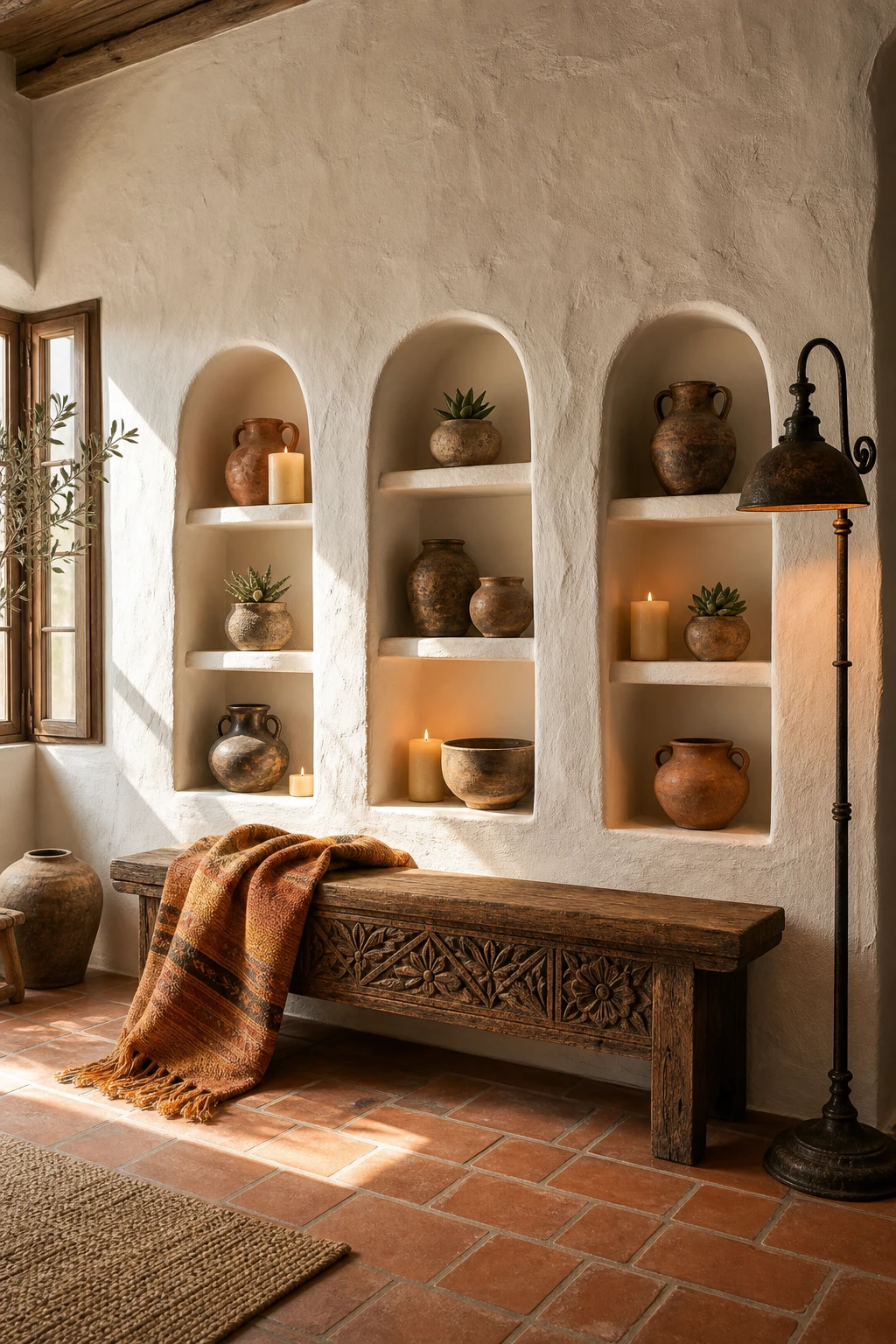
Carving depth into a wall is one of my favourite moves in Spanish interiors because it turns a flat surface into something alive. You get pockets of shadow and light that no shelf can replicate, and the thick plaster edges give every object its own quiet stage. What I love most is how the arch softens the whole wall, so even a single clay vessel inside a niche feels considered rather than just placed.
The Key Details
Arched plaster display niches
Hand thrown ceramic vessels
Carved mesquite wood bench
Terracotta floor tiles
Wrought iron floor lamp
Pro TipRun a small warm LED strip along the top inner edge of your deepest niche and watch how it pulls the eye straight to whatever you place below it.
AvoidA niche that is too shallow forces objects to sit right at the face of the wall, which flattens the whole effect and makes a careful display look cluttered instead of calm.
An Arched Fireplace Opening That Becomes the Heart of the Room
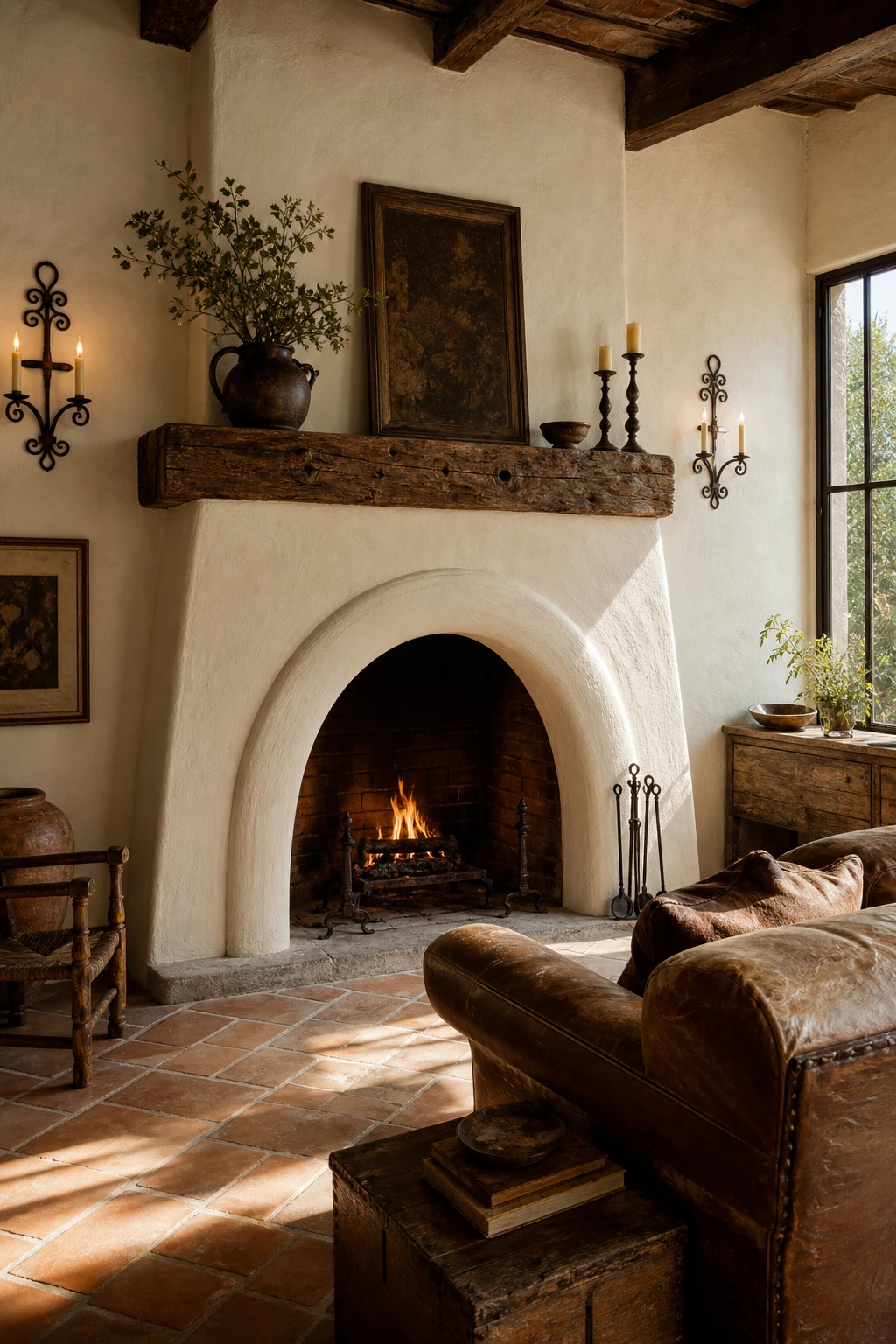
An arched fireplace opening does something a square one simply cannot: it pulls every eye in the room toward it without demanding attention. What I love is how the curve reads as almost organic, like the wall grew around the fire rather than a builder cutting a hole in it. You get instant warmth before a single log is lit, and the arch naturally signals to anyone who walks in that this is where the room gathers.
The Key Details
Hand troweled plaster arched fireplace surround
Reclaimed timber mantel
Wrought iron candle sconces
Terracotta floor tiles
Aged leather sofa
Pro TipTrowel the plaster surround in a tone one shade lighter than the surrounding wall so the arch lifts forward gently without needing a contrasting colour.
AvoidFixing a flat mantel shelf across a flowing arch breaks the continuous curve and leaves the whole surround looking like two unfinished ideas sitting next to each other.
The Mediterranean Fireplace Detail That Makes a Living Room Sing
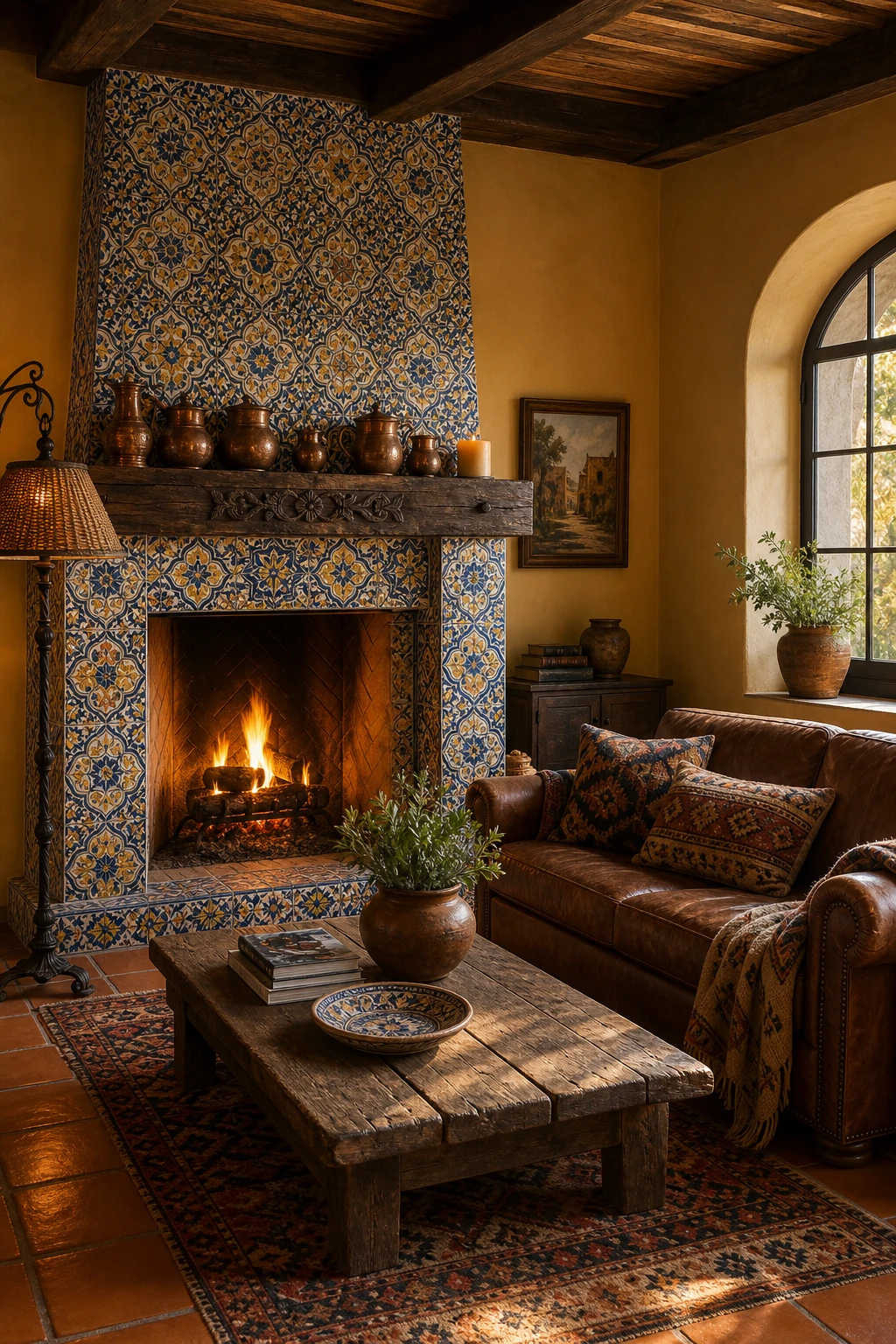
A hand painted Talavera surround turns the fireplace from a functional box into the room’s whole personality, and that shift is something I chase on every Spanish style project. What I love here is the restraint: two colours on the tile, cobalt and cream, let the pattern breathe rather than compete with the carved wood mantel above it. You get a focal point that feels genuinely old world without tipping into busy.
The Key Details
Hand painted Talavera tile fireplace surround
Carved solid wood mantel
Hammered copper vessels
Low slung leather sofa with embroidered wool cushions
Terracotta tile floor
Pro TipPick a Talavera tile in just two colours, one warm and one cool, so the pattern reads clearly from across the room without fighting the mantel or the floor.
AvoidLayering a second decorative pattern on the hearth apron or the surround sides pulls the eye in too many directions at once and flattens the impact of every tile you have chosen.
Rustic Ceiling Beams and the Instant Warmth They Add Overhead
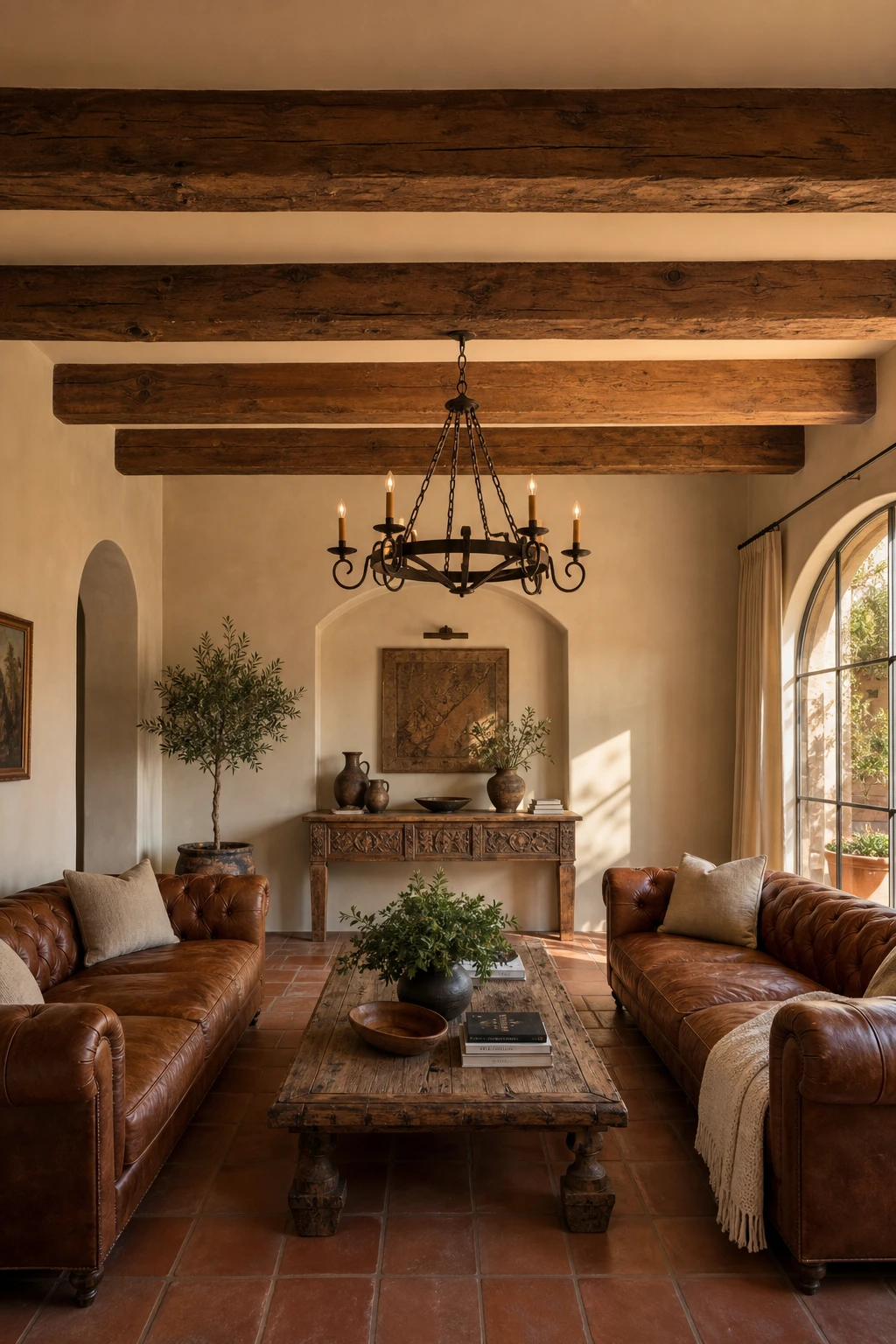
Exposed beams are one of my favourite moves in a Spanish room because they give the ceiling a job to do. Your eye travels up, traces the lines across the span, and suddenly the whole room feels taller and more deliberate. What I love most is the warmth they add without a single extra accessory. The wood grain holds all that texture overhead so the walls and floor can breathe.
The Key Details
Hand hewn oak ceiling beams
Wrought iron chandelier
Terracotta floor tiles
Tufted cognac leather sofas
Arched alcove with carved console table
Pro TipStain your beams one or two shades darker than your floor so the eye reads a clear contrast and the ceiling feels anchored rather than floating.
AvoidBeams that are perfectly uniform in width and colour read as plastic or factory made, and that kills the rustic soul of a Spanish room instantly.
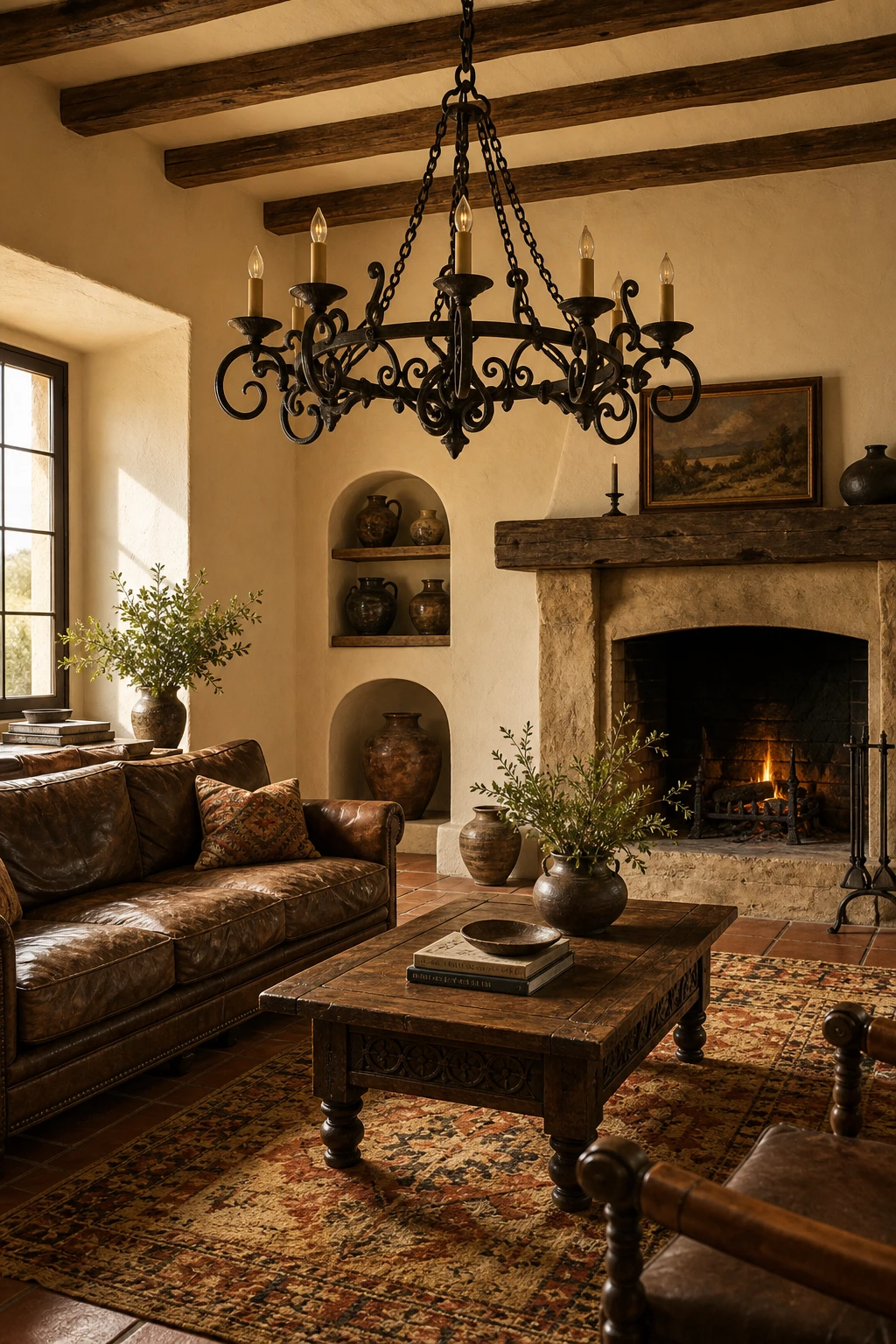
A Wrought Iron Chandelier That Fills the Room With Character
A wrought iron chandelier does something no recessed light ever could: it gives the ceiling a story. What I love about this choice is the way the scrolled arms and candle cups read as pure sculpture the moment you walk in, so the fitting earns its place before a single bulb is lit. Hang it above hand hewn beams and terracotta floors and you get that layered, aged quality I am always chasing in Spanish interiors.
The Key Details
Scrolled wrought iron chandelier with candle cups
Hand hewn exposed timber ceiling beams
Hand laid terracotta floor tiles
Carved wooden coffee table
Glazed ceramic vessels in arched alcoves
Pro TipDrop the chandelier a full foot lower than the standard guideline and the drama lands exactly where you want it, right in your eyeline as you move through the room.
AvoidA chandelier that spans less than half the width of the room floats away visually and loses all the sculptural weight that makes this style so compelling.
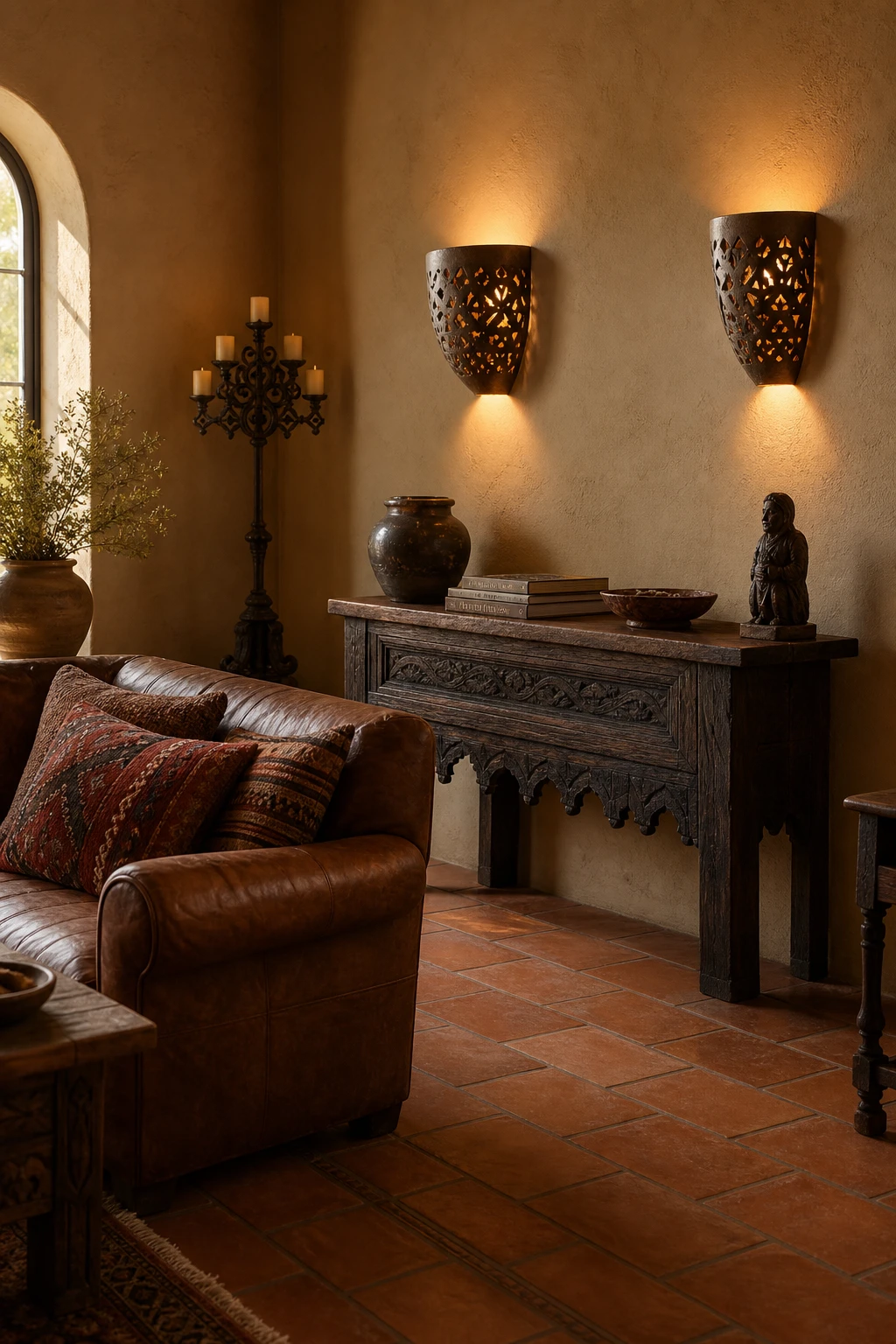
Ceramic Sconces That Add a Handmade Glow to Every Wall
Ceramic sconces placed at eye level do something overhead lighting simply cannot: they pull warmth into the exact zone where faces, textures, and conversation all live. What I love about handmade glazed pieces is the slight irregularity in the glaze, each one catching the light a little differently and giving the wall real life. You get that soft, amber pool spreading upward across lime plaster, and the whole room suddenly feels like it was lit by someone who actually cared.
The Key Details
Handmade glazed ceramic wall sconces
Textured lime plaster walls
Low slung leather sofa with woven wool throw pillows
Hand carved wooden console table
Terracotta floor tiles in running bond pattern
Pro TipChoose a sconce with an open top so the beam washes upward, giving you that gentle, flattering ambient glow rather than a harsh downward spotlight.
AvoidLeaving the cord exposed along the wall immediately kills the handmade, artisan quality you are trying to achieve, so always chase the wire into the wall or route it cleanly behind a plaster channel before finishing.
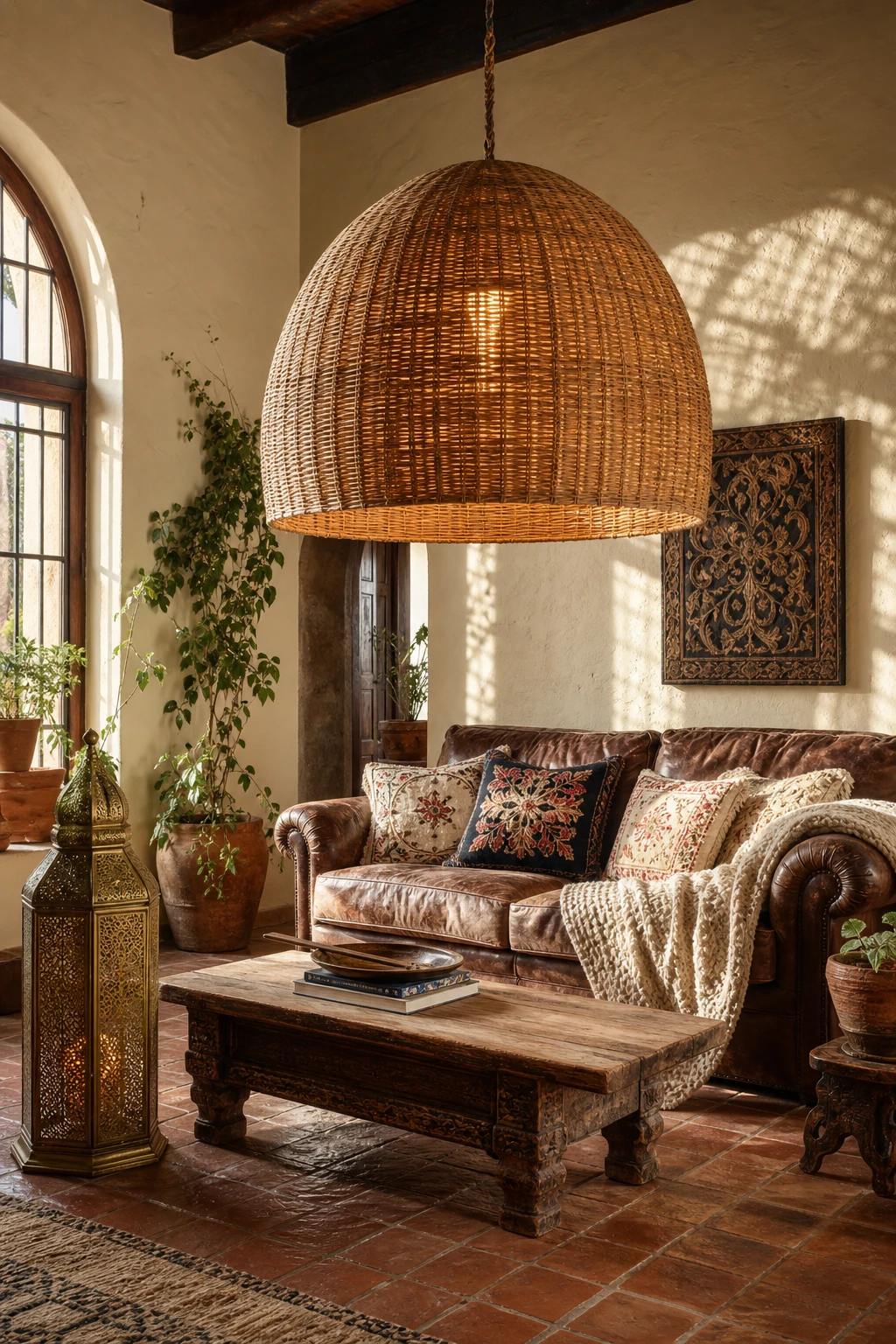
A Rattan Pendant That Brings Natural Light and Texture Together
Rattan earns its place by pulling texture all the way up to ceiling height, which is a move I find most Spanish rooms desperately need. The woven weave casts the most beautiful dappled shadows across lime washed walls, and you get that warm, lantern like glow that feels genuinely of the region rather than shop dressed. One fitting quietly does the work of several accessories, grounding the whole seating area with organic warmth in a way hammered iron or ceramic simply cannot replicate.
The Key Details
Oversized woven rattan pendant light
Aged terracotta floor tiles
Carved wooden coffee table
Hand embroidered cushions and wool throw
Arched plaster window surround
Pro TipGroup two or three rattan pendants hung at staggered heights above your seating area to create depth and make the ceiling feel like a real design feature rather than dead space.
AvoidChoosing a pendant with thin, loosely spun weave leaves you with a fitting that looks too fragile against the heavy plaster, carved wood, and terracotta that rustic Spanish rooms are built on.
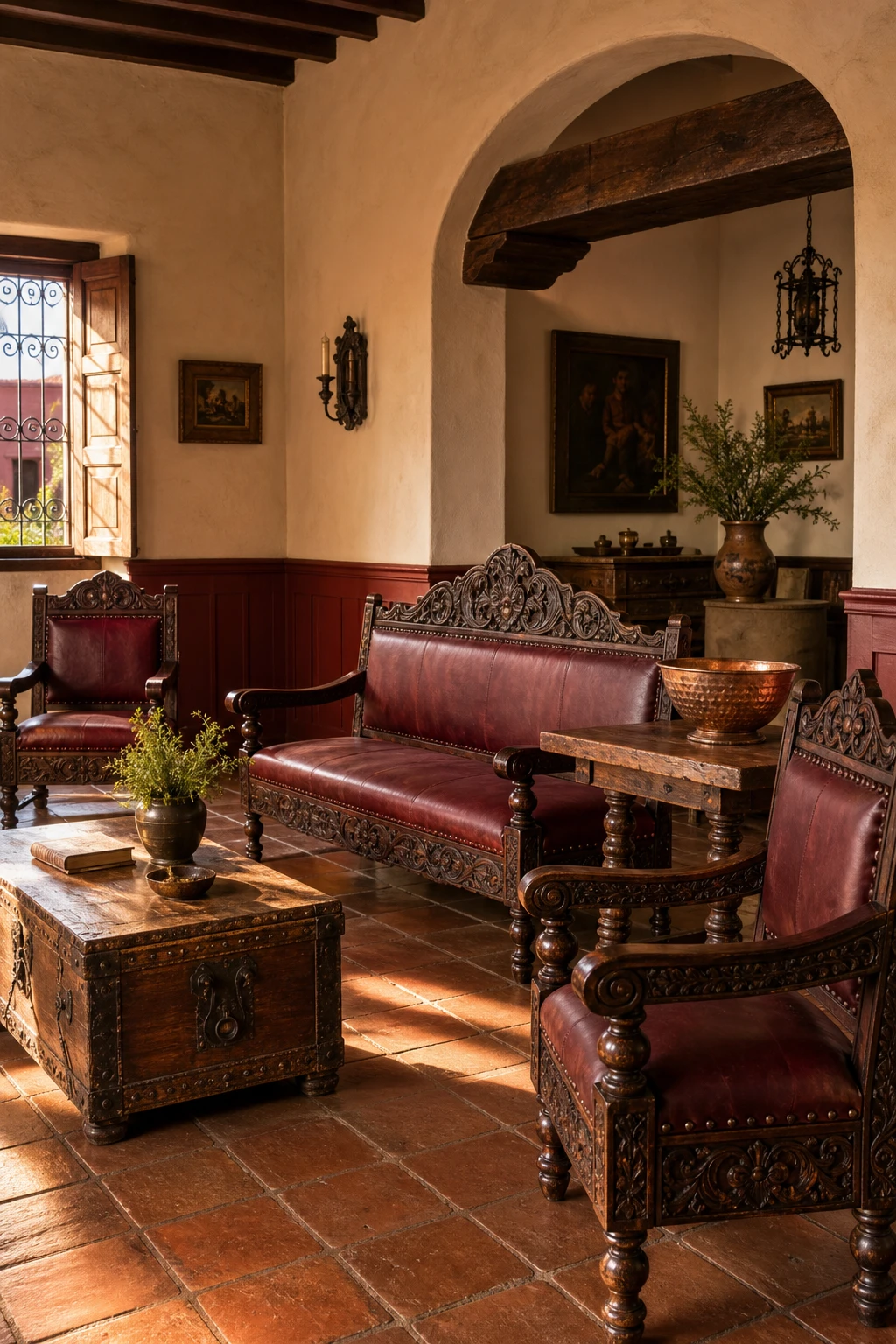
Spanish Style Furniture and the Shapes That Feel Most at Home
Spanish furniture earns its place through weight and carve work, and those turned legs and scrolled aprons are what I look for first when sourcing pieces. A walnut settee with carved detail reads as grounded and honest against rough plaster walls. You will notice how the low chest doubling as a coffee table keeps the room anchored, which is exactly the silhouette this style needs.
The Key Details
Carved walnut settee with turned legs
Low carved wood chest coffee table
Trestle side table with hammered copper bowl
Arched doorway with exposed timber lintel
Iron grilled window with terracotta tile floor
Pro TipRun your hand along the leg before you buy: genuine turned and carved detail has a slight irregularity that machine made copies never quite manage.
AvoidBringing in a clean lined Scandinavian piece alongside carved Spanish wood creates a visual argument the room cannot settle, and the rustic warmth loses every time.
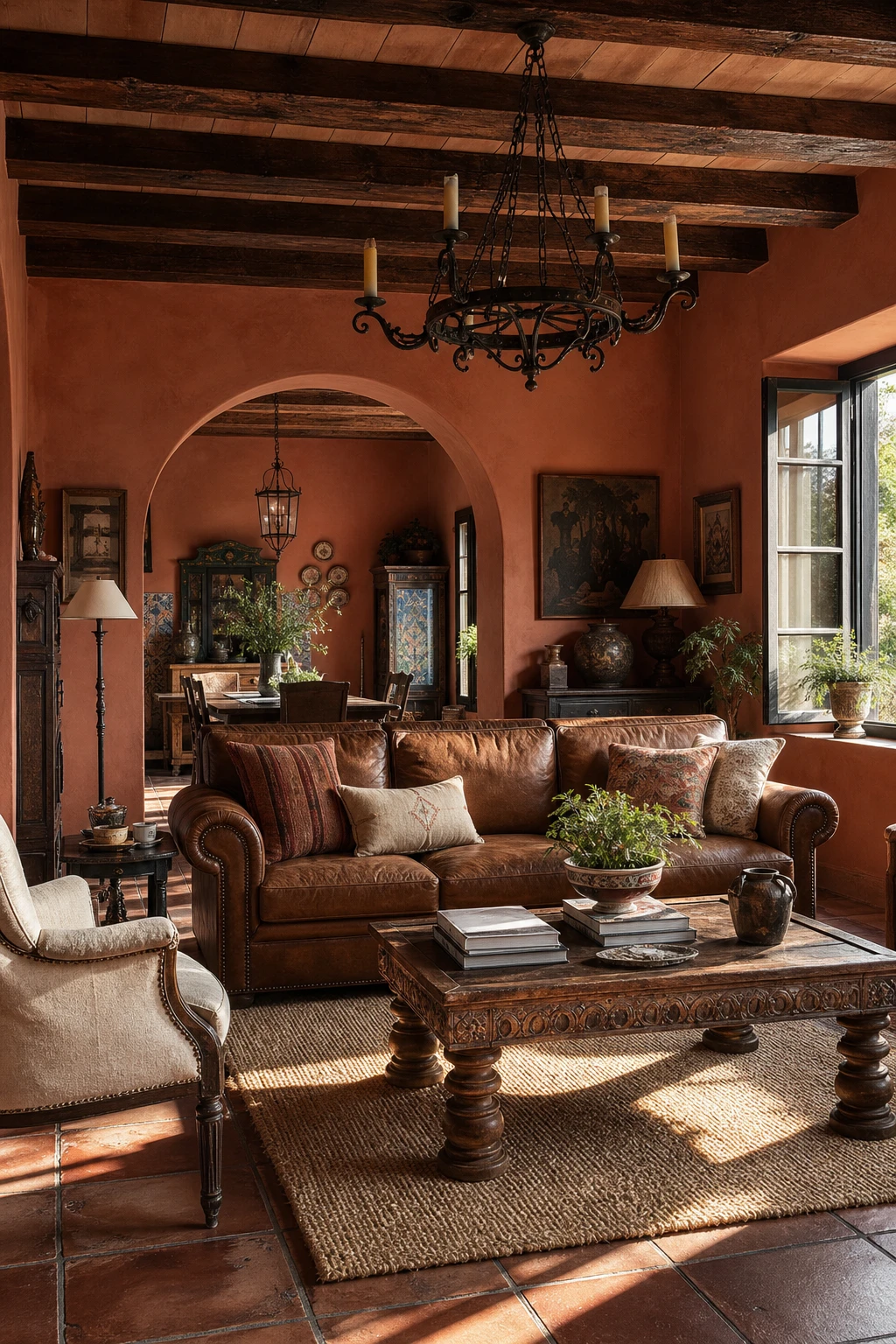
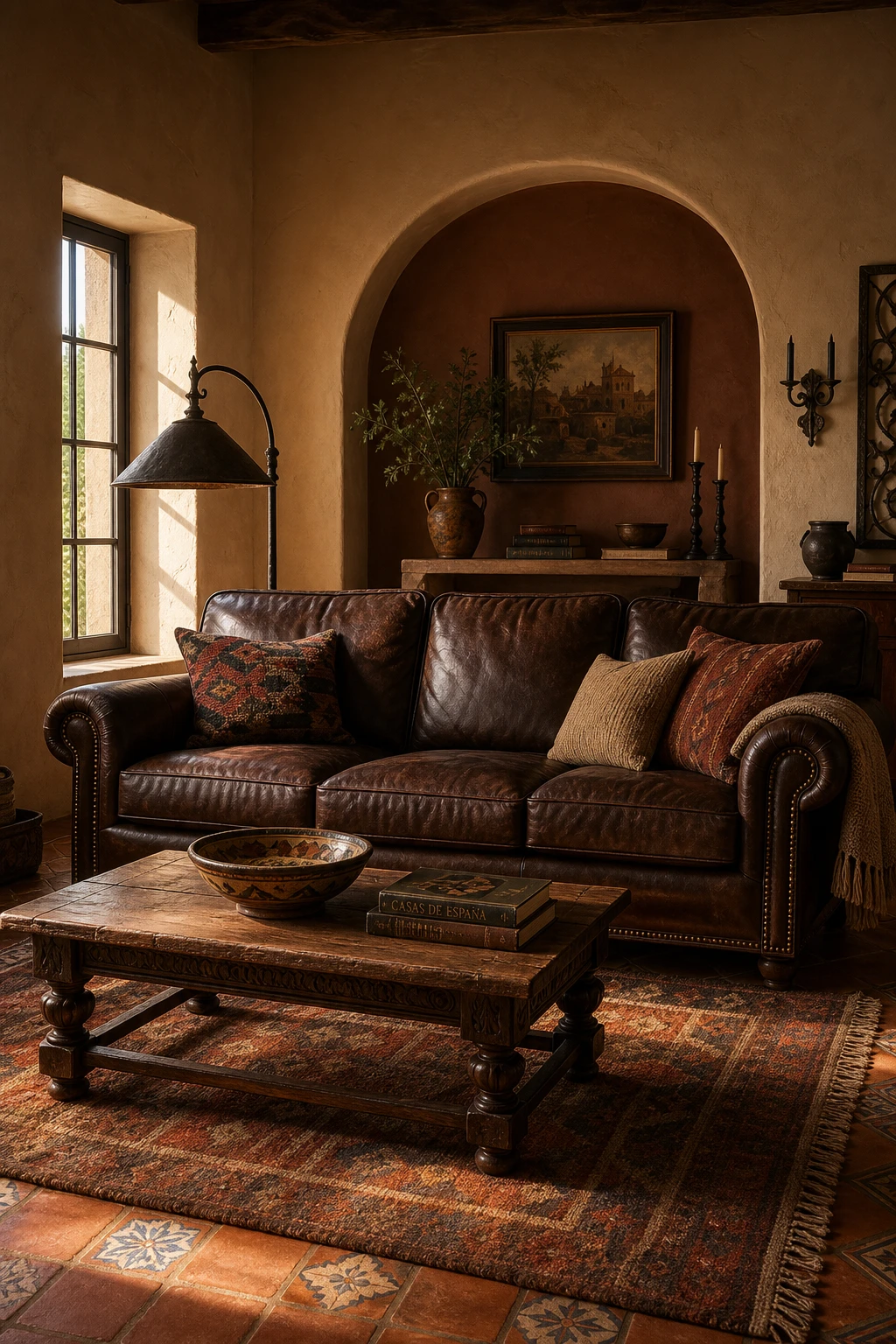
Dark Brown Sofas and Why They Look So Right in This Style
A dark brown sofa does something no other piece can quite pull off: it settles the room, the way a heavy wooden beam settles a ceiling. What I love is how it reads as part of the earth itself, connecting the terracotta floor, the plastered walls, and the timber overhead into one honest whole. You get a natural anchor that everything else leans into rather than competes with.
The Key Details
Dark brown leather sofa
Hand hammered iron floor lamp
Carved walnut coffee table
Wool kilim rug in rust and ochre
Arched plastered alcove
Pro TipChoose full grain leather over faux, because real hide develops a patina over years that only deepens the aged, sun worn character this style is built on.
AvoidPushing a dark brown sofa flush against a dark wall flattens the whole composition and the sofa simply disappears, losing all the grounding weight you put it there to create.
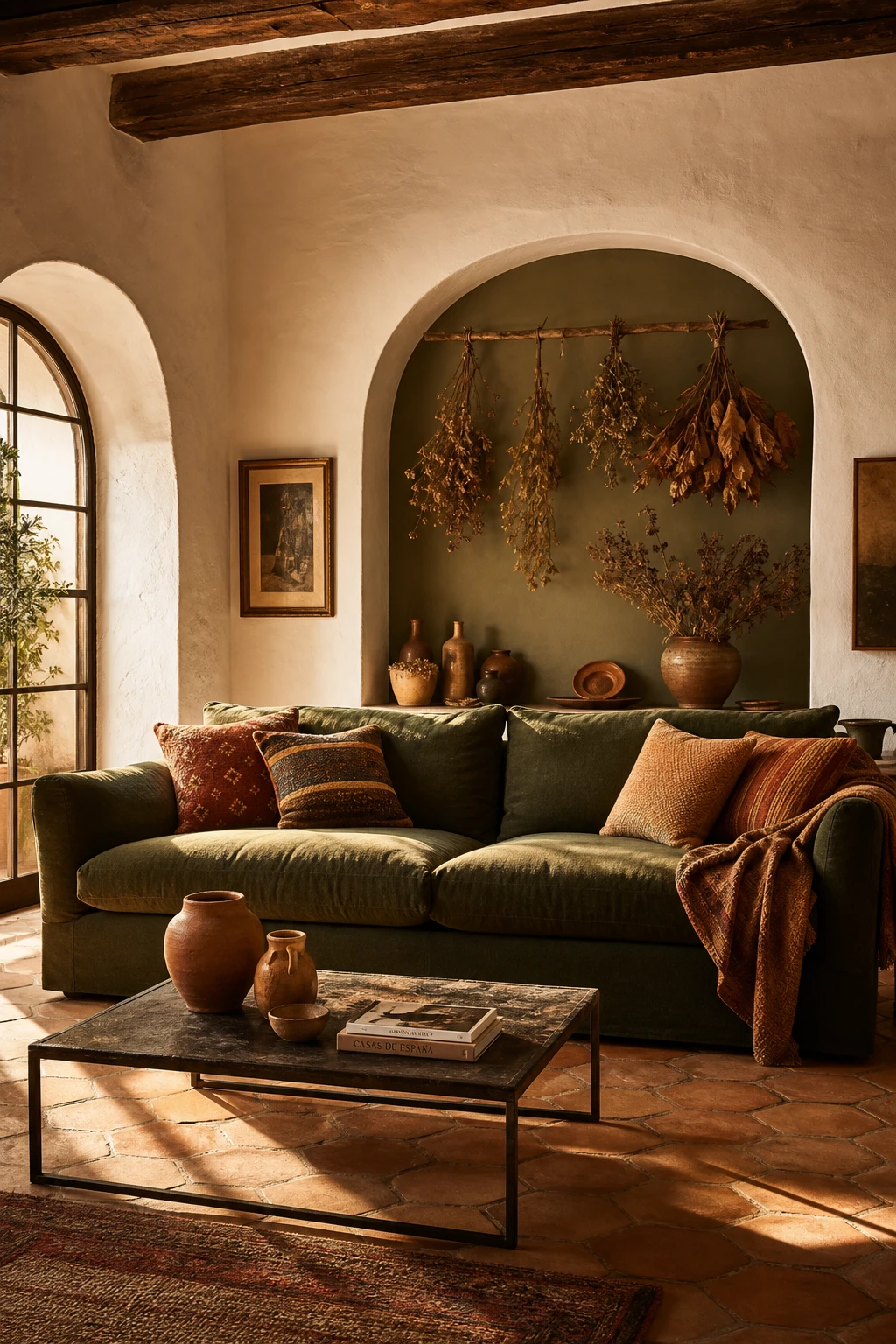
A Green Sofa in a Rustic Spanish Room and How Well It Works
Earthy green and terracotta are nature’s own pairing, and a green sofa pulls that contrast right into the centre of the room. What I love here is how the warmth of the plaster walls and handmade floor tiles keeps the green from ever feeling cool or out of place. You get a grounded, almost garden like calm that feels entirely at home in a rustic Spanish setting.
The Key Details
Earthy green linen sofa with layered woven cushions
Exposed rough hewn wooden ceiling beams
Handmade terracotta floor tiles
Wrought iron coffee table with terracotta pottery
Arched deep set alcove with dried botanical display
Pro TipChoose a velvet finish in a muted sage or olive tone, as the texture catches light softly and adds richness without pushing the colour toward anything sharp or modern.
AvoidA bright lime or yellow toned green will fight the warm plaster walls rather than settle into them, and the whole room loses its earthy cohesion in an instant.
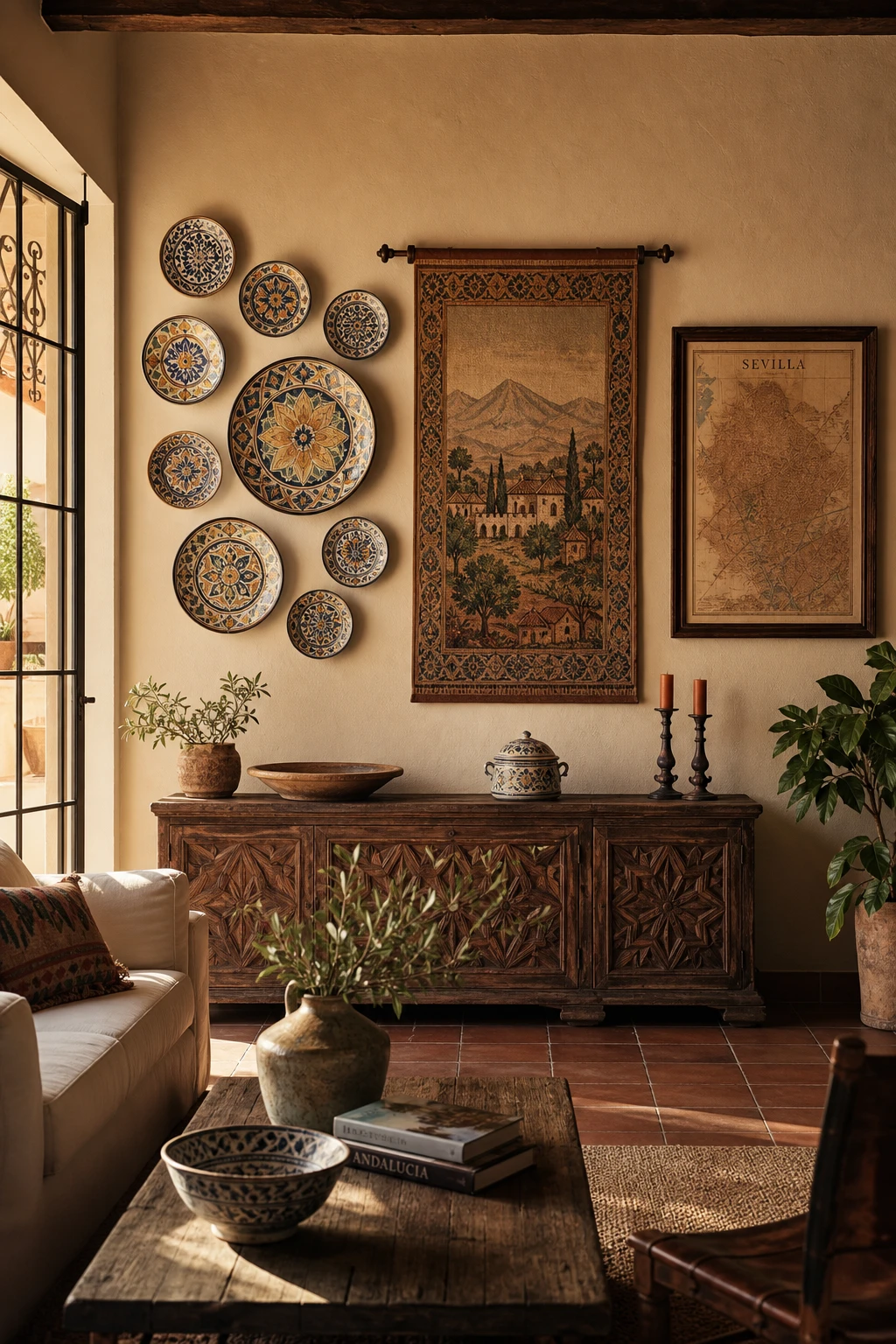
Spanish Wall Art That Tells a Story Across Your Walls
Art rooted in craft and place does something a generic print never can: it carries memory. What I love about a Talavera plate cluster or an old Seville map is that you feel the hand behind it. You get walls that read less like decoration and more like a collection gathered over a lifetime, and that sense of story is exactly what rustic Spanish rooms live on.
The Key Details
Talavera ceramic plate gallery
Woven Andalusian wool tapestry
Antique framed Seville map
Carved reclaimed oak console
Iron grille windows
Pro TipChoose frames in rough hewn wood or hand painted terracotta tones so each piece looks like it belongs to the wall rather than hanging in front of it.
AvoidSpacing art in a perfectly even grid pulls the whole arrangement into gallery territory, which works against the relaxed, collected feeling this style depends on.
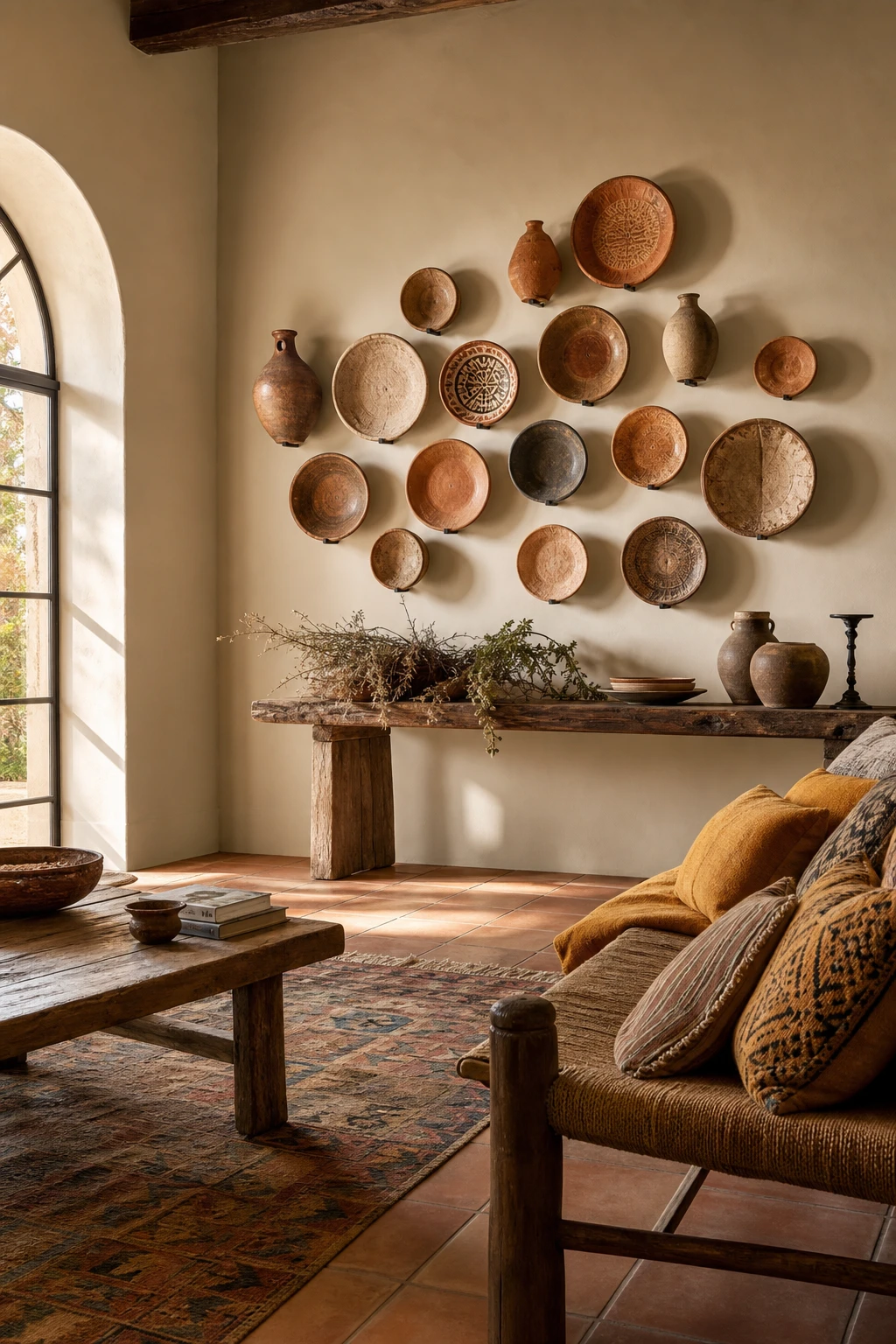
Pottery on the Wall and the Instant Craft It Brings to a Room
Hanging handmade pottery on the wall is one of my favourite moves in a Spanish living room because it gives you texture, shadow, and depth all at once, and none of that needs a frame or a nail picture hook. The glaze catches the light differently through the day, and every small bowl or plate reads as a tiny sculpture rather than a flat decoration. What wins me over every time is how a loose cluster of pieces feels as though it arrived over years rather than in a single afternoon at a homeware shop.
The Key Details
Mounted ceramic vessel gallery
Low slung timber framed sofa
Rough hewn wooden console table
Terracotta tile floor with kilim runner
Arched plaster window surround
Pro TipArrange your plates and bowls in an organic cluster, letting the gaps between pieces vary in size so the whole group breathes and feels like it grew on the wall naturally.
AvoidHanging a canvas print alongside ceramic pieces on the same wall splits the eye between two completely different visual languages and weakens the impact of both.
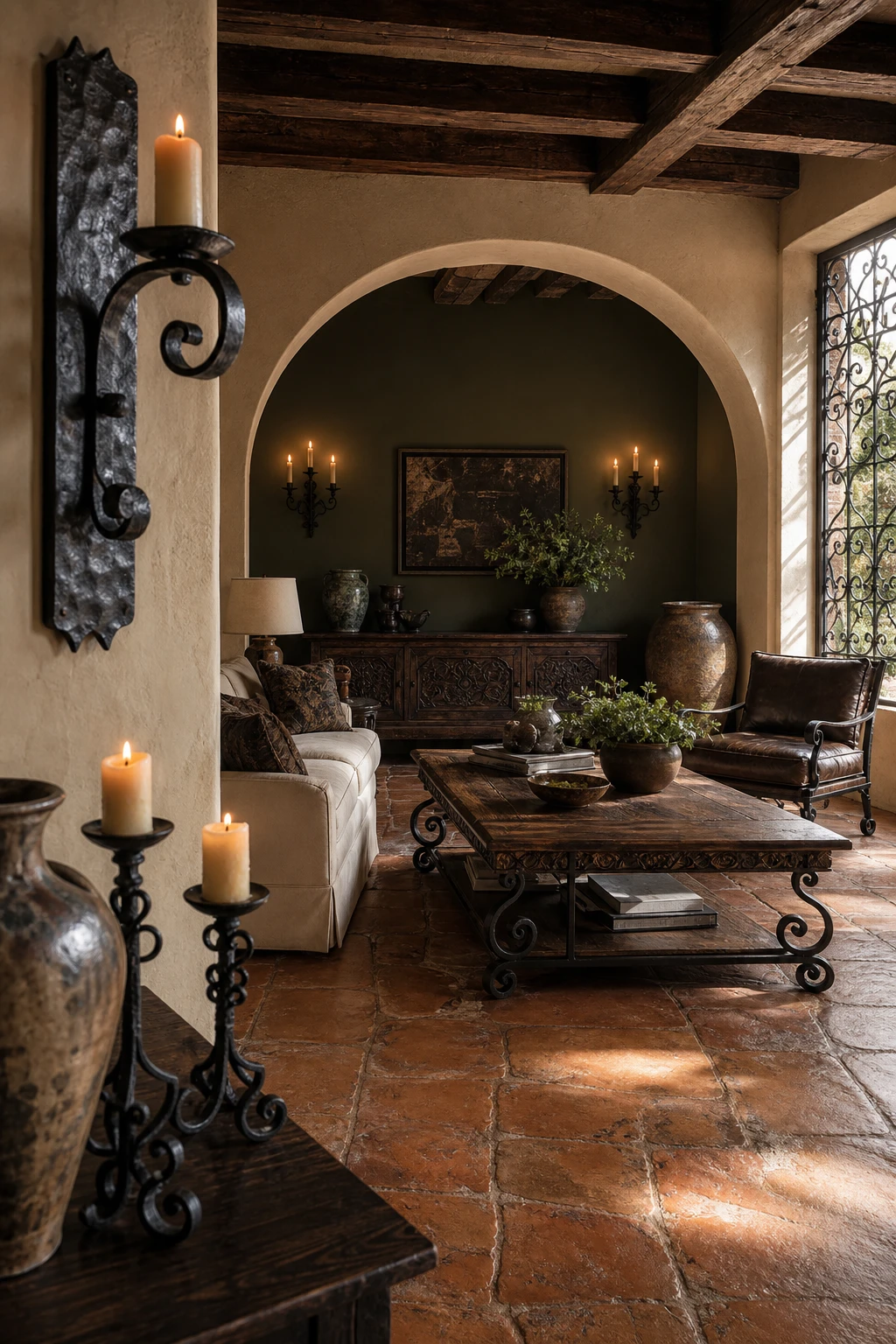
Wrought Iron Accents That Thread the Whole Room Together
Repeating one metal finish across a room is a quiet trick that pulls everything together without shouting. What I love about wrought iron is how naturally it belongs in a Spanish interior, sitting beside rough plaster and terracotta as if it has always been there. You will notice how the sconces, the window grille, and the table base echo each other, so the eye moves around the room and feels settled rather than scattered.
The Key Details
Hand forged wrought iron wall sconces
Scrolled iron window grille
Carved timber and iron coffee table
Terracotta tile floor
Rough plaster arched wall
Pro TipPlace wrought iron in at least three separate spots, such as a wall sconce, a table leg, and a small candle holder, so the repeat reads as a deliberate choice rather than a lucky accident.
AvoidDropping a polished brass piece into an iron scheme lifts the warmth right out of the room and leaves the earthy mood feeling unfinished.
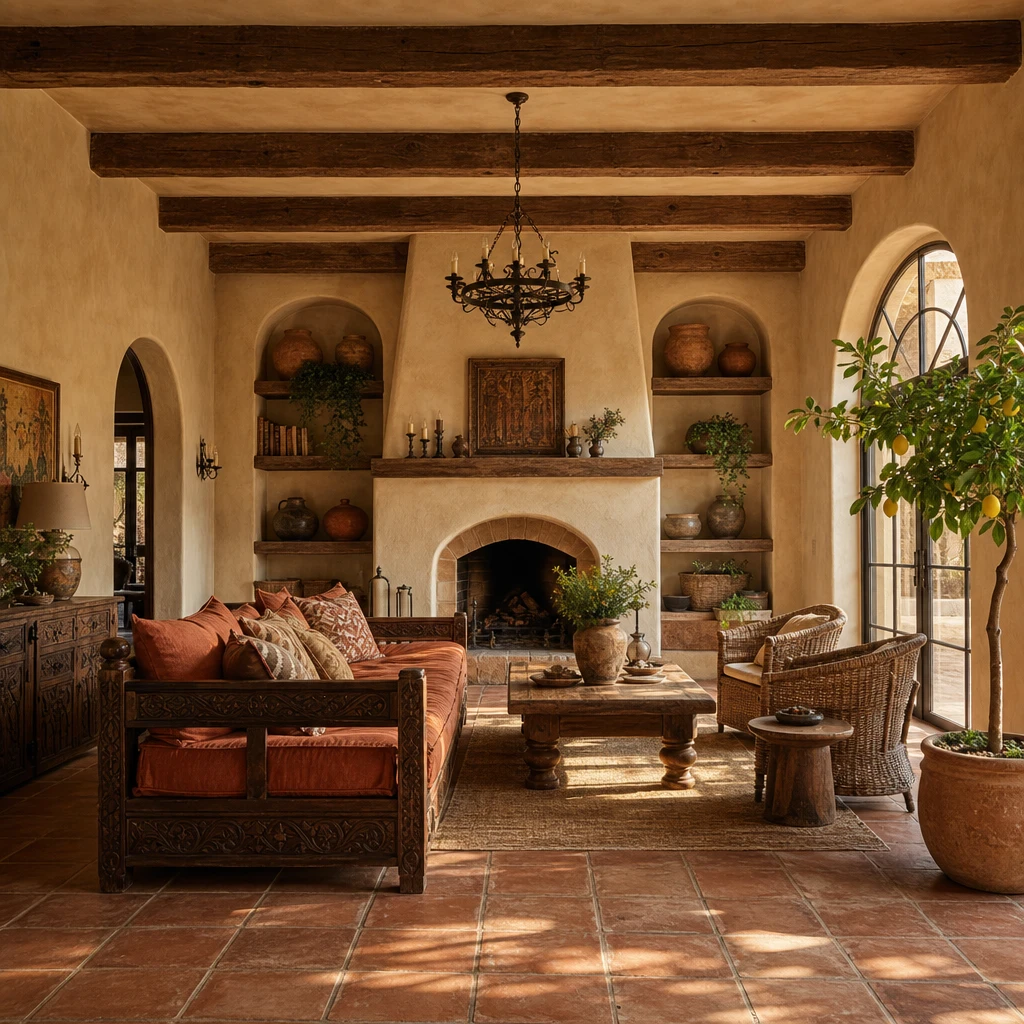
A Potted Lemon Tree and the Alive Feeling It Brings to a Spanish Room
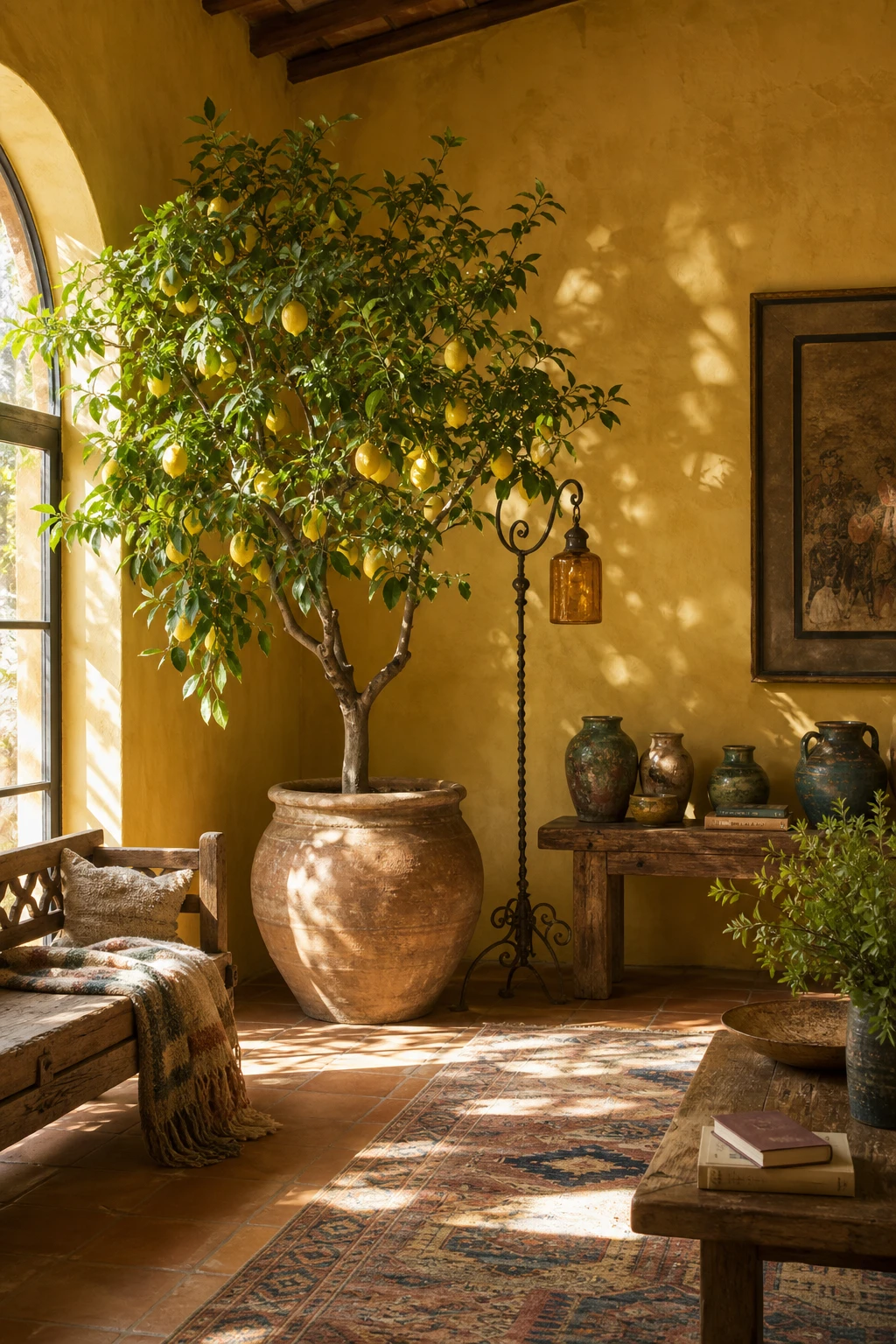
A lemon tree planted in a hand thrown terracotta pot and set beside a deep arched window brings something no cushion or candle ever could: the actual scent and colour of the Mediterranean. What I love is how one living thing does the work of a whole shelf of accessories, drawing the eye upward and giving the room a pulse. You get glossy dark leaves, occasional white blossom, and bright fruit all at once, and that layering of colour feels completely natural in a Spanish room rather than staged.
The Key Details
Mature potted lemon tree in hand thrown terracotta planter
Arched south facing window with deep plaster reveal
Carved low wooden bench with woven wool throw
Wrought iron floor lamp with amber glass shade
Faded kilim rug over aged terracotta floor tiles
Pro TipPosition the pot as close to your south facing window as the space allows, rotating it a quarter turn each week so every side of the tree gets an even share of light.
AvoidPlanting a young tree into a pot that barely contains its rootball will make the whole thing look precarious and force you to repot within months, stressing the tree right when you want it to settle.
Alan launched Edward George London in 2017. Since completing his masters in Town & Regional Planning (MPlan) he has combined the skills he learned at the University of Sheffield with his passion for design, to help create a foundation for those looking to create a beautiful home.