I have always loved the quiet confidence of a dark charcoal house exterior, the way it sits in a landscape like it belongs there completely. What I find most interesting is how much the smaller details do the heavy lifting, whether that is the trim colour, the door, the roofline, or the way light plays across the cladding at dusk. Every look here is one you can genuinely steal, whatever the size or shape of your home.
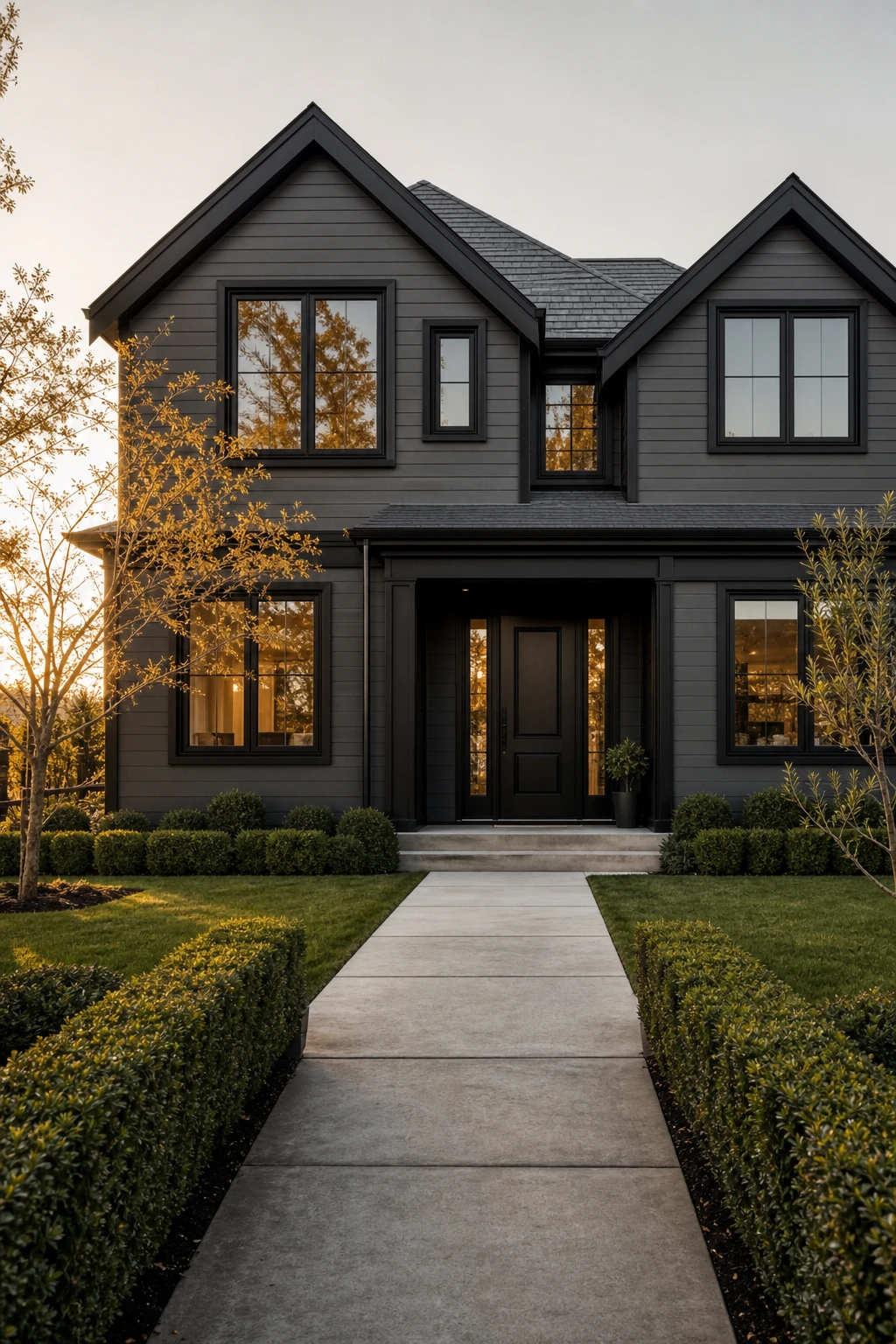
Why Black Trim Makes a Dark Grey House Look So Sharp
Pairing black trim against a dark grey wall is one of my favourite moves on a modern exterior. The tones sit close together, yet you get a clean line wherever the two meet, and that edge is what sharpens the whole facade. What I love most is how the contrast stays calm rather than shouty, so the house reads as one considered thing rather than a collection of parts.
The Key Details
Black panelled front door with slim sidelights
Dark slate pitched roof tiles
Fibre cement wall cladding
Poured concrete entry pathway
Clipped boxwood foundation hedging
Pro TipChoose a satin or semi gloss finish for the trim so the sheen alone separates it from the flatter wall surface without needing a dramatic colour jump.
AvoidPainting both the trim and the wall in the same flat finish removes that separation entirely, and the crisp lines you want simply disappear into the facade.
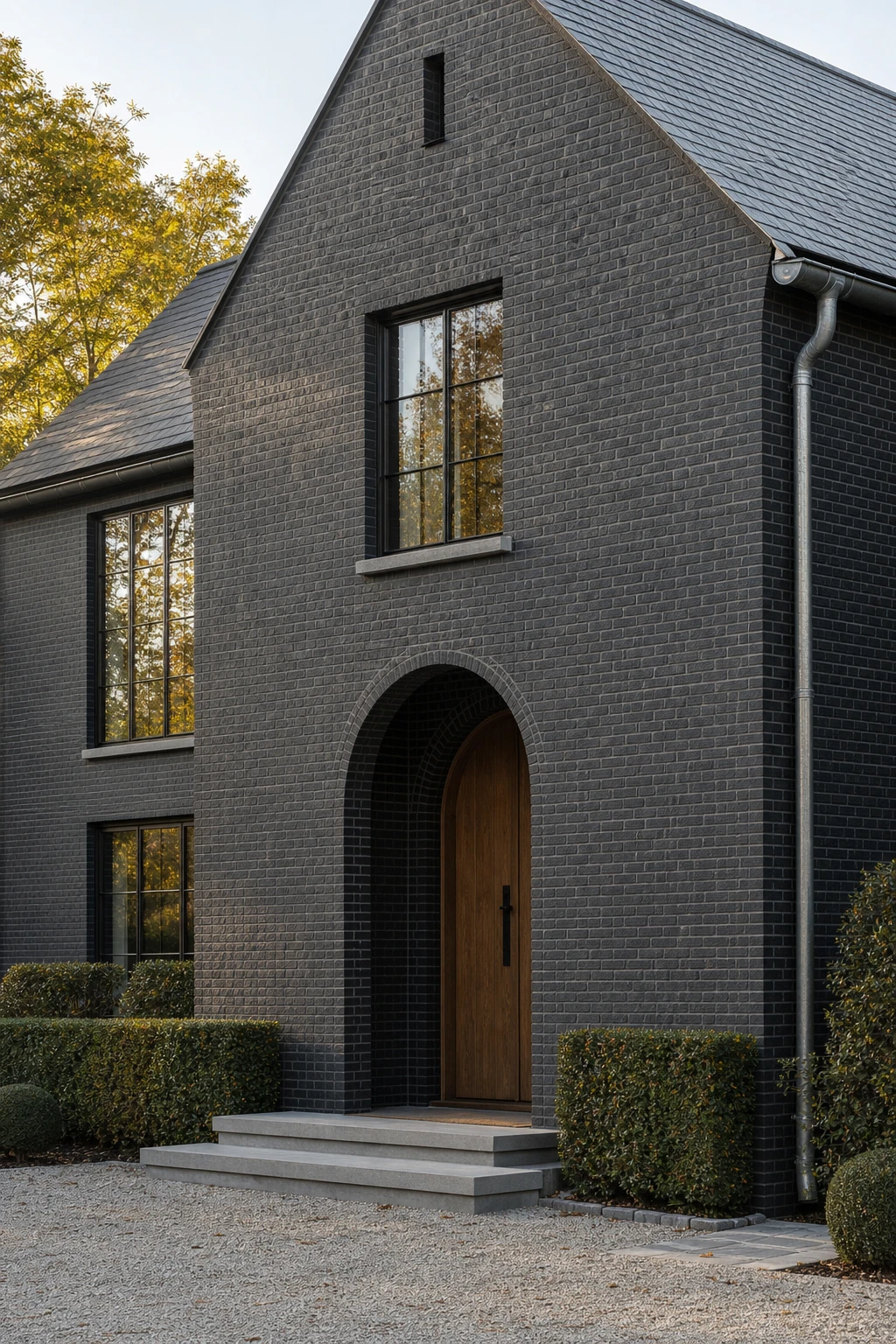
How Painted Brick Turns a Dark Grey Exterior Into Something Timeless
Brick has a roughness that flat render simply cannot match, and what I love about painting it in a deep charcoal is how the texture suddenly reads as a feature rather than just a background. You get all that shadow and depth playing across the mortar lines, so the colour looks alive rather than flat. The result feels permanent, like the house has always looked this way.
The Key Details
Black steel casement windows
Recessed arched oak front door
Steeply pitched slate roof
Raw zinc guttering and downpipes
Box trimmed hornbeam hedging
Pro TipApply a dedicated masonry primer before your dark topcoat so the brick stops absorbing paint unevenly and you get a true, consistent depth of colour in two coats rather than three or four.
AvoidPainting over brick that holds any moisture will trap the damp behind the film and cause the paint to peel or blister within a single season, undoing all the work.
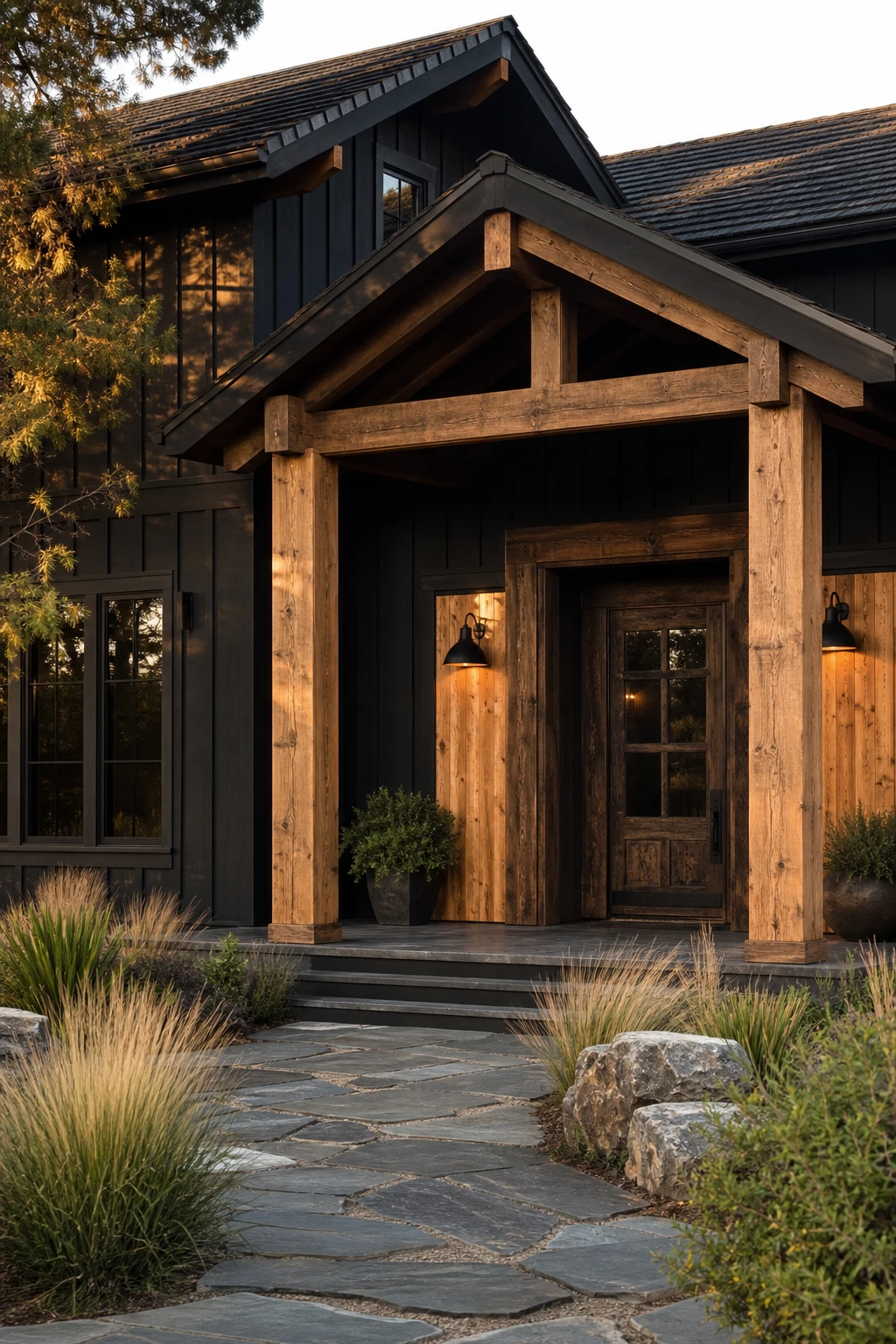
The Warmth Wood Brings to a Head to Toe Black Exterior
Charcoal alone can tip into cold and severe, and wood is what pulls it back. What I love about running cedar cladding or a reclaimed timber surround against a near black wall is the instant sense of life it adds, a material that breathes and ages rather than just sits there. You get contrast without colour, texture without noise. The warm grain pulls the eye and softens the drama so the whole exterior feels considered rather than stark.
For an existing facade, the black house exterior wood accents guide maps where cedar belongs and how to test it against the retained building.
The Key Details
Cedar tongue and groove cladding panels
Exposed timber rafter tails at roofline
Reclaimed wood front door surround
Board and batten charcoal siding
Quarried slate stone entry path
Pro TipSeal all exposed timber with a quality exterior oil or microporous stain before installation, and reapply every two to three years to stop the grain greying out and losing the warmth that makes it worth having.
AvoidUsing a single narrow strip of wood trim around a door or window leaves it looking like a last minute addition rather than a deliberate design choice, and the contrast you were hoping for simply disappears into the overall dark mass.
Modern Board and Batten Siding That Makes Dark Exteriors Look Brand New
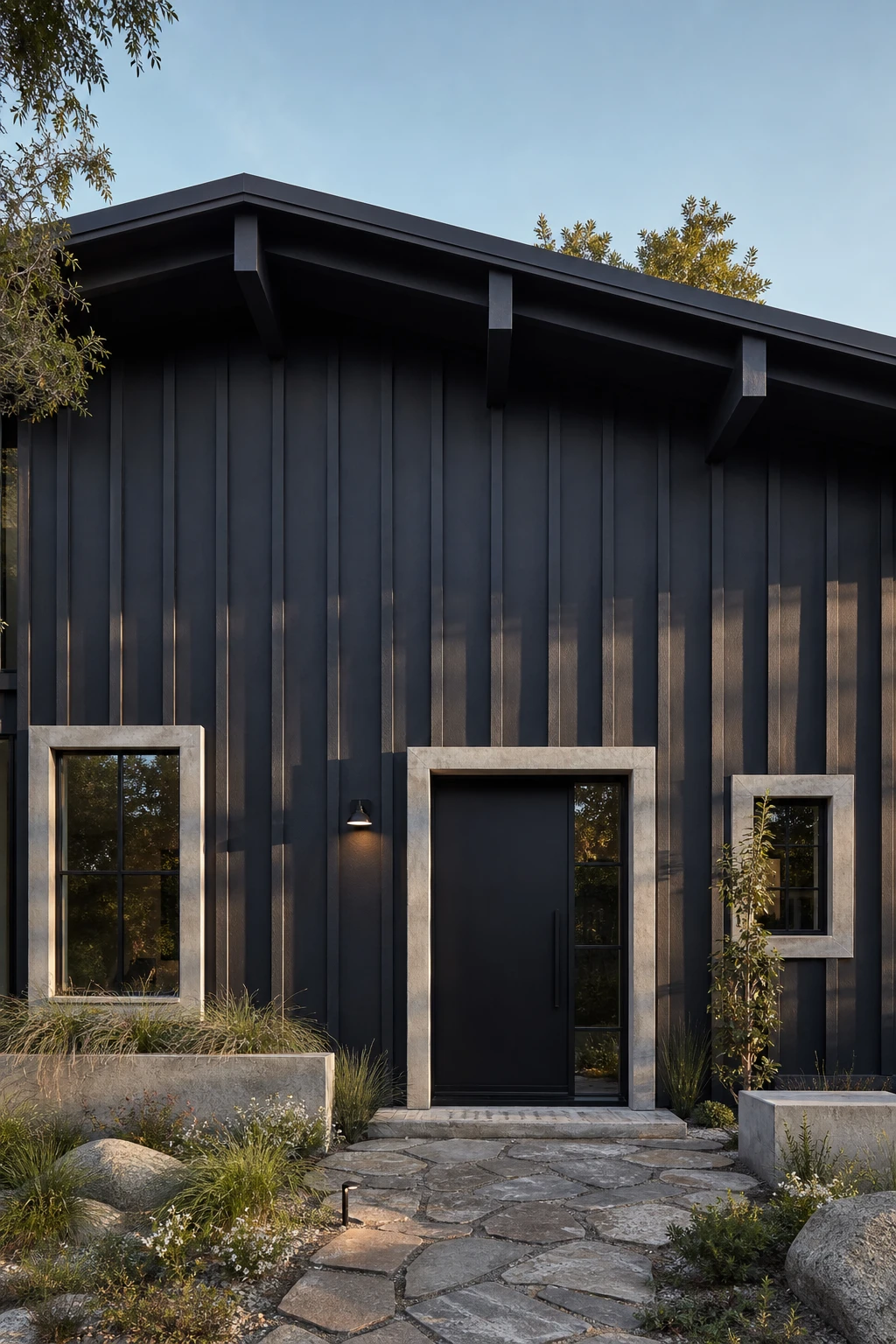
Vertical lines are one of my favourite tools for a house that feels taller and more composed than its footprint suggests. Board and batten pulls the eye straight up, giving the facade a clean rhythm you notice the moment you arrive. What I love here is how the dark finish deepens those shadow lines between boards, making the texture read from the street rather than disappearing into a flat wall. You get structure and warmth at the same time.
The Key Details
Vertical board and batten timber cladding
Exposed rafter tail roofline overhang
Solid dark pivot entry door
Cast concrete window surrounds
Natural fieldstone entry pathway
Pro TipSpace your battens at equal intervals of 12 to 16 inches for a modern, uncluttered rhythm that reads well from the street.
AvoidMixing two different batten widths across the same facade breaks the rhythm and makes the whole elevation feel unresolved.
Black Paint Meets Natural Stone and the Result Is Quietly Stunning
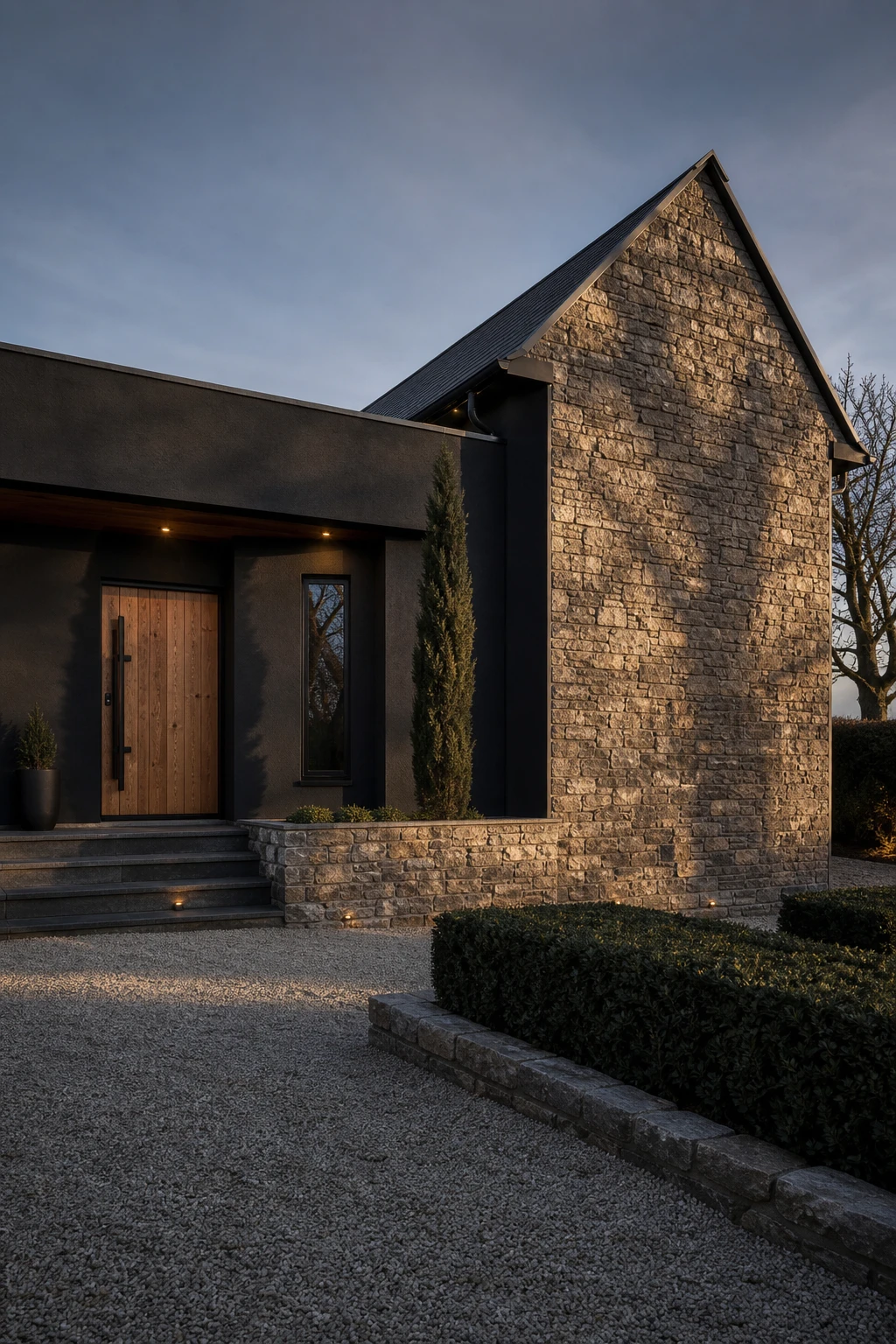
Pairing raw limestone with smooth painted render is one of my favourite moves on a dark exterior. The stone brings warmth and texture, and the flat black panels make it read as intentional rather than patchy. What I love is how each material sharpens the other: you get the roughness of the stone looking richer, and the painted surface looking crisper. It is a quiet tension that gives the whole facade a grounded, almost timeless quality.
The Key Details
Coursed natural limestone gable wall
Smooth painted render panels
Solid oak front door with iron hardware
Recessed soffit downlights
Gravel approach with clipped dark hedging
Pro TipMatch your mortar tone as closely as possible to the stone face so the coursing reads as one calm mass rather than a grid of competing lines.
AvoidLeaving an obvious gap or unfinished trim edge where the stone meets the painted render makes both materials look like an afterthought rather than a considered pairing.
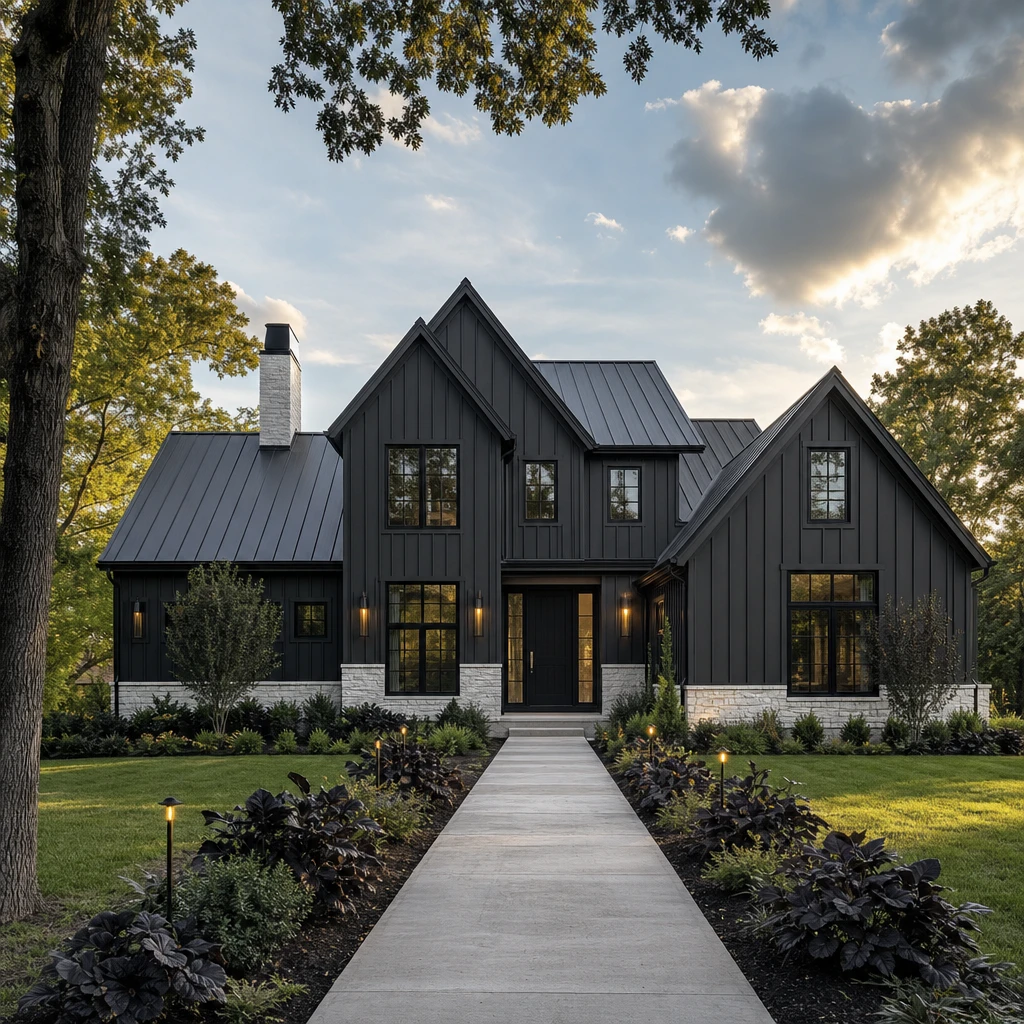
The Charcoal Modern Farmhouse Exterior That Feels Both Fresh and Familiar
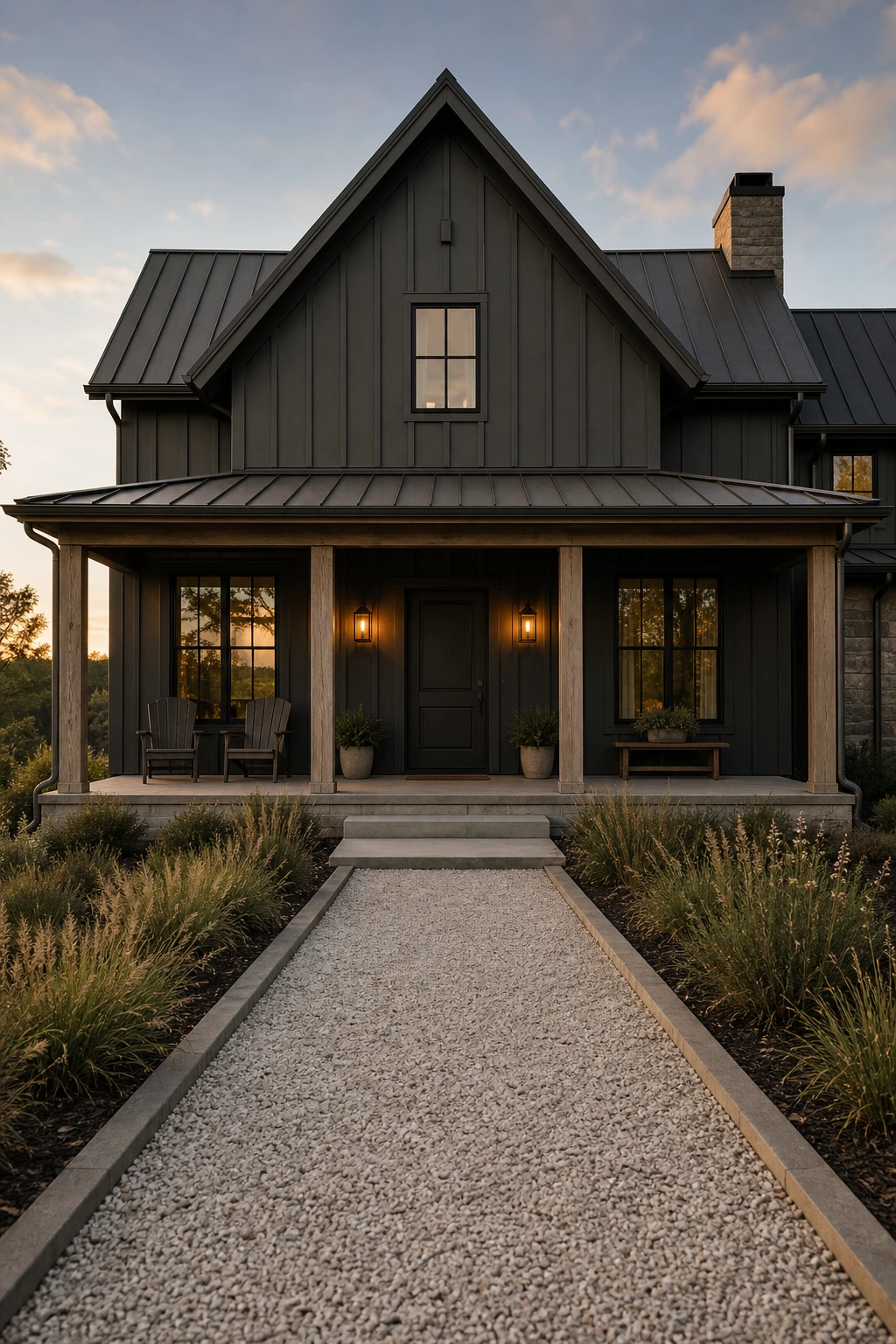
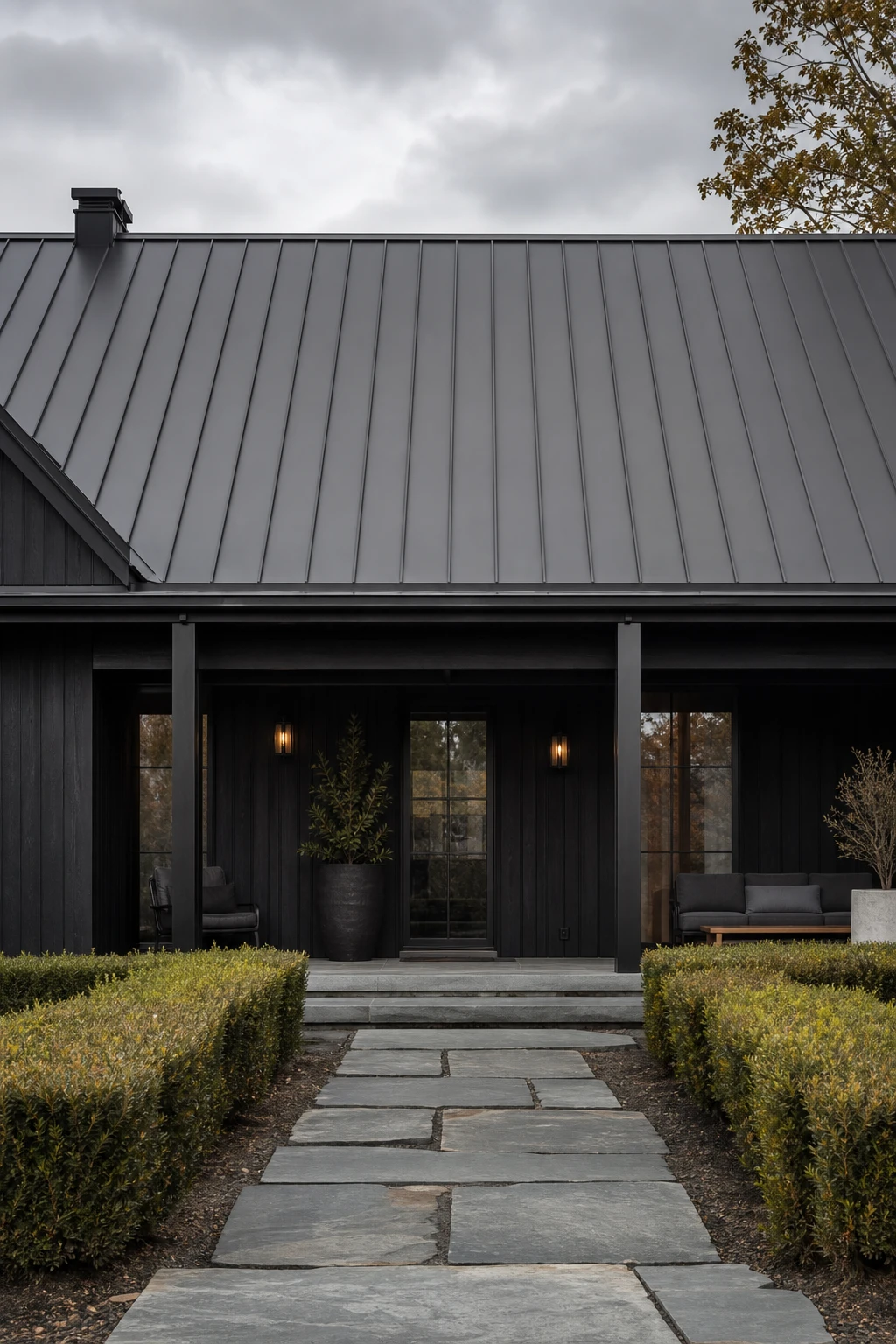
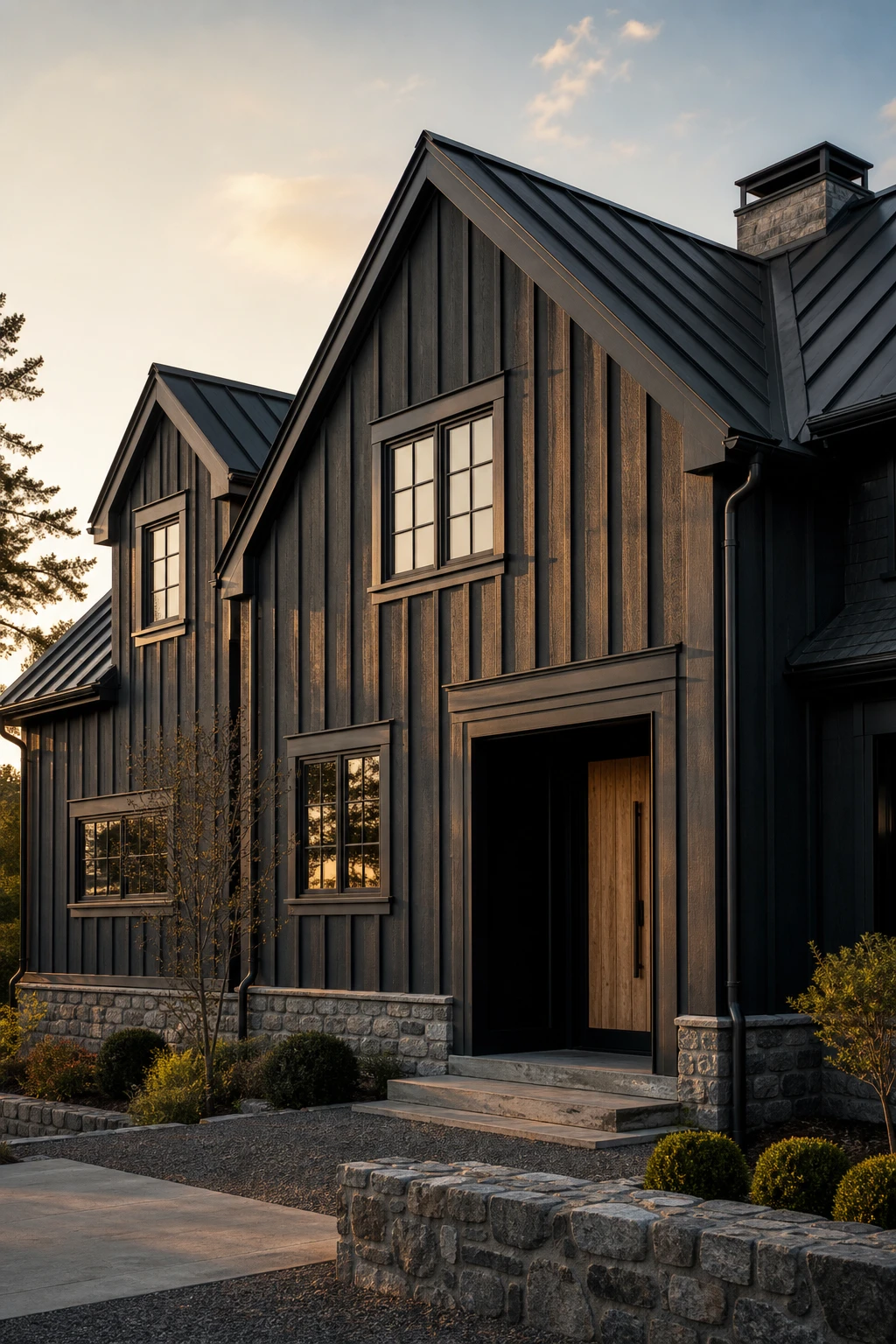
The farmhouse silhouette is one I keep returning to, because its steep gables and covered porch already carry so much charm before a single colour decision is made. Wrapping that familiar form in deep charcoal board and batten is the move that makes it feel current without erasing any of the warmth you fell for. Watch how the graphite standing seam roof reads as a natural extension of the walls rather than a contrast, pulling the whole exterior into one resolved, quietly confident statement.
The Key Details
Steep symmetrical gabled roofline
Board and batten timber cladding
Covered front porch with raw timber posts
Standing seam graphite metal roof
Matt black panelled front door with wall lanterns
Pro TipKeep your roofline clean and unbroken so the dark tone flows from cladding to ridge without interruption, letting the silhouette speak for itself.
AvoidAdding white window trims, black gutters, and a contrasting porch ceiling all at once fragments the elevation and works against the calm, unified feeling that makes this palette so powerful.
A Dark Exterior Bungalow That Proves Small Homes Look Best in Bold Colours
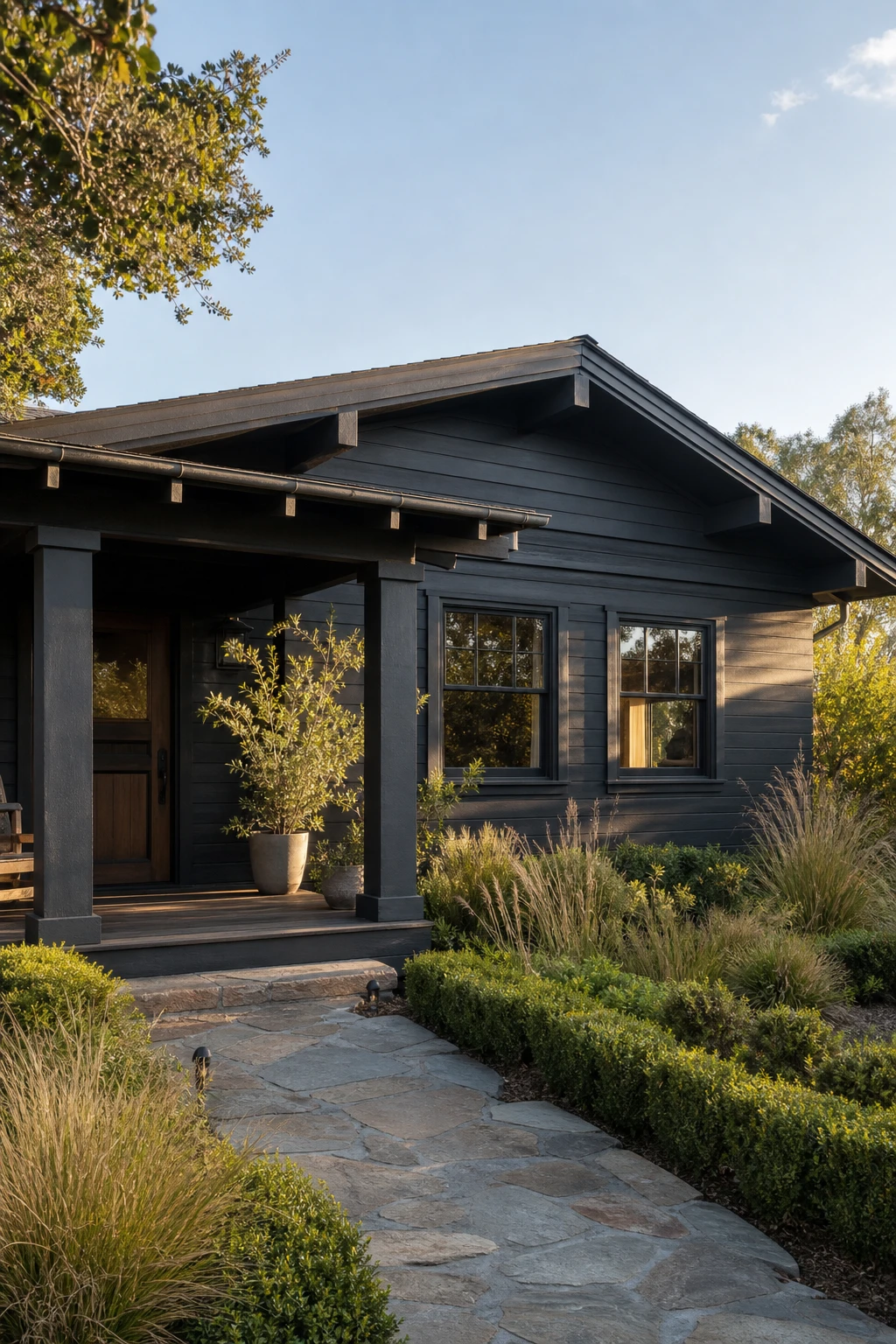
Bending a bungalow into something that feels grounded and deliberate is one of my favourite challenges, and a deep charcoal does the work almost on its own. What I love here is how the dark tone pulls every element, rough cedar, low windows, stone path, into one calm read rather than a scattered collection of parts. You get a sense of weight and intention that a pale facade rarely delivers at this scale.
The Key Details
Wide front porch with square timber columns
Irregular natural stone slab path
Low ornamental grass and box hedge foundation planting
Black framed casement windows set close to grade
Rough sawn cedar wall cladding
Pro TipPaint the fascia and eaves the same dark charcoal as the walls so the roofline reads as one continuous form rather than a separate cap sitting on top.
AvoidSplitting a small facade into two or three paint zones creates visual noise that chops the home into fragments and makes the whole thing feel even smaller.
How a Ranch House Wears Dark Charcoal Better Than Any Other Style
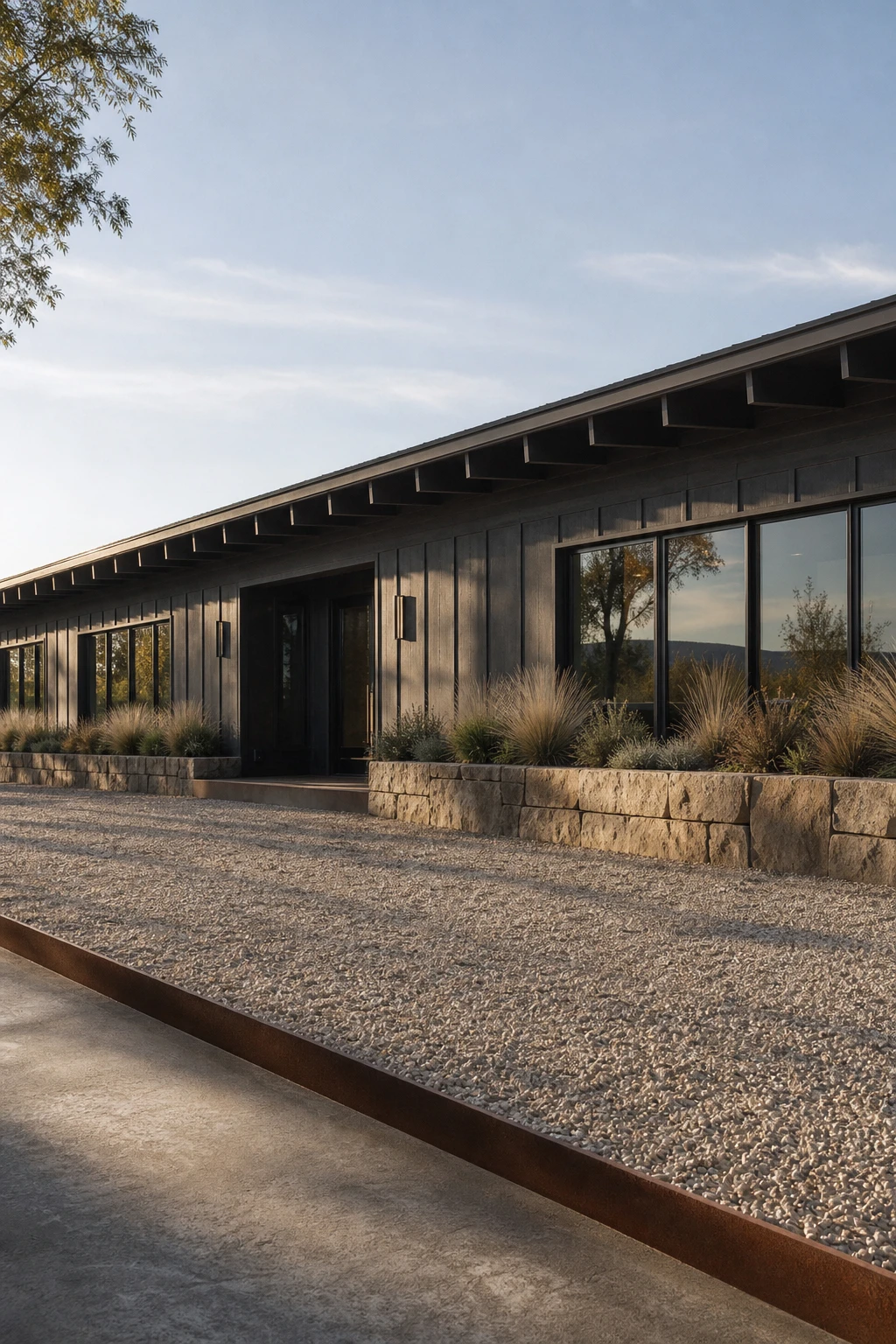
Bending a ranch into dark charcoal is one of my favourite moves because the colour does exactly what the form asks of it. Those long, low lines pull your eye sideways across the facade, and the deep tone anchors the whole house to the ground in a way pale paint simply cannot. What I love most is the shadow play under wide eaves, where the dark cladding and the overhang become one continuous band. You get a house that feels rooted, calm and completely intentional.
The Key Details
Board and batten horizontal timber cladding
Wide overhanging eaves with deep shadow line
Continuous stone planter with ornamental grasses
Flat gravel drive with raw steel edging
Flush set black steel framed casement windows
Pro TipPlant low, spreading shrubs along the front edge to mirror the roofline and reinforce that satisfying horizontal rhythm all the way to the ground.
AvoidTall vertical elements like a feature chimney stack painted a contrasting colour or a narrow gabled porch break the horizontal rhythm and make the whole composition feel restless.
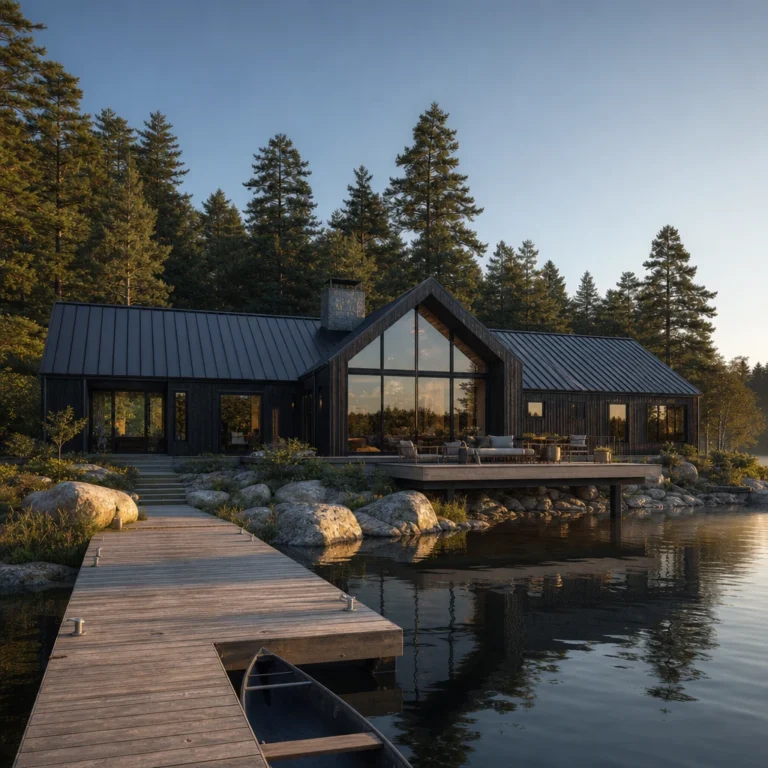
A Black Cabin in the Trees and Why It Disappears in the Best Way
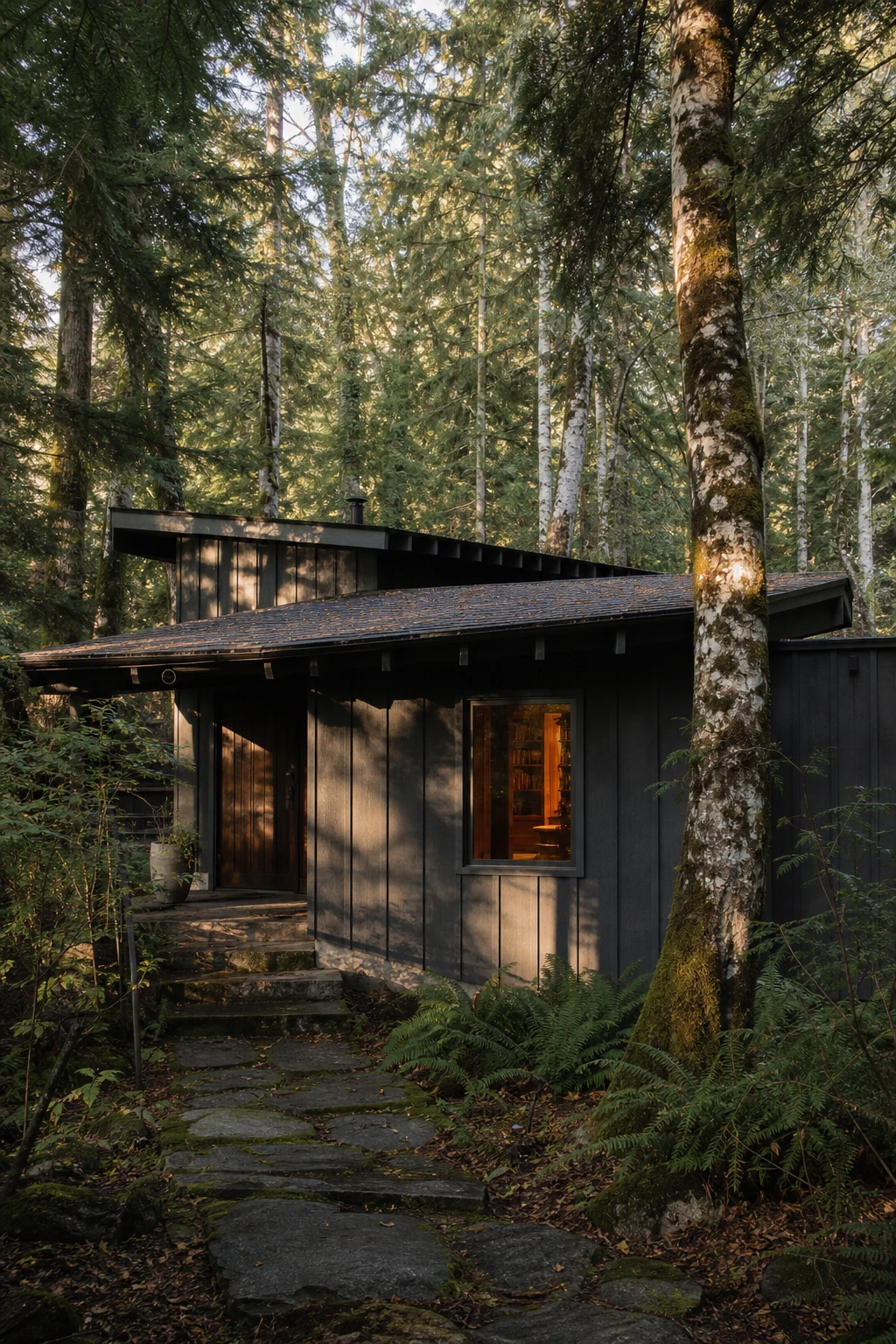
A black cabin in the trees does something quietly magical: the dark cladding pulls the building back into the treeline so your eye lands on the forest first and the house second. What I love about this is how the landscape becomes the decoration, with mossy stones and fern fronds doing far more than any planted border could. The deep overhangs cast soft shadow across the facade, and you get that sense of the house belonging there rather than sitting on top of the land.
The Key Details
Board and batten timber cladding
Low pitched roof with deep overhangs
Timber framed picture window
Mossy stepping stone path
Native fern groundplanting
Pro TipKeep mature trees within arm’s reach of the facade rather than clearing them back, because the dappled shade they cast breaks up the flat dark plane and stops the exterior from reading as a solid block.
AvoidGlossy black paint creates harsh mirror like patches wherever direct sunlight hits the facade, which pulls the eye straight to the surface and destroys the effect of the house receding into the trees.
Standing Seam Metal Roofs Are the Finishing Touch a Dark Exterior Deserves
A standing seam metal roof is the one material that holds a dark exterior together from top to bottom, and what I love most is how the vertical seam lines carry the eye upward and give the whole facade a clean, deliberate rhythm. You get a surface that reads as part of the same palette as the walls rather than a separate lid dropped on top. The metallic sheen shifts with the light across the day, adding depth without competing with the charcoal below.
The Key Details
Standing seam metal roof panels
Rough sawn timber cladding
Blackened steel porch posts
Brushed zinc gutters and fascia
Flagstone entry pathway
Pro TipSpecify your seam caps in a finish that matches the wall tone exactly, whether that is a graphite powder coat or a dark zinc, so the roofline feels grown from the building rather than placed on it.
AvoidChoosing a warm bronze or weathered brown metal roof against a cool blue grey charcoal wall creates an undertone clash that makes the whole exterior look unresolved, no matter how carefully everything else is chosen.
Dark Stucco Gives a Charcoal Exterior a Smoothness Nothing Else Can
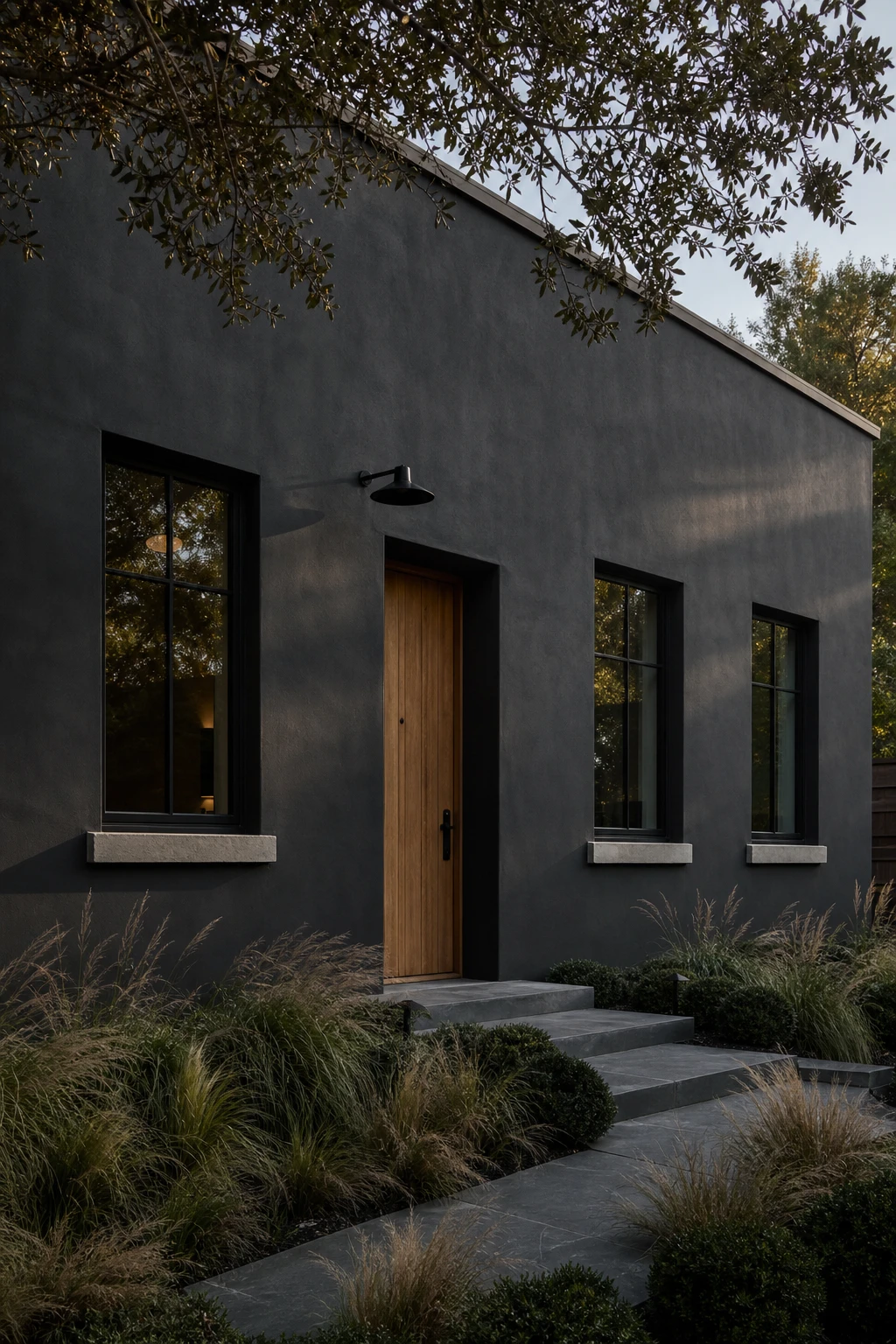
Smooth trowelled stucco does something to a dark charcoal exterior that timber cladding or brick simply cannot match: it turns the whole facade into one continuous, almost sculptural plane. What I love is how the light grazes across that flat surface and shifts through the day, giving the colour real depth without any texture competing for attention. You get a finish that reads as quiet and deliberate, which is exactly the mood a strong dark exterior needs.
The Key Details
Smooth trowelled stucco facade
Oversized black steel framed casement windows
Recessed flush timber front door
Honed bluestone entry path
Low clipped boxwood and ornamental grass border
Pro TipTint your scratch coat close to the finish colour so any small chips or hairline cracks that appear over time blend in rather than showing as a pale scar against the dark top coat.
AvoidRunning stucco across a large facade in one unbroken section without expansion joints causes the material to crack as the wall moves, and those cracks will split right through the finish coat and ruin the smooth plane you worked so hard to achieve.
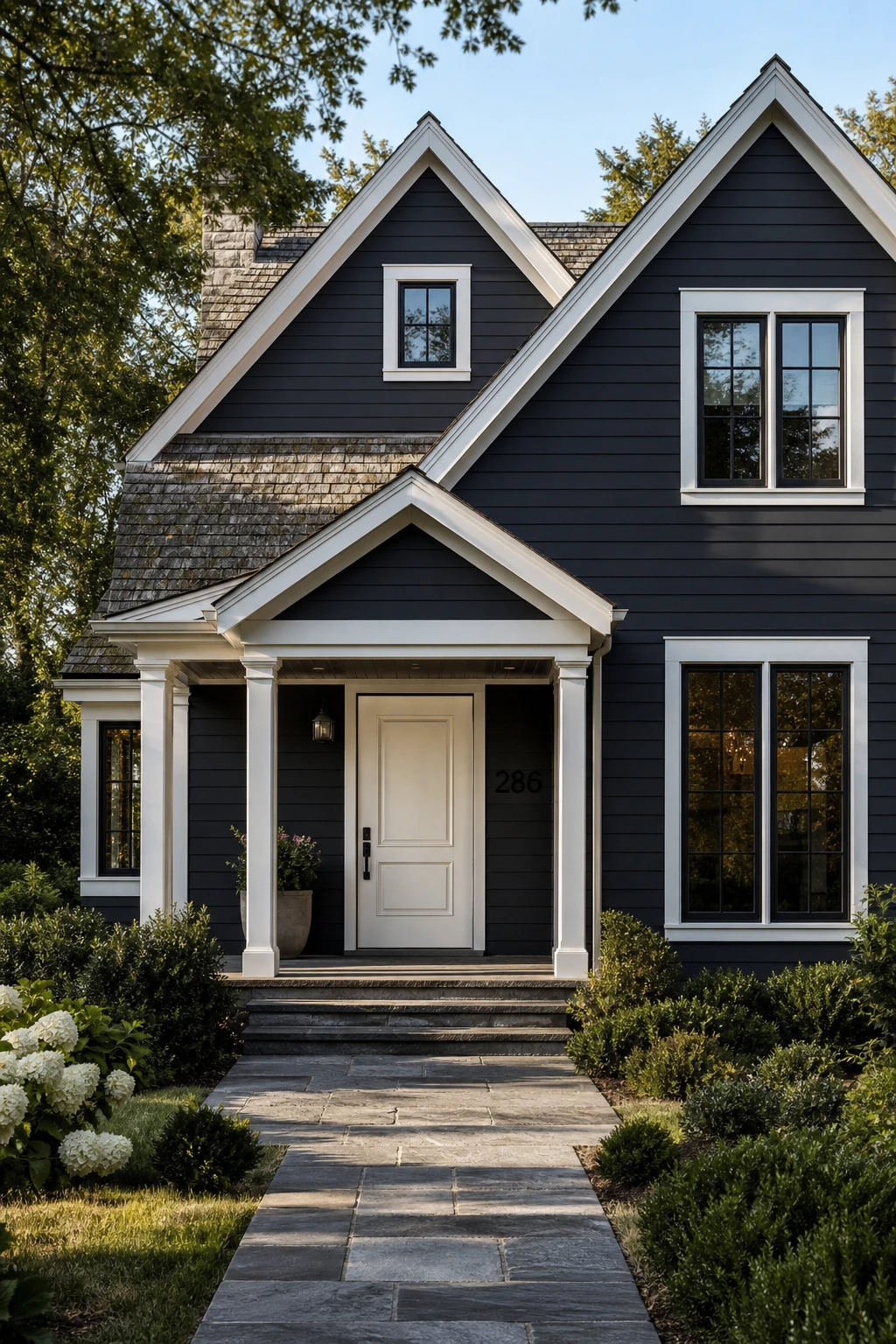
White Trim on a Dark Gray House Is the Contrast That Makes Both Colours Sing
White trim on a dark gray house is one of my favourite moves because it does something almost architectural: it draws a clean outline around every window, roofline and door frame, so the eye reads the whole facade as a composed, deliberate design. What I love is the way each element gets its own moment. The darkness recedes and the white jumps forward, and you get that crisp definition that makes a house look far more considered than it actually is to achieve.
The Key Details
Painted timber window surrounds
White fascia and barge boards
Turned timber porch columns
Stone pathway
Panelled front door
Pro TipReach for a warm white with a hint of cream or stone undertone, because a pure blue white trim can look cold and harsh against deep charcoal siding.
AvoidPainting trim and body in the same finish sheen flattens the contrast and the whole point of the pairing is lost.
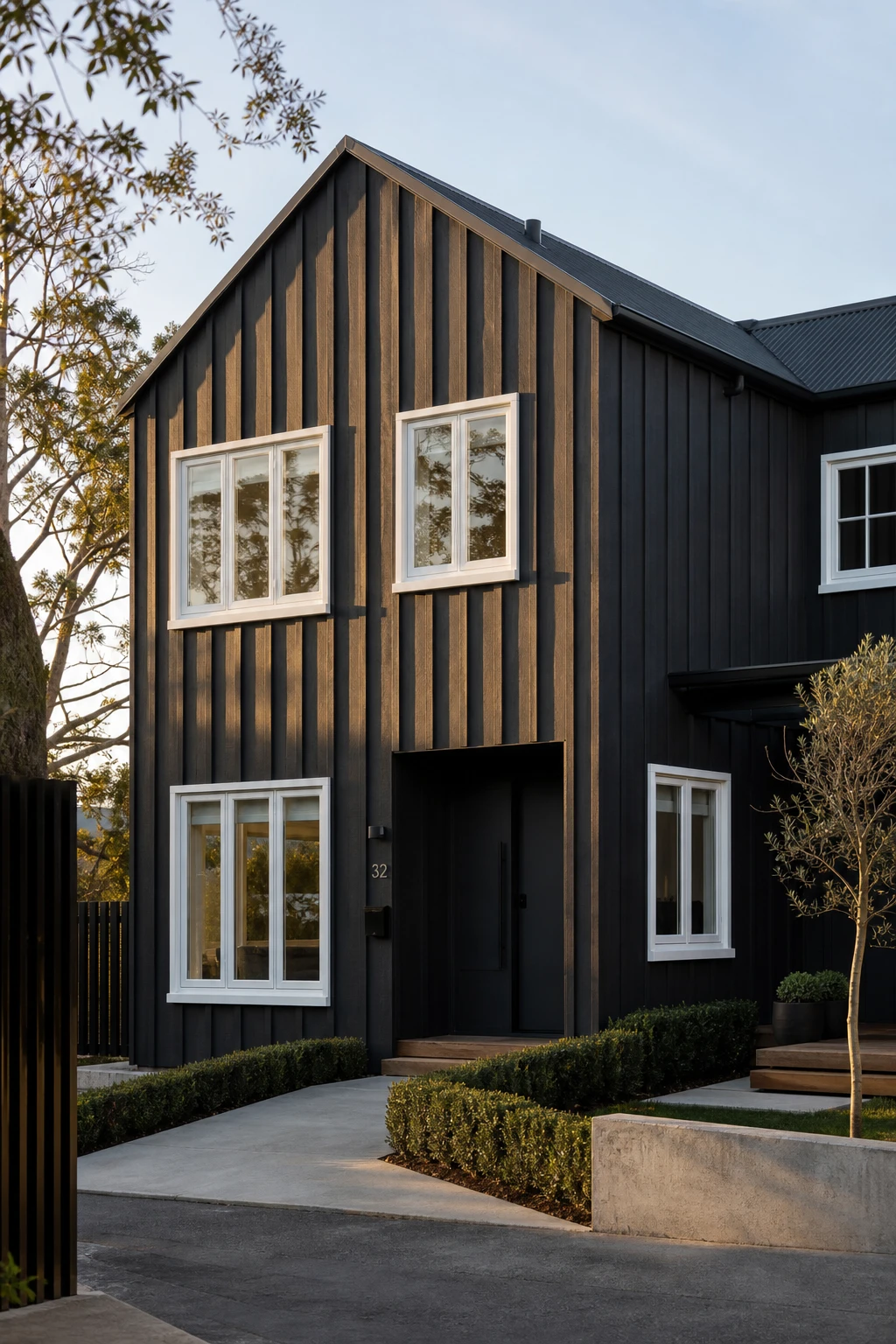
White Windows on a Dark Exterior and How They Change Everything Inside Too
White windows on a dark exterior do something I find quietly brilliant: they draw the eye to every opening in the facade, giving the house a composed, portrait like quality. What I love most, though, is the interior payoff. That bright white frame acts like a reflector, bouncing daylight deeper into the room so you get softness rather than a hard contrast with a dark wall. You will notice rooms feel airier than the square footage suggests.
The Key Details
Board and batten vertical cladding
Recessed charcoal front entry door
White painted window sills
Clipped low hedging border
Pale poured concrete path
Pro TipPaint the interior face of the frame and the window board the same bright white so the light keeps bouncing rather than stopping at the glass.
AvoidPainting only the exterior face white and leaving a dark interior reveal creates a shadow frame that actually makes the room feel smaller and the window feel mean.
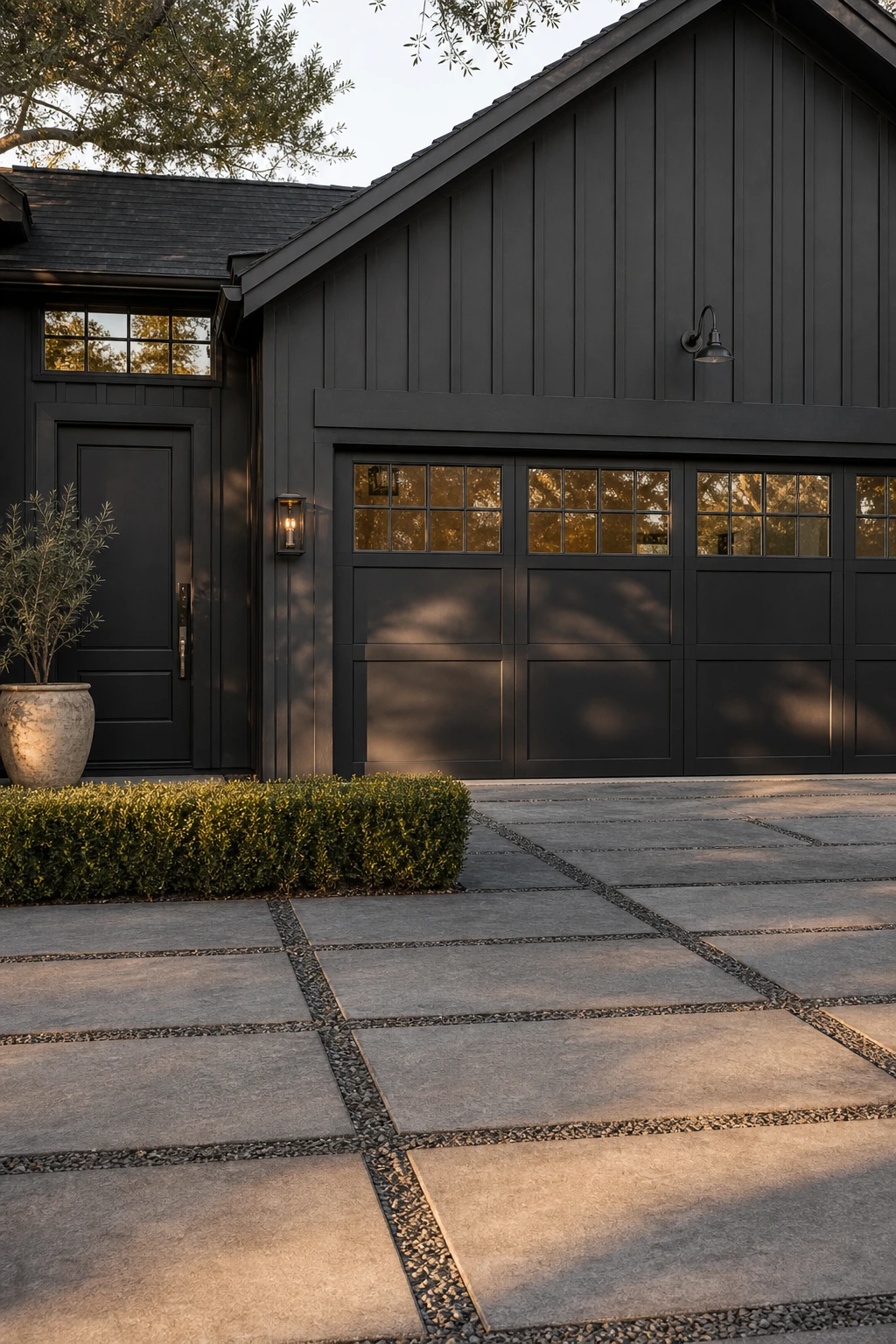
Adding Windows to a Black Garage Door Is the Small Move That Looks So Considered
Garage doors eat up a huge amount of facade space, and leaving them as a blank slab is the thing I see let down so many otherwise well considered exteriors. Adding grid pane windows breaks that flat panel into something with rhythm and life. You get a door that reads as architecture rather than an afterthought, and the whole front elevation feels intentional and complete.
The Key Details
Grid pane garage door windows
Board and batten facade cladding
Transom window above entry door
Brushed iron door hardware
Clipped boxwood hedge border
Pro TipLine up the top of your garage door windows with the head height of your house windows so the eye travels across the facade on one clean horizontal.
AvoidChoosing window panes that are too small for the door panel makes the glass look like an accessory rather than a proper feature, and the whole door ends up looking cheap.
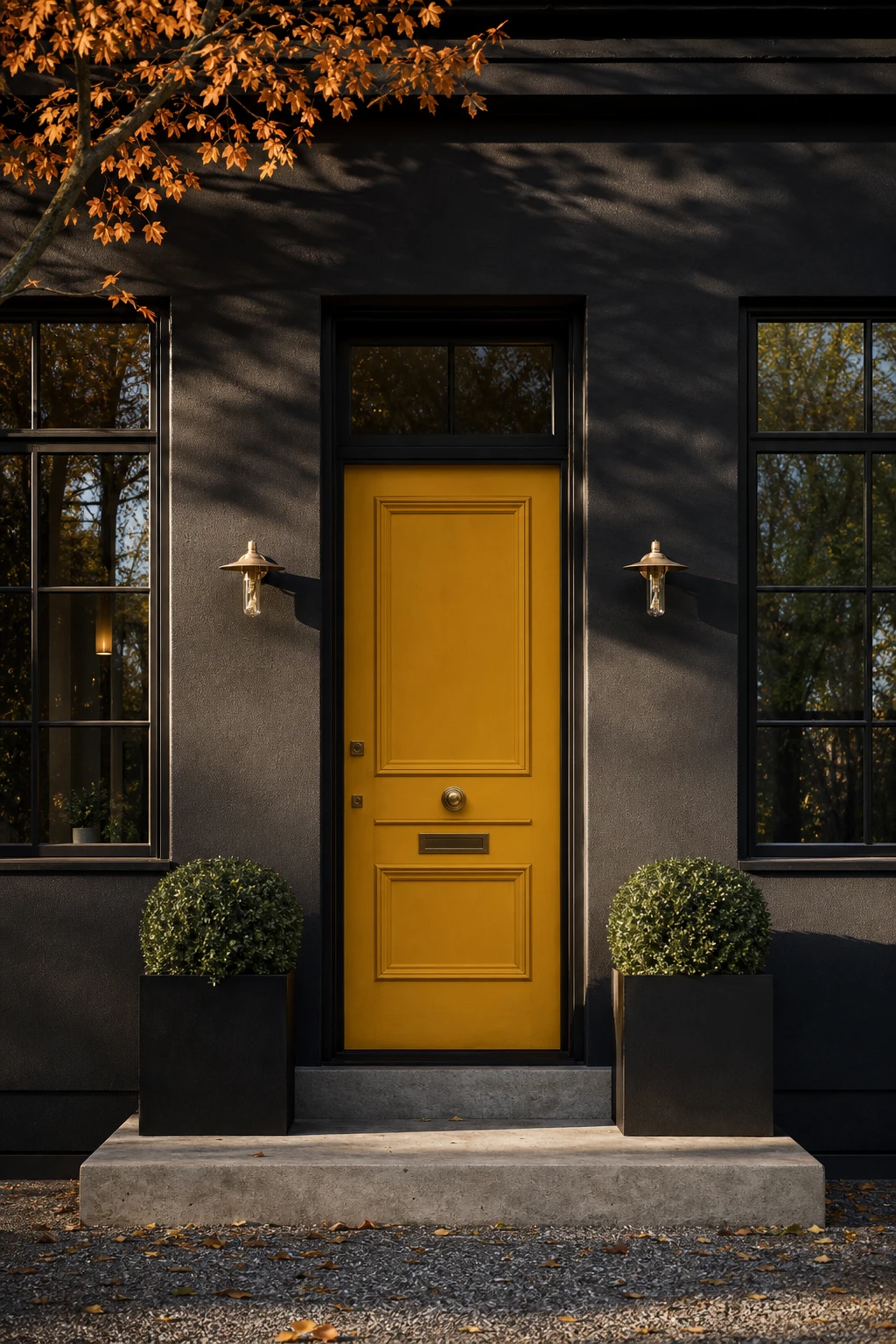
A Yellow Front Door on a Dark Grey House Is the One Pop of Colour That Actually Works
A single yellow door on a dark grey facade is one of my favourite moves because the contrast is so controlled. The warm tone pulls your eye straight to the entrance and gives the whole house a personality without competing with anything else. What I love is that it reads as confident rather than loud, and you get that effect precisely because everything around it stays dark and quiet.
The Key Details
Painted timber front door
Black steel divided light windows
Smooth mineral render facade
Raw concrete threshold step
Clipped box topiaries in matte black planters
Pro TipReach for a muted, ochre leaning yellow rather than a bright primary tone, as the earthy warmth sits far more naturally against dark render or charcoal cladding.
AvoidRepeating the yellow on planters, house numbers, or any other detail dilutes its power and turns a focal point into a pattern.
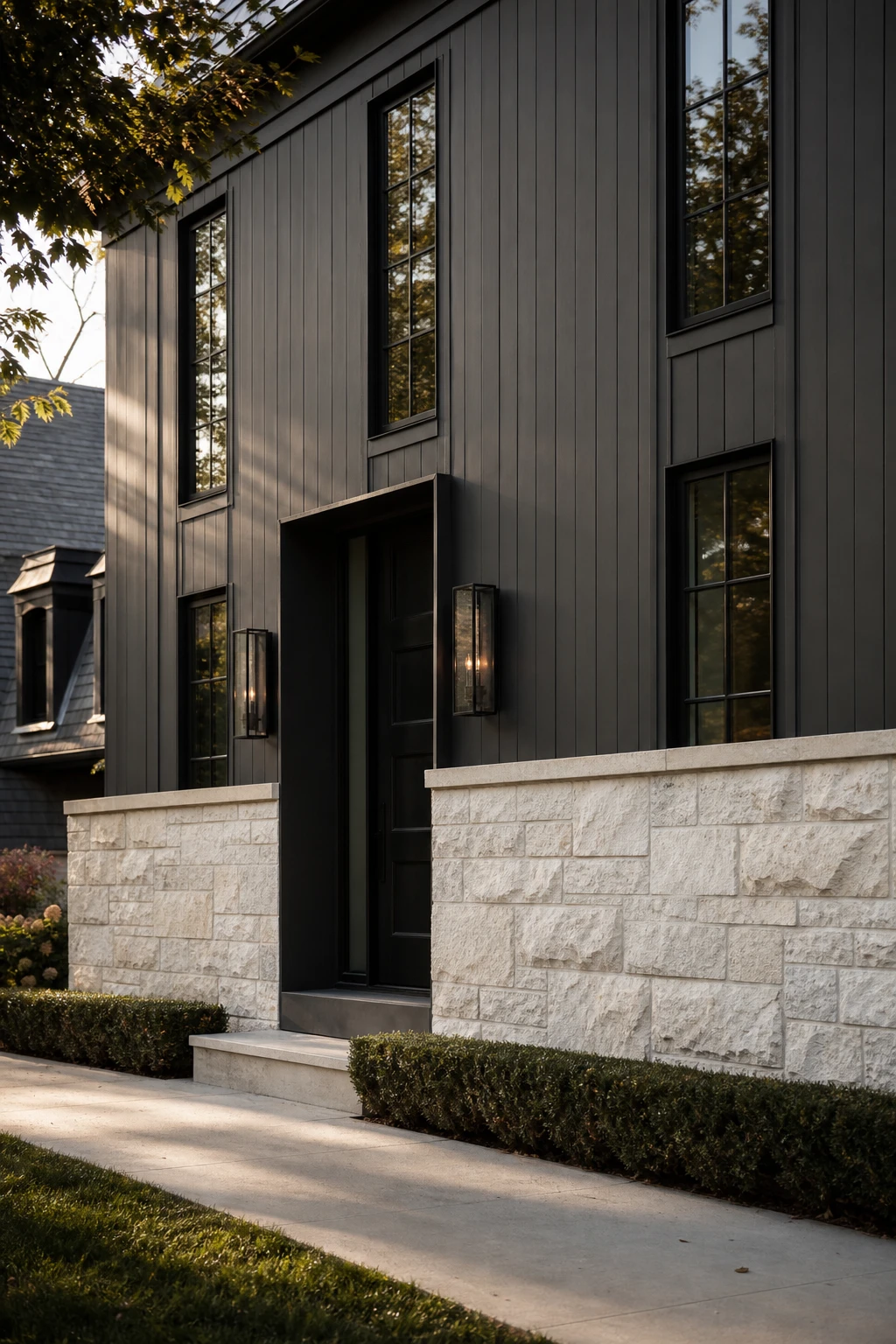
White Stone at the Base of a Black House Grounds It in the Most Elegant Way
Anchoring a dark facade on a pale stone base is one of my favourite moves because it gives the whole house a sense of weight and intention. You get this natural stopping point where the eye settles before travelling up into all that beautiful charcoal. What wins me over every time is how the rough texture of the limestone reads as something grown from the ground rather than bolted on.
The Key Details
Rough hewn limestone foundation course
Charcoal fibre cement board cladding
Slim black casement window frames
Recessed solid front door
Clipped boxwood border planting
Pro TipRun the stone up to window sill height so the band is substantial enough to read as a true foundation rather than a decorative trim.
AvoidA stone band narrower than about 400mm loses its grounding effect entirely and reads as an afterthought rather than a considered design decision.
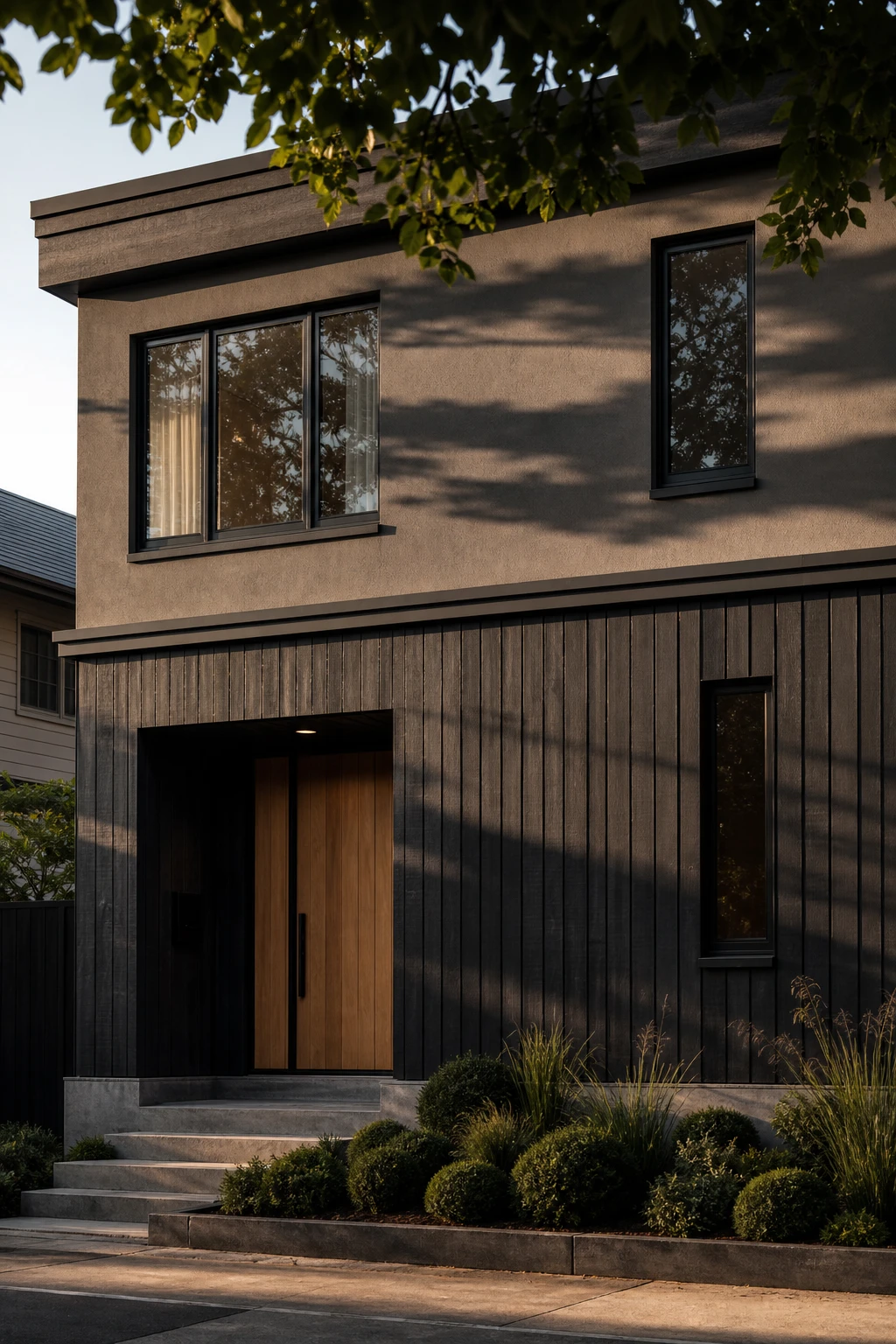
Two Tones on One Dark Exterior and How to Split Them Without It Looking Awkward
Splitting a dark exterior into two tones only lands well when the dividing line has a reason to be there, and that is what wins me over about this approach. The belt course or material change gives the eye a logical resting point, so the upper and lower zones feel deliberate rather than accidental. You get depth and architectural interest without either colour fighting for attention.
The Key Details
Horizontal belt course divider
Board and batten charcoal cladding
Slim black steel window frames
Recessed timber front door
Cast concrete ground plinth
Pro TipLet an existing horizontal feature do the work: a window sill line, a change from render to cladding, or a concrete plinth all give the split a reason that reads immediately from the street.
AvoidSplitting at a height chosen purely by eye, with no material or structural logic behind it, makes the two zones look like a painting mistake rather than a design decision.
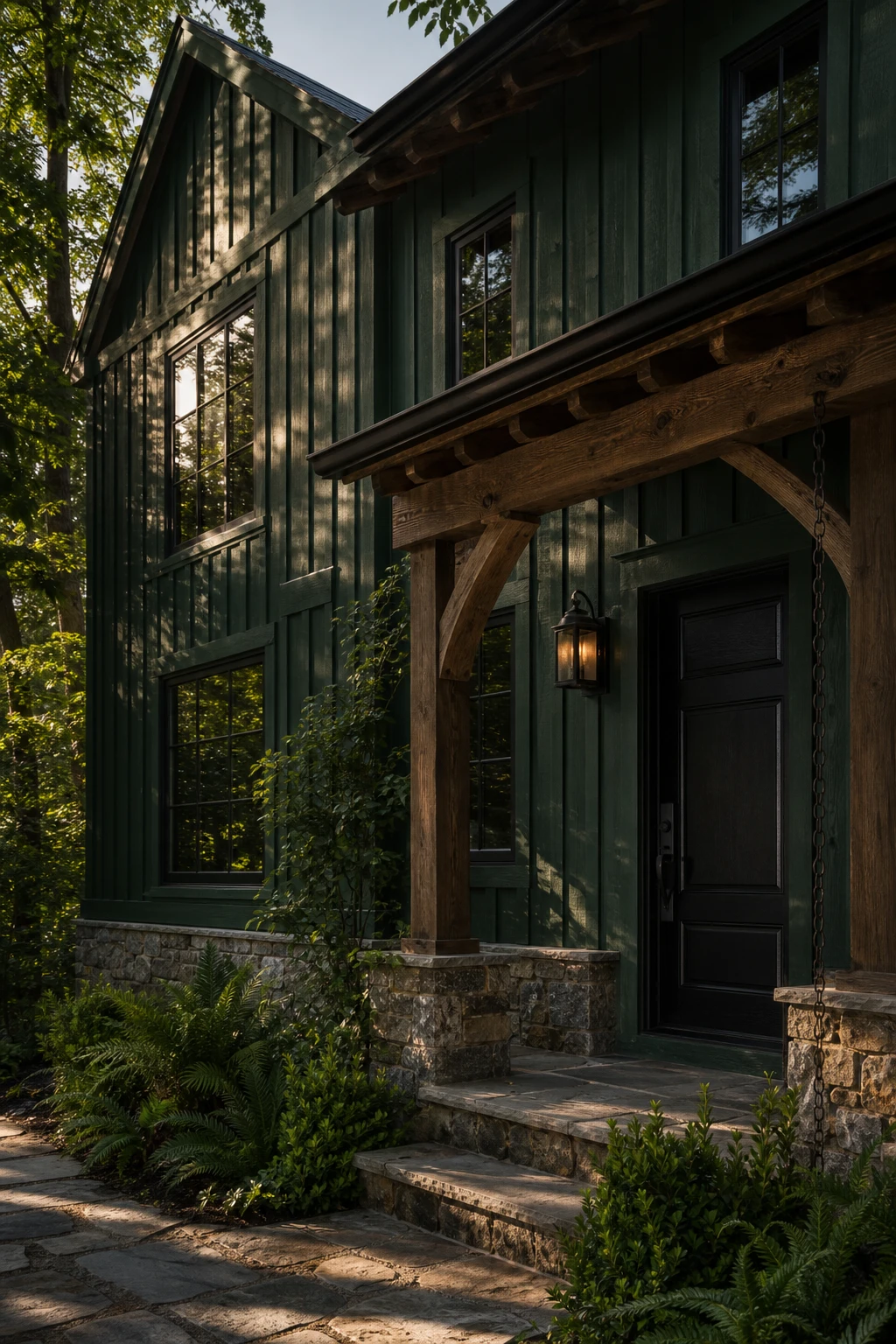
Dark Green Is the Charcoal Adjacent Colour Your Exterior Might Actually Prefer
Deep green siding has a warmth that straight charcoal simply cannot match, and that is what wins me over every time I specify it. You get the drama of a dark exterior but with a living, breathing quality rooted in the landscape around the house. What I love most is how the colour shifts across the day, mossy and soft in morning light, then richer and more saturated come evening.
The Key Details
Board and batten timber siding
Rough hewn stone foundation plinth
Heavy timber porch beams
Matte black panel front door
Dense ornamental fern and hedge plantings
Pro TipHold your shortlisted green sample against the wall at both 8am and 6pm before you order, because the same shade can read entirely differently across those two light conditions.
AvoidChoosing a green so deep it loses all its colour cast means you end up with something that simply reads as black on a cloudy day, and the whole warmth of the choice disappears.
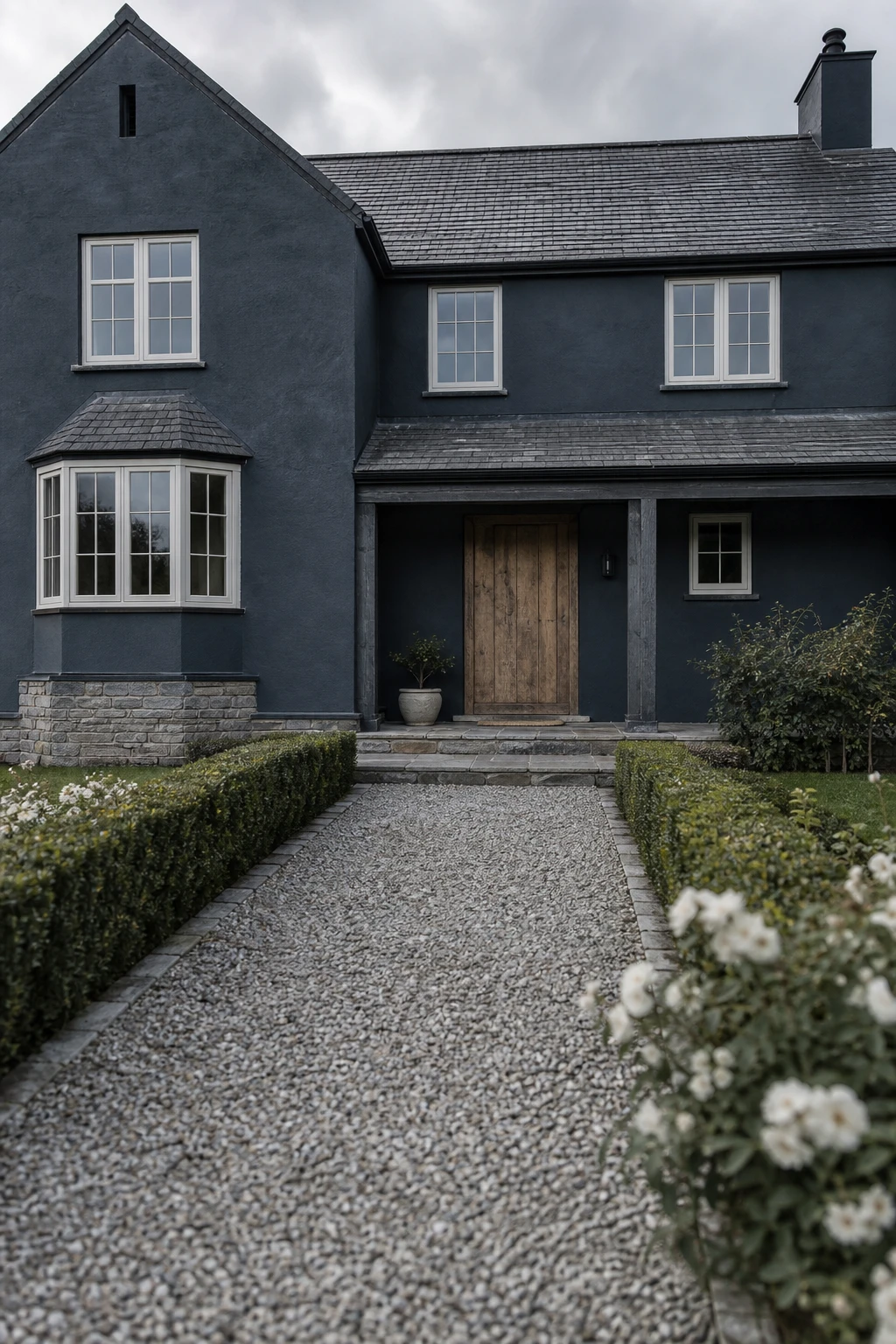
The Blue Grey Exterior That Sits Somewhere Between Stormy and Serene
Blue grey sits in this fascinating middle ground where it reads almost neutral on a bright day and goes full stormy drama under cloud cover. That shift is exactly what wins me over about it as an exterior choice. You get a colour that feels calm rather than cold, and the weathered oak door and slate roof pull out the warmth hiding inside the blue so the whole facade feels considered rather than just dark.
The Key Details
Weathered oak front door
White painted timber window trim
Wide casement windows
Riven slate roof tiles
Gravel pathway with clipped hedging border
Pro TipHold your shortlisted swatch flat against an actual roof tile in natural light before you order a full tin, because the undertones in both will either click together or clash in a way that is impossible to unsee once you spot it.
AvoidTesting the colour only on a sunny afternoon gives you a false read, because that same blue grey can look almost purple under a heavy sky and the gap between the two is wide enough to leave you regretting the whole decision.
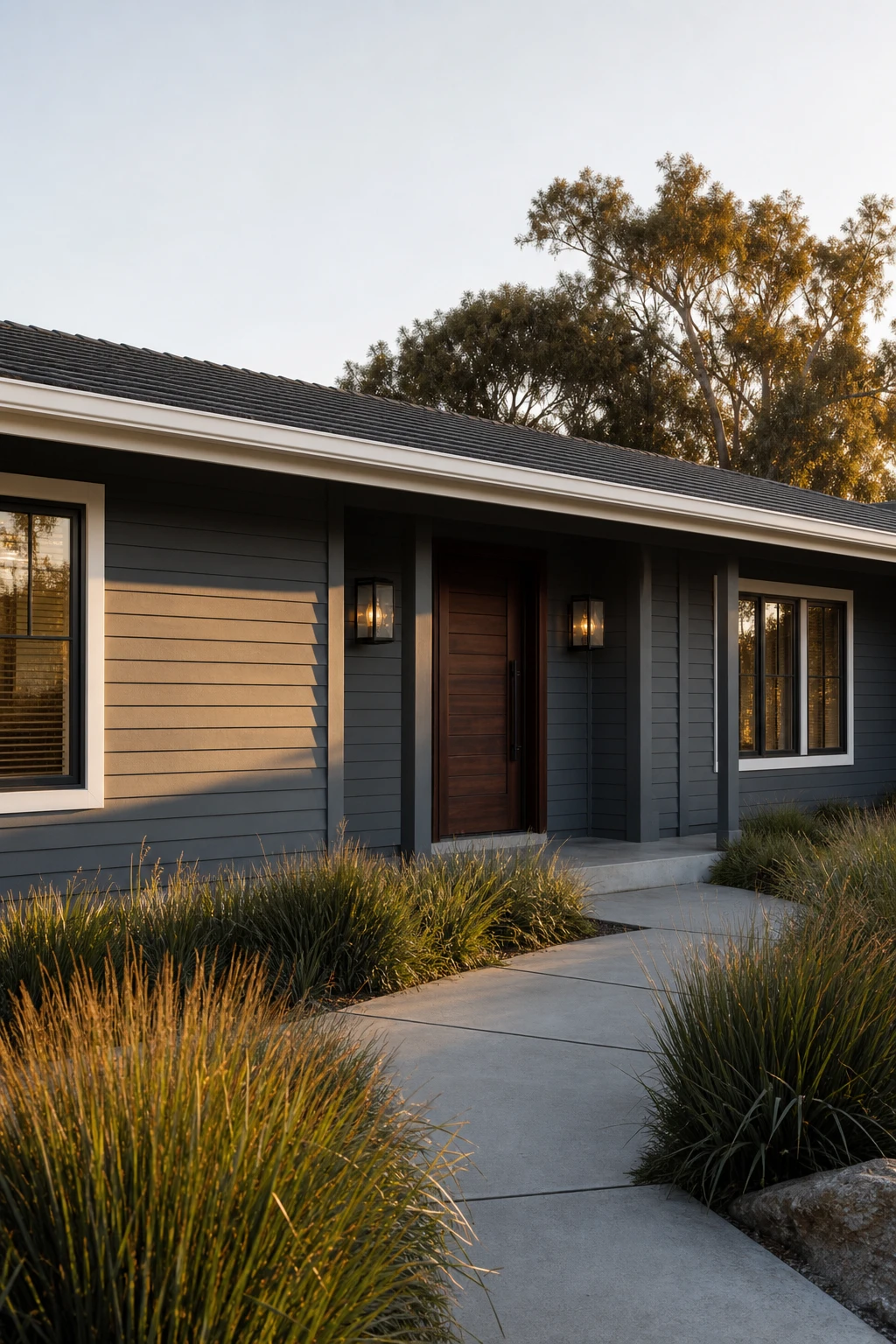
Charcoal Gray Siding on a Ranch House Is the Look That Looks Effortlessly New
Bending a flat ranch profile into something that feels genuinely new with paint alone is one of my favourite moves. Charcoal wraps the long horizontal lines and makes them read as intentional rather than dated, and you get this quiet, grounded confidence the house never had before. Watch how the dark stained door and matte black lanterns pull everything into one continuous palette, with the concrete ribbon and native grasses finishing it softly at ground level.
The Key Details
Horizontal board and batten cedar cladding
Wide overhanging eaves with white fascia trim
Dark stained solid timber front door
Matte black coach lanterns
Concrete ribbon pathway through native grasses
Pro TipRepaint your soffits and gutters in the same charcoal as the siding so they melt into the roofline rather than sitting on top of it like an afterthought.
AvoidLeaving original brass or antique coach lamps in place drags the whole scheme backwards and tells every visitor the dark palette is just a coat of paint over an unchanged house.
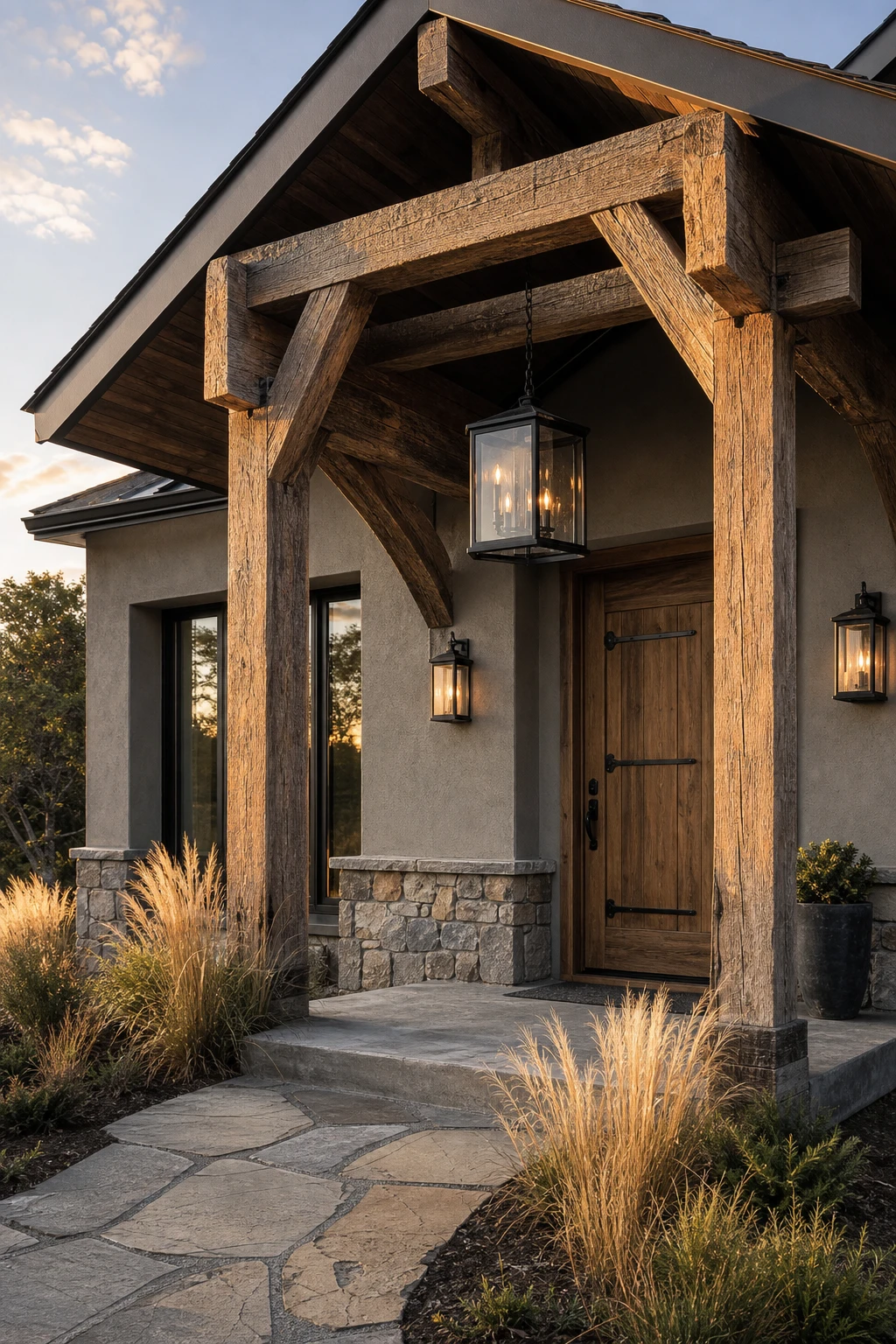
Exposed Wood Beams on a Gray Exterior Add the One Layer of Character It Was Missing
A flat charcoal facade can read as one heavy slab until you introduce something with grain and warmth, and exposed timber beams do exactly that. What I love here is the contrast: the wood pulls your eye across the elevation and gives it a rhythm that paint alone never could. You get depth because the material itself changes with the light, casting soft shadows that make the whole front feel sculpted rather than flat.
The Key Details
Exposed structural timber porch beams
Stone clad base course
Oversized black steel lantern pendant
Wide plank oak front door with iron strap hardware
Flagstone pathway with ornamental grass edging
Pro TipTreat your beams with a clear or lightly tinted exterior oil so the natural grain stays fully visible and does the visual work you put them there to do.
AvoidChoosing a beam stain that sits too close in value to the charcoal wall makes both elements fight to be seen, and the contrast you needed simply disappears.
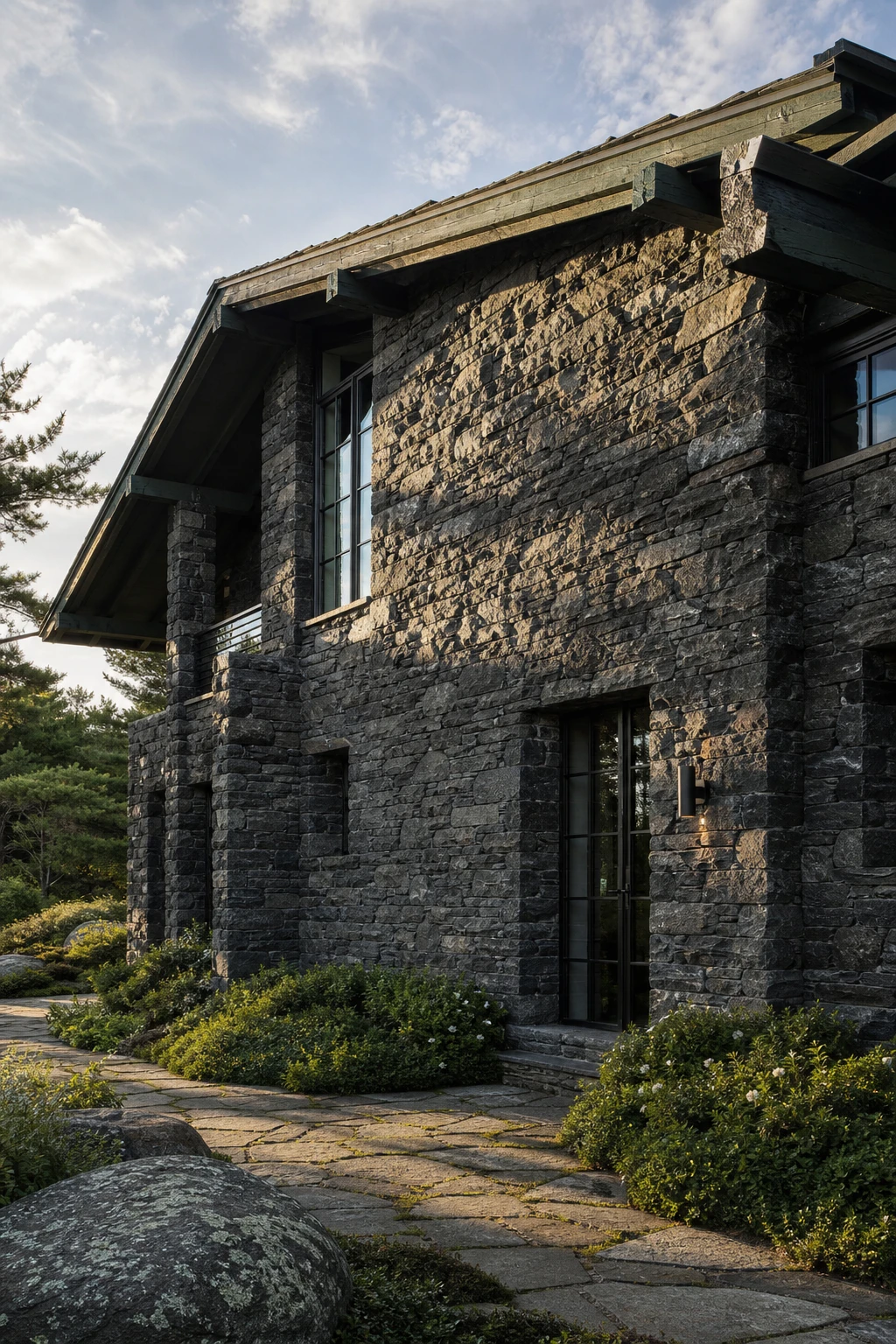
A Full Dark Stone Exterior That Looks Like It Grew Out of the Ground
Stone that reads as grown rather than applied is the thing I keep coming back to with this look. When you cover the full facade in rough hewn fieldstone, the dark tones shift and breathe with the light across the day, and no painted finish can do that. What wins me over here is the permanence: you are not repainting every decade, you are settling a house into its site for good. Watch how the low slate roof and timber fascia pull the whole envelope into one quiet, grounded composition.
The Key Details
Rough hewn fieldstone cladding
Deep set black steel casement windows
Wide overhanging timber fascia boards
Low pitched slate roof tiles
Natural stone paving at base
Pro TipWhen you source your stone, mix at least three different course heights so the eye travels across the wall naturally rather than landing on a repeating pattern.
AvoidOrdering all your stone cut to the same height and length turns a beautiful raw material into something that reads like a 1980s feature wall, and the whole point of fieldstone is lost.
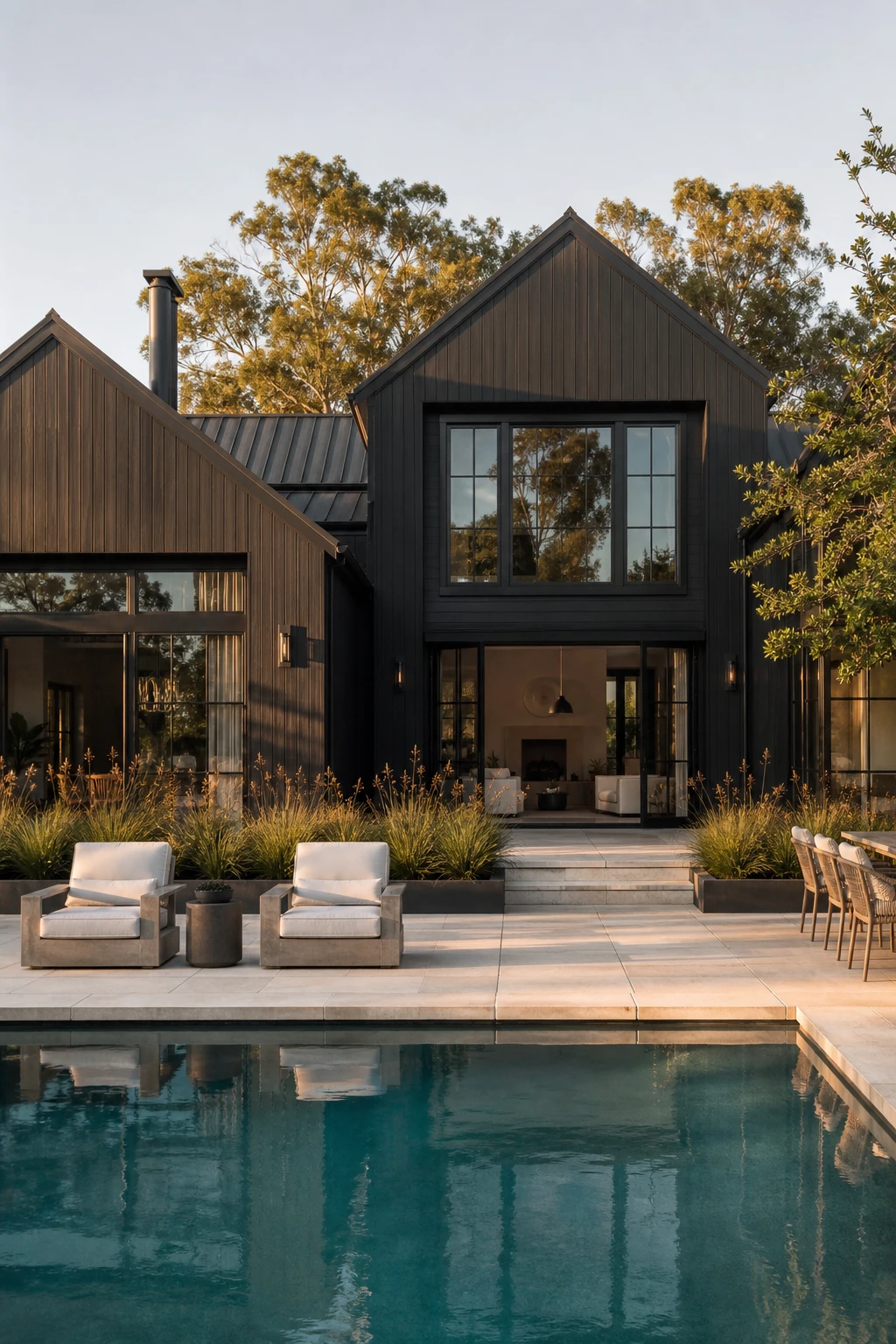
How a Dark Charcoal House Exterior Becomes the Perfect Backdrop for a Pool Patio
Treating the house as scenery rather than just a building is one of my favourite moves around a pool. The dark charcoal facade drops back visually so the water, the pale stone and the loungers all step forward, and you get this quiet drama where the house frames the whole outdoor room without competing with it. What I love is how the rough sawn timber softens the charcoal just enough to keep it from feeling heavy against bright midday light.
The Key Details
Rough sawn timber cladding facade
Large format honed limestone pavers
Concrete sun loungers with linen cushions
Low horizontal planter with ornamental grasses
Flush pool coping in pale stone
Pro TipChoose pool coping in the same pale stone as your pavers and carry a dark charcoal edge band between the two so the house colour echoes right to the water line.
AvoidPlanting tall shrubs along the pool fence without first standing at the water’s edge to check what they will block, because losing sight of that dark facade from the pool destroys the whole framed backdrop effect.
A Long Walkway to the Front Door Turns a Dark Exterior Into a Proper Arrival
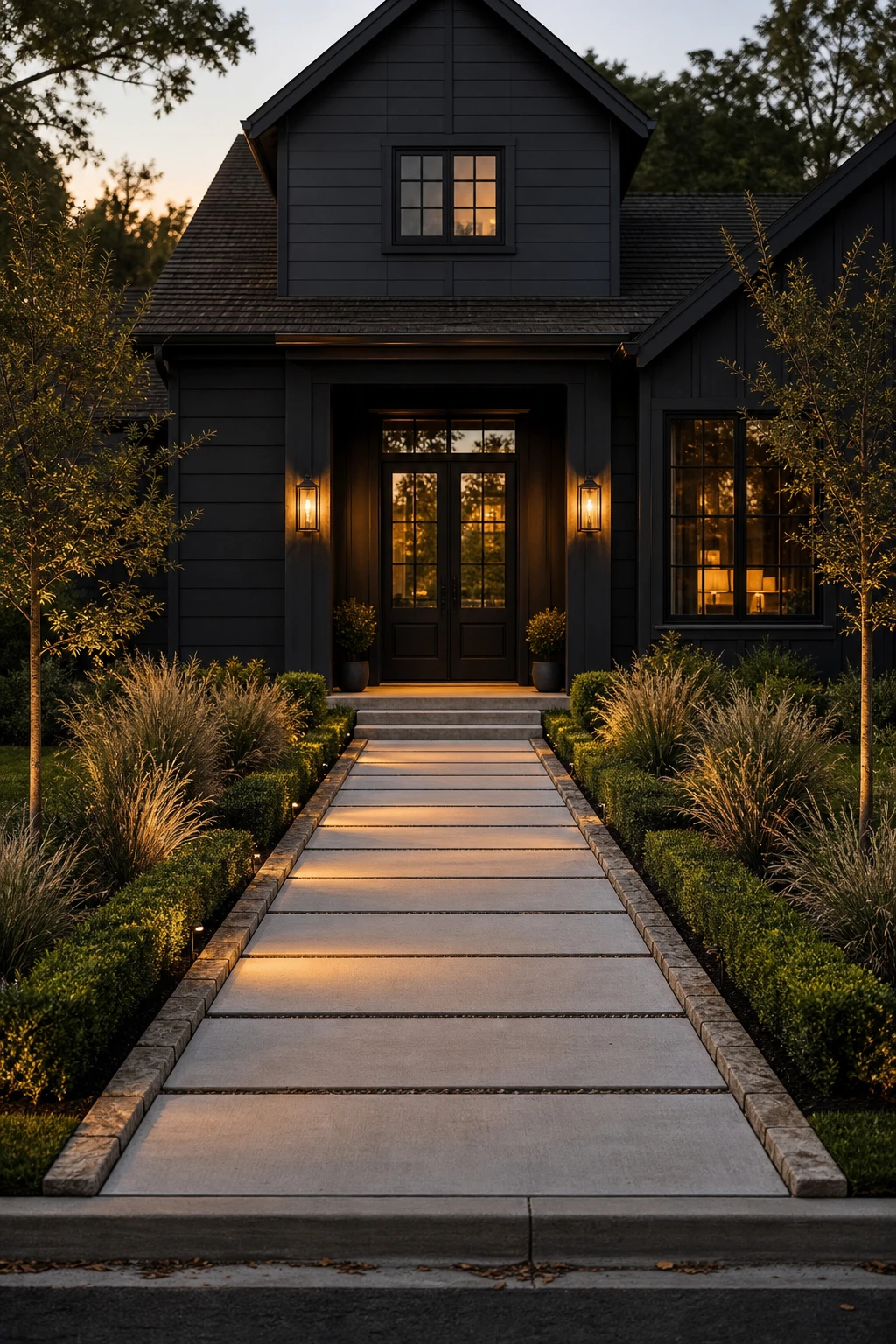
A long walkway does something a short one simply cannot: it makes you feel the house before you reach it. What I love here is the slow reveal, the way each step builds a quiet sense of occasion so by the time you arrive at the door, it already feels like somewhere worth entering. Against a dark charcoal exterior, a wide paved path reads as a calm, confident line that pulls the eye straight to the entrance. You get that rare sense of ceremony without anything feeling overdone.
The Key Details
Wide format concrete pavers
Oversized black steel wall lanterns
Low clipped boxwood hedges
Board and batten timber siding
Ornamental grasses flanking path
Pro TipMatch your paver tone as closely as possible to the foundation stone so the path reads as an extension of the house rather than something laid in front of it.
AvoidA walkway under about 900mm wide shrinks the whole arrival and turns what should feel like an entrance into a side passage.
Landscape Lighting Is What Makes a Dark Charcoal Exterior Look Magical After Dark
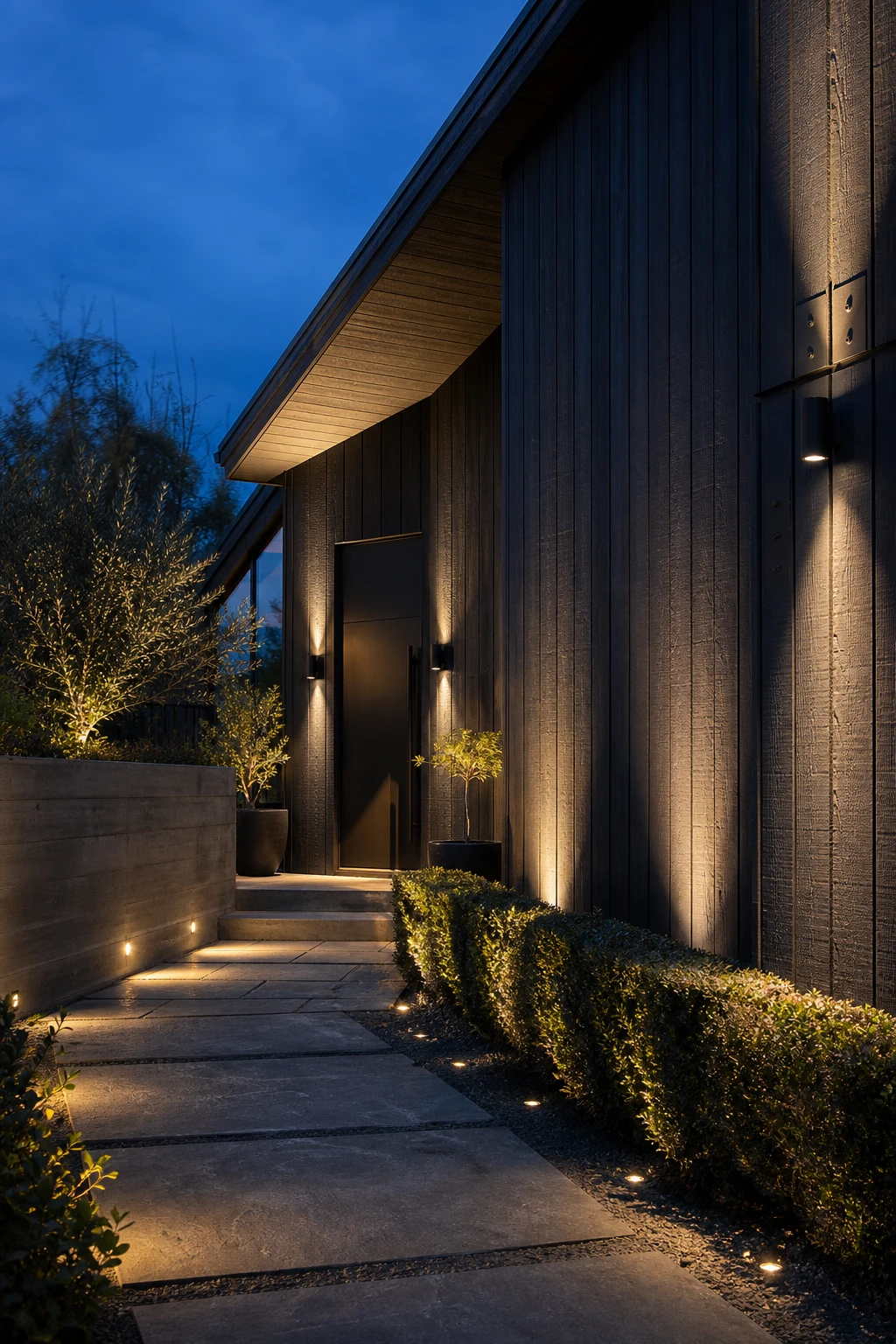
Landscape lighting on a dark charcoal exterior is one of those details that completely changes how a house reads at night. What I love is the way a grazing uplight, aimed close to the wall face, pulls every grain and shadow out of rough sawn cladding so the texture almost breathes. You get depth and drama that flat overhead light could never give you, and the house stops looking like a dark box and starts looking deliberate.
The Key Details
Recessed low voltage path lights
Architectural wall sconces
Solid pivot front door
Rough sawn vertical timber cladding
Bluestone stepping stone path
Pro TipPosition uplights no more than 30 cm from the wall face so the beam skims the surface at a low angle and every texture ridge casts its own small shadow.
AvoidFlooding the facade with a single bright floodlight washes out all the tonal richness of charcoal and leaves you with a flat, grey wall that looks closer to unpainted concrete than a considered design choice.
Dark Charcoal on a Craftsman House Lets Every Architectural Detail Do Its Job
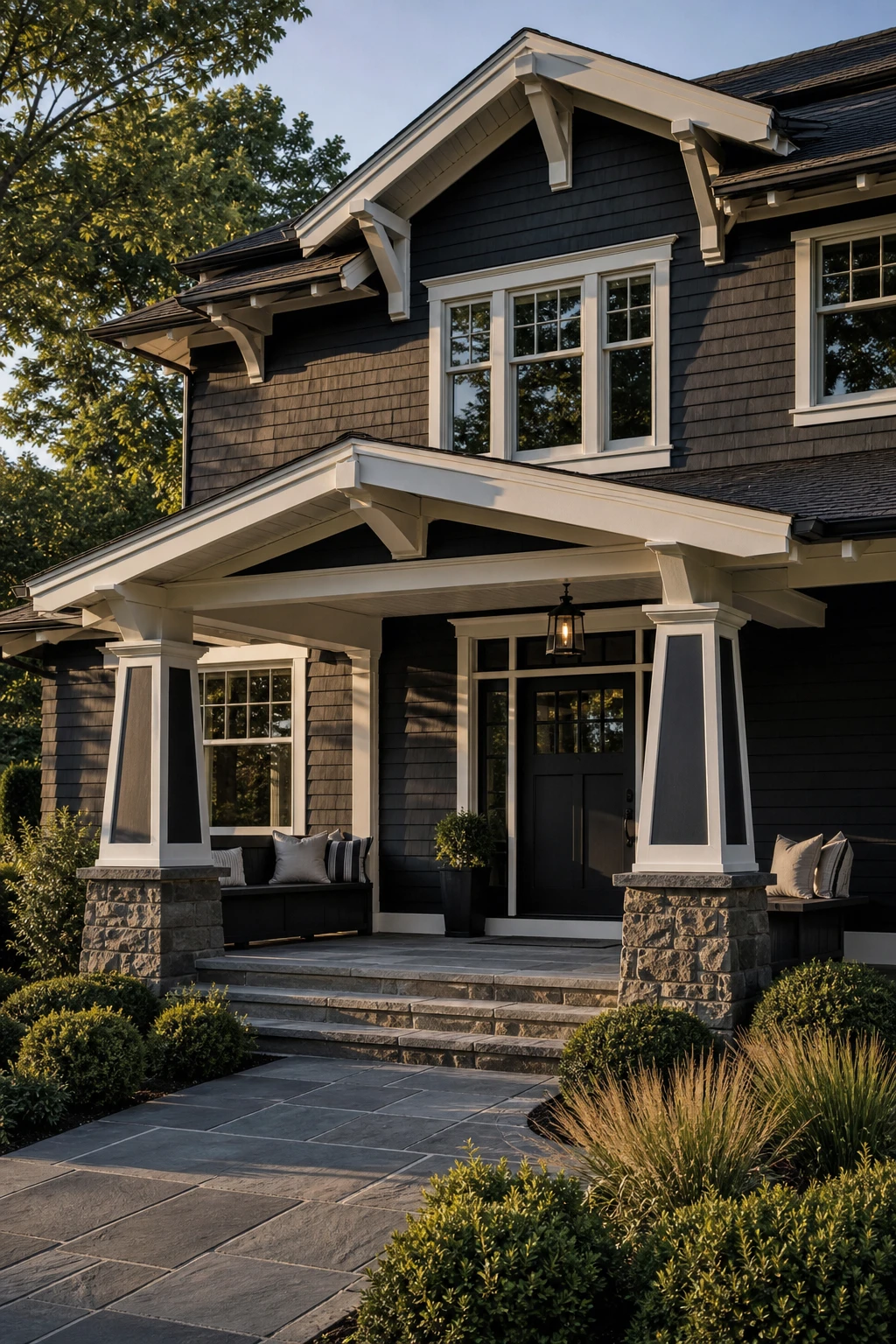
Craftsman houses were built to show off their bones, and deep charcoal is the best thing I can put on them to make that happen. Watch how the dark field pulls every tapered column, bracket and rafter tail forward so your eye reads the whole composition at once. You get a house that feels proud of its craft rather than just painted over it, and that is the whole point of the style.
The Key Details
Tapered cedar porch columns on stone bases
Exposed rafter tails under wide roof overhang
Decorative timber knee brackets
Recessed panelled front door
Bluestone porch pavers with built in bench seating
Pro TipPaint your exposed rafter tails and timber knee brackets the exact same dark tone as the siding so the roofline reads as one bold, continuous shadow rather than a series of disconnected pieces.
AvoidTrim that goes too light turns into a competing pattern across the facade, breaking up the very details the Craftsman style was designed to celebrate as a unified whole.
A Dark Charcoal Cottage Exterior That Swaps Cute for Something Much More Captivating
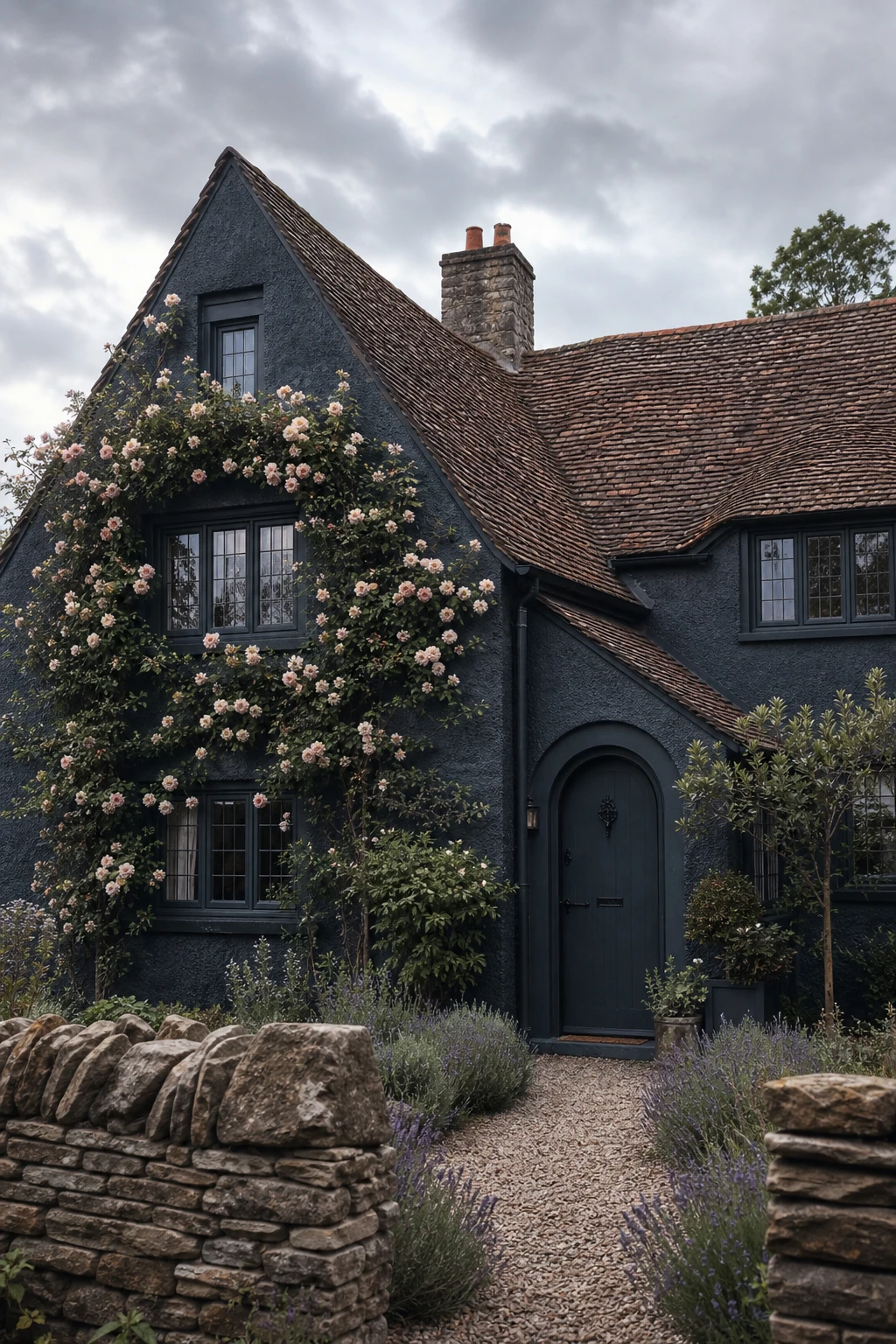
Cottage forms are already full of personality, all those curves and small panes and uneven rooflines, and what I love is how a deep charcoal plays against that softness rather than fighting it. You get something that feels genuinely captivating instead of just pretty. The climbing rose on the gable and the leaded windows hold all the charm in place, so the dark reads as romance rather than severity.
The Key Details
Arched front door surround
Leaded casement windows
Climbing rose on gable
Dry stone boundary wall
Handmade clay roof tiles
Pro TipKeep at least one window box filled with trailing greenery or soft blooms so the charcoal has something living to lean against.
AvoidStripping back every plant and leaving bare dark walls turns a cottage into something that reads cold and uninviting, losing the very quality that made the form worth painting in the first place.
Charcoal Siding With Black Trim Is the Tonal Pairing That Always Looks Intentional
Charcoal and black sitting side by side sounds like it could go flat, but the sheen difference is what saves it and gives the facade real depth. What I love about this pairing is that the eye reads it as one cohesive dark scheme while still picking up the quiet contrast between body and trim. You get all the drama of a monochromatic exterior without it looking like one unbroken shadow.
The Key Details
Board and batten charcoal siding
Matte black metal gabled roof
Natural stone plinth foundation
Recessed timber front door
Black casement windows with deep reveals
Pro TipPaint your trim in semi gloss black and your siding in flat charcoal so the two tones stay distinct in any light without needing a single colour change.
AvoidUsing the same finish on both the body and the trim flattens the whole scheme into one dull wash and loses every bit of layering you were building toward.
Alan launched Edward George London in 2017. Since completing his masters in Town & Regional Planning (MPlan) he has combined the skills he learned at the University of Sheffield with his passion for design, to help create a foundation for those looking to create a beautiful home.