I’ve always thought a dark lake house exterior does something no bright white facade can quite manage: it settles into the landscape like it grew there. What I love about these looks is how much variety lives inside that one dark idea, from black siding paired with raw cedar, to deep green walls under a copper roof, to soaring glass fronts framed in near black trim. Every approach here is something you can actually use on a real house, wherever your waterfront happens to be.
Why an All Black Exterior Feels So at Home on the Water
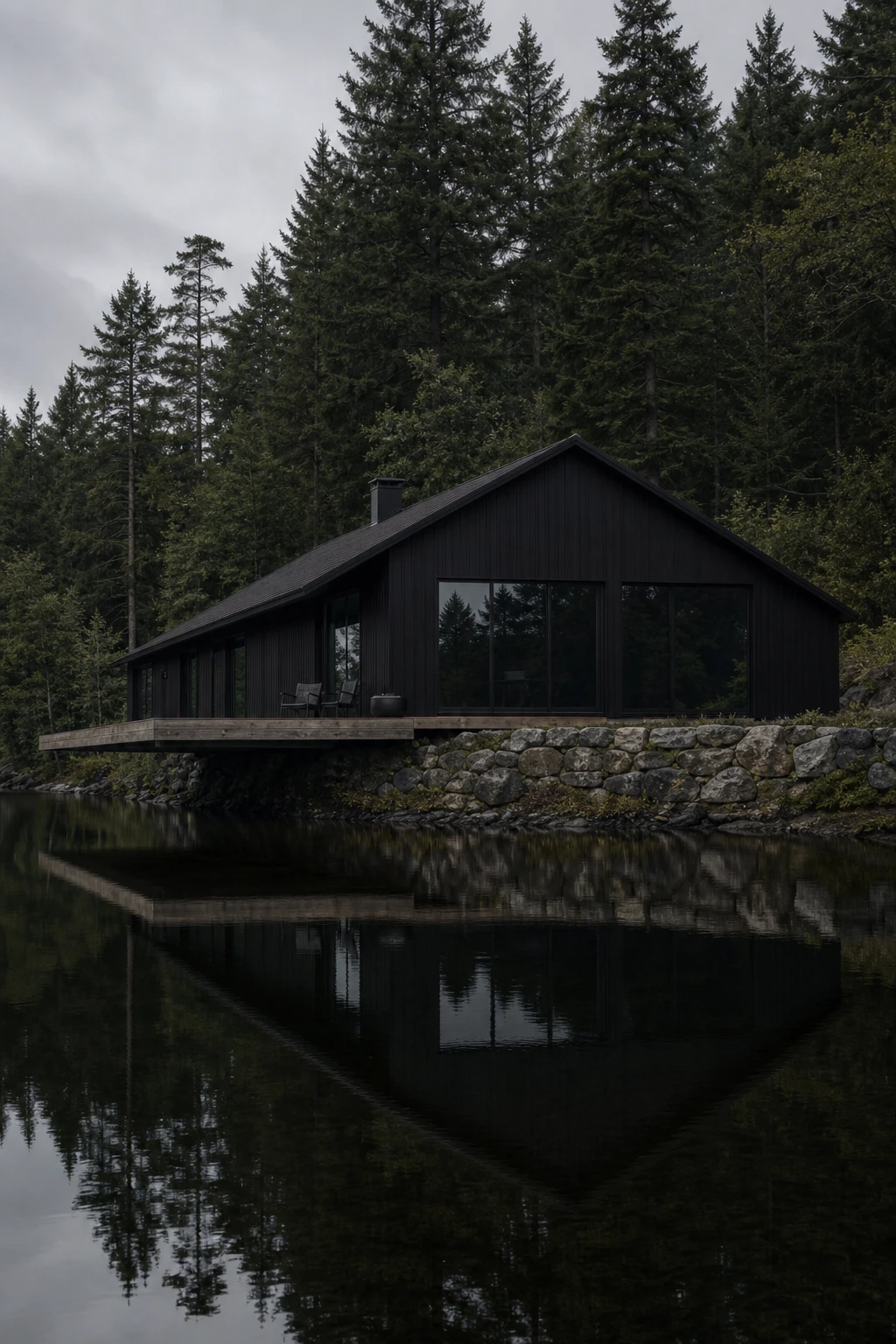
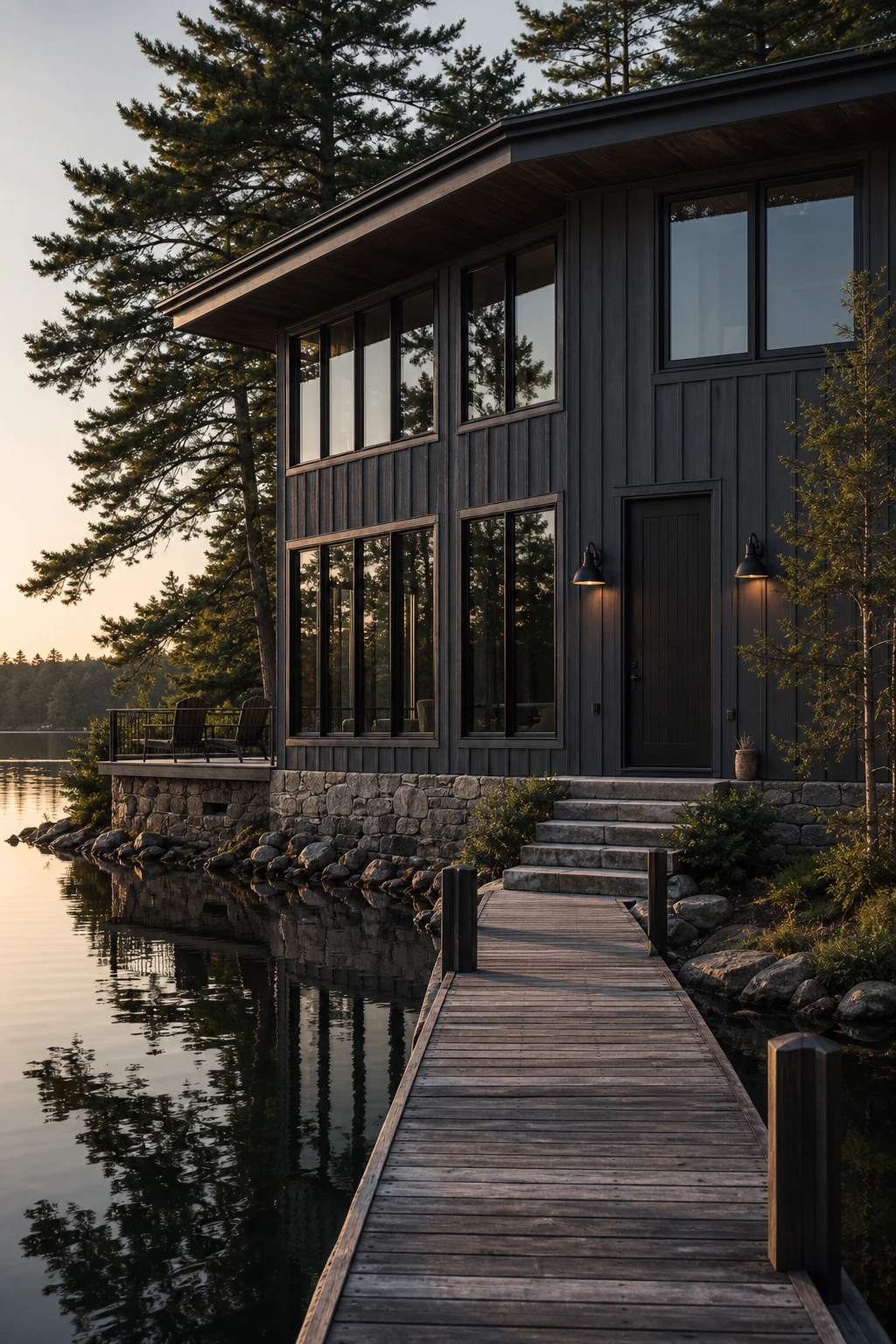
Painting a lake house fully black is one of my favourite moves because the house stops competing with the treeline and simply disappears into it. You get this quiet drama where the water and the pines do all the talking and the building becomes a dark, confident frame. What wins me over every time is how black absorbs the shifting lakeside light rather than bouncing it back, so the house looks different at dawn, midday and dusk without you changing a thing.
The Key Details
Vertical board and batten cedar siding
Cantilevered steel post deck over water
Floor to ceiling glass wall panels
Weathered timber dock
Mossy granite boulder landscaping
Pro TipChoose a flat or low sheen satin finish for black siding so the surface drinks in natural light and holds that soft, receding quality against the water.
Avoid a high gloss black finish outdoors because it picks up every reflection and makes the house read as industrial rather than rooted in its landscape.
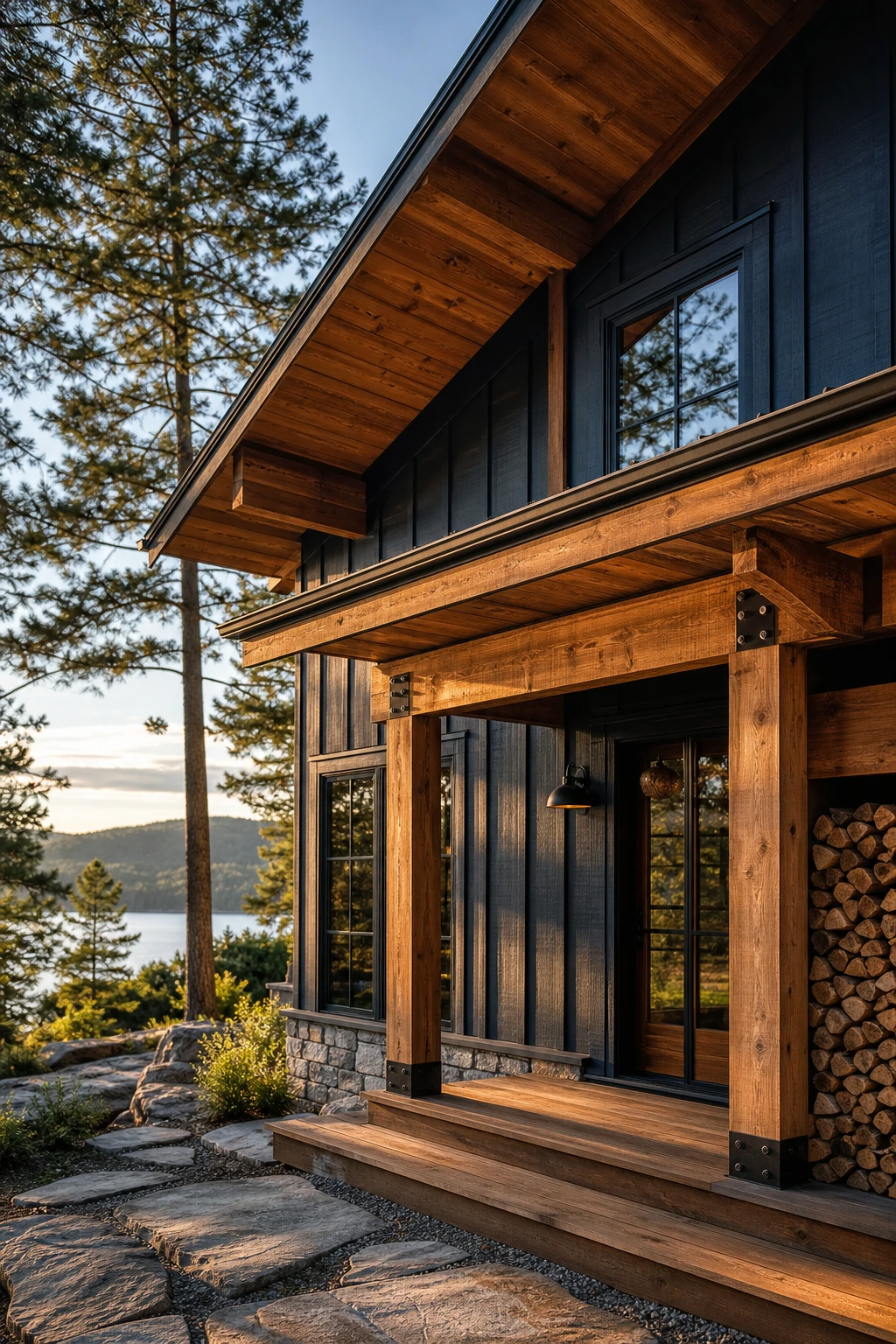
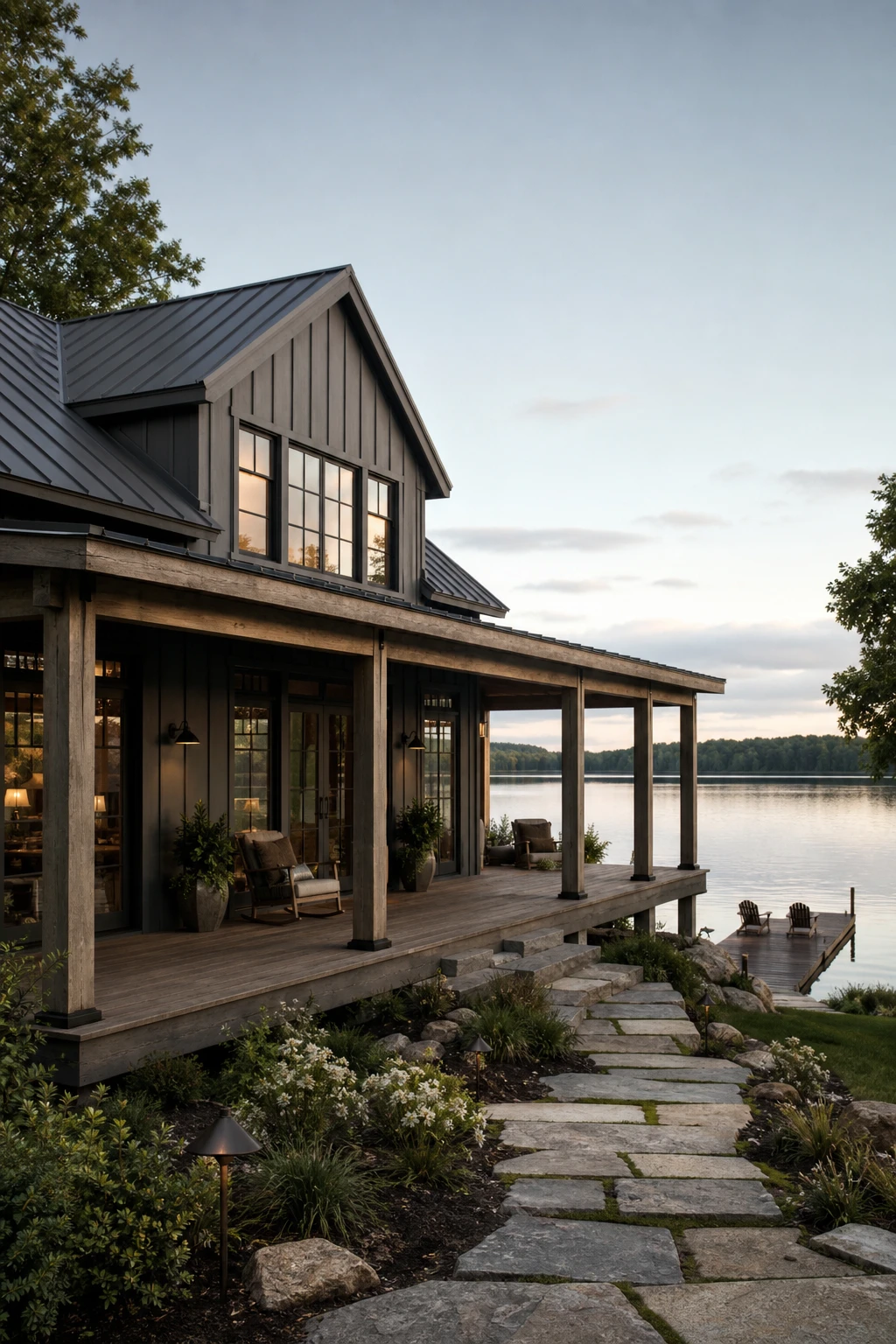
How Dark Grey Gives a Lake House That Quiet, Weathered Look
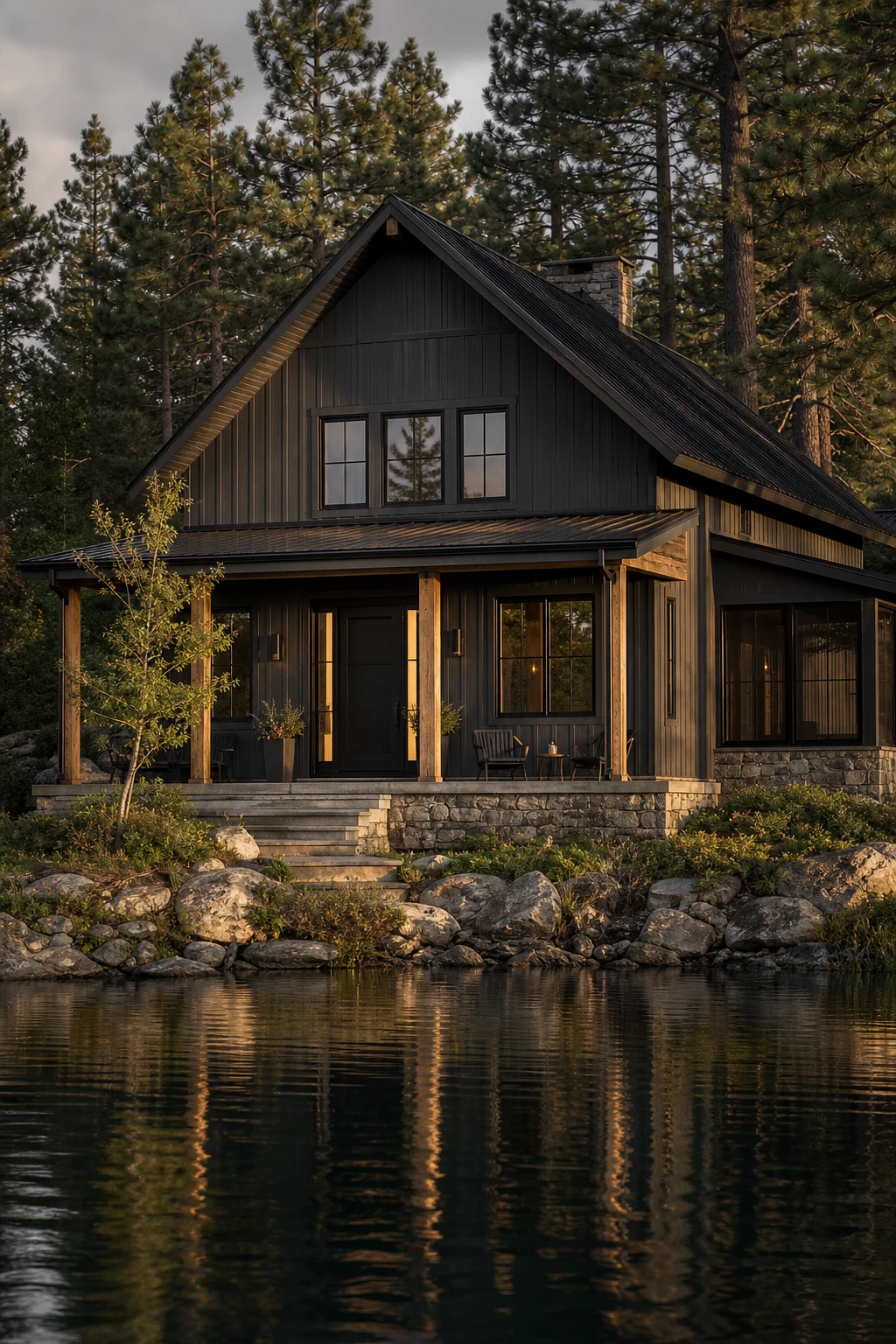
Dark grey is the move I reach for when a client wants drama without committing to full black. Against water, you get that quiet, weathered quality, like the house has always been there. The tone pulls warmth from raw timber and stone rather than fighting them, and the whole facade settles into the landscape instead of shouting at it.
The Key Details
Board and batten timber siding
Dry stacked stone foundation
Raw timber porch columns
Black steel front door with sidelights
Wide gabled overhangs
Pro TipPair your dark grey siding with a dry stacked stone foundation in a similar cool tone and the two materials create a layered depth that reads as one considered palette rather than two separate choices.
Avoid any grey with a blue or purple undertone, because lakeside light, especially on overcast days, will pull those cool hints right to the surface and your house will read violet rather than the moody charcoal you intended.
Dark Green Siding That Melts Right Into the Treeline
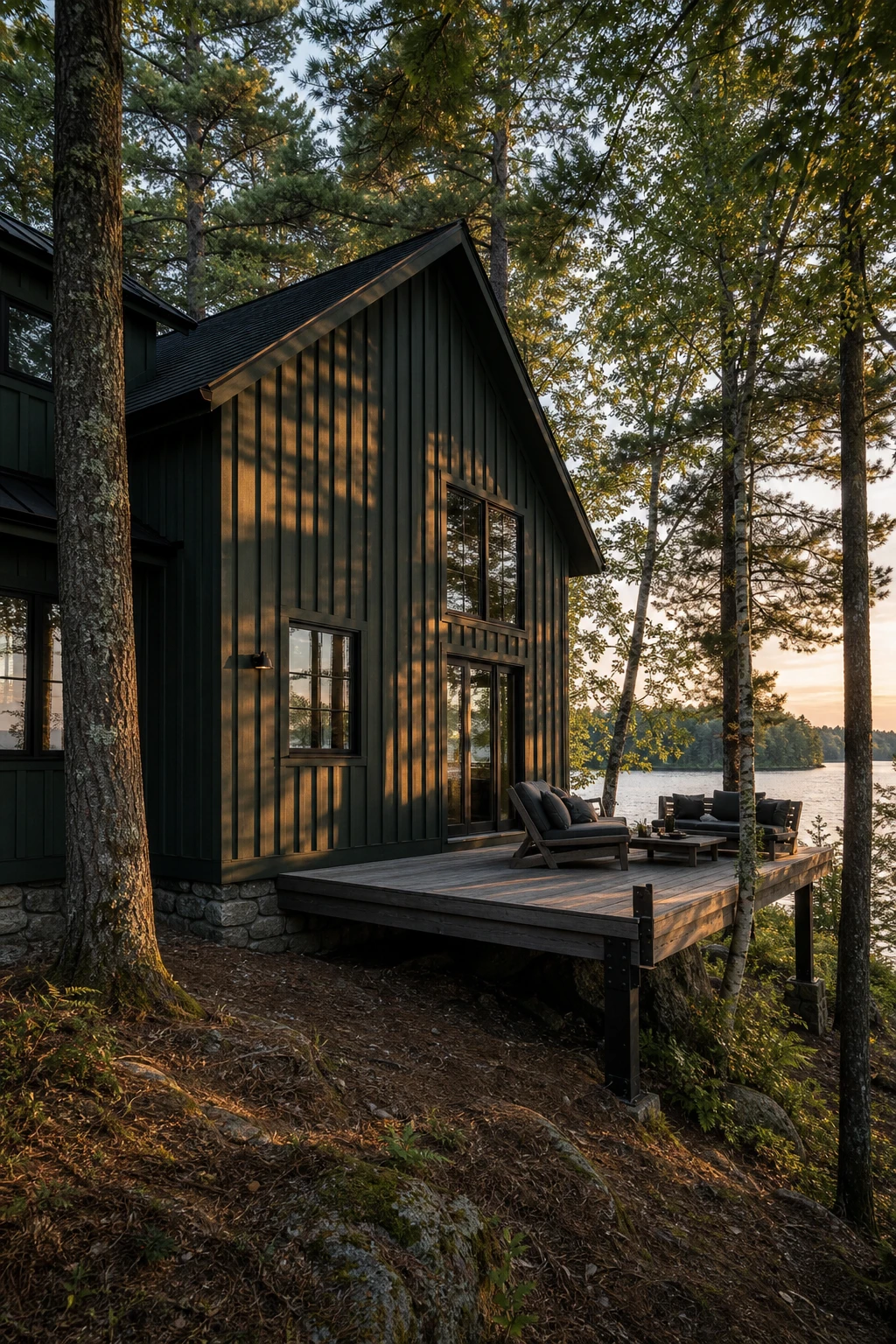
Dark green siding earns its place on a lake house when you pull the shade straight from the treeline rather than guessing at it, because then the building stops competing with the landscape and starts belonging to it. Board and batten pulls that shadowy forest tone flat across the facade, and a dry stacked fieldstone plinth grounds it further into the earth. What I love here is how the whole structure genuinely disappears into the pines and birches behind it, making the site feel quieter and more intentional than almost any other colour choice could.
The Key Details
Board and batten vertical siding
Dry stacked fieldstone foundation plinth
Black powder coated casement windows
Cedar plank deck with steel post brackets
Mature pine and birch treeline backdrop
Pro TipPaint the siding one shade deeper than your trim so the vertical battens catch the light and give the facade real depth without adding any extra detail.
Avoid any green with a blue or teal lean, because it will read as artificial against the warm yellow greens of living foliage and the whole camouflage effect falls apart.
Dark Blue Siding With Warm Wood Accents That Feels Effortlessly Cozy
Dark blue and warm wood do opposite jobs on a lake house facade, and that is precisely why the pairing works so well. The blue reads grounded and calm while the wood pulls just enough warmth into the elevation to stop it feeling severe. My favourite thing about this combination is how the wood tones shift through the day: golden at midday, almost amber at dusk, so you get a living exterior that never looks flat or corporate no matter what the light is doing.
The Key Details
Board and batten siding
Timber porch columns
Cedar plank soffit
Stacked stone base course
Oiled hardwood deck boards
Pro TipReach for a honey or amber toned cedar rather than a pale or grey washed wood, because that golden undertone is what neutralises the cool side of the blue and keeps the whole facade feeling warm.
Avoid wrapping wood across too many surfaces at once, because once the accent starts covering columns, soffits, fascia boards and a full deck simultaneously, it stops softening the blue and the two materials end up competing for attention.
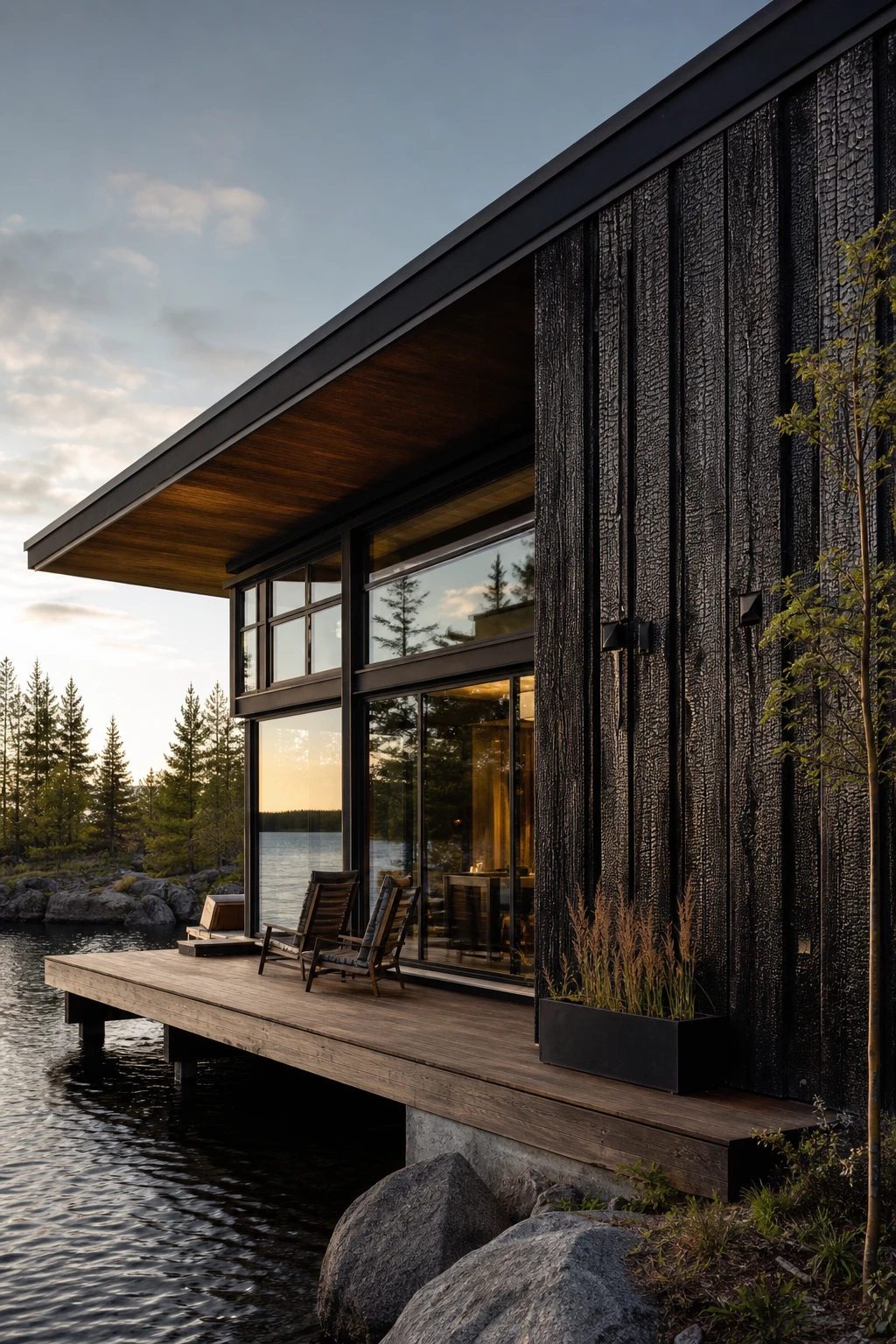
The Ancient Japanese Trick That Makes Charred Wood the Most Beautiful Siding Around
Charred wood does two things at once, and that efficiency is what wins me over every time. The burning closes the grain so the timber resists rot and insects for decades, and you get this deeply textured, almost velvet black surface that catches light beautifully at the water’s edge. Watch how vertical boards pull the eye upward and make the whole facade feel taller and more deliberate. Ancient Japanese craft, doing very serious modern work on a lake house.
The Key Details
Vertical charred cedar boards
Cantilevered timber deck over water
Floor to ceiling glass panels
Wide flat roof with deep eaves
Raw steel fixing details
Pro TipBuy pre charred and factory oiled boards from a specialist supplier rather than burning raw cedar yourself, because an even char depth and a proper oil finish applied before installation is very hard to match on site.
AvoidNever fix charred cladding and leave it bare, because rainwater will lift soot from any unsealed surface and streak pale stains down the boards within the first wet season.
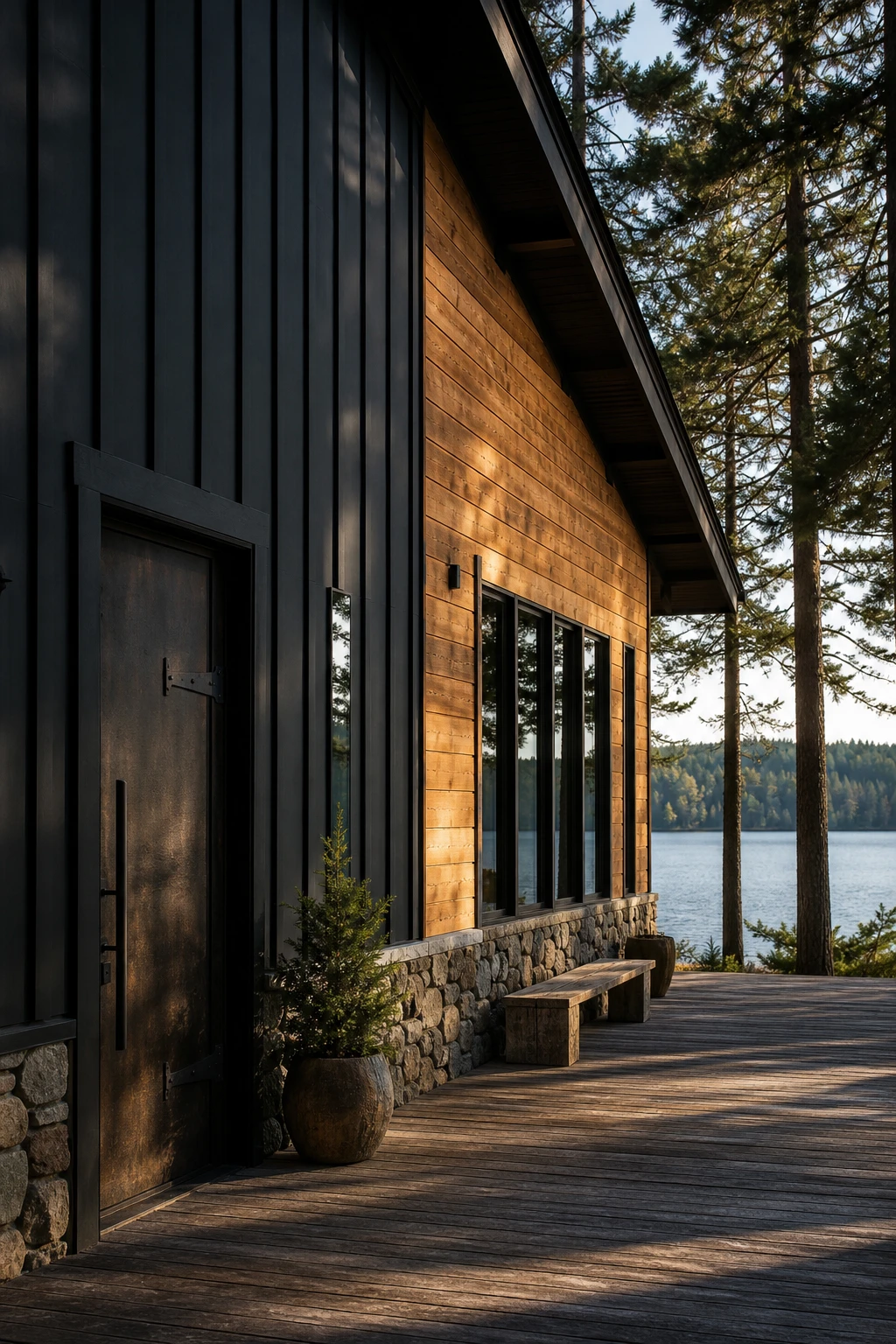
The Black and Cedar Combo That Makes a Cabin Look Like It Was Always There
Black and cedar is one of my favourite pairings on a lakeside cabin because the two materials tell completely different stories and that tension is exactly what makes the facade feel alive. The black reads as deliberate, sharp, human made, while the cedar brings warmth and grain that looks like it grew there. What I love is how your eye moves between the two, never settling, which gives a modest cabin real presence on the water without any fuss.
The Key Details
Raw cedar plank cladding
Board and batten siding
Slim black framed picture windows
Fieldstone foundation course
Wide timber deck with overhanging roofline
Pro TipLet black dominate at roughly seventy percent of the facade and cluster the cedar in one clear zone, such as a gable end or a single accent wall, so the contrast reads as a decision rather than an accident.
AvoidSplitting the two materials evenly across the facade leaves neither one in charge, and the whole design ends up feeling uncertain rather than confident.
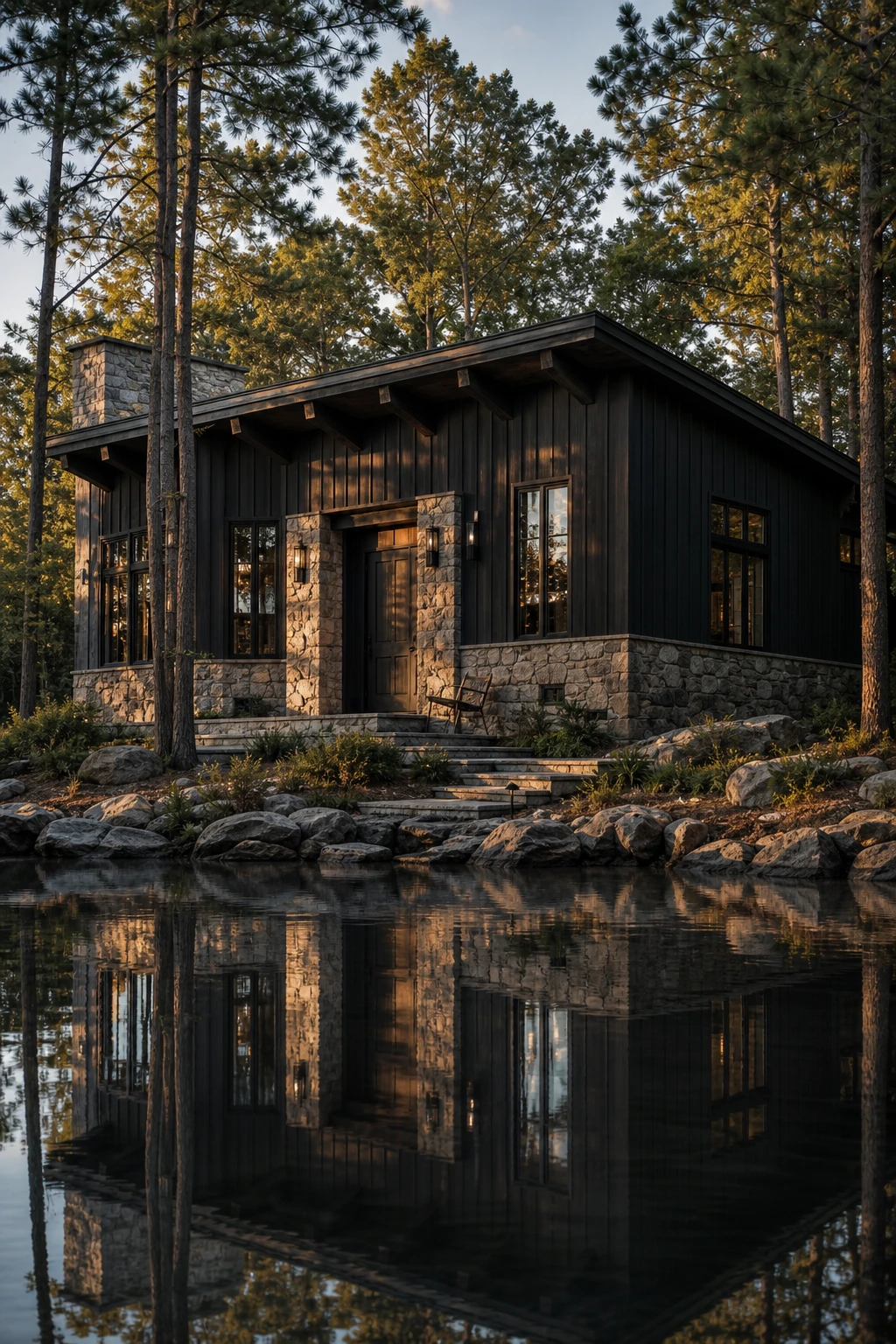
How to Mix Dark Siding With Stone So a Lake House Looks Rooted in the Ground
Pairing dark siding with stone at the base is one of my favourite moves on a lake house because the stone anchors the whole building to the ground, so it reads as grown from the site rather than dropped onto it. What I love is the textural contrast: rough fieldstone against flat vertical board and batten creates that push and pull your eye needs to stay interested. You will notice the stone surround around the entry pulls double duty, framing the door and softening the darkness so the facade feels welcoming rather than forbidding.
The Key Details
Rough hewn fieldstone foundation and entry surround
Vertical cedar board and batten cladding
Exposed timber rafter tails under broad roof overhang
Deep set casement windows with slim black frames
Solid plank entry door centered on stone surround
Pro TipPick up a chip of your siding colour and hold it against several stone samples in full daylight, because a siding with cool grey undertones will clash quietly but badly against a warm buff or honey stone.
Avoid any stone veneer with repeating, perfectly matched pieces, because the moment the pattern becomes predictable the organic quality disappears and the whole base reads as a printed tile rather than real rock.
Full Tonal Black: When the Roof Matches the Walls and It All Just Works
Letting the roof and walls share the same dark tone is one of my favourite moves on a lake house because the whole building stops being a collection of parts and becomes one clean sculptural shape against the water. You lose the visual chop of contrasting trim lines and what you gain is weight and presence. The thing I always check is texture: vertical board and batten against a matte standing seam roof gives you just enough surface variety to keep the eye moving without breaking the spell.
The Key Details
Vertical board and batten cladding
Cantilevered weathered timber deck
Flush fixed glazing panels
Low fieldstone retaining wall
Matte steel window framing
Pro TipPair a flat finish cladding with a ribbed or corrugated roof panel so the two black surfaces catch light differently and the facade stays alive through the day.
AvoidSkipping a natural material accent like fieldstone, raw timber, or a gravel bed at the base leaves the all black silhouette looking more industrial yard than considered lake house.
Why a Standing Seam Metal Roof Is the Best Finish a Lake House Can Get
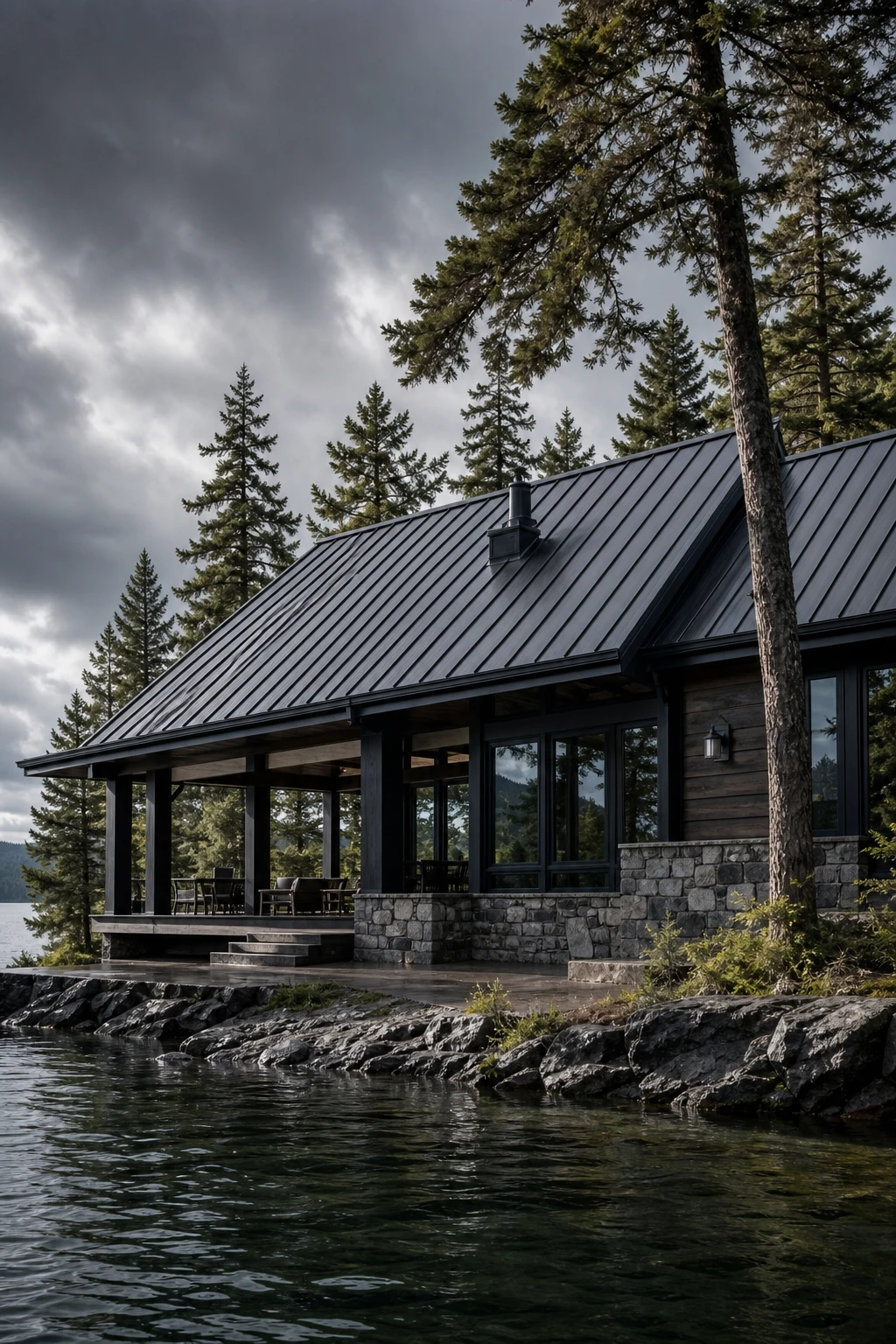
A standing seam metal roof earns its place on a lake house in ways most other materials simply cannot match. The surface sheds rain, snowfall, and fallen leaves without holding onto any of it, and the vertical seam lines draw the eye up and give the whole roofline a clean, purposeful authority. What I love most is how charcoal steel sits against dark timber cladding: the two tones are close enough to feel unified, but the metal adds just enough cool contrast to stop the exterior from going flat.
The Key Details
Vertical seam charcoal steel roof panels
Broad overhanging timber eaves
Rough hewn stone foundation
Dark stained horizontal timber cladding
Covered lakeside deck with heavy wooden posts
Pro TipChoose a roof colour that reads one or two shades cooler than your siding so the two materials feel like a considered pair rather than an accidental match.
AvoidNever skip an acoustic underlayment beneath metal roofing on a lake house, because without it a heavy downpour turns the whole interior into a drum.
The Exterior Colour That Makes a Copper Roof Look Like Pure Magic
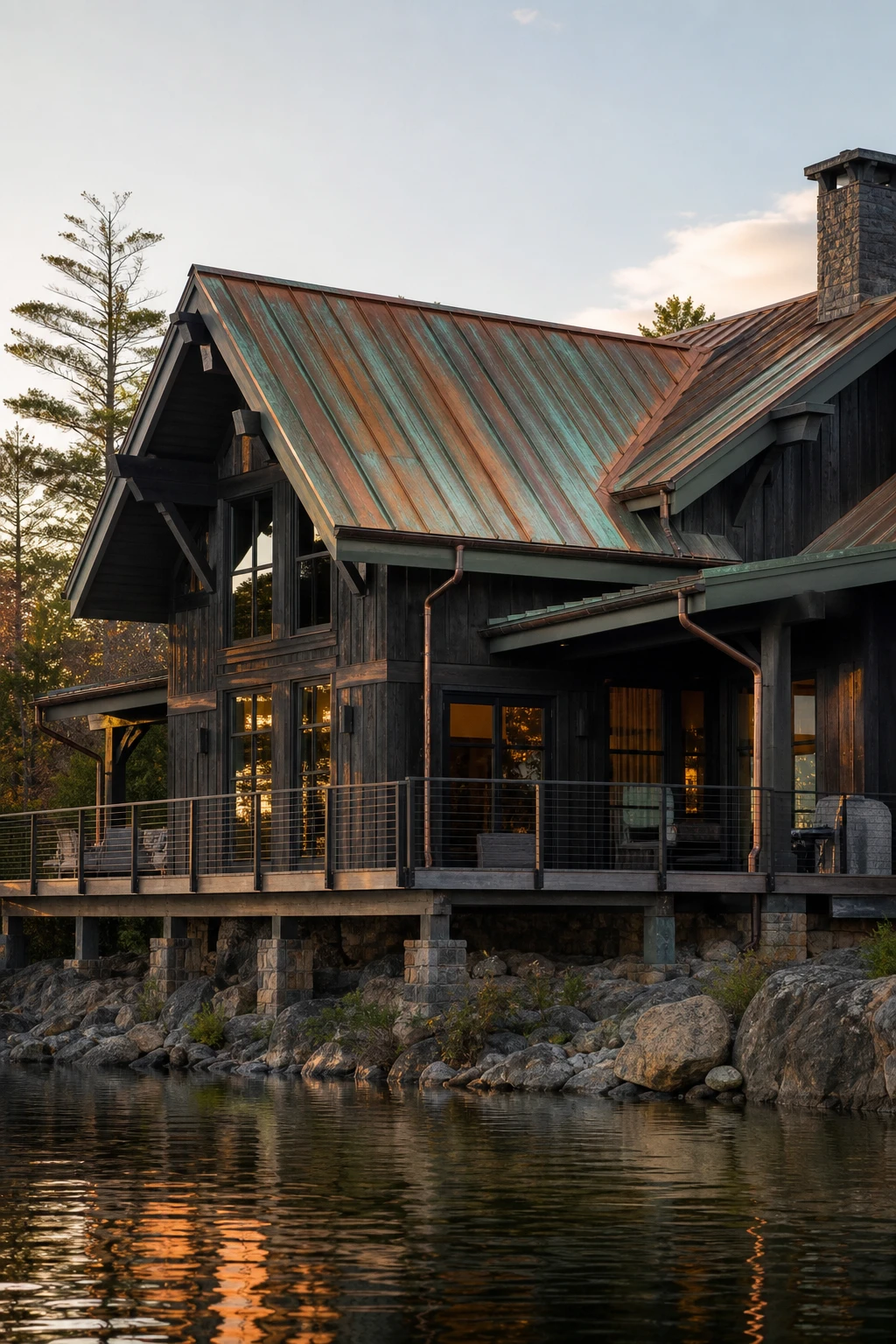
Copper is the only roofing material that earns its beauty slowly, and that process is the whole point. What I love is how the patina moves through warm amber, then bronze, then that soft blue green verdigris, so the house never looks finished in a static way. Set it against blackened larch and you get the contrast doing all the heavy lifting: cool, dark walls make the copper glow like something lit from inside. Watch how the stone plinth ties the whole composition to the ground.
The Key Details
Standing seam copper roof with aged verdigris patina
Blackened larch timber wall cladding
Wraparound hardwood deck with raw steel balusters
Deep overhanging eaves with painted soffit lining
Stone plinth base with copper downpipes and flashing
Pro TipMatch your wall colour to the mid stage brown bronze patina rather than the new bright copper, so the house looks intentional and cohesive from day one all the way through to full verdigris.
Avoid warm amber or terracotta tones on the walls because they blend into the early copper rather than framing it, and you lose the contrast that makes the whole roof sing.
Glass Walls on a Lake House: How to Frame the View Without Losing the Drama
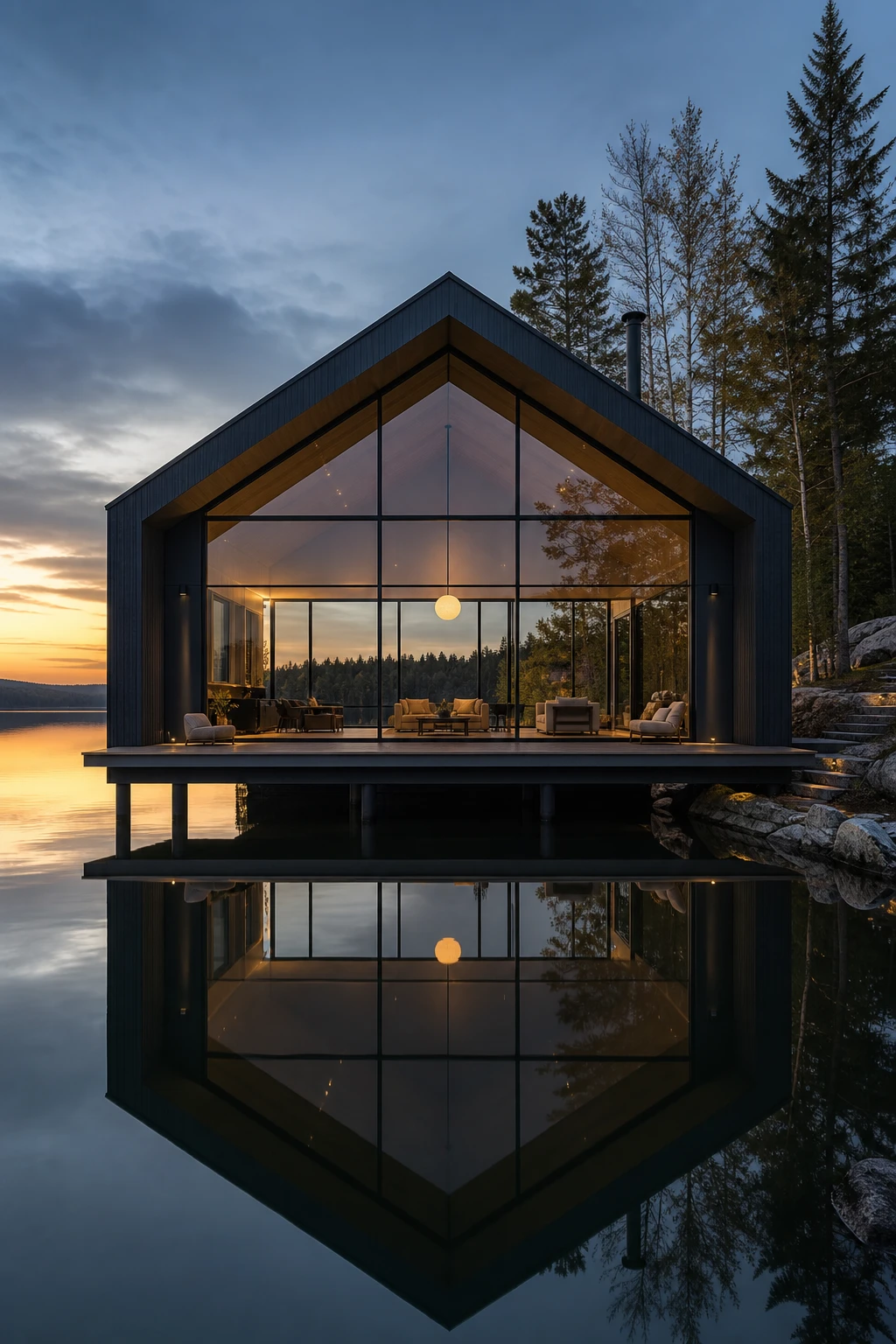
Full glass fronts work because the lake does all the decorating for you, and what I love is how a dark frame around that glass makes the view feel curated rather than accidental. Keep the structure minimal and you get a wall that almost disappears, leaving just water and sky. The blackened timber and steel columns hold the composition without competing, so every hour of light reads differently through that glass.
The Key Details
Floor to ceiling full width glazing
Blackened vertical timber cladding
Cantilevered deck over water
Exposed structural steel columns
Interior pendant light visible through glass
Pro TipSpecify low iron glass for your fixed panels so the reflection stays crisp and true rather than picking up that faint green cast standard glazing leaves behind.
Avoid breaking the glass run with too many mullions because once the grid takes over, you stop seeing the lake and start seeing the window.
Dark Grey Walls With Black Windows: The Layered Look That Always Looks Sharp
Stepping the palette from mid dark grey walls down to near black window frames is one of my favourite moves on a lake house because you get real depth without the facade ever feeling oppressive. The grey does the heavy lifting as a backdrop, and the blacker frames pull forward so each window reads as a deliberate feature. What I love most is how the contrast stays legible from across the water, giving the whole elevation a clean graphic quality that holds up in all light.
The Key Details
Black steel casement windows
Vertical dark grey board siding
Blackened timber soffit
Fieldstone foundation plinth
Matte black exterior wall sconces
Pro TipSpec your black frames at least 80mm wide so they sit proudly on the wall and register as a design choice rather than a thin afterthought.
AvoidPicking a grey that sits too close in value to your black trim flattens the whole facade into one murky tone and loses the layered effect entirely.
A Modern Blue Exterior With Oversized Windows That Feels Open and Alive
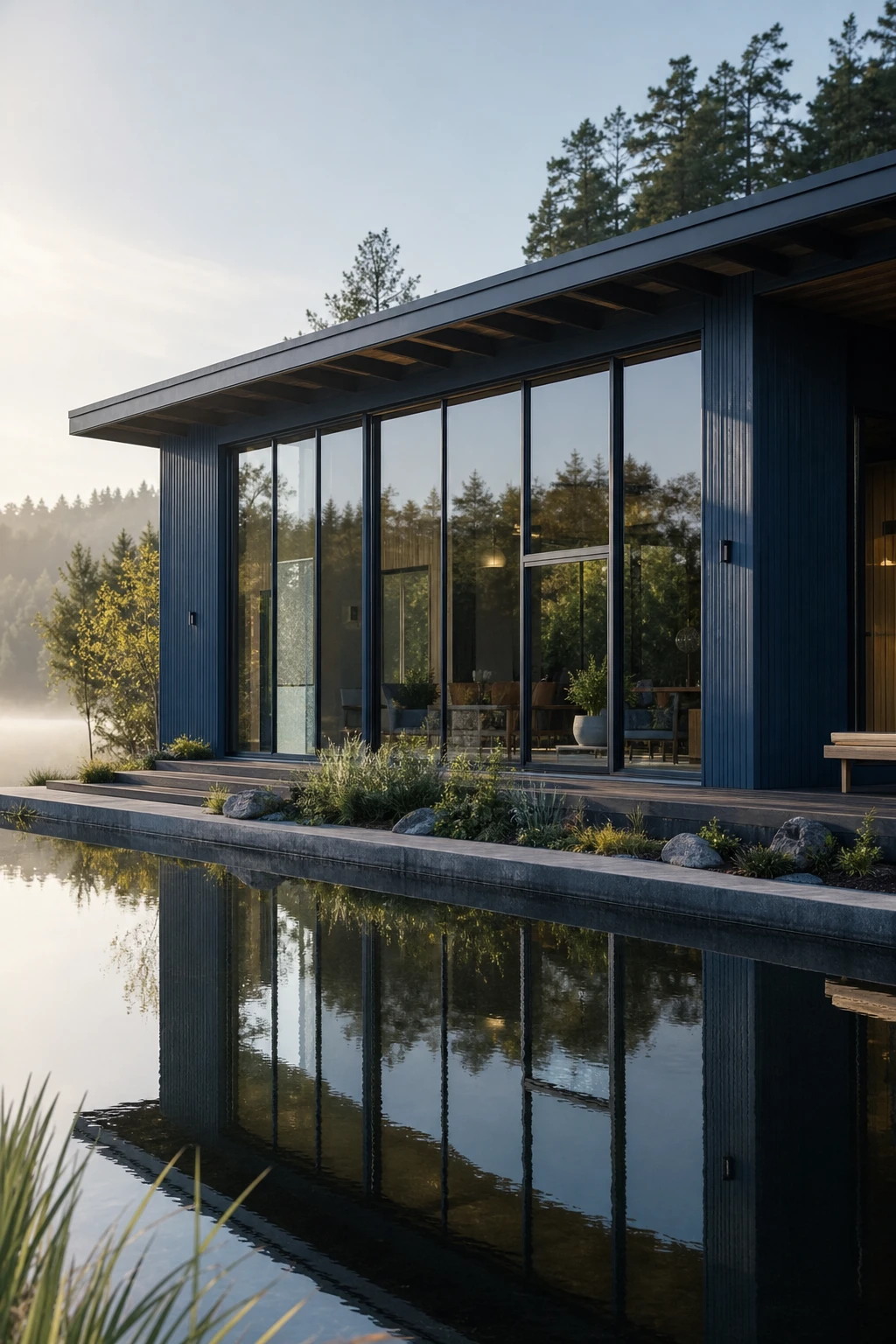
A deep blue facade could easily feel heavy, but scaling the windows right up is the move that changes everything. What I love here is how the oversized glazing pulls daylight deep into the house and keeps the exterior reading as open rather than closed off. You get this brilliant push and pull between the dark cladding and the bright, transparent panels that makes the whole elevation feel alive. The connection to the water outside becomes part of the interior, which is exactly what a lake house should do.
The Key Details
Floor to ceiling glazed window panels
Horizontal cantilevered roofline
Vertical timber batten cladding
Raw concrete window sills
Honed stone entry paving
Pro TipPosition your largest window opening on the elevation that captures both the best view and the morning sun, so the light moves through the glass and into the heart of the house from the very start of the day.
Avoid placing windows of different sizes randomly across one elevation, because a restless mix of openings breaks the calm, considered rhythm that makes a dark facade look intentional rather than patched together.
One Front Door Detail That Turns a Dark Cabin Into Something Really Special
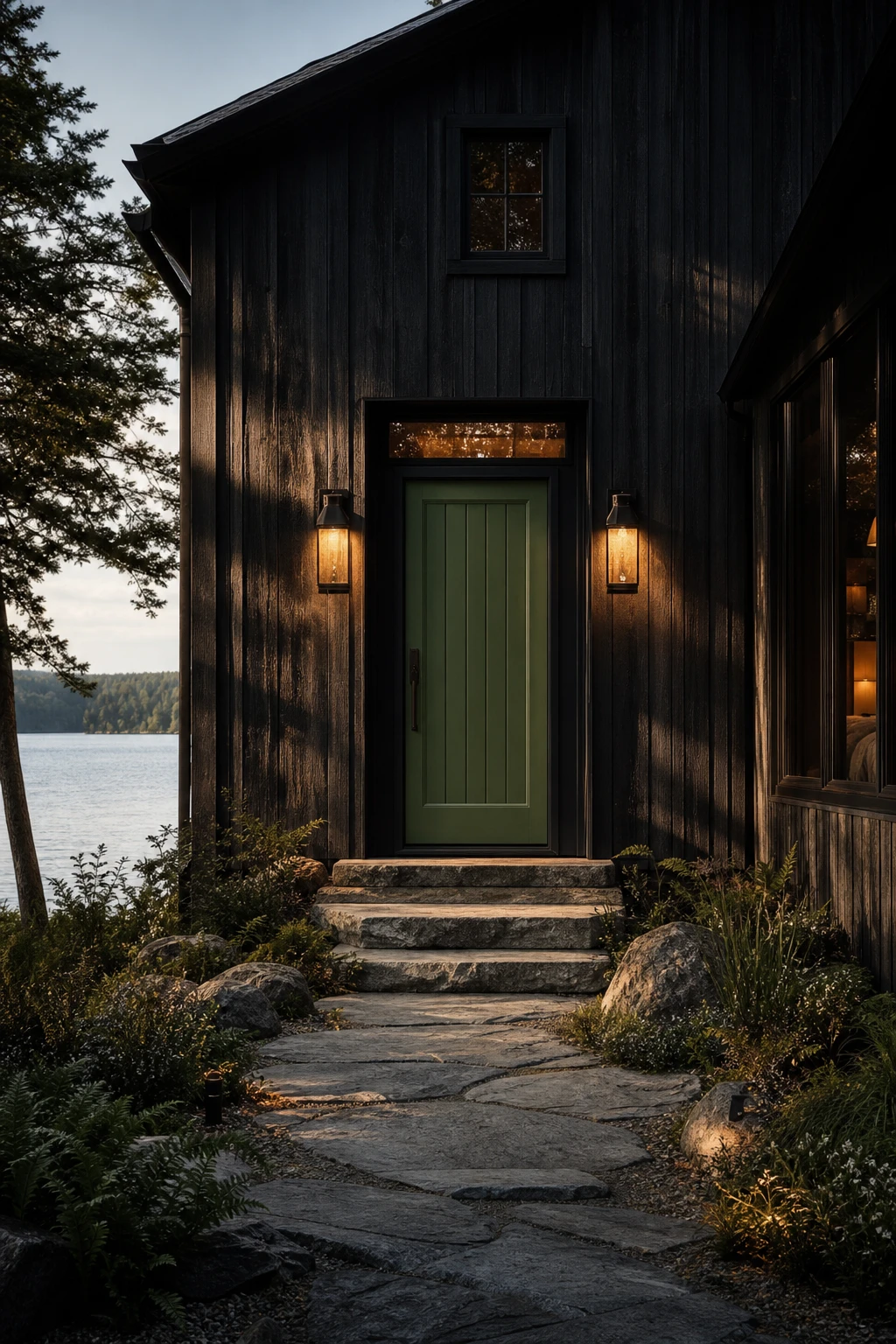
A single warm door on an all dark facade is one of my favourite moves because the contrast does all the work. Your eye goes straight to it, and you get that sense of welcome before you have even reached the steps. What wins me over every time is how the door stops the exterior feeling heavy, giving the charcoal cladding somewhere to rest against. One honest timber panel or a deep forest green is all it takes.
The Key Details
Solid timber entry door
Blackened steel wall lanterns
Rough hewn stone steps and path
Charcoal vertical timber cladding
Slender transom window above door
Pro TipChoose a pivot or barn style door so the strap hinges and handle become focal points, adding warmth and craft right at eye level.
Avoid picking a door colour so close to the wall tone that the entry disappears into the facade and the whole front reads as one flat dark mass.
How a Long Walkway Builds Anticipation Before You Even Reach the Door
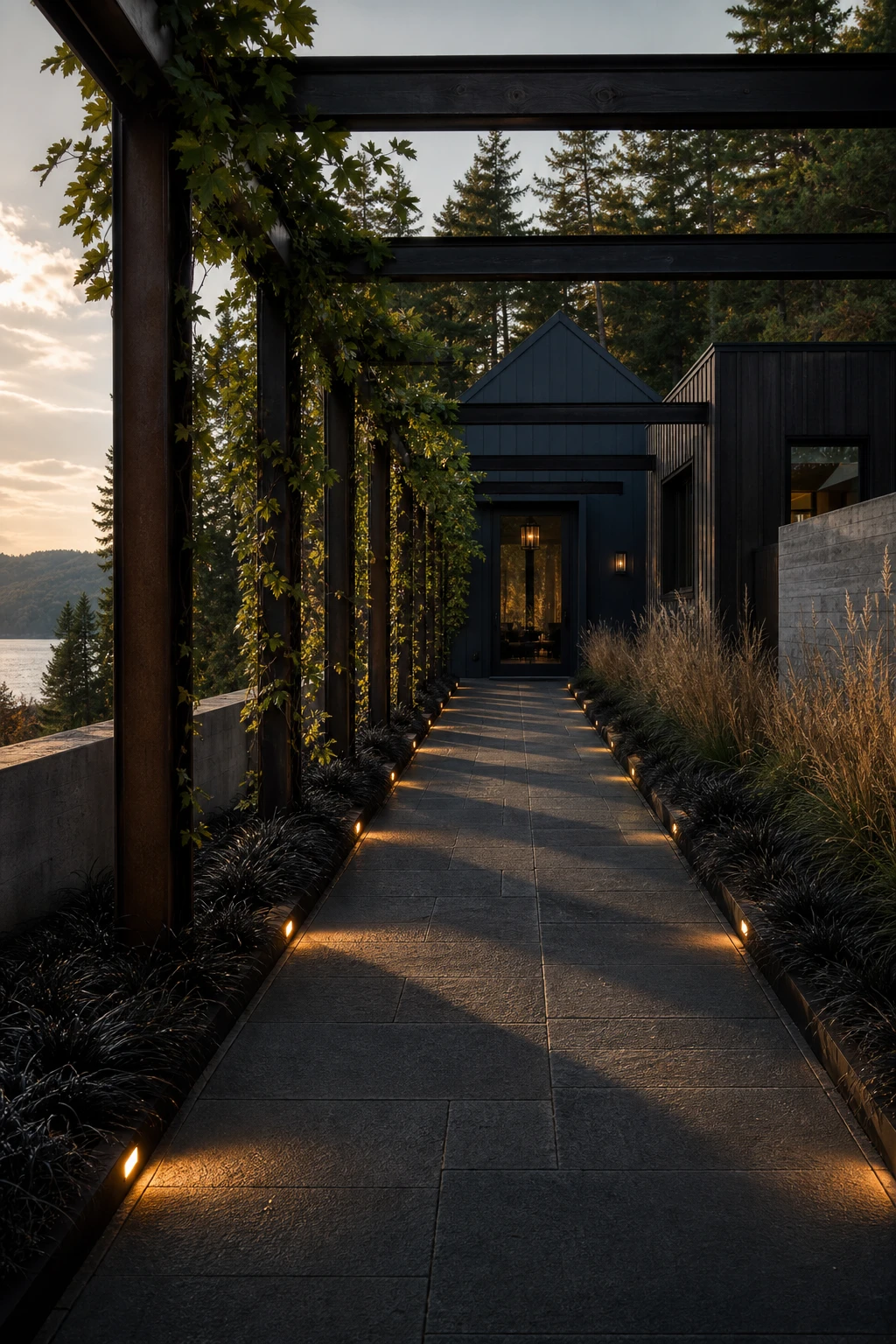
A long walkway does something a short path never can: it makes you pause and take in the whole house before you arrive at it. What I love about pairing dark basalt pavers with clipped grass borders is the contrast, crisp geometry against soft planting, that pulls the eye forward in stages. You get a sense of theatre, and by the time you reach the door the house has already made its impression.
The Key Details
Recessed ground path lights
Dark basalt paver walkway
Timber and steel pergola
Clipped mondo grass border planting
Board formed concrete facade detail
Pro TipSet recessed ground lights flush into the paver edges rather than on tall spikes so the path glows from the ground up, keeping the dark facade clean and dramatic against the night sky.
Avoid laying a single straight run of plain concrete from gate to door as it reads like a car park forecourt and kills every bit of the arrival drama you are trying to build.
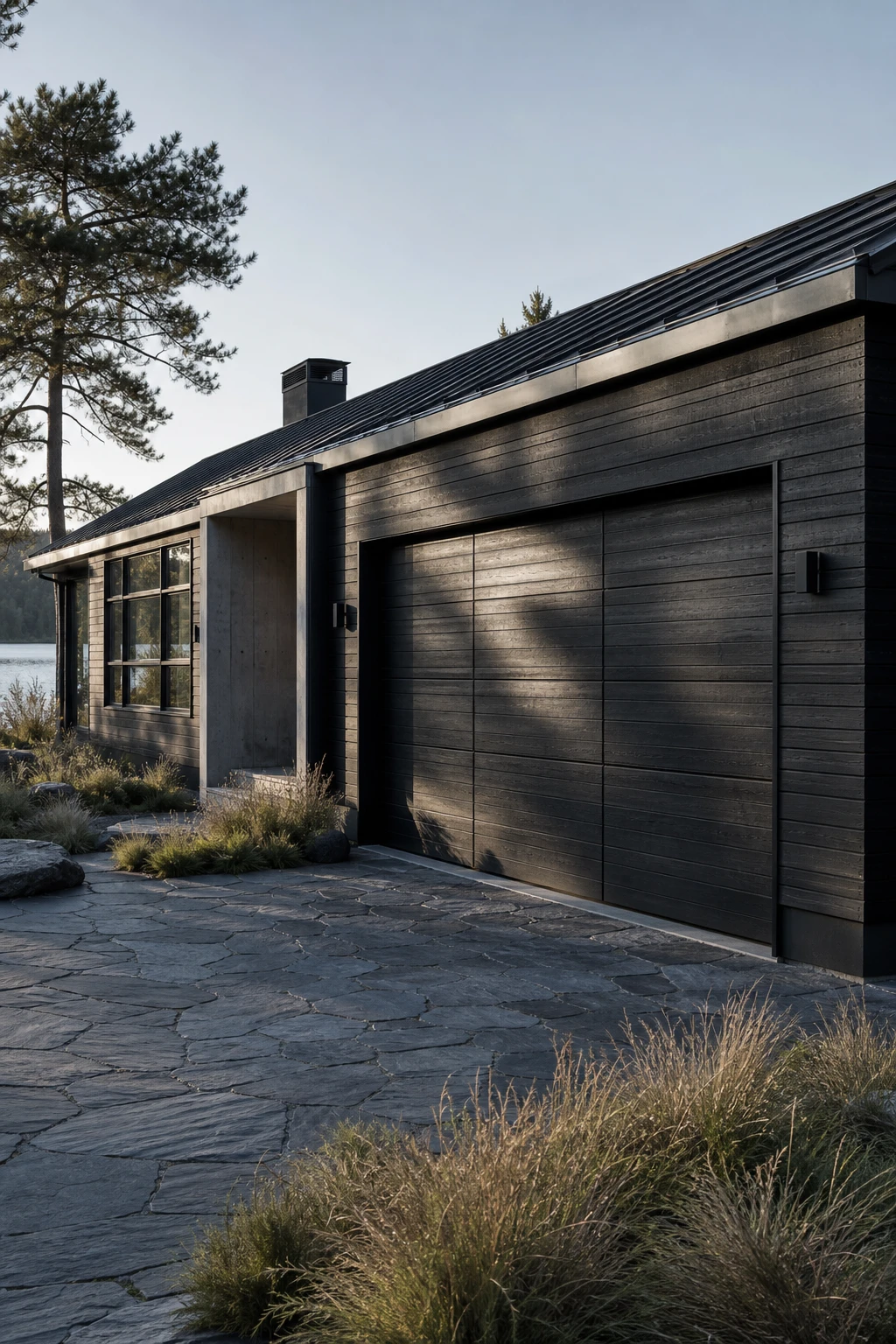
How to Design a Lake House Garage That Looks Like Part of the Home Not an Add On
Garages are one of the most overlooked parts of a lake house facade, and getting this wrong shows. What I love about this approach is how the horizontal timber cladding wraps the garage face so seamlessly you read the whole elevation as one move. The continuous roofline is doing serious work here, pulling the garage volume into the same family as the living space rather than letting it sit as a clumsy add on. You get a front elevation that feels resolved, calm and deliberately dark from every angle.
The Key Details
Oversized panel lift garage doors in horizontal timber cladding
Continuous roofline unifying garage and main living volume
Recessed board formed concrete entry reveal
Slim black steel window frames echoing garage door grid
Riven slate forecourt paving
Pro TipClad the garage face in the exact same material and finish run as the main house walls so the eye travels across the whole elevation without stopping.
AvoidNever let the garage roofline sit higher than the main living volume as it will dominate the facade and make the house read as a garage with a home attached.
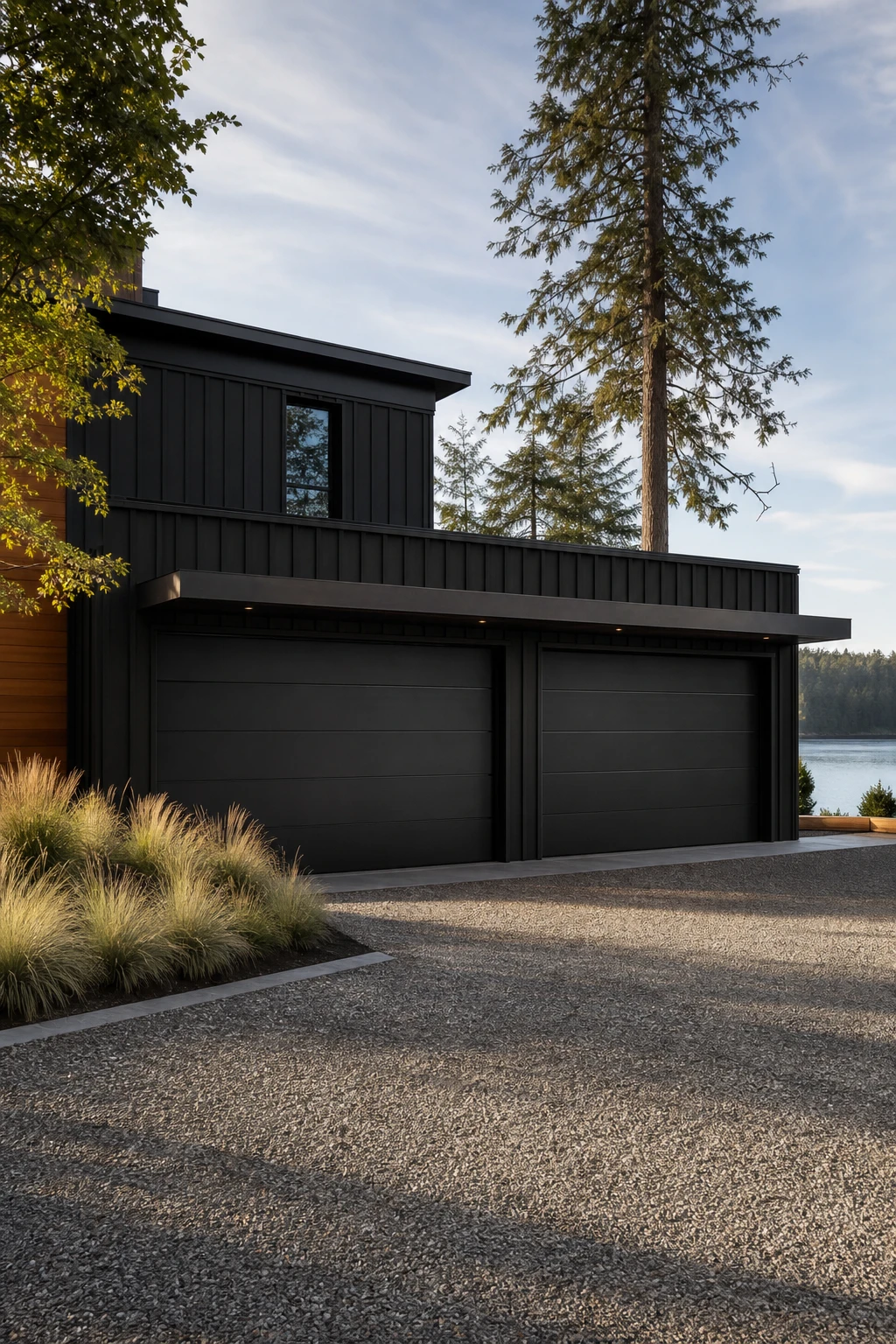
Black Garage Doors That Look Sleek Rather Than Heavy
Black garage doors done well stop being doors and start being architecture. What I love is how a large flush panel reads as a bold graphic rectangle, holding its own against timber cladding without competing with it. You get that clean, unbroken face that pulls the whole facade into line, and the scale works for you rather than against you.
The Key Details
Flush panel oversized garage doors
Slim steel canopy overhang
Board and batten timber cladding
Compacted gravel driveway
Low ornamental grass border
Pro TipChoose slim horizontal panel lines rather than vertical raised sections so the door sits flat against the facade and reads as one graphic piece.
Avoid recessed or raised panel doors on a dark contemporary house, as the grooves collect grime and the fussy detail fights every clean line around them.
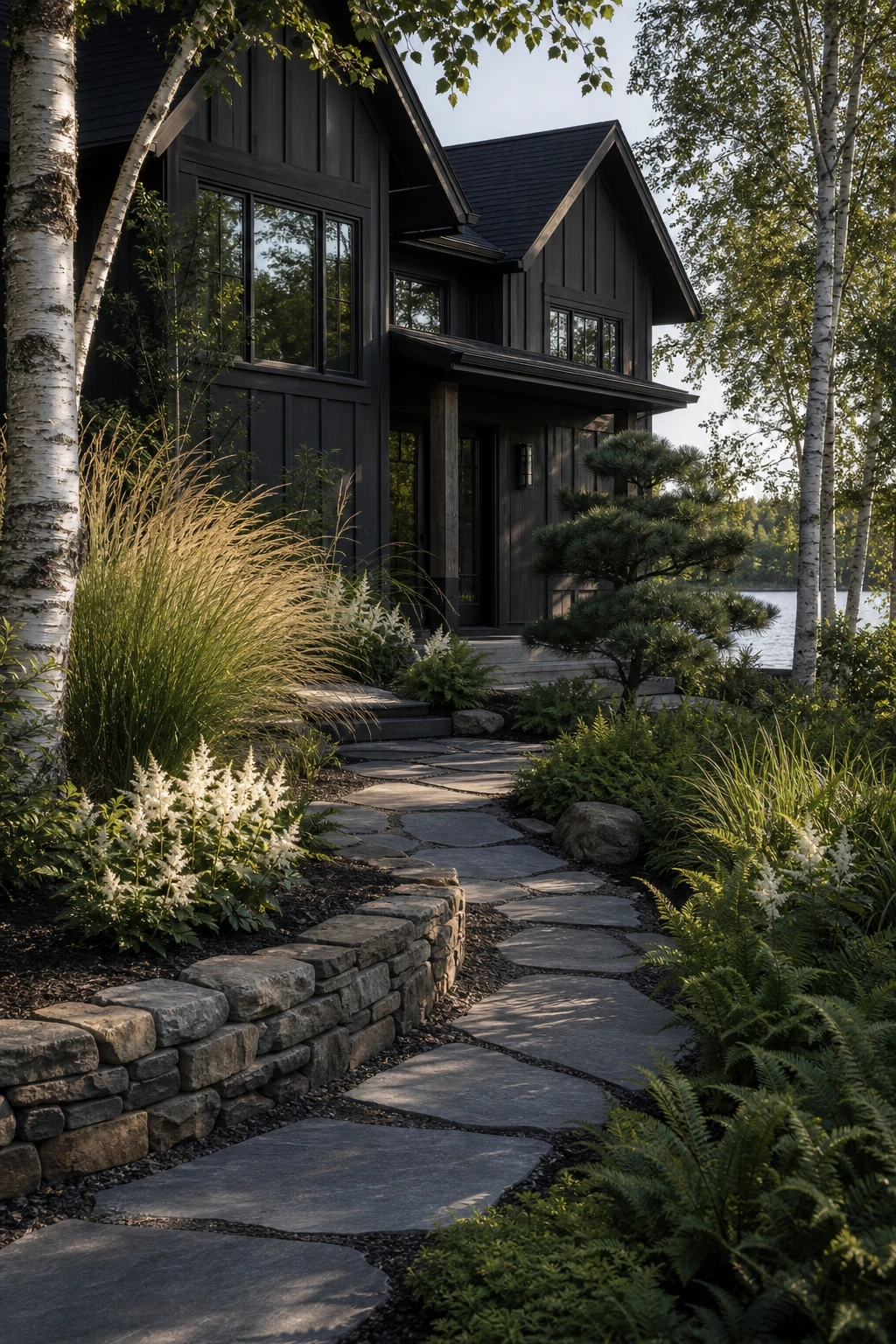
The Landscaping Choices That Make a Black Lake House Look Even More Stunning
Planting close to a black exterior is one of my favourite moves because the contrast does something almost theatrical. You get pale birch bark and white astilbe flowers glowing against that dark cladding, and the whole facade feels lit from within. What wins me over every time is the way ornamental grasses soften the foundation line so the house looks grown into the ground rather than dropped onto it. Watch how a dry stacked stone wall and an irregular bluestone path carry that same naturalistic feeling right through the garden.
The Key Details
Ornamental grass plantings
Irregular bluestone pathway
Dry stacked stone retaining wall
White flowering astilbe border
Birch trees with pale bark
Pro TipPlant ornamental grasses and ferns in uneven drifts right against the foundation so the base of the house blurs into the garden rather than sitting on top of it.
AvoidKeeping every edge clipped and every border ruler straight strips the landscape of the wildness that makes a dark lake house feel rooted and alive.
The Back of a Lake House Is Its Best Side. Here Is How to Treat It That Way.
The waterside elevation is the one that actually matters at a lake house, and treating it as the true front changes everything about how the building sits in its setting. What I love here is the way the cantilevered deck reaches out over the water, the frameless glazing opens the interior completely, and the fieldstone plinth anchors the whole thing so it reads as grown from the ground rather than dropped onto it. You get a rear elevation with real presence, its own rhythm, its own arrival sequence.
The Key Details
Cantilevered timber deck with dock extension
Floor to ceiling frameless glazing panels
Continuous fieldstone plinth base
Board formed concrete fascia details
Rough sawn cedar cladding panels
Pro TipStep your deck levels down in two or three tiers toward the water so guests naturally slow down and take in the view as they move through each level rather than walking straight off the threshold onto a dock.
AvoidCopying the proportions and cladding rhythm of your street facade onto the waterside wall leaves you with two elevations that feel like neither was designed with its setting in mind.
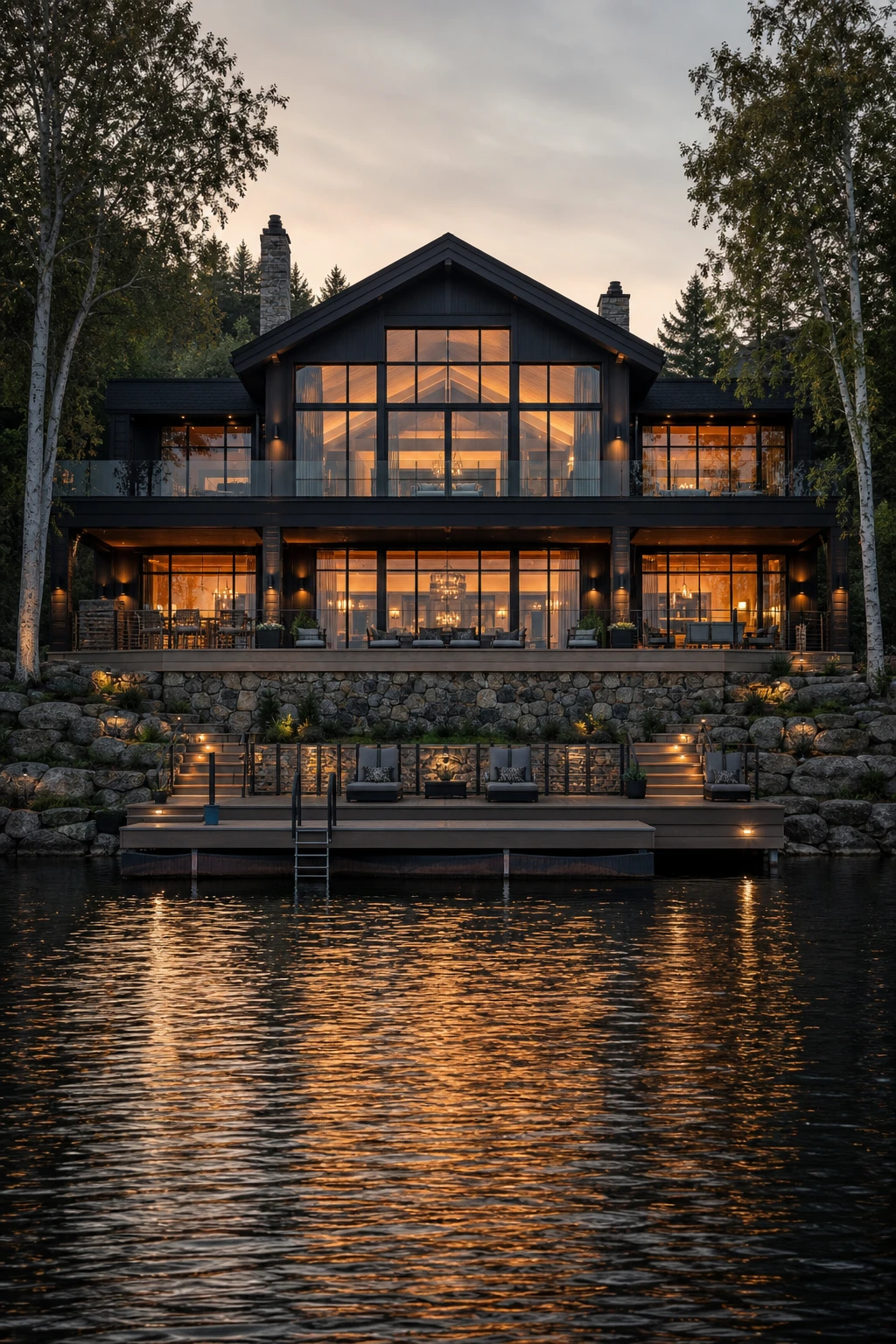
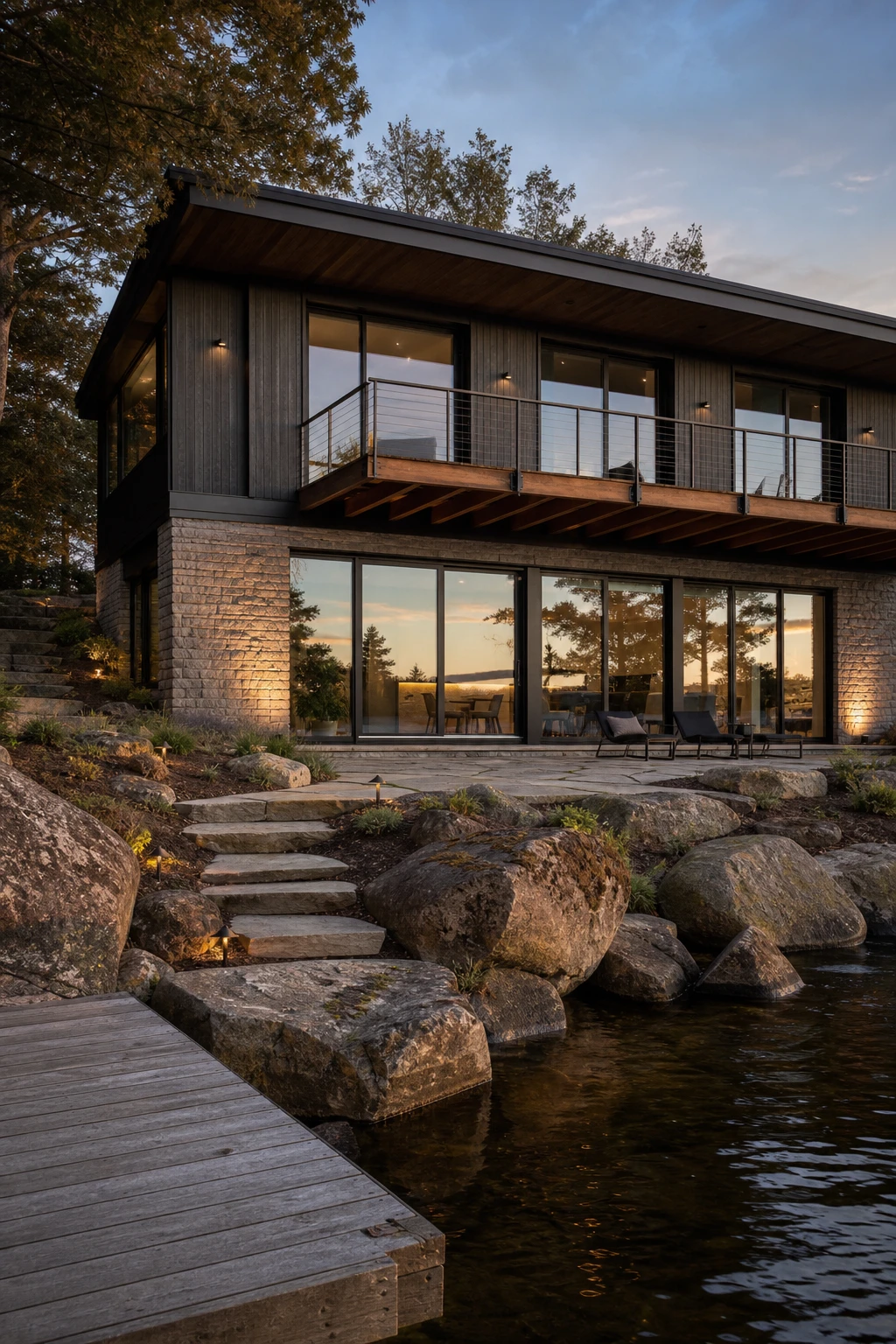
A Walkout Basement That Earns Its Place on a Dark Lake House Exterior
Giving the walkout basement the same design attention as the floors above it is one of those moves that completely changes how a house sits on its site. What I love here is how the rough fieldstone base reads as a natural extension of the ground itself, so the house feels rooted rather than plonked. Full height sliding doors across that lower facade mean you get light and lake views at every level, and the stone terrace stepping down to the dock ties everything together into one continuous, intentional composition.
The Key Details
Full height sliding glass doors spanning the lower facade
Rough fieldstone base wall at grade
Cantilevered upper deck with exposed timber joists
Ground level stone terrace stepping to the dock
Low profile landscape lighting at terrace edge
Pro TipClad the basement level in a contrasting material like fieldstone or board formed concrete so it reads as a solid base that the darker upper walls appear to rise from.
AvoidNever leave a walkout basement in bare or painted concrete when the storeys above it are finished in quality cladding, because the contrast reads as an afterthought and undermines the whole exterior.
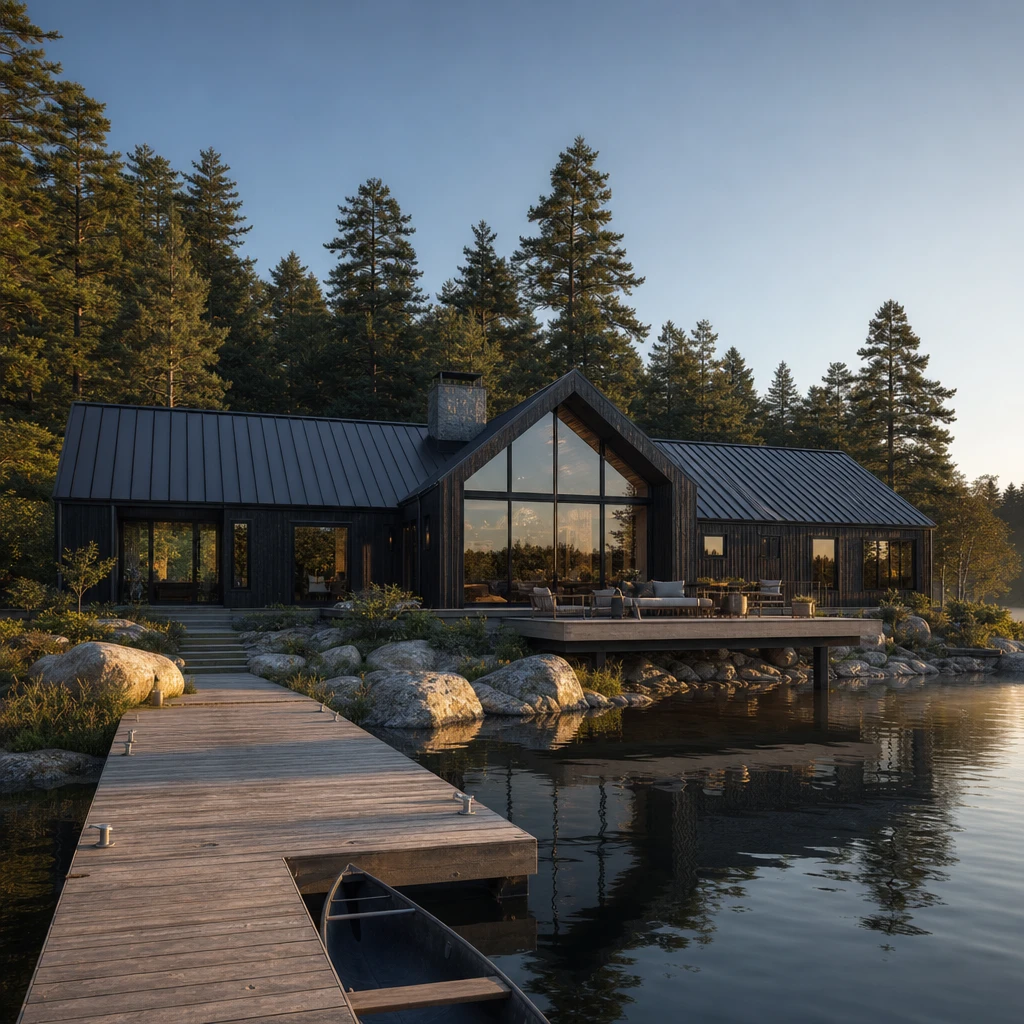
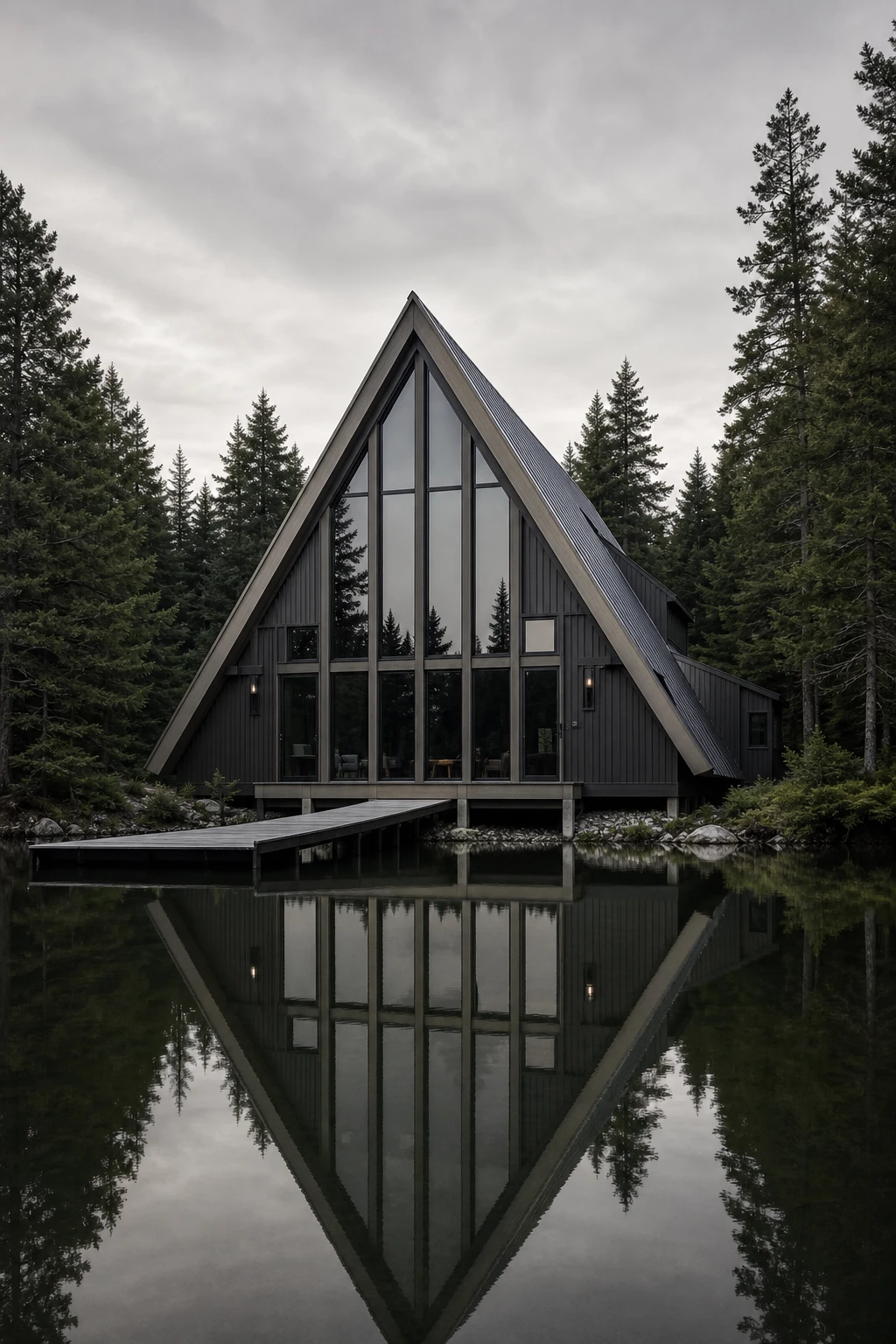
An A Frame Lake House in Dark Cladding and Why the Shape Does All the Work
The A frame is one of those silhouettes that does the heavy lifting before you even choose a material. What I love about pairing it with dark cladding is how the charcoal surface melts into the treeline so the roof pitch reads as pure graphic shape against the sky. You get this clean, almost architectural tension where the steep triangle pulls the eye straight up and the glazing at the gable sits inside it like a frame within a frame. Every detail here supports the line rather than fighting it.
The Key Details
Steep A frame roofline
Floor to ceiling gable glazing
Charcoal board and batten cladding
Timber dock over water
Evergreen treeline backdrop
Pro TipRun your cladding boards vertically so the lines chase the roof pitch upward and the whole facade feels taller and sharper.
Avoid mixing too many different window shapes across the gable because the moment that triangle gets interrupted the whole silhouette loses its power.
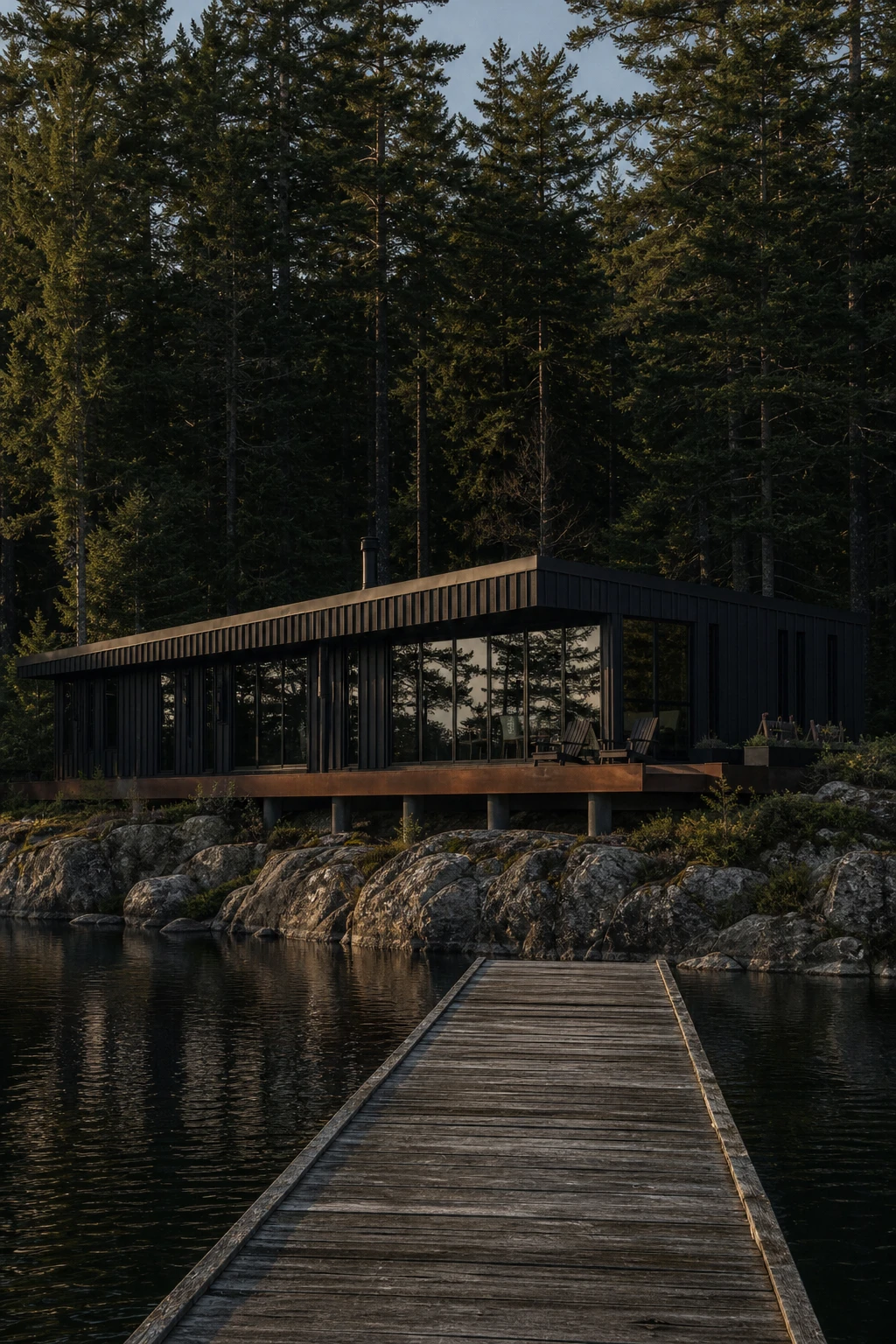
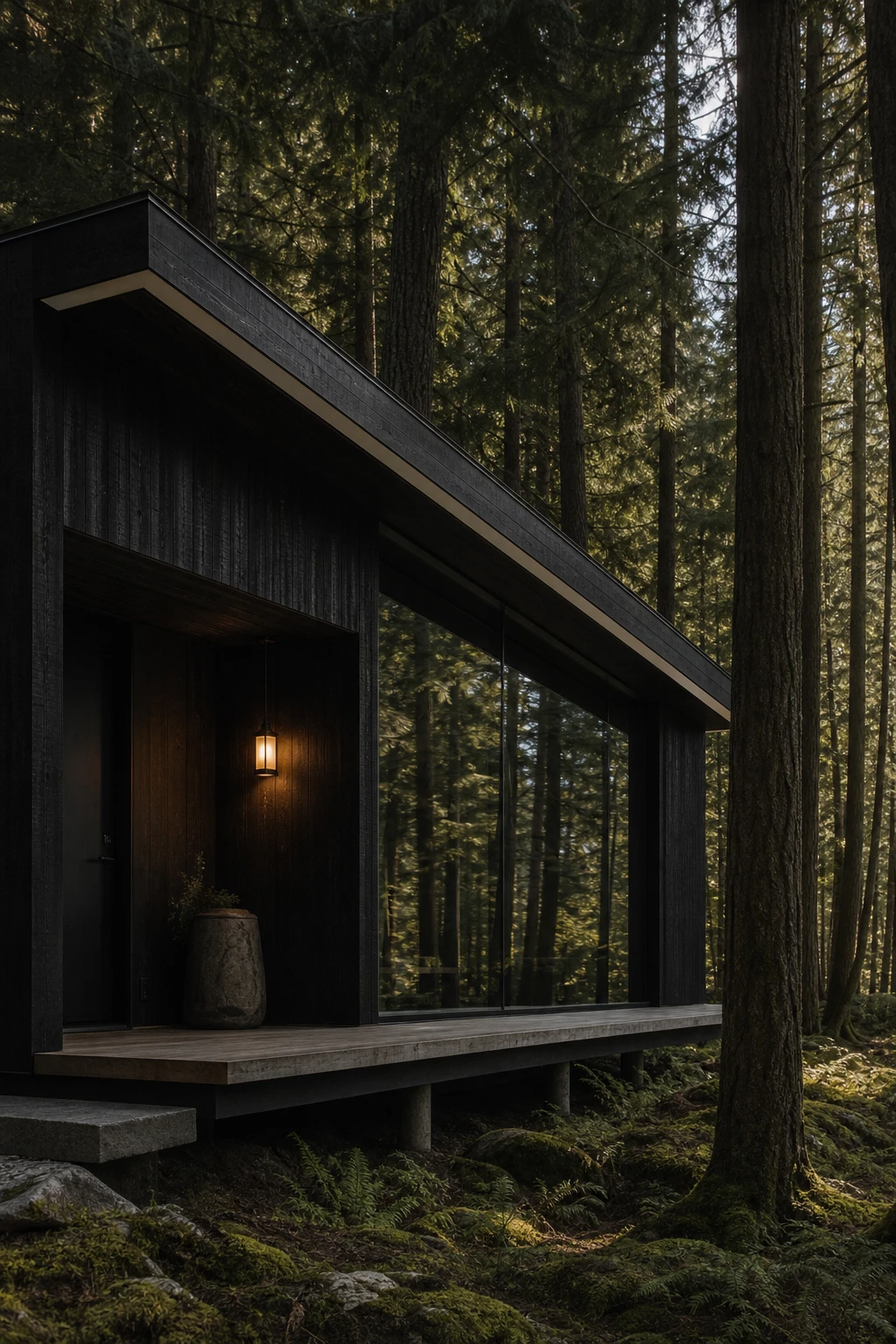
How a Modern Black Cabin Disappears Into the Forest in the Best Possible Way
Sitting a black cabin inside dense forest is one of those moves where the architecture stops competing and starts belonging, and that quiet disappearing act is what I keep coming back to. The charred cedar pulls the shadow of the tree canopy right into the walls so you stop reading the building as a separate object. What I love is the seamless push and pull between structure and nature that the combination creates. The glazed wall and raw steel frames give just enough contrast to anchor the whole thing without breaking the spell.
The Key Details
Charred cedar facade cladding
Cantilevered low profile deck
Raw steel window frames
Floor to ceiling glazed wall
Pendant entry lantern
Pro TipFix warm amber wall lights at ankle height along the deck edge so the cabin glows softly at night the way a lit lantern does, never a floodlit car park.
Avoid bright white exterior fittings entirely, because one cool white bulb is enough to shatter the whole dark forest mood the moment the sun goes down.
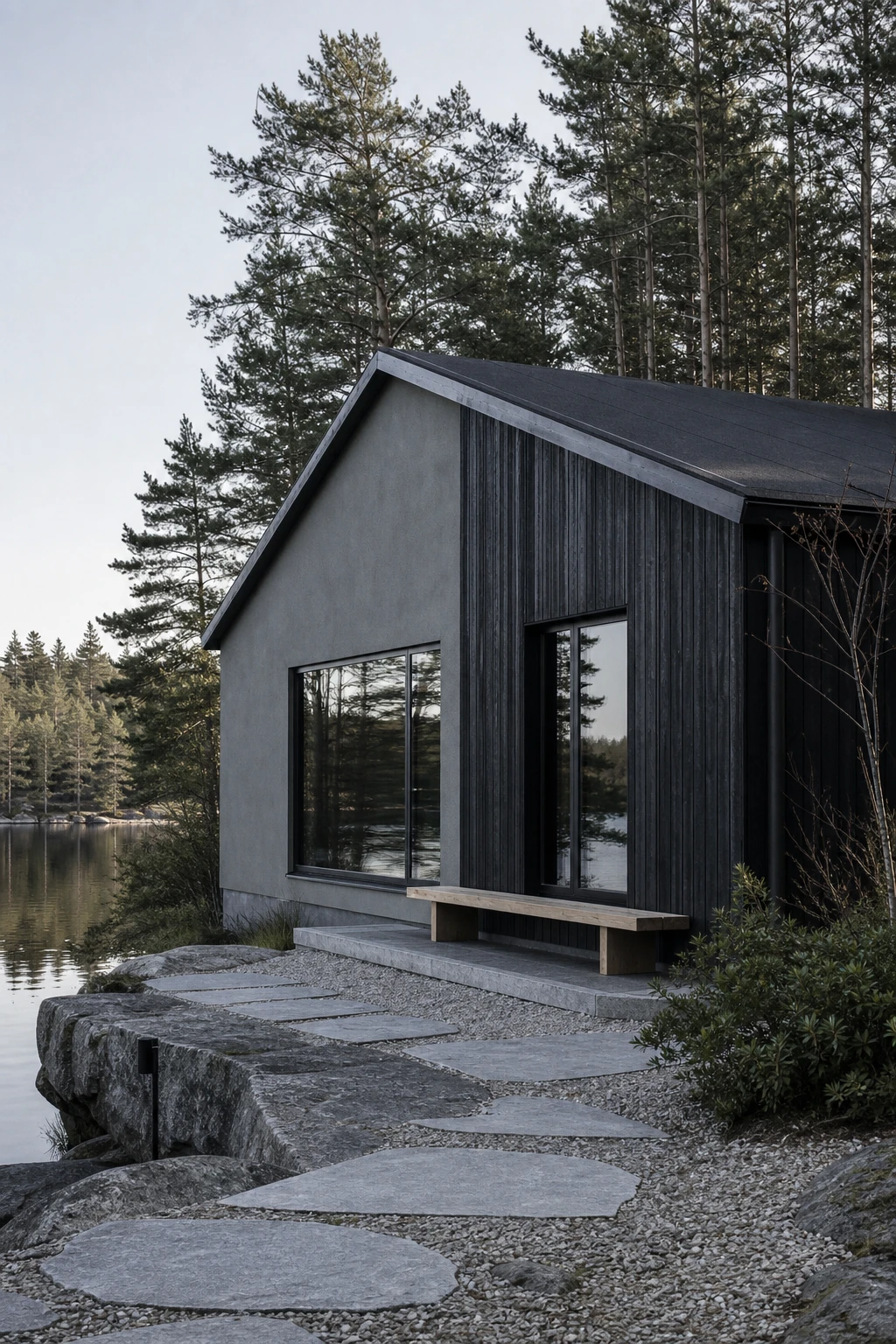
What Scandinavian Mountain Homes Get Right About Dark Exteriors That We Should All Copy
Scandinavian mountain cabins get dark exteriors right because nothing on the facade is there by accident. The charred larch cladding, slim steel windows, and stone plinth all pull in the same direction, and you get a building that feels completely settled in itself. That discipline is what wins me over: every element earns its place or it does not appear at all. What I find most compelling is how the dark timber fades unevenly over harsh winters, deepening rather than looking tired, so the house actually improves with age.
The Key Details
Charred larch vertical cladding
Slim dark steel casement windows
Low pitched gabled roofline
Honed granite stone plinth terrace
Raw oak bench
Pro TipChoose a pine tar or reactive larch stain rather than a film forming paint so the timber breathes, weathers to a soft silver grey at its own pace, and never peels.
AvoidAdding window shutters, decorative brackets, or any surface ornament, because even one unnecessary detail breaks the spell of Nordic restraint and the whole facade loses its quiet authority.
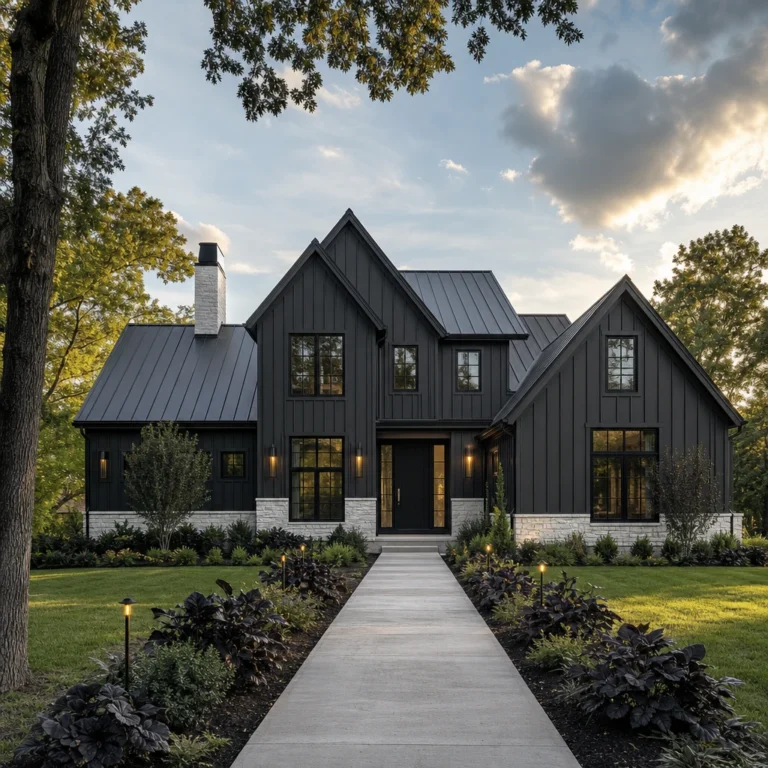
Modern Farmhouse Style on the Waterfront: How to Keep It Grounded and Not Fussy
Modern farmhouse on water only stays beautiful when you resist the urge to decorate every inch of it. What I love here is the restraint: vertical board and batten, a clean metal roof, and those big steel casement windows let the lake do the talking. You get a silhouette that feels honest and rooted rather than a catalogue replica dropped onto the shore. The timber porch and stone path to the dock are the finishing touches that tie the build back to its setting.
The Key Details
Vertical board and batten pine siding
Standing seam charcoal metal roof
Oversized black steel casement windows
Broad timber wraparound porch with square posts
Honed stone pathway to private dock
Pro TipRun your covered porch deep enough to cast a real shadow line, because that single horizontal band of shade is what gives a farmhouse its grounded, unhurried look from the water.
Avoid adding decorative trim bands, window surrounds, and extra battens all at once, because the cumulative detail shifts the house from lakeside retreat to suburban showpiece.
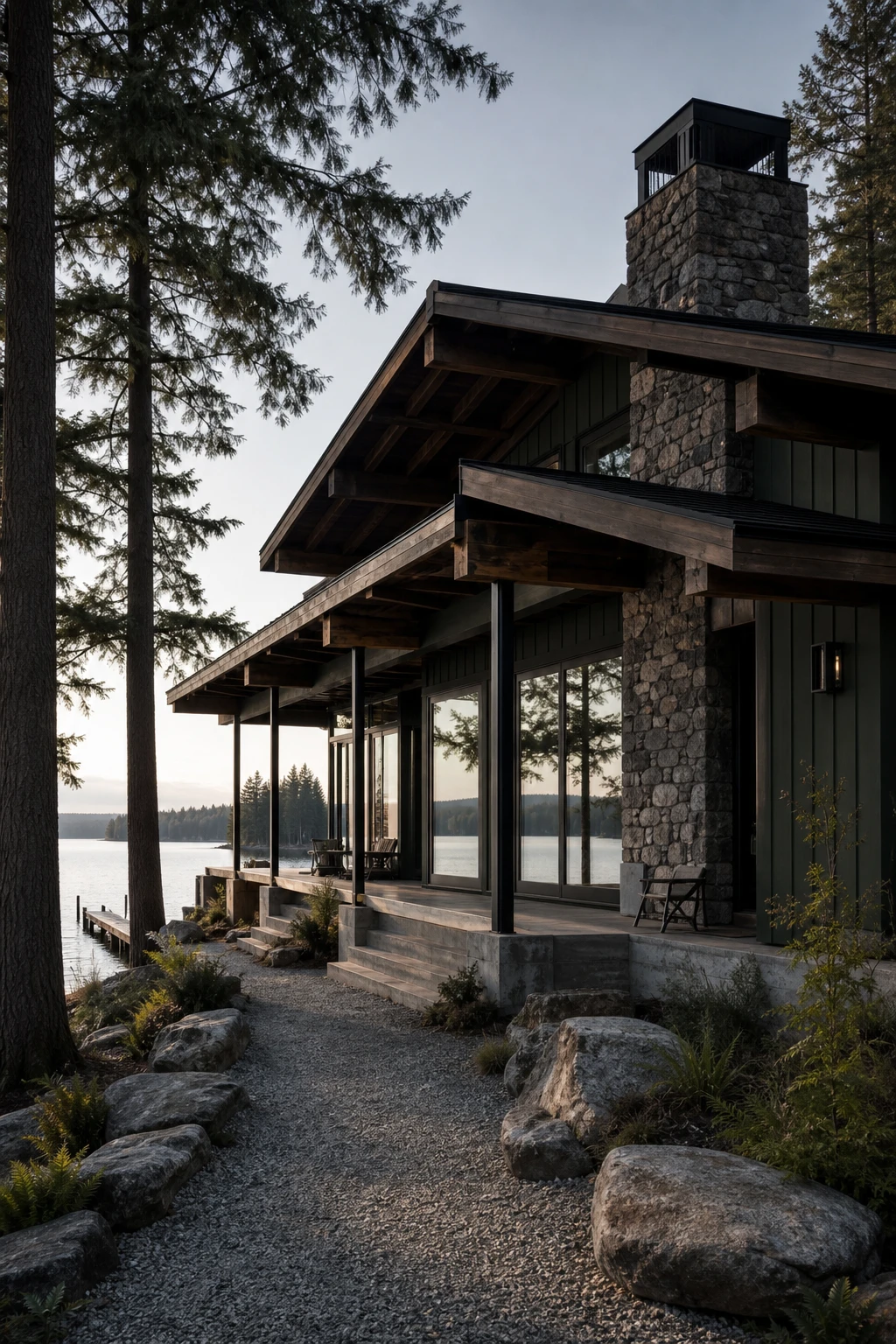
Dark Mountain Home Exteriors: The Moves That Work Just as Well at the Lake
Mountain homes have spent decades solving the same problems a dark lake build faces: weather, drama, and a landscape that demands respect. What wins me over about borrowing the low roofline and heavy overhang play is how it grounds the structure, pulling it into the hillside or the bank rather than sitting on top of it. You get shelter, shadow depth, and a silhouette that feels intentional rather than dropped in.
The Key Details
Low pitched roofline with extended timber overhangs
Fieldstone chimney breast
Floor to ceiling fixed glazing panels
Raw blackened steel support columns
Board and batten cedar facade cladding
Pro TipPush your overhangs to at least 900mm on the lake facing elevation so rain runs well clear of the cladding and you gain a usable covered strip for wet days outside.
AvoidBuilding a flat, level facade when the site slopes will make the whole house look like it is fighting the ground beneath it, so let the roofline follow the terrain instead.
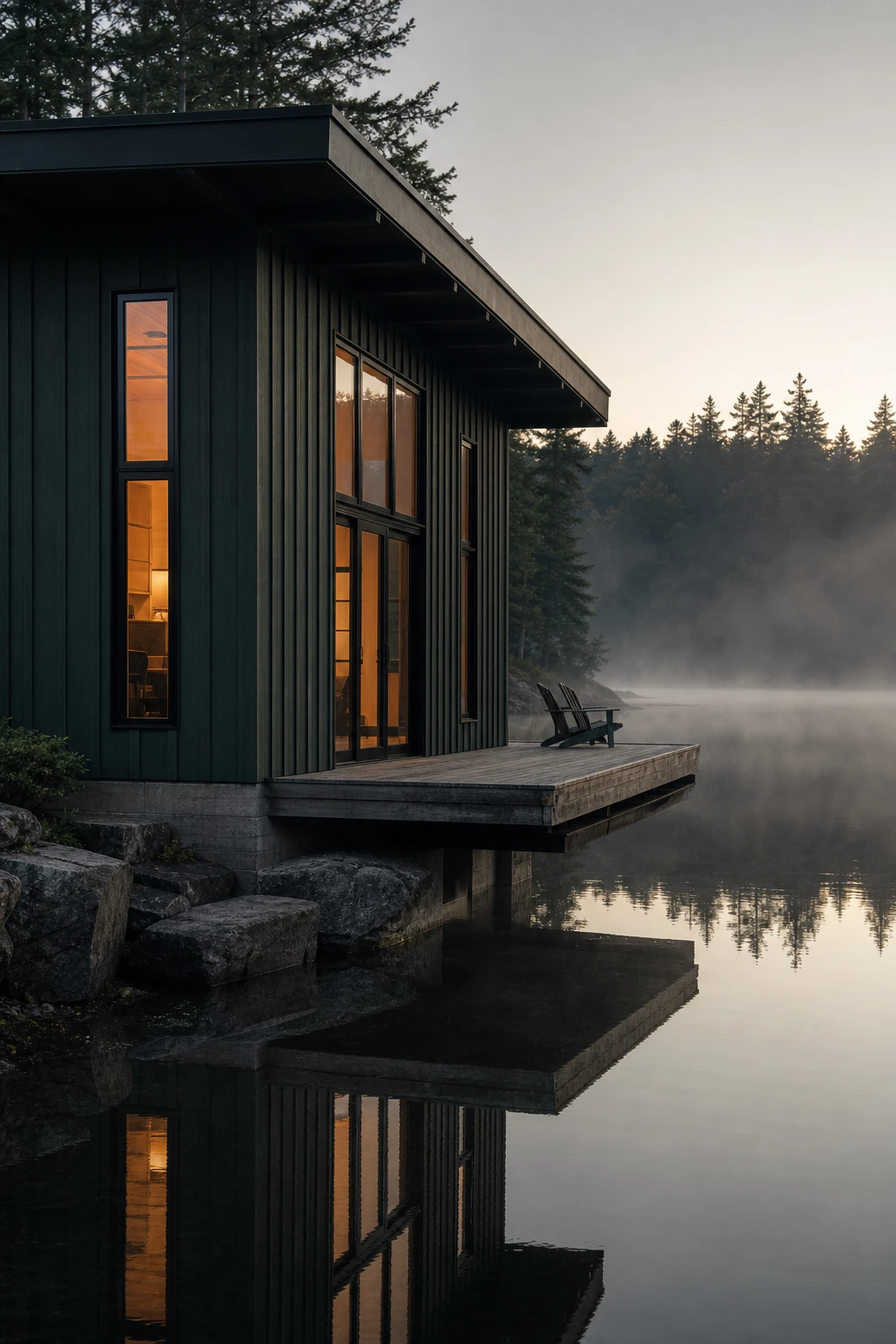
A Dark Lake House in the Fog: How to Design for Atmosphere All Year Round
A dark house dissolving into morning mist is one of the most quietly dramatic things a building can do, and what makes it work is texture, not just colour. The rough timber grain and raw stone base catch diffused light in a way smooth render simply cannot, so the facade stays alive and three dimensional even when the sky is flat. You get depth and shadow on the worst November morning, and that is exactly what I am always designing toward.
The Key Details
Board and batten vertical timber cladding
Cantilevered hardwood deck over water
Blackened steel window frames
Deep overhanging eaves
Poured concrete and natural stone base
Pro TipChoose a brushed or sawn face timber cladding rather than a planed smooth finish so every overcast day gives you a softly lit, textured surface instead of a dull flat wall.
Avoid relying on a dark paint colour alone to carry the design, because without surface texture underneath, a grey day will flatten the whole facade into a single lifeless block.
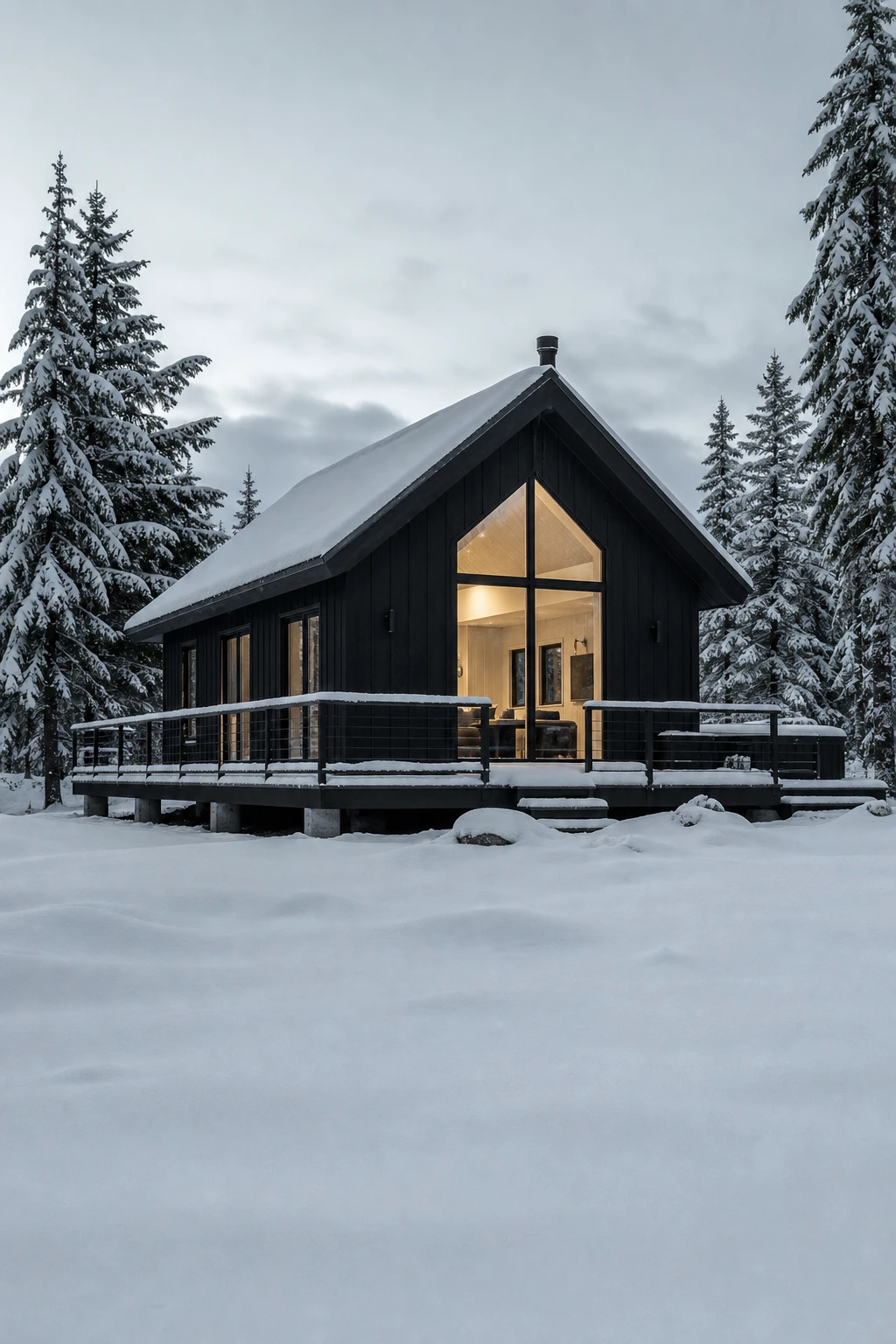
A Black Cabin in the Snow: The Contrast That Makes Every Winter Photo Worth Framing
Black board and batten against a field of fresh snow is one of the most arresting contrasts a lakeside cabin can offer, and I reach for this combination whenever a client wants every winter morning to feel cinematic. The dark cladding holds its edge sharply against white, so you get a clean graphic silhouette even in flat winter light. What wins me over every time is the warmly lit picture window glowing from inside, it pulls the whole scene together and makes the cabin look lived in and alive.
The Key Details
Black board and batten timber cladding
Dark steel cable railing deck
Snow dusted wraparound deck boards
Warmly lit picture window
Raw concrete foundation piers
Pro TipDesign your roof overhangs to extend at least 600mm past the wall line so accumulated snow creates a sculpted white crown that frames the dark facade perfectly in photographs.
AvoidNever underestimate the snow load on any flat or shallow pitch roof section, because a dramatic dark structure with a buckled or collapsed canopy undoes every visual gain the contrast delivers.
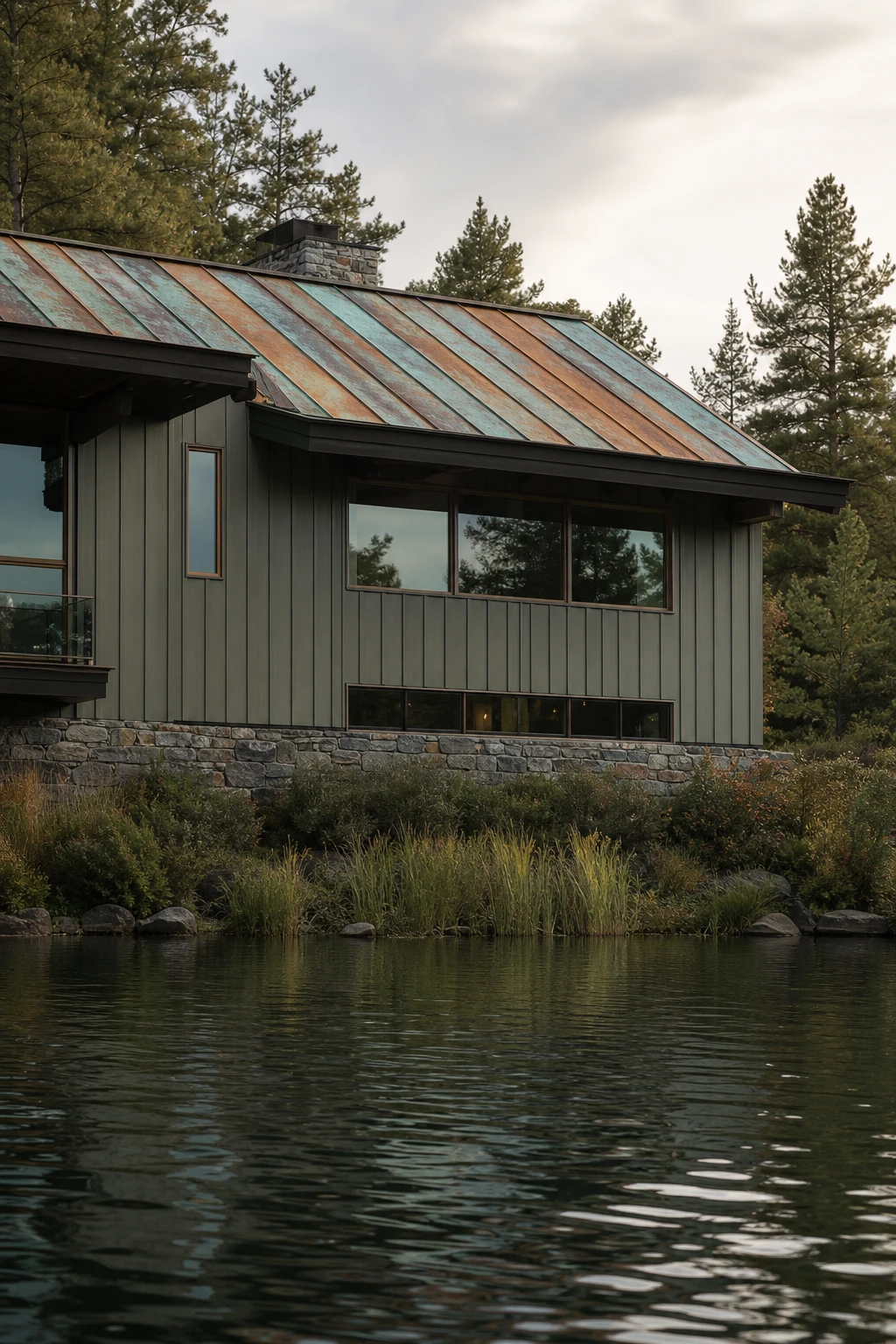
Sage Green Walls and a Copper Roof: The Softer Dark Palette Worth Considering
Sage green sits in that quiet zone where a colour reads dark and grounded from the street yet feels nothing like black or charcoal up close, and that warmth is what wins me over every time. The copper roof is the real partner here: watch how the reddish new copper and the blue grey aged verdigris both find something to echo in the green, so the palette shifts beautifully as the roof matures. You get the drama of a dark lake house exterior without the severity, which feels exactly right sitting against water and treeline.
The Key Details
Standing seam copper roof panels
Board and batten timber facade
Rough cut fieldstone plinth
Slim bronze framed horizontal windows
Dark stained timber soffits
Pro TipChoose an exterior trim paint that matches the blue grey verdigris tone copper settles into after a few years, so the walls, roof and trim feel like a single considered palette rather than three separate decisions.
Avoid any sage green with a strong yellow base, as it will fight the copper tones rather than harmonise with them and the whole palette will look accidental.
Alan launched Edward George London in 2017. Since completing his masters in Town & Regional Planning (MPlan) he has combined the skills he learned at the University of Sheffield with his passion for design, to help create a foundation for those looking to create a beautiful home.