Newsletter Subscribe
Enter your email address below and subscribe to our newsletter

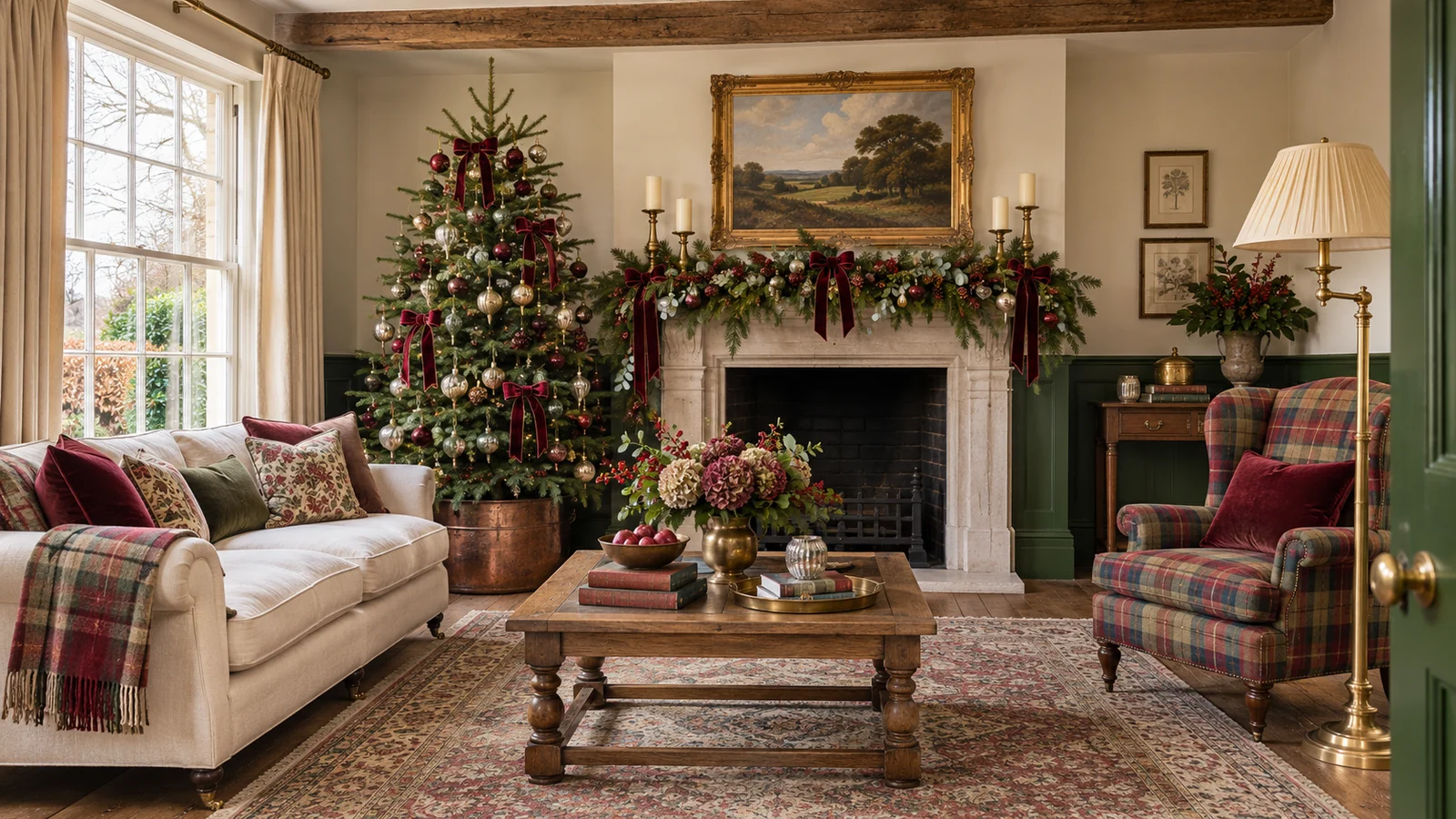
An English country Christmas living room should feel generous, familiar and a little uneven in the loveliest way. I would begin with the ornaments you bring out every year, then draw their colours through tartan, velvet and winter greenery. The aim is a room that feels beautifully dressed for Christmas while still belonging unmistakably to the people who live there.
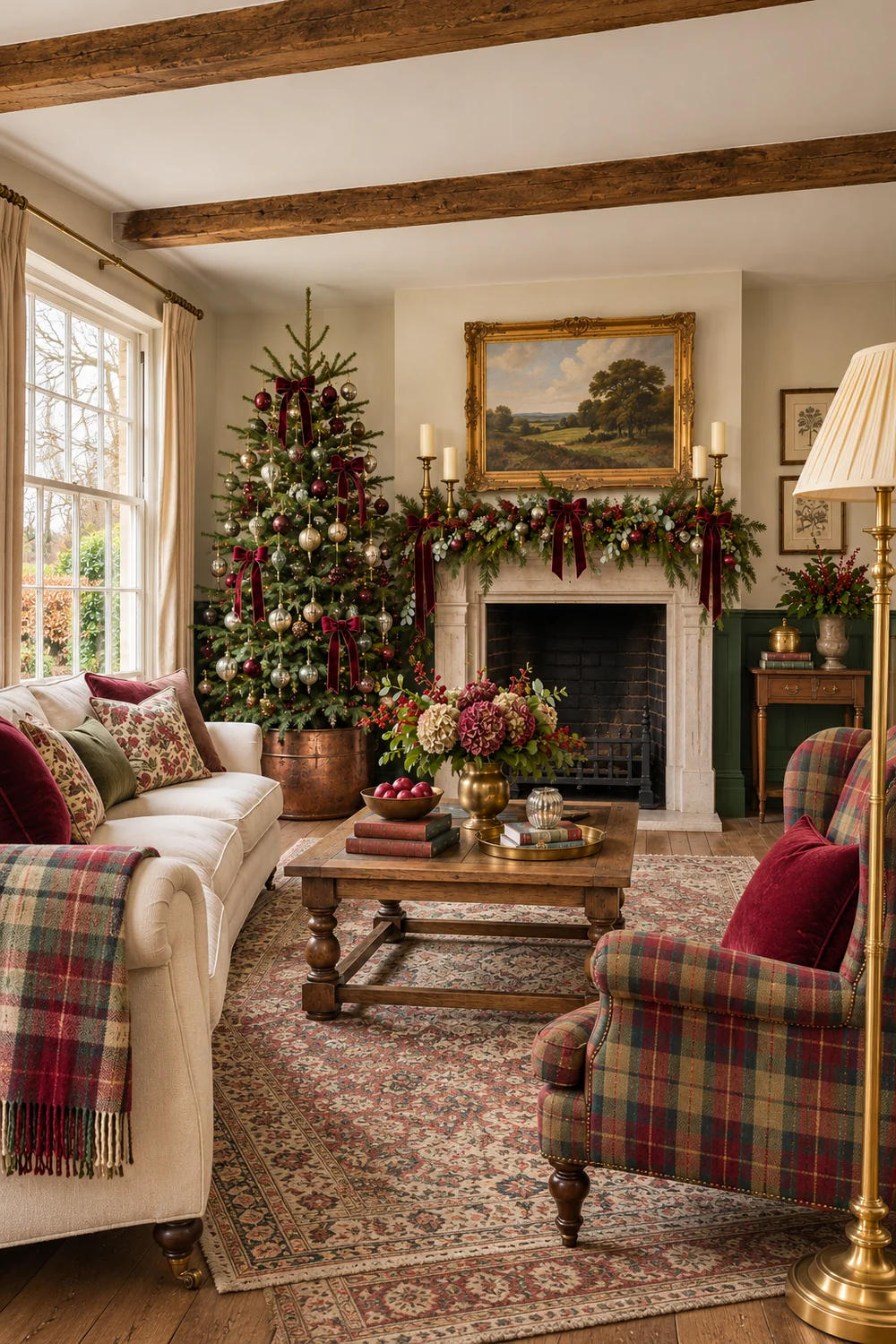
I would open the decoration boxes before looking for anything new. A faded red glass bauble, a silver bell and a handmade ornament can tell you more about the room you want than a perfectly coordinated shop display. Put the pieces you would miss on a clear surface and notice what they share. It might be a colour, a soft metallic finish or simply the pleasure of seeing them together again.
You do not need to make every ornament follow the same palette. I would choose a small group to establish the main direction and let the others keep their individuality. A collection of red and silver glass could lead towards burgundy ribbon, forest green foliage and warm cream. A painted wooden ornament can stay among those pieces without requiring an entire woodland theme around it.
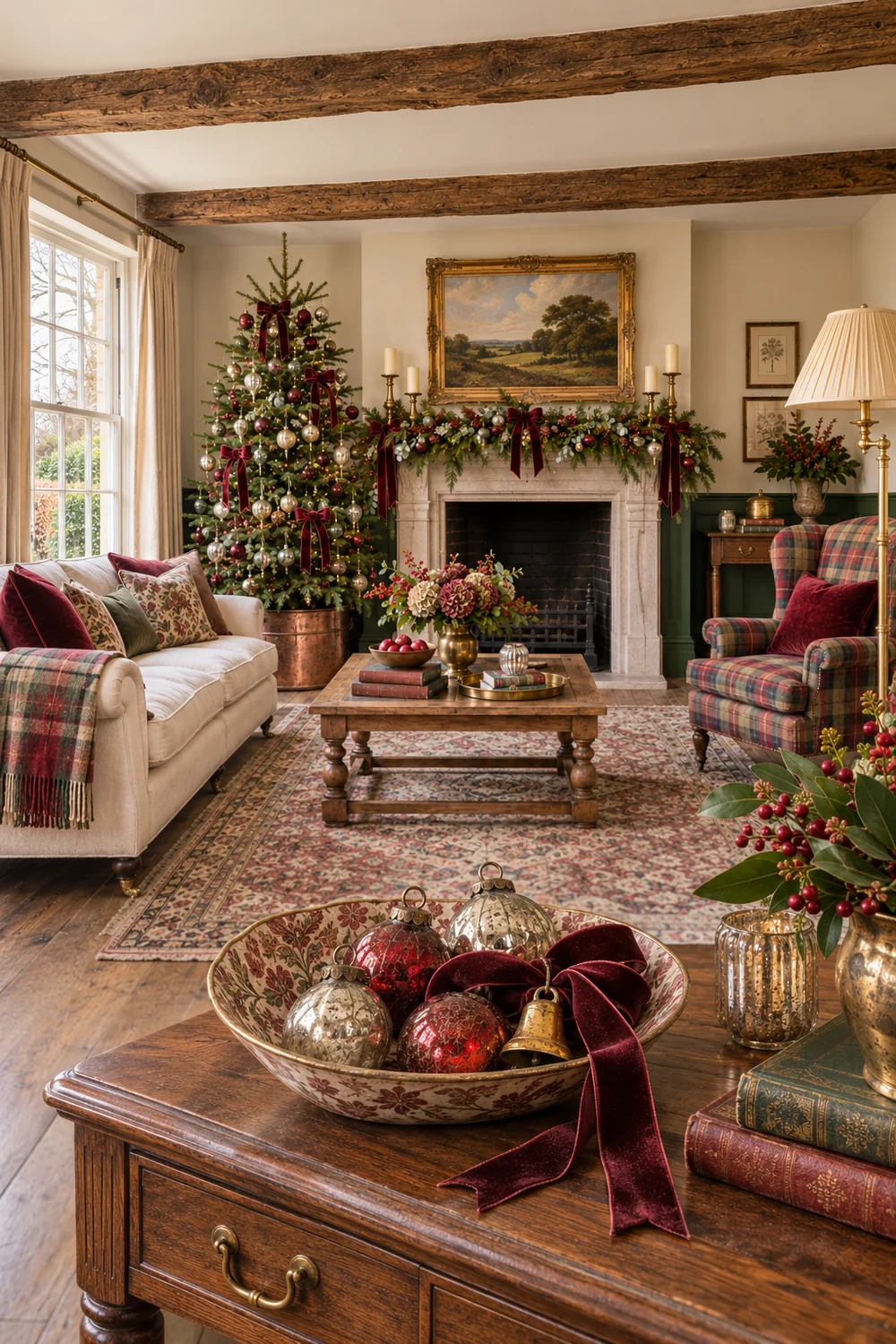
Our English country Christmas ideas offer the broader inspiration. Here, I would turn that inspiration into a short room brief: the decorations you are keeping, the colours you want to repeat and the mood you want when you open the door. Write that brief in ordinary words. “Family glass, deep red ribbon, generous greenery and the old tartan chair” is enough to guide the next decision.
I would also decide which pieces deserve their own moment. A fragile ornament does not have to disappear into the middle of a crowded tree. It could sit securely in a shallow bowl on the console, away from passing hands, with one or two related pieces. Give it an actual place in the plan rather than treating it as an awkward colour to disguise.
I would make that initial choice with the people who share the collection. Ask which pieces they expect to see, especially when an ornament has a meaning that is not obvious from its appearance. A small paper star might matter more than the oldest glass bauble. Knowing that before styling gives you a useful starting point for the room, rather than a correction to make after everything is hung.
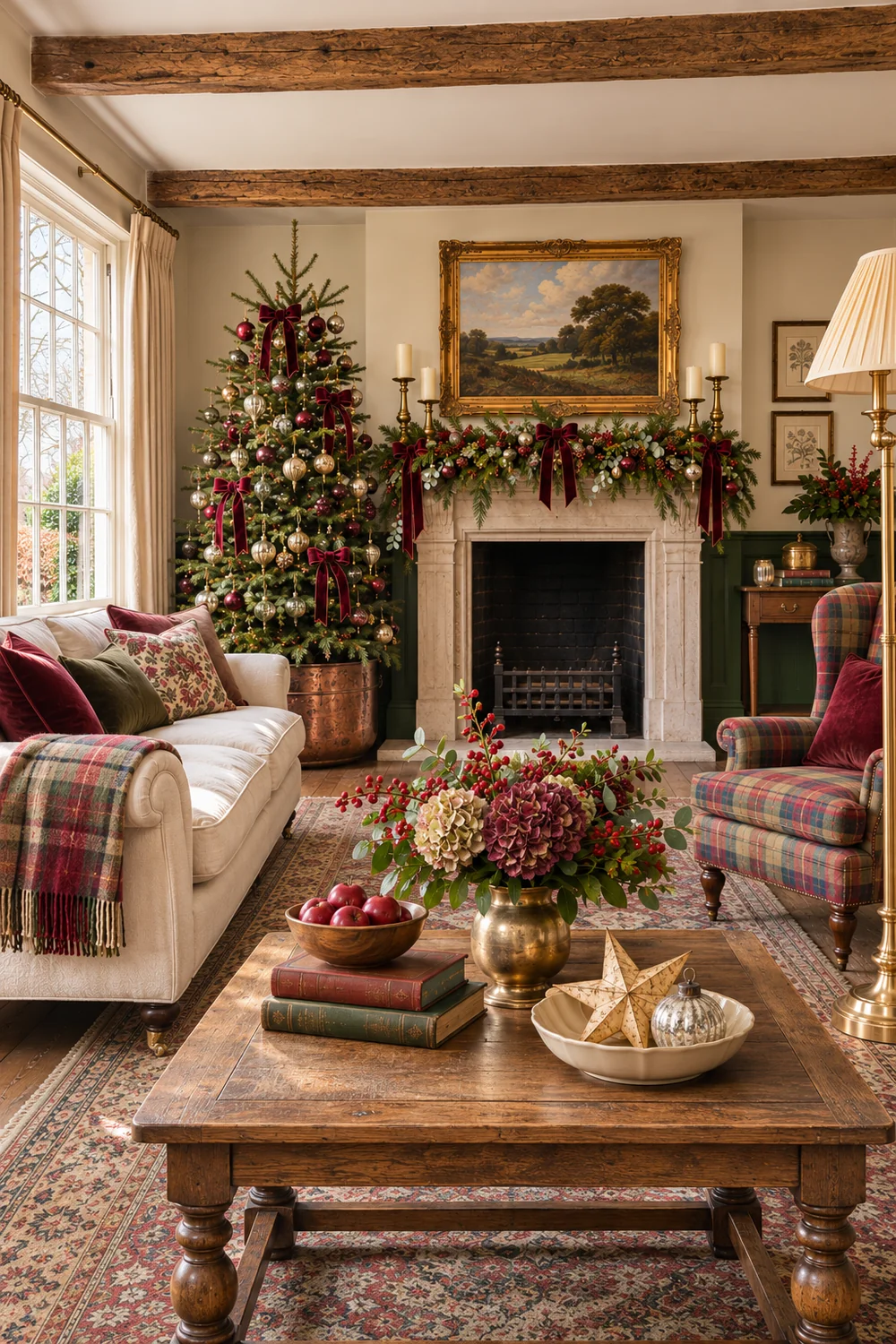
Keep a second group for decorations you enjoy but do not need in this room. Choosing where a collection belongs is different from discarding it. Some pieces might work beautifully in the hall or on a smaller tree elsewhere. I would let the living room have a clear visual story while leaving room for the family objects that make it personal.
Before adding Christmas, look at the room in daylight. The sofa, curtains, floor, fireplace and larger timber pieces already occupy most of the view. They should remain the foundation of the scheme. I would work with a green sofa, a patterned chair or warm wooden furniture rather than covering everything with seasonal fabric until the room feels unfamiliar.
Imagine a cream sofa, an old oak coffee table, a red and green tartan armchair and a pale stone fireplace. There is already plenty of character here. Burgundy velvet can pick up the red in the chair, while evergreen branches repeat its green. Cream cushions and an ordinary linen curtain give those richer elements somewhere quiet to sit. The room does not need a new colour on every surface.
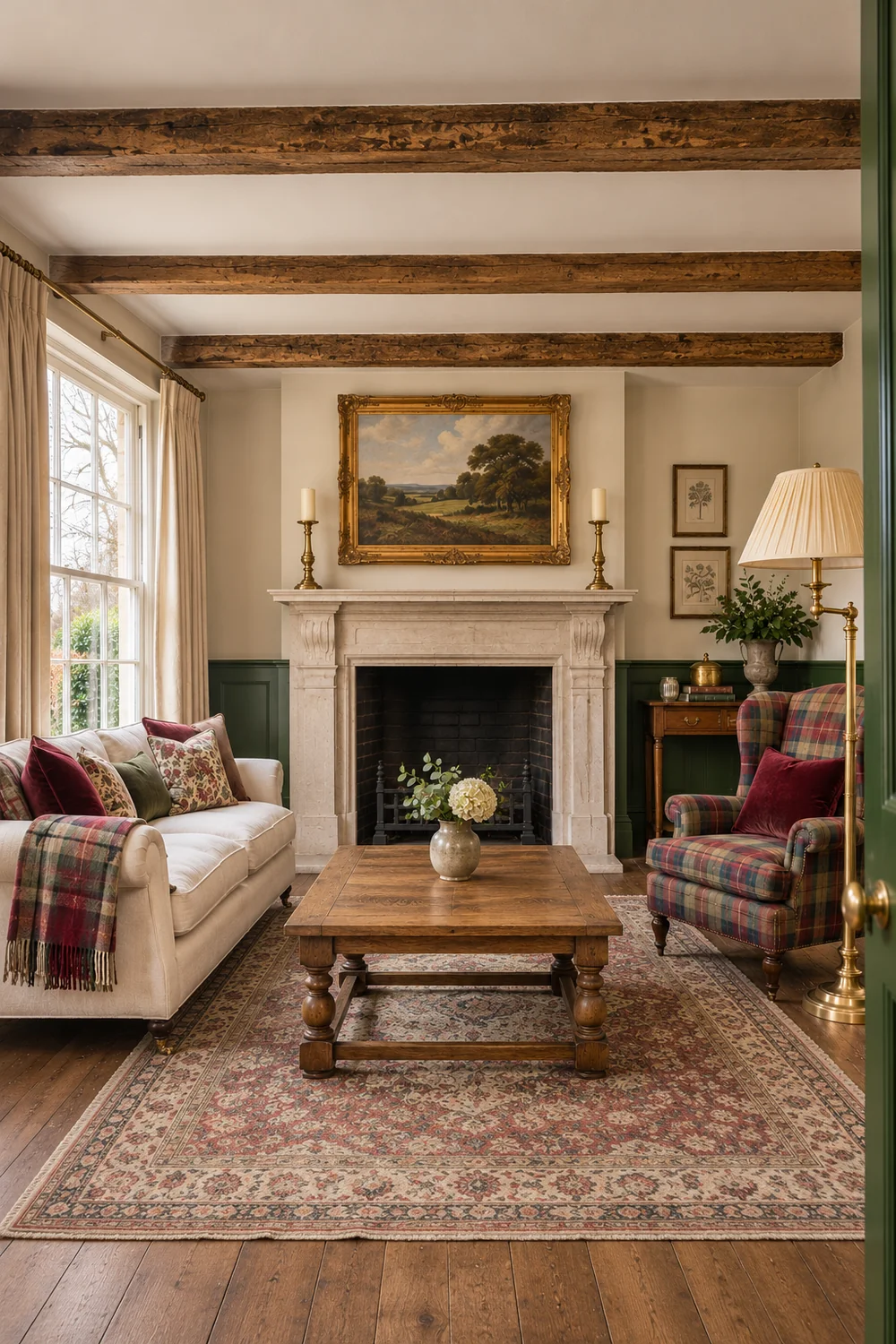
If your starting point is different, keep the same method. With blue upholstery, I would test red ribbon and aged silver against the blue before adding more tartan. With a heavily patterned sofa, I would make the tree and mantel simpler in their colour choices. The useful question is which existing element should lead, rather than which fashionable palette should replace the room you own.
The broader English country living room story can help you identify the underlying furnishings and layers. For Christmas, I would preserve the things that already make the room comfortable: a useful reading light, a place to put a cup and the chair everyone naturally chooses. Seasonal decoration should make those places more inviting.
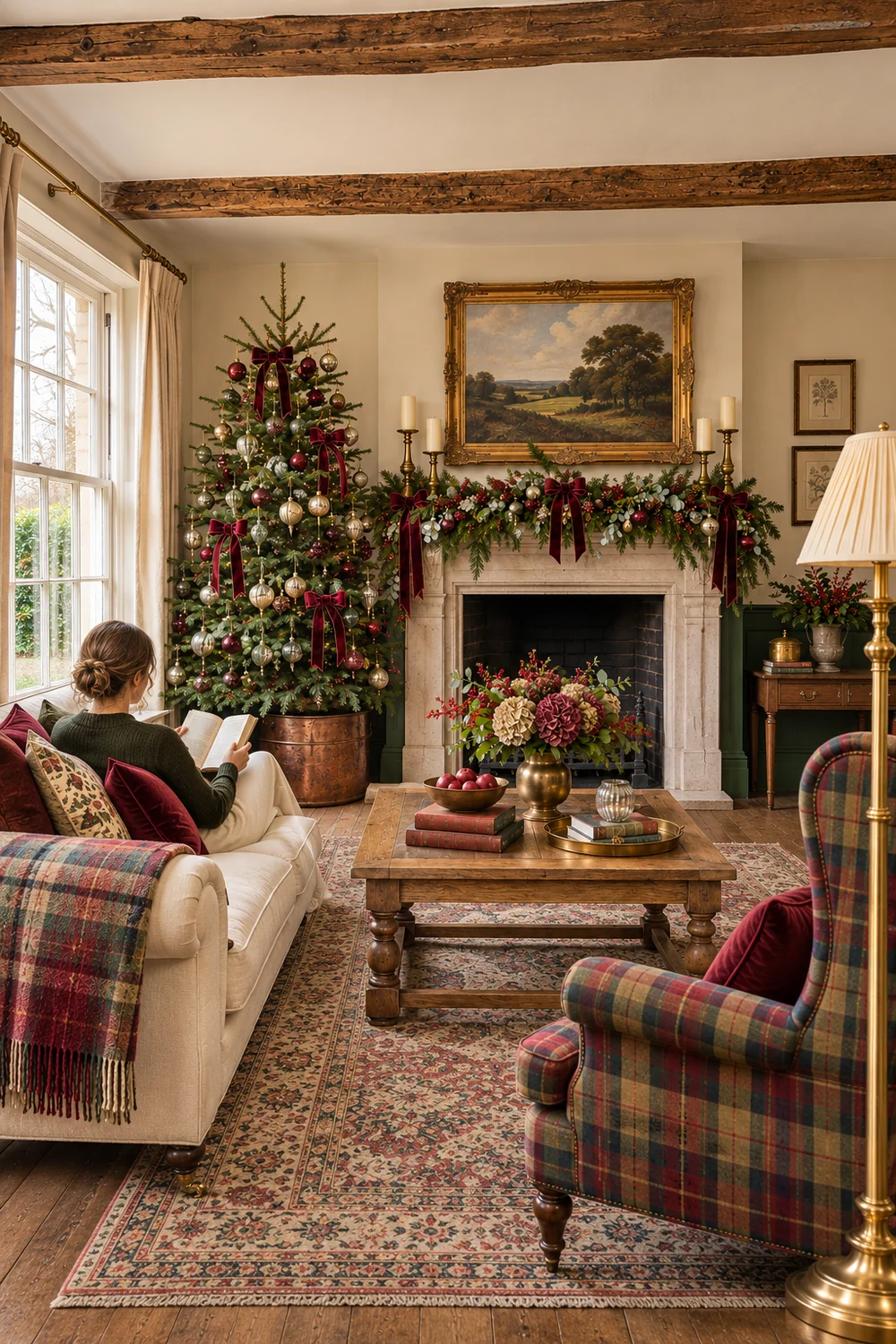
Stand at the doorway and check the largest shapes together. The tree may become the tallest seasonal feature, but it does not need to be the only thing you notice. An existing painting, a good curtain or the fireplace can remain visible. I would move a small accessory before moving a substantial piece of furniture, especially when that furniture already makes the room work well.
Try the main view with the tree location indicated before placing the decorations. You can use the undecorated tree itself, or mark the space it would occupy while you consider the composition. Check what it conceals and which existing shapes it repeats. This is a visual planning exercise as well as a furniture decision: the outline of the tree should strengthen the room, not erase its best feature.
Leave the everyday arrangement legible beneath the festive layer. A chair can carry one tartan cushion or a loosely folded throw; it does not need a stocking, a bow and a pile of packages as well. That restraint around the furniture gives the richer greenery and ornament collection more presence.
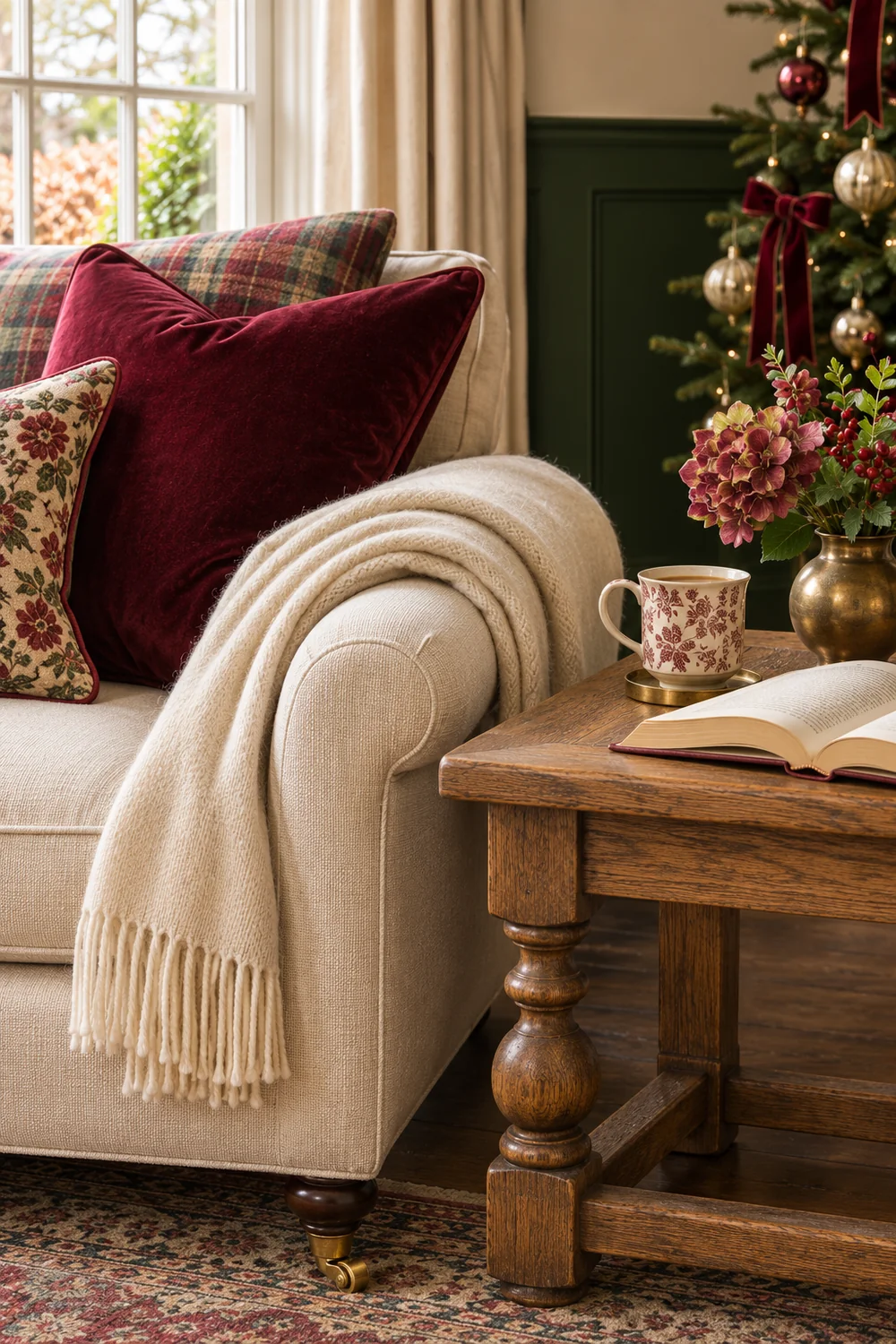
I would use tartan as the bridge between the room and its decorations. A muted check containing green, red and a little gold can connect the tree, ribbon and timber without making every object identical. Start with one tartan you actually like. Look at its quieter colours as well as the obvious red or green, because those small threads often suggest the most useful supporting tones.
Velvet then adds a different kind of depth. Burgundy ribbon beside wool tartan gives the same red family a softer, more substantial surface. I would repeat that velvet in a few visible places, such as the tree and a wreath, while allowing the main upholstery to remain itself. A pair of cushions can join the scheme if they add something the room is missing; they are not a compulsory purchase.
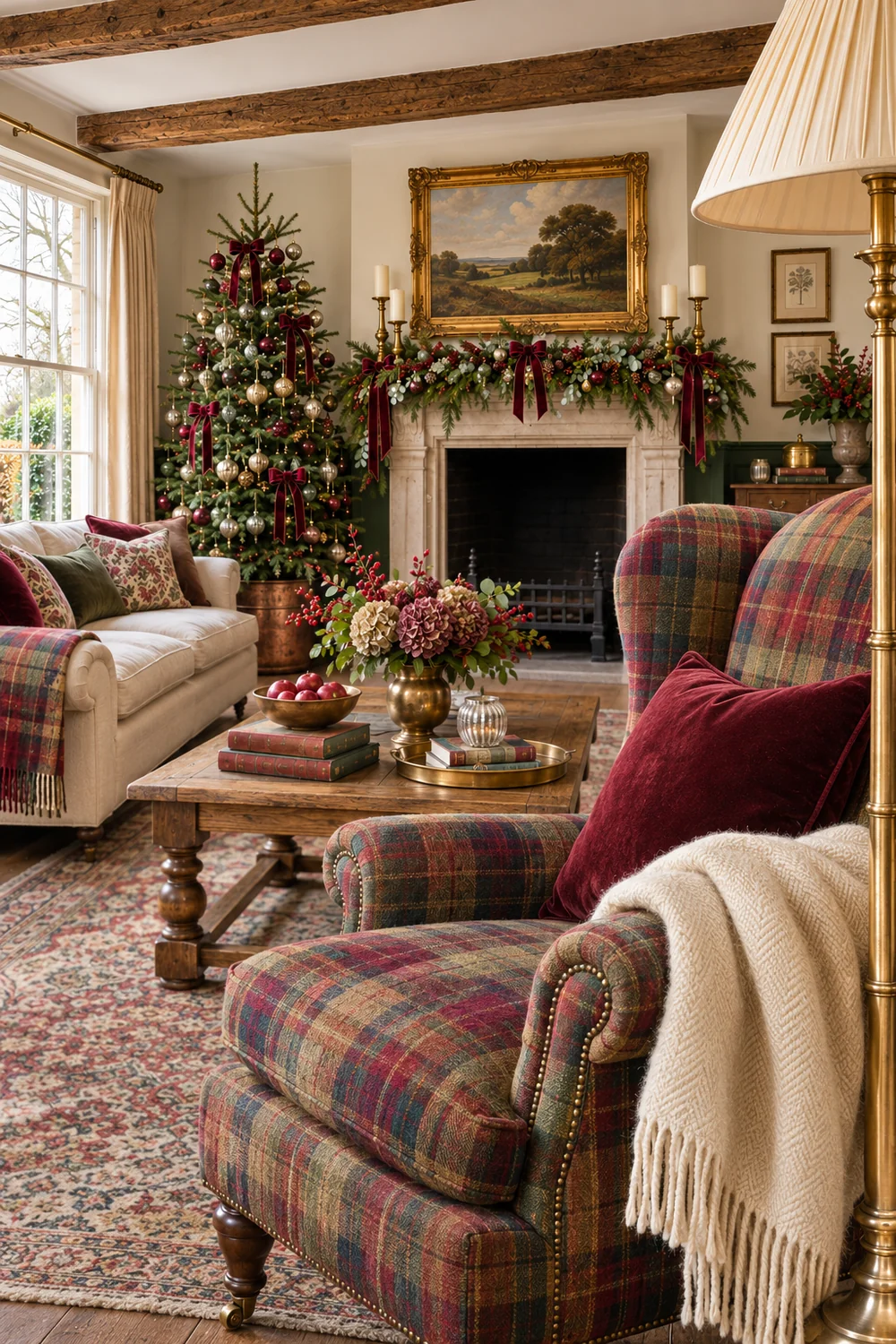
The English countryside colors guide is a useful reference for the relationship between greens, reds and quieter neutrals. Within this Christmas scheme, I would give each material a job. The greenery provides the broad green shape. Tartan connects the colours. Velvet supplies a rich accent. Cream linen and pale walls allow the darker details to stay visible.
Pattern scale matters as much as colour. If the armchair already has a broad tartan, I would avoid placing an equally bold, unrelated check immediately beside it. A smaller stripe, plain linen or a quiet wool blanket can give the eye a pause. You can enjoy several patterns in one room while still letting one of them lead the festive story.
If your room already has substantial green upholstery, let that supply some of the green weight and keep the added fabrics quieter. In a predominantly cream room, the tree and tartan may need to carry more of the colour. The hierarchy should respond to the room you have, rather than repeating the same quantity of every material in every setting.
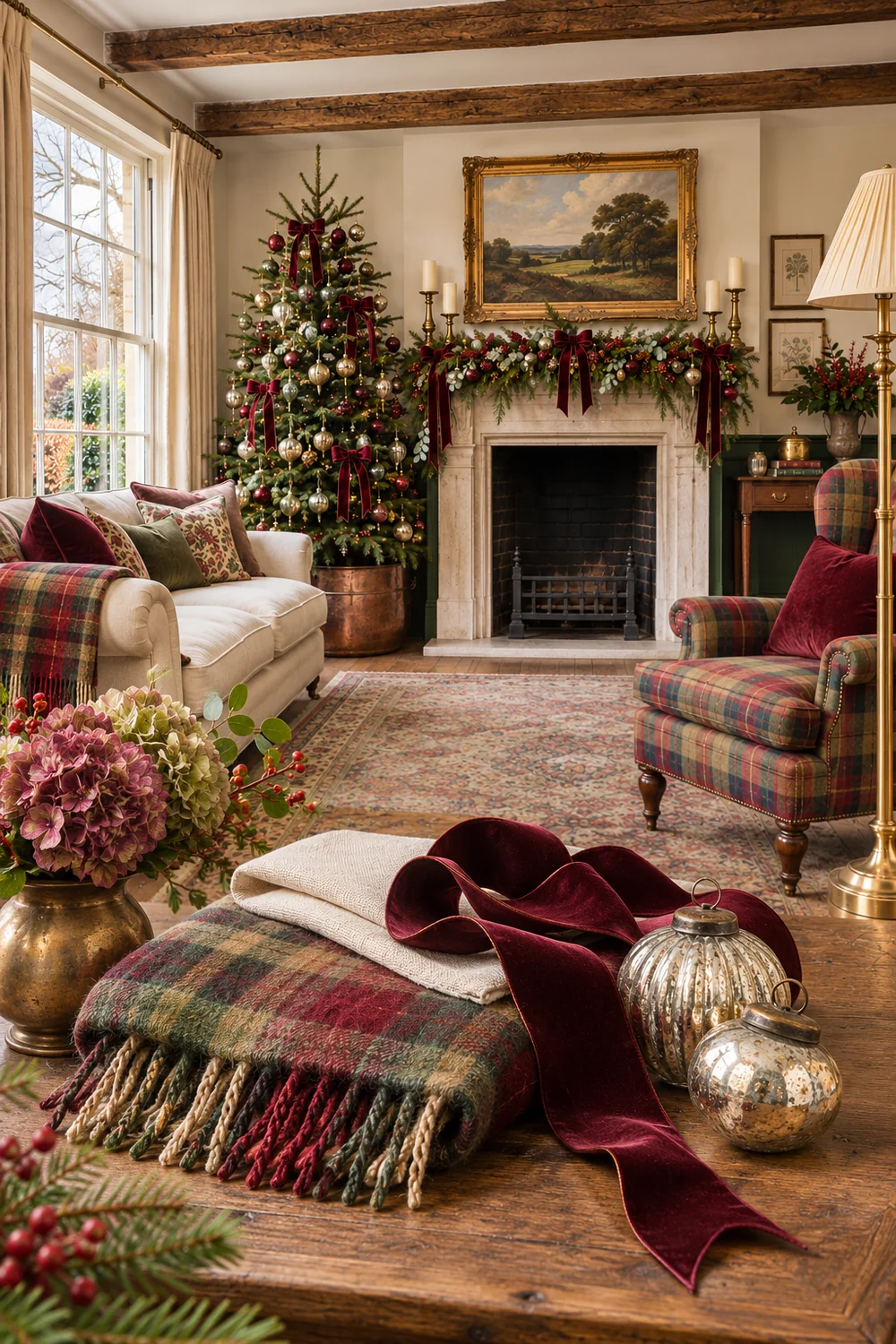
I would make the judgement from the doorway as well as from the chair. A ribbon that looks nearly black in your hand may read as a beautiful red beside a lit window, or disappear against the deepest part of the tree. Hold the proposed fabrics beside the retained ornaments in the room itself. Choose the relationship you can actually see, rather than relying on a colour name or a screen.
The tree and mantel should look as though they belong to the same Christmas, even when their decoration is different. I would repeat one ribbon colour and one metallic finish between them, then vary the scale. A tree can carry many small personal ornaments. The mantel usually benefits from a broader sweep of greenery and fewer, more legible objects.
Start by deciding which feature should lead when you enter. If the tree sits beside a bright window, let its outline and ornament collection draw the first glance. The mantel can answer with a quieter line of green and a few burgundy bows. If a substantial fireplace already dominates the room, the tree can feel lighter, with more space between the decorations and a less elaborate topper.
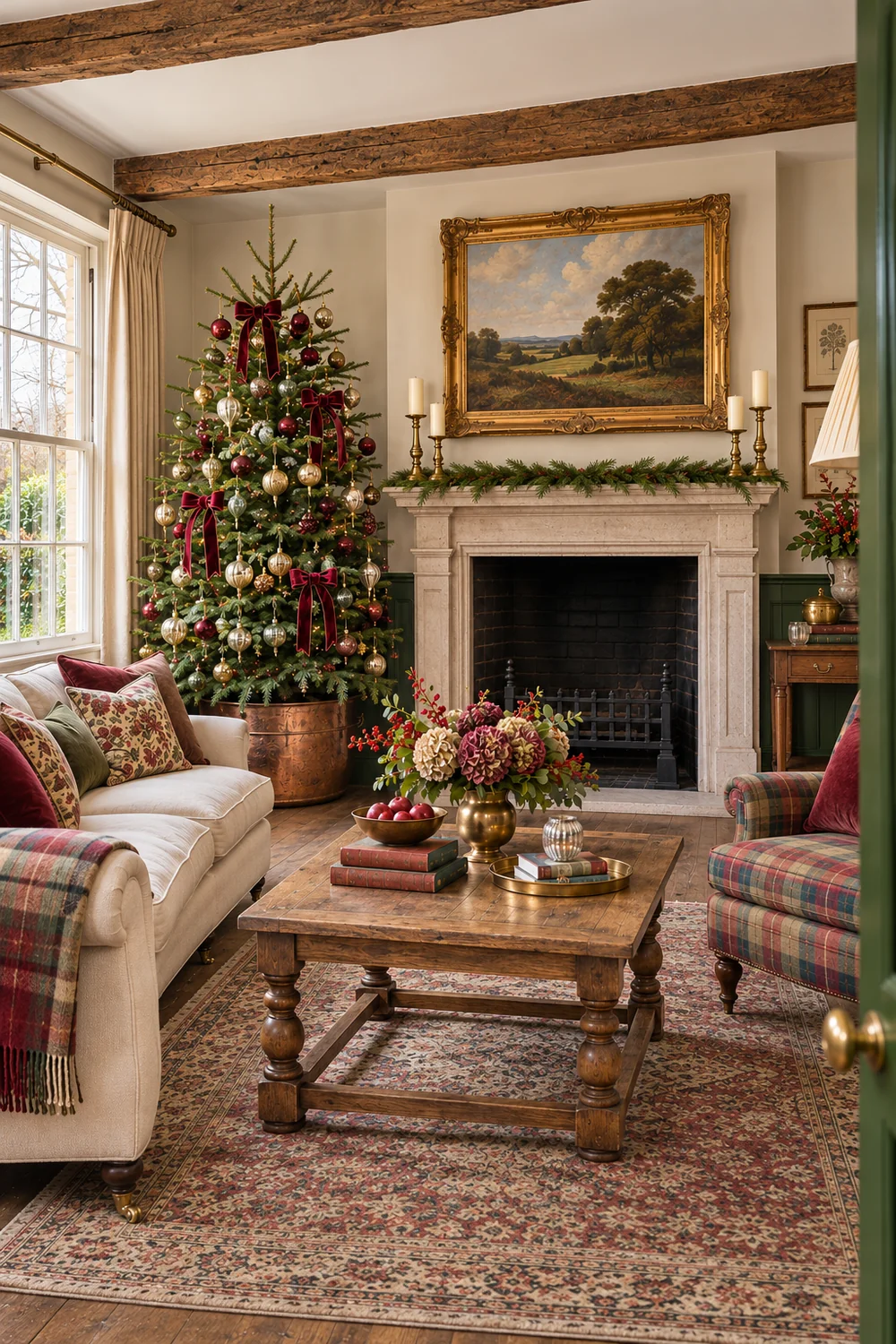
I would carry the room’s existing proportions into the greenery. A broad mantel can support an arrangement with some horizontal reach; a narrow shelf calls for a more contained shape. The aim is to relate the decoration to the architecture, not to make every mantel resemble the largest one in a photograph. Keep a painting or mirror visible if it is an important part of the room.
Once those relationships are clear, the English country Christmas decor selection guide takes the next step: choosing ribbon, greenery, glass and textiles that actually fulfil the plan. The room plan should already tell you where each material belongs. The selection stage can then resolve finish, scale and quantities without starting the entire scheme again.
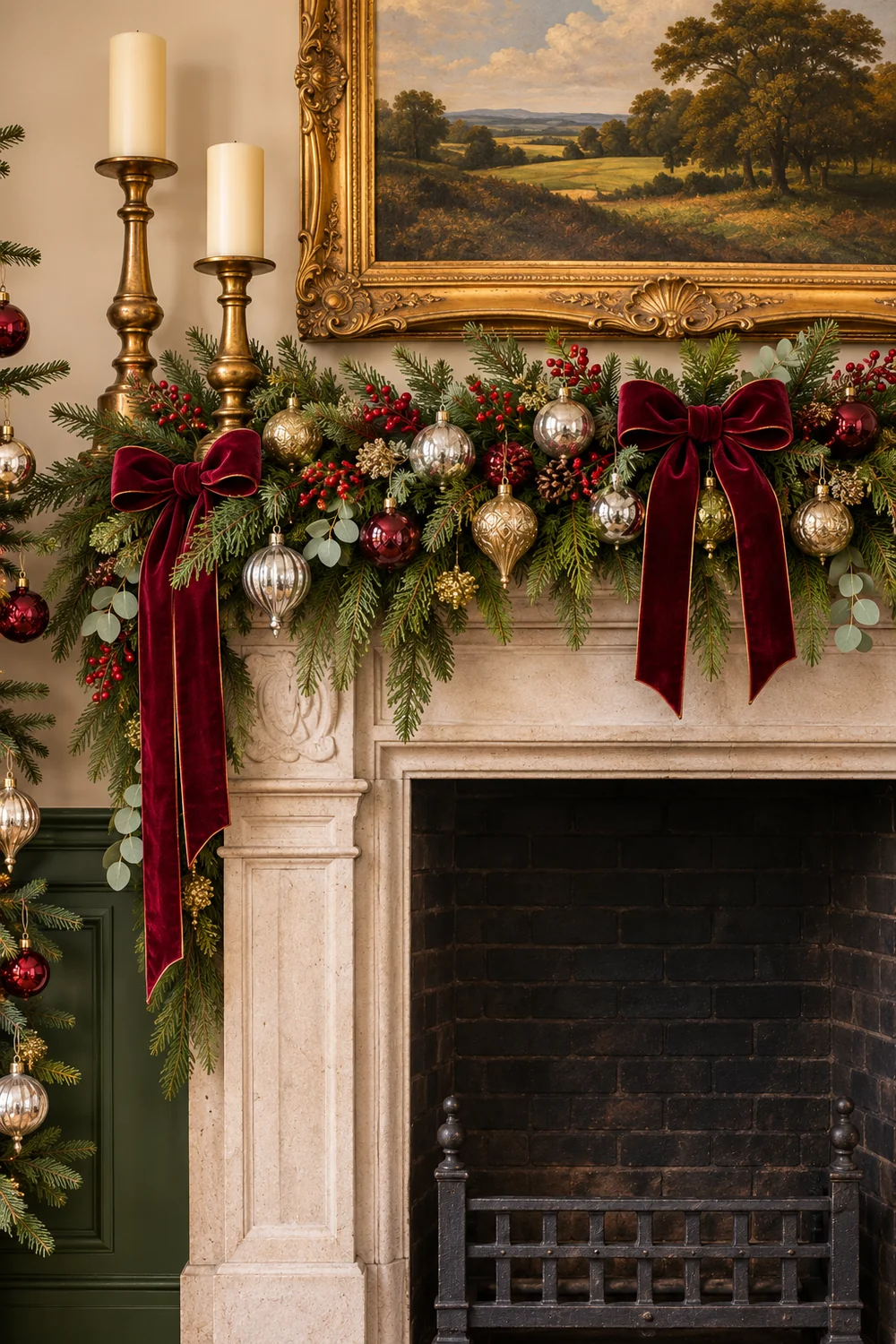
Treat greenery around a working fireplace as a separate practical decision. London Fire Brigade advises keeping decorations and other combustible materials away from heat and naked flames. I would follow the appliance instructions and move the decorative arrangement to a separate console if the fireplace clearances cannot be maintained. The illustrated stone fireplace in this scheme is unused, with an empty hearth.
A console can carry the same visual idea beautifully: a generous arrangement of foliage, a framed picture and a small group of ornaments. The essential relationship is the repeated palette and the balance of large and small shapes. You do not need a fireplace, or an elaborate garland draped over one, to make an English country room feel festive.
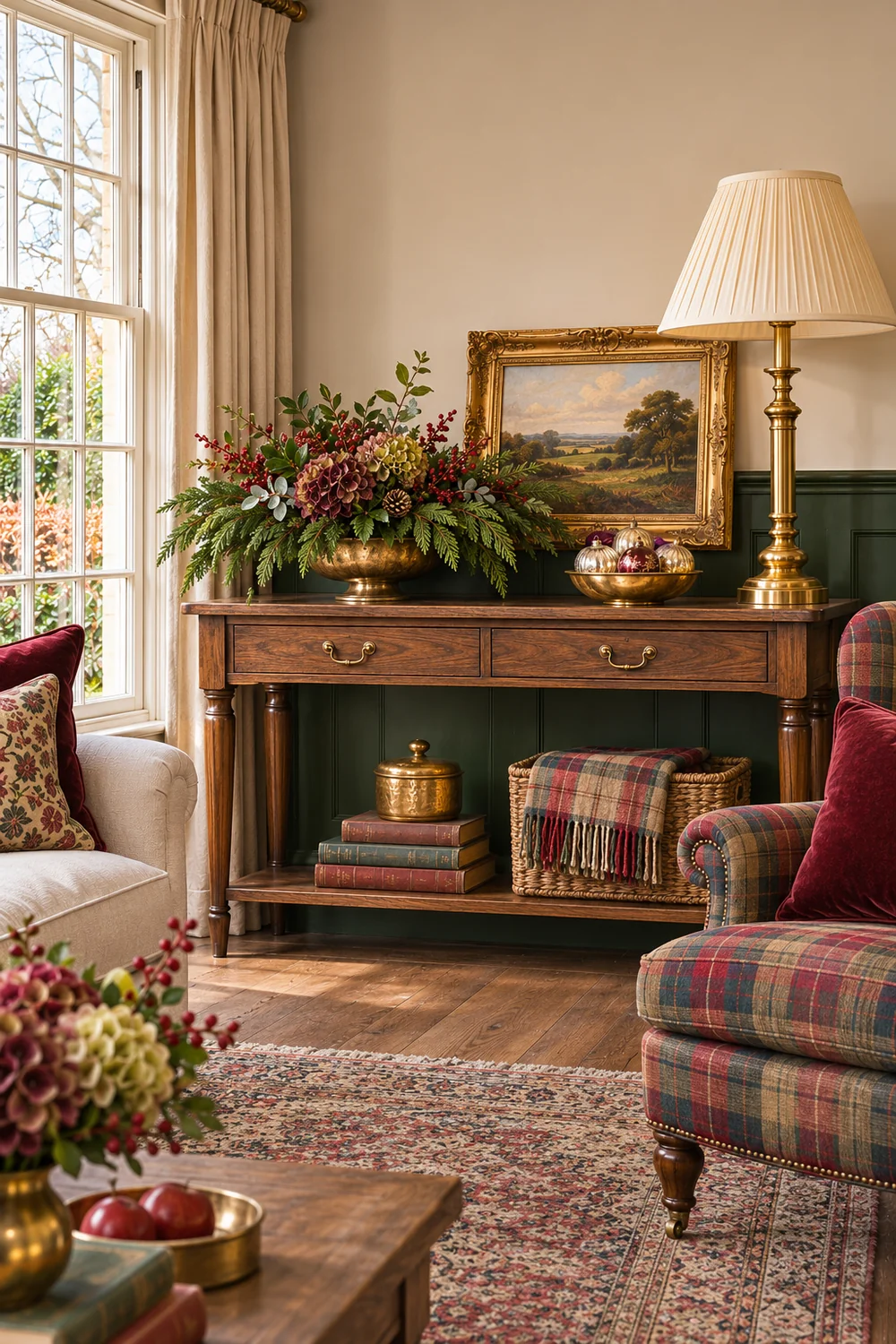
With the tree and main decorative surface established, I would bring the scheme back towards the places where people sit. A tartan armchair beside cream upholstery is already doing useful work. Add a wool throw where it will actually be used, or a burgundy cushion where the colour helps connect the seating to the tree. Keep enough space to sit down without first removing a display.
Look across the room at eye level. A wreath at the window, a small bowl of old baubles or a ribbon on one existing frame can carry the palette into the quieter side of the room. I would choose one of those gestures before trying all of them. The finished effect should feel repeated and comfortable, with some surfaces left calm.
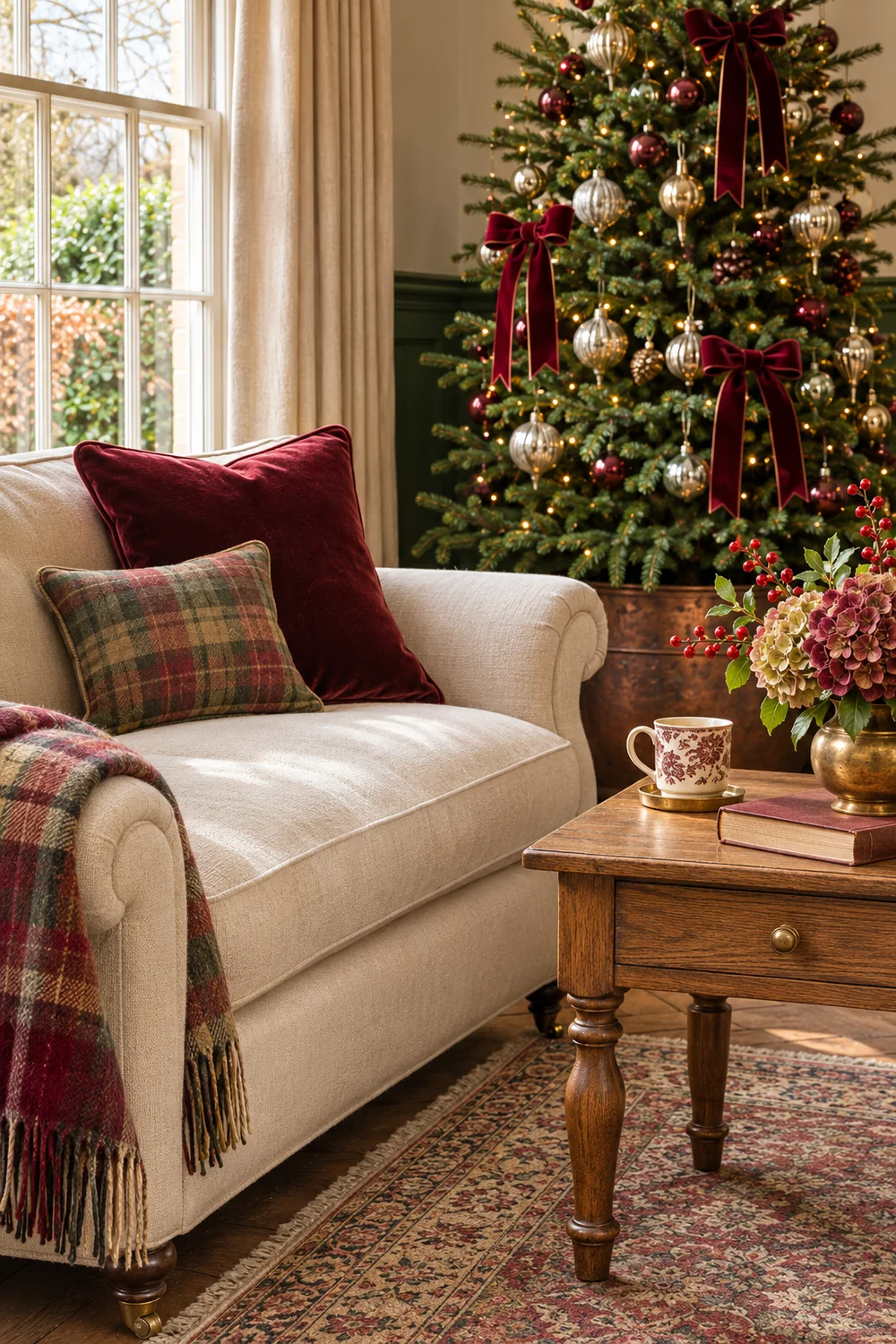
The Christmas fireplace collection offers further examples of greenery, stockings and seasonal texture. I would borrow only the detail that supports this room’s plan. If the tree already carries a large ornament collection, a simpler focal surface may serve it better than another dense display competing immediately beside it.
Keep the window’s daylight useful. A wreath can sit within the glazing without filling the entire opening, and ribbon can repeat the scheme without requiring new curtains. Check the view with the curtains both open and closed. A decoration that catches on the fabric, blocks a handle or makes the window awkward to use needs another position, however attractive it looks in a still photograph.
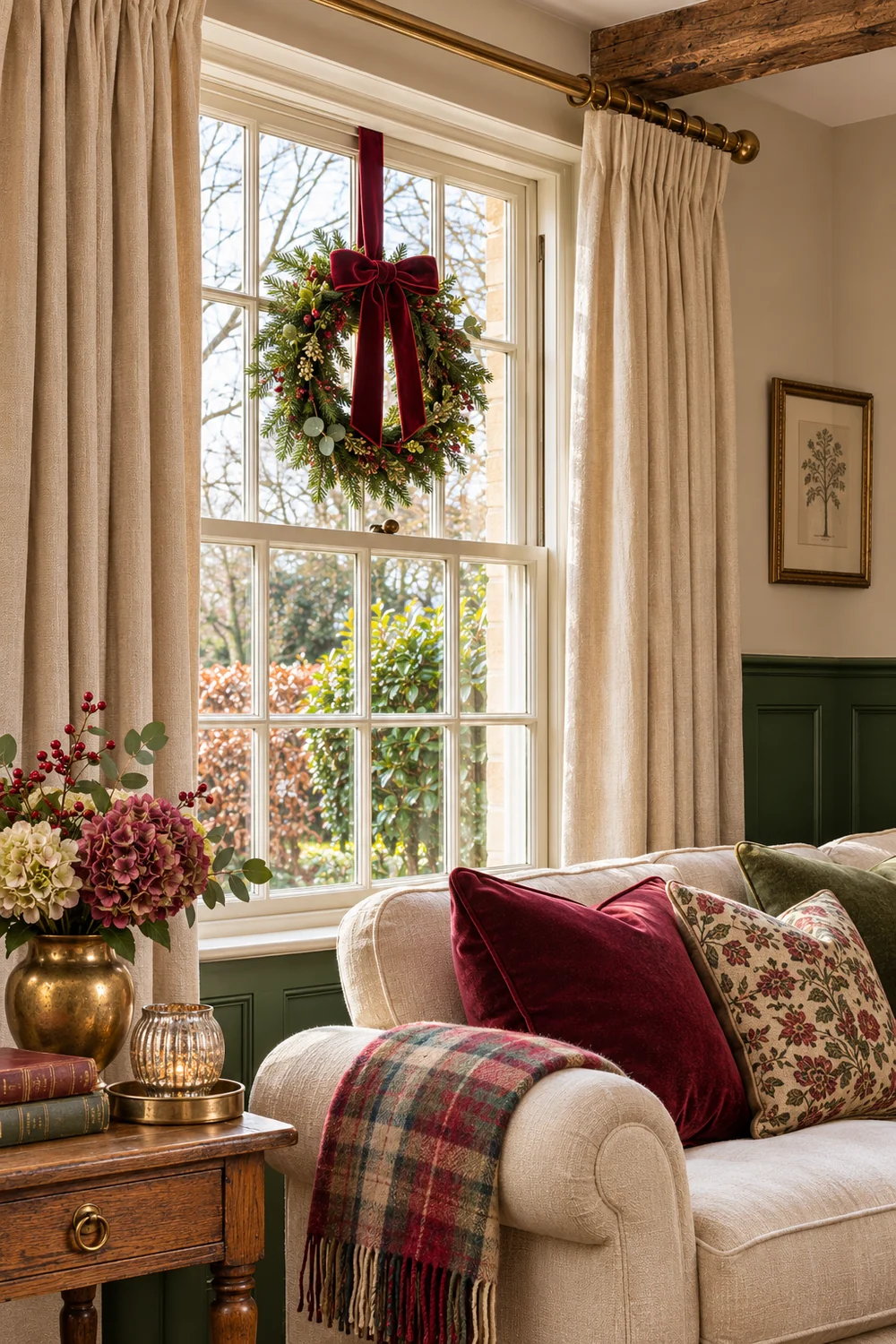
Finally, consider the room from the sofa. You may see the back of the tree, the side of the mantel and the console rather than the doorway composition. I would give that everyday view its own small pleasure: a favourite ornament facing the chair, a beautifully folded throw or a sprig of greenery beside the lamp. The people using the room should enjoy the scheme as much as someone arriving at the door.
I would finish with a simple record of the room, not a long list of decorations to buy. Photograph the existing furnishings and the family pieces you are keeping. Beside them, note the main palette, the role of the tartan, the ribbon colour and the surfaces that will carry greenery. That is the brief against which every proposed addition can be judged.
For the illustrated room, the brief is straightforward: cream seating and aged timber remain; the tartan chair supplies the red and green; burgundy velvet repeats between tree and mantel; varied old glass stays prominent. The new pieces should help those elements relate. A fresh packet of ornaments is useful only if it resolves an actual gap in that composition.
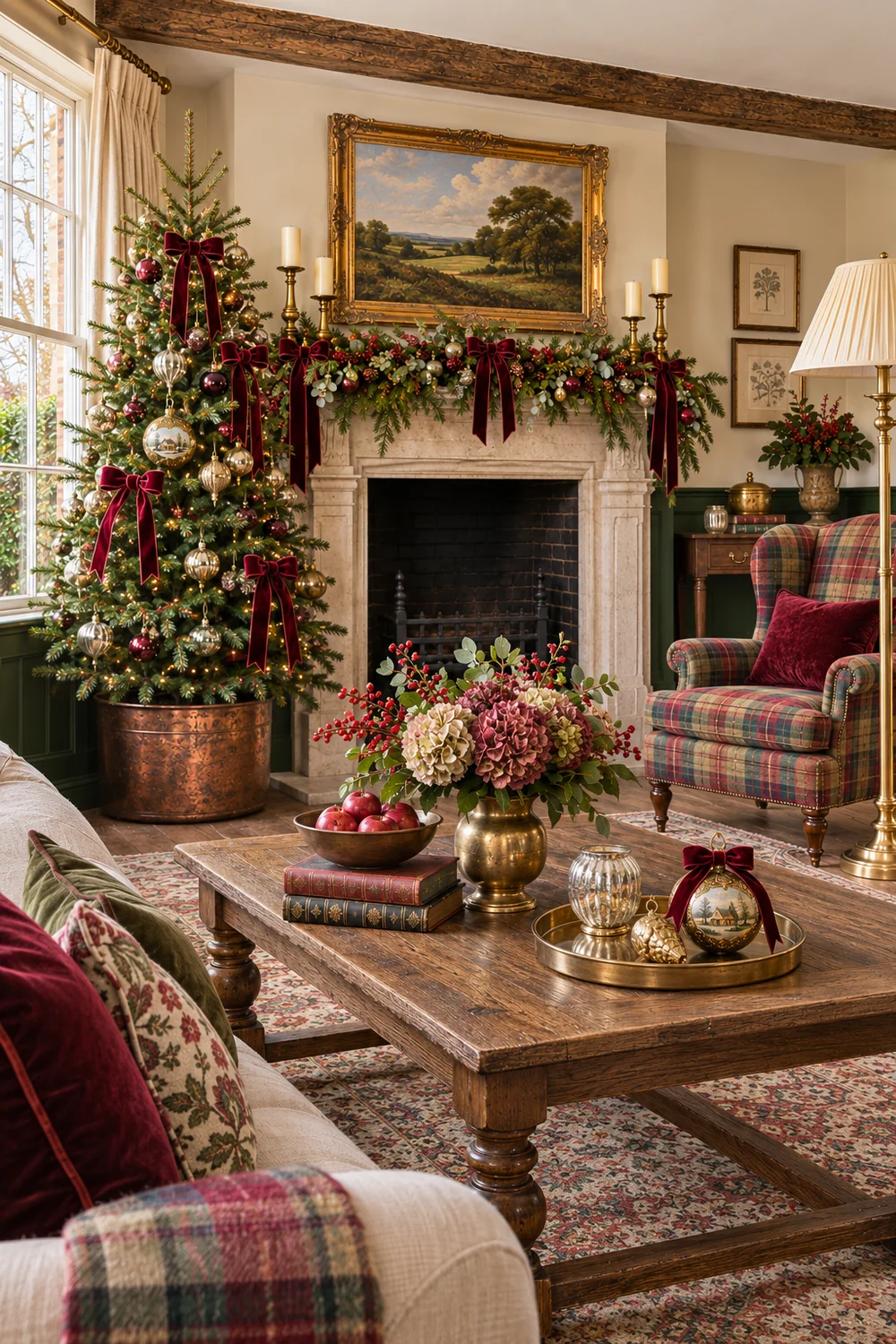
Before you shop, check three things:
If the answer is uncertain, I would wait. A room can feel generous because of a full tree, substantial greenery and good fabric, while still containing relatively few different decorative ingredients. More variety is not always what the composition needs.
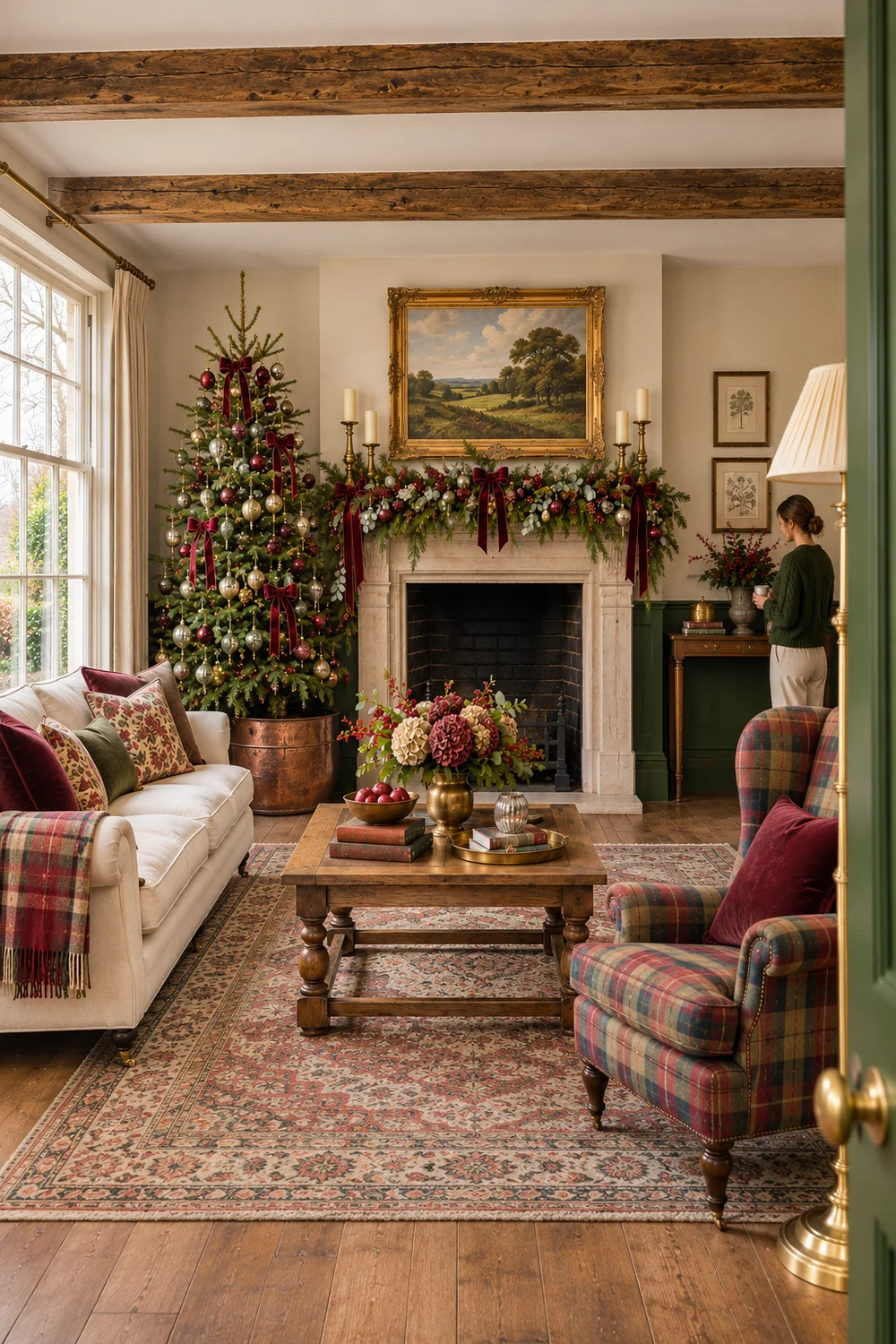
I would also keep one photograph of the finished room in daylight. It makes the relationship between ornaments, fabric and architecture easier to see than a collection of isolated closeups. Use it to decide whether an awkward area needs a change of proportion, a repeated colour or simply one less object. The next step is a precise selection of additions that supports the room you have already planned.
The result I would aim for is a living room where the family’s decorations look at home, the existing furniture still matters and the festive layers feel generous without taking over. Tartan, velvet and greenery provide the structure. The familiar ornaments supply the character that a completely matching set could never reproduce.