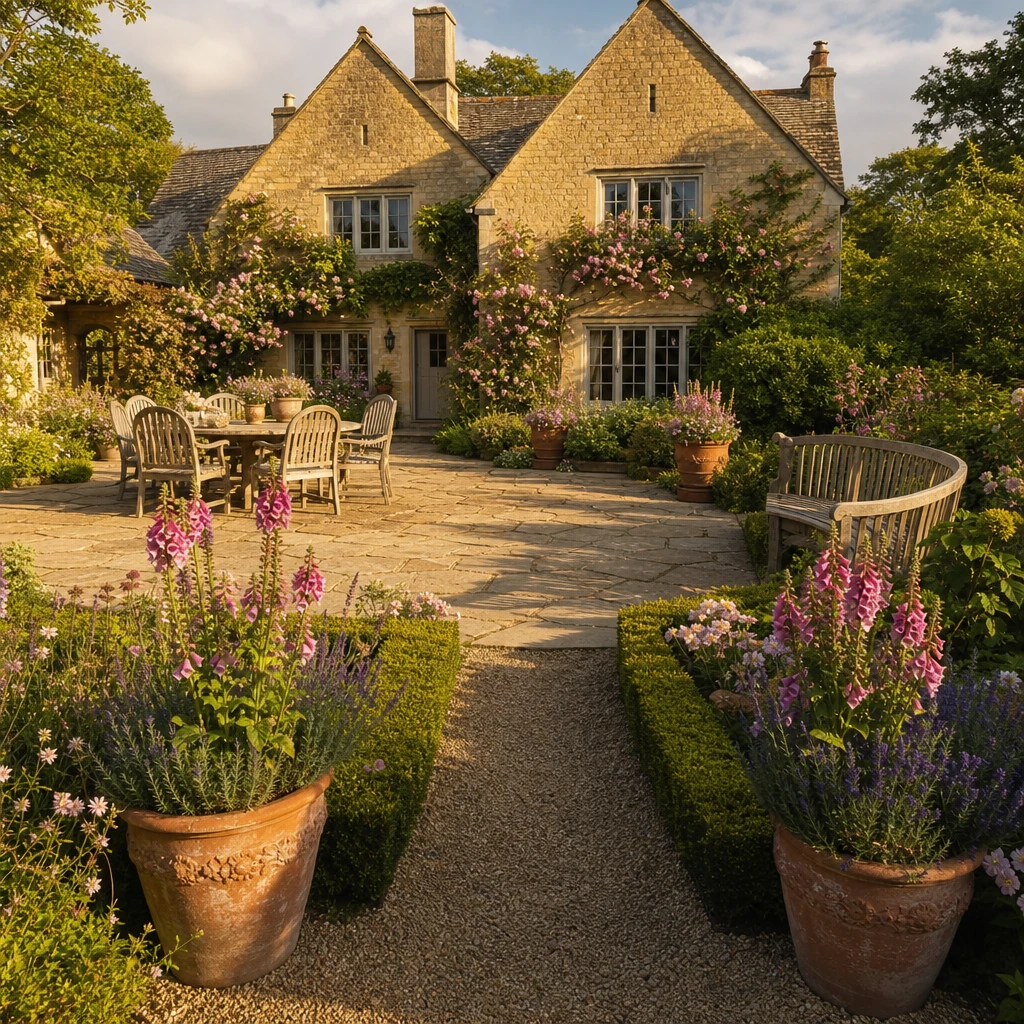
I’ve always thought a great English Country Garden Patio feels less like a designed space and more like somewhere that simply grew that way over time. What I love most is how a few well chosen details, a mossy stone terrace, a tangle of climbing roses, a bistro table set in dappled shade, can make even a modest backyard feel genuinely magical. Every look in this piece is one you can borrow and make your own.
How a Stone Cottage Backdrop Makes Outdoor Seating Feel Rooted and Real
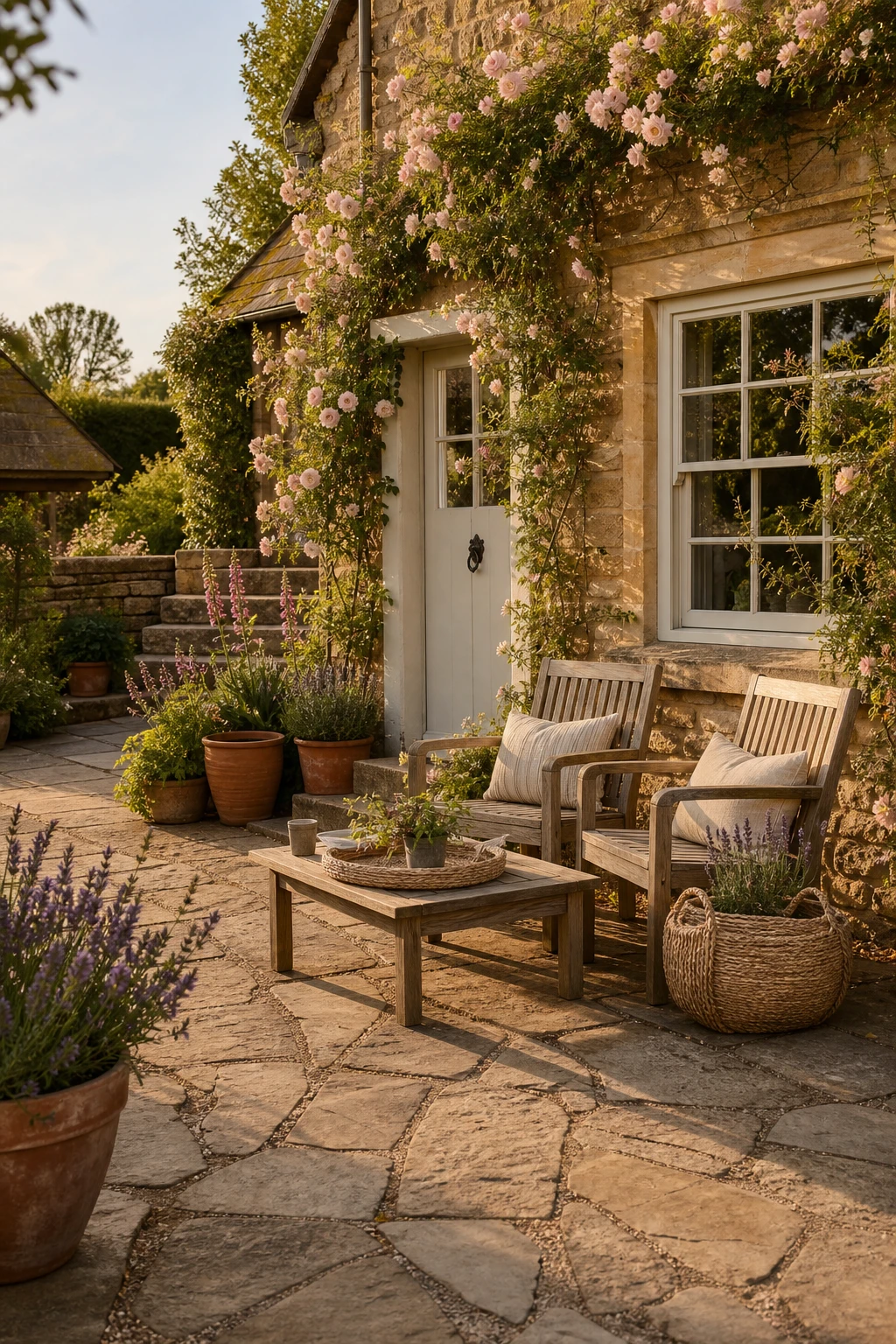
Placing seating right against a stone cottage wall is one of my favourite moves outdoors. The wall becomes a natural headboard for the space, and you get that settled, purposeful feeling that loose furniture on an open lawn never quite achieves. Watch how the rough texture of the stone plays against smooth teak or linen cushions, that contrast is what gives the scene its warmth and character.
The Key Details
Weathered teak armchairs
Irregular flagstone terrace
Climbing roses on cottage facade
Terracotta planted pots on steps
Timber cottage window frames
Pro TipPull a warm buff or sandy tone from the stone itself when choosing your cushion fabric and the whole seating area will look like it grew there.
AvoidPulling furniture even half a metre too far from the wall breaks the connection to the architecture and leaves the chairs looking abandoned rather than arranged.
The Cotswolds Cottage Exterior Touch That Gives a Patio Its Warmest Glow
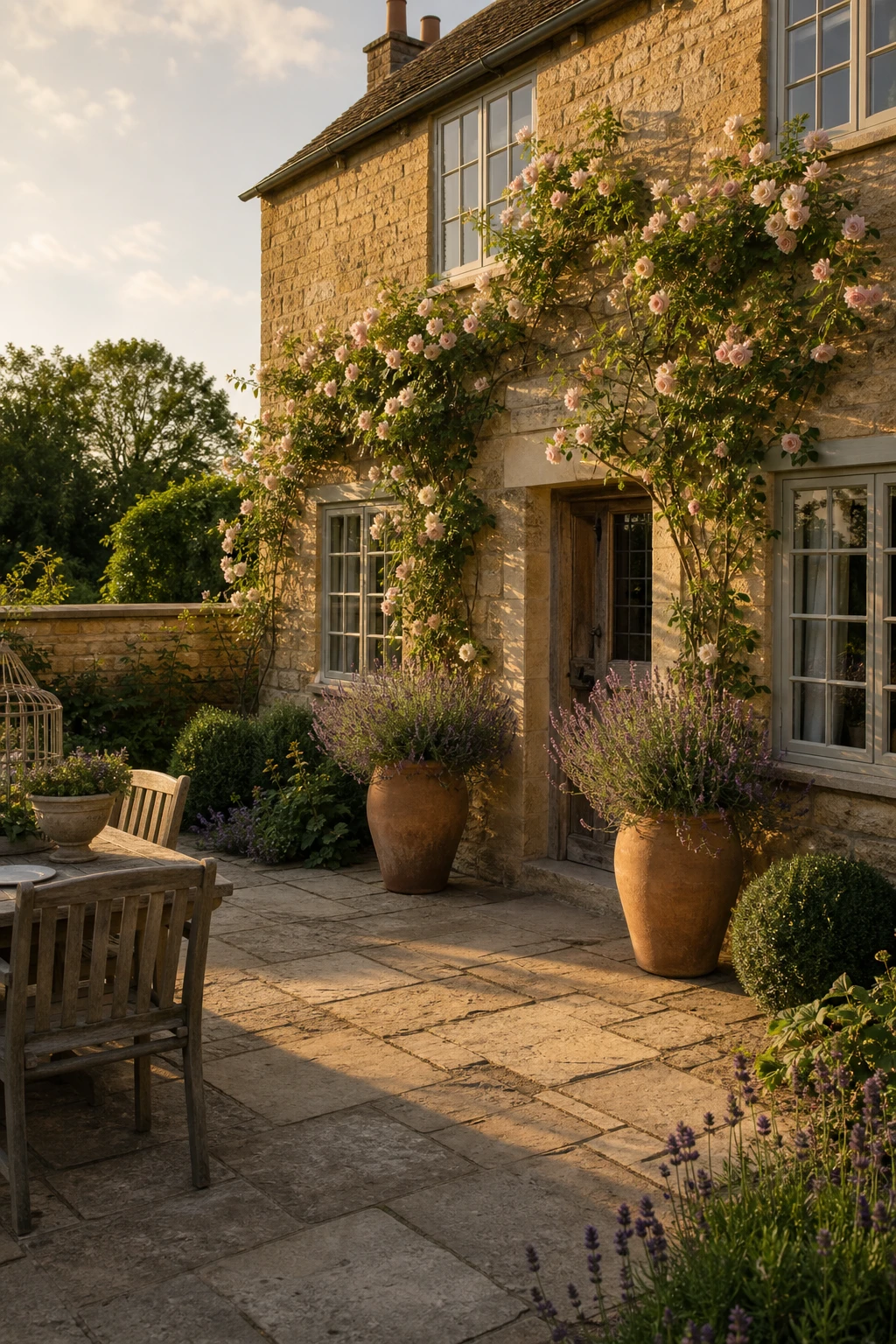
Honey stone pulls every outdoor element into the same warm orbit, so the patio feels settled and unhurried rather than assembled. What I love is how the amber tones in the wall face echo down into York stone underfoot, giving you that seamless glow from floor to facade. Climbing roses and aged terracotta lean straight into it, as if the whole scene grew there naturally.
The Key Details
Timber casement windows
York stone flagged terrace
Climbing roses on facade
Aged terracotta urns with lavender
Recessed timber cottage door
Pro TipMatch your flagstone as closely as you can to the wall stone in undertone, even a half shade difference in warmth keeps the eye moving smoothly from ground to facade.
AvoidCombining more than two distinct stone finishes on the same elevation breaks the warm continuity and leaves the space feeling patchy rather than considered.
Tudor Garden Geometry That Gives a Patio Its Sense of Order and Age
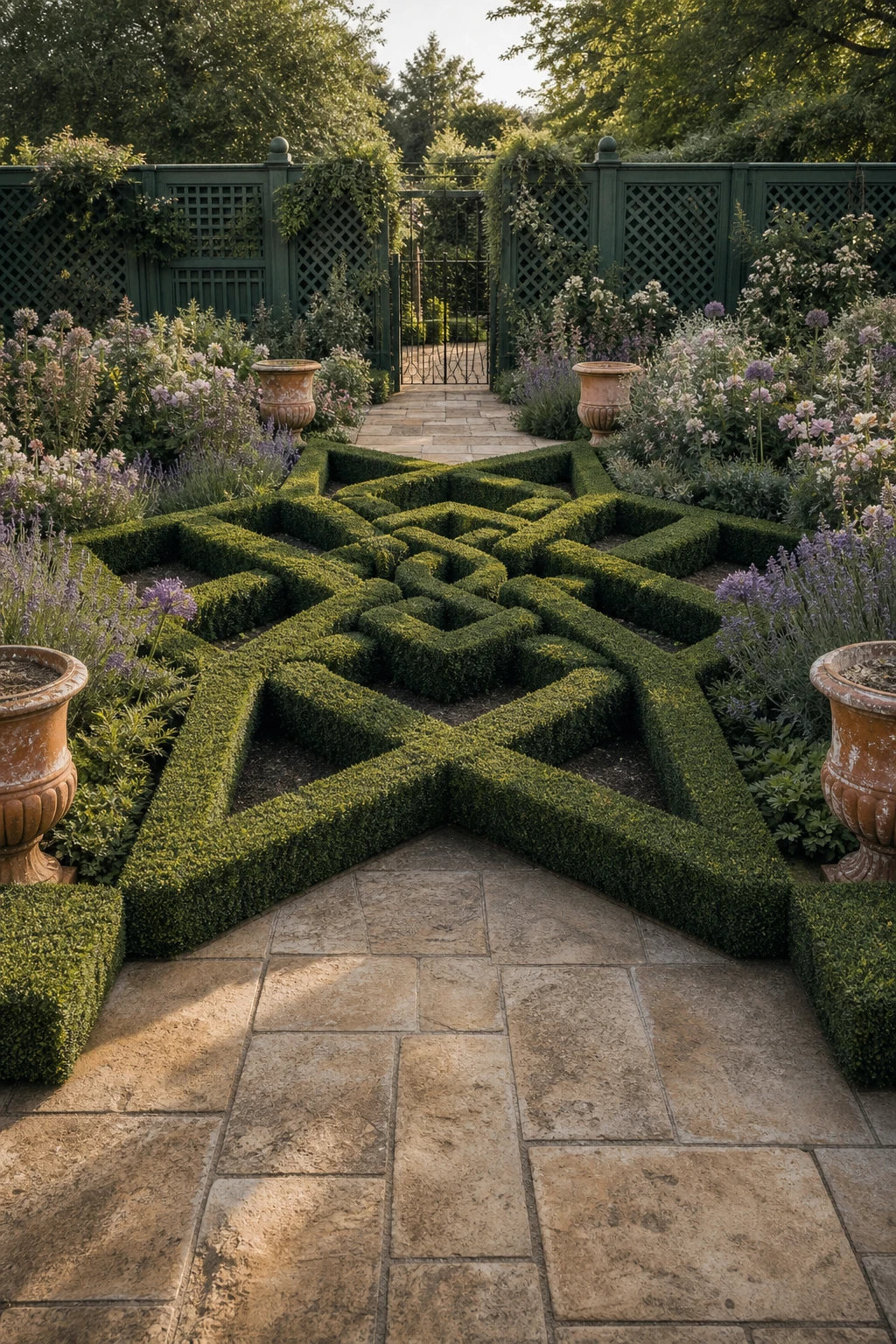
Tudor knot structure gives a patio that sense of always having been there, and the clipped geometry is what I keep reaching for when a space needs a clear framework for the eye to rest on. Then the loose cottage planting spilling inside each compartment feels generous rather than messy. You get that satisfying pull between control and wildness, which is exactly what English country gardening does best.
The Key Details
Clipped box knot hedging
York stone paving
Timber garden trellis
Weathered terracotta urns
Wrought iron edging details
Pro TipLay out your low clipped borders and let them establish for a full season before you plant anything inside them, so the geometry reads clearly from the first day.
AvoidLetting soft planting swallow the clipped lines turns the whole composition into a muddle, and the sense of age and order you worked to create disappears completely.
Stealing the English Country Estate Look for a Garden You Actually Have
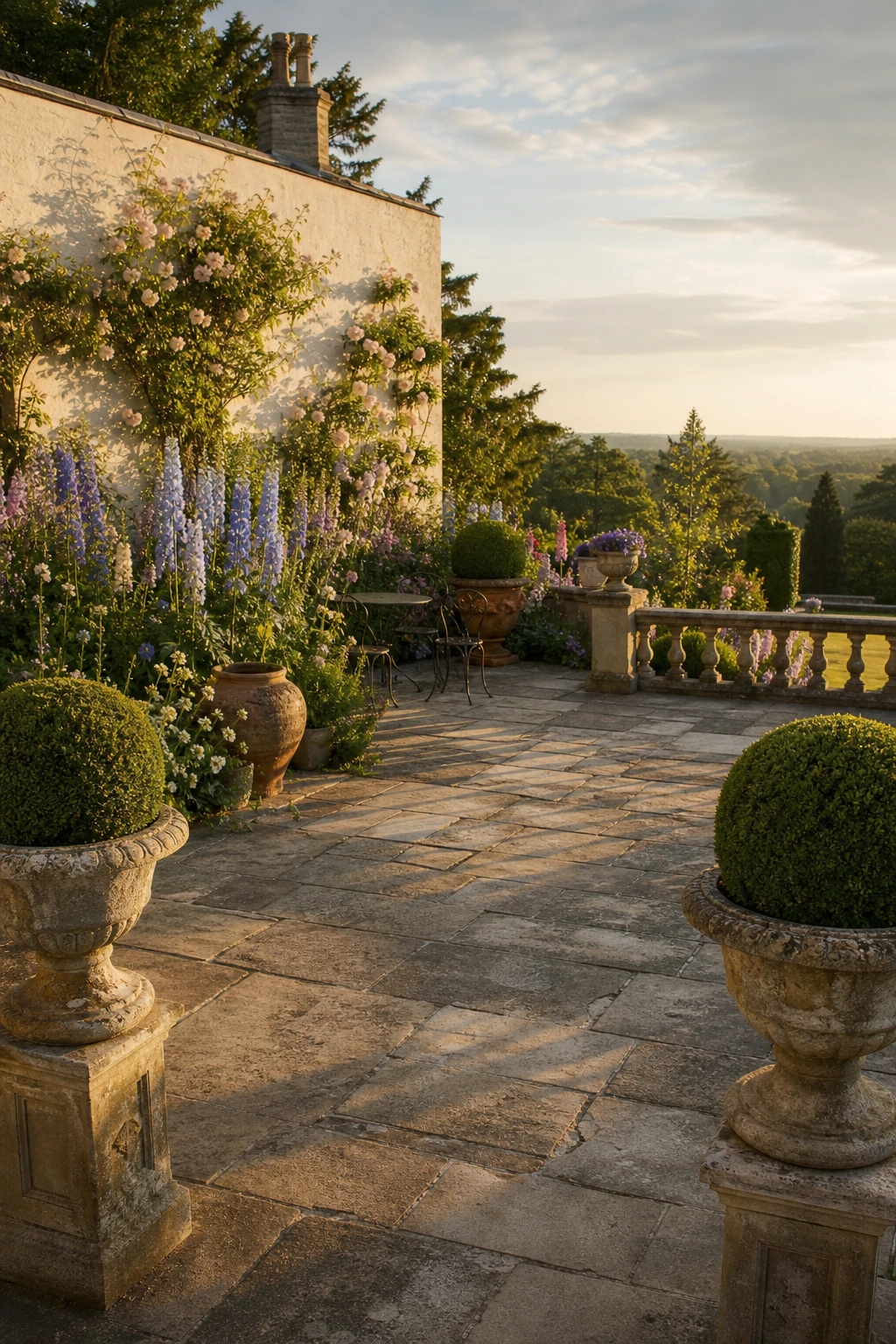
Borrowing from the grand estate is really about editing down to one or two signature moves, and what wins me over every time is a single oversized focal point that pulls the whole space upward. You get that sense of arrival and permanence without needing acres behind you. Watch how a pair of weathered stone urns flanking a doorway or steps does the heavy lifting: the eye reads scale, the surrounding planting feels considered, and suddenly a modest terrace carries real weight.
The Key Details
Clipped box topiary in aged stone urns
Reclaimed limestone flagstone terrace
Low stone balustrade
Sweeping herbaceous border with delphiniums and climbing roses
Wrought iron garden furniture
Pro TipChoose one large focal point, a substantial urn, a bold topiary or a stone bench, and let everything else sit quietly around it so the grandeur lands in one clear, unhurried moment.
AvoidMixing an oversized urn, a wide balustrade, a large table and statement topiary all at once crowds the space and cancels the very sense of calm authority you were after.
Why a Courtyard Garden Feels So Sheltered and How to Copy That Coziness
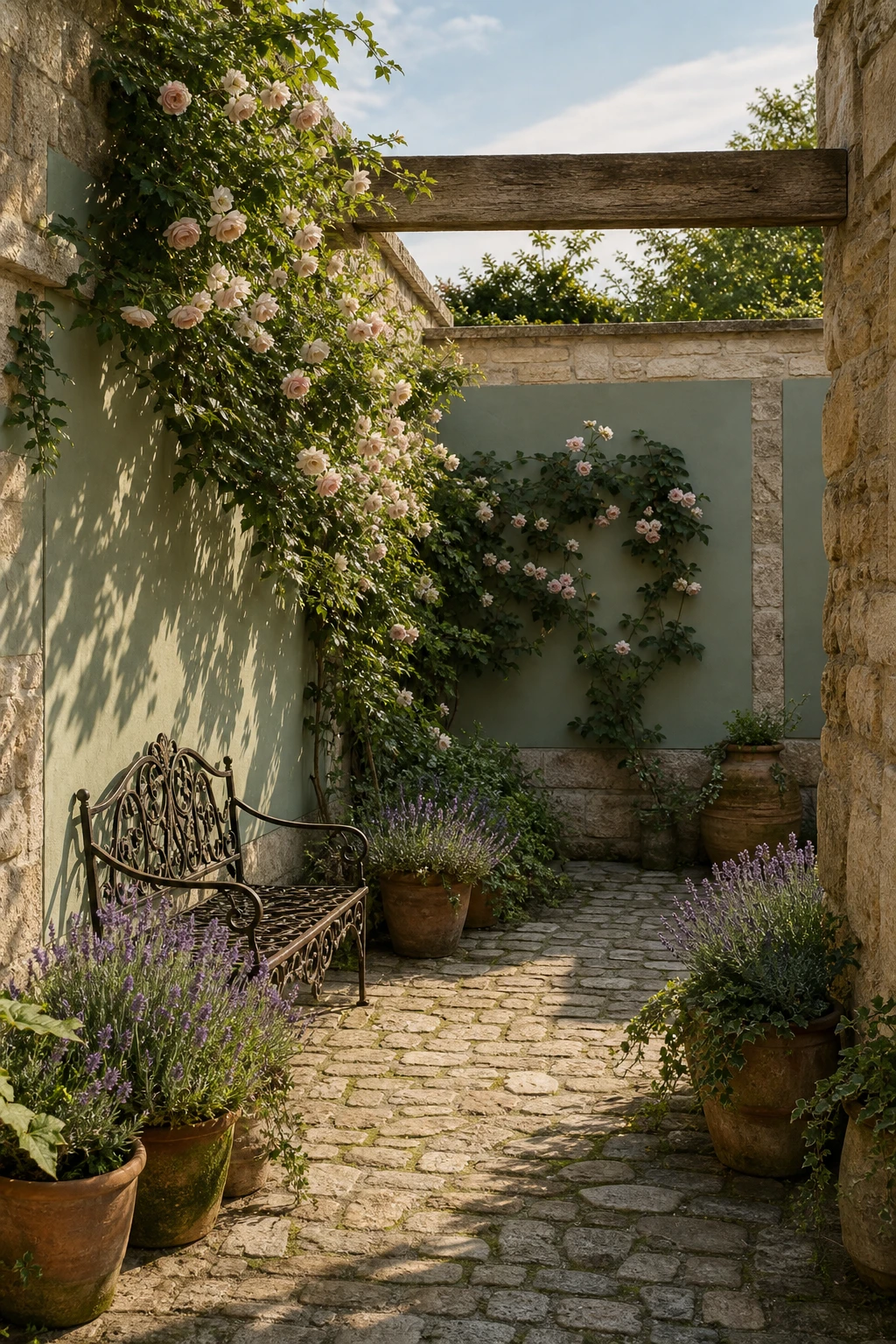
An enclosed courtyard does something the open garden rarely can: it wraps you in. When tall walls or trained climbers rise on two or more sides, the space stops feeling like a patch of ground and starts feeling like a room. What I love most is that enclosure also traps warmth and muffles noise, so you actually linger longer. You get that tucked away intimacy that makes a small courtyard feel more generous than a sprawling open terrace ever could.
The Key Details
Wrought iron garden bench
Climbing rose on stone wall
Aged terracotta pot cluster
Reclaimed timber pergola beam
Cobblestone courtyard floor
Pro TipFix trellis panels to at least two facing walls before you plant anything, so climbers have a clear path to meet overhead and close the space in.
AvoidBare courtyard walls with only ground level planting leave the eye with nowhere to travel upward, and the whole space reads as a box rather than a retreat.
Front Yard English Cottage Garden Ideas That Make Guests Stop and Stare
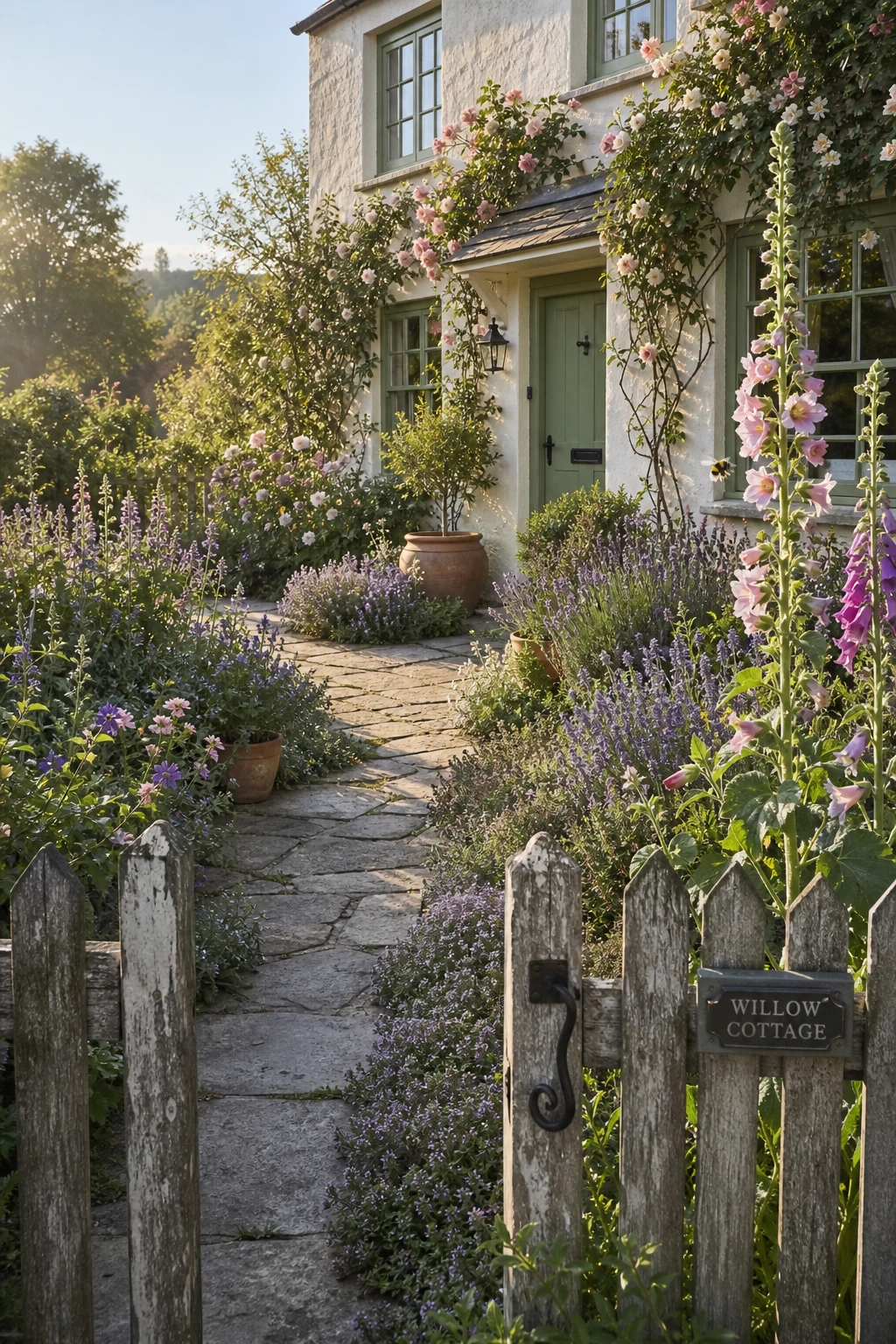
Layering height from the path edge right up to the door is the move that gives a cottage front garden its signature tumbling charm. You get low edging plants spilling softly over the stone, mid height perennials pulling the eye inward, and tall hollyhocks or climbing roses leaning into the facade, so the whole planting reads as one generous, breathing sweep rather than a flat border. What wins me over every time is how guests slow down without quite knowing why.
The Key Details
Aged York stone path
Weathered timber picket gate
Layered cottage planting with hollyhocks and climbing roses
Hand thrown terracotta pots
Lime rendered cottage facade
Pro TipPlant your tallest climbers and hollyhocks within a metre of the front wall so the facade itself becomes part of the planting, anchoring the whole layered composition.
AvoidClipping everything into neat, matching rows strips out the gentle asymmetry that makes cottage planting feel alive, leaving you with something that looks more like a municipal border than a front garden.
Small English Garden Tricks That Make a Tiny Patio Feel Twice as Big
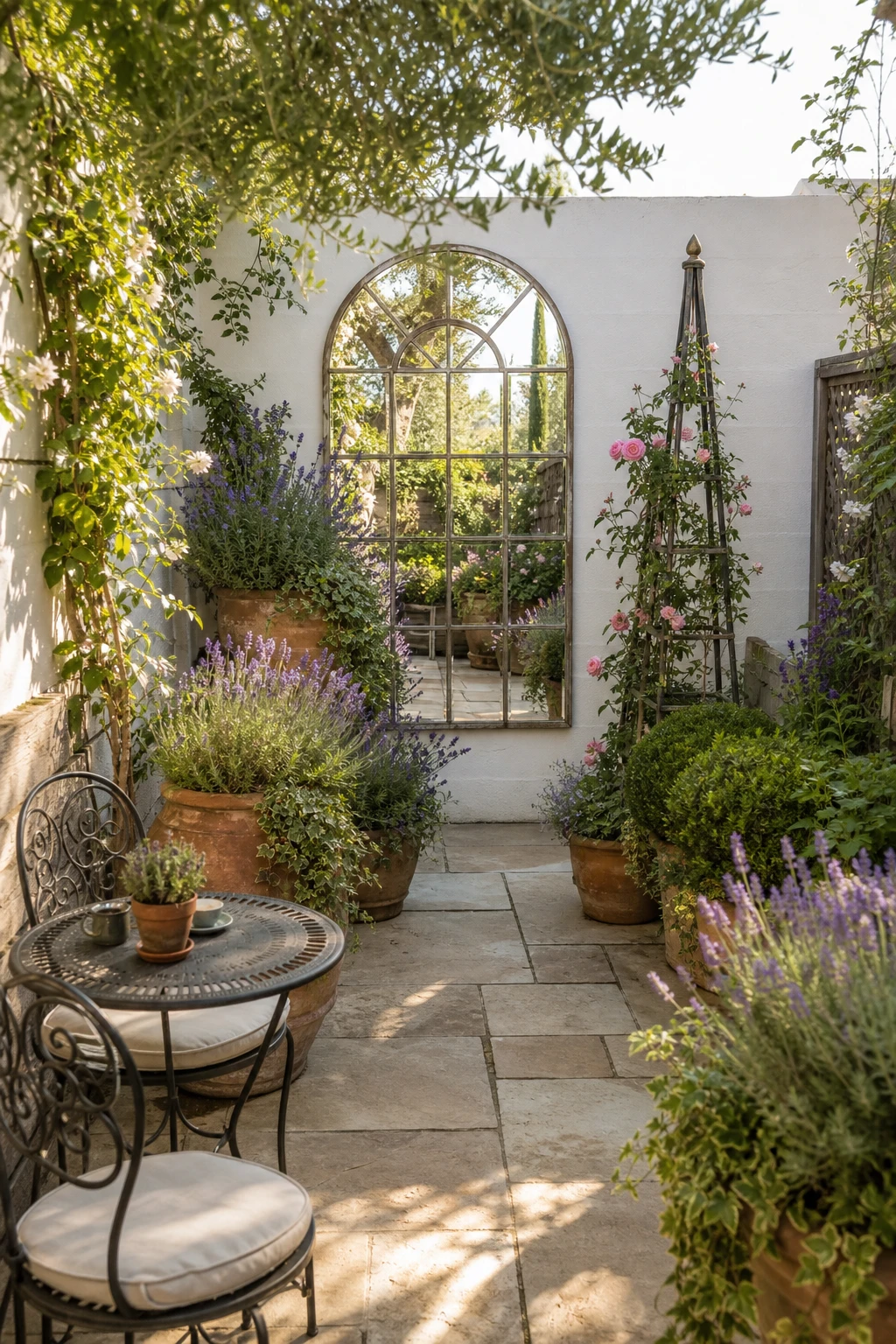
A tiny patio can feel genuinely lush when you work with layers instead of clutter, and that is the trick I keep coming back to. Climbing roses on an obelisk pull your eye upward, so you feel height before you notice the footprint. Staggered terracotta pots at different levels add depth, and a mirrored trellis panel at the far end fools the eye into reading twice the space. You get that full, abundant English garden feeling without the garden.
The Key Details
Arched trellis mirror panel
Staggered terracotta planters
Wrought iron bistro set
Climbing rose obelisk
Aged limestone pavers
Pro TipRun a matching planted border along both long sides of the patio and the space will read as noticeably wider the moment you step outside.
AvoidPacking every spare inch with pots blocks the natural flow through the space and makes even a generous patio feel like an obstacle course.
Garden Terrace Ideas That Add a Beautiful Layer to a Flat Outdoor Space
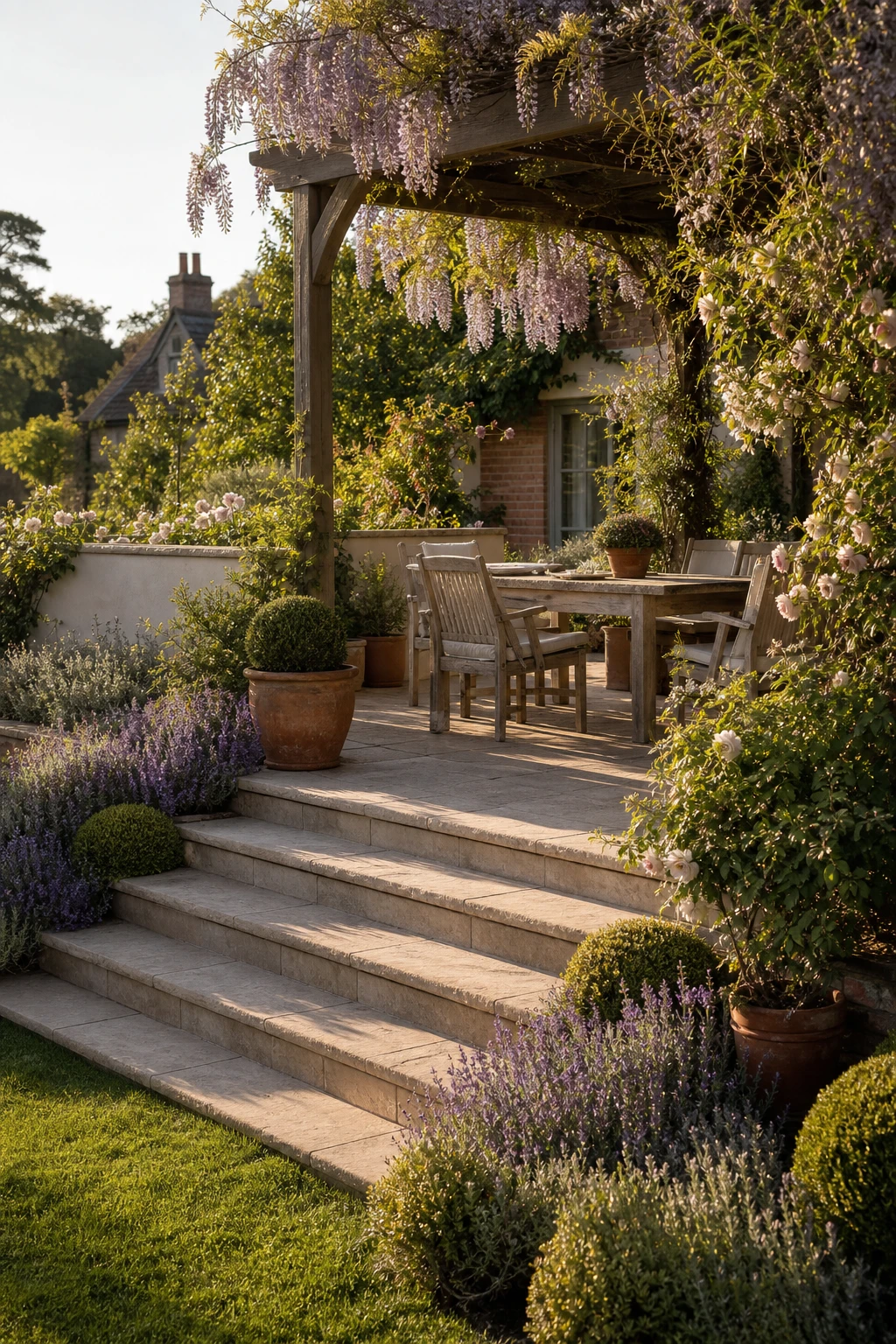
Lifting part of your garden by even one generous step changes everything, and it is one of my favourite moves on a flat plot. You get an instant sense of arrival, a clear dining destination, and the eye travels up rather than skating across a single plane. What I love here is the way the limestone treads, low parapet wall, and soft border planting all work together to make the level change feel earned rather than abrupt.
The Key Details
Dressed limestone terrace treads and platform paving
Weathered teak dining table and cushioned garden chairs
Wisteria draped timber pergola overhead
Low rendered parapet wall edging the raised level
Clipped box spheres and tumbling lavender border planting
Pro TipPlant creeping thyme or aubretia into the gaps along the riser face so the stonework blooms rather than just sitting hard and bare.
AvoidSteps with a rise much taller than 15 cm will make guests hesitate every time they move between levels, breaking the easy flow a terrace should have.
A Sandstone Patio Is the Warmest Surface You Can Lay and Here Is Why
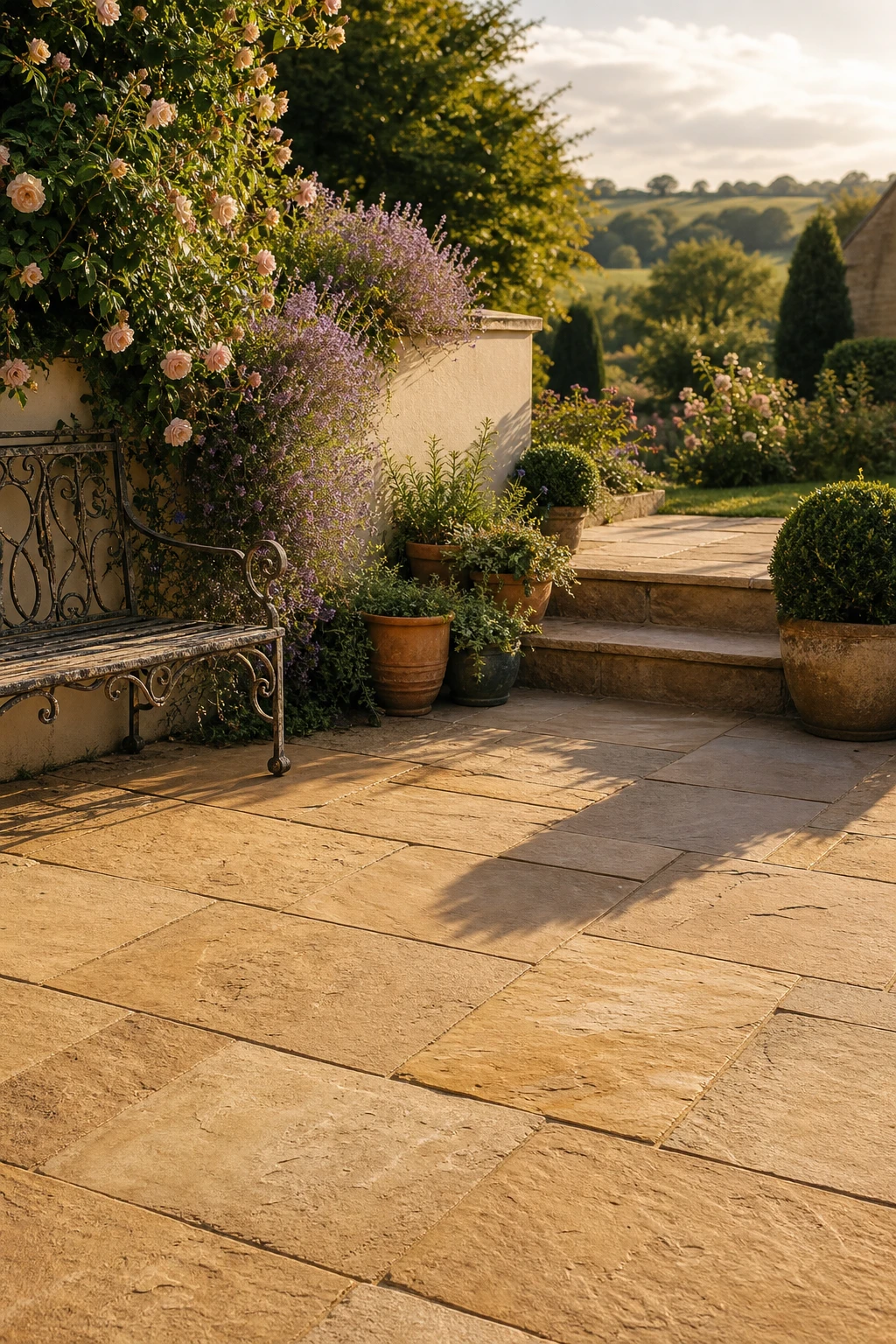
Sandstone wins me over every single time because it only gets better the longer it sits outside. You will notice how the surface drinks in weathering gradually, picking up soft amber and honey tones that no manufactured slab can fake. What I love is that each stone lands slightly different from its neighbour, so the whole patio reads as something grown rather than installed. That quiet sense of age is exactly what an English country garden needs underfoot.
The Key Details
Wrought iron garden bench
Climbing roses on low garden wall
Terracotta herb pots
Clipped box topiary
Worn stone garden step
Pro TipApply one thin coat of a breathable sandstone sealer after laying and you will deepen those warm honey tones without killing the natural variation that makes the stone beautiful.
AvoidOrdering a single slab size across the whole patio gives you a grid pattern that reads as a car park rather than a garden, and all that careful planting above it loses its charm instantly.
Brick Patio Flowers That Soften Every Hard Edge in the Loveliest Way
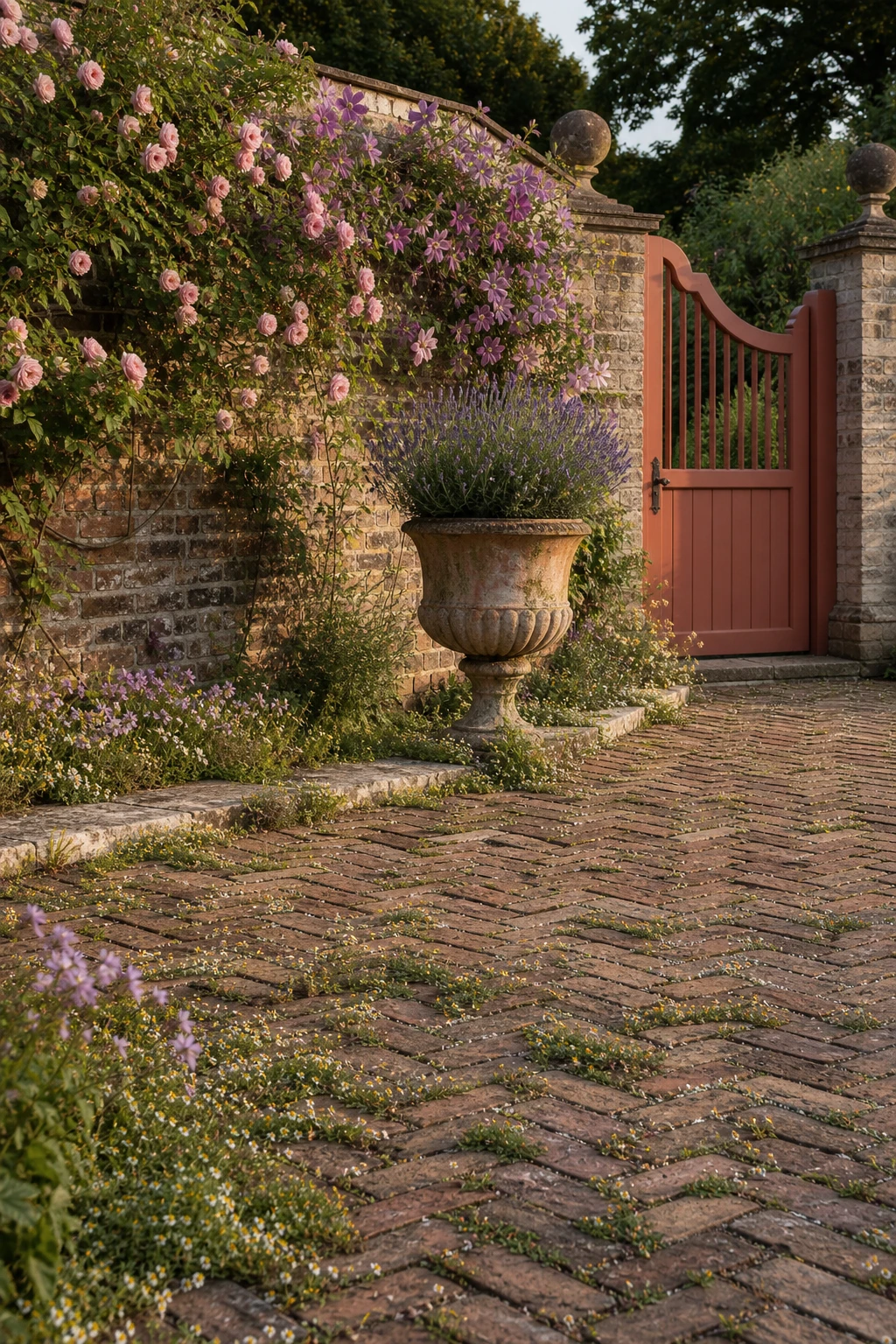
Brick and bloom is one of my favourite pairings because the hardness of the paving and the softness of the planting pull in opposite directions, and that tension is exactly what makes the scene so satisfying. Watch how a few tufts of thyme or chamomile nudging up through the joints dissolve what would otherwise feel like a flat, unbroken floor. You get texture at ground level, fragrance underfoot, and a sense that the garden has been quietly growing into itself for decades.
The Key Details
Herringbone aged clay brick pavers
Climbing roses and clematis on garden wall
Creeping thyme and chamomile planted in paver joints
Stone urn planter overflowing with lavender
Weathered wrought iron garden gate
Pro TipWhen you lay your brick pavers, leave every fourth or fifth joint open and fill it with gritty compost so creeping thyme can root down and spread sideways through the cracks over one full season.
AvoidPlanting a single flower colour across the whole scheme can fight badly with warm red brick, especially sharp pinks and hot oranges, leaving the patio feeling unsettled rather than romantic.
Gravel Path Ideas That Wind Through a Patio Garden With Total Grace
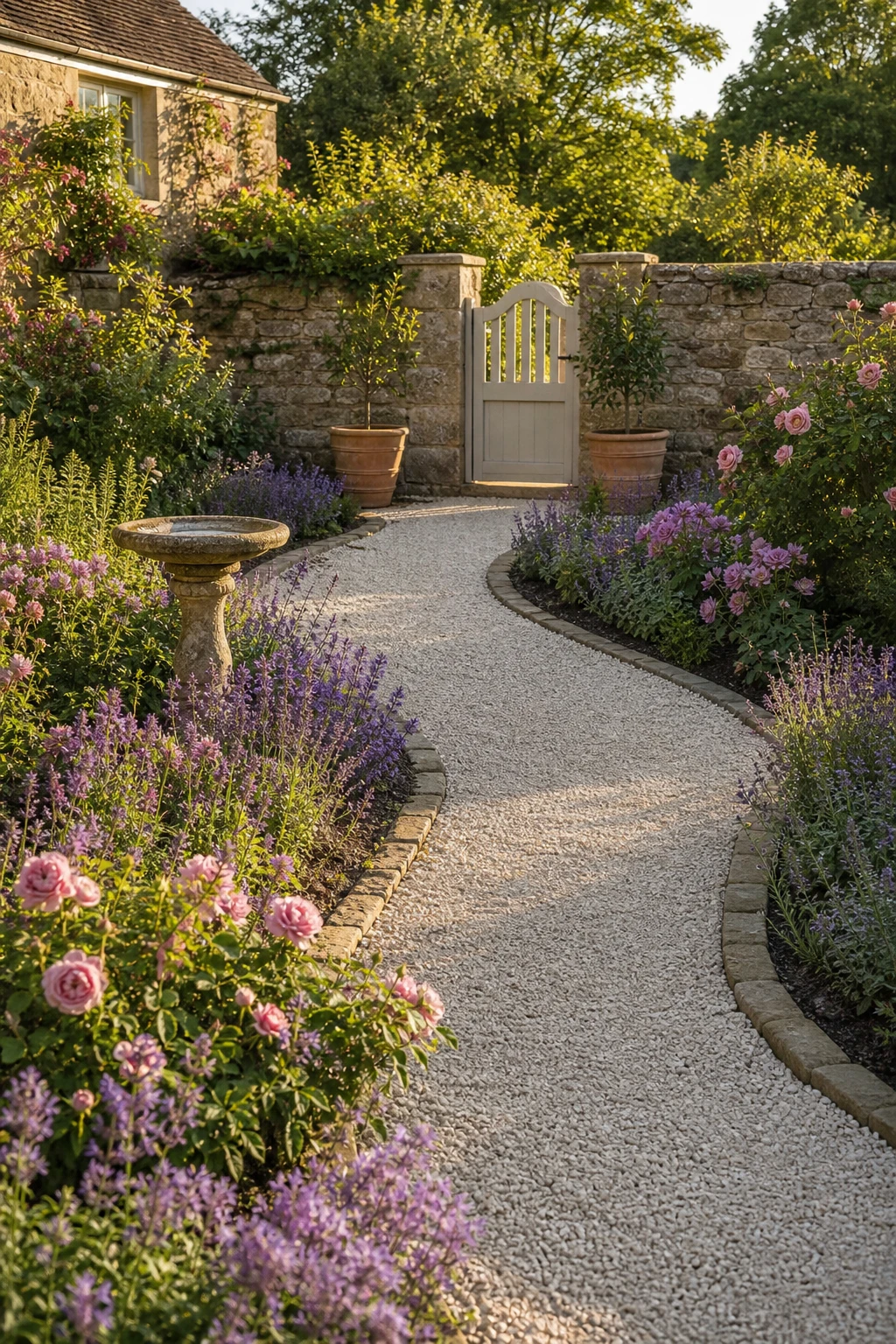
A path that curves just enough to hide where it ends is one of my favourite tricks in a garden. You never see the full picture at once, so you keep walking, keep looking, and the garden feels twice as large as it really is. What I love about crushed limestone here is the soft warm tone, it sits quietly underfoot and lets the planting steal the show. Watch how the eye follows the line without rushing, and you get that lovely unhurried feeling every English country garden is after.
The Key Details
Crushed limestone gravel path
Sandstone path edging
Weathered stone birdbath
Terracotta border pots
Mortared stone boundary wall
Pro TipBend your path by just ten or fifteen degrees at the midpoint so the far end disappears behind a pot or a clump of planting, leaving the garden with a sense of quiet mystery.
AvoidBright white or silver gravel catches direct sun and throws harsh glare back into the space, making even a beautifully planted garden feel uncomfortable to sit in.
Terracotta Flooring Outdoors Gives a Patio That Irresistible Sun Baked Charm
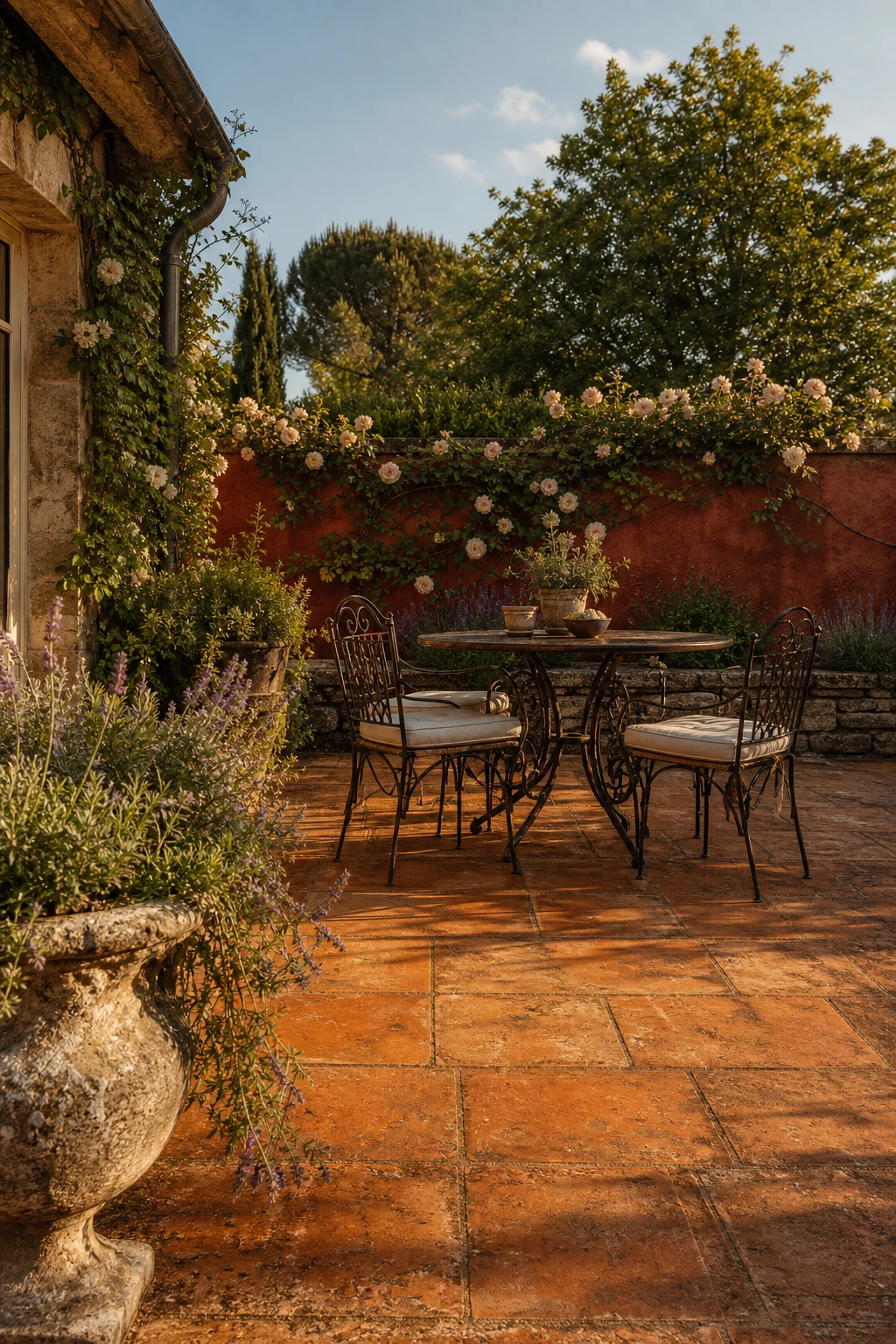
Terracotta underfoot does something no other material quite manages: it soaks up the warmth of the day and gives it back to you in colour, so even a cloudy afternoon feels golden. What I love about it is how the earthy tones pull every other element of the garden together, the stone planters, the climbing roses, the ironwork, as if they all belong to the same quiet story. You will notice the floor stops being a floor and starts feeling like the ground itself.
The Key Details
Handmade terracotta floor tiles
Wrought iron bistro table and chairs
Climbing roses on boundary wall
Aged stone planters with herbs
Linen outdoor cushions
Pro TipChoose antique or tumbled finish tiles over smooth ones, because the slightly worn surface hides marks, weathers gracefully, and looks as though your patio has been there for a hundred years from day one.
AvoidPicking tiles without checking the frost rating is a costly mistake in the UK, as trapped moisture will crack unsealed or low rated terracotta through the first hard winter.
How to Lay Out a Garden Dining Area That Feels Like a Room in Its Own Right
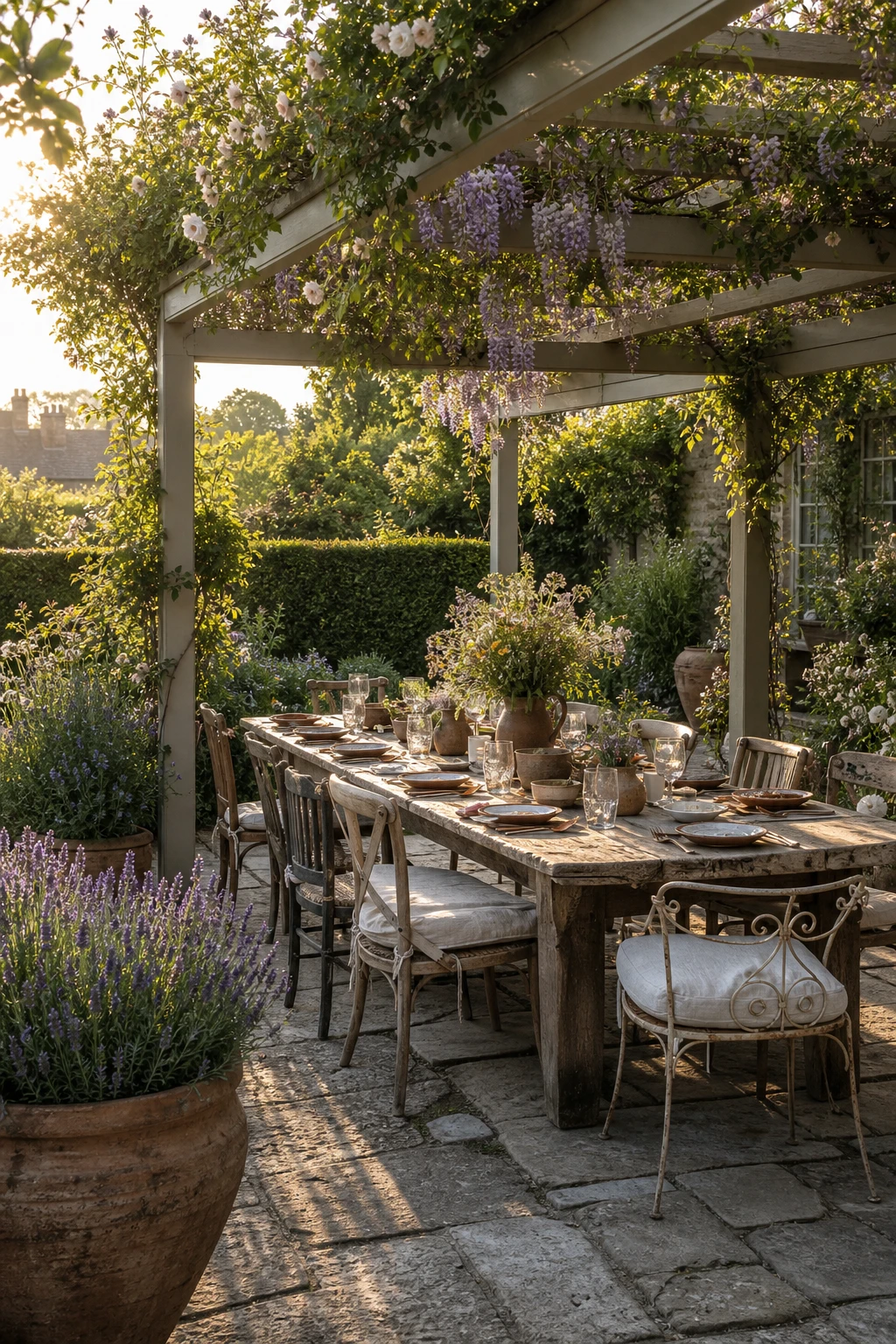
Defining a dining zone outside without walls is one of my favourite puzzles to solve, and the answer is almost always layers. The pergola draped in rose and wisteria acts as a soft ceiling, the clipped box hedge draws a quiet boundary, and the aged limestone paving underfoot says ‘you are somewhere specific now.’ You get all the openness of a garden and all the feeling of a proper room.
The Key Details
Reclaimed oak dining table
Rose and wisteria draped pergola
Aged limestone paving
Clipped box hedge boundary
Terracotta urn with lavender
Pro TipLay a large outdoor rug under the table and chairs to pull the whole setting together and stop the furniture from looking like it just landed there.
AvoidPlacing the table in full afternoon sun without any overhead shade turns a lovely long lunch into a retreat indoors before the pudding arrives.
An Outdoor Breakfast Nook in Your Garden Is the Small Luxury You Did Not Know You Needed
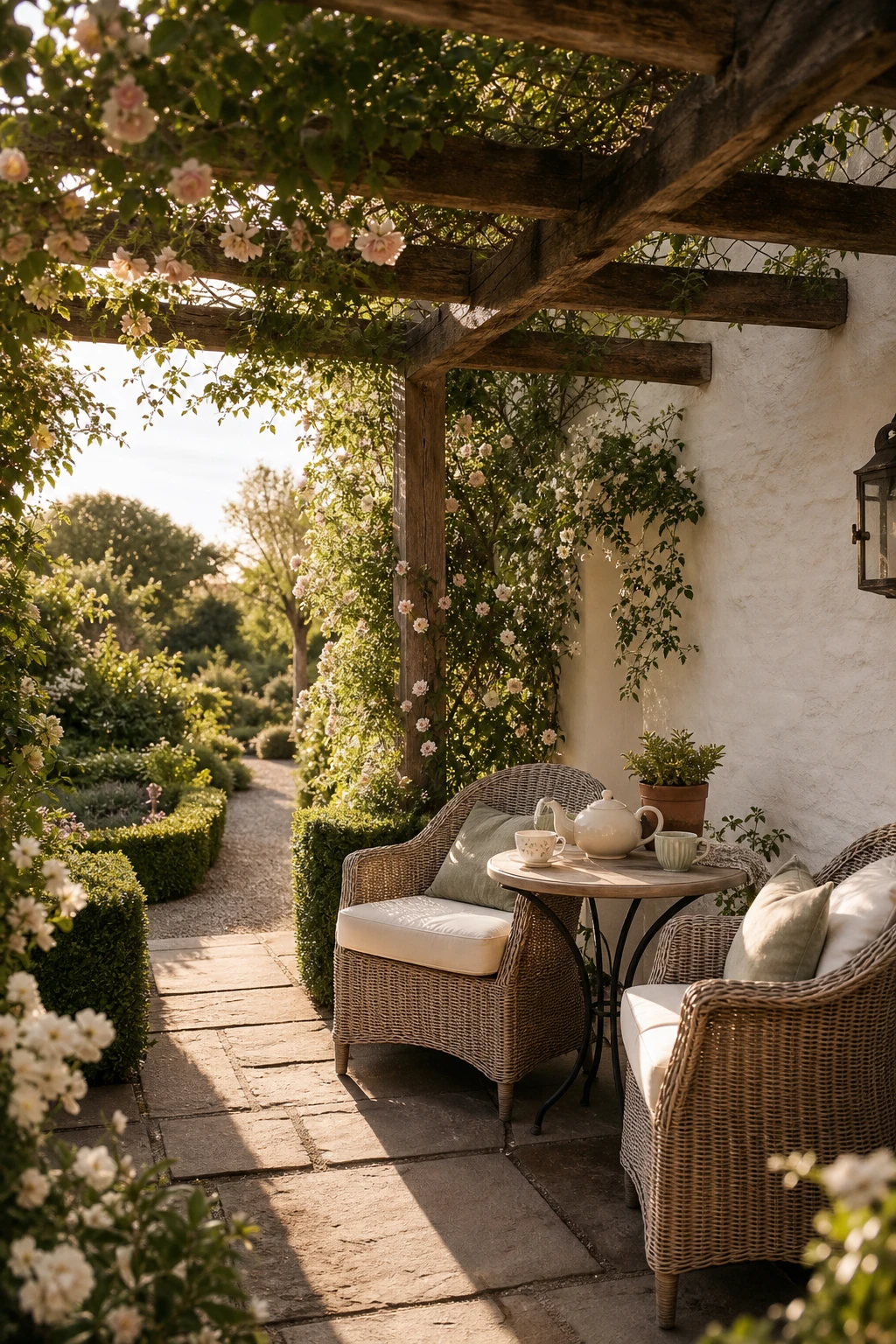
Carving a nook out of a larger patio gives you somewhere that feels genuinely yours, even when the rest of the garden is open and shared. Shelter on two or three sides makes a mild morning feel warmer than it actually is, and I find that intimacy is what keeps people sitting for a second cup. The small scale wins me over every time: a round bistro table, two armchairs, a climbing rose overhead, and it reads as a complete room rather than a corner that was left over.
The Key Details
Round bistro table with ceramic breakfast setting
Cushioned wicker armchairs
Weathered timber pergola with climbing roses and jasmine
Aged York stone paving
Clipped box hedge enclosure
Pro TipPush the table and chairs right into the angle where a clipped hedge meets a wall and you gain natural windbreak and shade without adding any structure at all.
AvoidSizing the table too small means a pot of tea, a plate, and a folded newspaper will not all fit at once, which quietly ruins the whole ritual the nook is meant to support.
A Bistro Set Is the Quickest Way to Give Any Patio a Parisian Garden Feel
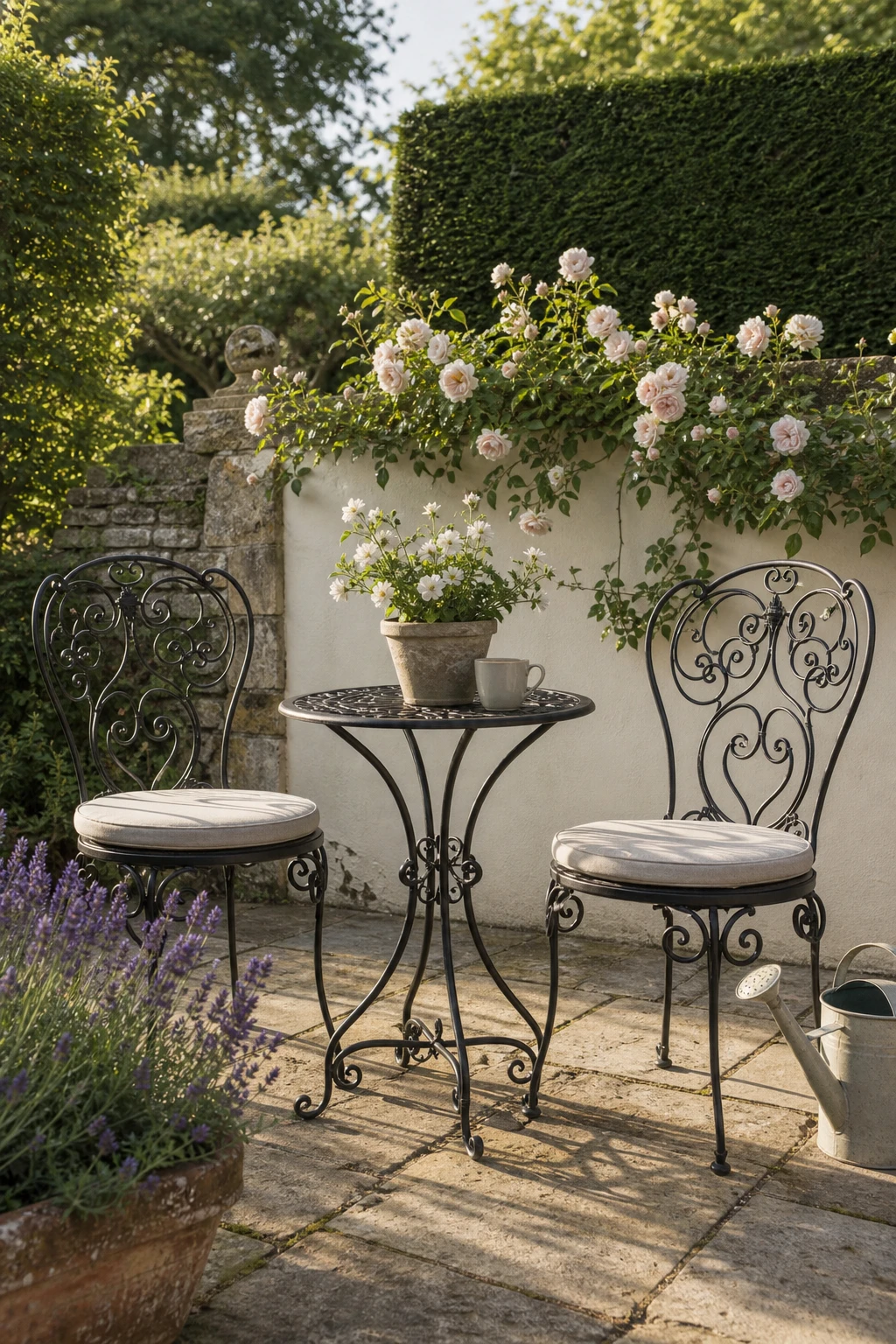
A single bistro set does something remarkable: it tells you exactly what kind of garden you are sitting in before a single flower has been planted. What I love about iron is the way it holds its ground visually, two chairs and a table that feel like they have always belonged there. You get that effortless Parisian mood without needing to style every corner, and the aged patina only deepens over time.
The Key Details
Wrought iron bistro table and chairs
Climbing roses over stone garden wall
Hand cut limestone paving
Terracotta border planter with lavender
Linen seat cushions
Pro TipAlways choose cast iron over plastic or aluminium resin versions, because the weight alone stops the set shifting in wind and the material weathers into something genuinely beautiful rather than faded.
AvoidRinging a bistro set with too many pots closes the space in and kills the light, airy feeling that makes the arrangement work in the first place.
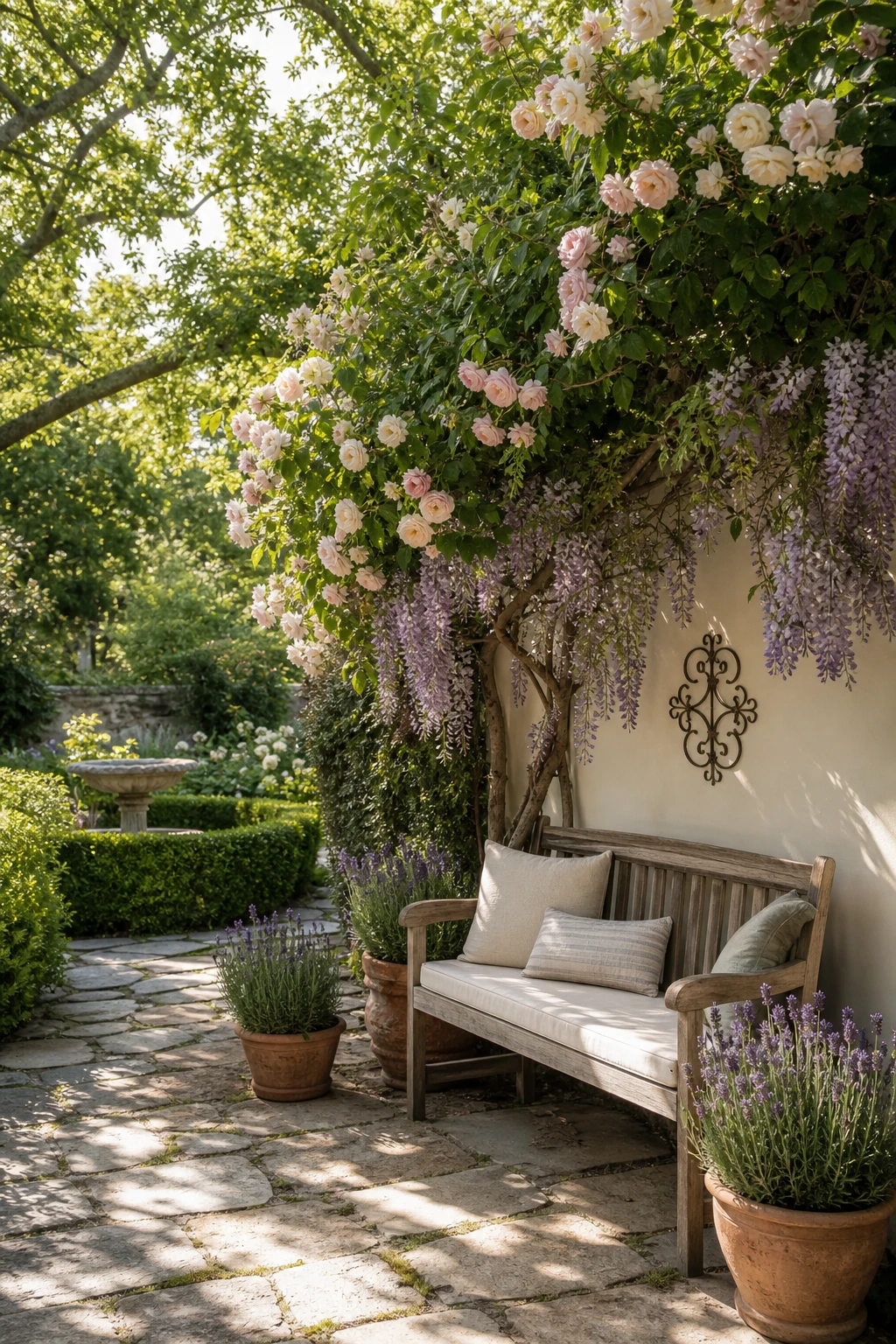
Garden Bench Seating That Turns a Corner of the Patio Into a Quiet Retreat
Tucking a bench into a corner with a clear sightline across the garden is one of my favourite moves on a patio. You get that sense of shelter at your back while the prettiest part of the planting opens up right in front of you. The weathered teak, linen cushions, and soft lavender pots flanking the seat all say slow down and stay a while, and the clipped box behind gives just enough enclosure to make the spot feel genuinely apart from the rest of the garden.
The Key Details
Weathered teak slatted bench with linen cushions
Climbing roses and wisteria overhead canopy
Irregular limestone flagstone floor
Terracotta lavender pots flanking the bench
Clipped box hedge boundary planting
Pro TipSit in the spot before you fix the bench in place and check that the view from eye level is the one you actually want to look at.
AvoidBackless benches look charming but leave you with nowhere to rest after ten minutes, which means the nook never gets used the way you imagined.
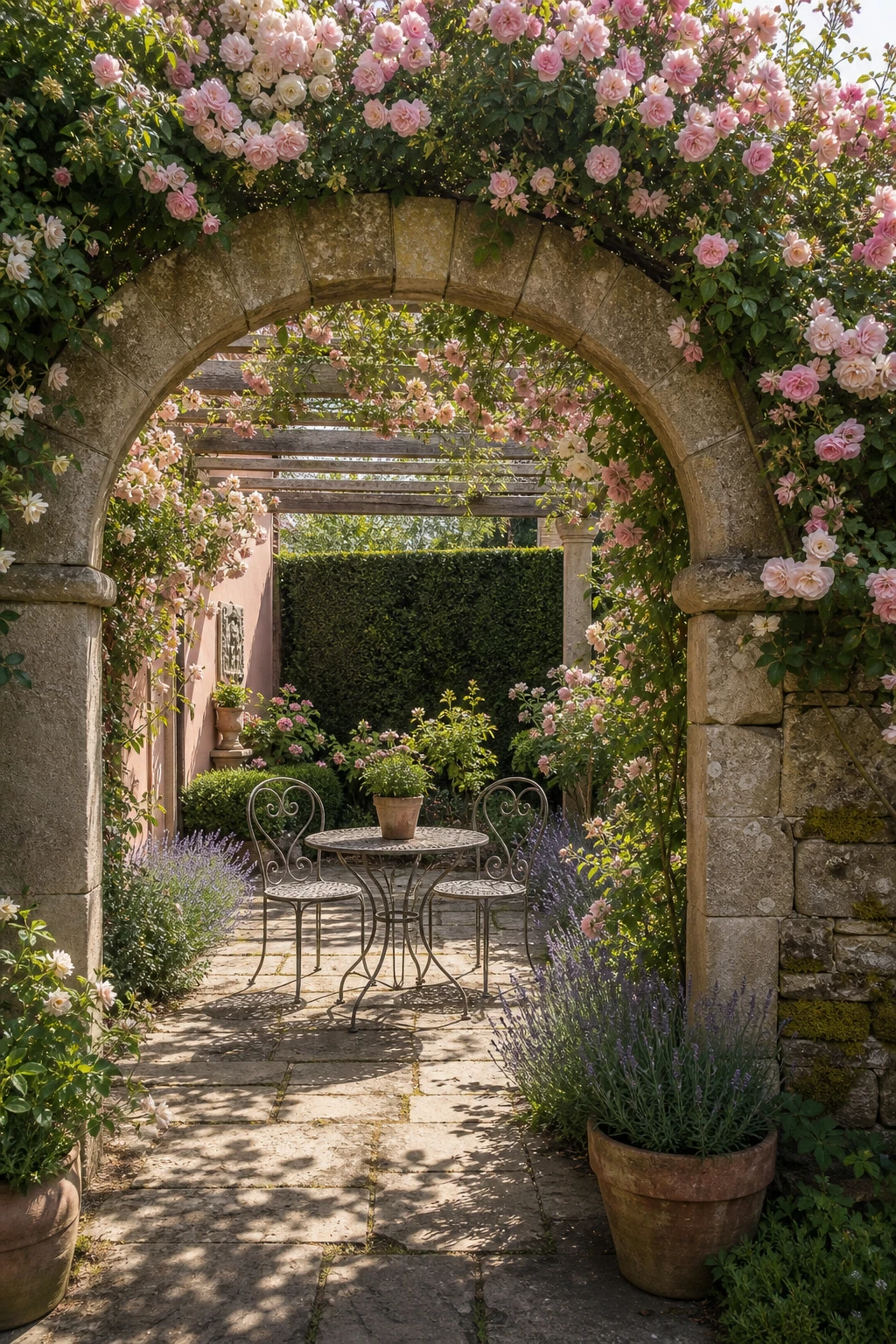
Climbing Roses Are the One Plant That Can Make a Whole Patio Feel Romantic
Climbing roses do something no other plant quite manages: they pull a flat wall or bare post into the scene and make it feel like the garden has always been there. What I love is how the canes arc upward and outward, drawing the eye up and giving the whole space a soft, enclosed feeling, the way a room feels settled once it has curtains. You get that sense of being held inside the garden rather than just standing in it.
The Key Details
Stone arch with trained rose canes
Wrought iron bistro table and chairs
Limestone flagstone floor
Terracotta pot grouping
Clipped yew hedge rear boundary
Pro TipWhen you tie in new stems, run them as horizontally as you can rather than straight up, because a near horizontal cane tells the rose to push out flowering side shoots all along its length instead of saving its energy for a single top bloom.
AvoidPlanting a climber flush against a wall with no gap behind it traps moisture, blocks airflow, and almost guarantees blackspot and mildew within a season or two.
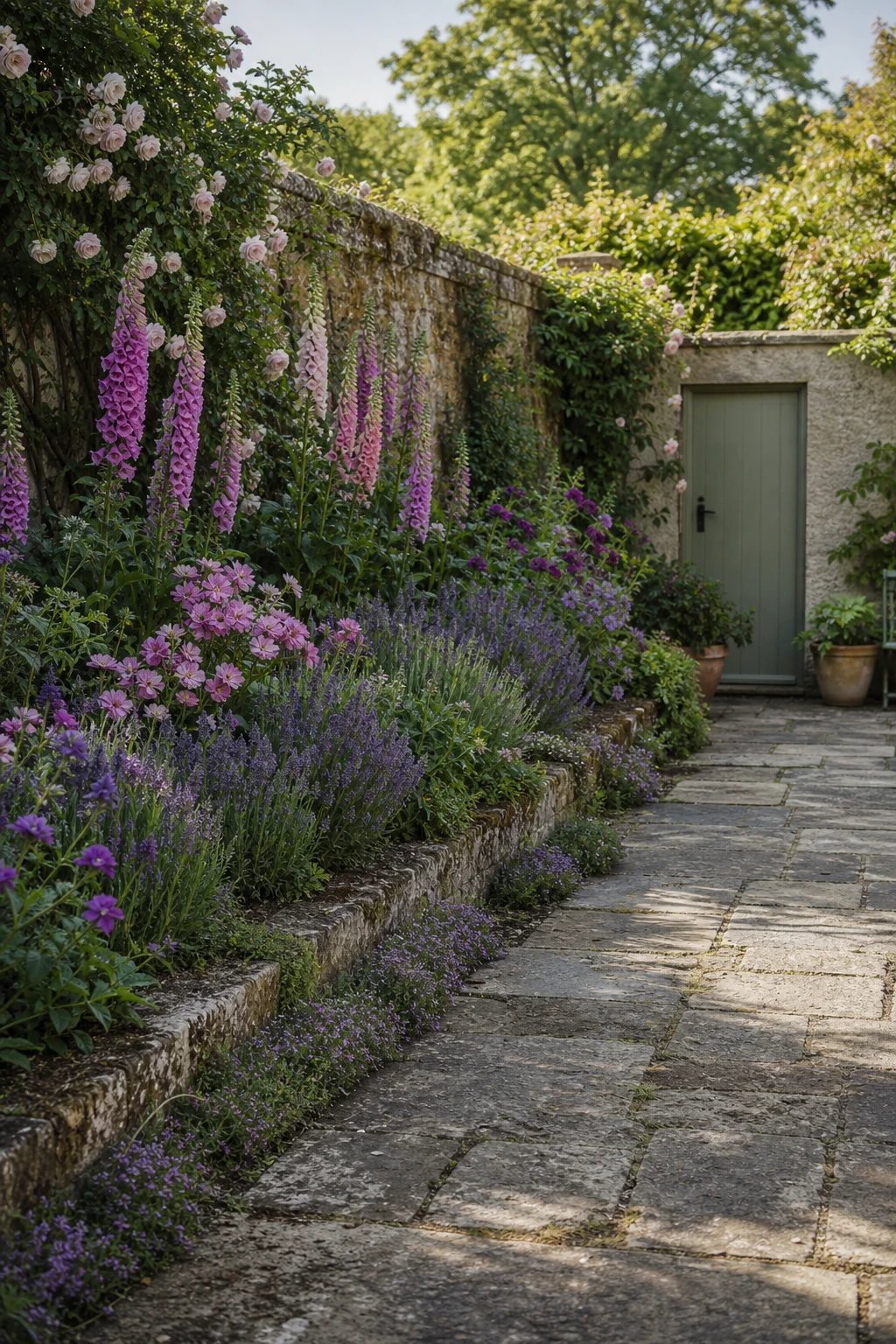
English Garden Border Ideas That Make Your Patio Edge Burst With Life
A deep cottage border is one of my favourite moves for a patio edge because the succession planting means something is always coming into its moment. You get lavender carrying the early summer, foxgloves rising tall behind, and hardy geraniums threading colour through the gaps right into autumn. Watch how the layered height pulls your eye from the paving up to the climbing roses on the wall, giving the whole space a sense of lush, living depth rather than a flat strip of green.
The Key Details
York stone patio pavers
Layered perennial planting with foxgloves, lavender and hardy geraniums
Climbing roses over a low stone rear wall
Limestone border edging
Terracotta accent pots at patio edge
Pro TipPlant your perennials in groups of three, five, or seven rather than even rows so the colour drifts and weaves the way it would in a wild hedgerow garden.
AvoidA border less than a metre deep leaves you with no room for the tall, mid and low layers that give a cottage planting its character, and the whole edge ends up looking thin and flat.
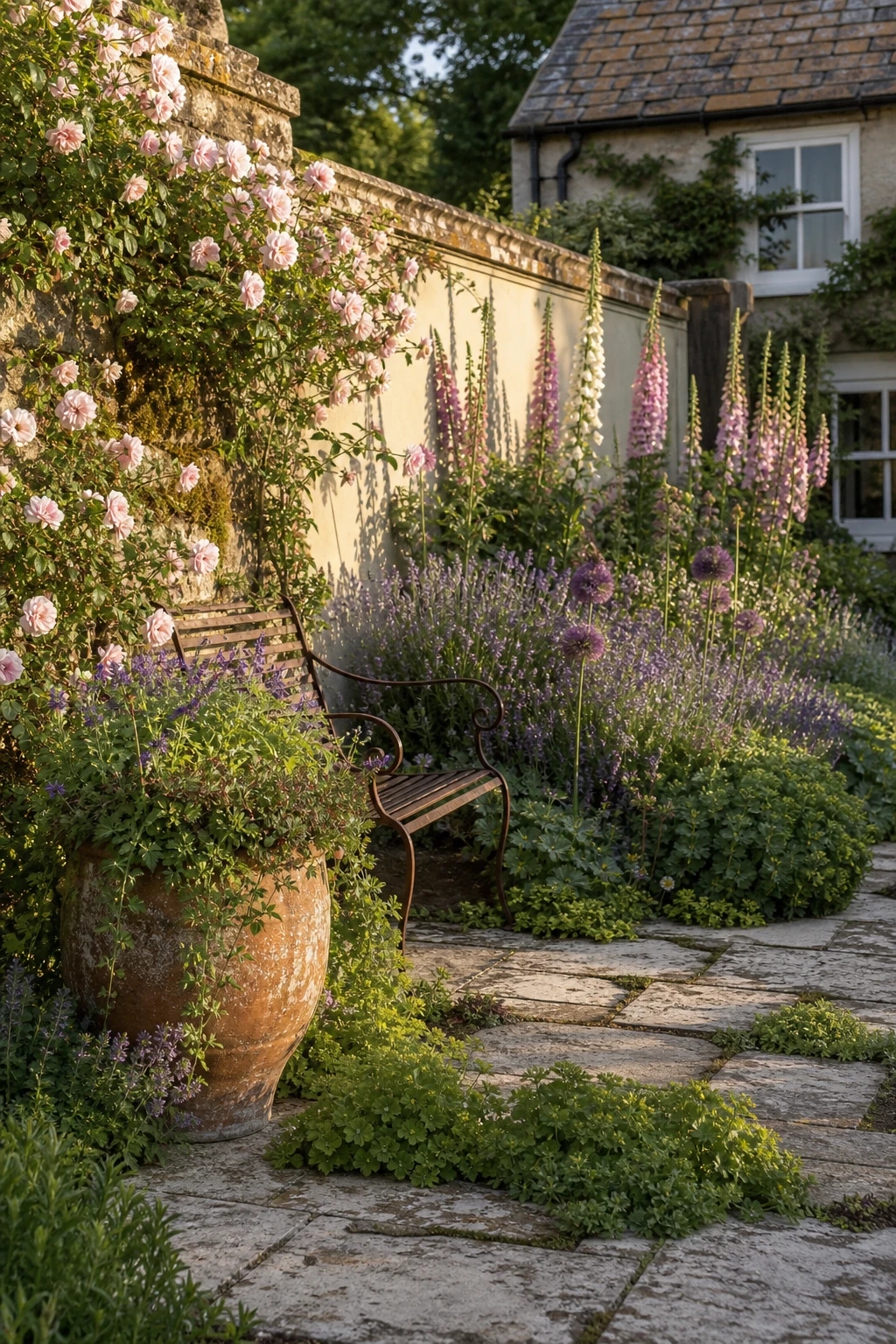
The Cottage Garden Plants That Give Every English Patio Its Signature Charm
The plants that define a cottage patio are the ones that refuse to stay in line, and that is exactly what makes them so charming. Foxgloves spike upward, alliums bob at mid height, and sprawling roses tumble sideways, so your eye travels the whole space rather than landing flat. What I love is how that gathered feeling arrives naturally, as though the garden simply decided to grow this way, and coaxing it in that direction is really just a matter of choosing the right companions and then stepping back.
The Key Details
Climbing roses on stone wall
Terracotta urn planter
Aged limestone flagstone pavers
Wrought iron garden bench
Foxglove and allium vertical planting
Pro TipTuck in a handful of self seeding annuals like nigella or calendula so new plants pop up each spring and fill bare patches without you lifting a trowel.
AvoidPlanting everything at the same height and with the same rounded bloom shape flattens the whole composition and strips out the layered, wandering quality that makes cottage planting feel alive.
How a Backyard Meadow Garden Brings Wild Beauty Right to the Patio Edge
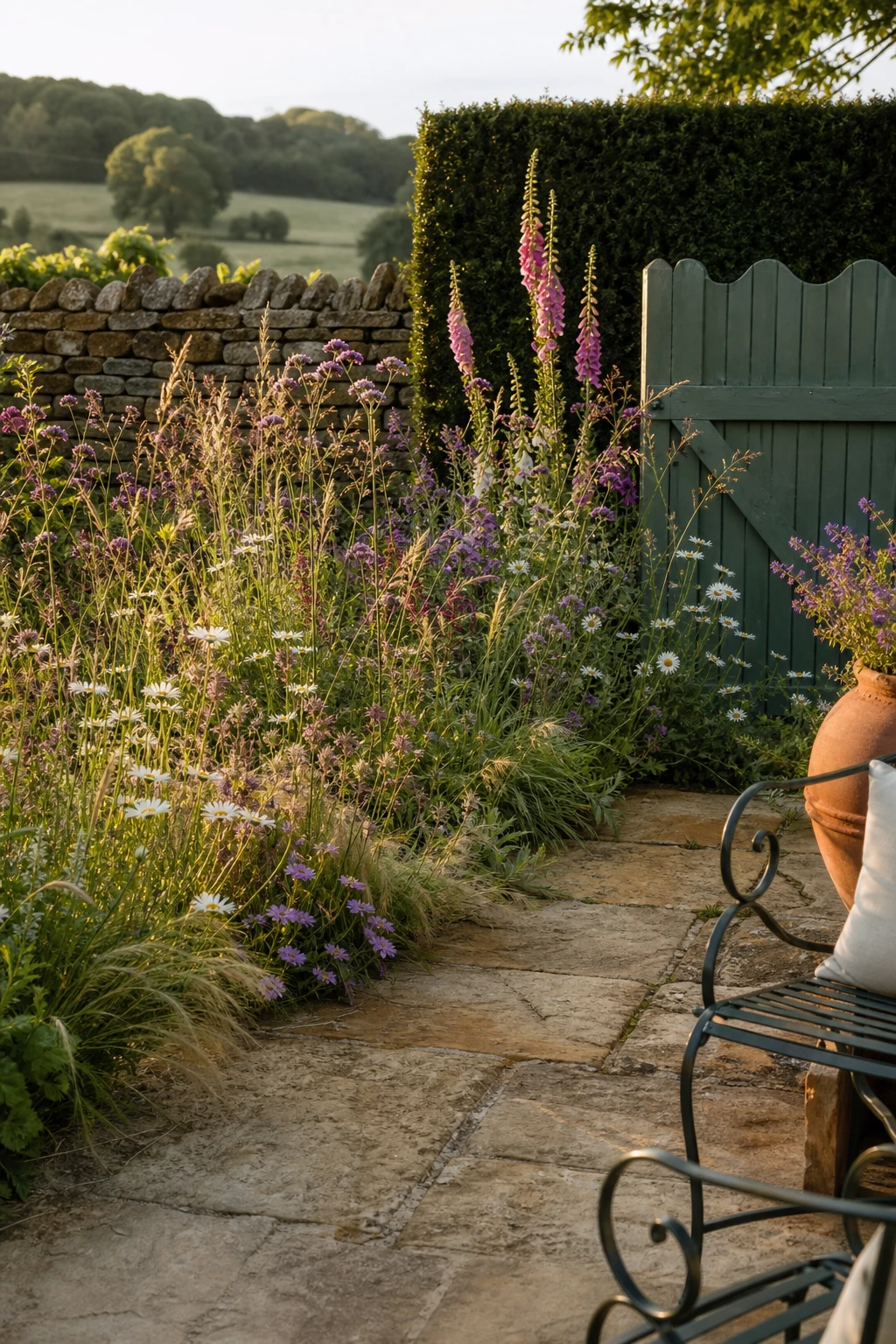
Meadow planting right at the patio edge is one of my favourite contrasts in an English garden. The loose, wild drifts of ox eye daisy and verbena push against aged limestone paving, and that tension between untamed and ordered is what gives the whole space its personality. You get softness without losing structure, and the clipped yew backdrop holds it all together so nothing feels chaotic.
The Key Details
Ox eye daisy and verbena meadow planting drifts
Aged limestone paving with weathered mortar joints
Dry stacked sandstone boundary wall
Cast iron garden chairs with linen cushions
Clipped yew hedge backdrop
Pro TipMow a clean, deliberate path through the meadow grass right up to the paving edge so the boundary reads as a choice rather than an accident.
AvoidMeadow planting that creeps onto the paving without a sunken edging strip will lift mortar joints over time and make the whole patio look neglected rather than romantic.
Clipped Boxwood in the Patio Garden Is the Classic Shape That Never Gets Old
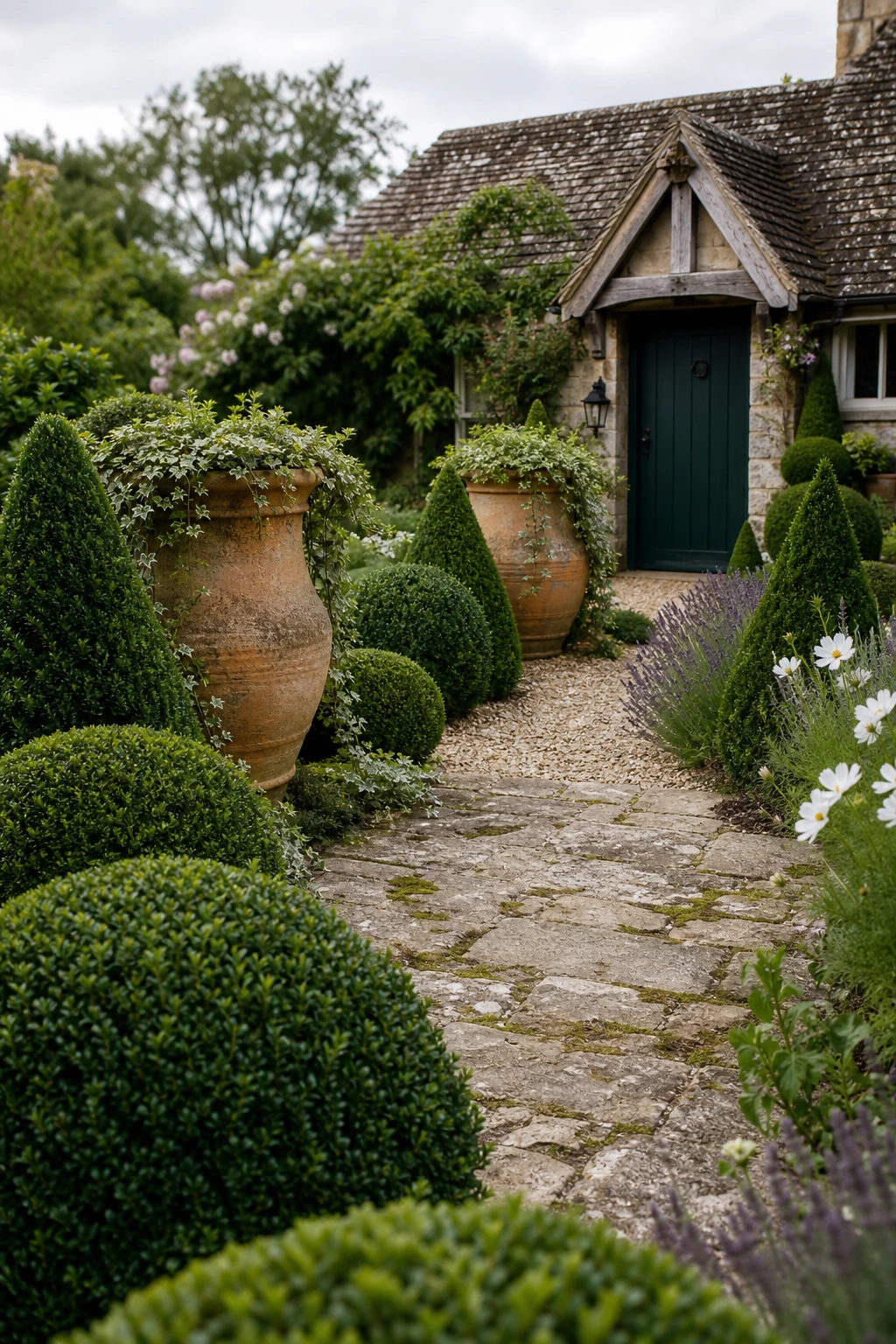
Clipped boxwood is the quiet backbone I come back to on almost every garden project, because it holds the whole composition steady when everything else changes. You get that satisfying geometry in January just as much as in June, and that reliability is what I love most about it. Watch how a single clipped sphere in a terracotta urn anchors a planting scheme the way a full stop anchors a sentence.
The Key Details
Clipped boxwood spheres and cones
York stone terrace paving
Aged terracotta urns with trailing ivy
Timber garden door
Hand raked gravel path
Pro TipClip your box in May and again in August, always choosing a dull overcast day so the freshly cut leaves don’t scorch in direct sun.
AvoidPlanting boxwood on its own without softer companions leaves the space feeling stiff and cold, and you lose the warmth that makes a patio feel like somewhere to linger.
An English Potager Garden Beside Your Patio Makes Beauty and Dinner Coexist
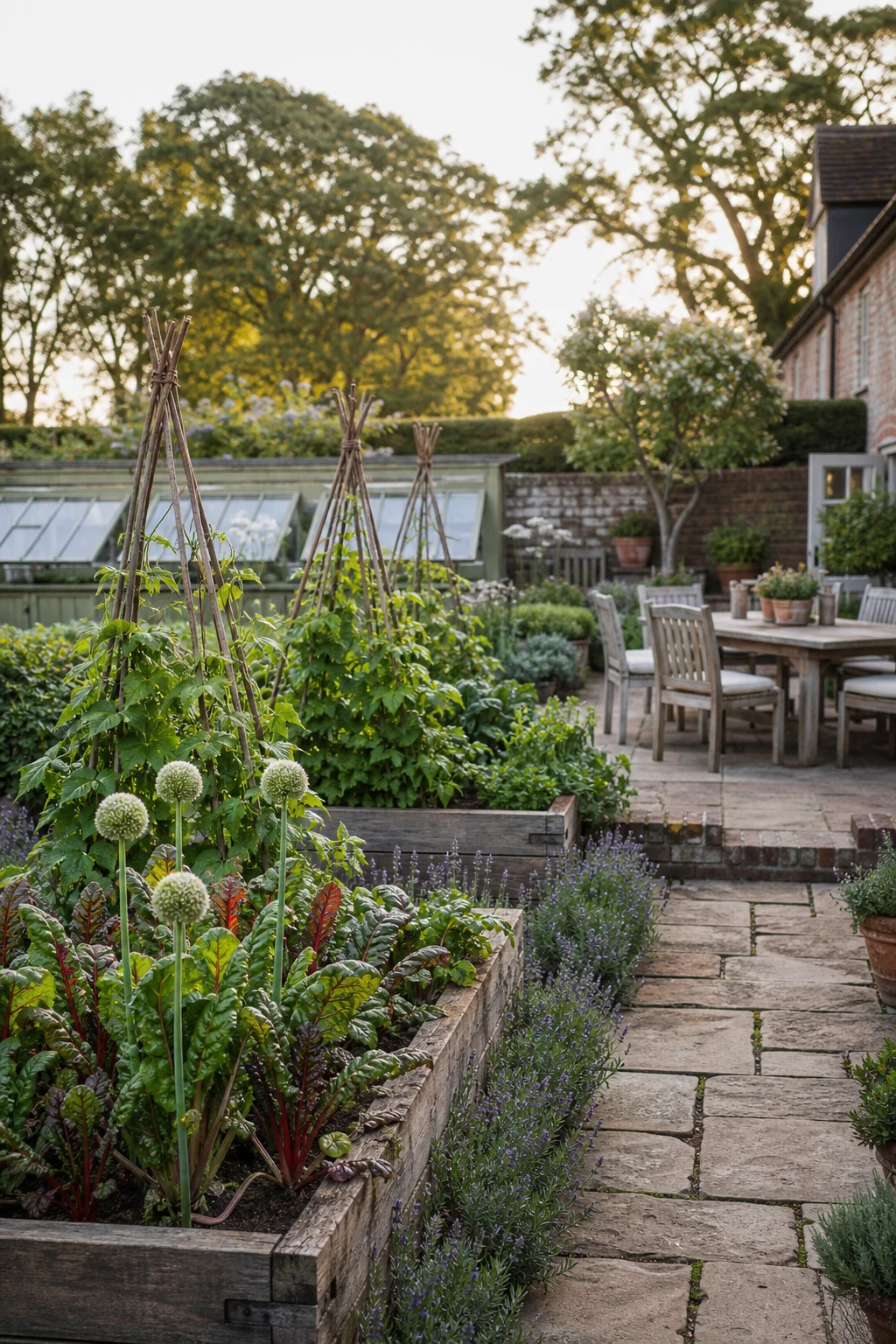
A potager beside the patio is one of my favourite moves because it collapses the distance between cooking and gardening into one beautiful space. Hazel wigwams trailing runner beans, terracotta pots spilling with thyme, and cold frames catching the morning light all earn their place as ornamental features. You get structure from the raised timber beds, softness from the planting, and the whole thing works as hard as any border.
The Key Details
Raised timber kitchen beds
Hazel pole wigwams
York stone path
Terracotta herb pots
Yeabridge Green cold frames
Pro TipSet your raised timber beds flush to the paving edge so the grid of the potager reads as a deliberate design choice rather than an afterthought tucked behind the garden.
AvoidPushing vegetable beds to a far corner robs your patio of their colour, texture, and the lovely busyness they bring to a view.
Patio Planters Are the Easiest Way to Bring an English Garden to Any Outdoor Space
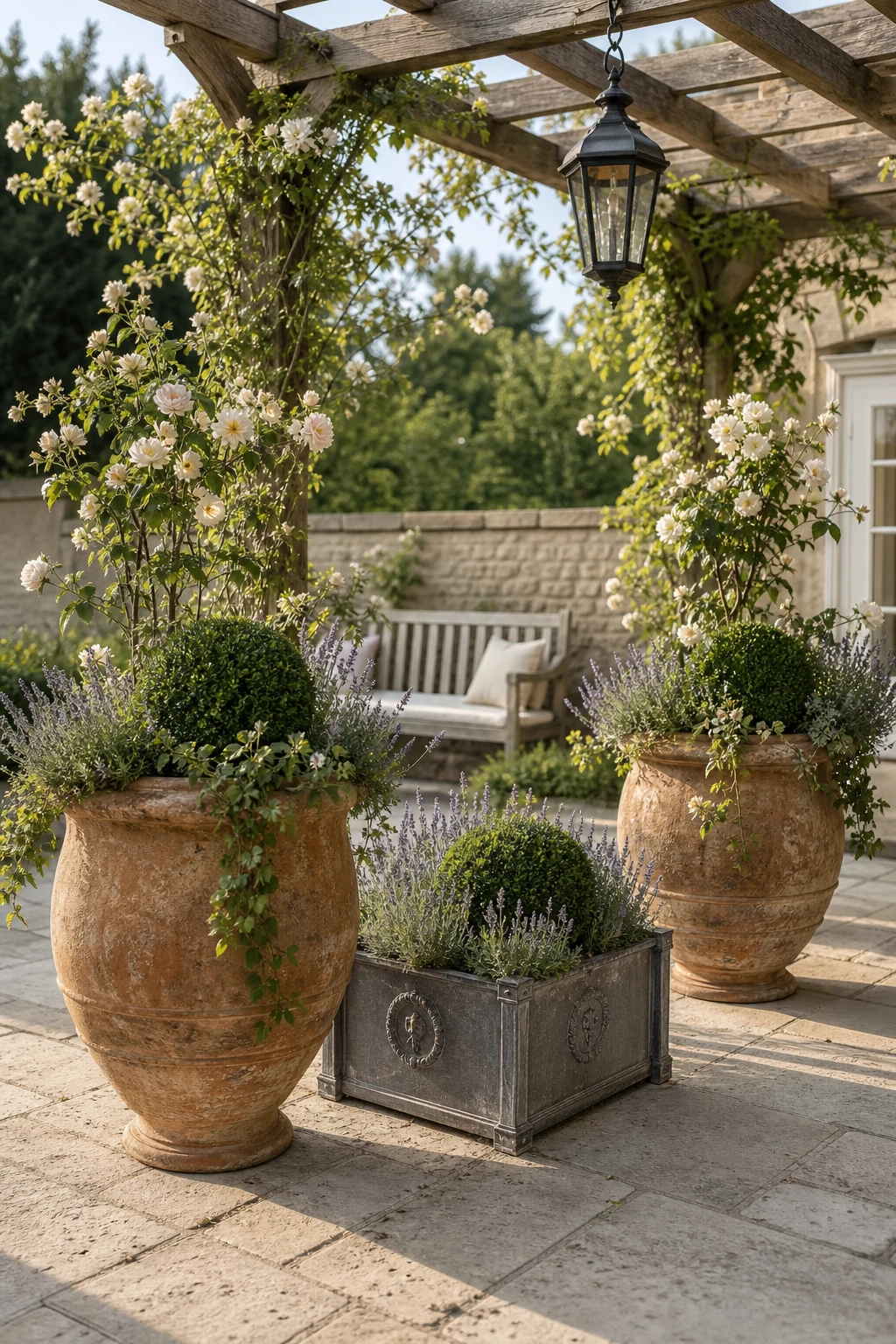
Statement planters are one of my favourite shortcuts for anyone who wants a proper English garden feel without breaking ground. You get instant structure, real height, and that layered abundance that takes a border years to build. What wins me over every time is how a cluster of aged terracotta urns or a lead effect trough can anchor a patio corner the way a planted bed would, giving the whole space a sense of intention.
The Key Details
Aged terracotta urns
Lead effect square trough
Limestone paving
Wrought iron hanging lantern
Timber pergola overhead
Pro TipGroup your planters in threes or fives, mixing a tall urn, a mid height trough, and a low bowl, so the eye travels upward and the arrangement reads like a planted composition rather than a collection of pots.
AvoidLining up five identical planters of the same size creates a rigid, repetitive row that strips the space of the relaxed, layered character that makes an English garden patio feel genuinely charming.
Vintage Patio Decor Is What Gives an English Country Garden Its Story and Soul
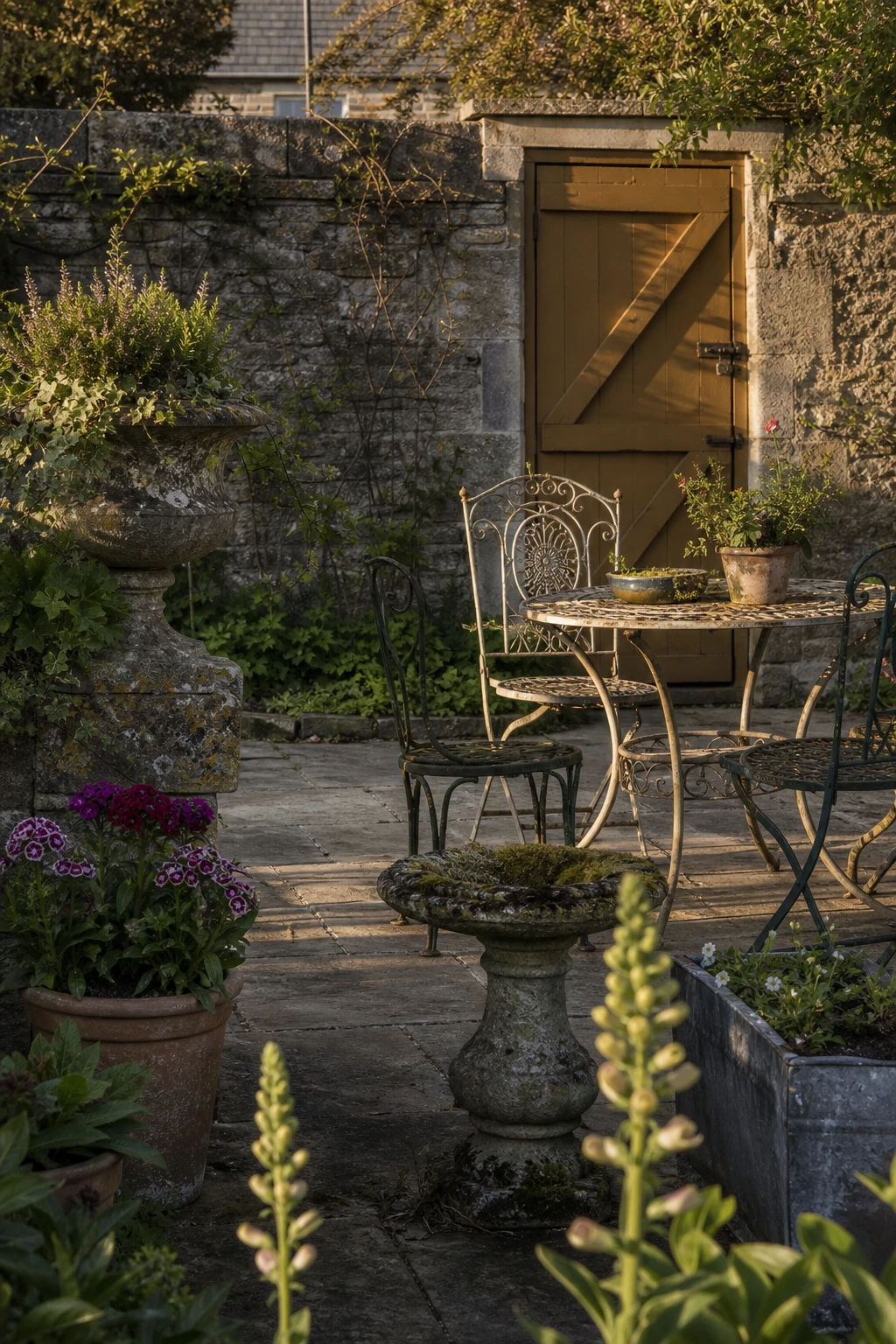
Vintage finds are what I reach for when a patio feels too polished and a little lifeless. A moss covered birdbath, a salvaged lead planter, mismatched urns gathered over time: the space starts to look genuinely lived in rather than assembled in one afternoon. Aged metal, worn stone, and old terracotta each carry a completely different surface and weight, so layering them together feels rich rather than cluttered, and that quiet visual variety is what gives a patio its real story.
The Key Details
Scrolled cast iron bistro table and chairs
Moss covered stone birdbath
Mismatched terracotta and stone urns
York stone paving
Salvaged lead planter
Pro TipArrange pieces in odd numbers at varying heights, and leave a clear patch of paving between each cluster so the eye has somewhere to pause before it moves on.
AvoidFilling every corner with vintage objects leaves nowhere for the eye to rest and the whole patio starts to feel more like a junk shop than a garden.
Floral Cushions Are the Quickest Swap That Transforms a Plain Patio Seat
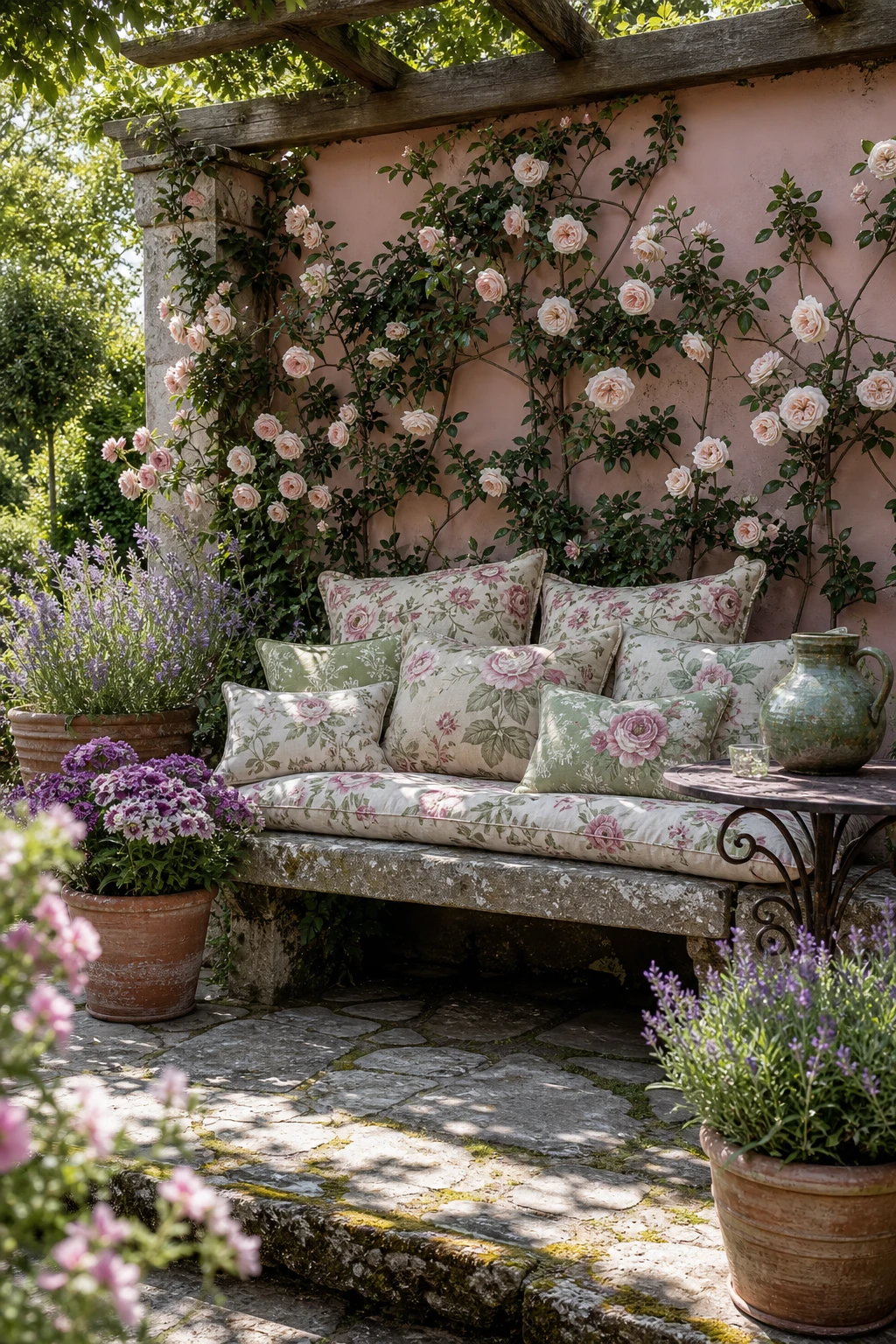
Floral cushions are the one swap I reach for when a patio feels too hard and bare. A muted tonal print pulls the colours already blooming around you into the seating, so the bench feels like part of the garden rather than furniture dropped into it. You get that layered, lived in softness without touching a single plant, and I find guests always gravitate toward a seat that looks as though it belongs exactly where it is.
The Key Details
Floral linen blend outdoor cushions
Weathered stone garden bench
Climbing blush roses on pergola
Hand thrown terracotta pots
Wrought iron side table
Pro TipChoose a cushion print where the florals share the same dusty, faded tones as your planting rather than bright primaries, and everything will feel like it grew together naturally.
AvoidLeaving cushions out overnight soaks the fill with dew and eventually breeds mildew, which ruins even the best outdoor fabric far faster than sunlight ever would.
Backyard Twinkle Lights Turn Your Patio Into the Most Magical Place After Dark
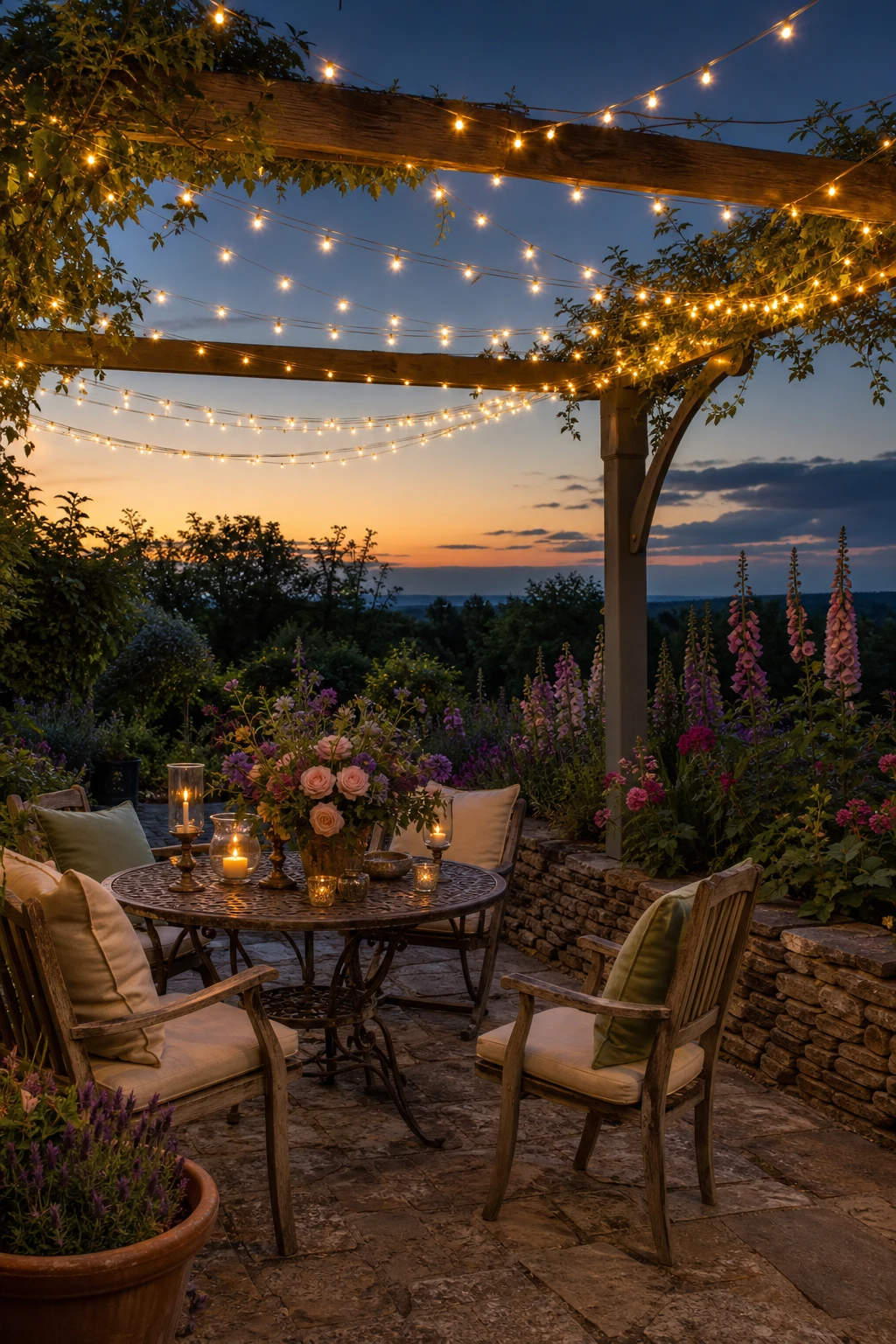
Soft catenary loops of warm bulbs overhead do something almost theatrical to a patio, pulling the eye upward and wrapping the whole space in a glow that feels candlelit rather than lit. What I love is how the light lands gently on the limestone flags and the sage linen cushions without flattening them the way a single overhead fixture would. You get depth, you get warmth, and the garden beyond simply melts into darkness so the table becomes the whole world.
The Key Details
Wrought iron dining table with vintage candle holders
Timber pergola framework with Hay painted uprights
Weathered limestone flagged terrace
Linen cushion garden armchairs in sage and cream
Dry stone perimeter wall with cottage perennial border
Pro TipFix your anchor points further apart than feels necessary, then let the cable sag into a generous curve, because a tight, straight run looks commercial where a loose drape looks romantic.
AvoidCold white or daylight temperature bulbs strip every warm tone from the stone, the timber and the cushions and leave the table looking more like a car park than a cottage garden.
An Outdoor Chandelier Over the Patio Is the One Detail That Makes It Feel Truly Special
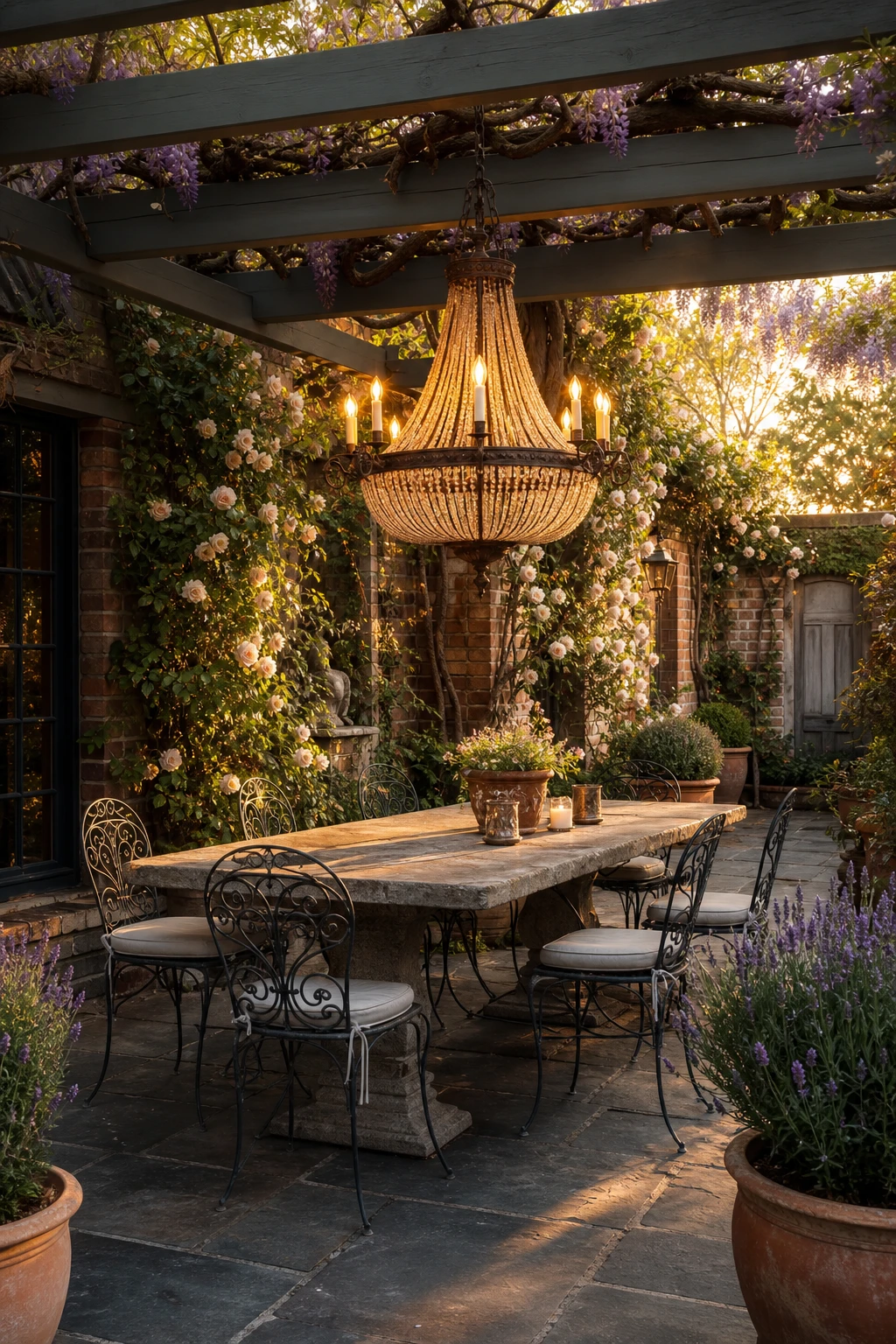
Hanging a chandelier above the patio table is the move that shifts a garden from pretty to genuinely special, and what I love is how it tells guests this space was designed, not just assembled. You get a focal point overhead that draws the eye upward into the pergola timbers and the wisteria, making the whole ceiling feel intentional. That wrought iron frame with its candle lights keeps things rooted in the English country spirit rather than pulling toward something too modern.
The Key Details
Wrought iron chandelier with candle style lights
Weathered stone dining table
Slate flagstone floor
Timber pergola draped in wisteria
Terracotta pots of lavender
Pro TipFix the chandelier so the lowest point sits at least two metres above the tabletop, which keeps the light generous and the sightlines open across the table.
AvoidFitting an indoor chandelier outside because it looks right will lead to corrosion and a real safety risk, so always check the IP rating before you buy.
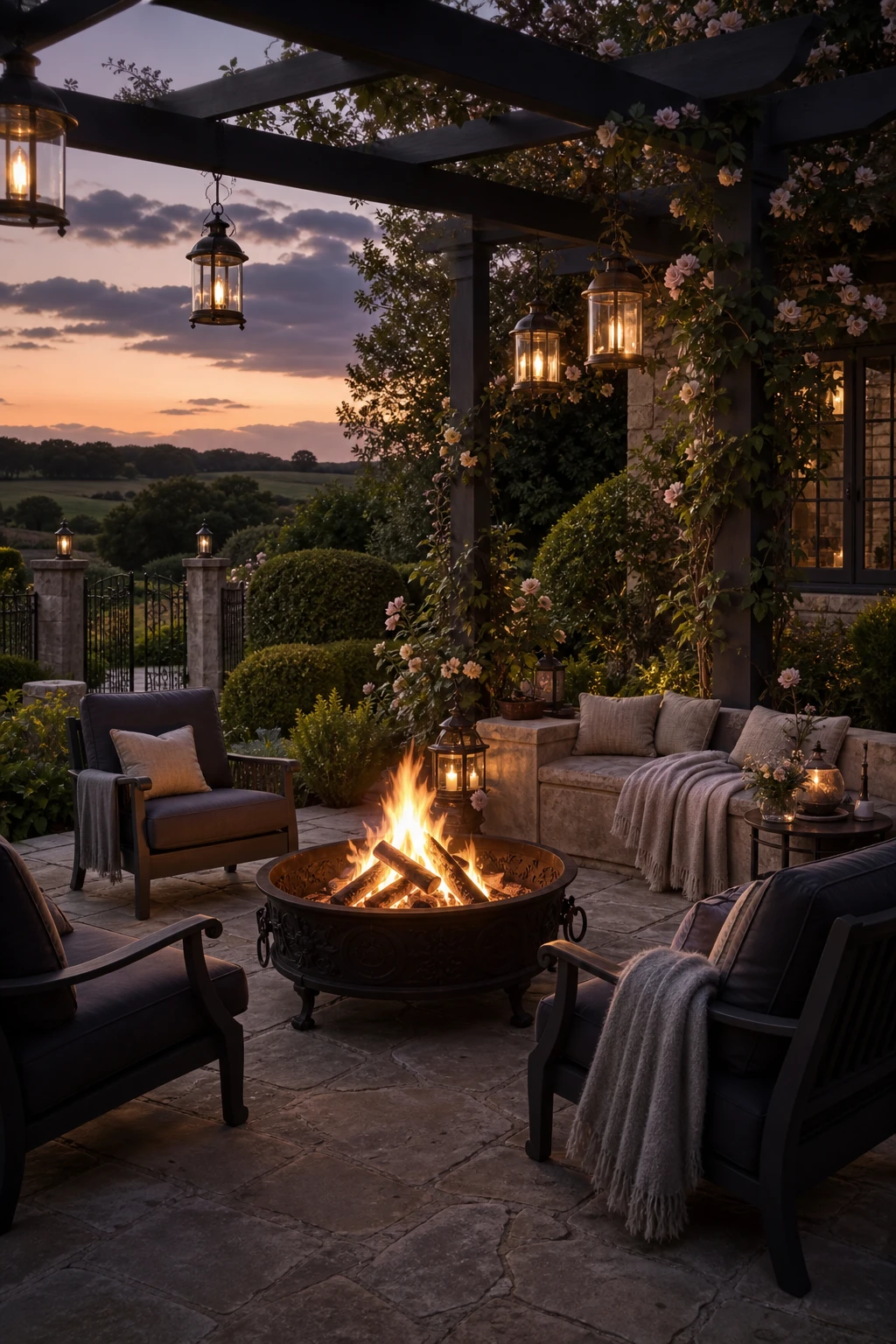
A Fire Pit in the Garden Design Keeps Your Patio in Use Long After Summer Ends
A fire pit turns a patio corner into a destination, and that is what I am always trying to create: a reason to stay outside. You get warmth, light, and a natural gathering point that pulls people together even on a cool October evening. What I love most is how the flickering flame does all the decorating for you, making every other element, the stone bench, the lanterns, the climbing roses overhead, feel more alive after dark.
The Key Details
Cast iron fire pit
Curved stone bench
Antique brass hanging lanterns
Limestone flagstone paving
Timber pergola with climbing roses
Pro TipSet the fire pit on a generous gravel circle, at least a metre wider than the bowl, so stray embers land safely and you avoid scorch marks on your flagstones.
AvoidPositioning a fire pit beneath low hanging tree branches is a serious fire risk and will force you to move the whole setup once you realise flames and dry wood overhead do not mix.
Alan launched Edward George London in 2017. Since completing his masters in Town & Regional Planning (MPlan) he has combined the skills he learned at the University of Sheffield with his passion for design, to help create a foundation for those looking to create a beautiful home.