I’ve always thought the vanity is where an English country bathroom either earns its charm or loses it entirely. What I love about this style is how much it borrows from the rest of the house: furniture legs, aged wood, painted finishes, proper hardware. In this piece I walk through everything from antique washstands and wood panelling to green cabinetry and vintage tiles, and every single look is one you can genuinely steal for your own space.
How a Country House Bathroom Sets the Tone for the Whole Look
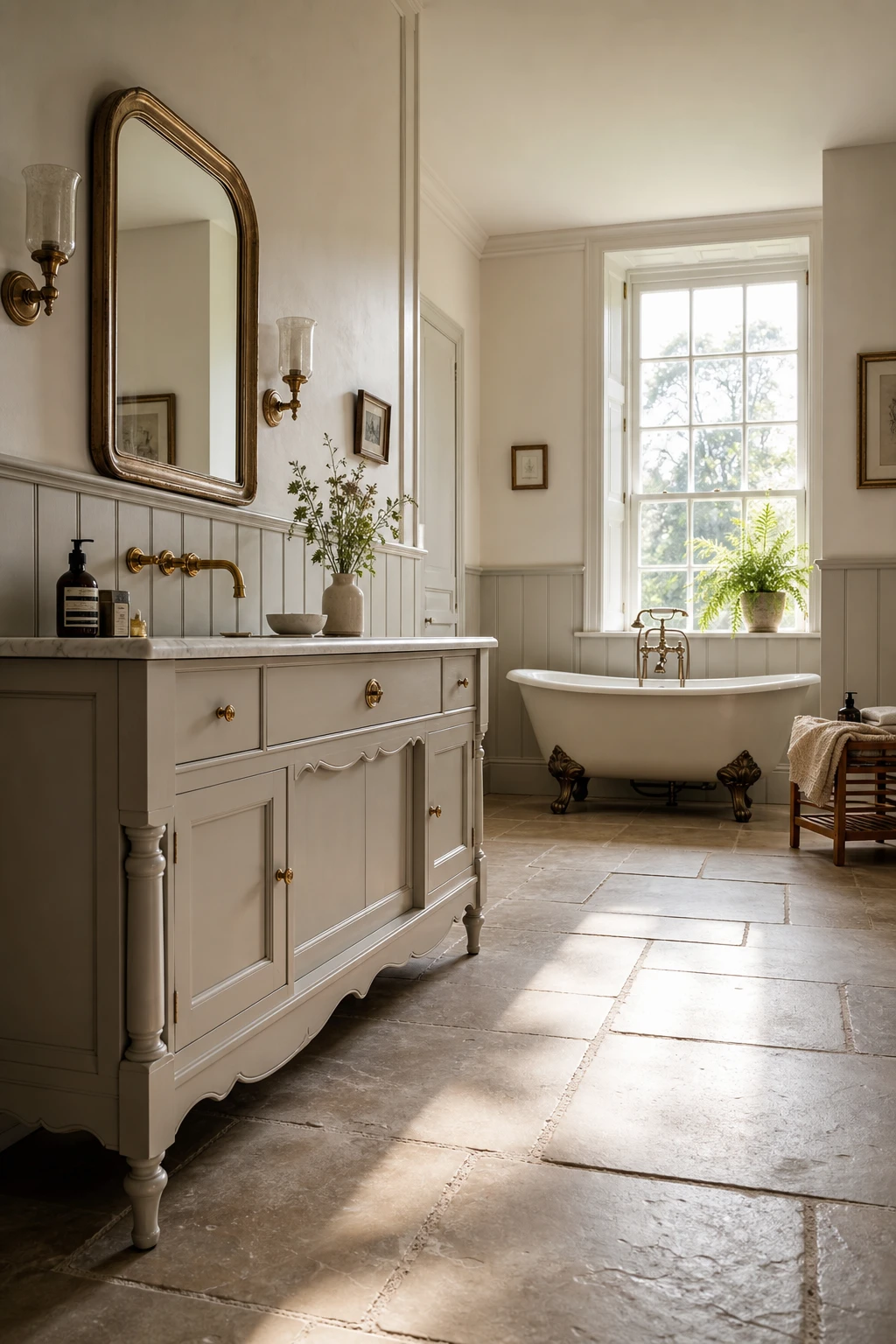
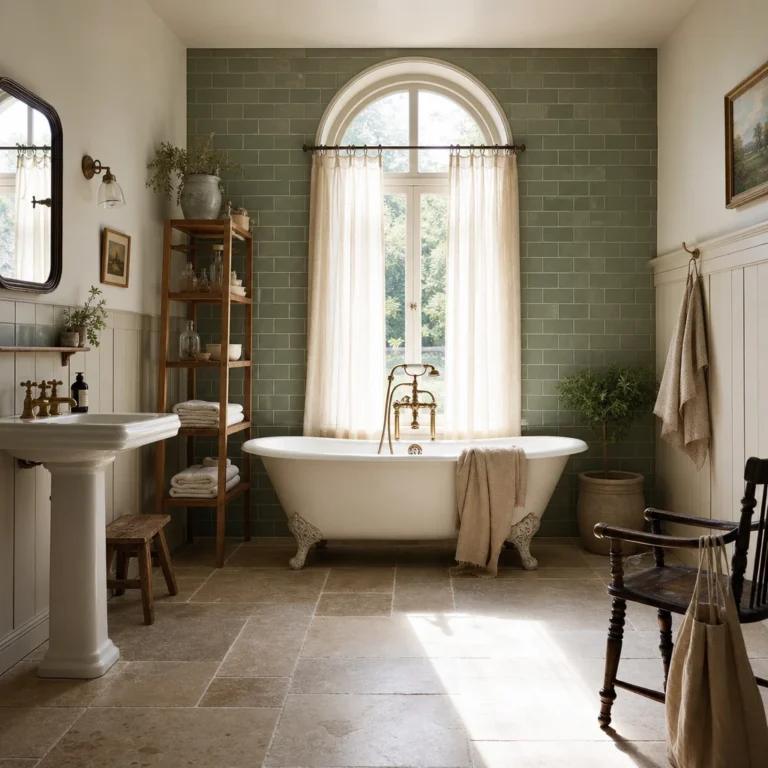
Anchoring the room with one grand, furniture style washstand is the move that pulls the whole country house feeling together. What I love about this approach is that the room stops feeling like a bathroom and starts feeling like a room, full stop. You get that sense of solidity and age that no fitted unit can fake, and every other choice, the bath, the tiles, the panelling, falls naturally into place around it.
The Key Details
Furniture style timber washstand
Roll top cast iron freestanding bath
Aged brass tap set and mirror
Wide flagstone floor tiles
Tongue and groove wall panelling
Pro TipChoose your washstand first and let its scale, timber tone, and leg detail set every other decision in the room.
AvoidPairing a Georgian washstand with Victorian fittings and Arts and Crafts tiles pulls the eye in three directions at once and the room loses all its calm authority.
The Modern Twist That Keeps an English Country Bathroom Feeling Fresh
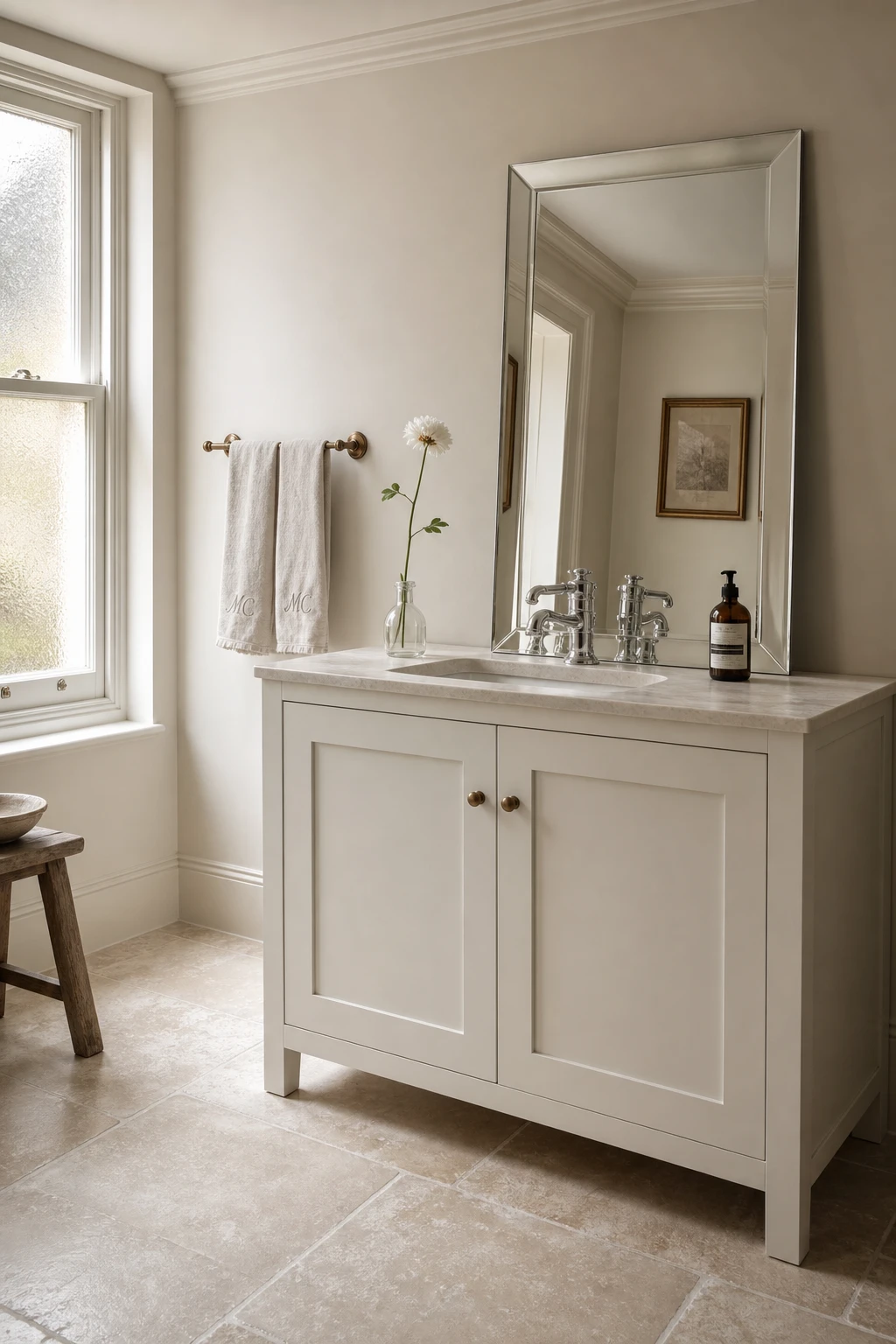
Blending a clean undermount basin with a shaker vanity is one of my favourite moves in a country bathroom, because the simplicity of each piece lets the other breathe. You get that crisp, modern edge without losing the warmth the panelled doors bring to the room. Watch how the column tap holds the whole thing together, acting as the one slightly ornate detail that nods to tradition without tipping into fussy.
The Key Details
Shaker vanity cabinet with panelled doors
Undermount ceramic basin with column chrome mixer tap
Frameless bevelled leaner mirror
Aged brass towel rail with linen guest towels
Honed limestone floor tiles
Pro TipChoose a tap with a gentle curve at the spout rather than a fully square silhouette, so it reads as contemporary but still sits comfortably alongside traditional cabinet hardware.
AvoidStripping out every soft or decorative element in favour of clean lines leaves the room feeling cold and clinical, which is the opposite of what an English country bathroom should do.
Edwardian Bathroom Ideas Worth Borrowing for a Timeless Vanity
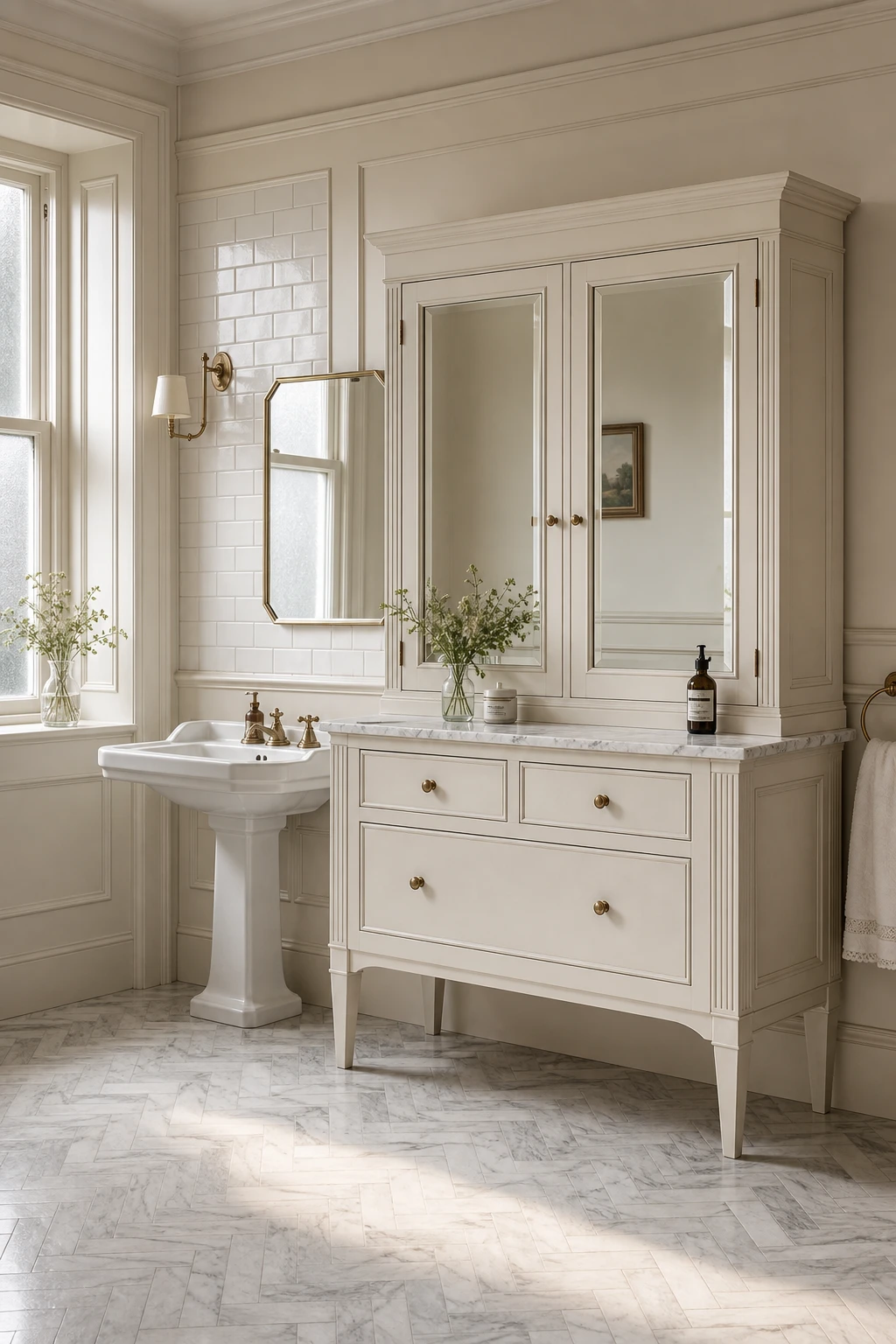
Edwardian bathrooms win me over because they prove elegance comes from proportion, not decoration. The tapered legs on a furniture grade vanity lift the whole room, and you get that light, airy quality without a single fussy detail. Pair that with a pedestal basin and cross head taps and watch how the eye reads the whole space as considered rather than cluttered.
The Key Details
Furniture grade vanity cabinet with tapered legs and moulding detail
White pedestal basin with period cross head brass taps
Slim brass edged bevelled mirror
Full height subway tile in traditional brick bond layout
Herringbone pale veined marble floor
Pro TipWhen sourcing Edwardian profile cabinet doors, look for a shallow raised centre panel with a pencil round edge rather than the deeper ogee moulding you find on Victorian pieces, as that flatter profile is what keeps the look refined instead of heavy.
AvoidLayering too many period details into one room, full panelling plus decorative corbels plus ornate tile borders together, tips the space from elegant into costume, and the timeless quality you were chasing disappears completely.
Victorian Vanity Details That Give Your Bathroom Its Best Character
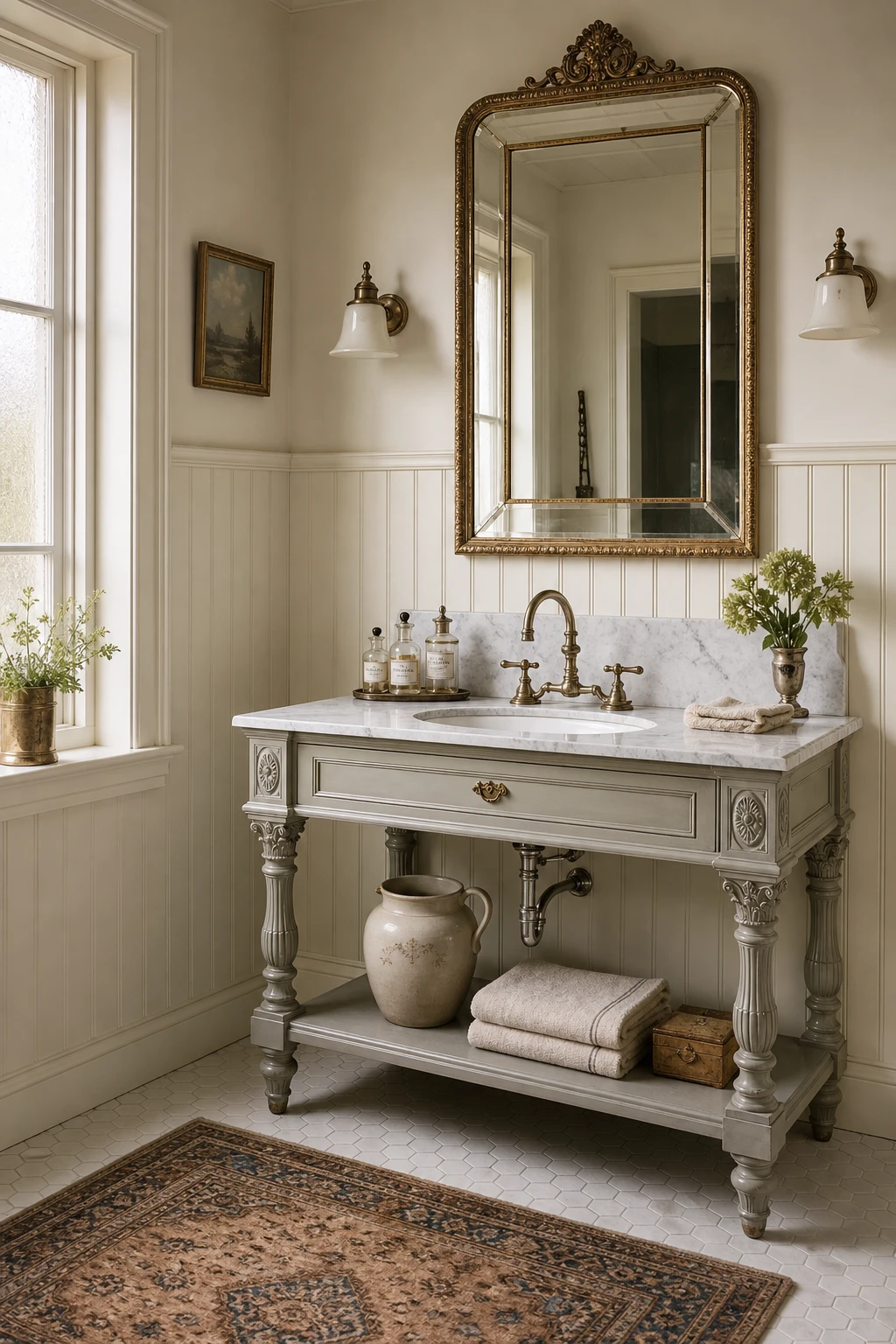
Ornate moulding and turned legs are the details I reach for when a bathroom needs genuine personality rather than just polish. You get that sense of a room that was built to last, where every surface rewards a second look. The carved profiles on the cabinet doors create shadow and depth, and the turned legs lift the vanity so the floor reads as larger than it is. Watch how one gilded mirror pulls all those warm timber tones together into something that feels complete.
The Key Details
Ornate carved moulding on vanity cabinet doors
Turned solid oak legs on freestanding vanity base
Gilded bevelled edge antique mirror
Honed Carrara marble countertop
Tongue and groove wainscoting panels
Pro TipIn a smaller bathroom, choose one richly carved feature, such as the mirror frame, and keep the vanity moulding simpler so the room breathes.
AvoidApplying heavy carved detail to every surface in a compact room leaves it feeling busy and dark, which works against everything Victorian ornament is meant to do.
Country Cottage Bathrooms and the Cosy Vanity Details That Make Them Work
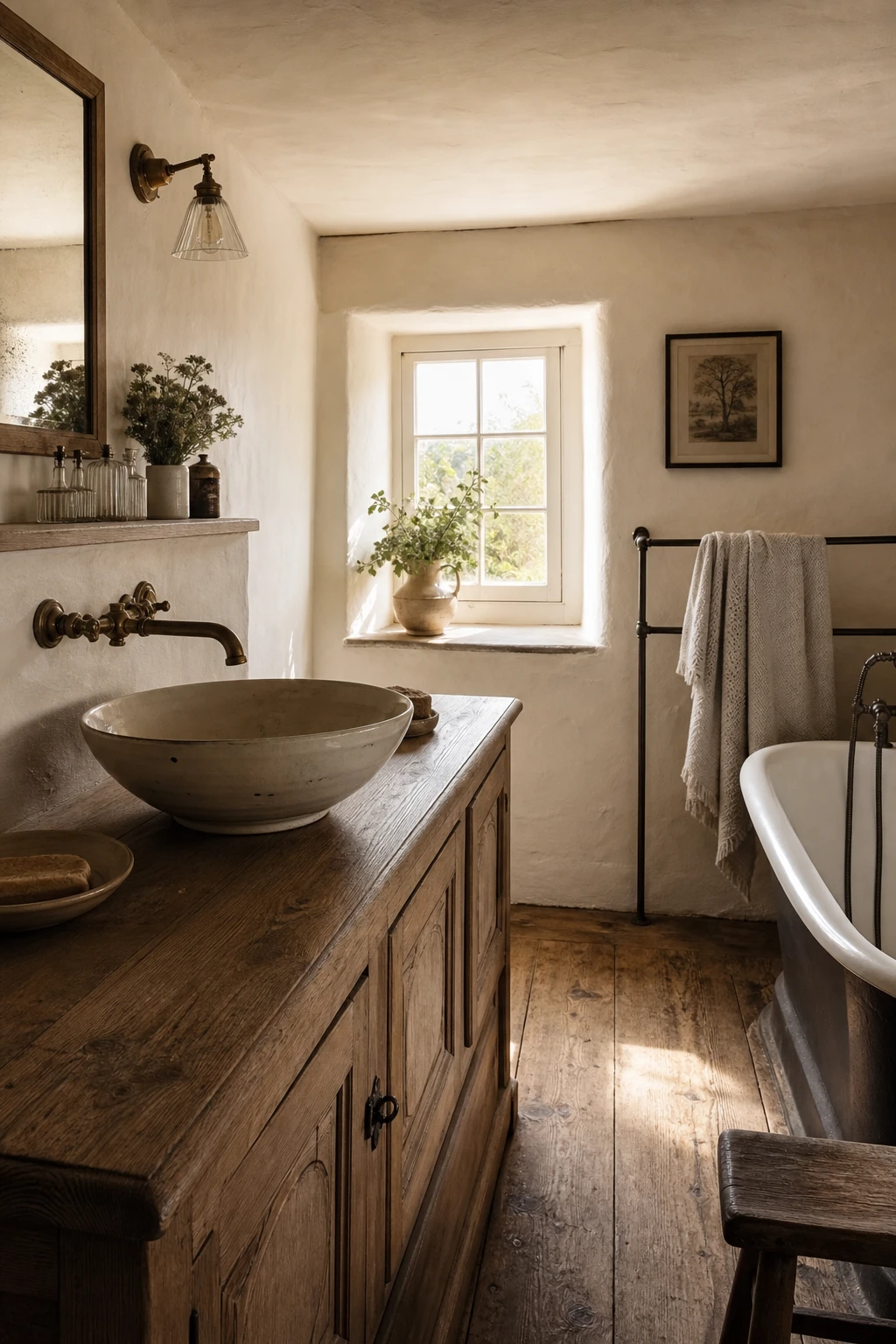
The constraints of a cottage bathroom are genuinely the charm, and that is what I find so satisfying about getting one right. A low ceiling and a narrow run of wall push you toward a compact vanity, and that snugness, when you lean into it, reads as cosy rather than tight. The carved timber cabinet, the hand thrown basin, and the worn oak boards all carry a little imperfection, so nothing feels too precious or fitted out. You get warmth you simply cannot buy with smooth, modern surfaces.
The Key Details
Carved timber vanity cabinet
Hand thrown ceramic basin
Small deep silled sash window
Worn oak floorboards
Freestanding rolled edge cast iron bath
Pro TipIn a low ceilinged cottage bathroom, choose a vanity cabinet no taller than 85 cm so the room keeps its breathing space above the basin.
AvoidFitting a wide double basin vanity into a cottage scale room eats the floor plan and leaves you with a bathroom that feels blocked rather than intimate.
Why a French Country Vanity Feels So at Home in an English Bathroom
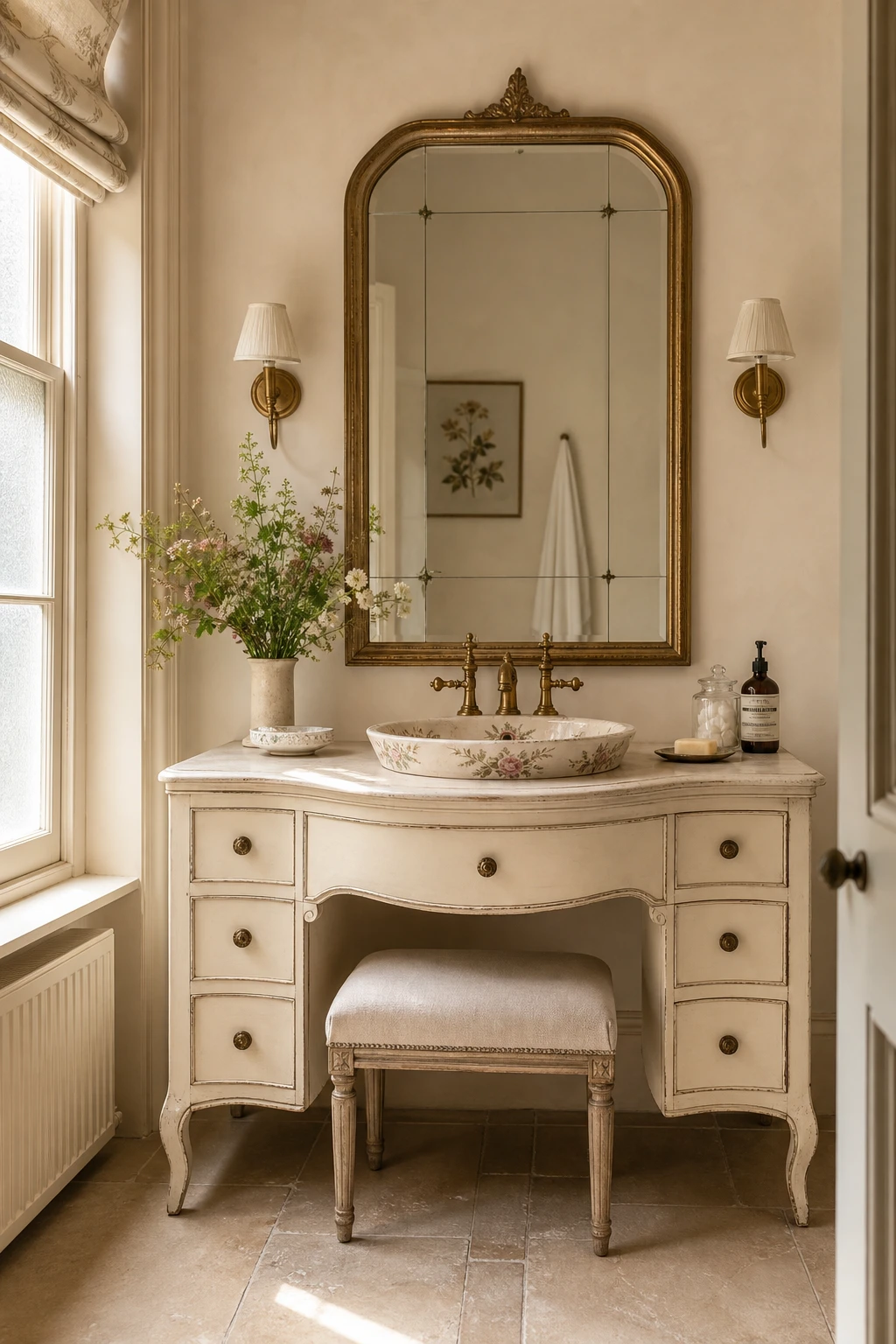
Soft curves and a lightly distressed ivory finish sit so naturally in an English country bathroom that most people never question where the idea came from. What I love about borrowing from French country style is that the two traditions share the same bones: worn paint, handmade ceramics, and metal that looks like it has lived a life. You get warmth without fussiness, and the room never feels like it is trying too hard.
The Key Details
Curved distressed ivory vanity cabinet
Hand painted floral ceramic basin
Aged brass pillar taps
Bevelled overmantel mirror with gilded frame
Stone effect floor tiles
Pro TipKeep one firmly English anchor, a butler style tap or a tongue and groove panel, so the French curves feel like a welcome guest rather than a takeover.
AvoidLeaning too heavily into gilded and ornate French pieces strips the room of the easy, unpretentious warmth that makes English country bathrooms feel so liveable.
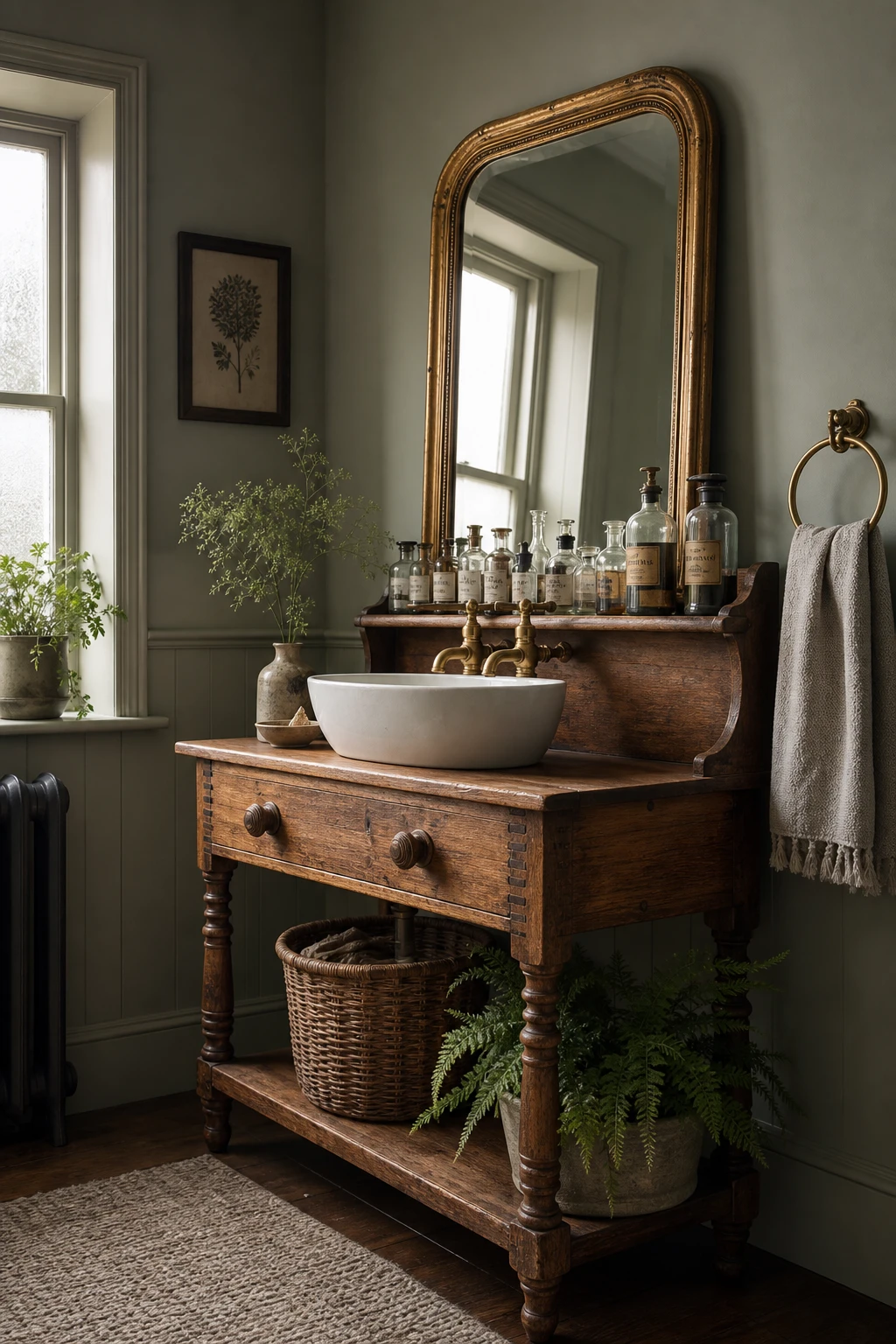
An Antique Washstand Turned Vanity Is the Detail Every Country Bathroom Wants
An antique washstand brought into a working bathroom is one of my favourite conversions, because you get all the character of a piece that has lived a real life and none of the flatpack sameness. The turned legs, the worn patina, the gentle bow of an old oak top: you will notice straight away how those details warm a room that tile and chrome alone can never quite manage. What I love most is that the furniture sets the mood first and the plumbing follows quietly behind it.
The Key Details
Antique oak washstand with turned legs
Ceramic vessel sink
Aged brass pillar taps
Gilded bevelled mirror
Tongue and groove wall panelling
Pro TipBefore fitting the basin, seal every face and edge of the wood with at least two coats of a hard wearing waterproof oil or lacquer rated for wet rooms, paying close attention to the cutout edge where water is most likely to creep in.
AvoidA washstand with a top shallower than about 45 cm will leave the basin sitting proud and awkward, giving you a constant drip line down the front and a tap height that is genuinely uncomfortable to use.
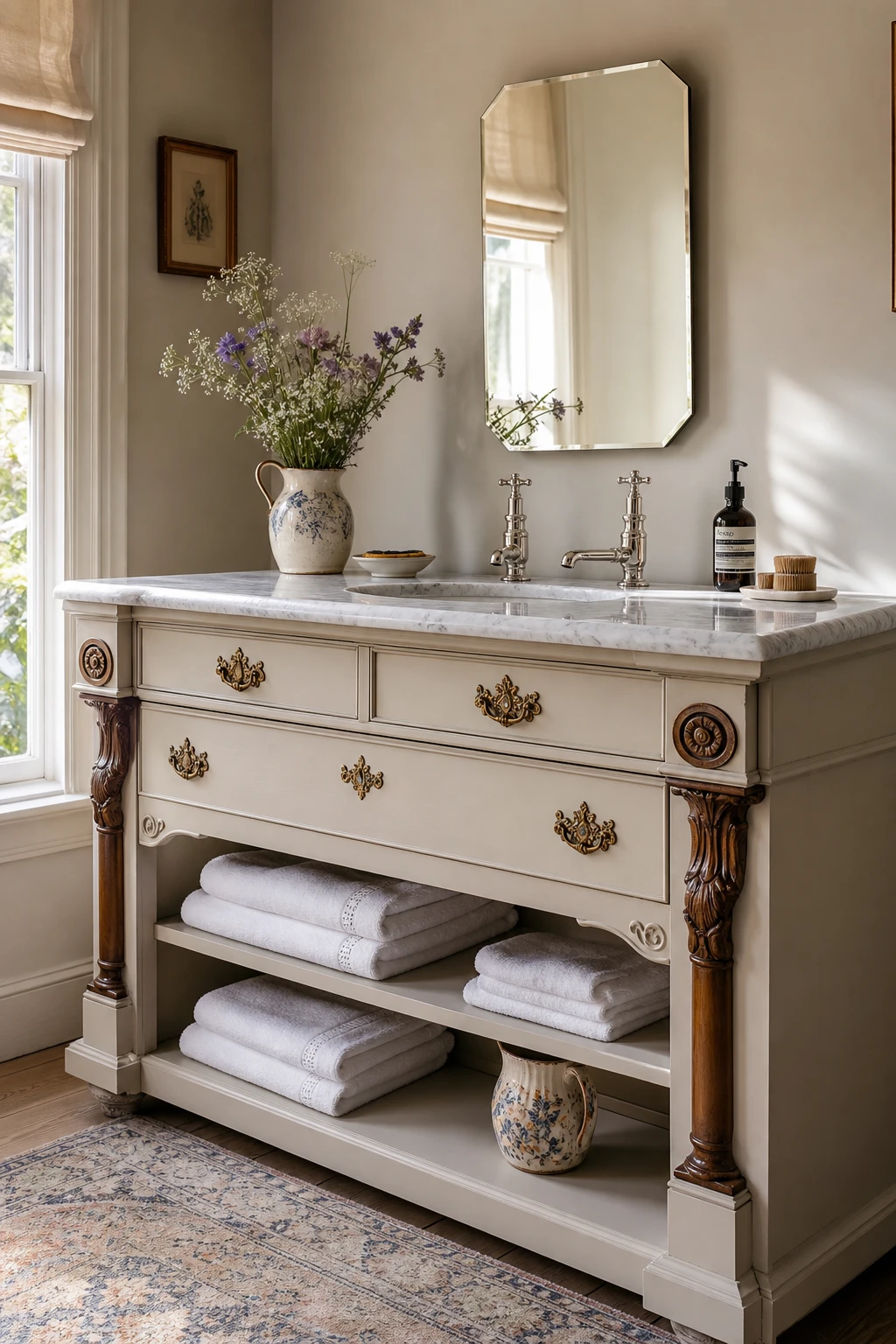
Turning a Vintage Dresser Into a Bathroom Vanity That Looks Made for the Job
Bedroom furniture carries a warmth that no flat pack vanity unit can fake, and a carved mahogany dresser brings exactly that to the bathroom. You get the patina, the original brass hardware, the slightly imperfect proportions that tell a story. What wins me over every time is how the honed Carrara top and undermount sink look completely at home on it, as though a craftsman planned it that way from the start.
The Key Details
Carved mahogany dresser frame with original brass hardware
Honed Carrara marble slab top with undermount porcelain sink
Polished nickel pillar taps
Bevelled frameless wall mirror
Sash window with white painted frame
Pro TipRoute your plumbing access through the back panel of the lowest drawer cavity rather than cutting into a drawer front, so the remaining drawers still open and give you real storage.
AvoidA dresser with laminate faces will bubble and peel within months in a steamy bathroom, leaving you with something that looks far worse than a basic vanity unit ever would.
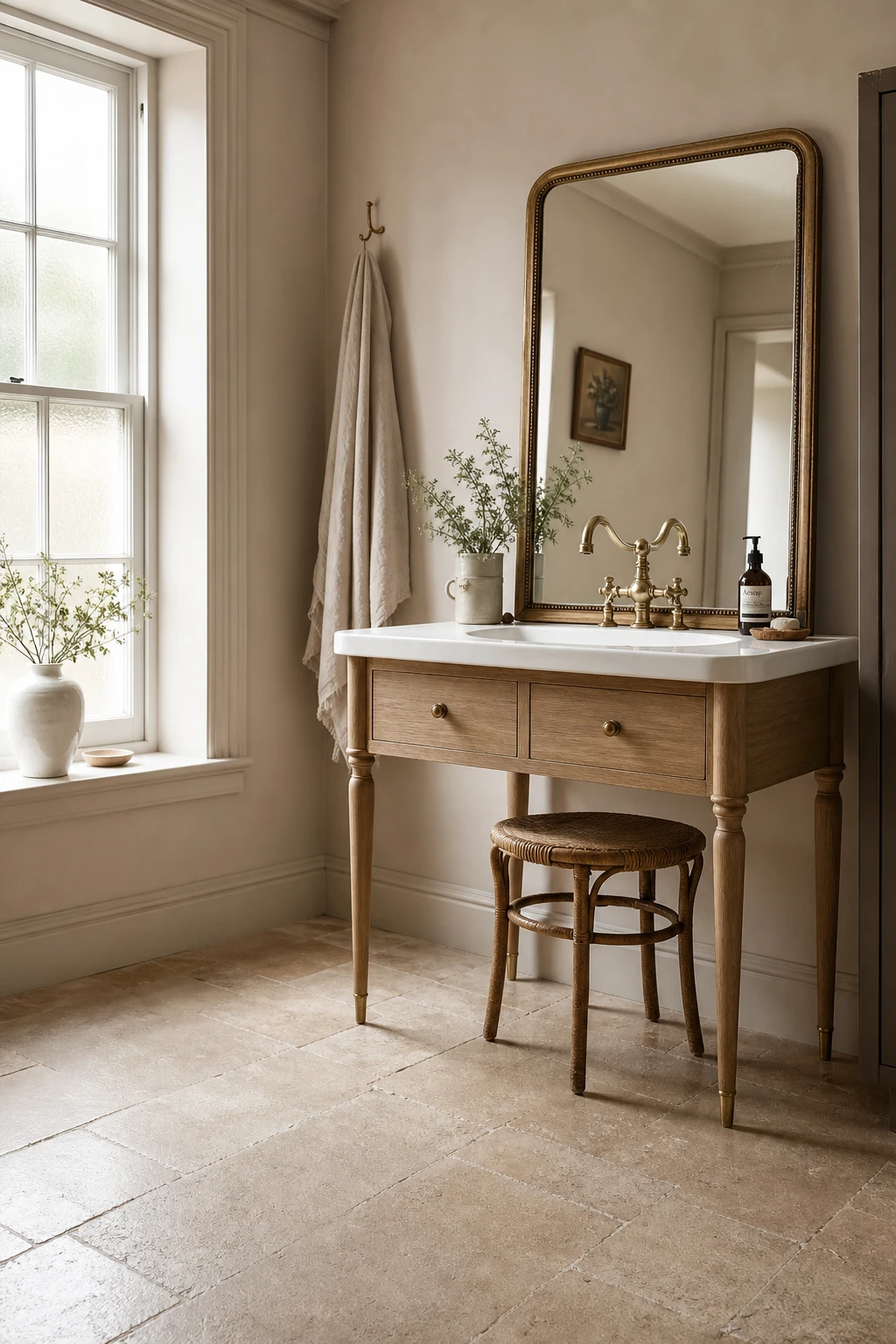
A Vanity on Legs Is the One Choice That Makes a Bathroom Feel Instantly Lighter
Lifting a vanity onto legs is one of my favourite moves in a small bathroom. You get a clear run of floor between the base and the tiles, and the eye reads that gap as breathing room even when the room itself is tight. Watch how the aged limestone underneath pulls you through the space rather than stopping at the cabinet. It is a small shift in construction that buys you a surprisingly big feeling of light.
The Key Details
Tapered oak vanity legs
Aged limestone floor tiles
High neck bridge mixer in unlacquered brass
Bevelled framed mirror
Rattan stool
Pro TipMatch the leg height to your tile format: taller legs over large format stone let you see a full tile clearly, while shorter legs suit a busy pattern that you want to settle rather than spotlight.
AvoidGoing leg only without any drawer or shelf nearby leaves you with nowhere to put the everyday items, and the airy look quickly disappears under bottles and brushes sitting on the floor.
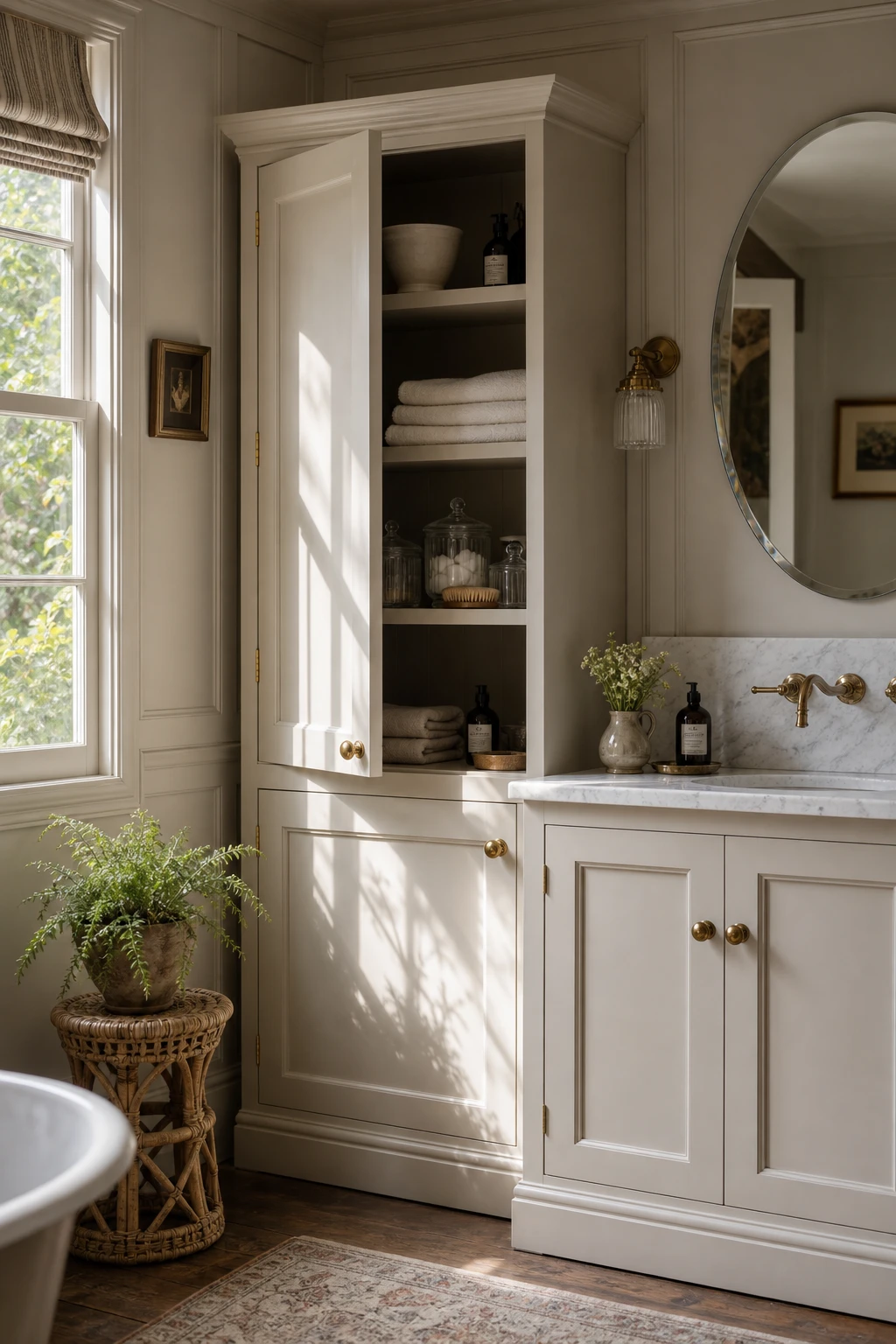
How a Freestanding Bathroom Cabinet Earns Its Place Beside the Vanity
A freestanding cabinet standing beside the vanity gives the room that collected, lived in quality you simply cannot fake with built ins. Two pieces of similar height read as a considered pair rather than an afterthought, and you get generous storage without losing the warmth of visible floor space. The aged brass knobs pull the whole arrangement together, and what I love most is how the room ends up feeling furnished rather than fitted. That is the whole point of the English country approach.
The Key Details
Panelled freestanding cabinet with aged brass knobs
Oval bevelled wall mirror
Marble topped vanity unit
Rattan stool with potted fern
Wall mounted brass tap set
Pro TipMatch the top of the cabinet to within two or three inches of your vanity height so both pieces form one calm horizontal line across the wall.
AvoidA cabinet with thin, flat pack carcass sides will look cheap the moment it stands next to aged or painted wood, and that contrast is very hard to style your way out of.
A Double Sink Wooden Vanity That Feels Like a Family Heirloom
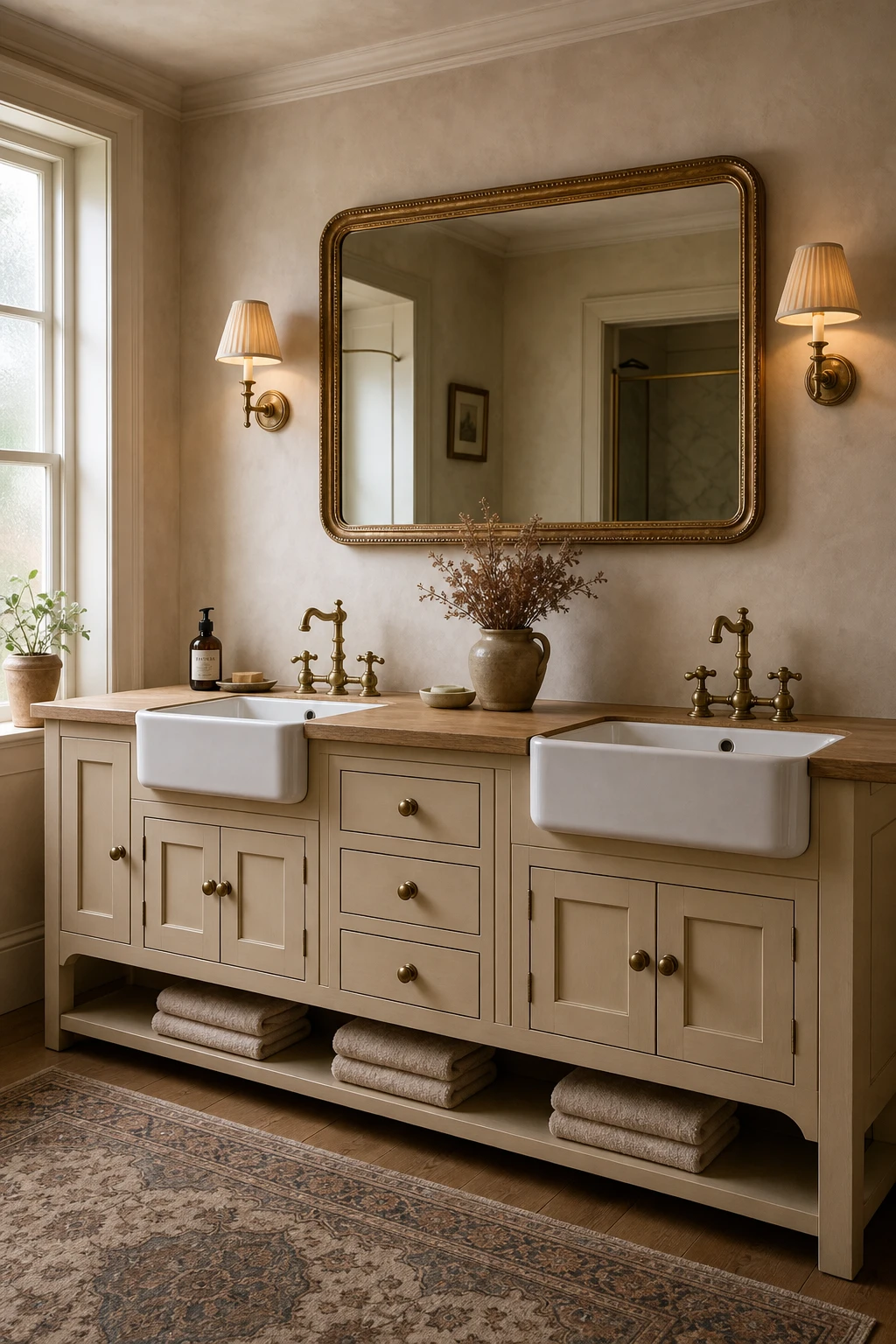
A double vanity done right feels generous rather than clinical, and what wins me over here is how the solid oak keeps both sides anchored in the same warm grain so the whole piece reads as one considered object. You get two distinct spaces without the vanity splitting into two separate pieces of furniture. The butler basins sit close enough together that the counter between them becomes usable, a small tray, a candle, a little breathing room that softens any sense of utility.
The Key Details
Solid oak double vanity cabinet
Ceramic butler basins
Aged brass pillar taps and wall sconces
Gilt framed antique mirror
Frosted sash window
Pro TipPosition the two basins so the gap between them matches the overhang at each outer edge, giving the vanity an even, composed rhythm rather than two sinks dropped into a plank.
AvoidChoosing the longest vanity the wall can physically hold leaves the room feeling like a hotel corridor, with nothing left to give the eye anywhere to rest.
A Bowl Sat on Top of the Vanity and Why It Changes the Whole Mood
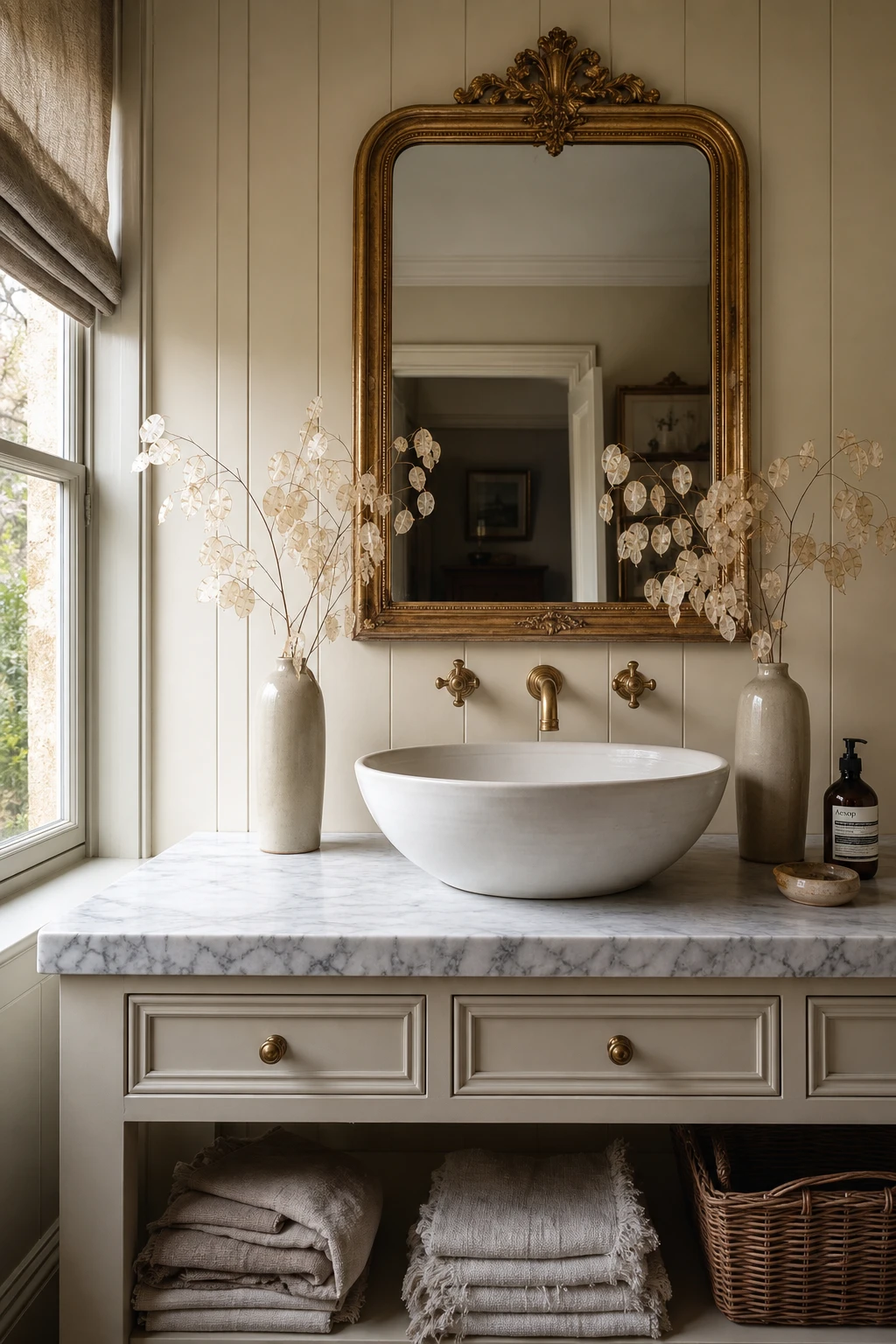
There is something almost sculptural about a ceramic bowl sitting on top of the vanity rather than dropped into it, and that is what draws me to this choice every time. The basin becomes a piece in its own right rather than a utility fixture, and you get a dresser like quality that feels completely at home in an English country bathroom. Watch how it lifts the eye upward and gives the whole vanity a presence that a recessed sink simply never achieves.
The Key Details
Ceramic vessel bowl basin
Carrara marble countertop slab
Ornate gilt framed mirror
Aged brass pillar taps
Tongue and groove timber wall panelling
Pro TipChoose a gently rounded or oval bowl with a rolled lip for a traditional vanity, as the softer profile echoes the period detailing far better than a stark geometric vessel.
AvoidA bowl with a very tall, straight sided profile pushes your tap height up and your mirror has to rise with it, leaving an awkward gap of bare wall between the two that breaks the composition entirely.
Oak Bathroom Vanity Ideas That Age Beautifully Over the Years
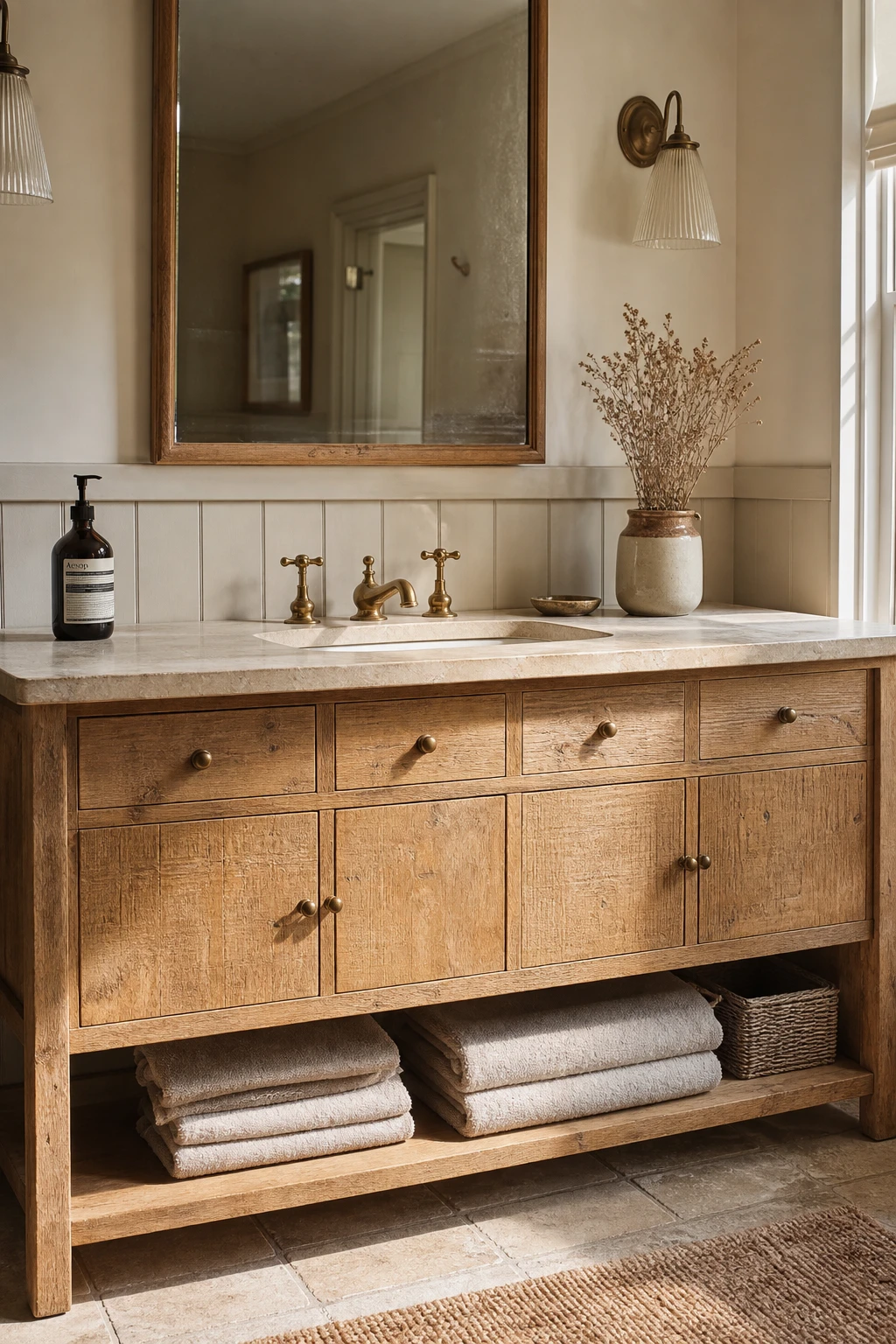
Oak in a bathroom wins me over every time because it does something no painted finish can: it genuinely improves with age. The grain deepens, the colour warms toward honey and amber, and every splash of light catches a slightly different surface. What I love most is that you stop fighting the humid conditions of a bathroom and let the material respond to them honestly. You get a vanity that looks more considered at ten years than it did on day one.
The Key Details
Solid oak vanity cabinet with visible wood grain
Honed limestone undermount basin
Aged brass cross head tap fittings
Bevelled mirror with slim timber surround
Open lower shelf with folded linen towels
Pro TipTreat the oak with a hard wax oil rather than a film varnish, so moisture can move through the grain slowly without lifting or cracking the surface.
AvoidLeaving oak bare or with a thin single coat means the end grain around the basin cutout absorbs water unevenly, and you end up with patchy grey rings that no amount of sanding fully removes.
Stained Wood on a Bathroom Vanity and the Warmth It Brings Without Paint
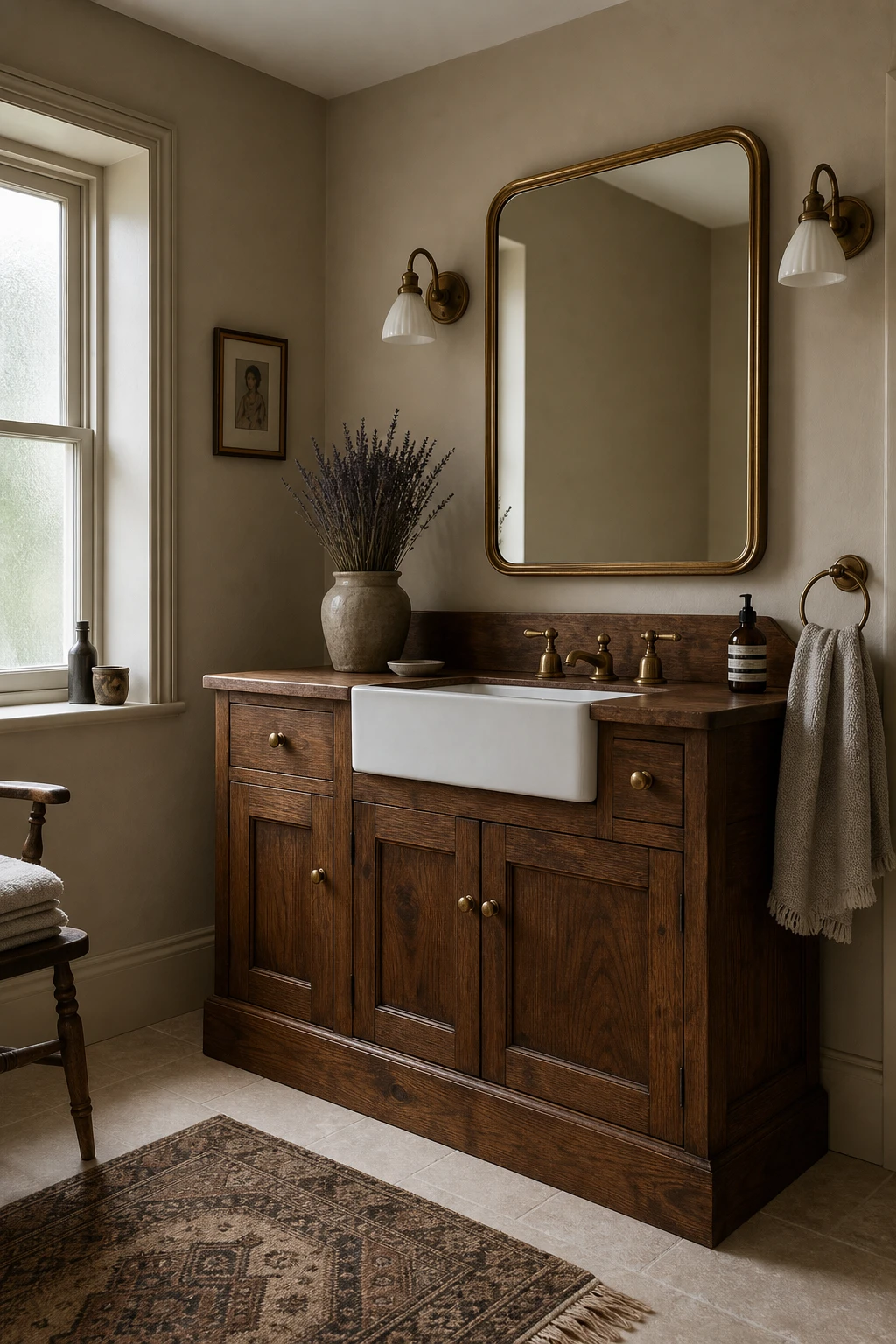
Stained wood pulls off something paint simply cannot: you get genuine depth and warmth while the grain still tells its own story beneath the surface. The oak here takes on a richer, quieter tone that sits beautifully against the limestone floor and the aged brass, and the whole thing reads as considered rather than decorated. What wins me over every time is how the visible grain keeps the vanity feeling natural, so the room breathes rather than trying too hard.
The Key Details
Freestanding stained oak vanity cabinet
Apron front ceramic sink
Aged brass lever taps and mirror frame
Honed limestone floor tiles
Frosted sash window
Pro TipAlways test your chosen stain on a spare offcut from the same board and let it cure for a full 24 hours before you judge the colour, because it will shift as it dries.
AvoidBuilding up coat after coat of stain to deepen the colour fills the grain and leaves the wood looking sealed and plastic rather than alive.
A Walnut Vanity Is Richer Than You Think and Here Is How to Style One
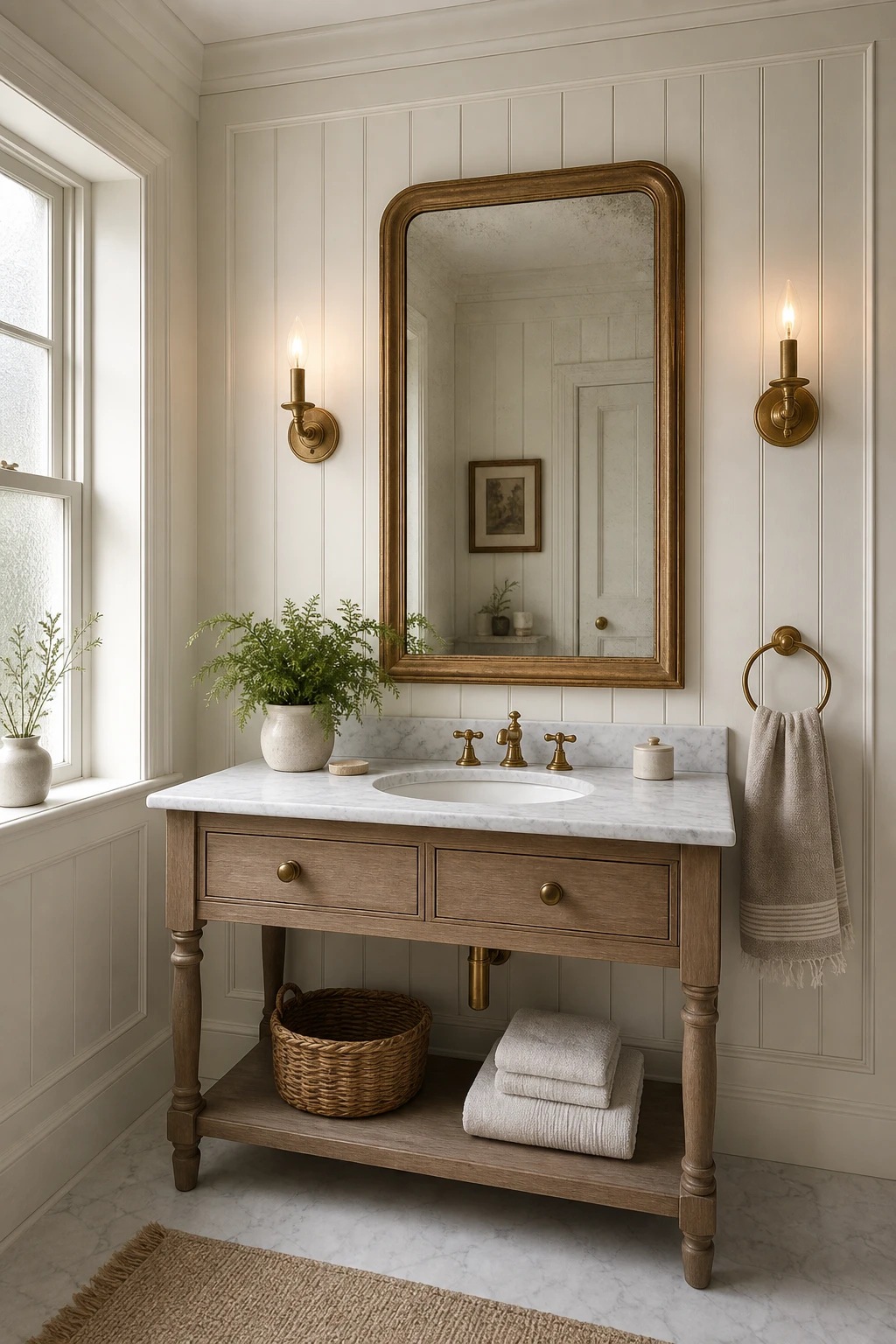
Walnut has this depth that photographs almost chocolatey, and what I love is how it pulls every warm tone in the room toward it. You get that richness without any heaviness when you set it against pale walls and keep the hardware light and honey toned. Watch how the grain does the decorative work, so you need very little else on the vanity itself.
The Key Details
Walnut cabinet with open lower shelf
Unlacquered brass cross handle taps
Tongue and groove dado panelling
Bevelled framed mirror
Honed limestone floor tiles
Pro TipPair walnut with brushed brass cross handles rather than polished chrome, because the warm gold in the brass echoes the red undertones in the wood and the two feel made for each other.
AvoidSurrounding a dark walnut vanity with dark tiles swallows the wood entirely and you lose the very feature you paid for.
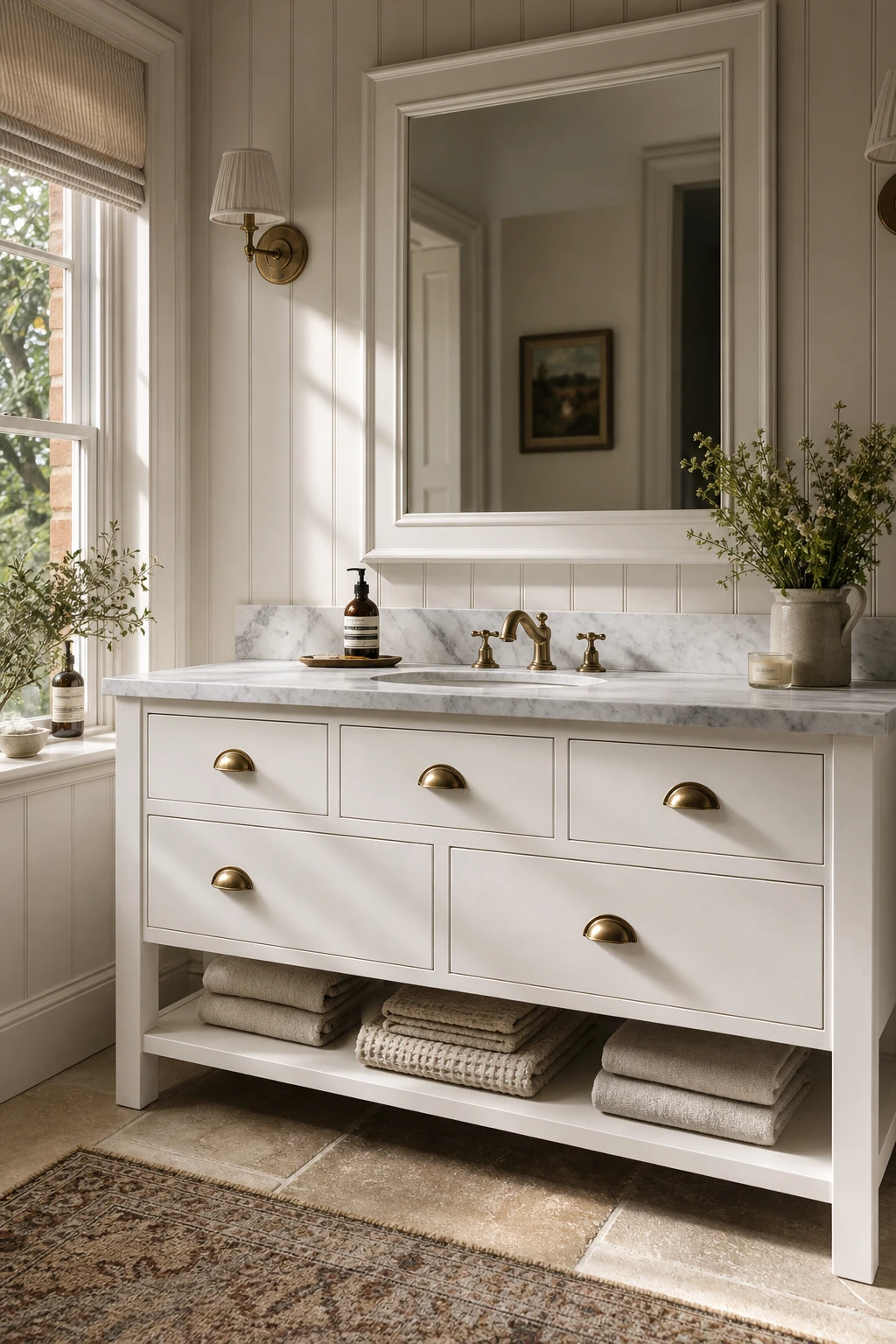
Painting Your Vanity Is the Lowest Effort Way to Transform the Whole Bathroom
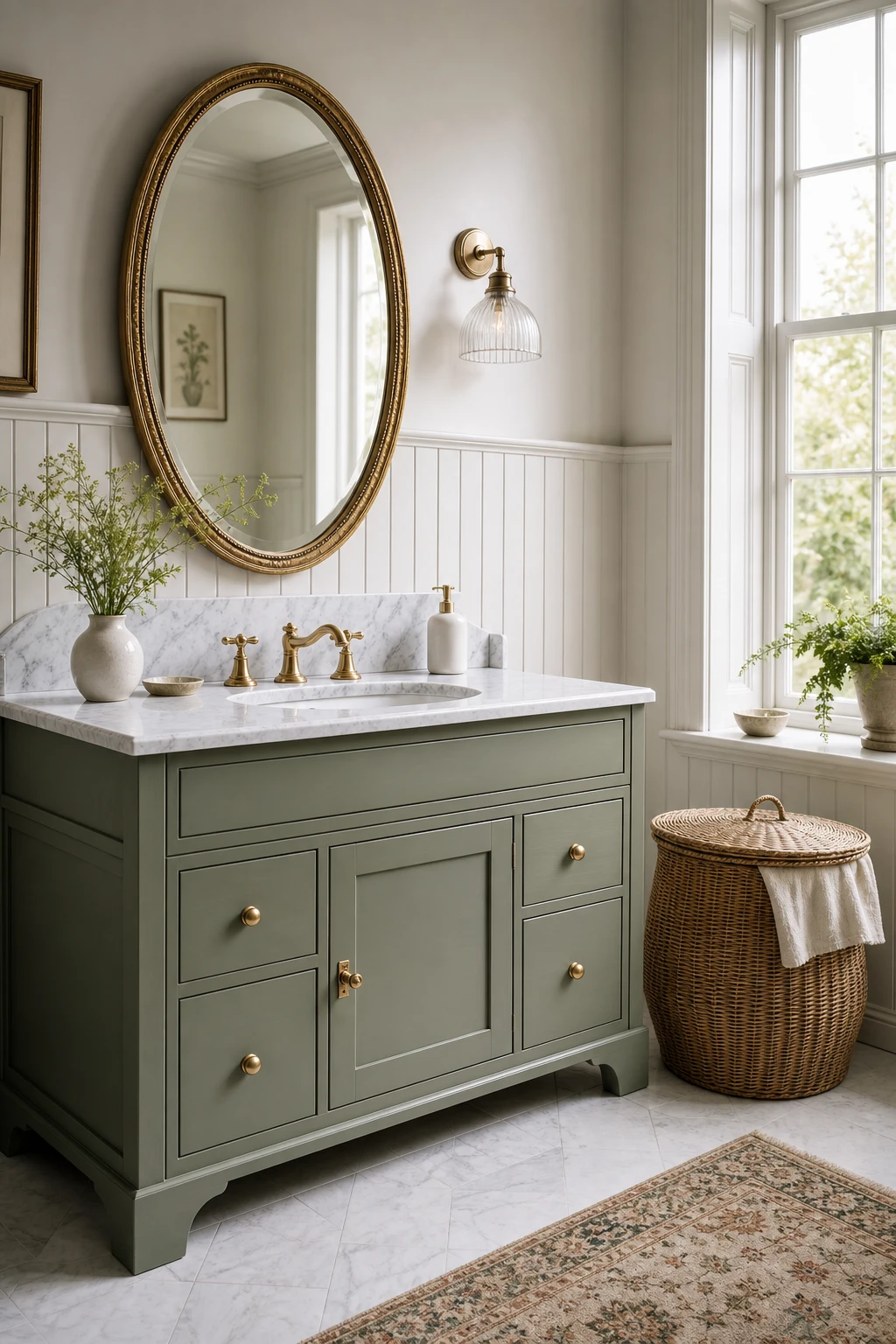
Colour anchors a vanity as a piece of furniture rather than a fitted unit, and that one shift changes how the whole room reads. A soft sage or dusty blue alongside aged brass pulls and a honed marble top suddenly looks warm, collected, and entirely English. What I find most satisfying about a freshly painted vanity is the scale of the transformation relative to the effort: not a single tile gets touched, yet the room feels like a completely different space.
The Key Details
Aged brass cup drawer pulls
Honed marble countertop
Panelled timber framed mirror
Tongue and groove wall panelling
Open lower shelf with folded linen towels
Pro TipUse a specialist cabinet paint formulated for kitchen or bathroom furniture rather than standard wall paint, because the harder resin in the finish resists chips and moisture far better over time.
AvoidSkipping a hardwearing topcoat leaves the colour vulnerable to every splash and knock, and the paint will chip back to bare wood within a few months.
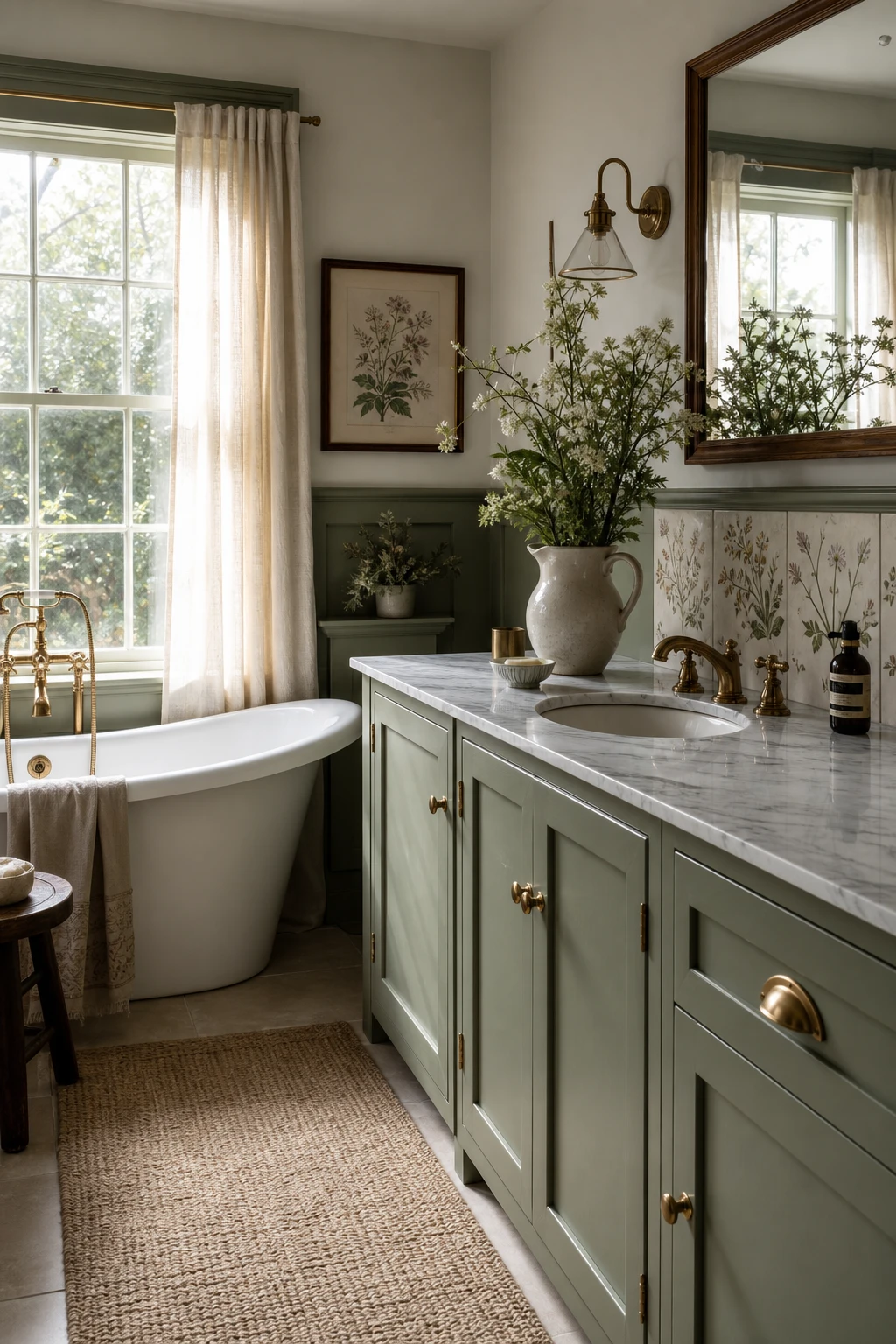
Green Cottage Bathrooms That Feel Like a Garden Has Come Indoors
Sage green on the vanity does something I find endlessly satisfying: it closes the gap between garden and bathroom so the room feels grown rather than decorated. The colour carries just enough grey to stay warm, and you will notice how it makes aged brass fittings glow rather than clash. Paired with botanical tiles and a linen dressed sash window, the whole room breathes.
The Key Details
Sage green panelled vanity cabinet
Freestanding rolled rim bathtub
Hand painted botanical splashback tiles
Sash window with sheer linen dressing
Aged brass basin hardware
Pro TipTest your green swatch next to your wood tones in natural morning light, as a grey sage will sit beautifully while a brighter green can turn sour once the sun shifts.
AvoidA yellow green that leans lime will fight warm oak and brass at every turn, making the whole scheme feel unsettled rather than garden fresh.
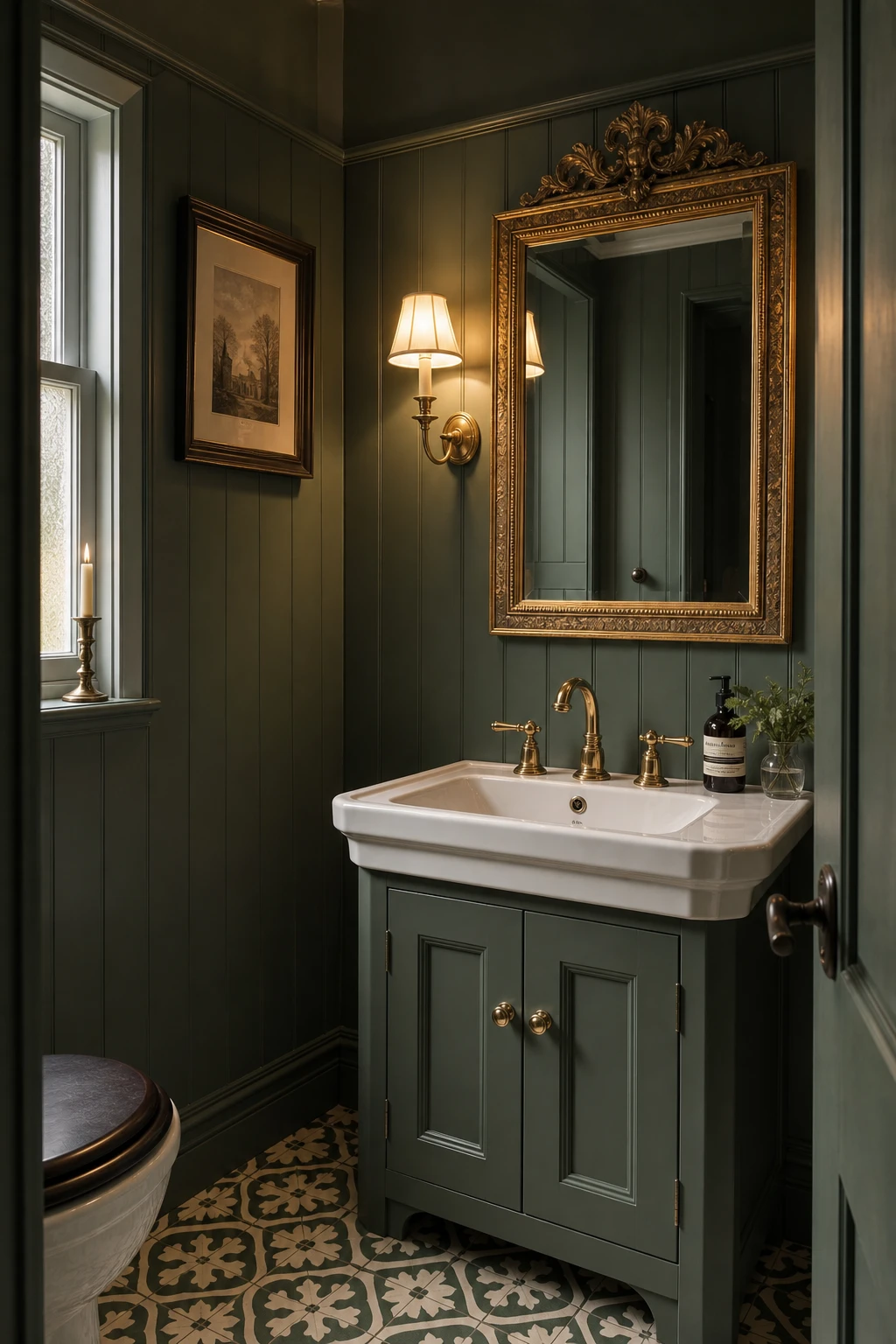
A Dark Green Cloakroom Vanity That Feels Like the Best Room in the House
A dark green cloakroom is one of my favourite moves in the whole English country playbook. You get a room that feels jewel like and considered, and because the space is small, the colour wraps around you rather than sitting at a distance. What wins me over every time is the way deep green reads as both rich and natural, so it never feels oppressive the way a dark grey or navy can. Watch how the brass and white ceramic lift the whole thing into something genuinely special.
The Key Details
Tongue and groove wall panelling
White ceramic pedestal basin
Polished brass tap set
Ornate gilt framed mirror
Encaustic patterned floor tiles
Pro TipTreat the cloakroom as a destination rather than an afterthought and commit fully to the dark vanity, because a half hearted approach with pale accessories will undercut the whole drama you are trying to build.
AvoidPairing dark green walls with a dark green vanity and no white or warm metal to break it up flattens the room into a single murky tone, and you lose every bit of the richness you were chasing.
Sage and White in the Bathroom and How to Get the Balance Just Right
Sage and white is a pairing I keep returning to because the two colours do completely different jobs and they never argue. The white holds the light and stops the room feeling closed in, while the sage on the vanity adds just enough warmth to feel considered rather than safe. You get a bathroom that reads as calm and pretty without tipping into bland, and I love how little else you need to do once those two colours are settled.
The Key Details
Painted wood vanity unit
Marble basin top
Brass tap set
Tongue and groove wall panelling
Oval framed mirror
Pro TipKeep white on every wall from dado height upward and save sage for the vanity unit alone, so the colour reads as a deliberate piece of furniture rather than an all over wash.
AvoidSplitting the room roughly half sage and half white leaves the eye with nowhere to settle, and the space ends up feeling like a decision that was never quite made.
A Blue Antique Bathroom Vanity That Looks Like It Has Always Been There
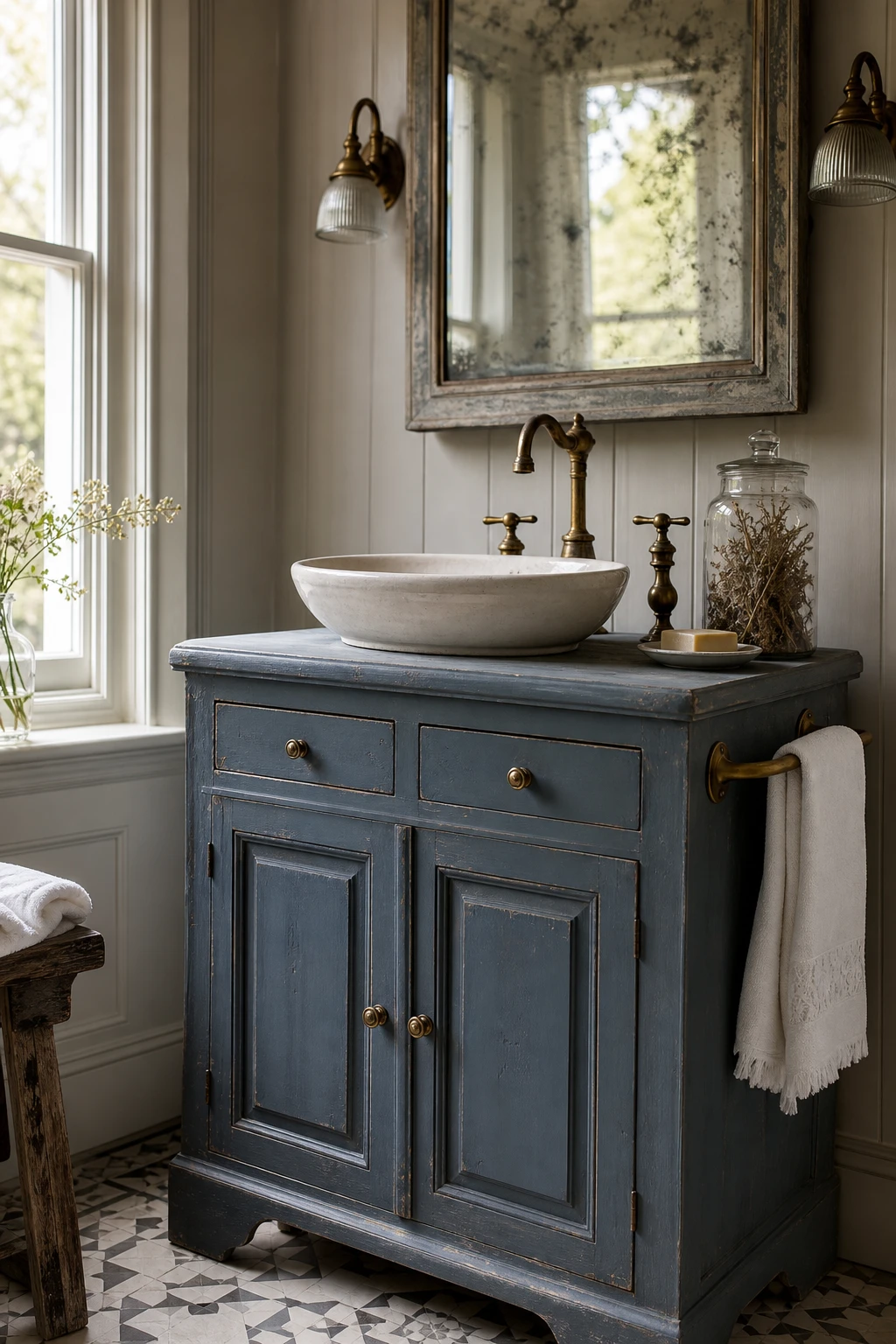
Antique blue is one of those shades that seems to carry its own history, and that is exactly what wins me over about it here. You get a vanity that looks settled and unhurried, as though it has stood in the same spot for a century. What I love is how the dusty, slightly greyed tone of the blue reads as weathered rather than painted, so the aged brass fittings feel found rather than chosen.
The Key Details
Hand thrown ceramic basin
Aged brass tap fittings
Foxed frame mirror
Encaustic mosaic tile floor
Tall sash window
Pro TipRun a little fine sandpaper along the edges and mouldings of the vanity after painting so the wood shows through just enough to sell the aged effect.
AvoidReaching for a bright, saturated blue creates an instant clash with aged brass fittings, making the hardware look tarnished rather than beautifully patinated.
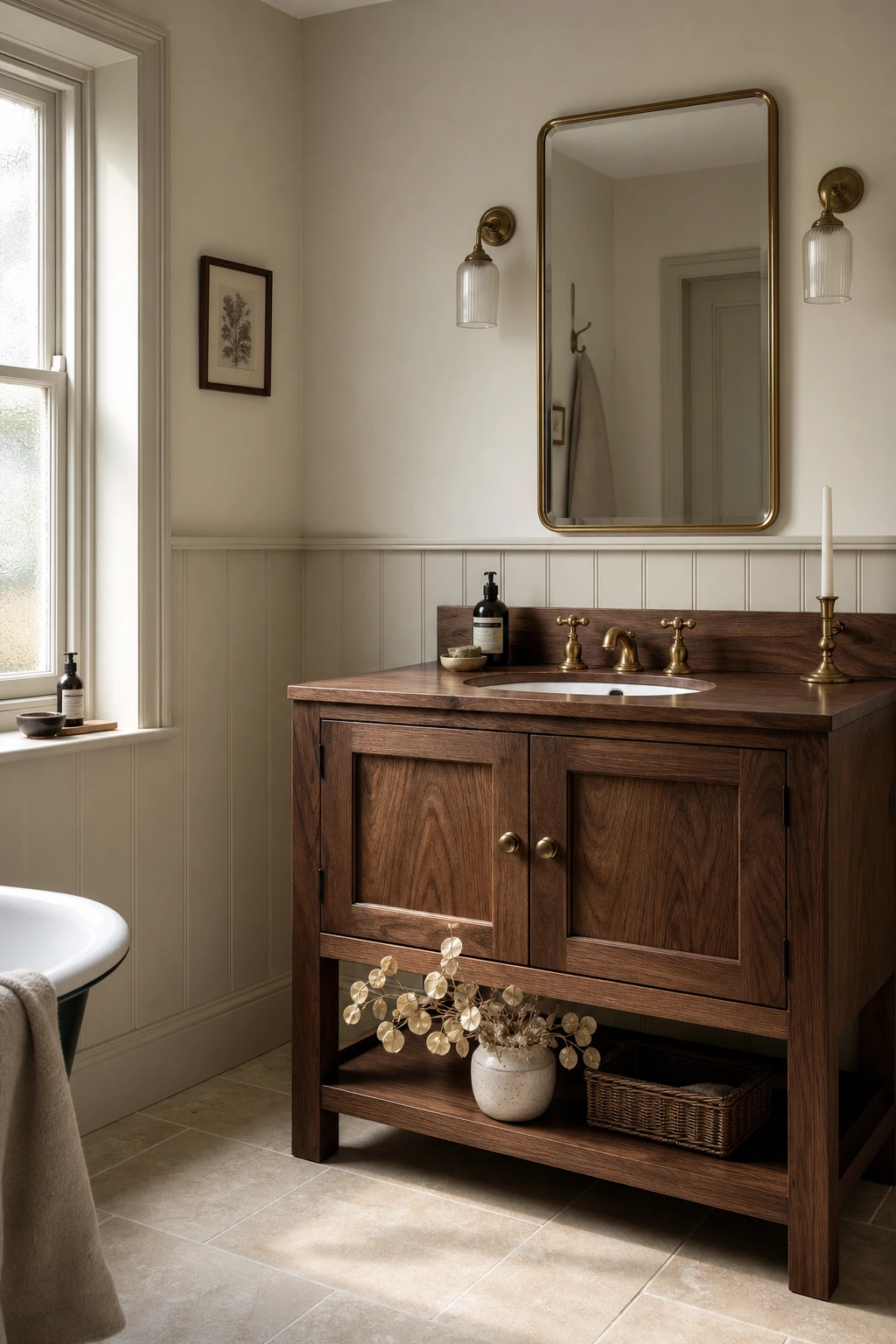
A Dark Brown Vanity Grounds the Whole Bathroom in Quiet Confidence
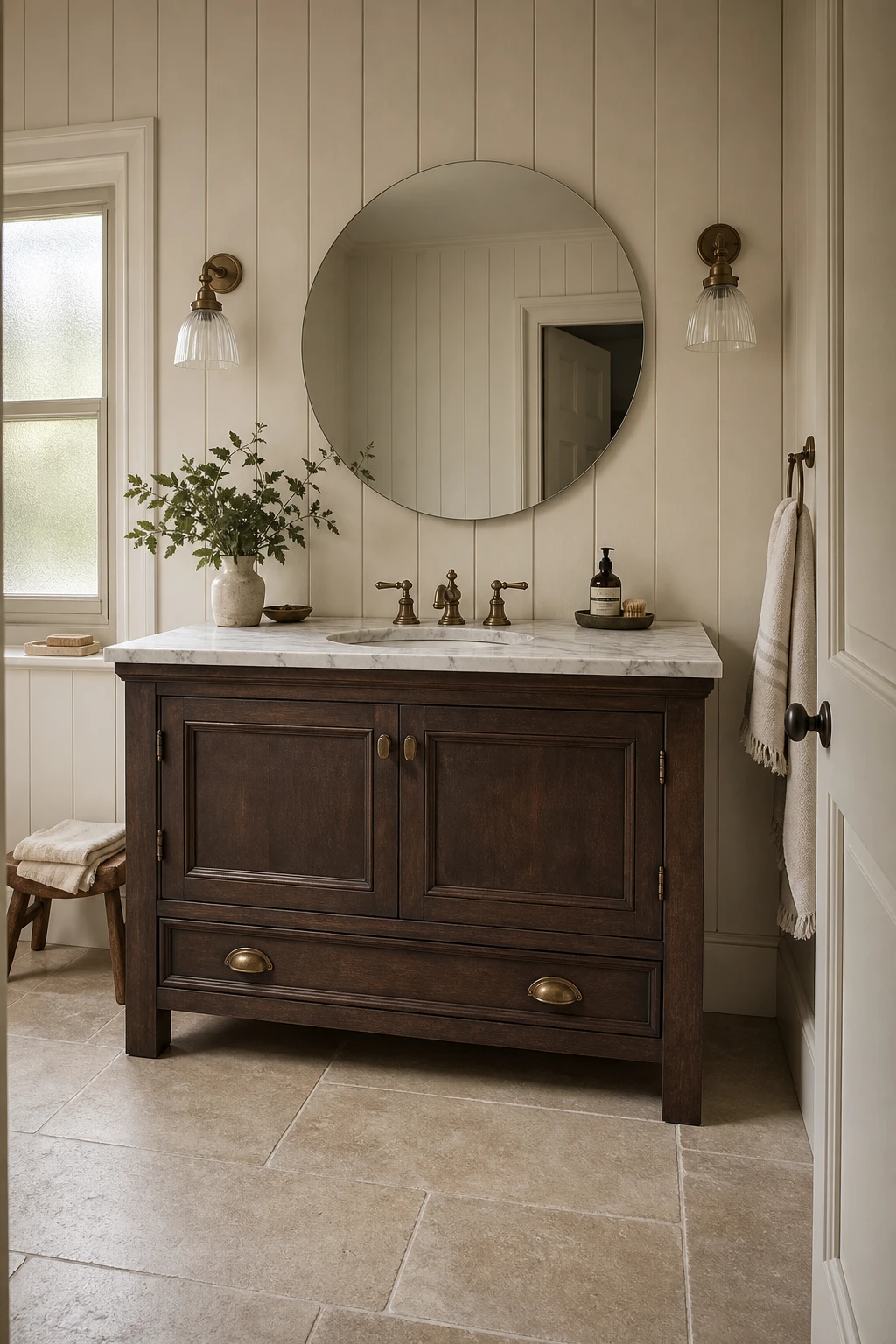
A deep brown vanity planted against lighter walls and a white marble top is one of my favourite moves in a country bathroom. You get that grounded, settled feeling the moment you walk in, like the room has always been there. The brown pulls the eye down and lets the marble and the aged brass do their job above it, catching the light and keeping things from ever feeling heavy.
The Key Details
Dark stained oak vanity cabinet
White marble countertop with grey veining
Aged brass tap fixtures
Round frameless mirror
Tongue and groove painted wall panelling
Pro TipPaint the walls a warm white with a yellow or pink undertone so the dark brown reads rich rather than draining the room of light.
AvoidPairing a dark brown vanity with cool grey tiles strips out every trace of warmth and leaves the room feeling cold and flat.
Wood Panelling Behind the Vanity Is the Backdrop That Pulls It All Together
Wall panelling behind a vanity does something a plain painted wall simply cannot: it gives the whole unit a sense of weight and permanence, as if it grew there rather than being placed. What I love most is how the vertical lines draw the eye up and frame the mirror like a picture, so you get a composed, purposeful scene rather than a sink floating against flat plaster. Painting the panelling to match the vanity ties everything into one calm, considered moment.
The Key Details
Shiplap wood panelling
Marble vanity countertop
Antiqued gilt framed mirror
Brass wall sconces
Cross handle brass taps
Pro TipMatch your panelling paint colour exactly to your vanity cabinet so the two read as one fitted piece rather than two separate elements competing for attention.
AvoidRunning panelling all the way to the ceiling compresses the room visually and robs it of the breathing space that makes a bathroom feel generous rather than boxed in.
Wainscoting in the Bathroom Gives Your Vanity a Setting It Deserves
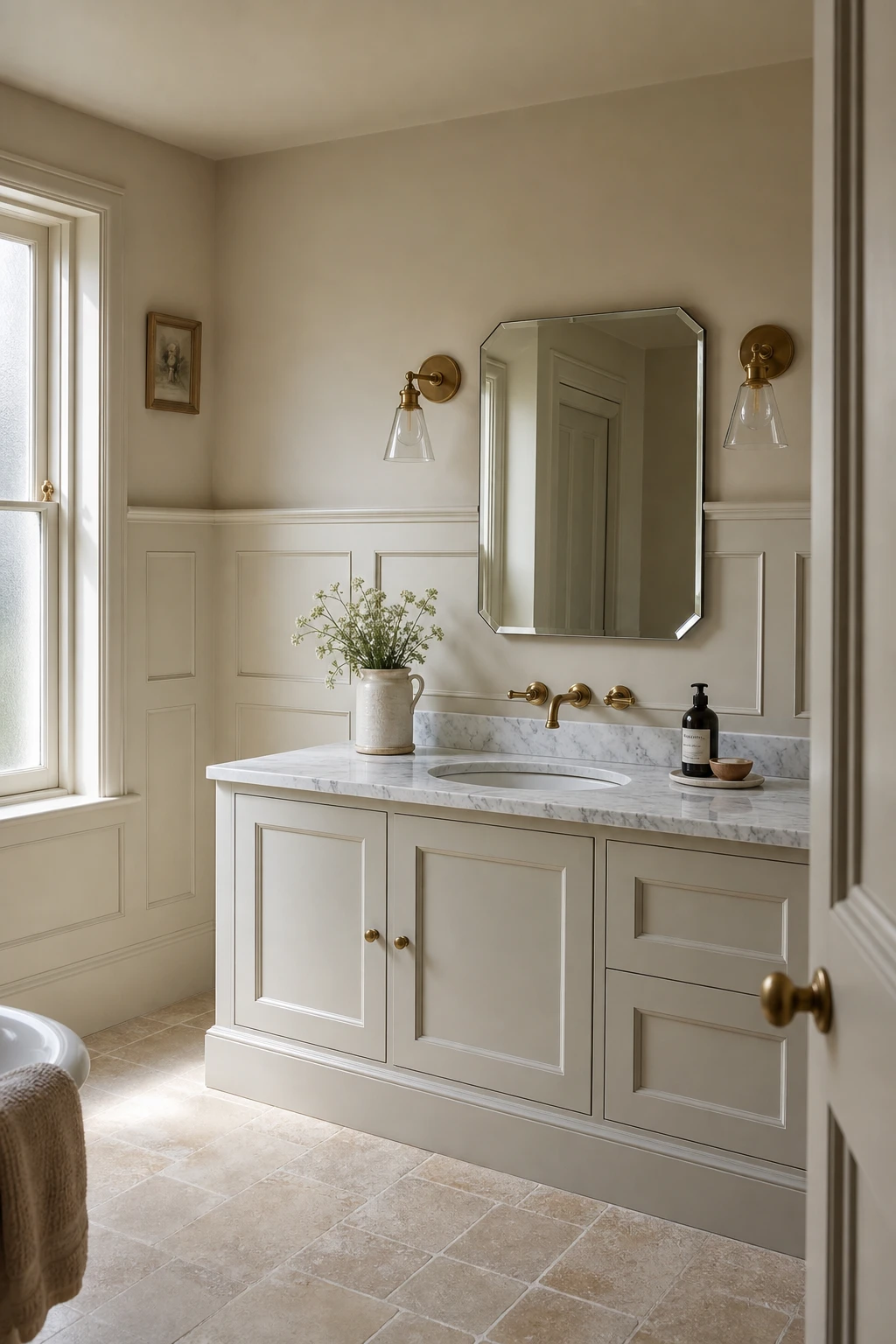
Wainscoting is one of those moves I keep returning to because it does so much quiet work. Running the panels across the lower half of the room pulls the eye around the space at a steady, even line, and that horizontal rhythm gives the vanity something solid to sit against rather than just floating on a bare wall. What I love most is how it borrows a detail from the great English country houses and brings that sense of order down to a room you use every single morning.
The Key Details
Shaker panel wainscoting with chair rail
Honed marble vanity countertop
Unlacquered brass wall sconces
Bevelled rectangular mirror
Limestone brick pattern floor
Pro TipSet your chair rail at exactly the same height as the vanity top so the two lines read as one continuous horizon across the room.
AvoidMixing Shaker panels on the wainscoting, raised panels on the door, and recessed panels on the vanity all at once turns the room into a catalogue of moulding styles rather than a considered space.
Antique Bathroom Wallpaper Above the Vanity and Why It Works So Well
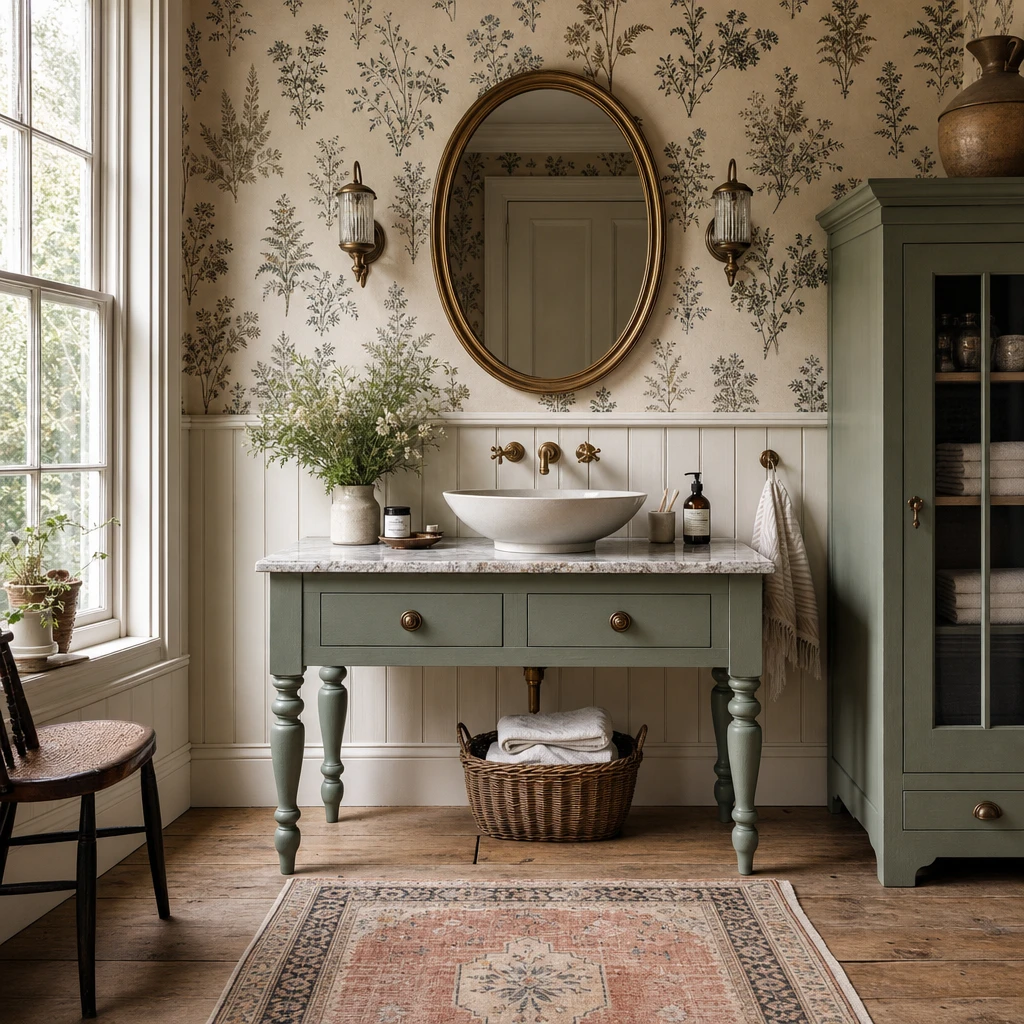
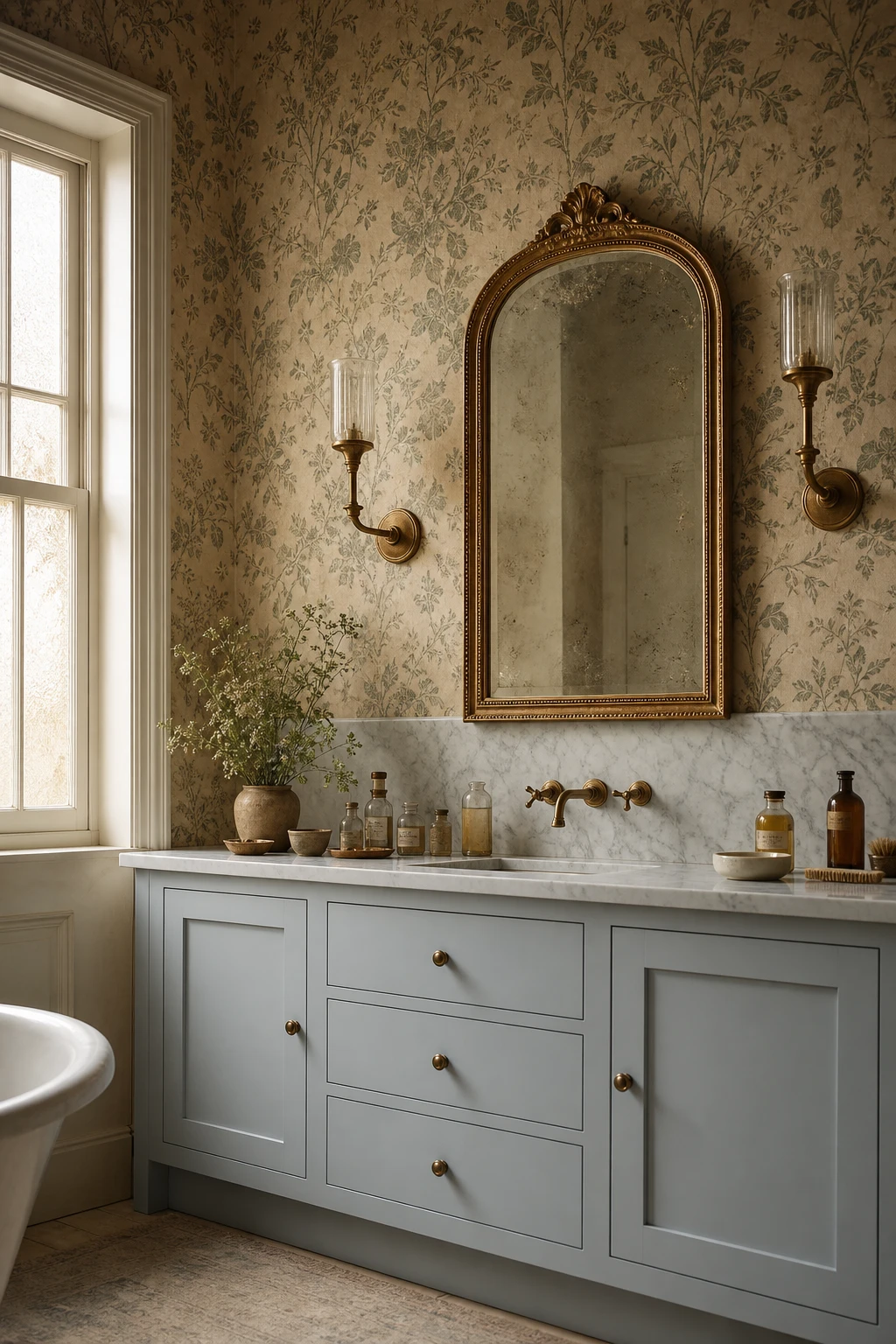
Keeping the vanity plain and letting the wall above carry all the pattern is one of the quietest tricks in a country bathroom, and it pays off every time. An antique botanical print brings richness without making the room feel busy, because the cabinetry sits below and lets the paper breathe. What I love about this balance is how story enters the space through one considered surface, with no extra accessories doing the heavy lifting.
The Key Details
Antique botanical wallpaper
Gilded overmantel mirror
Unlacquered brass wall sconces
Honed marble splashback
Apothecary glass bottles
Pro TipChoose a vinyl coated botanical paper for the zone above your splashback, so steam and condensation cannot lift the seams over time.
AvoidPasting patterned wallpaper below splash height means moisture creeps behind it within months, and you will be peeling the whole wall back far sooner than you planned.
Subway Tiles on the Bathroom Wall Give a Simple Vanity Exactly the Right Setting
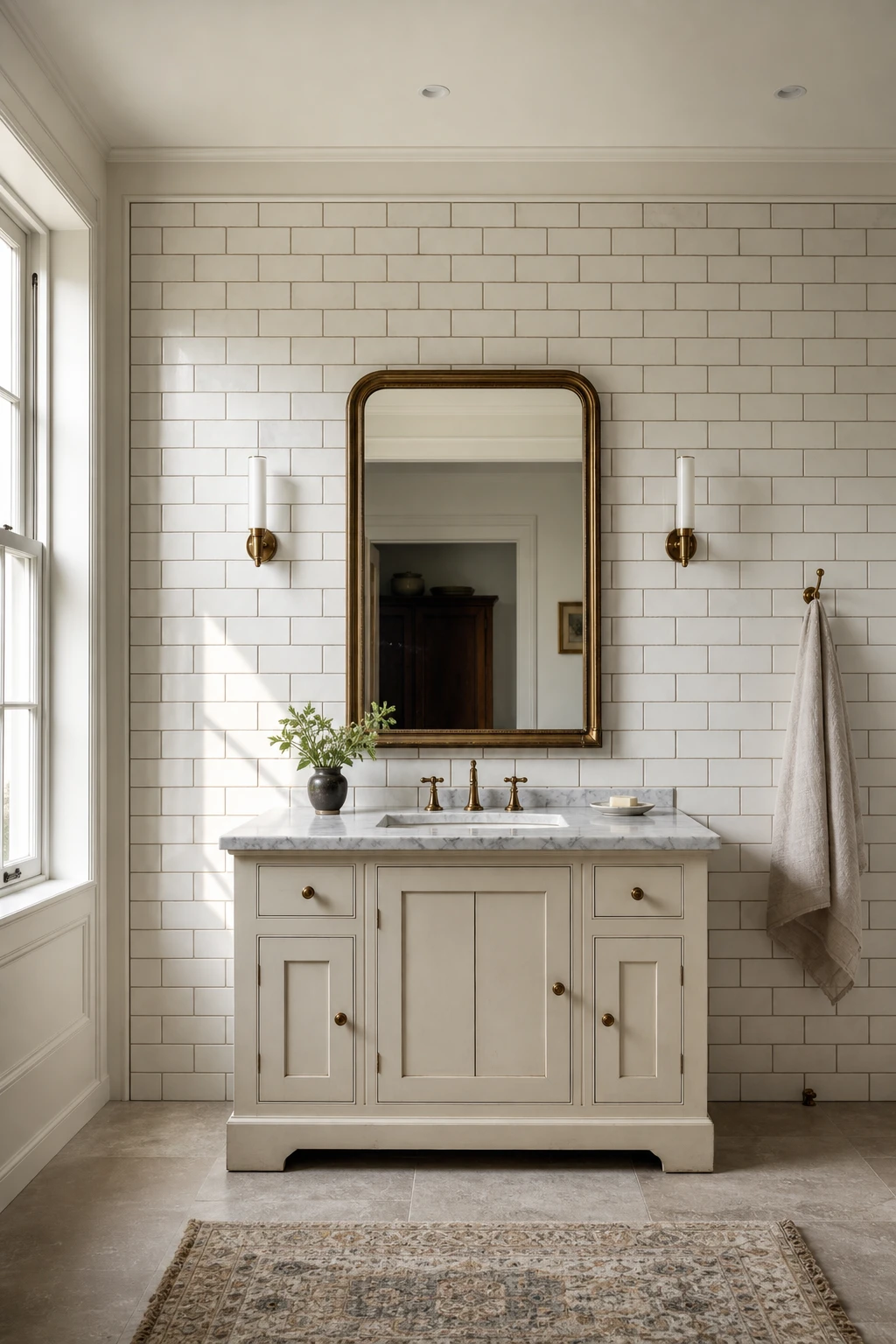
Subway tiles get a bad reputation for feeling cold, and honestly, bright white with matching grout is usually why. What I love here is the putty grout doing all the quiet work, warming the whole wall and letting the brick bond pattern read as texture rather than grid. You get something that feels like it has always been there, which is exactly the mood an English country bathroom needs.
The Key Details
Handmade ceramic subway tiles in brick bond pattern
Warm putty toned grout lines
Aged brass pillar taps and wall hook
Honed marble vanity countertop
Antique brass framed wall mirror
Pro TipRun your tiles in a classic brick offset rather than stacked, because the staggered joints catch the light differently and give the wall a gentle rhythm that a straight grid simply cannot.
AvoidChoosing brilliant white grout around a basin means every splash and watermark shows within a week, and the wall ends up looking grubby no matter how often you clean it.
Marble on the Bathroom Floor Gives the Vanity an Elegance Nothing Else Matches
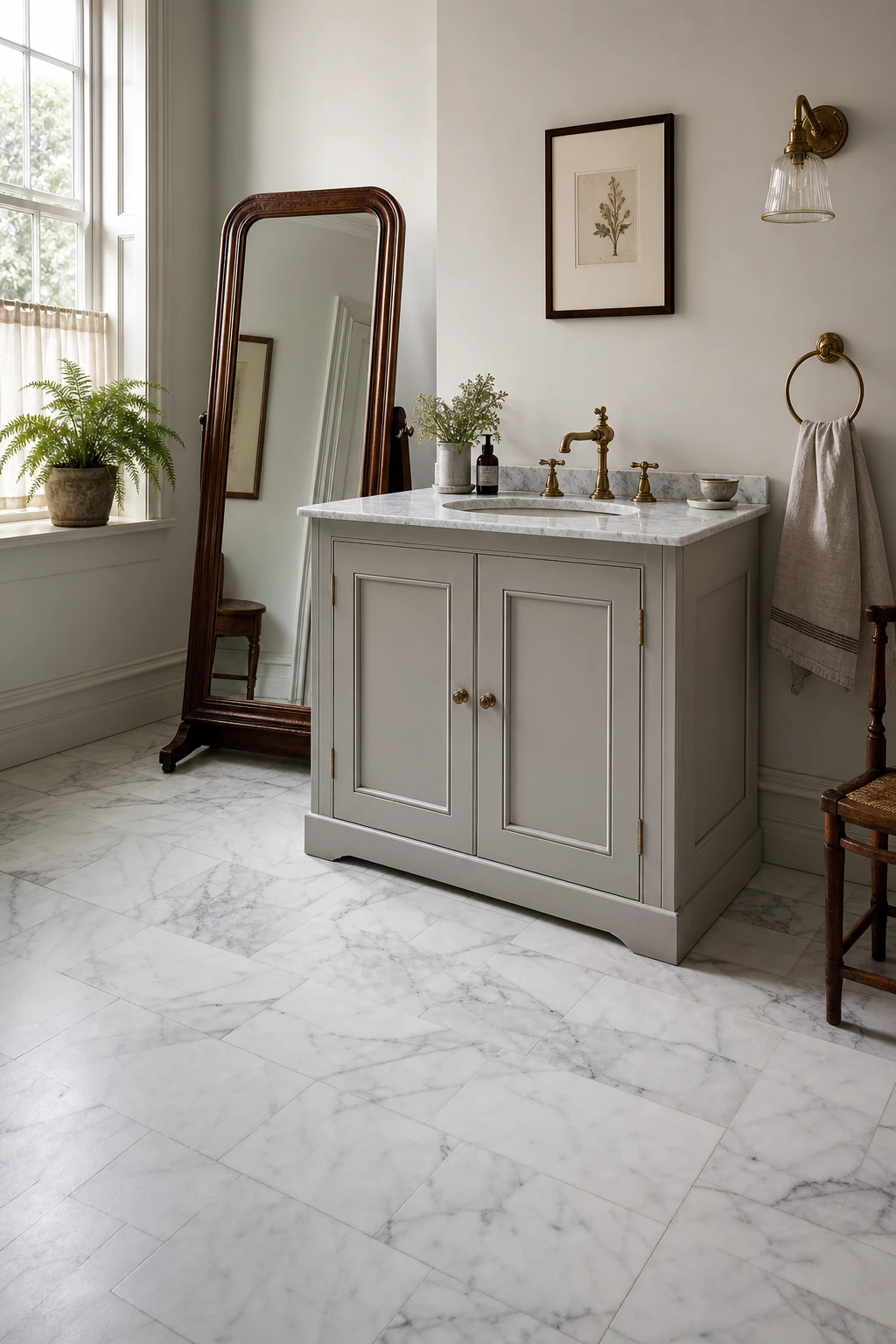
Marble underfoot does something a painted or tiled floor simply cannot: it pulls the whole vanity cabinet up in status without touching it. What I love is the contrast, a soft chalky painted wood sitting above all that veined stone, and you get this sense that the room has always been there. The honed finish keeps the surface quiet and warm rather than flashy, and the brick laid pattern adds just enough movement to hold the eye across the floor.
The Key Details
Honed Calacatta marble floor tiles in brick laid pattern
Inset panel painted wooden vanity cabinet
Aged brass basin tap and towel ring
Tall freestanding pivoting wood framed mirror
Sash window with deep painted reveal
Pro TipSeal the marble within thirty centimetres of the vanity base with a penetrating stone sealer every year, because that strip takes the most water splash and will stain long before the rest of the floor does.
AvoidHighly polished marble around a bathroom vanity shows every water drip, toothpaste splash, and footprint within hours of cleaning, turning a beautiful floor into a source of daily frustration.
Vintage Tiles on the Bathroom Floor Are the Detail That Makes the Vanity Sing
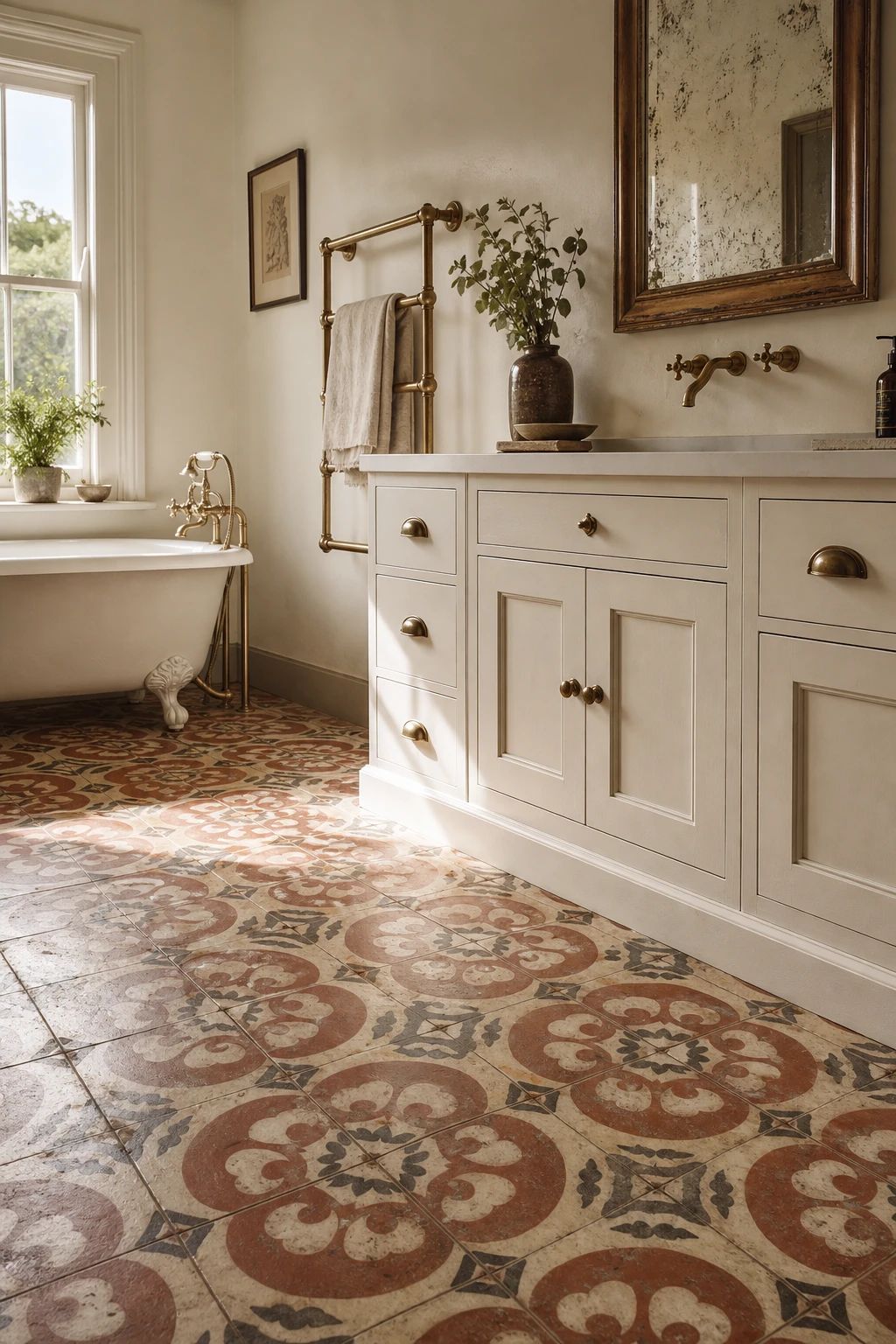
Vintage patterned tiles on the bathroom floor do something no paint colour or fitting can quite replicate: they give the room a sense of age, as if the house has always looked this way. What I love is how a strong terracotta and cream pattern pulls the eye down and anchors the whole space, so the vanity above it reads as part of a considered composition rather than a standalone piece. You get instant personality underfoot, and the rest of the room almost dresses itself around it.
The Key Details
Encaustic patterned cement floor tiles in terracotta and cream
Painted timber vanity cabinet with ceramic undermount basin
Freestanding cast iron bathtub on ball and claw feet
Brass wall mounted towel rail with draped linen towel
Foxed framed mirror above the vanity
Pro TipWhen your floor pattern is this confident, keep the vanity cabinet in a soft neutral like warm white or pale sage so the two can breathe alongside each other without competing.
AvoidRunning two or more different tile patterns in one small bathroom fractures the eye and makes the space feel restless rather than characterful.
Victorian Taps Are the Smallest Detail That Changes Everything About the Vanity
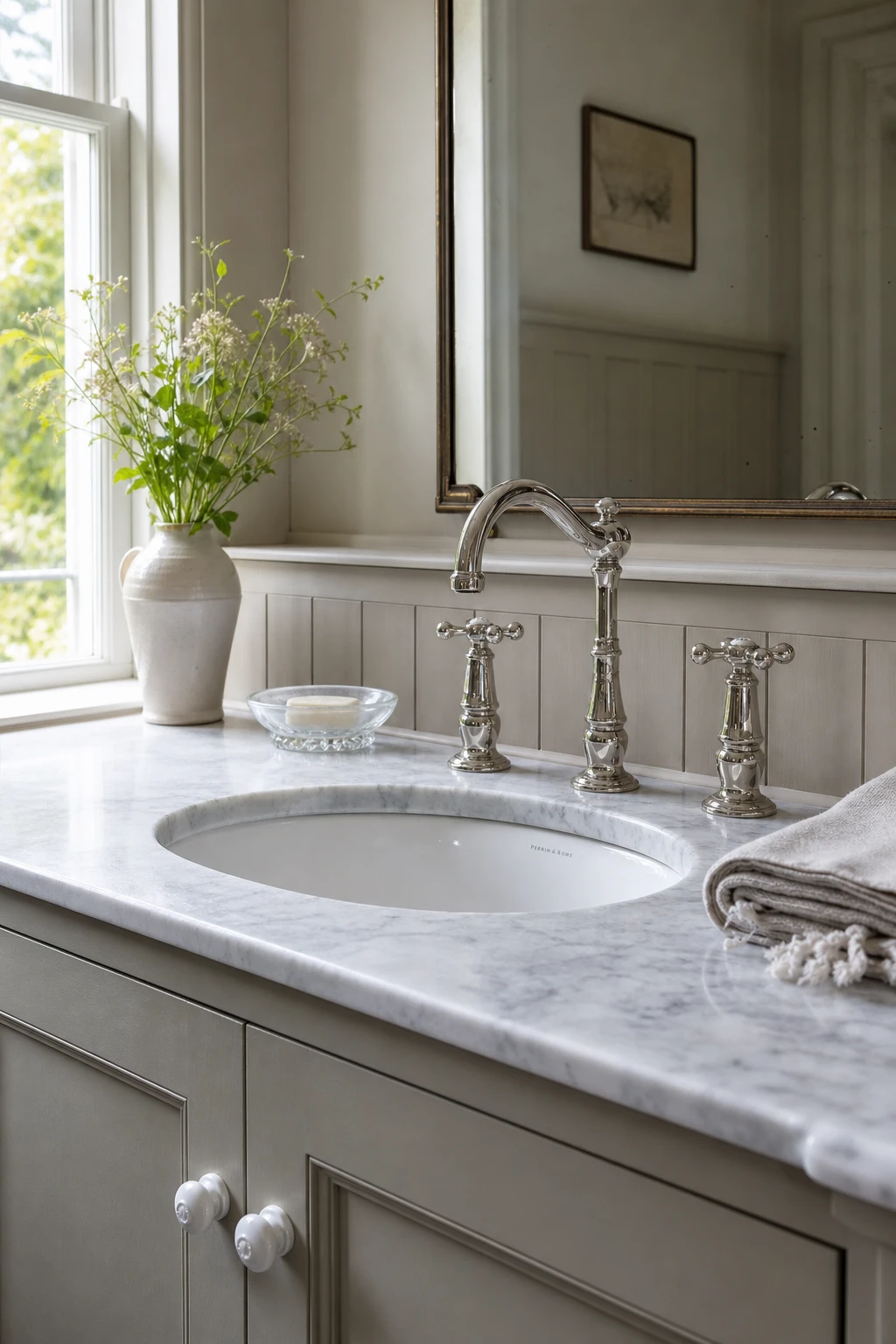
Victorian taps punch well above their weight for something so small, and that is what I find so satisfying about specifying them. Swap a plain lever tap for a polished nickel cross handle and you get an instant sense of age and intention that the rest of the vanity borrows from. You will notice the whole cabinet looks more deliberate, more collected, as though it has been there for years.
The Key Details
Polished nickel cross handle pillar taps
Painted timber washstand cabinet with ceramic knobs
White ceramic undermount basin
Bevelled mirror with slim wooden frame
Tongue and groove lower wall panelling
Pro TipPick up the tap finish in at least one other metal in the room, a towel ring, a mirror frame, even a single hook, and the whole space reads as considered rather than assembled.
AvoidFitting ornate Victorian taps onto a sharp, contemporary basin shape creates a collision that leaves both elements looking wrong and slightly awkward.
Alan launched Edward George London in 2017. Since completing his masters in Town & Regional Planning (MPlan) he has combined the skills he learned at the University of Sheffield with his passion for design, to help create a foundation for those looking to create a beautiful home.