I have always believed that a neutral garden is the most quietly confident kind you can make. There is something about soft stone, silvery grasses, and creamy blooms arranged together that feels both calm and completely considered. In this piece I walk through looks built around things like gravel courtyards with olive trees, lavender and rose borders, and candlelit pergola seating, each one a mood you can borrow for your own outdoor space.
How a Mediterranean Garden Brings Warmth to a Neutral Palette
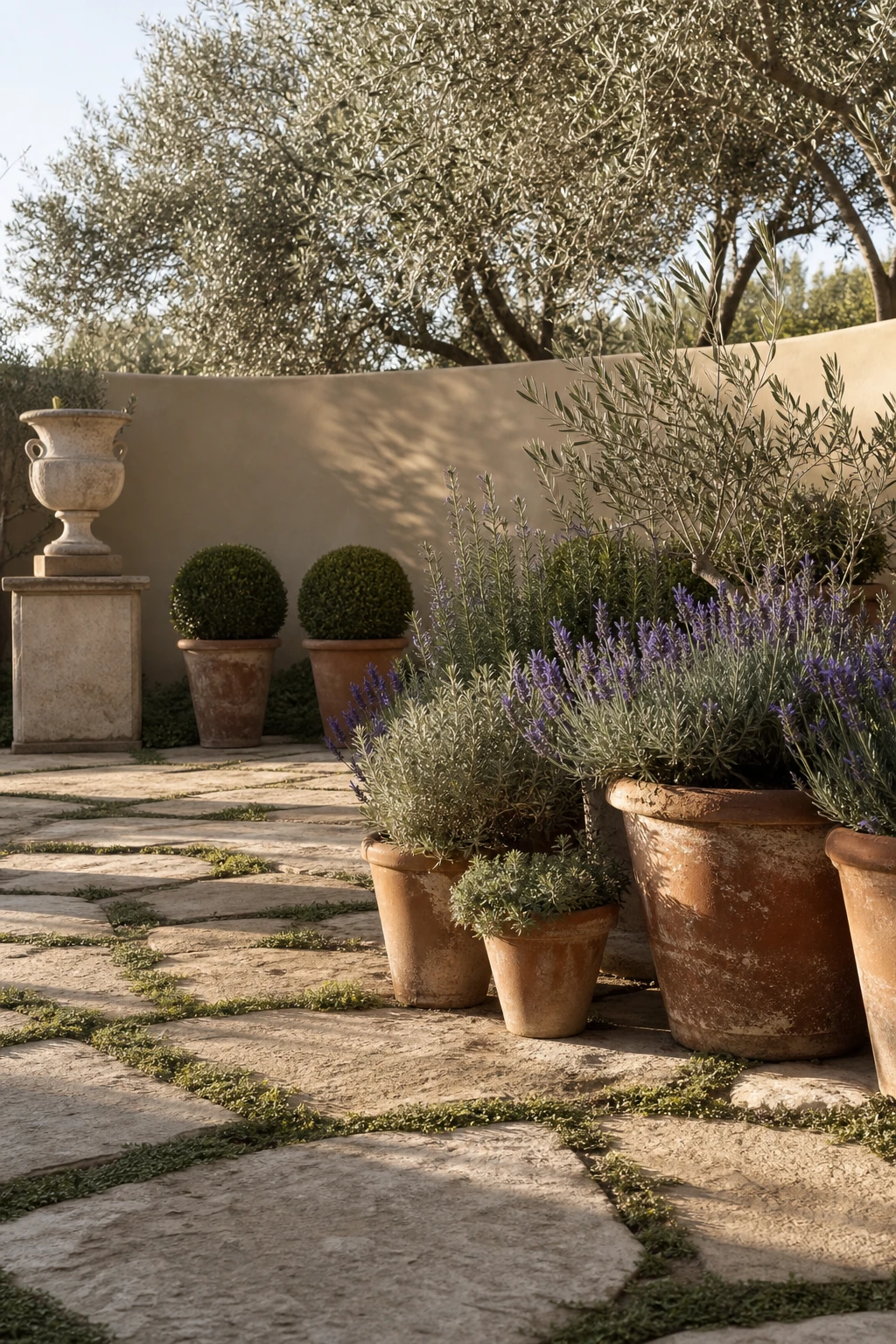
Sun baked terracotta, rough limestone underfoot, and a wall the colour of dry plaster give you that slow, warm feeling before a single plant is in the ground. What I love about this mood is how the materials do most of the work: the stone reads as aged the moment you lay it, and the terracotta pulls the whole palette together without asking for much. You get real depth here because every surface has a different texture, yet the tones all sit in the same dusty, quiet family.
The Key Details
Aged terracotta pots in graduating sizes
Irregular limestone paving with planted joints
Weathered stone urn on plinth
Clipped myrtle topiary balls
Low rendered garden boundary wall
Pro TipLayer your pots by grouping three graduating sizes together, tucking a folded piece of natural linen sacking underneath the tallest one to add softness between the hard surfaces.
AvoidAdding too many flowering plants in bright colours breaks the calm immediately, and the whole sun baked feeling you worked hard to build simply disappears.
French Cottage Garden Ideas That Keep Things Beautifully Unfussy
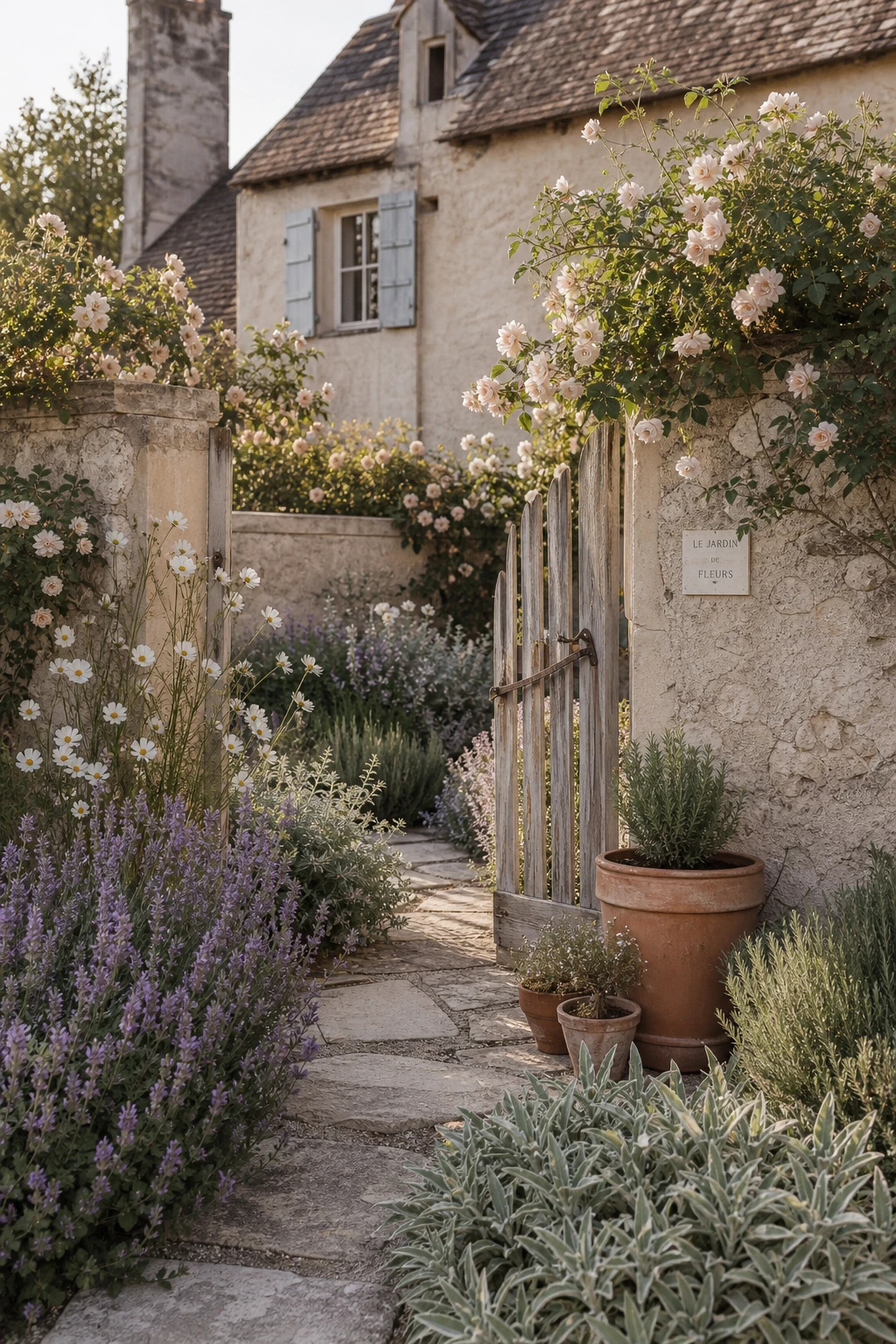
Soft planting that seems to lean into its own weight is what makes French cottage style so quietly lovely. Lavender and catmint spilling forward over an aged limestone path give you that romantic looseness without any sense of neglect, and I find that balance genuinely hard to achieve any other way. The climbing roses anchoring a stone wall pull the eye upward and add vertical warmth, while a cluster of terracotta pots near a weathered gate keeps things grounded and human in scale.
The Key Details
Aged limestone path
Weathered picket gate
Climbing roses on stone wall
Terracotta pot cluster
Billowing lavender and catmint border
Pro TipRun a gravel path alongside a loosely clipped box or rosemary hedge border and you get instant structure that still lets the planting breathe and tumble naturally.
AvoidTrimming every hedge and topiary into tight geometric shapes drains all the softness away and leaves the garden feeling more like a municipal park than a romantic French retreat.
The English Garden Look and Why Neutral Tones Make It Even Lovelier
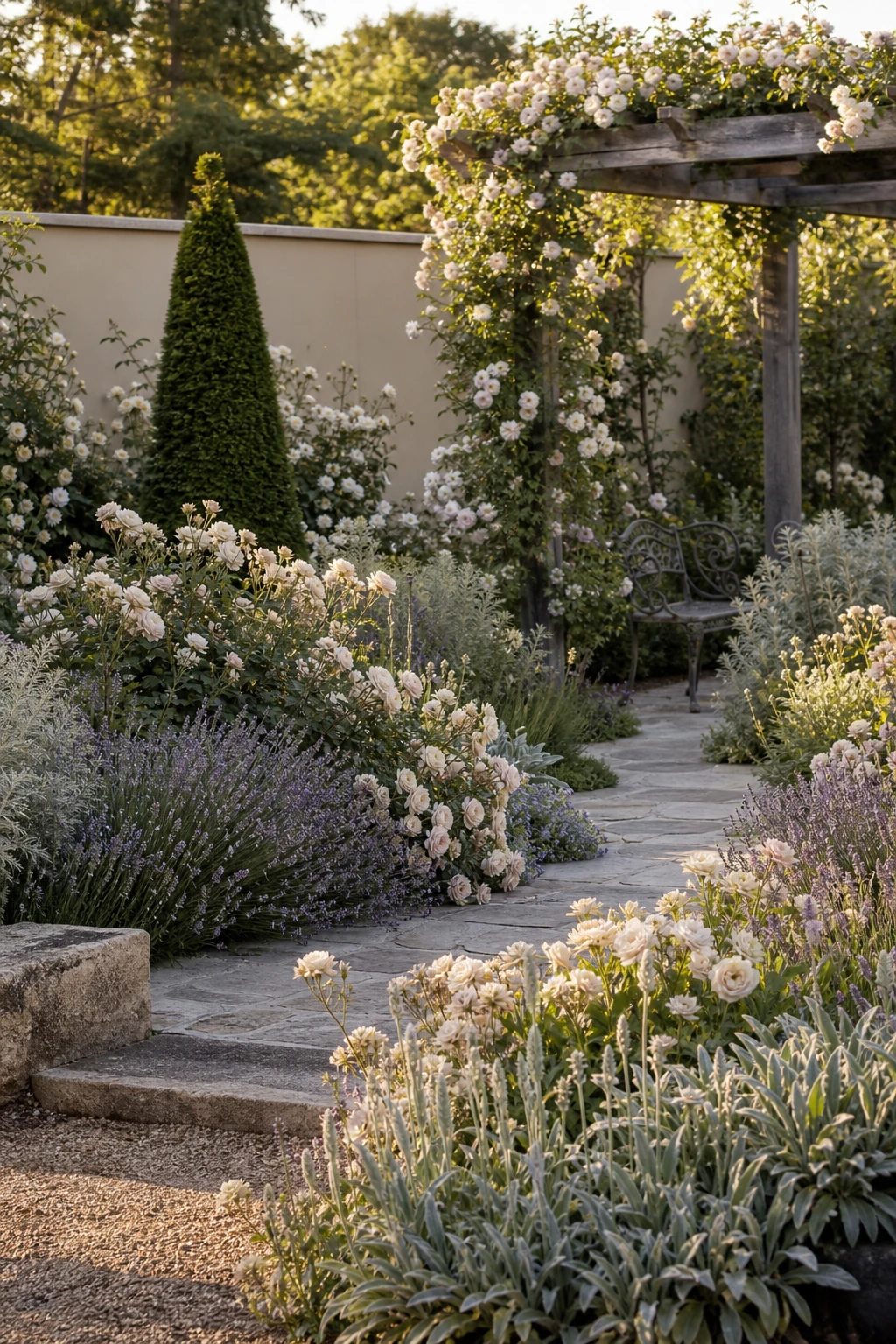
Sweeping borders full of pale roses and lavender already carry so much romance, and a limestone path or weathered stone wall is the quiet decision that pulls it all together. That neutral backdrop does real work, letting the soft pinks, whites and mauves breathe as one cohesive picture rather than a jumble of competing patches. I keep coming back to this look because the restraint is what makes it so moving: the less the background asks of you, the more the planting gives back.
The Key Details
Sweeping herbaceous border with pale roses and lavender
Clipped yew topiary
Weathered limestone path
Wrought iron garden bench
Timber pergola with climbing roses
Pro TipChoose a pale natural stone wall or whitewashed timber fence as your fixed anchor before you plant a single thing, so every colour you add sits against a consistent, calm base.
AvoidDropping in strong reds or hot oranges between your roses and lavender pulls the eye in three directions at once and the border loses that gentle, unified feeling entirely.
A Modern Wabi Sabi Garden Thrives on the Beauty of Imperfect Neutrals
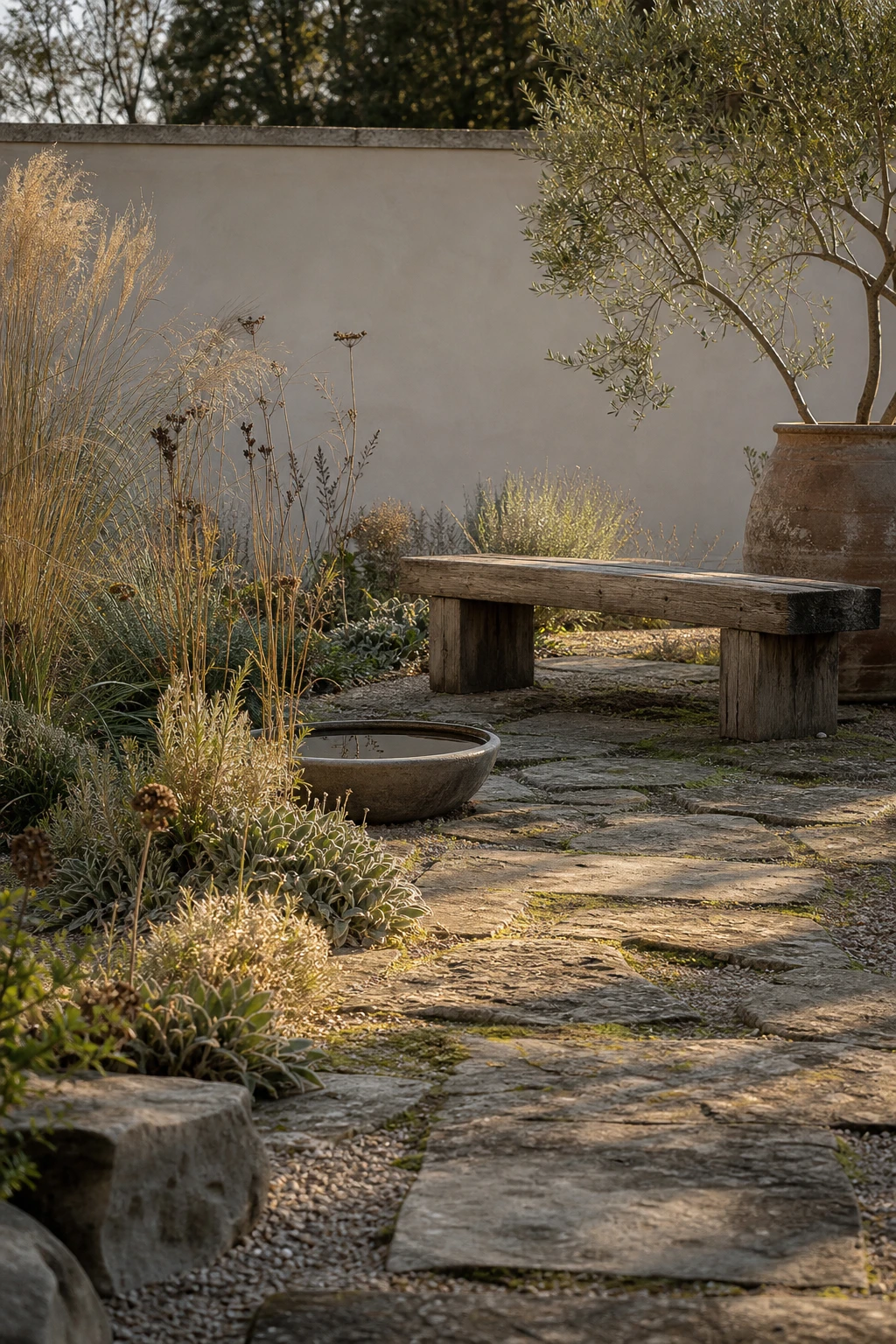
Worn stone, mossy gaps, and lopsided planting are the whole point here, not problems to fix. What I love about wabi sabi is that the garden does the decorating for you over time, and you get a space that feels genuinely lived in rather than assembled. Watch how a cracked limestone path or a timber bench silvered by weather carries more warmth than anything brand new ever could.
The Key Details
Weathered limestone path with mossy joints
Asymmetric ornamental grass and dried seed head planting
Hand worn timber bench
Shallow unglazed ceramic water basin
Coarse gravel ground cover
Pro TipWhen you source aged timber or cracked stone, place the most worn face upward so the texture catches the light and reads as a deliberate choice rather than damage.
AvoidPressure washing the moss from stone joints or deadheading every seed head strips out exactly the quiet character that makes this style work, leaving you with a garden that looks unfinished rather than intentional.
Scandinavian Garden Design and the Cool Neutrals That Define It
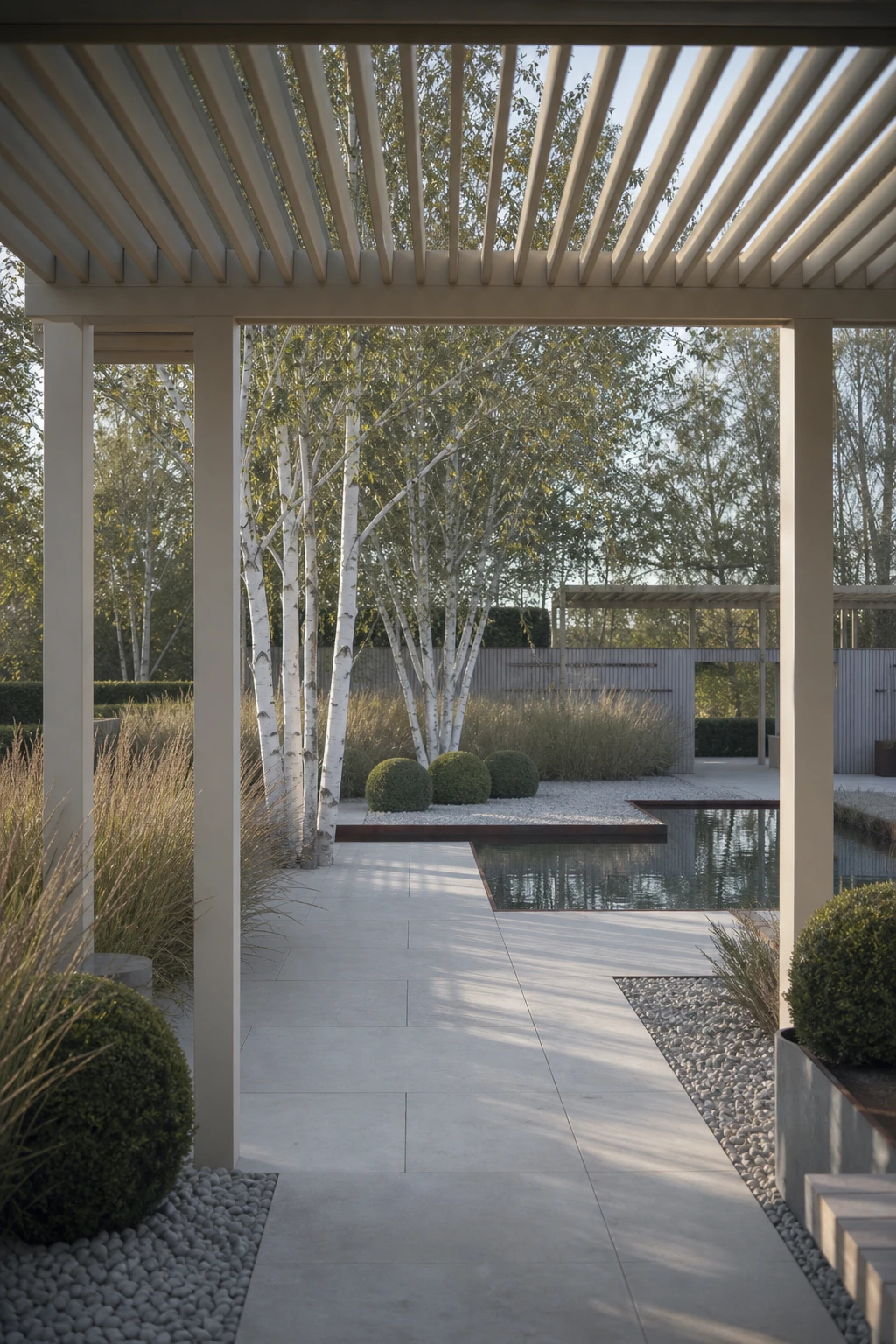
Scandinavian restraint is probably the hardest discipline to hold, and the one I find most rewarding when it lands right. Strip a garden back to clean lines, a handful of structural plants, and a cool, limited palette and you will notice something interesting: the space starts to feel like a room. What I love about this approach is that every element earns its place, so the clipped spheres, the flush paving, and the birch backdrop read together as a single composed idea rather than a collection of features.
The Key Details
Slatted timber pergola
Clipped boxwood spheres
Flush limestone paving
Corten steel pond edging
Birch tree grove backdrop
Pro TipRun white gravel right up to a dark steel edge to get that razor sharp line that makes the whole scheme look considered.
AvoidDropping in lanterns, decorative pots, or seasonal ornaments one by one until the clean grid you built disappears under clutter.
Dry Garden Ideas That Turn Low Water into High Style
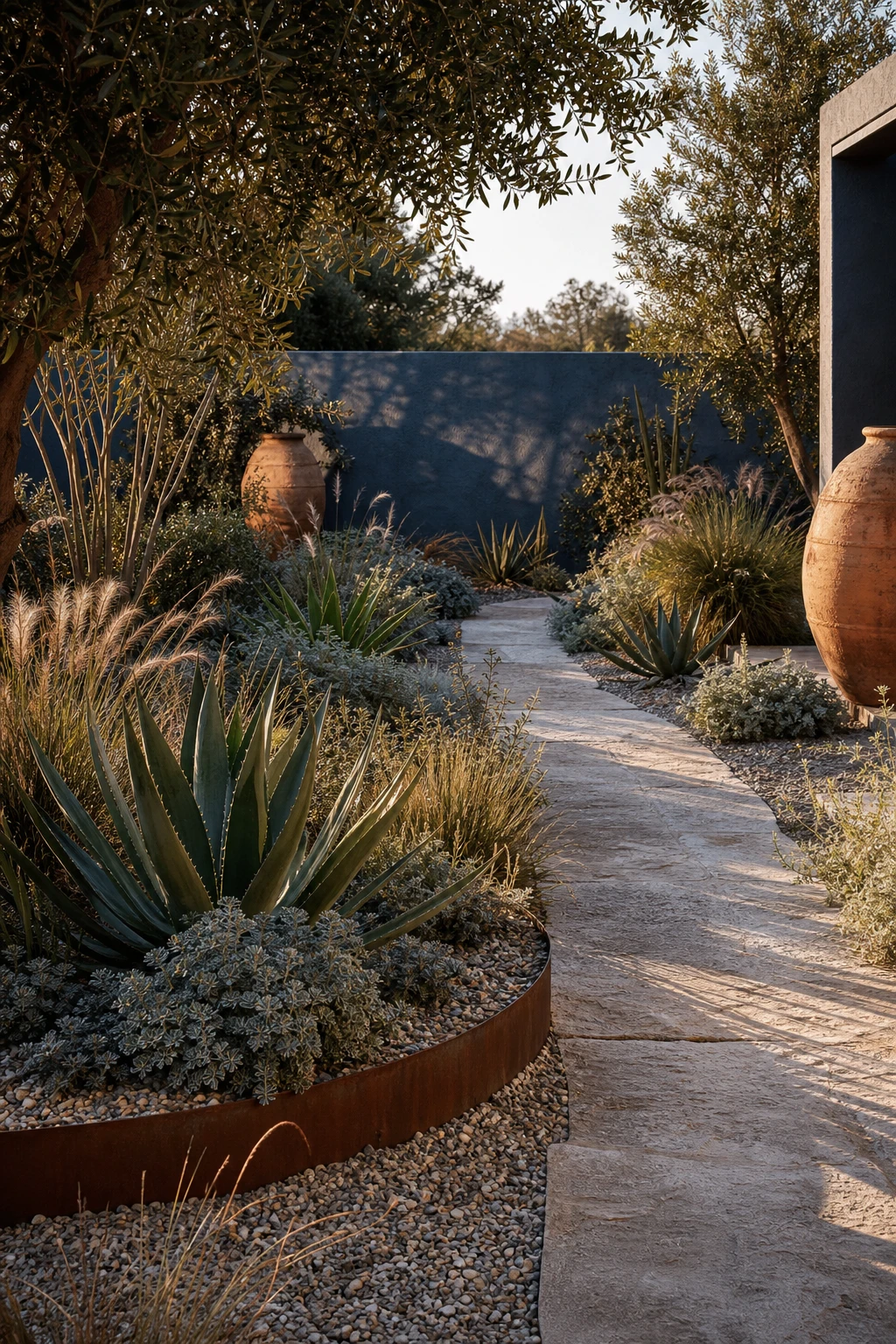
Dry gardens win me over every time because the plants look just as beautiful in August heat as they do in April. Silver artemisia low at the front, feathery pennisetum in the middle, and a bold agave spire holding the back give you movement and stillness at once, and I find that layered rhythm more interesting than any flower border I have planted. The crushed limestone ties it all together, and you will notice how the pale gravel bounces light up through the planting in a way darker mulch never does.
The Key Details
Silver artemisia ground planting
Feathery pennisetum grass clumps
Bold agave spire specimen
Crushed limestone gravel bed
Oversized terracotta urns
Pro TipArrange plants in three clear height bands, low, mid, and tall, so every texture stays visible from the terrace rather than getting lost behind its neighbour.
AvoidSkipping mulch leaves the soil exposed and the whole planting starts to look scrappy and dusty within one dry season, undoing every careful plant choice you made.
Why a Gravel Garden Is the Most Elegant Neutral Base You Can Lay
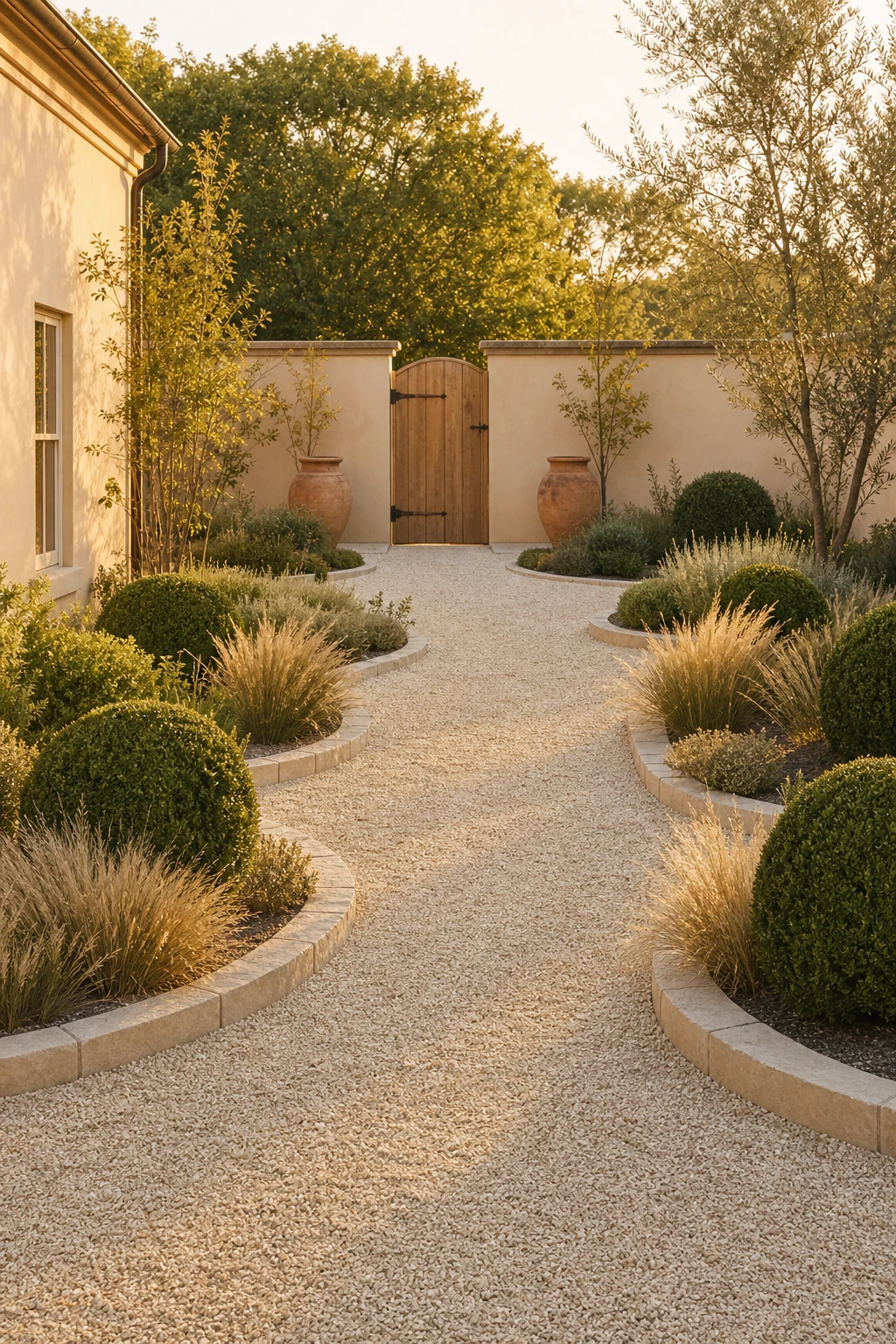
Gravel is the quiet hero of the neutral garden and one of my favourite tools for tying a whole space together. Lay a warm limestone ground plane and you have an instant canvas that lifts every plant above it, the way a pale linen cloth sets a table. The texture does the visual work too, softening hard edges and lending that effortless, unhurried calm you want from an elegant outdoor room, and it does all of that without a single pot or plant in place yet.
The Key Details
Fine limestone gravel ground plane
Clipped box sphere topiary
Low sandstone kerb edging
Terracotta statement urns
Warm rough sawn oak timber gate
Pro TipRake your gravel into gentle, uneven drifts around plants rather than spreading it flat, because that small irregularity reads as natural and considered rather than freshly poured.
AvoidBright white gravel looks almost fluorescent in full sun and will overpower every plant and material around it, so it is worth testing a handful in your actual light before you commit.
Grey Clay Pavers and the Quiet Sophistication They Bring to Any Garden
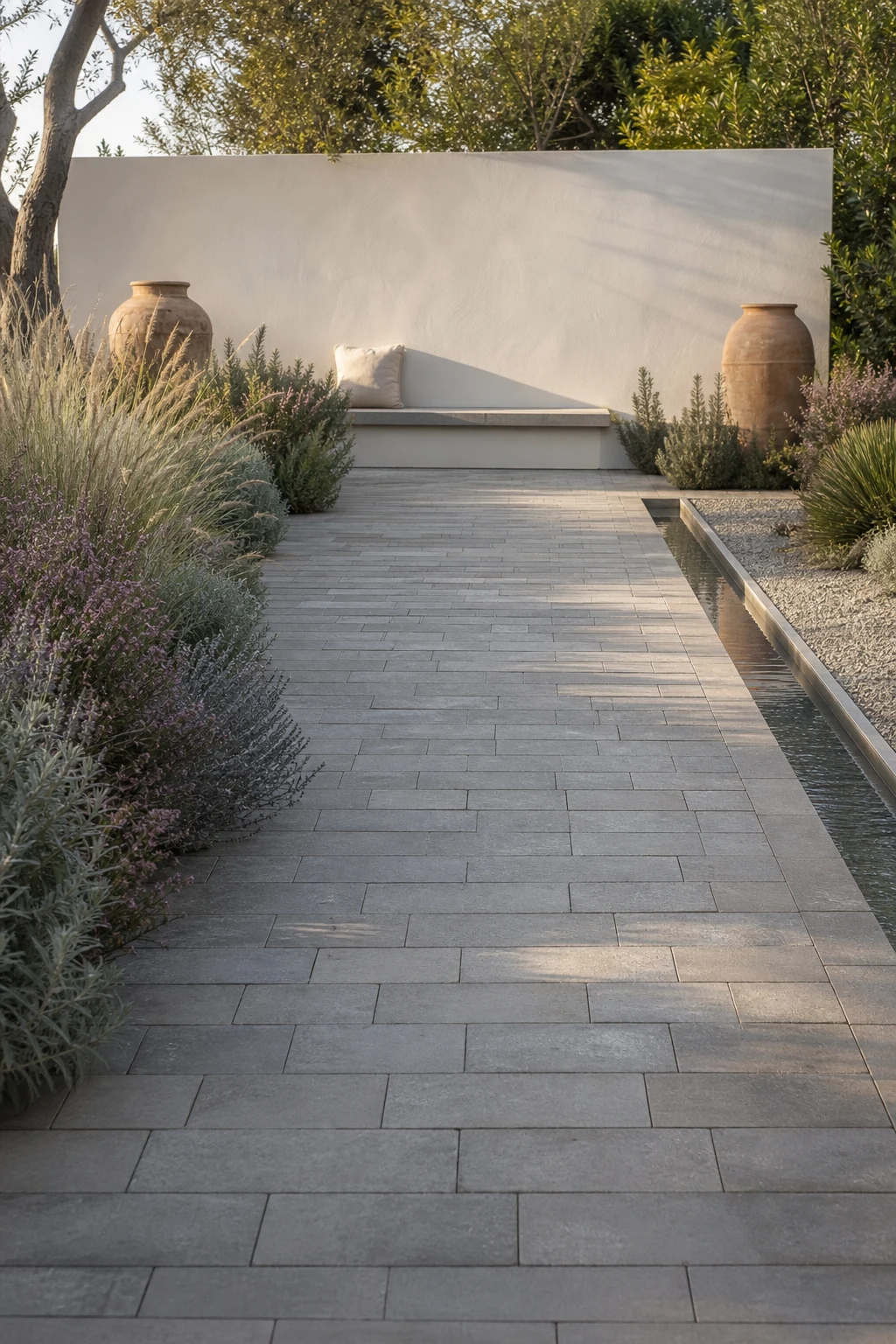
Grey clay pavers are the quietest decision you can make underfoot, and that quietness is exactly the point. Once the planting fills in the surface simply disappears, so your eye travels straight to the lavender and grasses rather than getting snagged on the floor. I am always pleased by how much warmth the clay itself carries: that subtle undertone stops the garden ever feeling cold, and you will notice it shifting beautifully as the light moves across the day.
The Key Details
Staggered bond clay paver field
Slim recessed water channel
Aged terracotta statement urns
Ornamental grasses and lavender border planting
Low rendered perimeter garden wall
Pro TipLay your pavers in a staggered bond rather than a grid so the surface reads as gentle texture rather than a rigid pattern that competes with the planting.
AvoidChoosing a grout colour that is noticeably lighter or darker than the paver breaks the surface into a grid and pulls attention away from the garden you have worked so hard to plant.
Sandstone Flagstone Patios and the Warm Neutral Glow They Give All Day
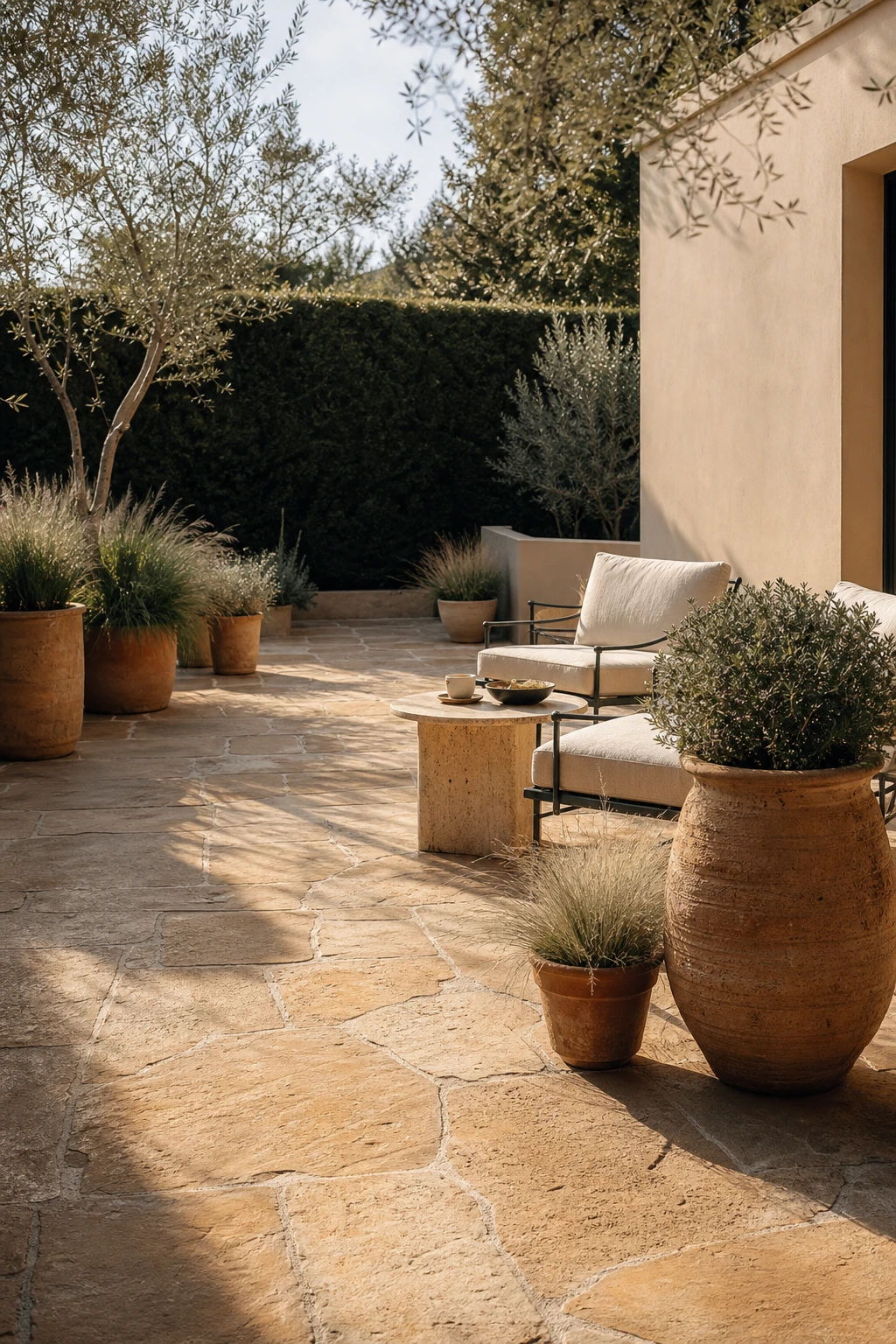
Sandstone flagstones are one of my favourite ways to anchor an outdoor room because the stone does most of the work for you. That honey and amber grain catches the light from morning to evening, and you will notice how the whole space reads warmer without a single accessory added yet. What wins me over every time is the way that warmth sets a clear direction: everything you place on top, the linen cushions, the terracotta pots, the clipped hedge behind, all locks into the same soft neutral key the stone has already established.
The Key Details
Riven sandstone flagstone paving
Linen cushioned garden chairs
Travertine low side table
Terracotta planters with olive trees
Clipped yew hedge backdrop
Pro TipApply a breathable, low sheen impregnating sealer to your sandstone rather than a surface coat, so the honey tone deepens just enough to look rich without any plasticky shine.
AvoidPairing sandstone with cool grey or slate toned furniture pulls the two warm and cool undertones against each other, leaving the whole patio looking muddy and unresolved rather than calm.
Limestone Outdoor Tiles Bring a Cool, Creamy Finish No Other Material Matches
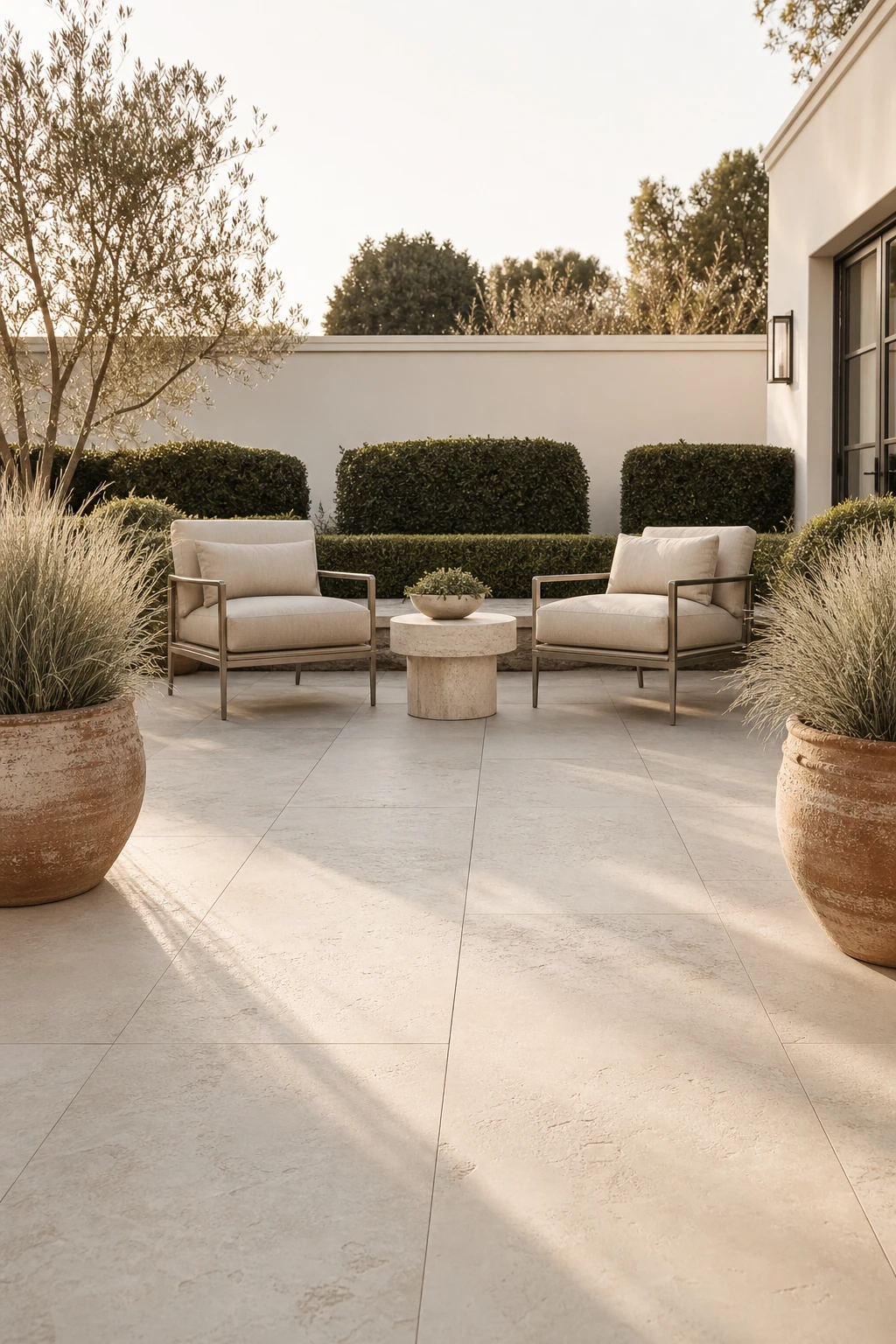
Limestone brings a coolness to a patio that no painted surface or porcelain copy ever quite captures, and that subtle shift in temperature is what I love most about it. You get a creamy, chalky tone that reads as both fresh and ancient at the same time, pulling the whole garden palette into something quieter and more considered. Watch how it softens strong sunlight into a gentle, even glow rather than a harsh bounce.
The Key Details
Large format honed limestone patio tiles
Linen upholstered garden chairs
Low travertine side table
Weathered terracotta planters with ornamental grasses
Clipped box hedge backdrop
Pro TipAlways specify a honed finish rather than polished so the surface stays matte and grippy underfoot even after rain.
AvoidLaying limestone in a north facing or permanently shaded spot lets moisture sit on the surface, and within a season you will have a green, slippery slab that looks neglected rather than elegant.
Pebble Garden Design and the Small Moments That Make It Feel Special
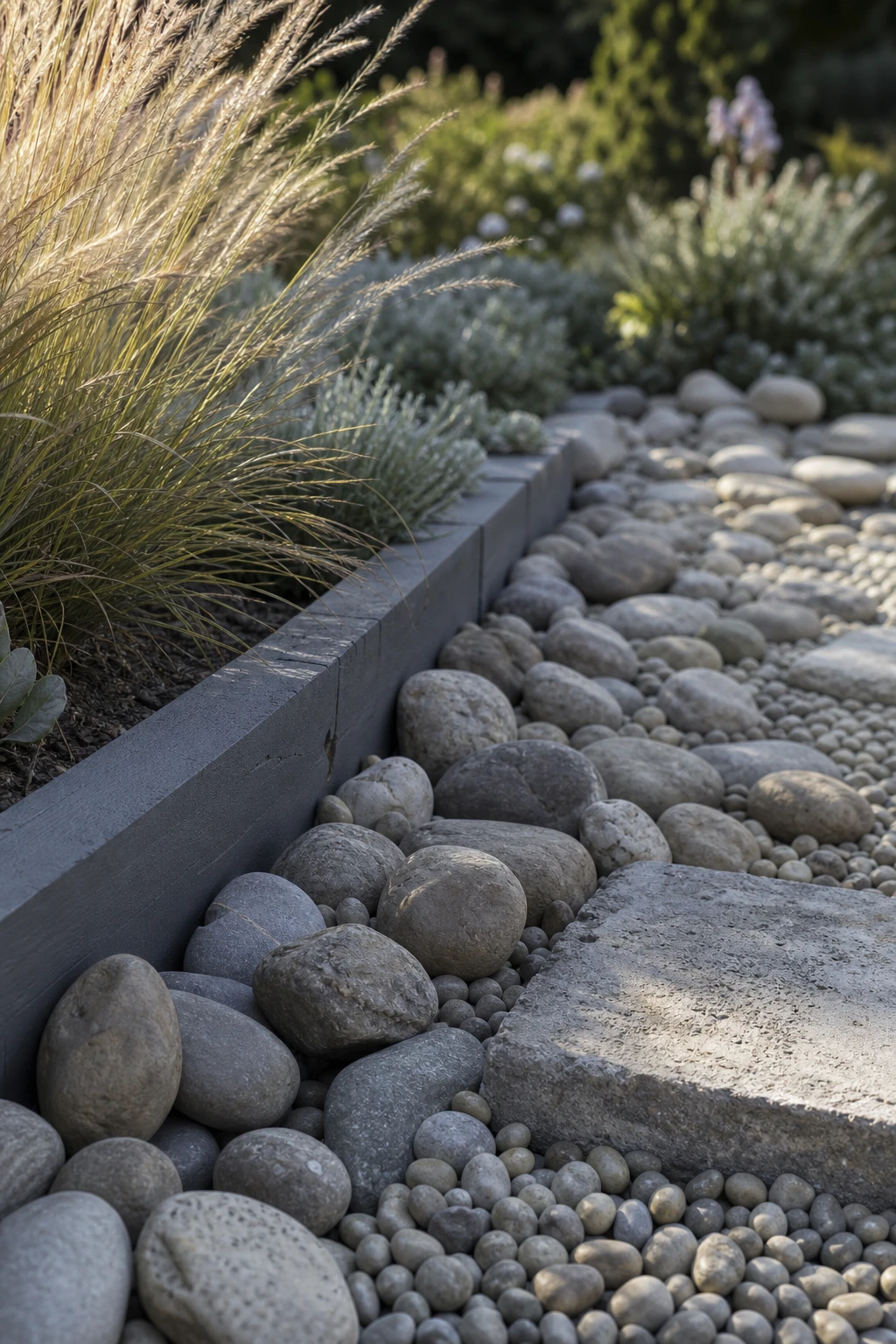
Pebbles earn their place when you treat them as something to compose rather than just pour down. What I love is the shift that happens when you graduate the sizes, larger stones anchoring a centre, smaller ones fanning outward, because you get a ground plane that actually draws the eye rather than disappearing underfoot. The variation in tone and texture across a neutral palette keeps things quietly alive, and that is the whole point of a detail like this.
The Key Details
Graduated river pebble arrangement
Weathered concrete stepping stone
Low timber path edging border
Ornamental grasses at path edge
Fine gravel infill between stones
Pro TipSet a panel of pebbles in mortar as a mosaic flush with the surrounding path so the arrangement holds its pattern for years and gives the space a clear focal point.
AvoidSpreading loose pebbles too thinly leaves patches of bare soil showing through, which makes the whole area look unfinished rather than considered.
An Olive Tree in a Gravel Garden Is the Most Effortless Statement You Can Make
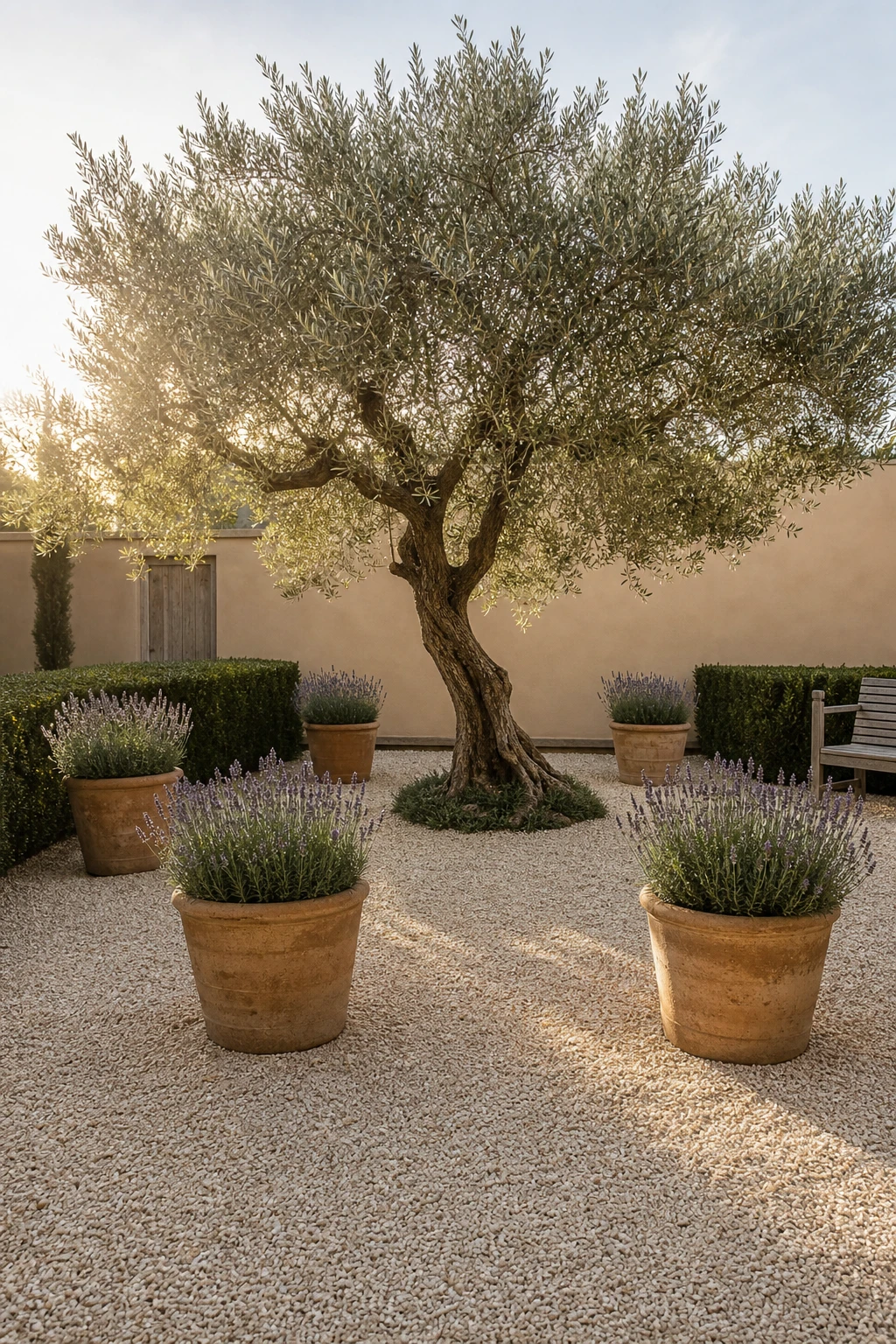
A single gnarled olive anchored in pale limestone gravel stops you in your tracks, and that stillness is exactly the point. The silvery leaves, the twisted trunk, the shadows it casts at midday: the tree does all the talking, and I think that confidence is what most gardens are missing. One beautiful thing given space to breathe always reads as more assured than a dozen specimens competing for attention, and this combination makes that argument better than almost anything else I know.
The Key Details
Gnarled specimen olive tree
Hand raked pale limestone gravel
Weathered terracotta urns
Low clipped box hedging
Rough hewn timber garden bench
Pro TipPlant your olive in a deep hand carved stone urn rather than directly into the ground and you instantly lift it into sculpture, giving the whole garden a focal point that works even in the depths of winter.
AvoidAdding a second specimen tree nearby splits the eye and weakens both, leaving the garden feeling indecisive rather than composed.
Ornamental Grass Curb Appeal and How Soft Movement Elevates a Neutral Front Garden
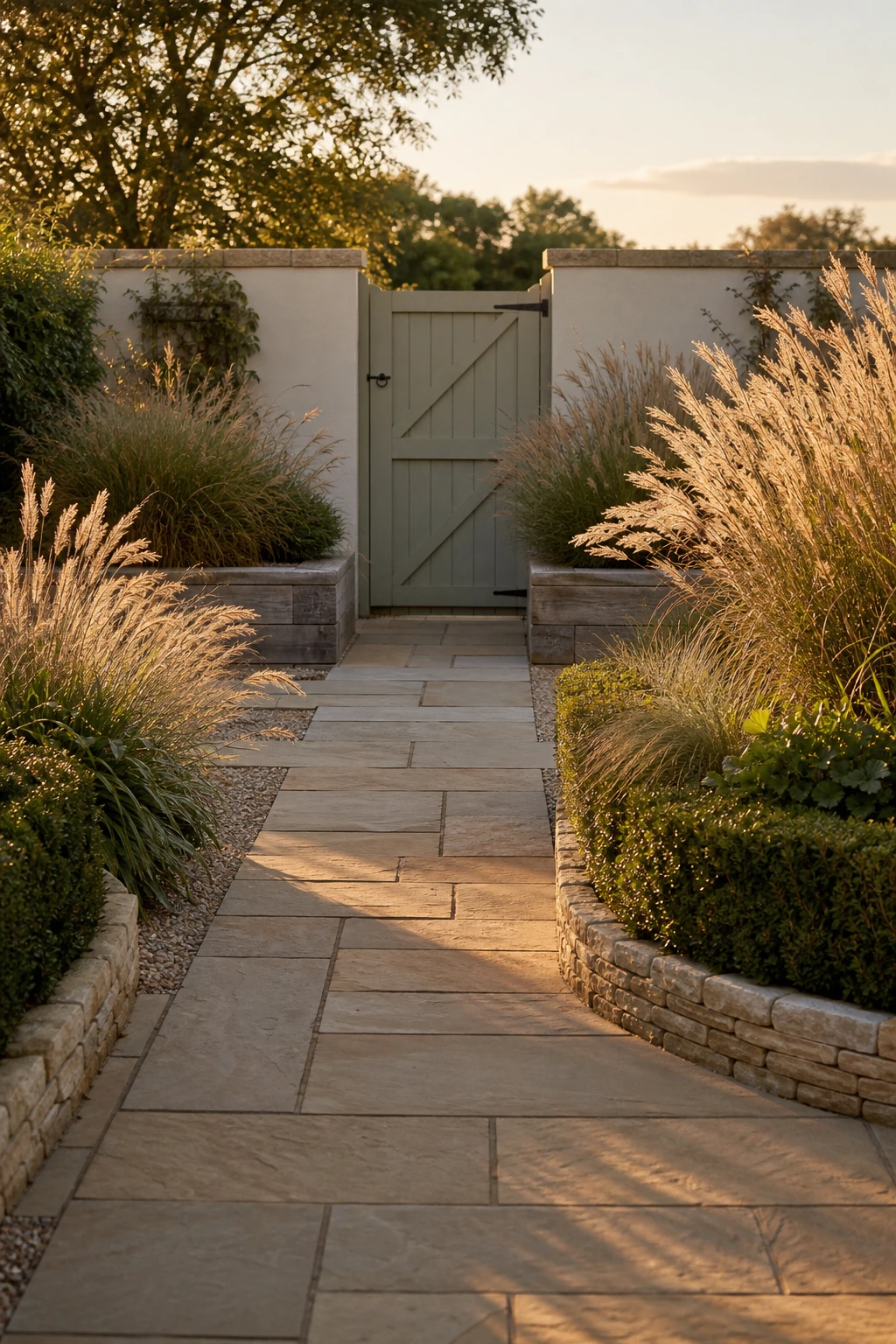
Ornamental grasses do something flowers simply cannot: they move. Even on a still day, the finest blades catch the air and the whole planting comes alive with a gentle shimmer that you notice from the street. What I love about using them at the front is that you get seasons of interest, from the tight green spikes of spring right through to the tawny, frosted plumes of winter, all without a single bloom. They hold a neutral palette together and give it that elusive quality that makes people slow down as they pass.
The Key Details
Ornamental grass drifts
Riven sandstone path
Clipped evergreen hedging
Timber raised planters
Dry stacked limestone coping
Pro TipPlant your grasses in bold, generous sweeps of five or more of the same variety rather than dotting single plants around, because mass planting is what creates that full, rippling movement that reads so well from the road.
AvoidLeaving grasses uncut through spring means the dead, tatty growth smothers the new shoots and the whole planting looks neglected right through the season when your garden should be at its freshest.
English Lavender With Roses Is the Neutral Garden Pairing That Never Goes Wrong
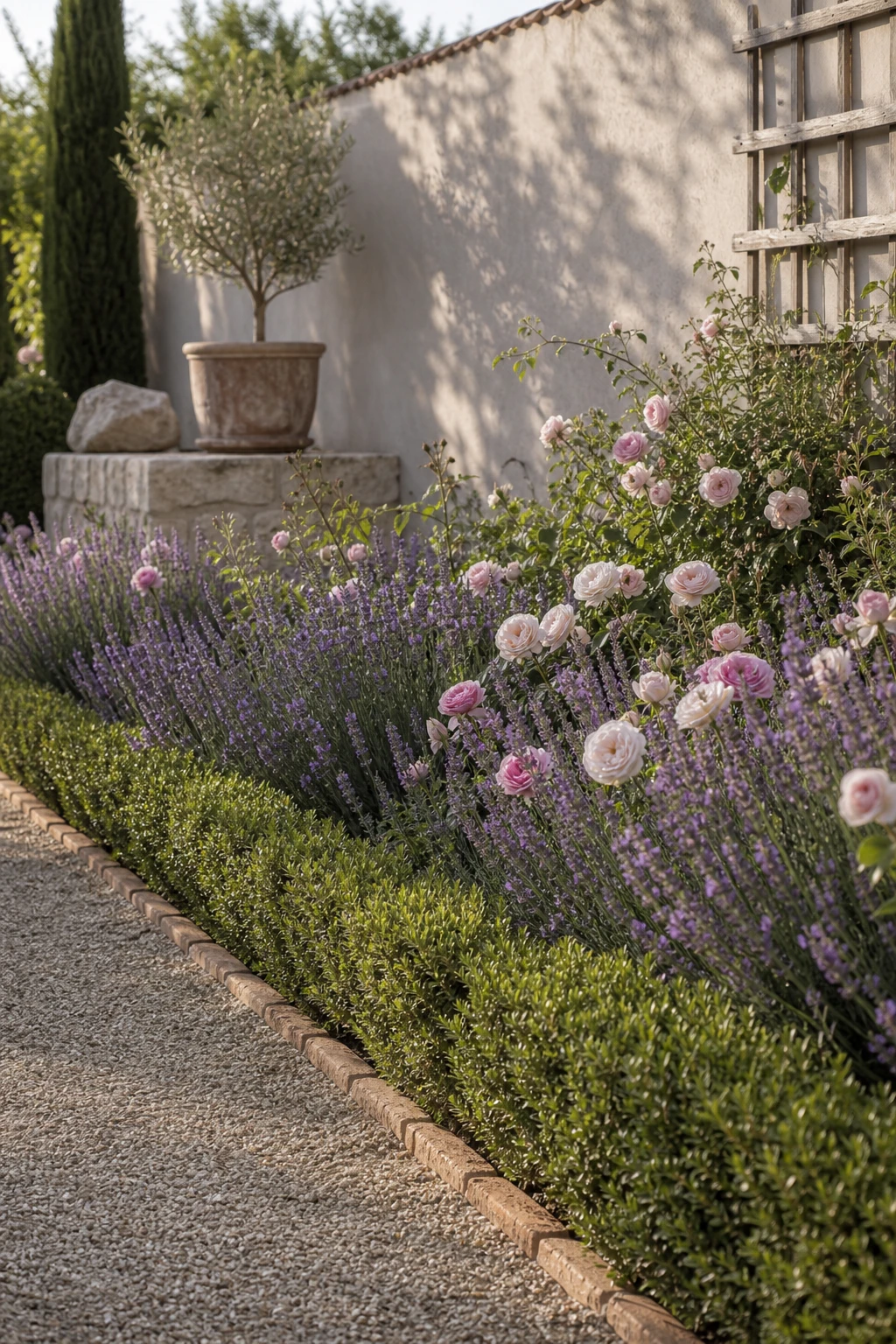
Soft purple and blush sit so close on the tonal scale that they calm each other down rather than compete, and that is exactly what makes this pairing feel neutral rather than floral and fussy. What I love is the way English lavender brings a hazy, almost grey quality to the purple, which you will notice pulls it right into the same quiet family as dusty pink roses. The result reads as a single soft wash of colour rather than two separate plants doing separate things.
The Key Details
English lavender border planting
Open blush garden roses
Clipped boxwood edging hedge
Pale limestone gravel path
Weathered stone garden wall
Pro TipRun a single tight row of lavender along the front edge of a rose bed and it gives the whole planting a clean, defined frame that makes even an informal rose variety look considered.
AvoidPlanting heavily scented roses right beside a seating area sounds lovely in theory, but two strong fragrances competing at close range can feel overwhelming rather than relaxing within minutes.
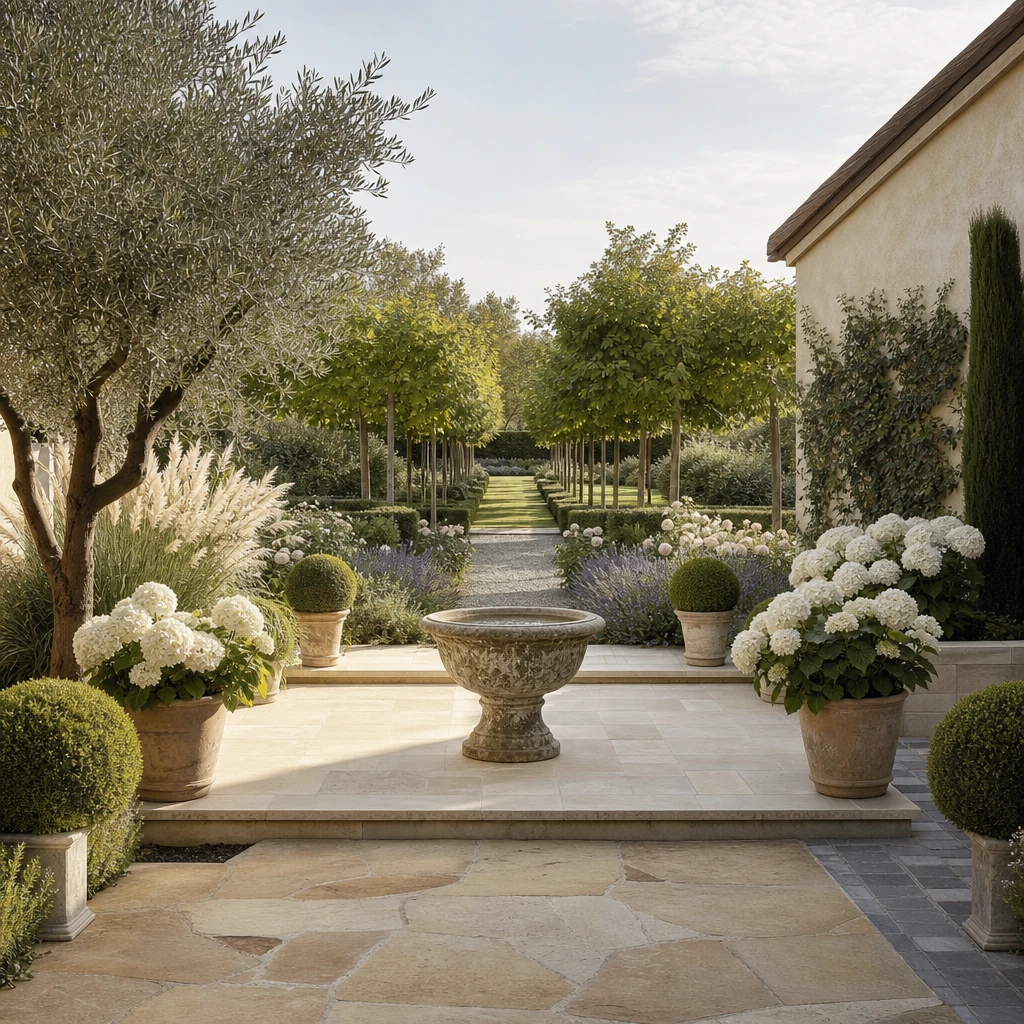
Hydrangea in Planters Make the Simplest Elegant Neutral Garden Statement
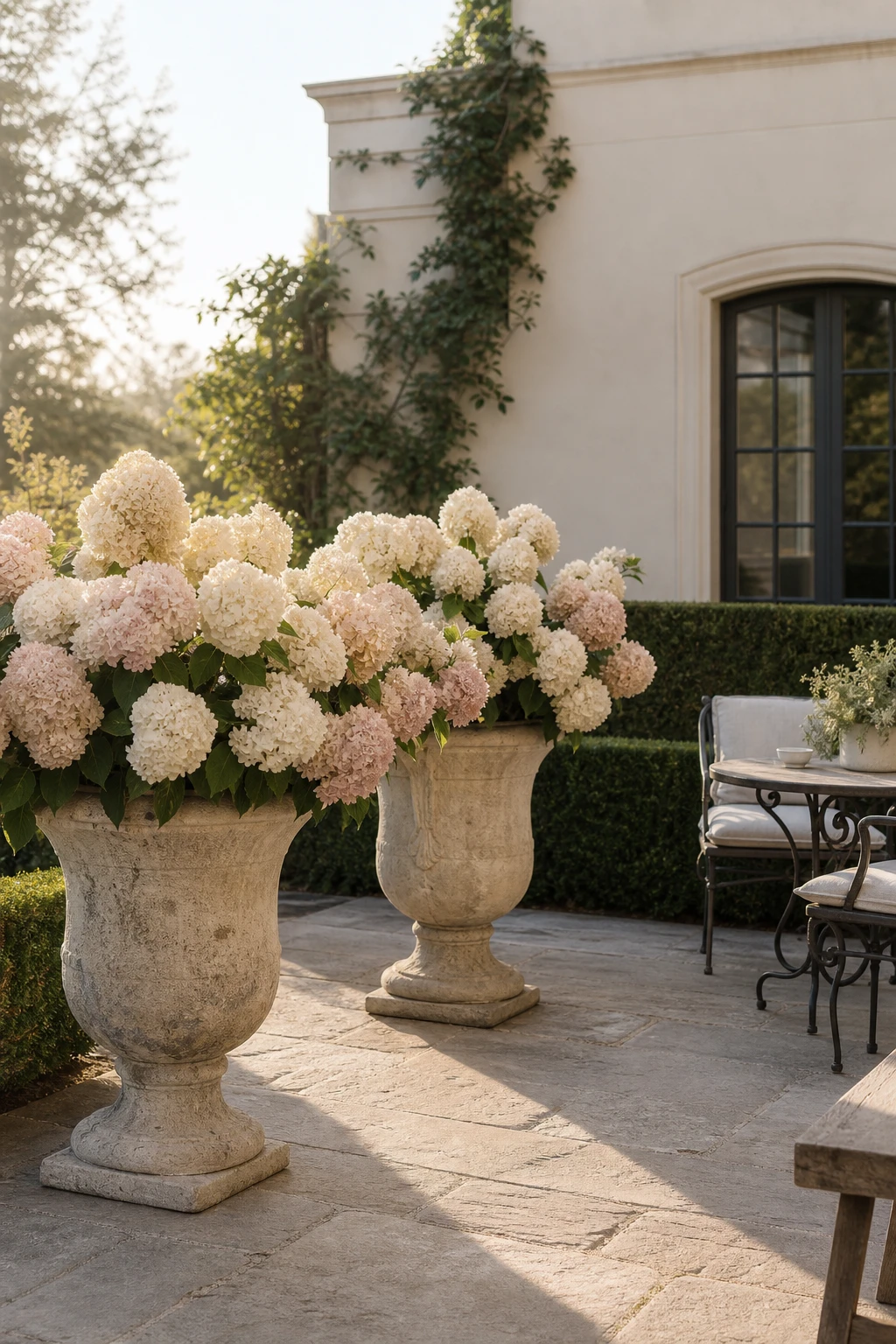
Hydrangeas in planters are one of my favourite moves for a terrace that feels too hard and flat. Those big, blousy heads bring an instant softness that smaller flowers simply cannot match, and you get all of that impact without disturbing a single paving stone. What I love most is how the blooms blur the line between the garden and the seating area, making the whole space feel curated rather than just furnished.
The Key Details
Oversized stone urns
Flagstone terrace paving
Clipped boxwood hedge
Wrought iron bistro table
Linen cushioned seating
Pro TipGroup three planters at slightly different heights so the eye travels upward and the display reads as a proper focal point rather than a row of pots.
AvoidChoosing a pot that looks right but holds too little soil means the roots dry out within days, and a wilting hydrangea undermines every other elegant detail around it.
Pleached Trees Give an Elegant Neutral Garden Its Most Architectural Moment
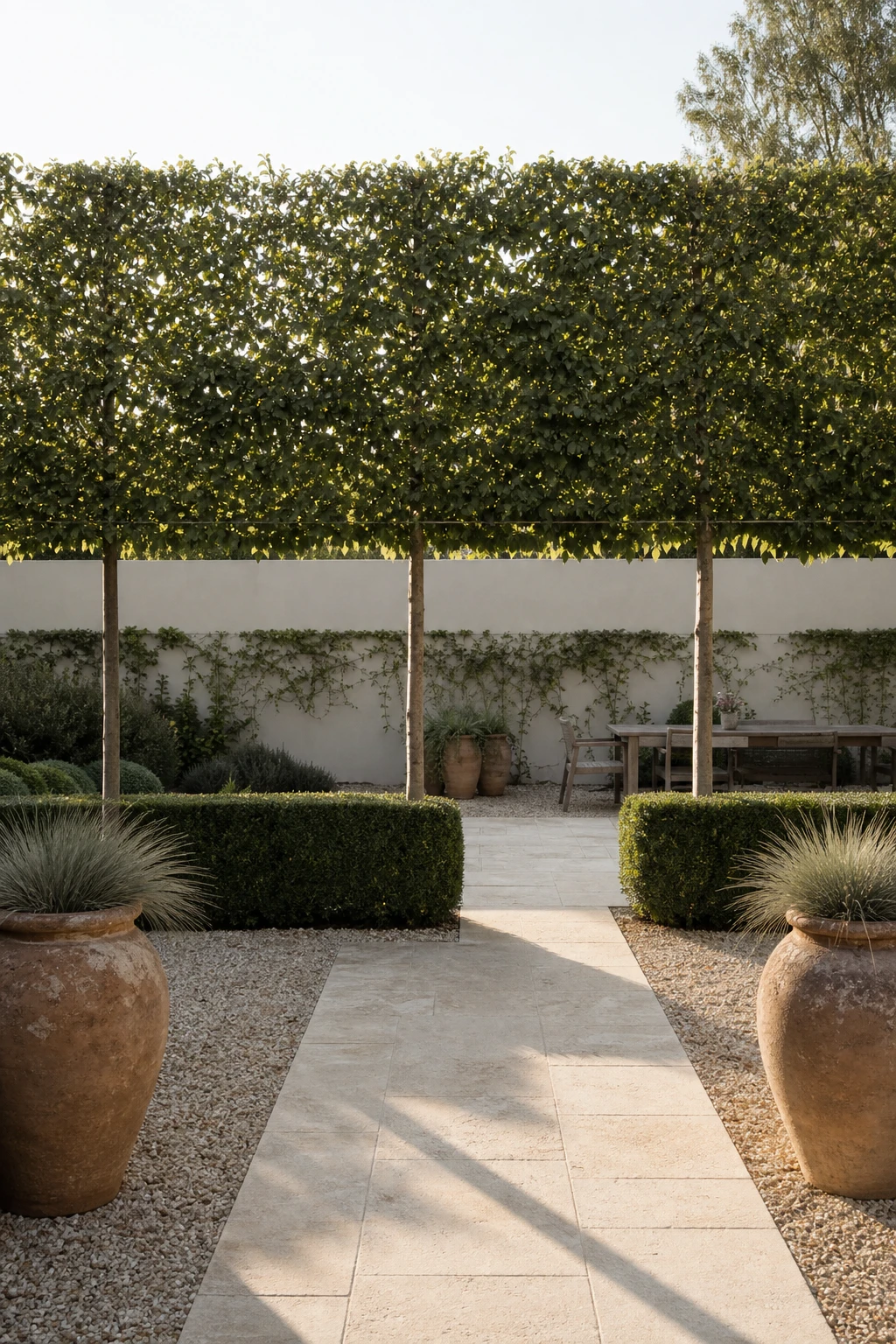
Pleached trees are one of my favourite moves when a garden needs height and privacy without bulk. You get a flat, hovering canopy that reads almost like a living wall, adding strong architectural lines while still letting light pass beneath. That one row of trained trees quietly does three jobs at once: screens a neighbour, defines a boundary, and brings a sense of calm deliberate structure that no fence panel could ever match.
The Key Details
Pleached tree canopy wall
Clipped hornbeam underhedge
Wide pale limestone path
Oversized terracotta urns
Silvery ornamental grasses
Pro TipPlant your pleached trees along a single straight stake line with identical spacing, typically two to two and a half metres apart, so the finished canopy locks together into one seamless horizontal plane.
AvoidSkipping the annual tie in and trim lets new shoots cross the frame within a single growing season, and once that flat canopy goes uneven it takes two or three years of patient work to restore.
White Pampas Grass Outdoors Adds the Kind of Drama That Still Reads as Calm
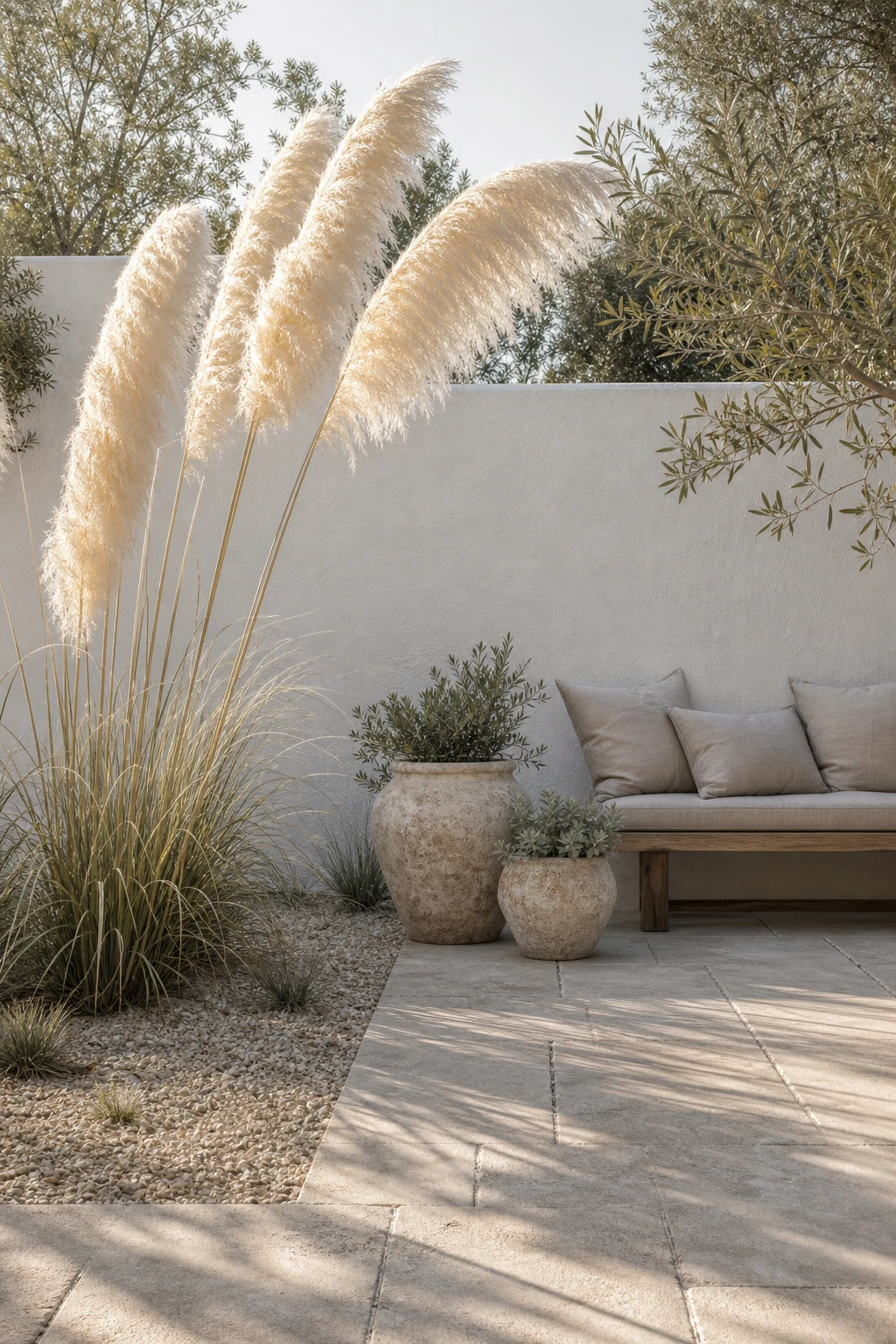
White pampas grass is one of those plants that stops you in your tracks without shouting a single colour at you. What I love is how the drama is entirely about scale, those tall, feathery plumes catching the breeze and drawing the eye upward while the palette stays completely calm. You get maximum impact with zero visual noise, which is the quiet trick behind a truly elegant neutral garden.
The Key Details
Towering pampas grass plumes
Natural stone paving slabs
Weathered limestone planters
Teak bench with linen cushions
Fine gravel planting bed
Pro TipPlant your pampas with a dark yew hedge or painted fence behind it so the pale plumes are silhouetted and every feathery detail reads clearly against the contrast.
AvoidPositioning pampas too close to a path leaves the sharp leaf edges at exactly the height to catch bare legs, turning a beautiful feature into a painful one.
A Courtyard With a Fire Pit Turns an Elegant Neutral Garden Into an Evening Destination
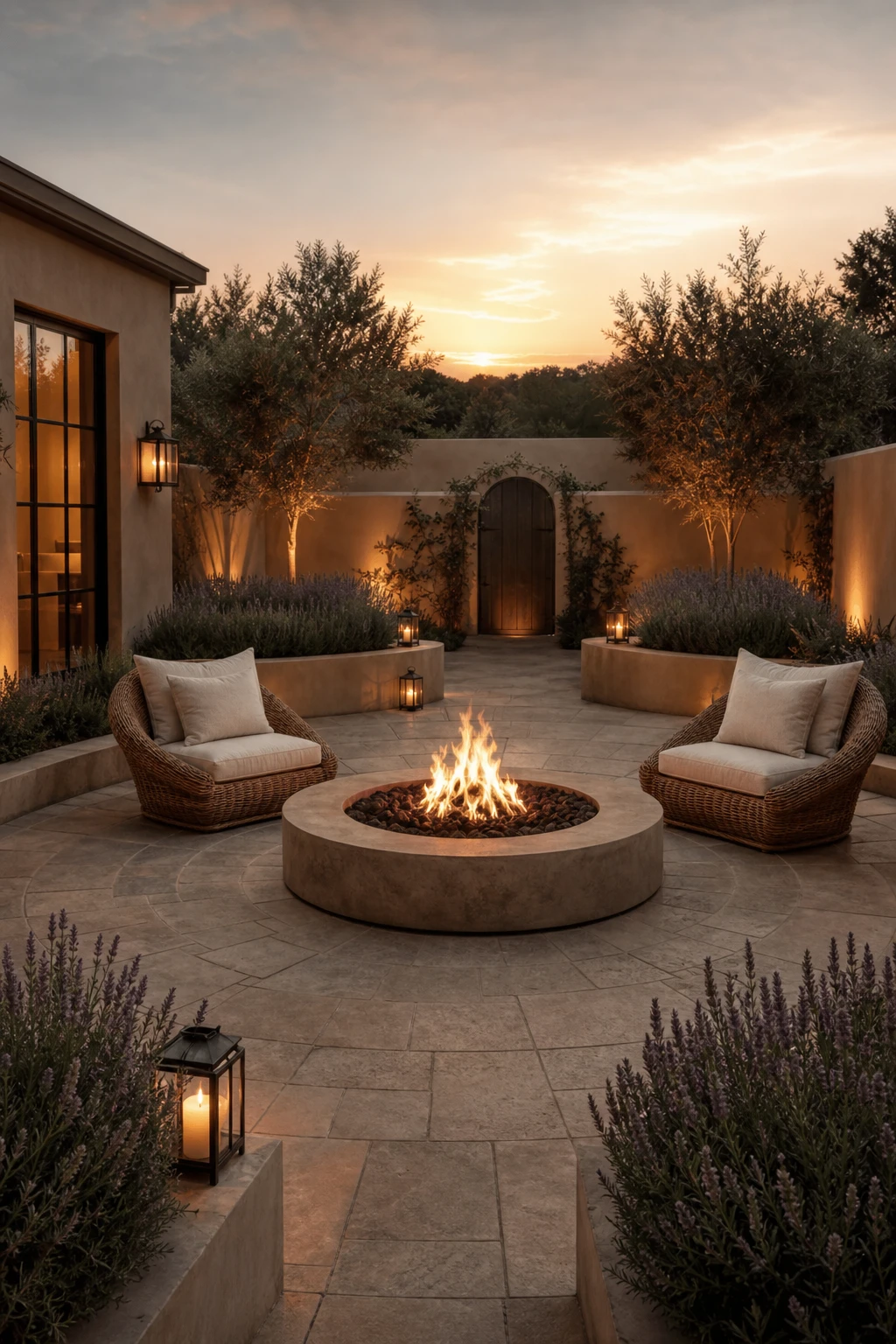
Centering a courtyard around a fire pit is one of my favourite moves for gardens that need to earn their keep after the sun goes down. The flame becomes the focal point that pulls every chair, every planter, and every lantern into orbit around it, so the space reads as intentional rather than just furnished. What I love most is how the warm glow plays off honed limestone and neutral linen, softening the whole palette into something that feels genuinely inviting once evening falls.
The Key Details
Central cast iron fire pit
Honed limestone courtyard pavers
Low sculptural concrete planters
Woven rattan lounge chairs with linen cushions
Wrought iron pathway lanterns
Pro TipSet the fire pit into a shallow recess of around 20 to 30 centimetres so the flame sits at eye level when you are settled into a low lounge chair, which makes the whole experience feel far more intimate.
AvoidPlacing a fire pit directly beneath a fabric pergola canopy or overhanging branches traps heat and embers, creating a real fire risk that no amount of atmosphere is worth.
A Mediterranean Backyard With a Pool Looks Stunning When the Surround Stays Neutral
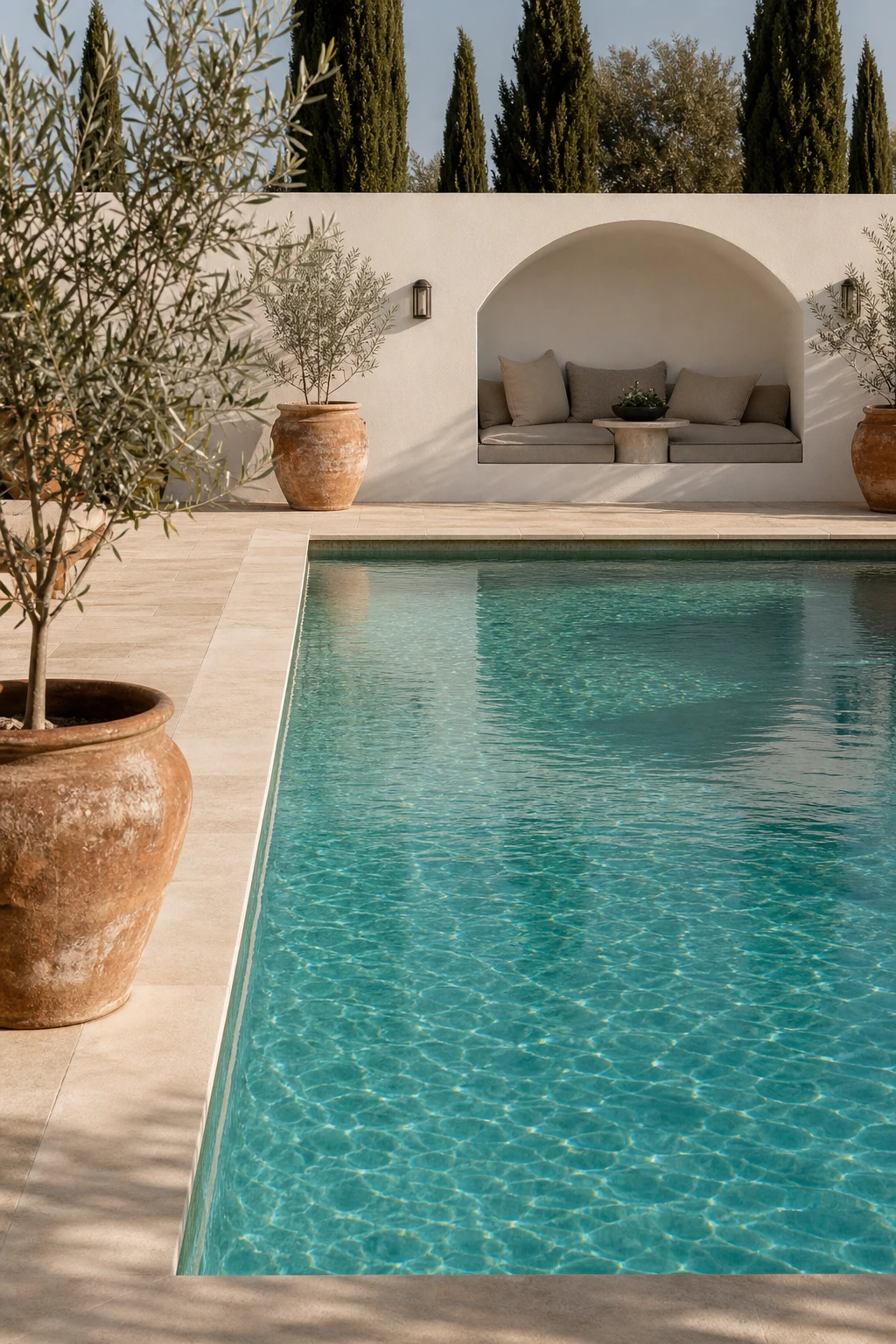
Keeping the surround in one quiet family of stone means your eye has nowhere to land except the water, and that is exactly where you want it. What I love about honed limestone and travertine together is the way they share the same warm grey undertone, so the pool reads as the jewel rather than one more element competing for attention. You will notice how the rendered wall and clipped cypress row frame the whole scene without shouting.
The Key Details
Honed limestone pool coping
White rendered garden wall
Clipped cypress tree row
Low terracotta planters with olive branches
Travertine deck tiles
Pro TipChoose a dark grey or slate coloured pool liner rather than white, because it reflects the sky, deepens the blue of the water, and makes the whole pool feel almost Mediterranean.
AvoidGlossy white tiles around a pool catch every angle of direct sun and become painfully bright, which makes the space uncomfortable to sit in and actually pulls focus away from the water itself.
Outdoor Seating Under a Pergola Gives Every Neutral Garden Its Cosiest Corner
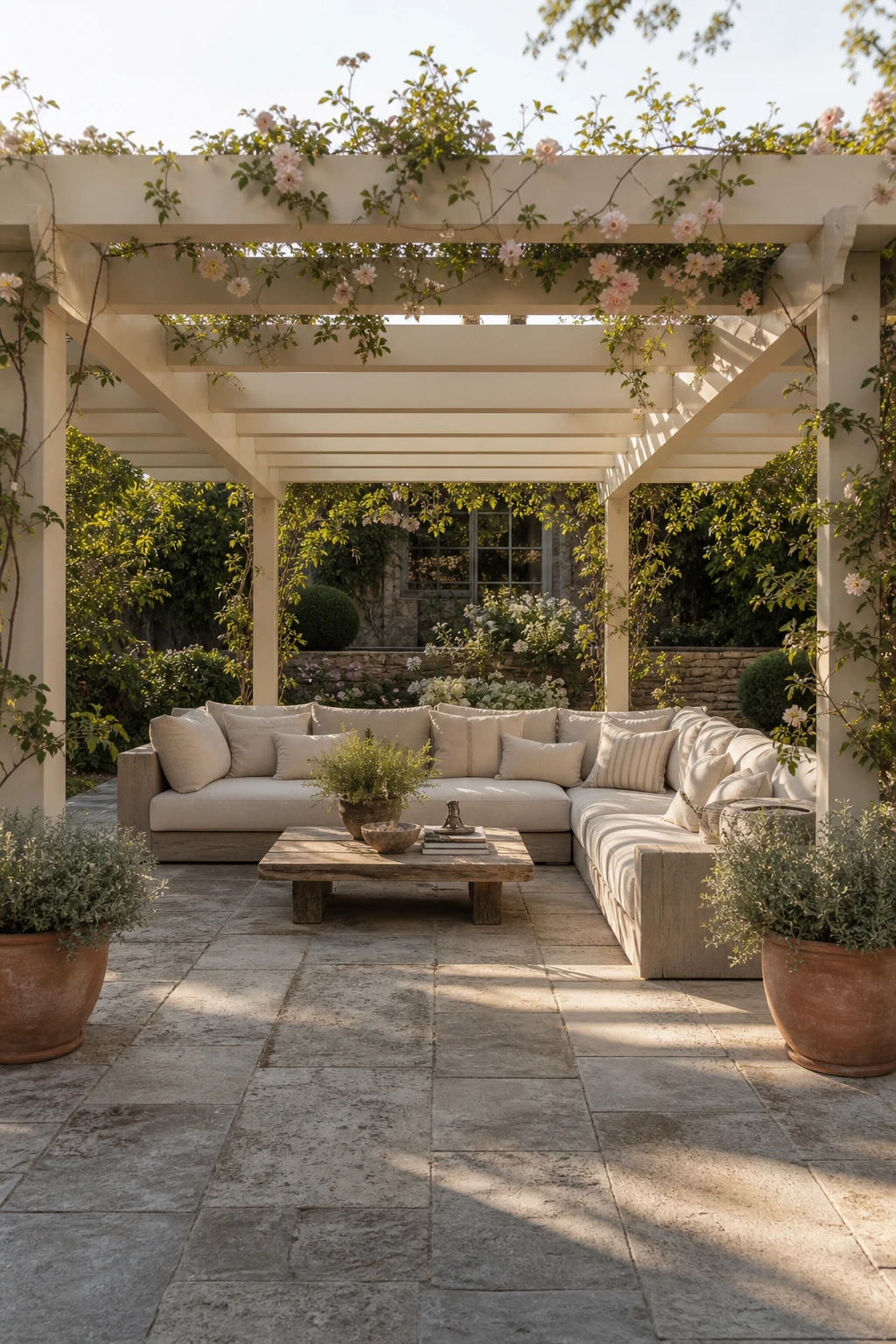
A pergola turns an open patch of garden into a proper room, and that shift is what I find so satisfying about it. The overhead beams frame the sky without closing it off, so you get shelter and openness in the same breath. Linen cushions, weathered oak and reclaimed stone all sit within that neutral palette, and the whole corner reads as calm and considered rather than cobbled together.
The Key Details
Timber pergola with painted overhead beams
Linen and oatmeal cushioned outdoor seating
Reclaimed stone paving
Weathered oak low coffee table
Terracotta pots with trailing silver green foliage
Pro TipTrain a single climbing rose or wisteria up one side post so the canopy gets a little natural dapple without full shade blocking the light.
AvoidA pergola set too low compresses the space beneath it, making what should feel like a sheltered retreat feel more like a low ceiling pressing down on you.
Backyard Patio Dining Ideas That Look Elegant No Matter How Simple the Table
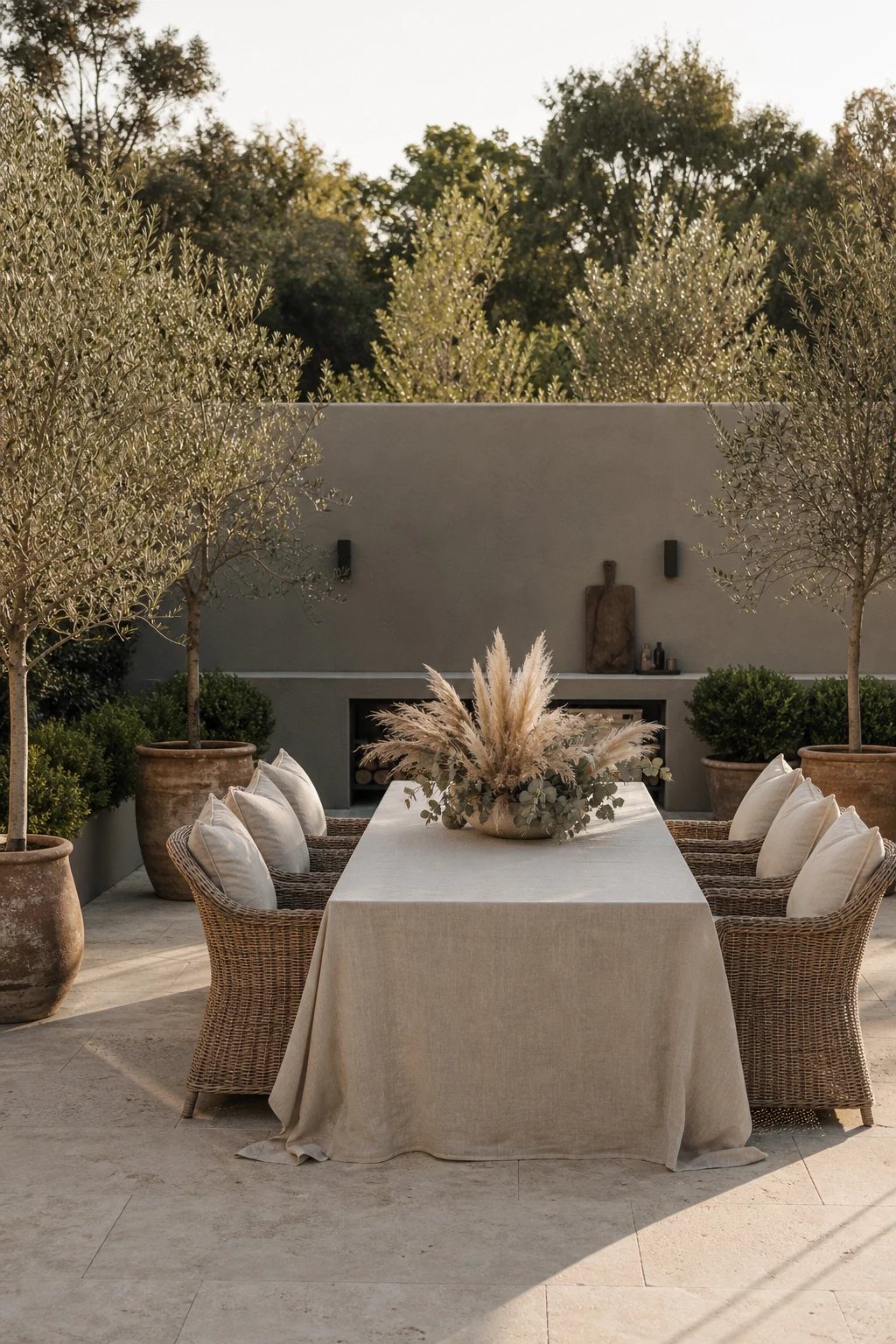
A patio table styled with restraint always reads more elegant than one loaded with props. What I love here is how each element, rattan chairs, loose linen, a single dried centrepiece, pulls from the same quiet palette as the garden itself, so the whole setting feels grown rather than arranged. You get that rare thing outdoors: a table that looks considered but completely relaxed.
The Key Details
Rattan armchairs with oatmeal cushions
Honed limestone pavers
Terracotta planters with olive trees
Loose linen table cloth
Dried pampas and eucalyptus centrepiece
Pro TipFold linen napkins in a natural stone shade loosely beside each plate rather than standing them upright, and the whole table will feel softer and more connected to the surrounding planting.
AvoidFilling the centre of the table with multiple decorative objects leaves guests with nowhere to set a drink or pass a dish, and the setting tips from styled into cluttered the moment food arrives.
An Outdoor Kitchen Patio Feels Truly Elegant When the Cabinetry Stays Beautifully Neutral
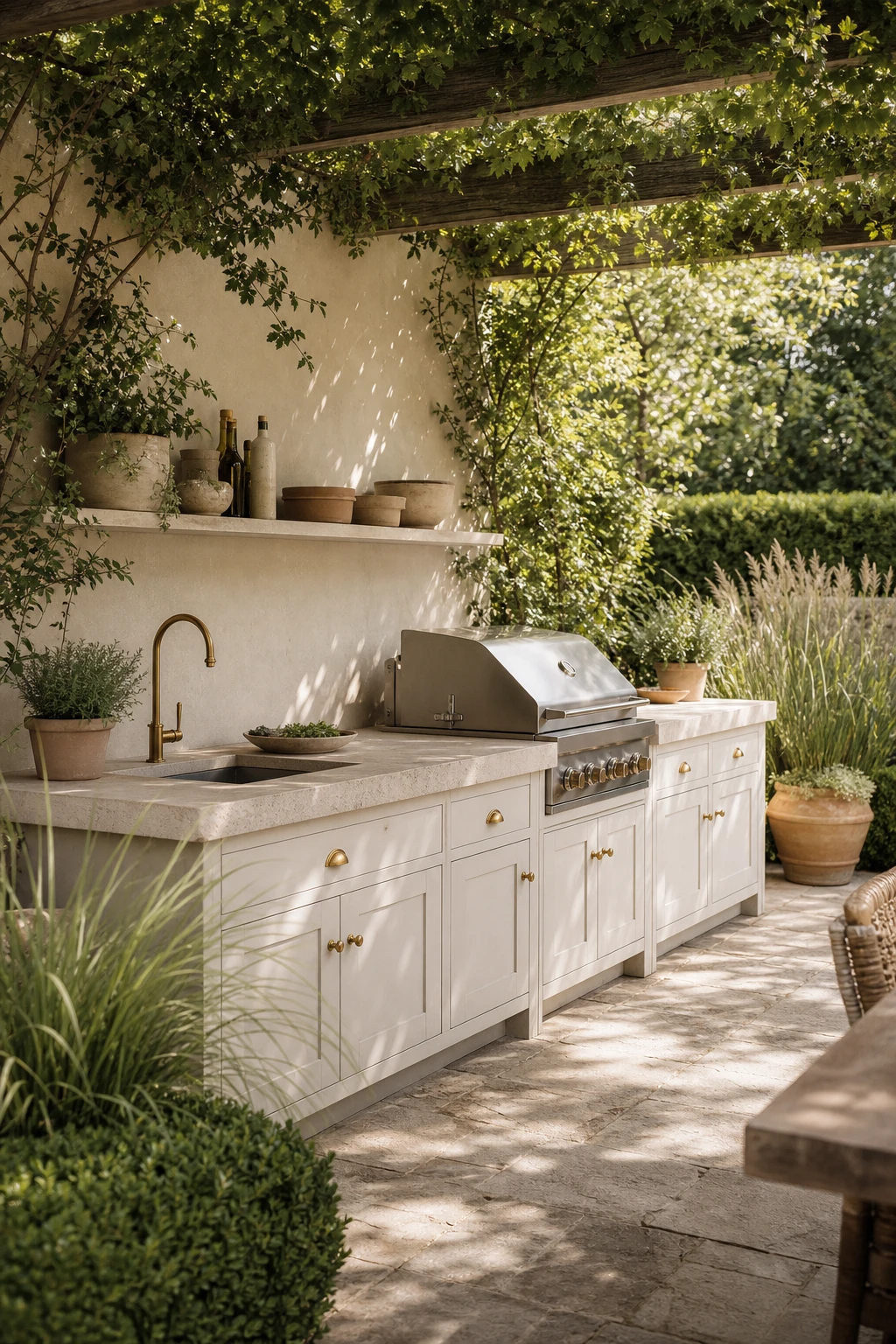
Outdoor kitchens earn their elegance when the cabinetry feels grown from the garden rather than dropped into it. What I love here is how painted timber with inset doors and honed limestone worktops borrow the same quiet palette as the planting and paving around them. You get a space that reads as a room, not an appliance. The aged brass hardware and reclaimed stone underfoot add just enough warmth to stop it feeling cold.
The Key Details
Painted timber cabinetry with inset doors
Honed limestone countertops
Aged brass cabinet hardware
Reclaimed stone paving underfoot
Pergola with climbing foliage overhead
Pro TipMatch your limestone worktop as closely as possible to the paving stone below so the eye travels straight from floor to counter without a visual break.
AvoidSkipping a canopy or pergola overhead means the whole kitchen becomes unusable the moment the weather turns, which in most gardens is more often than you would like.
Garden Lighting Ideas That Make a Neutral Garden Glow After Dark
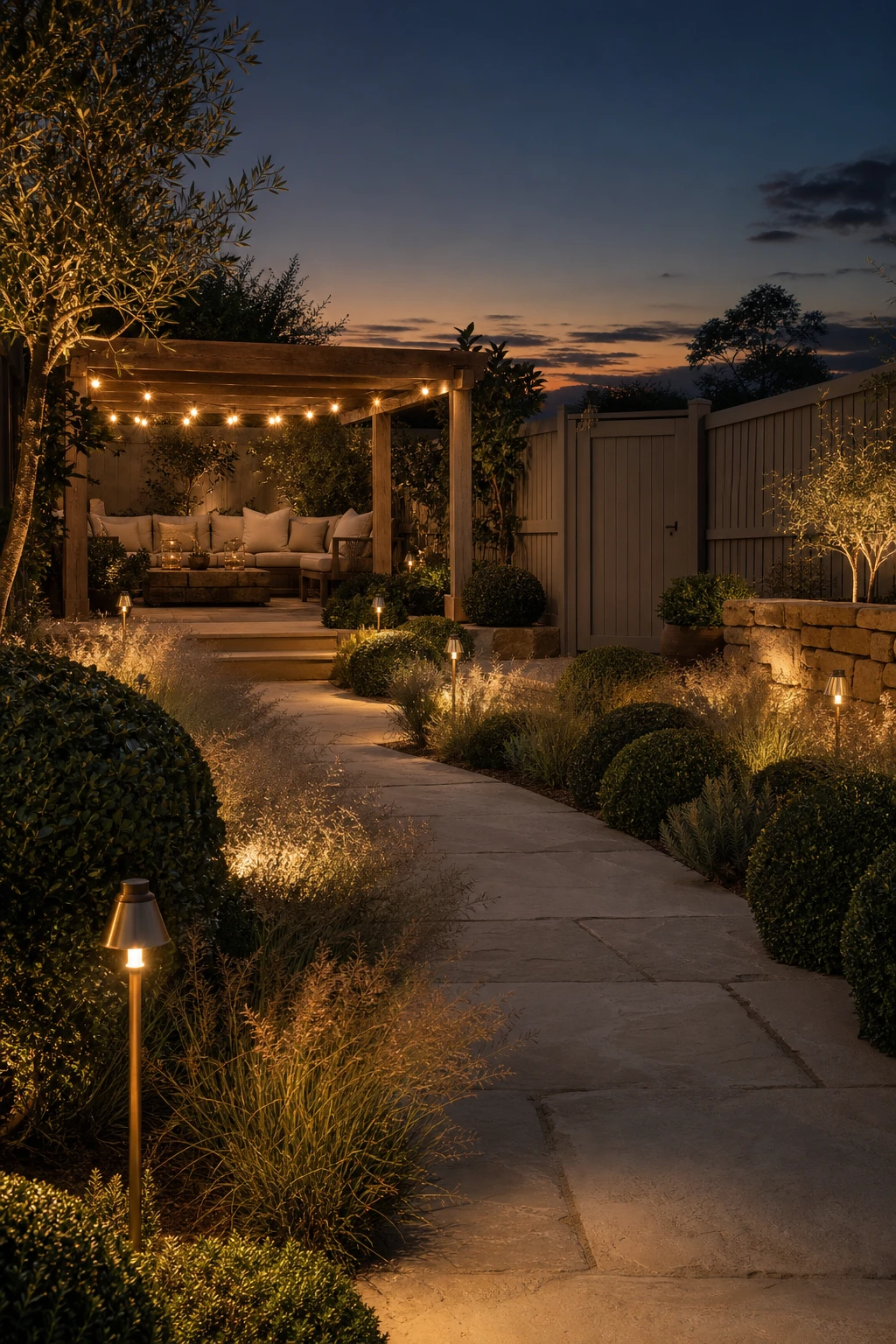
Warm filament bulbs and brass lanterns do something beautiful to a neutral garden at dusk: they hold all that softness you built in daylight and simply deepen it. What I love about uplighting a specimen tree is how the shadows it throws across pale paving become their own decoration. You get movement, texture and drama without a single extra plant. The stone and linen tones you chose by day stay just as quiet and considered after dark.
The Key Details
Brass spike lanterns
Festoon filament lights on timber pergola
Pale limestone pathway
Cloud pruned box spheres
Stone coloured linen outdoor cushions
Pro TipPosition a single uplight at the base of your best tree and angle it slightly off centre so the shadow pattern falls across the paving at a gentle diagonal rather than straight up the wall.
AvoidCool blue white bulbs drain every last drop of warmth from a neutral scheme, leaving the garden feeling clinical and flat when it should feel like the best part of the evening.
A Tiled Path to the Front Door Is the Elegant First Impression Your Garden Deserves
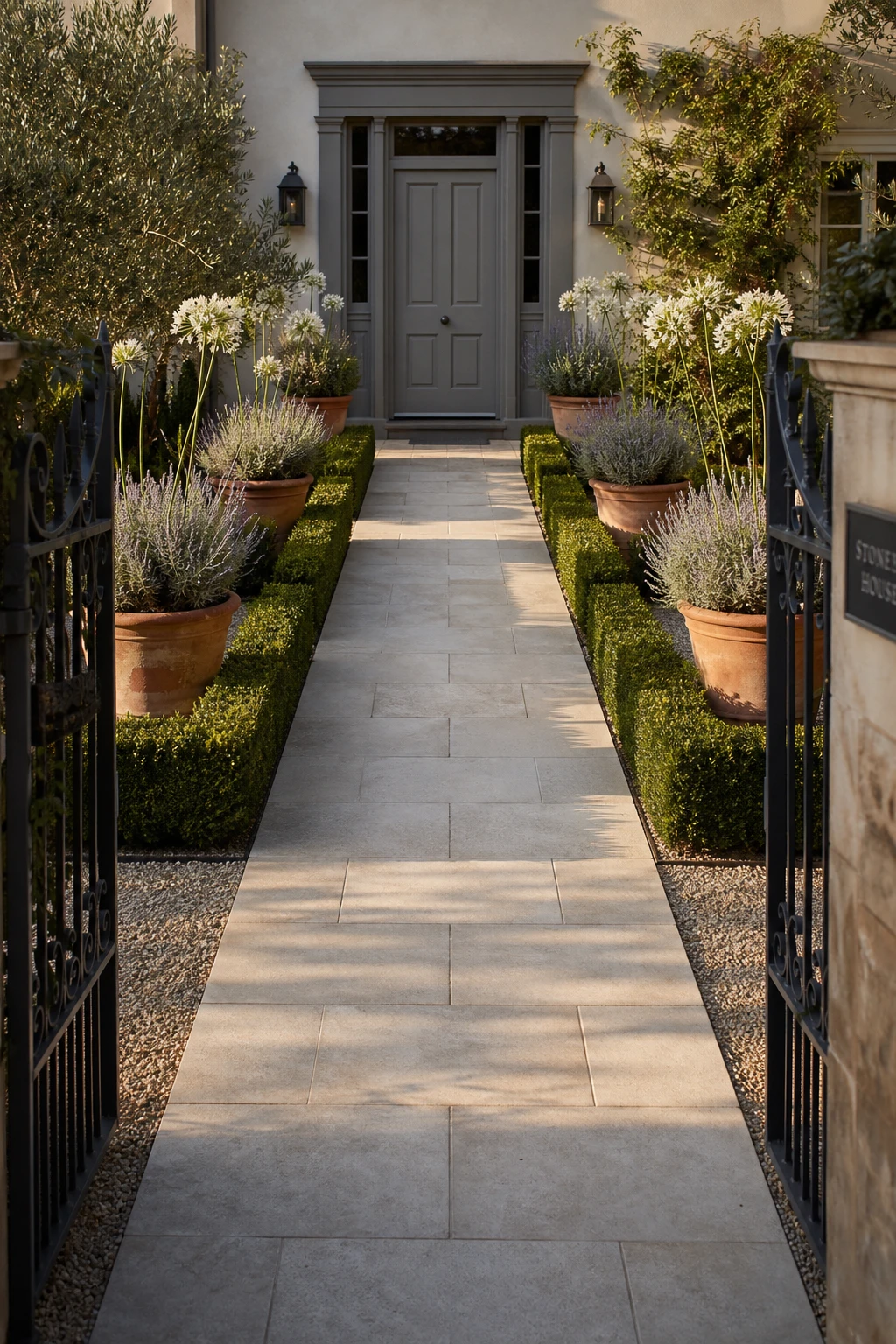
A tiled front path is the opening line of the whole garden story, and getting it right sets the tone before anyone reaches the door. Limestone or smooth stone laid in a clean run pulls the eye forward with real intention, and I love the quiet ceremony of it, that sense of arrival that gravel or stepping stones simply cannot deliver. That calm, unbroken surface tells a visitor the garden has been thought about from the very first step, which is exactly the impression worth making.
The Key Details
Limestone path tiles
Clipped box hedging
Terracotta urns
Wrought iron garden gate
River pebble planting beds
Pro TipFlank the path with low clipped box or lavender to create a soft corridor that draws the eye straight to the front door.
AvoidA tile with heavy surface variation looks restless on a long straight run and breaks the calm rhythm you are trying to build.
A Gravel Path Garden Guides the Eye and the Feet in the Most Natural Way
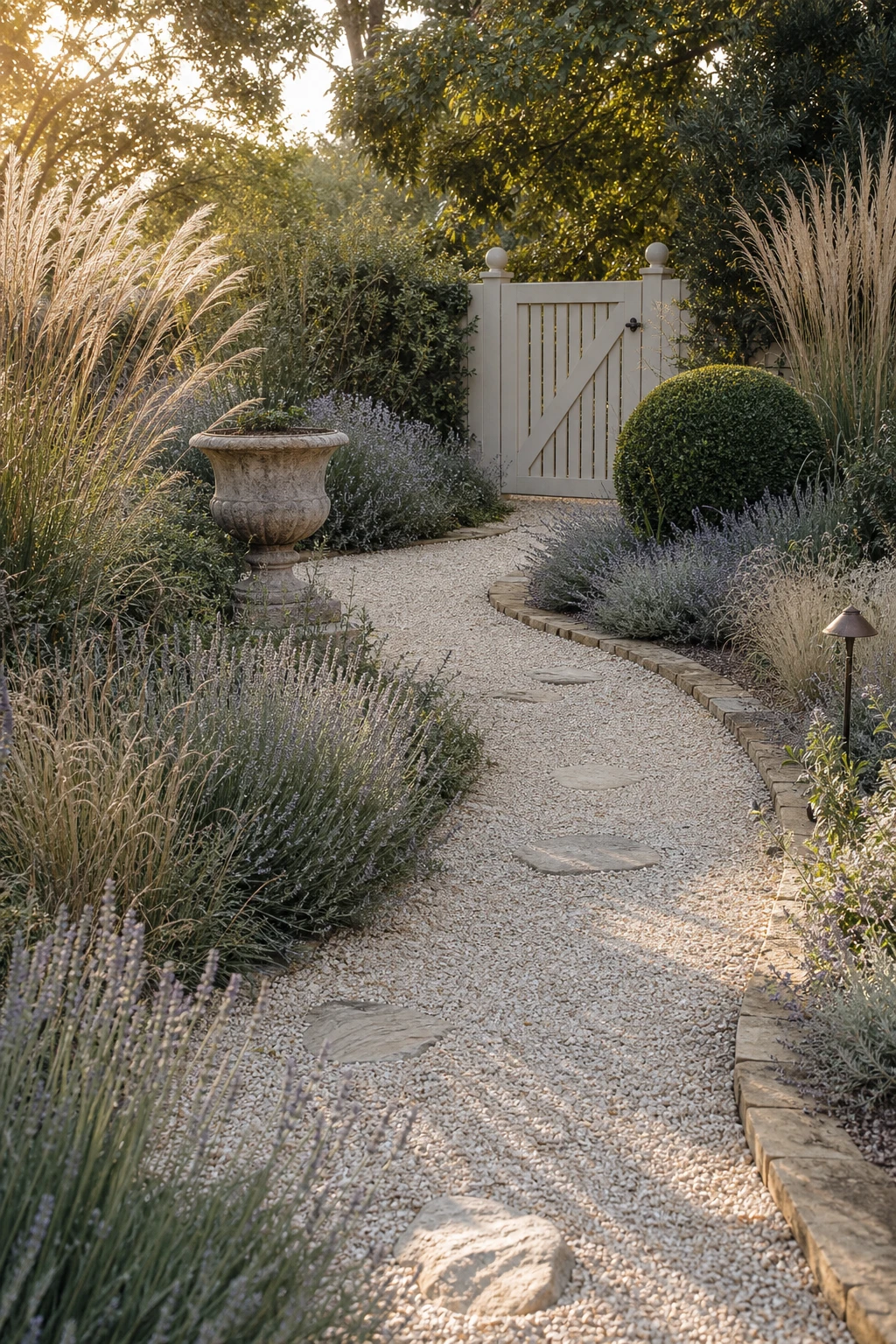
A winding gravel path does something a straight paving slab never can: it turns a walk across the garden into a small adventure. The gentle curve hides the destination just long enough to make you want to keep going, and I find that small psychological trick more powerful than almost any planting decision. You get a real sense of arrival when the path finally opens out, and the gravel underfoot adds a satisfying crunch and texture that connects you to the garden in a way hard surfaces simply do not.
The Key Details
Winding gravel path
Timber garden gate
Clipped yew sphere
Weathered stone urn
Ornamental grass borders
Pro TipEven a gentle S bend of fifteen centimetres either side is enough to suggest mystery and slow a visitor’s pace right down.
AvoidSkimping on membrane depth lets weeds push through within a single season, and once they are established the whole path needs lifting to fix it properly.
Large Potted Plants Outdoor Make an Elegant Neutral Garden Feel Instantly Grown Up
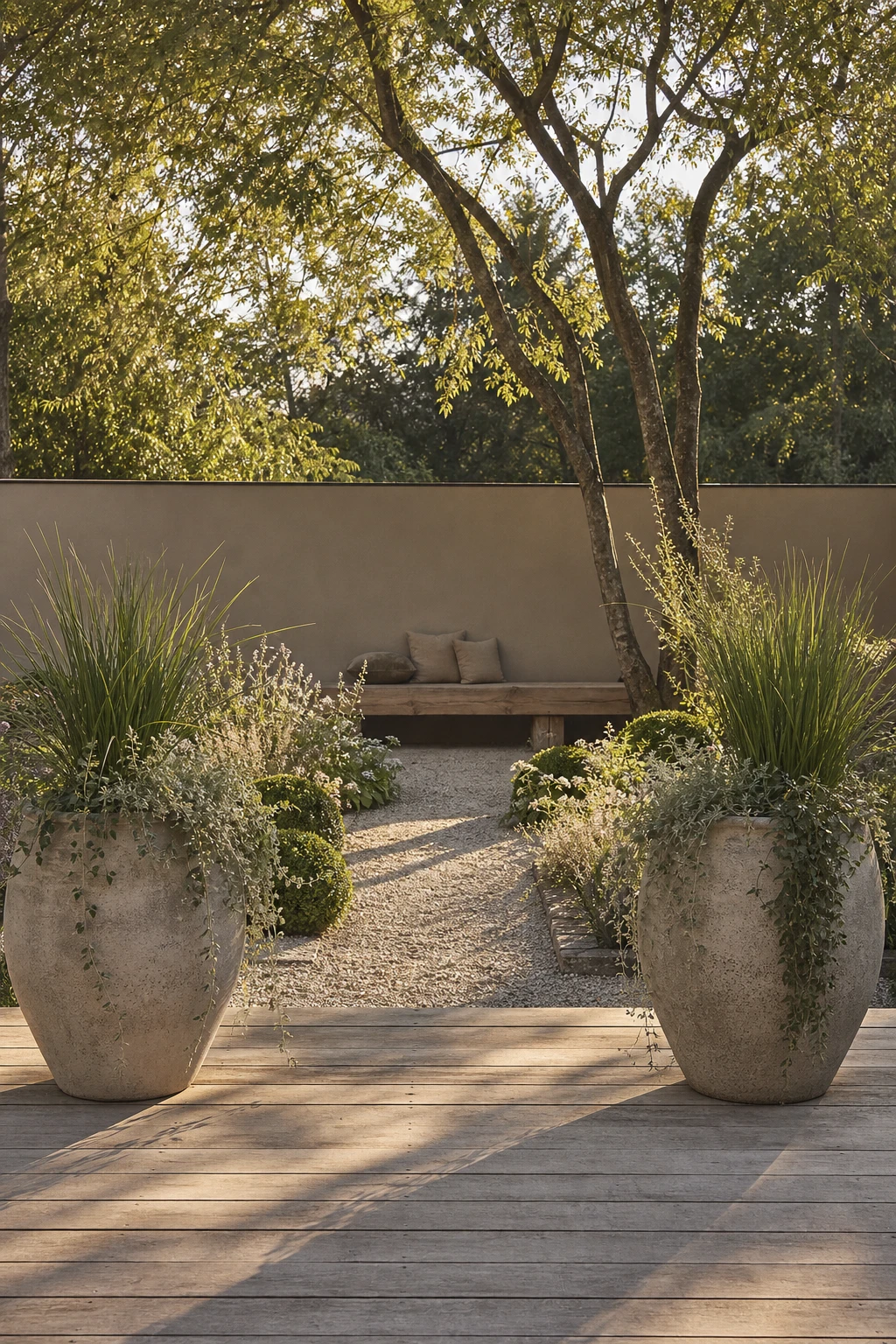
Scaling up is the move I always push clients on when a terrace feels thin and unconvincing. One generous pot commands space the way a piece of furniture commands a room, and you get that same sense of intention. What wins me over here is the way oversized urns anchor the gravel and decking without competing with the planting behind them. You will notice the whole scheme reads as composed rather than collected.
The Key Details
Oversized ceramic urns
Architectural ornamental grasses
Raked gravel path
Clipped boxwood spheres
Rough sawn hardwood deck boards
Pro TipStick to one material across every pot on the terrace, stone or concrete being my first choice, so the grouping reads as a considered set rather than a random assembly.
AvoidMixing terracotta, glazed ceramic, zinc, and fibreglass all at once pulls the eye in too many directions and the terrace ends up feeling like a garden centre display rather than a designed space.
Potted Topiary Is the One Touch That Gives a Neutral Garden Its Sharpest Edge
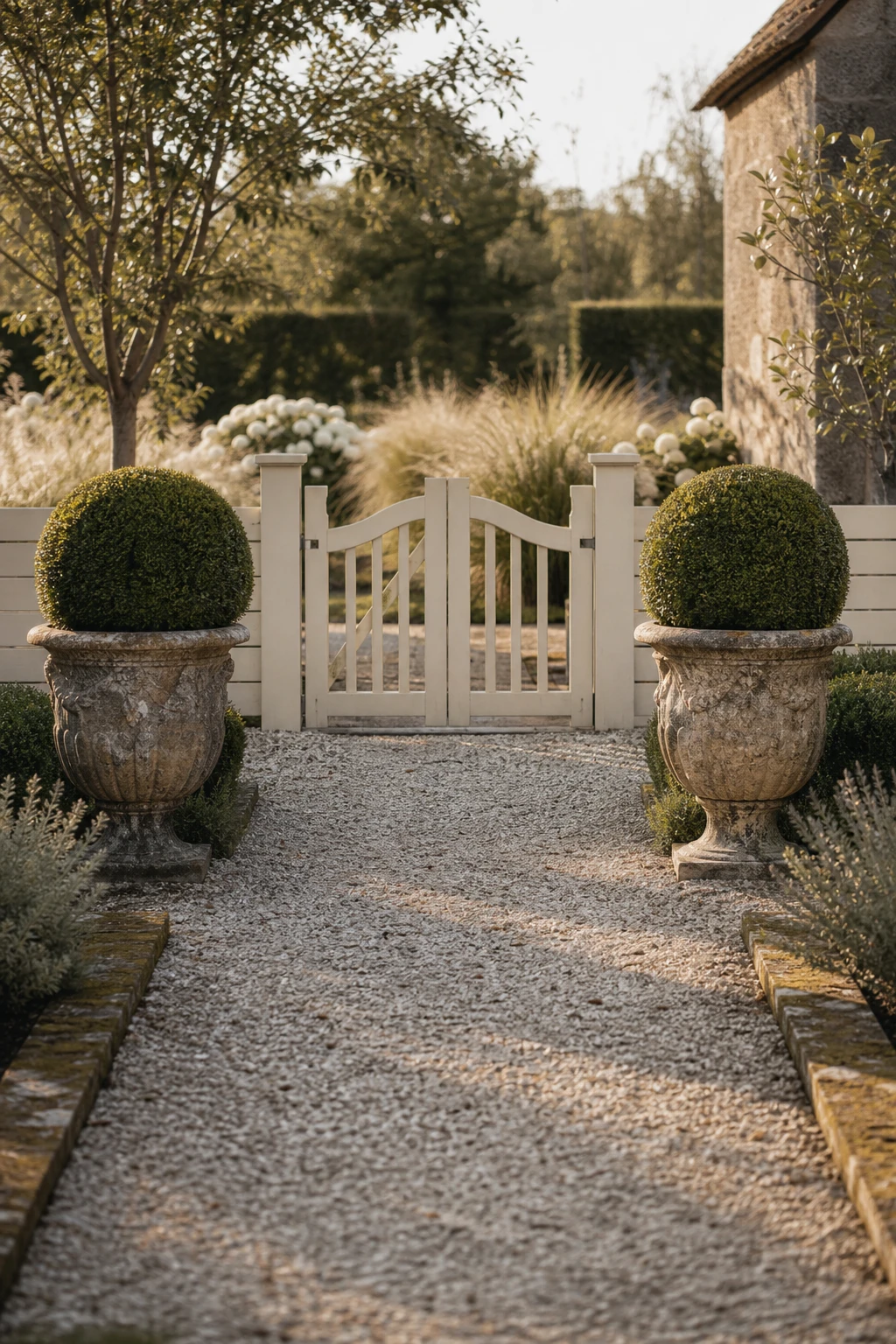
Clipped topiary in pots is the sharpest tool in a neutral garden, and what I love most is the contrast it creates. Set a pair of tight box spheres against loose ornamental grass and the whole scheme snaps into focus. You get structure without severity, and the eye reads the garden as intentional rather than simply planted. That push and pull between clipped form and flowing softness is what gives a neutral palette its character.
The Key Details
Clipped box sphere topiary
Carved stone urns
Crushed limestone gravel path
Farrow and Ball Cream painted timber gate
Loose ornamental grass drifts
Pro TipPosition a matching pair of topiary spheres either side of a door, gate, or flight of steps so the symmetry reads from a distance and anchors the whole garden entrance.
AvoidLeaving topiary unclipped through summer means the crisp silhouette that does all the work slowly dissolves into a shapeless mound, and the contrast with your looser planting disappears entirely.
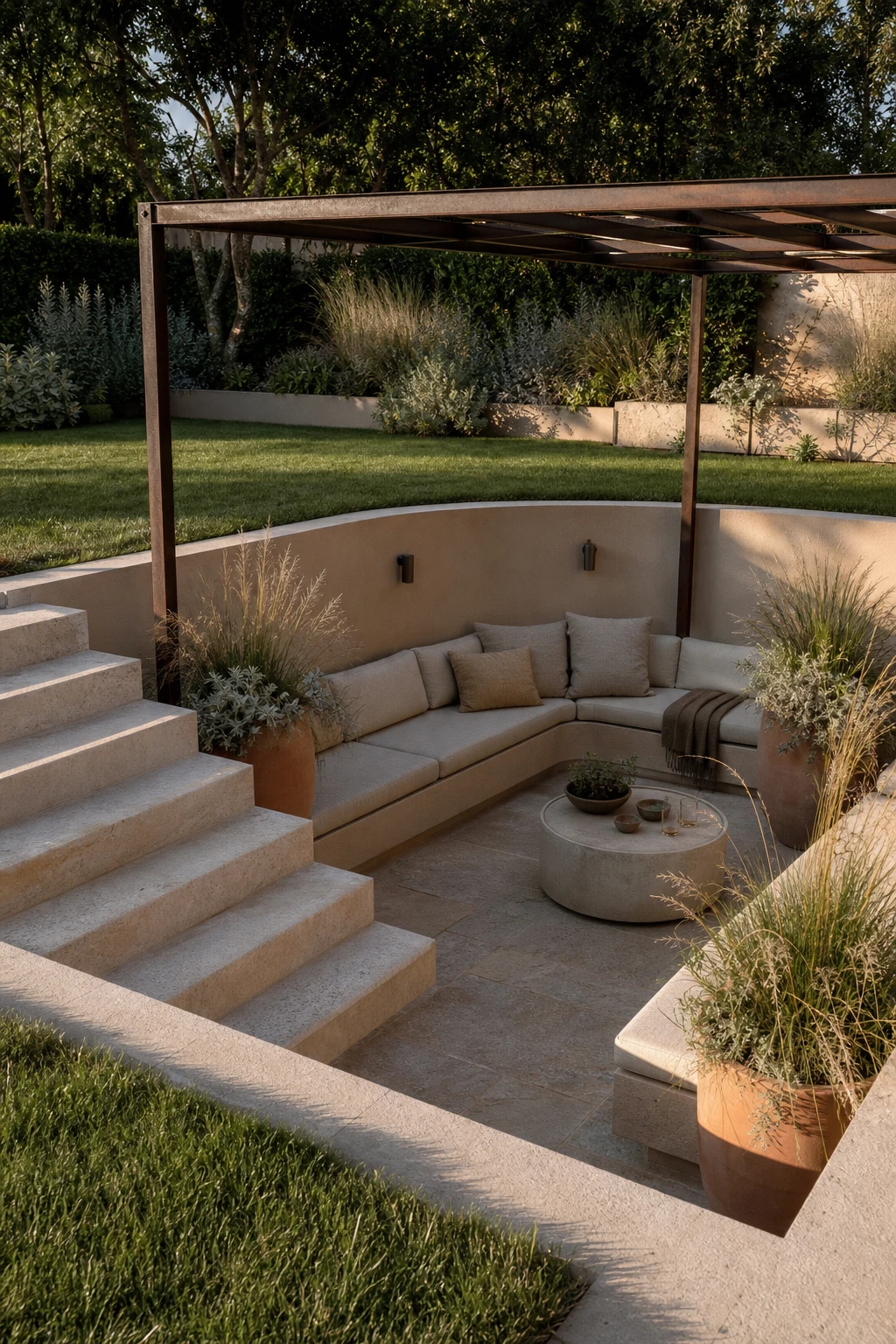
A Sunken Garden Design Creates the Kind of Shelter That Makes Every Neutral Detail Sing
Dropping a seating area below the main garden level is one of my favourite moves for a neutral scheme, because you get enclosure without walls closing everything in. You will notice how the sunken edges frame the space like a room, so every calm linen tone and weathered stone detail reads with more weight. What I love is the sense of arrival it gives, that small step down signals something considered is waiting, and the neutral palette makes it feel restful rather than theatrical.
The Key Details
Dressed limestone step treads
Curved rendered garden wall
Low slung linen cushion bench
Steel pergola with shadow detailing
Ornamental grasses in terracotta planters
Pro TipTrail soft plants like catmint or creeping thyme along the top of your retaining wall so the hard edge softens into the garden rather than sitting there as a blunt line.
AvoidSkipping proper drainage when you dig the space down means the lowest point of your garden becomes a catch pool after any decent rain, and a flooded seating area is useless for months of the year.
Alan launched Edward George London in 2017. Since completing his masters in Town & Regional Planning (MPlan) he has combined the skills he learned at the University of Sheffield with his passion for design, to help create a foundation for those looking to create a beautiful home.