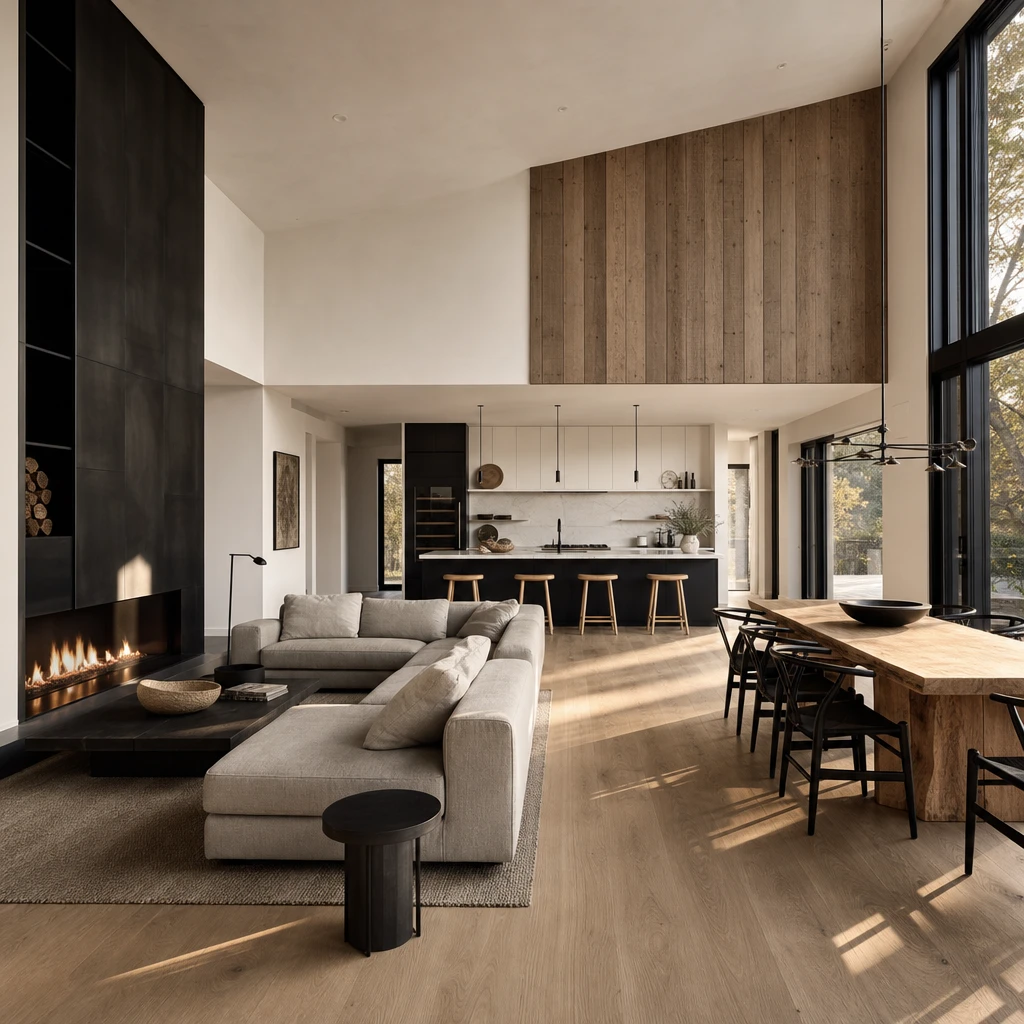
I have always loved the way black, white, gray, and natural wood sit together so naturally, each one doing exactly what the others need. What draws me to this palette is how honest it feels, never fussy, never cold, just grounded and quietly beautiful. In this piece I walk through the details that make it sing, from black kitchen cabinets paired with open shelves to wood room dividers and statement lighting, and every look here is one you can genuinely steal for your own home.
How Black, White, and Natural Wood Build a Palette That Never Feels Cold
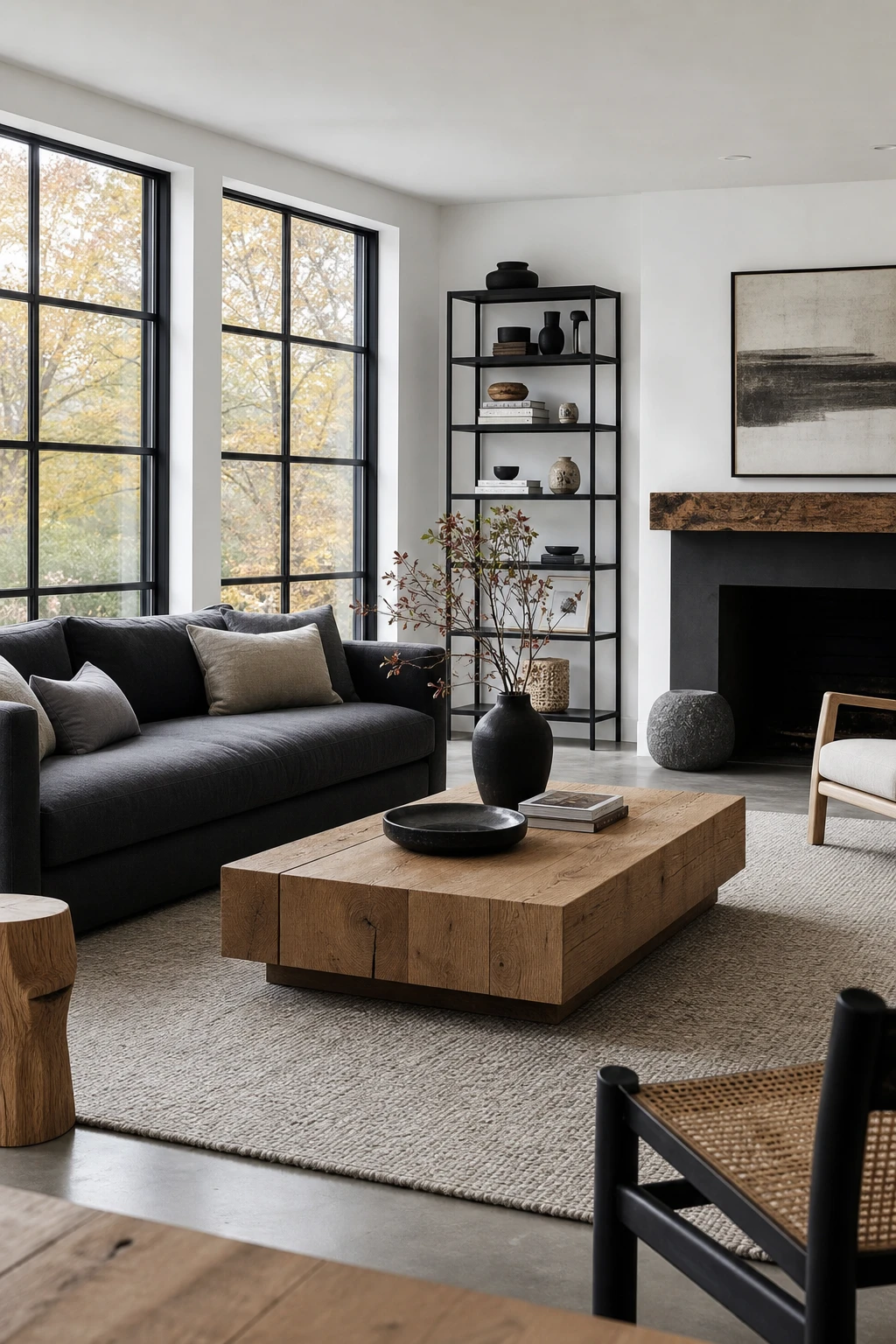
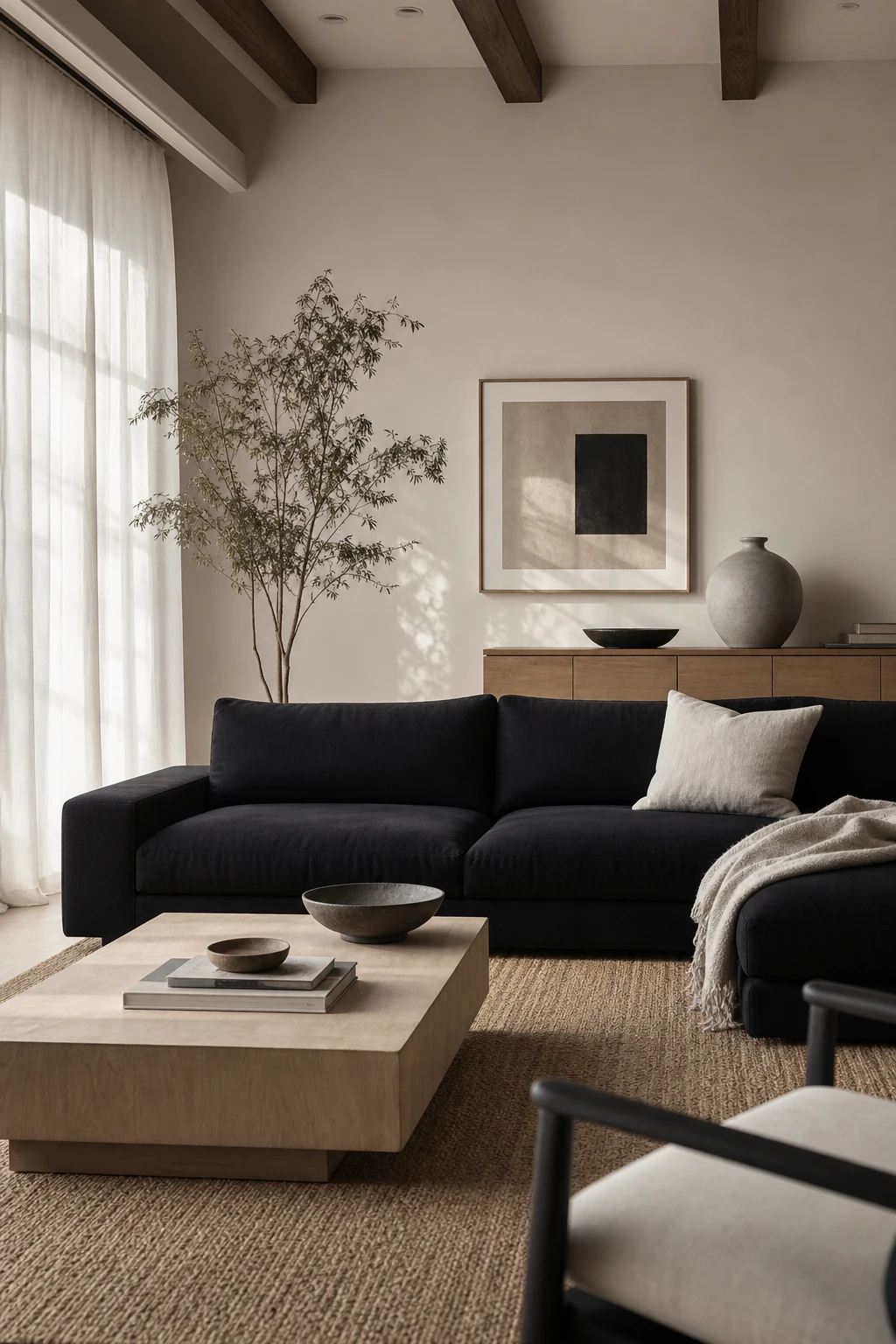
Pairing black and white with natural wood is one of my favourite moves because the contrast does the heavy lifting while the wood keeps everything from tipping into stark territory. What I love is that the warm grain pulls the eye and softens the whole room, so you get drama without the chill. Watch how an oak coffee table sitting against a charcoal sofa instantly reads as inviting rather than cold.
The Key Details
Chunky natural oak coffee table
Charcoal linen sofa
Matte black steel shelving unit
Ivory and ash gray wool rug
Full height window wall
Pro TipReach for a mid tone wood like oak or walnut rather than a pale ash, as the richer grain adds enough warmth to hold its own against strong black and white contrast.
AvoidChoosing a wood with grey or bleached undertones strips out the very warmth the palette relies on, leaving the room feeling cold and unfinished no matter how good the furniture arrangement is.
What a Room Looks Like When All Four Elements Work Together
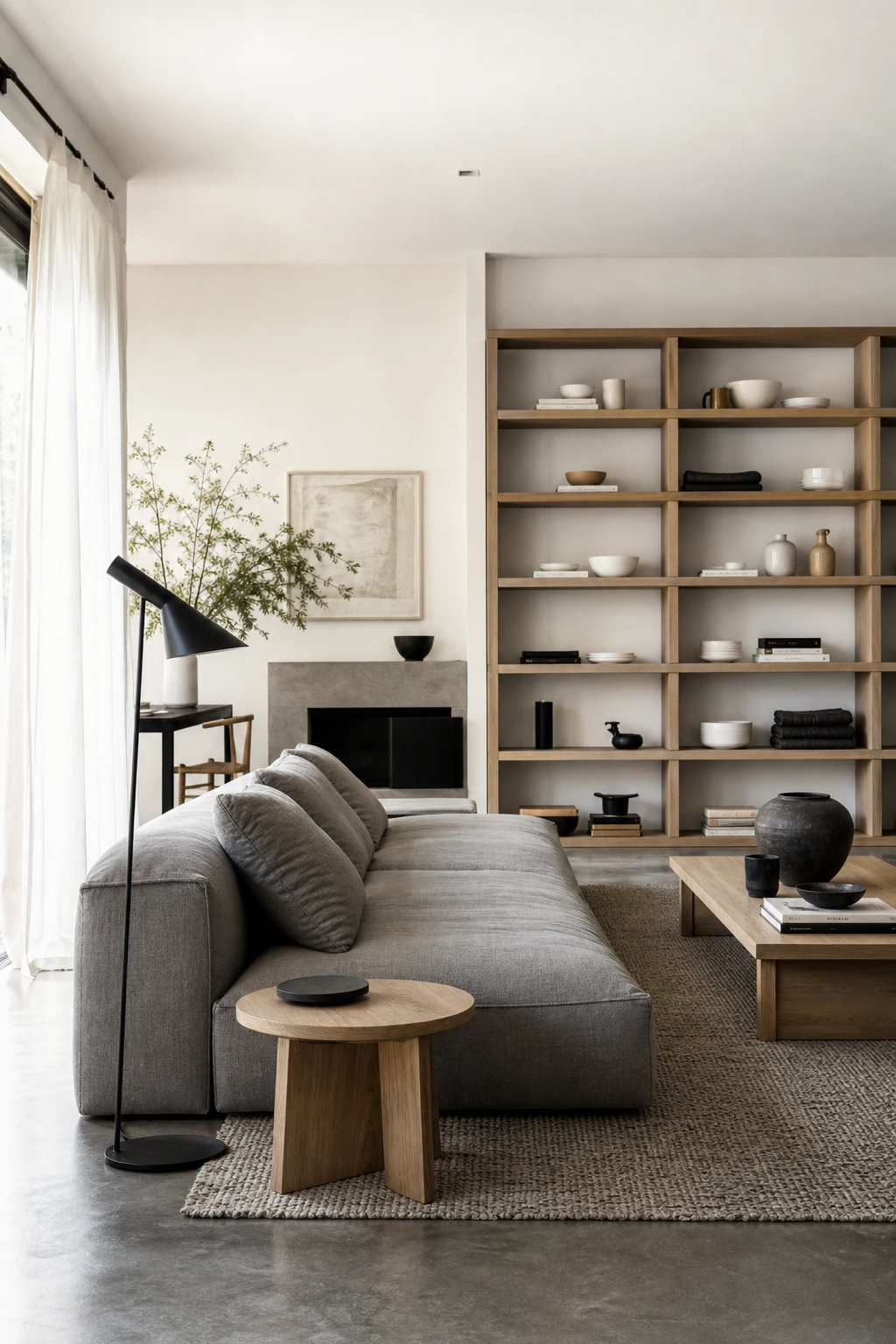
Seeing all four tones share a single room is what wins me over every time, because the balance is never equal and that is exactly the point. Gray anchors the big surfaces, white lifts the light, black lands in small precise moments, and natural wood slips in as the warmth that stops the whole thing feeling cold. You will notice how each tone has a clear job, so none of them fights for attention.
The Key Details
Gray linen low profile sofa
Bleached oak shelving unit
Matte black steel floor lamp
Sheer white linen curtains
White ceramic vessel grouping
Pro TipGive gray roughly half the room, white and wood a quarter each, then let black take no more than ten percent as sharp accents only.
AvoidSplitting all four tones into roughly equal shares flattens the room into a pattern that reads as busy rather than composed.
How Black and Earth Tones Make a Living Room Feel Grounded and Alive
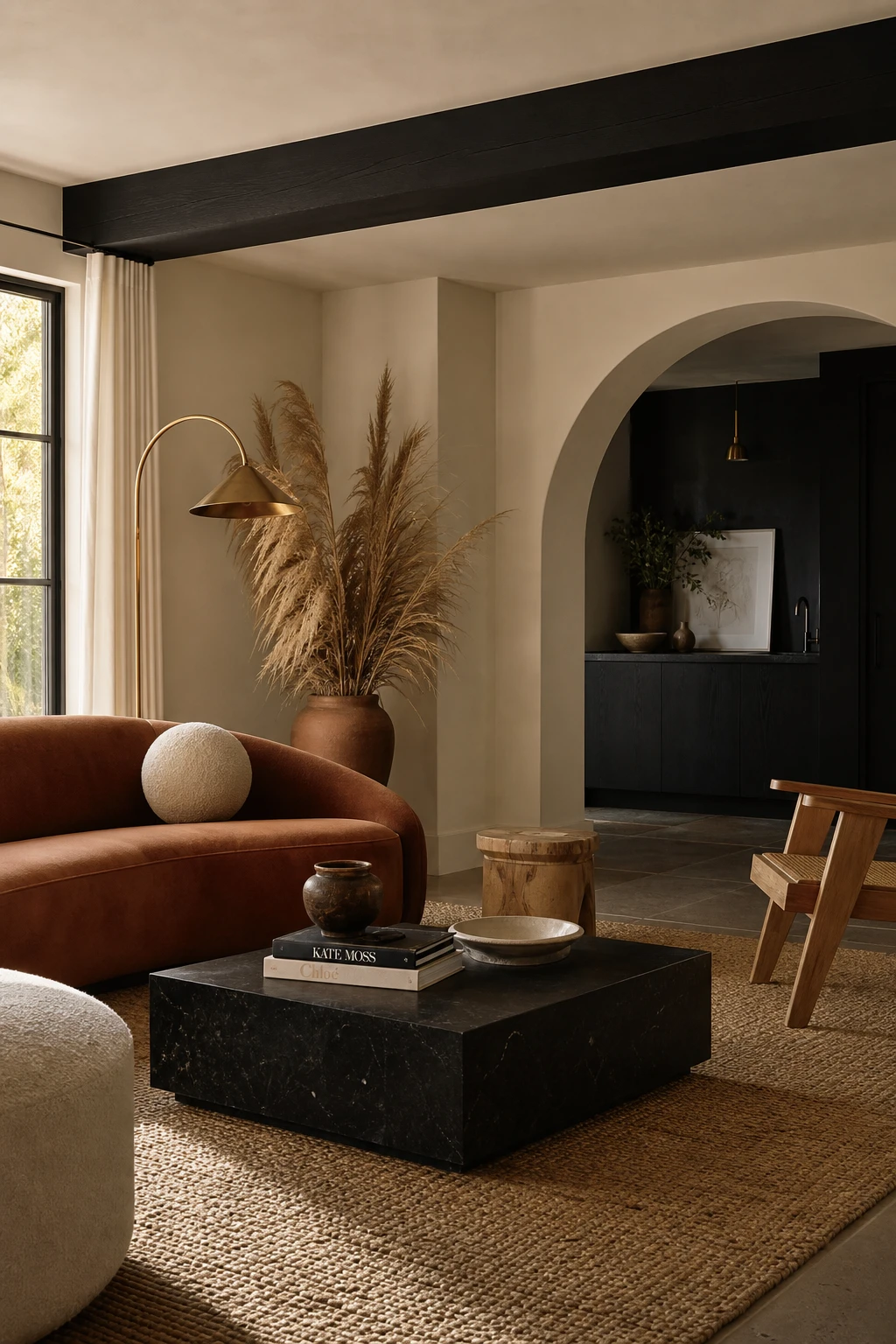
The living rooms that stop me in my tracks are never the ones chasing drama for its own sake. Black holds this room together while terracotta, raw linen, and oiled oak pull warmth up around it, and you get a space that actually breathes. The organic texture does the softening work here, which is the part I find so satisfying, because the black never tips cold or heavy no matter how much of it you use.
The Key Details
Matte black structural ceiling beam
Curved terracotta linen sofa
Raw oiled white oak side tables
Chunky woven jute area rug
Hammered brass floor lamp
Pro TipLayer a terracotta linen throw over the arm of your black anchor sofa first, then build outward with jute and raw wood so the warmth reads as a gradual crescendo rather than a single note.
AvoidPiling in too many muddy mid tones at once flattens the contrast black depends on, and the room loses the crisp backbone that made the earthy palette feel intentional in the first place.
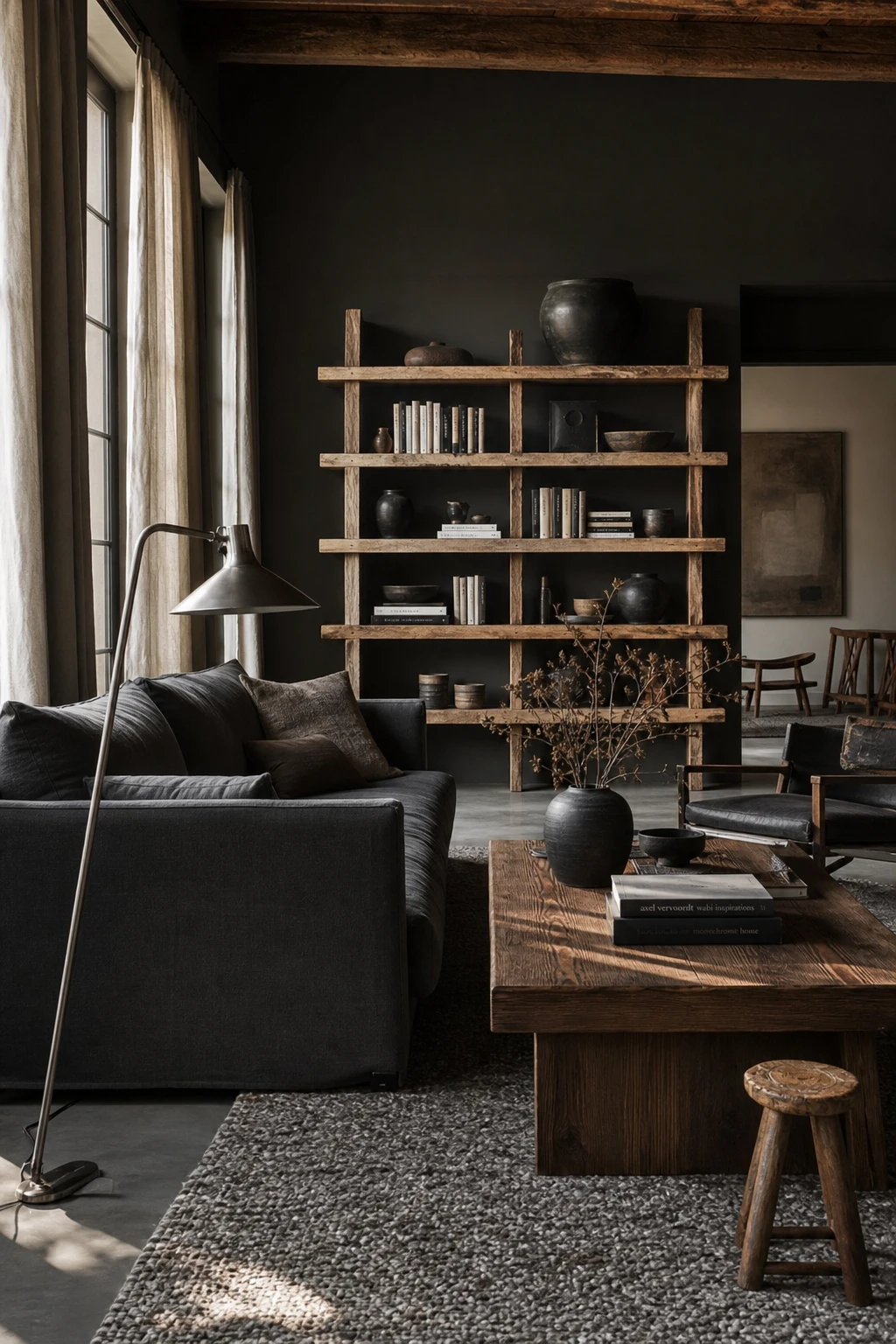
The Quiet Magic of Black, Brown, and Gray Sharing One Living Room
Mixing black, brown, and gray in one room is the move I reach for when a client wants depth without drama. The trick is letting each tone own a different surface: black anchors the lines, warm walnut pulls the eye down to the floor level, and gray fills the softer middle ground. What I love is how the room breathes even though every tone is dark, because the eye has enough contrast to travel between them rather than reading the whole thing as one heavy block.
The Key Details
Deep charcoal bouclé sofa
Warm walnut brown coffee table
Open oak timber shelving unit
Heathered gray chunky wool rug
Brushed steel floor lamp
Pro TipWhen two dark shades sit close together, separate them with a difference in texture rather than colour: a smooth walnut table reads as clearly distinct from a rough bouclé sofa even when the tones are almost the same.
AvoidChoosing a brown and a gray that share the same depth on the tonal scale blurs the boundary between them and the room loses all its definition, turning what should feel rich into something that just looks muddy.
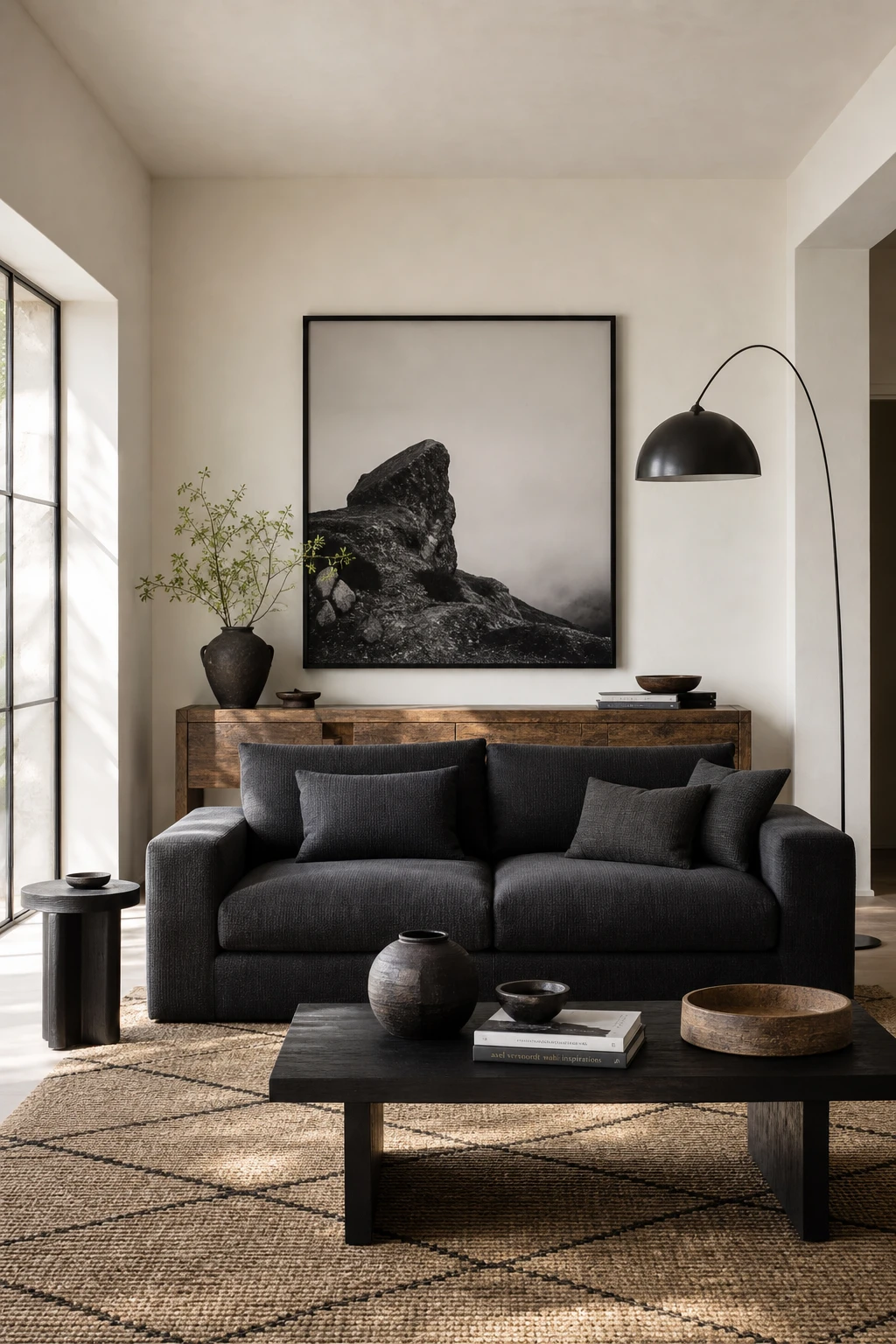
White Walls and Dark Furniture Create More Drama Than You Might Expect
There is something almost architectural about what happens when white walls meet dark furniture, and it is the pairing I keep returning to. Each piece reads like a sculpture set against a clean gallery wall, and you get that sense of weight and intention that busy rooms never quite manage. The pale surround pulls back and lets the furniture speak for itself, and that breathing room is what I find most compelling about this combination.
The Key Details
Charcoal linen sofa
Ebony side tables
Raw walnut console
Blackened steel floor lamp
Geometric jute rug
Pro TipKeep the wall finish dead matte so light stays flat and your eye travels straight to the furniture, not the surface behind it.
AvoidPushing too many dark pieces into the space closes it down fast, and all that breathing room the white walls were doing the hard work to create simply disappears.
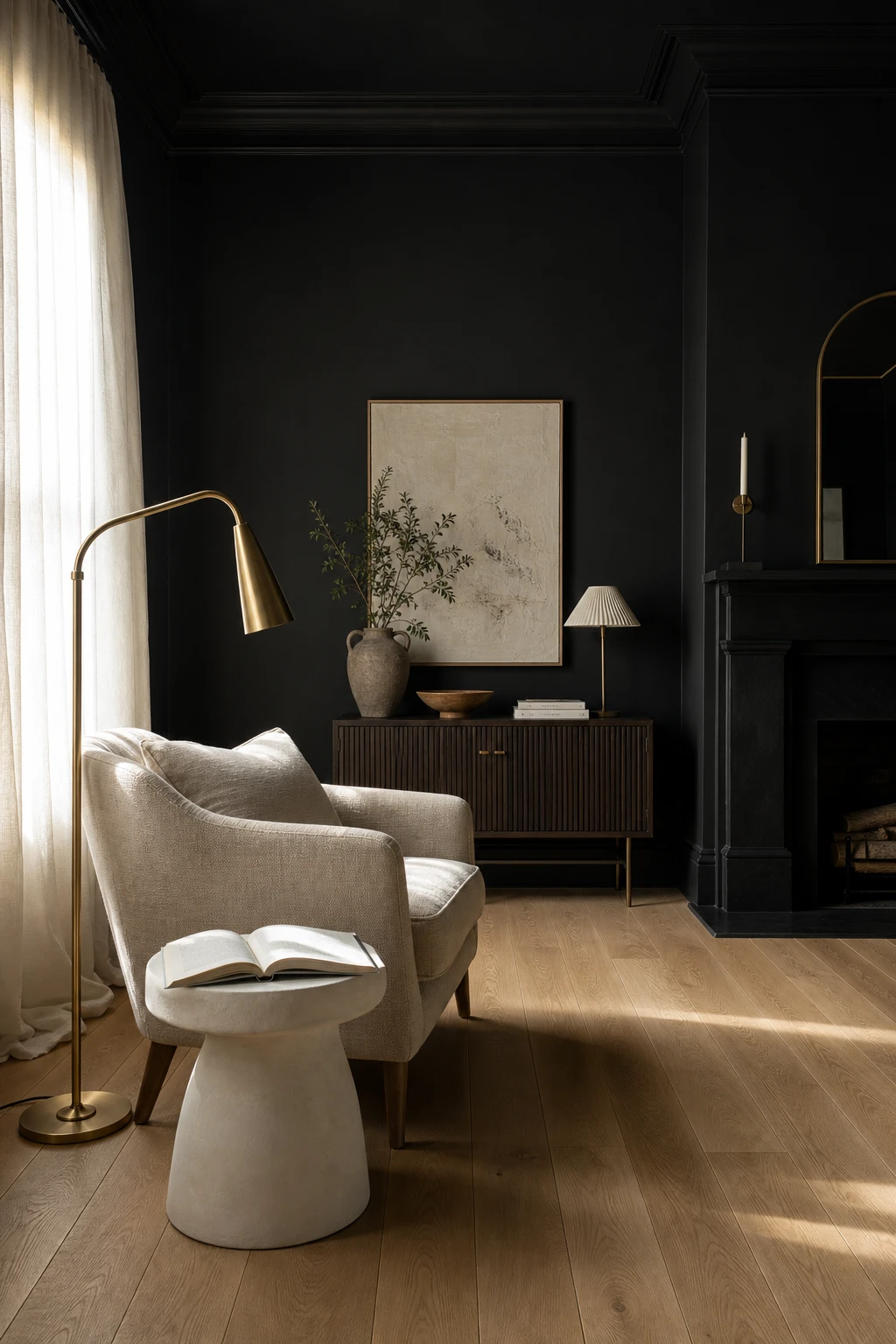
Black Walls Feel Surprisingly Warm When Light Wood Floors Run Beneath Them
Black walls pulling all the drama upward is one of my favourite inversions, because it hands the floor a job it rarely gets: being the brightest thing in the room. You notice it instantly. The pale oak planks almost seem to glow against that dark backdrop, and what I love is how that warmth from the wood stops the black from ever reading cold or heavy. Watch how the eye travels down to the floor and then bounces back up, keeping the whole room feeling alive rather than closed in.
The Key Details
Wide plank white oak floor
Linen upholstered armchair
Slim brass floor lamp
Low white plaster side table
Sheer white linen curtain
Pro TipChoose a matte or soft satin finish for your black rather than anything glossy, so the walls absorb light quietly and let the floor do all the reflecting.
AvoidFilling the room with dark cushions, dark rugs, and dark shelving eats up the floor’s brightness and turns what should feel dramatic into something just dim.
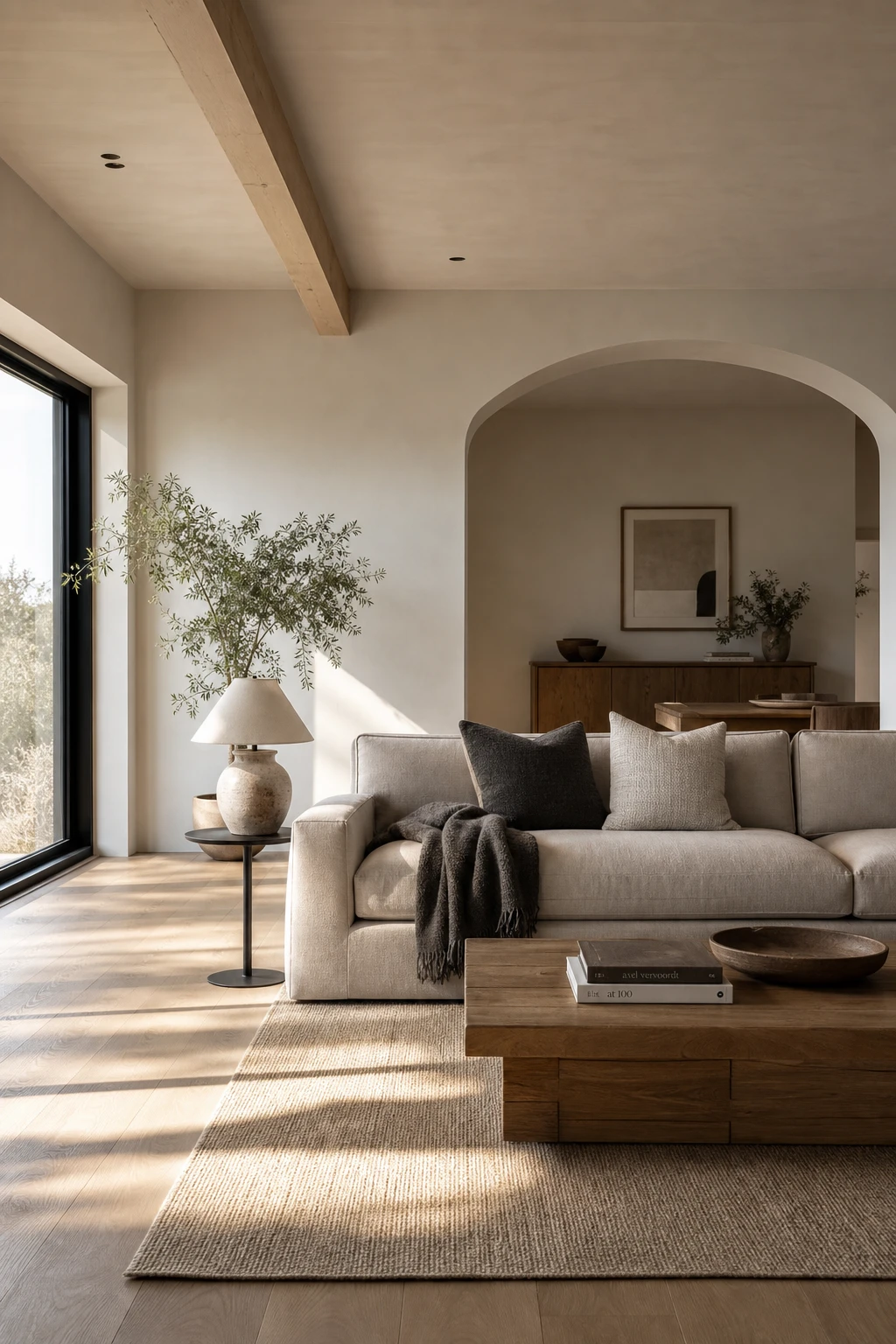
A Minimalist Living Room in This Palette Still Feels Lived In and Warm
Editing a room down to its bones takes nerve, but the trick is knowing what to keep rather than what to remove. A low profile linen sofa in oatmeal holds the warmth here, and echoing the oak from the floor in the coffee table creates a quiet rhythm that feels considered rather than sparse. The room still has real weight through texture and a few honest materials, so it reads as calm and that calm, to me, is the whole point.
The Key Details
Low profile linen sofa in oatmeal
Chunky natural oak coffee table
Sculptural ceramic table lamp
Wide plank pale oak floor
Charcoal and off white textured cushions
Pro TipChoose your hero material, pale oak here, and let it appear in at least two places so the room reads as intentional rather than unfinished.
AvoidPulling out the last throw or cushion because it feels like clutter will tip the balance from minimal to clinical, and the room loses all sense of welcome.
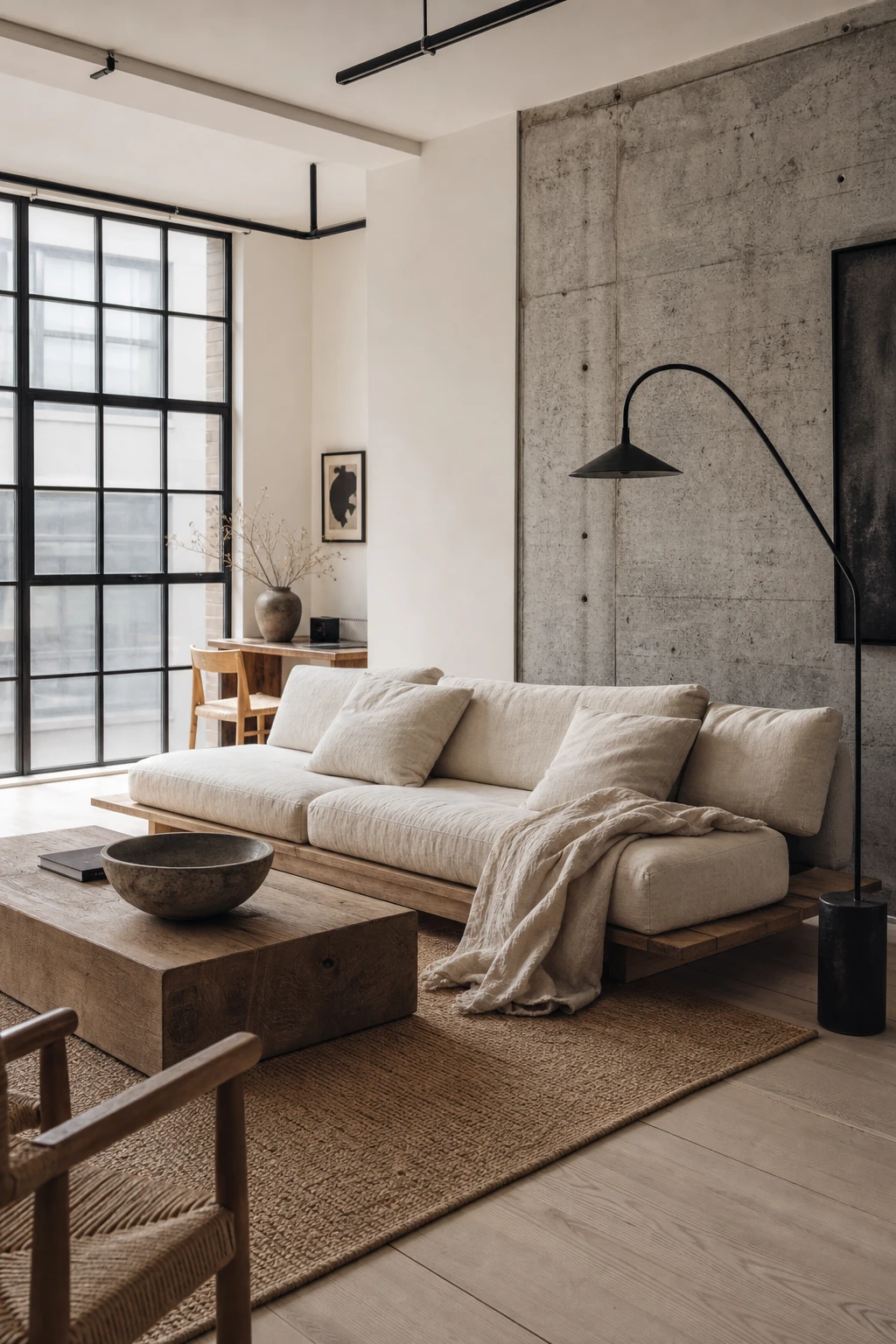
Industrial Japandi Brings the Best of Both Worlds Into One Calm Room
Blending industrial and Japandi feels like it should clash, but the two styles share a quiet honesty about materials that makes the combination genuinely exciting to work with. Raw steel and exposed concrete give the room its backbone, while warm wood grain and low profile furniture soften everything back to calm. The balance you land on is grounded and alive at the same time, and I find that harder to achieve with any single style working alone.
The Key Details
Low profile oak platform sofa
Blackened steel arc floor lamp
Exposed raw concrete feature wall
Gridded black steel window frame
Chunky solid wood coffee table
Pro TipPick one warm wood tone, oak or walnut, and let it appear in at least two spots so it acts as a thread pulling the metal and concrete together rather than sitting as a lonely warm note in an otherwise cold room.
AvoidFilling a room with too much steel and concrete tips the balance toward cold and hard, and the stillness that makes Japandi so restorative simply disappears.
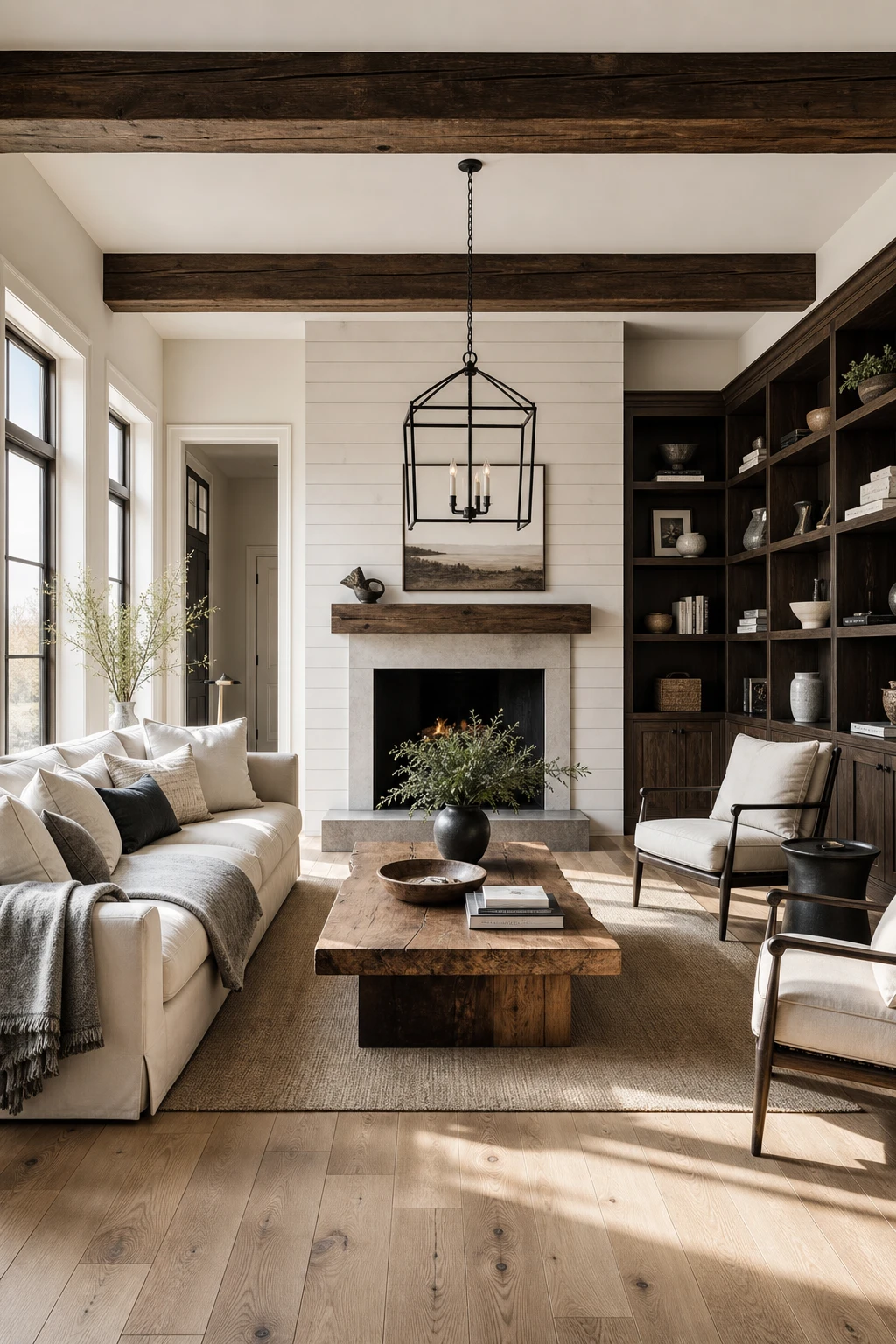
Dark Wood Gives a Modern Farmhouse Living Room Its Most Grounding Moment
When a room feels like it is floating without an anchor, dark wood is the thing I reach for first. Walnut ceiling beams pull your eye up and give the white walls something solid to lean against, while floor to ceiling shelving adds real visual weight without closing the room in. The pale oak underfoot keeps everything lifted, so you get depth and warmth together and the space never tips into heavy.
The Key Details
Dark walnut ceiling beams
Floor to ceiling dark wood built in shelving
Whitewashed shiplap fireplace surround
Black iron pendant lantern
Wide plank pale oak flooring
Pro TipPair one reclaimed rough edged piece, like a raw timber shelf, with one clean line dark wood item to keep the look feeling modern rather than rustic.
AvoidLoading the room with too many rough, knotted, heavily distressed wood pieces strips out the modern half of the farmhouse look, and what you end up with reads more like a barn than a considered living room.
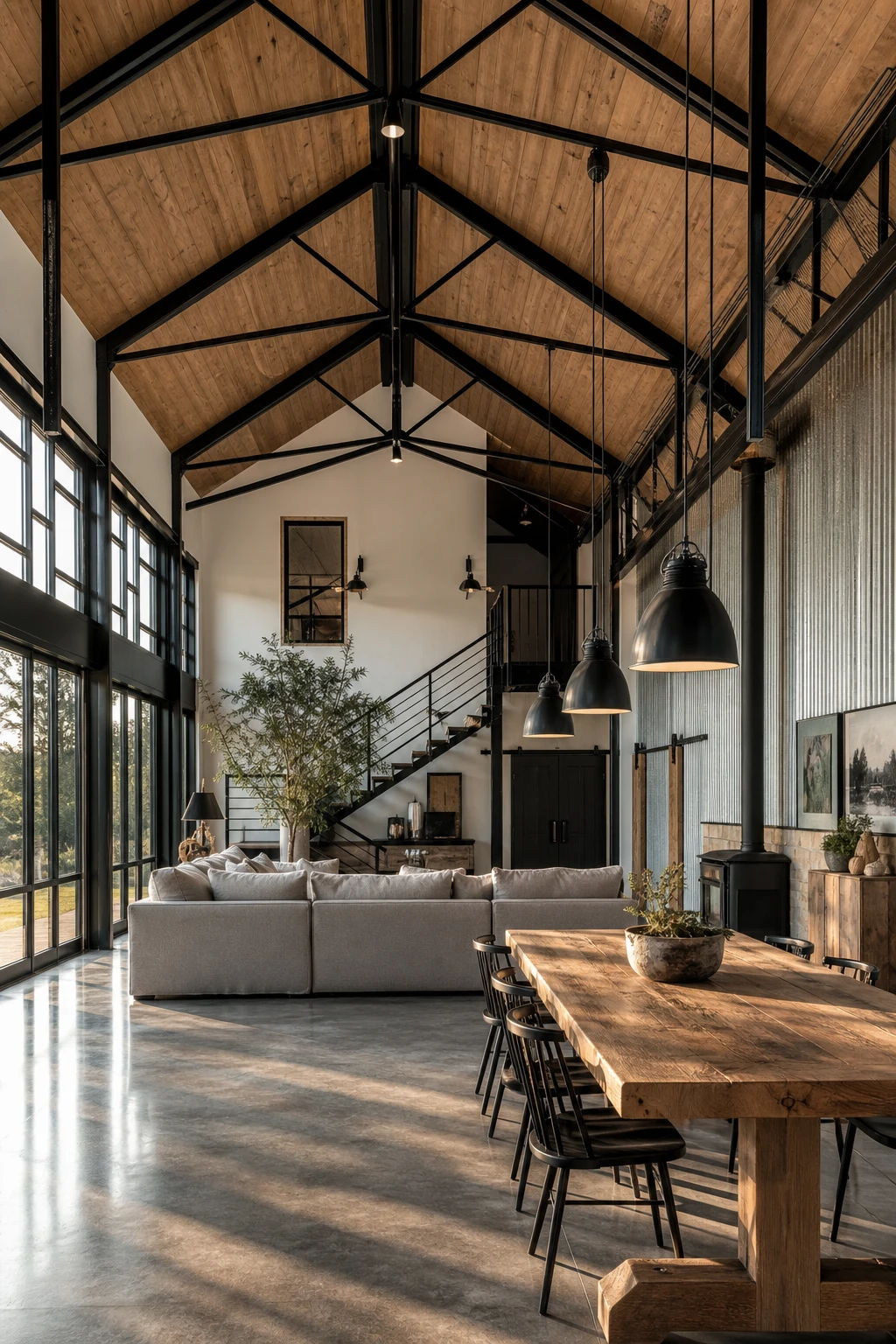
The Barndominium Look Works Indoors When You Know Which Details to Keep
Barndominium style wins me over when the raw bones stay visible but the finishes tip toward warmth. Wire brushed white oak ceiling decking is the detail I always reach for first, because it pulls the eye up and adds grain without looking rustic or rough. You get the drama of black steel trusses and corrugated metal without the space reading cold, because the wood and the concrete floor keep everything grounded. Watch how the cluster pendants tie the black ironwork to the ceiling plane and make the whole composition feel intentional rather than unfinished.
The Key Details
Exposed black powder coated steel roof trusses
Corrugated metal accent wall panel
Poured gray concrete floor
Natural wire brushed white oak ceiling decking
Black iron cluster pendant lights
Pro TipPaint the structural walls and any collar ties white so the exposed beam framework reads as an architectural feature rather than a construction site.
AvoidLeaning so hard into the industrial shell that you strip out every soft surface will leave the room echo prone and uncomfortable, no matter how striking the bones look.
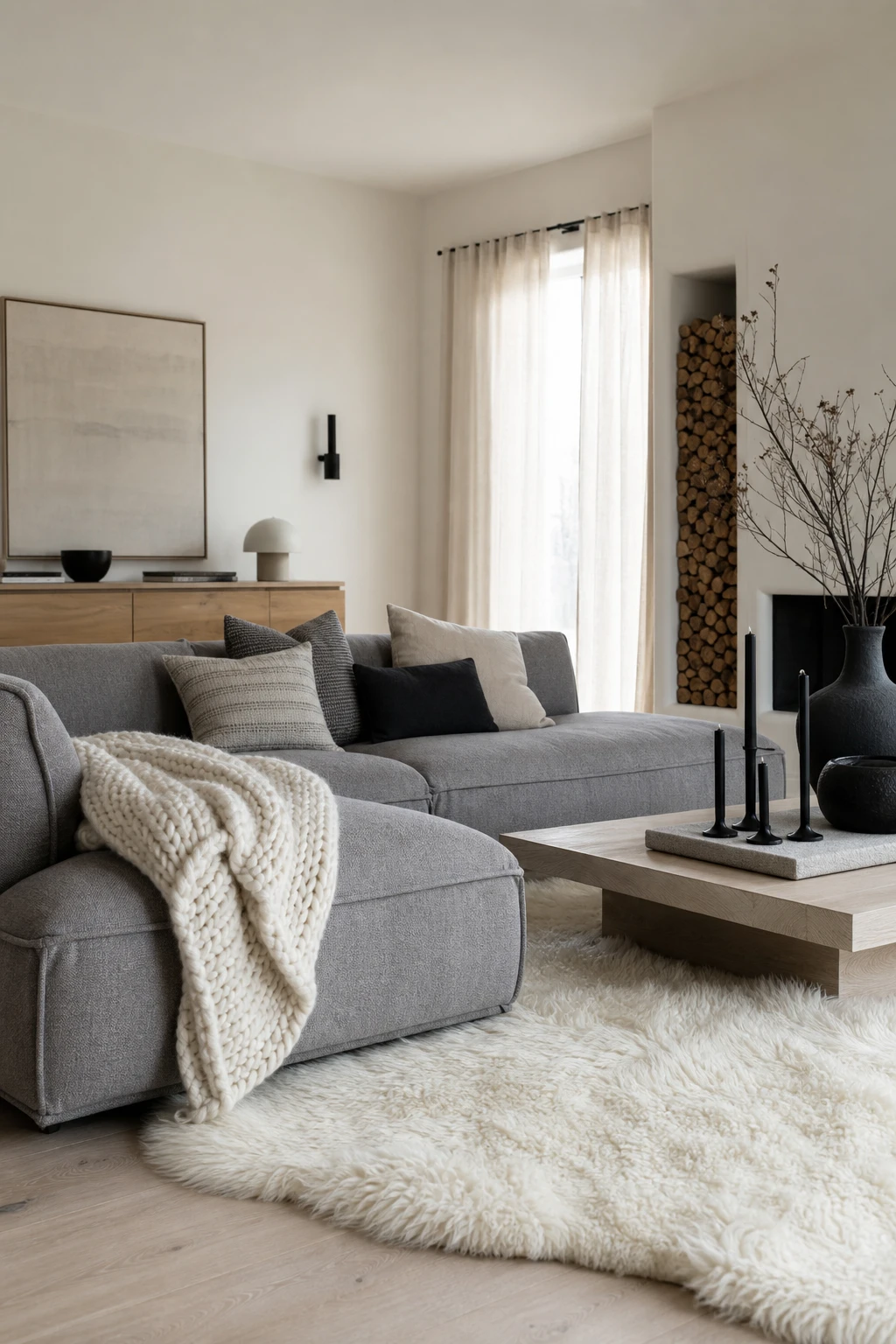
Modern Nordic Living Rooms Stay Cozy Because They Follow One Simple Rule
Nordic rooms can feel cold on paper, but the ones I love most prove that hygge lives in the layering, not the colour. A low sofa in soft gray wool keeps the room grounded and human scaled, and the bleached ash table beside it pulls in just enough grain and warmth to stop the palette feeling clinical. Watch how the pale oak floor ties it all together, giving you a quiet base that lets candlelight and sheepskin do the rest.
The Key Details
Low slung gray wool sofa
Bleached ash coffee table
Wide plank pale oak floor
Sheepskin floor rug
Matte black taper candle grouping
Pro TipLayer at least three different natural textiles, a wool throw, a sheepskin, and a linen cushion, so the room reads warm the moment you walk in.
AvoidStopping at white walls and gray upholstery with no wood in sight turns a Nordic room into a cold waiting room rather than the snug retreat it should be.
A Black Sofa Is the Piece a Japandi Room Has Been Quietly Waiting For
A black sofa in a Japandi room is one of those quiet surprises that earns its place the moment you see it. One low, dark piece pulls the whole composition to earth without fighting the calm around it, and because the sofa sits so close to the floor, the weight never feels imposing. When linen, rattan, and pale wood surround it, the sofa simply settles in rather than shouts, and that restraint is exactly what wins me over.
The Key Details
Low profile black linen sofa
Pale ash wood coffee table
Hand thrown matte gray ceramic vase
Woven natural jute area rug
Sheer white panel curtains
Pro TipLayer a natural linen throw across one arm of the sofa so the eye reads texture before it reads colour, and the black feels soft rather than stark.
AvoidSurrounding a black sofa with dark shelving, a charcoal rug, and moody walls at once collapses all the breathing room that makes Japandi feel restful rather than oppressive.
Gray Sofas Are More Interesting Than You Think When You Style Them This Way
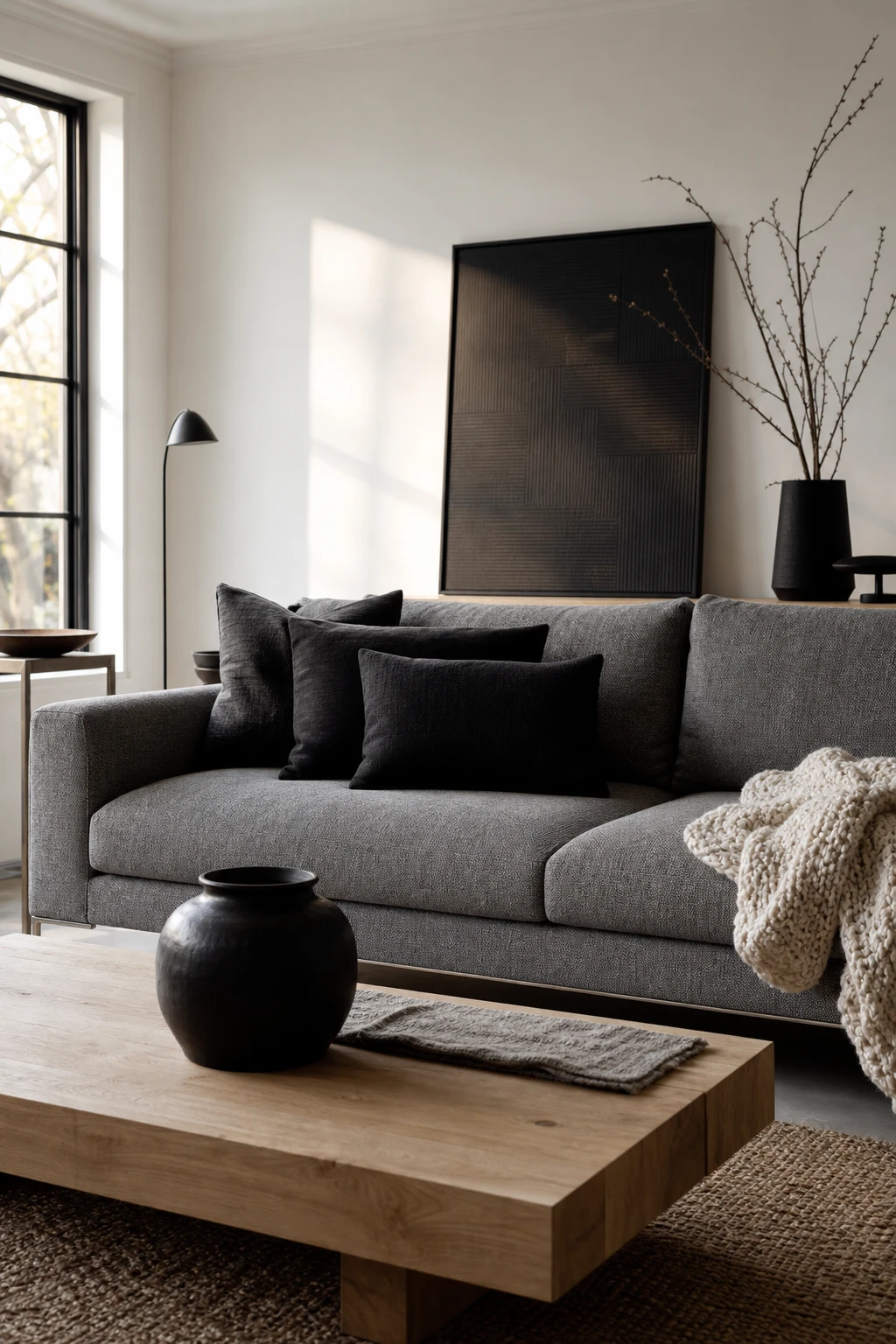
A gray sofa wins me over when it becomes the anchor rather than the filler, and that shift starts with treating it as your first decision, not your last. What I love here is how the woven texture gives the upholstery enough surface interest to hold its own beside the black framed art and the warm oak table. You get that satisfying push and pull between cool gray, natural grain, and deep black without any single element swallowing the others.
The Key Details
Textured woven gray upholstery sofa
Layered black linen cushions
Slim natural oak coffee table
Large format black framed art panel
Matte black ceramic vessel accent
Pro TipPull out the undertone in your sofa fabric, whether it leans cool blue or warm greige, and use that reading to decide whether you reach for ashy oak or a richer honey wood nearby.
AvoidLoading every surface around the sofa with gray accessories flattens the whole room into a single dull note, draining the contrast that makes a gray anchor worth having.
Earth Tones Unlock the Full Potential of a Black Couch in Your Living Room
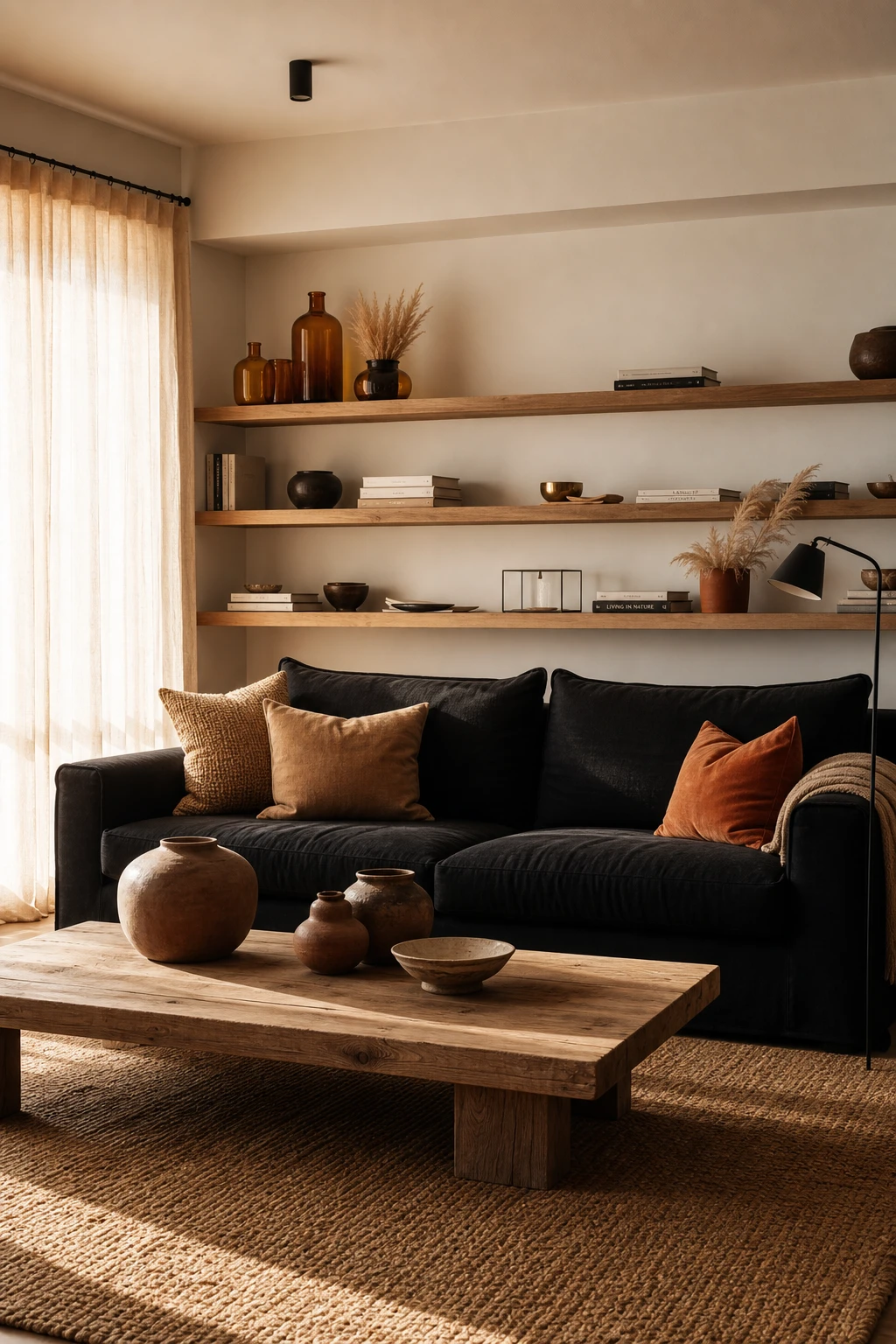
A black couch can feel cold and heavy when you leave it alone, but surround it with warm earth tones and watch how it shifts into something grounded and inviting. The jute underfoot, the raw clay vessels, the terracotta cushions: each one pulls a little warmth out of the black and softens the whole room. The natural oak shelving lifts the eye and keeps the palette from feeling too low and serious, and that upward movement is the detail I find makes all the difference. You get that rare balance where the couch anchors everything without dominating it.
The Key Details
Matte black upholstered sofa
Hand woven jute area rug
Floating natural oak shelving unit
Raw clay vessel grouping
Terracotta and sienna throw cushions
Pro TipLay a hand woven jute rug large enough to sit under the front legs of the couch, so the two materials are visually connected and the transition from dark to warm reads as intentional.
AvoidReaching for earth tones in muddy or grayed out shades rather than genuinely warm ones leaves the couch stranded between two cool readings, and the room ends up feeling heavy rather than rich.
A White Sectional Is the Bravest and Most Rewarding Choice in This Palette
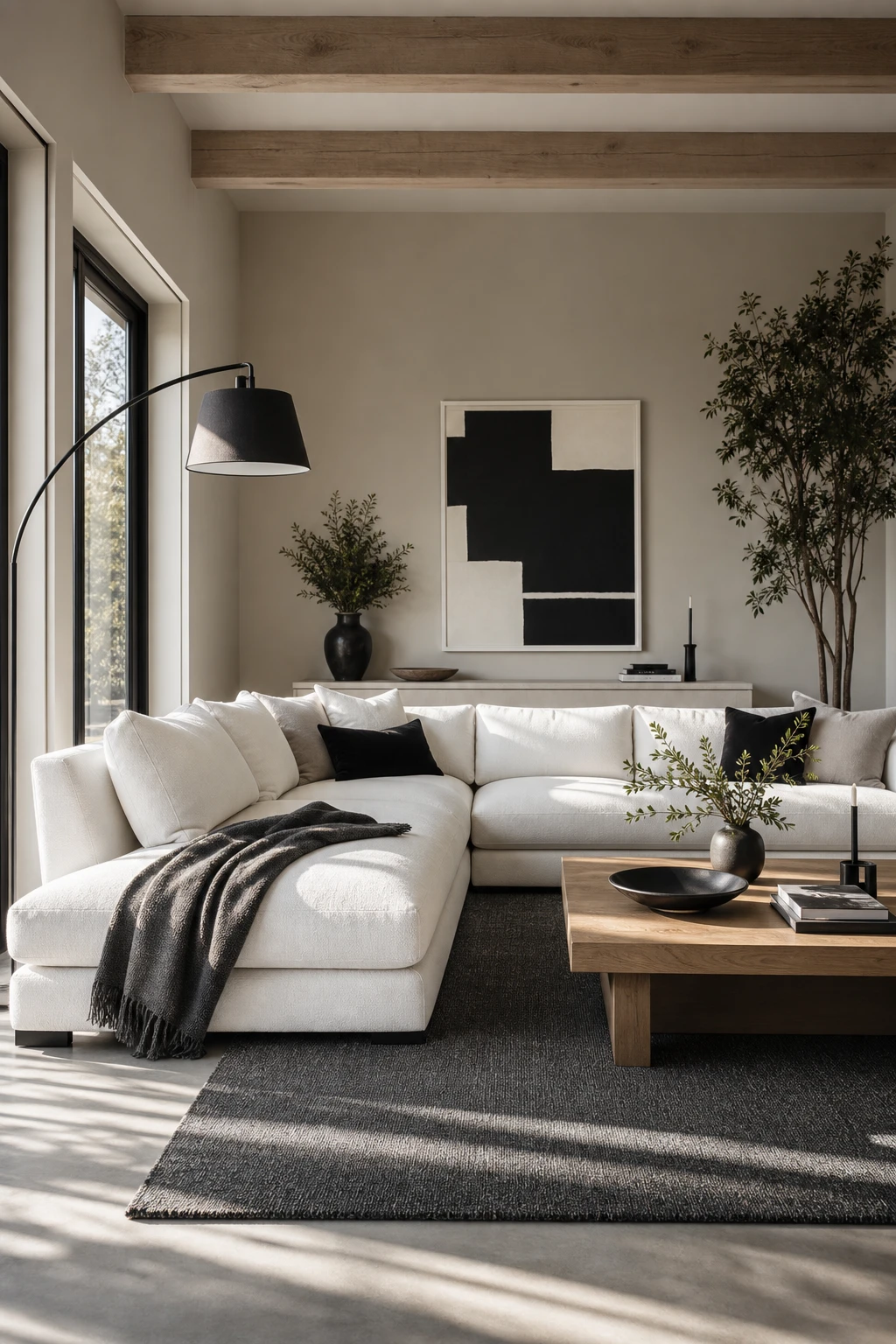
A white sectional in a black, gray and natural wood room is the move that separates a confident space from a cautious one, and I am always glad when clients commit to it. Against charcoal, black steel and warm oak, that white reads almost luminous, pulling all the contrast together in one generous piece. You get a visual anchor that is bold but never heavy, which is exactly the balance this palette needs.
The Key Details
L shaped performance fabric sectional sofa
Low natural oak coffee table
Charcoal gray area rug
Black steel arc floor lamp
Abstract black and white wall artwork
Pro TipChoose a sectional upholstered in a performance weave like bouclé textured polyester or solution dyed acrylic, and the white stays bright and wipeable for years without a single anxious moment.
AvoidPairing a white sectional with a pale gray rug and light wood tones all at once flattens the whole room into a washed out haze, stripping away the drama the sofa was supposed to create.
Black and Light Wood Cabinets Together Are the Kitchen Combination Worth Knowing
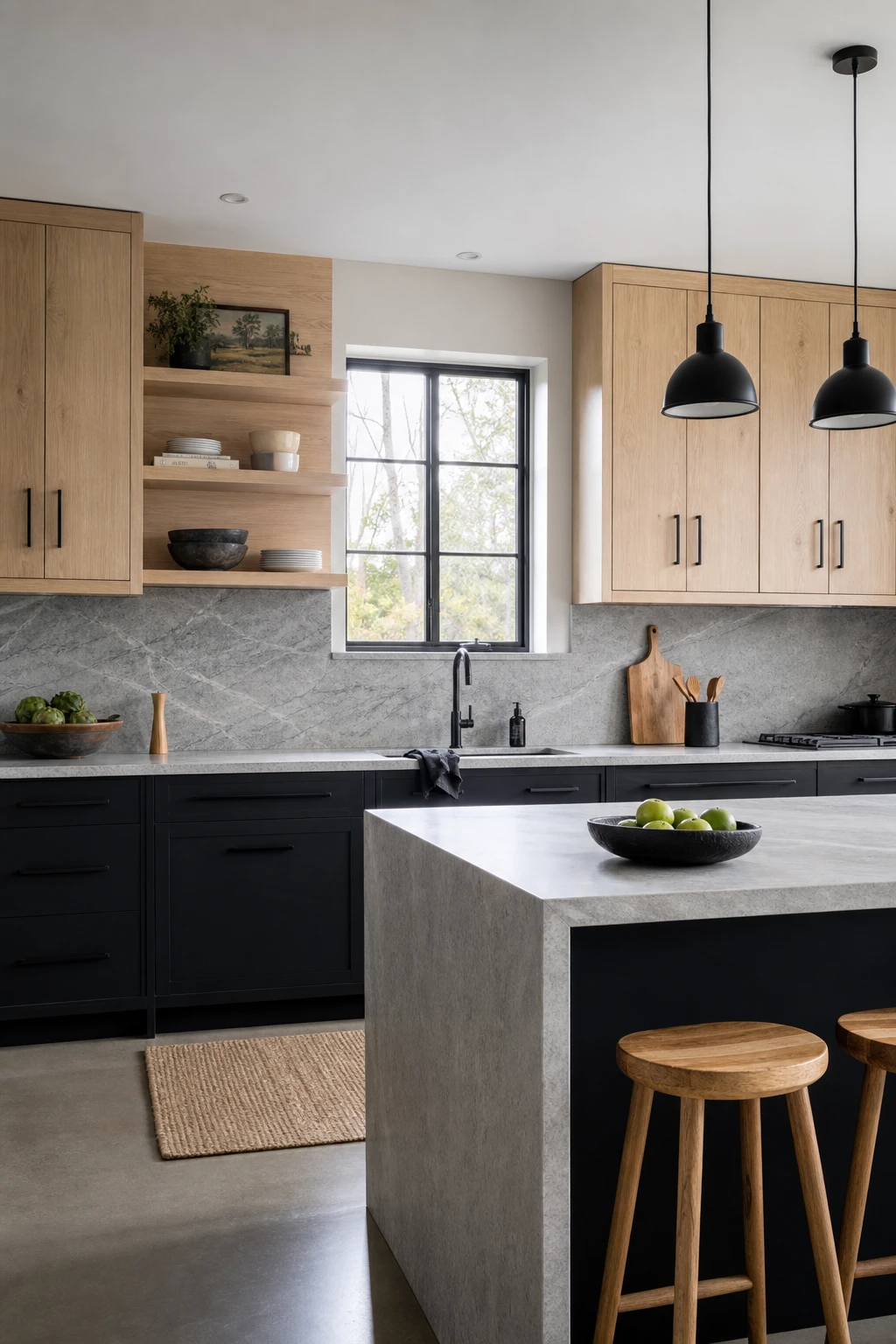
Splitting a kitchen between two finishes is one of my favourite moves when a space needs real personality without going loud. Black lower cabinets anchor the room and give it weight, while pale blonde wood up top keeps things from feeling heavy. You get contrast that actually makes sense visually because each finish has a clear job, and watch how the gray veined stone countertop sits right in the middle and bridges both perfectly.
The Key Details
Matte black lower cabinetry
Pale blonde open wood shelving
Gray veined stone countertops
Matte black cabinet hardware
Black metal pendant cluster
Pro TipKeep the light wood on your upper cabinets and reserve black for the lowers, so the room feels grounded rather than top heavy.
AvoidSplitting the two finishes evenly across the kitchen puts them in direct competition, and neither one wins.
Two Tone Kitchens Get Their Personality From Where Exactly You Draw the Line
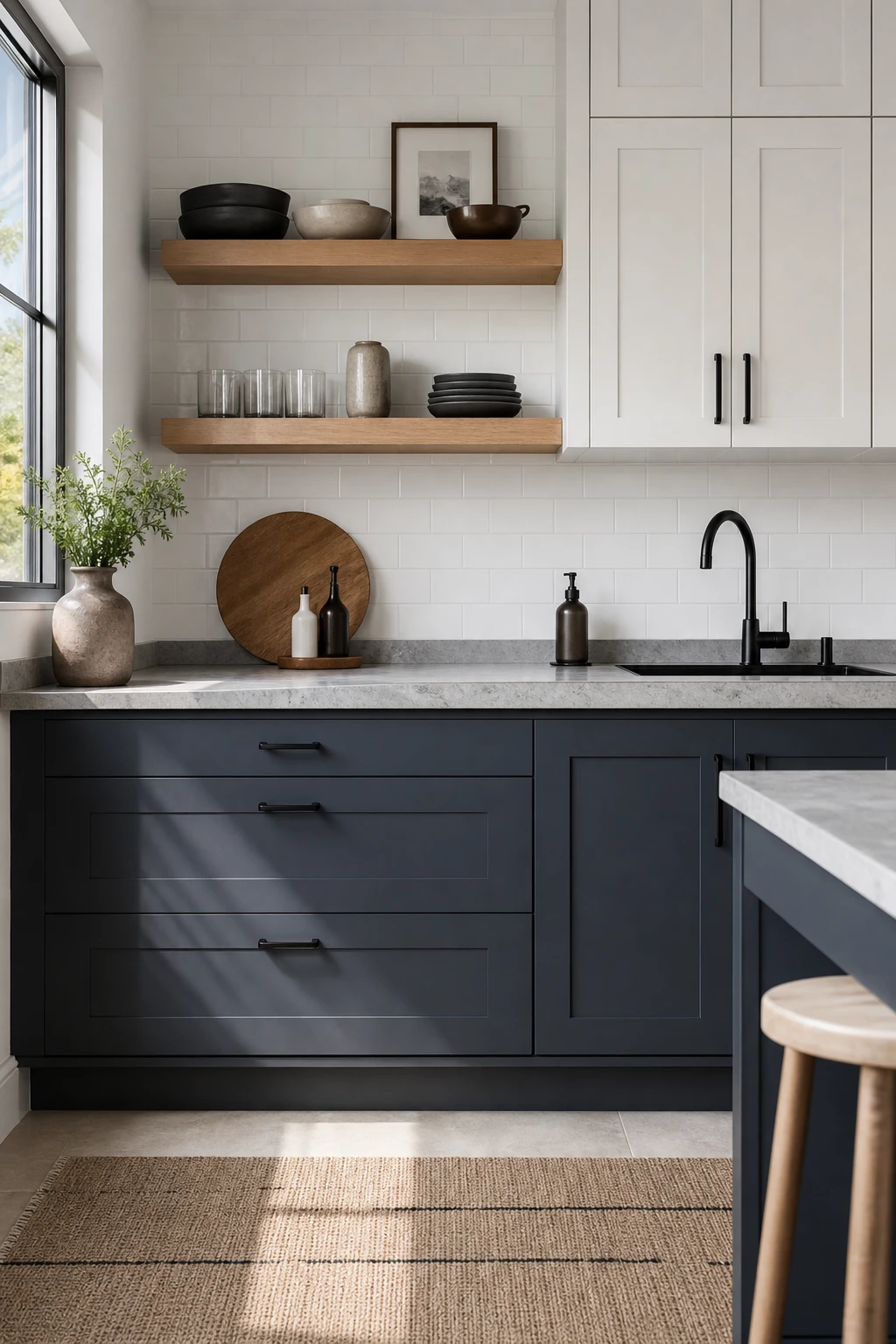
Two tone kitchens live or die by where the colour changes, and the counter is the line I keep coming back to. White uppers above, gray lowers below, and suddenly the room reads in two clean bands that feel completely deliberate. You get visual lightness at eye level and grounded weight at floor level, which is exactly the balance a kitchen needs. The oak shelves and matte black hardware tie both zones together so neither half looks like it wandered in from a different room.
The Key Details
White upper cabinetry
Gray stone slab countertop
Natural oak floating open shelves
Matte black cabinet hardware
White subway tile splashback
Pro TipSet your break point right at counter height so the worktop acts as a natural dividing shelf between the two tones and the split reads as a decision, not an accident.
AvoidSplitting the tones halfway up a cabinet door leaves the change floating in mid air with nothing structural to anchor it, and the whole kitchen ends up looking like a planning mistake.
Open Shelves Are Where Black and Wood Kitchens Really Come to Life
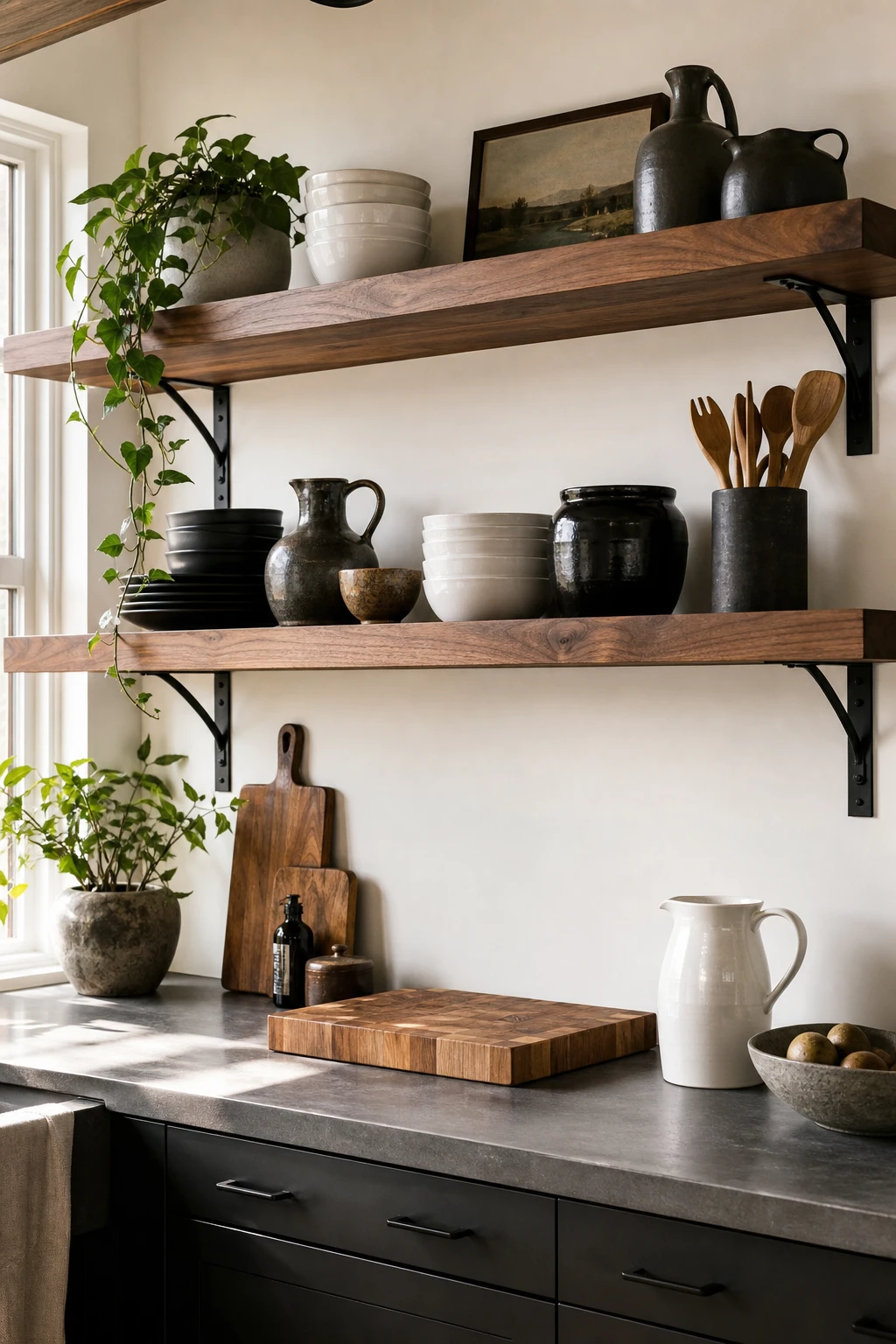
Open shelves are where the whole palette gets to breathe and climb the wall, and that upward movement is what gives a black and wood kitchen its real sense of height. What I love here is how the matte black brackets read as a continuation of the lower cabinet hardware, so nothing feels tacked on. You get a natural layering effect when the warm walnut planks sit above a honed gray stone counter, the tones echo each other without matching exactly. Keep it loose and it sings.
The Key Details
Matte black steel shelf brackets
Solid walnut shelf planks
White and dark glazed ceramic vessels
Honed gray stone countertop
End grain oak cutting board
Pro TipGroup your shelf objects by material so all your ceramics cluster together and your timber pieces sit as their own collection, because that editing discipline is what stops open shelves from reading as clutter.
AvoidPacking every shelf inch to inch pulls the eye in too many directions at once and flattens the impact of the cabinet scheme you worked hard on below.
A Moody Organic Modern Kitchen Feels Rich Without Feeling Dark or Heavy
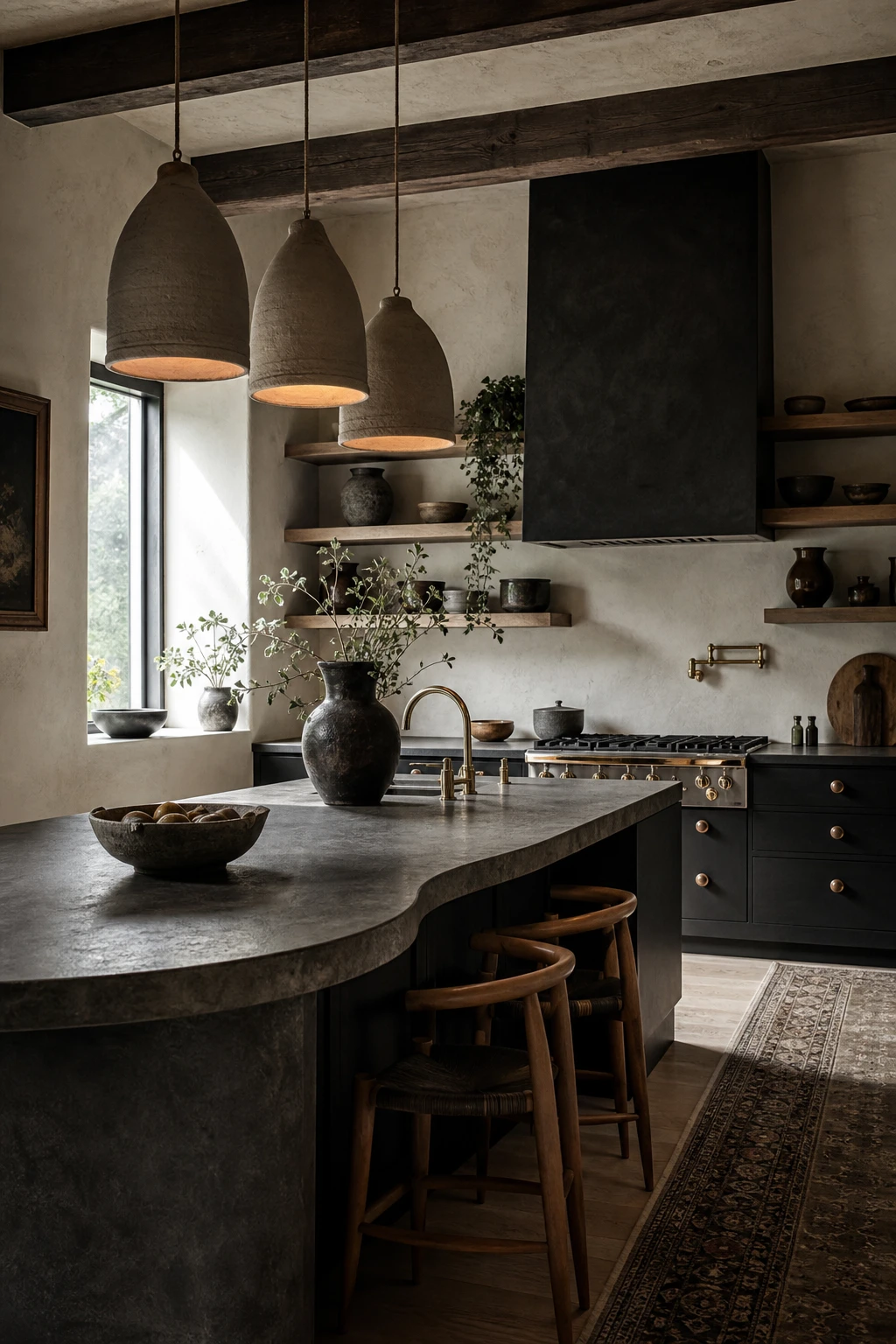
A moody kitchen lives or dies by texture, and what I reach for every time is the combination of matte black cabinetry, honed stone, and raw plaster that drinks in light rather than reflecting it back. You get depth and richness that way, without the space ever feeling like a cave. The organic edge on the island and the rounded hardware are the moves I love most here, because they keep everything from reading too severe. Watch how the wood shelves and hand thrown pendants warm the whole thing up, giving you atmosphere that feels lived in and full.
The Key Details
Matte black lower cabinetry with rounded hardware
Natural wood open floating shelves
Honed gray stone island with curved organic edge
Hand thrown ceramic cluster pendant lights
Deep set window with raw plaster surround
Pro TipChoose at least one vessel on those open shelves with a clearly irregular, hand formed shape, because that one imperfect object does more work than five perfectly matched pieces to keep the mood feeling warm rather than staged.
AvoidSwapping even one surface for high gloss finish breaks the spell entirely, bouncing sharp highlights around the room and dissolving the layered, absorbed quality that makes this atmosphere work.
Open Concept Spaces Stay Cohesive When the Palette Does One Simple Thing
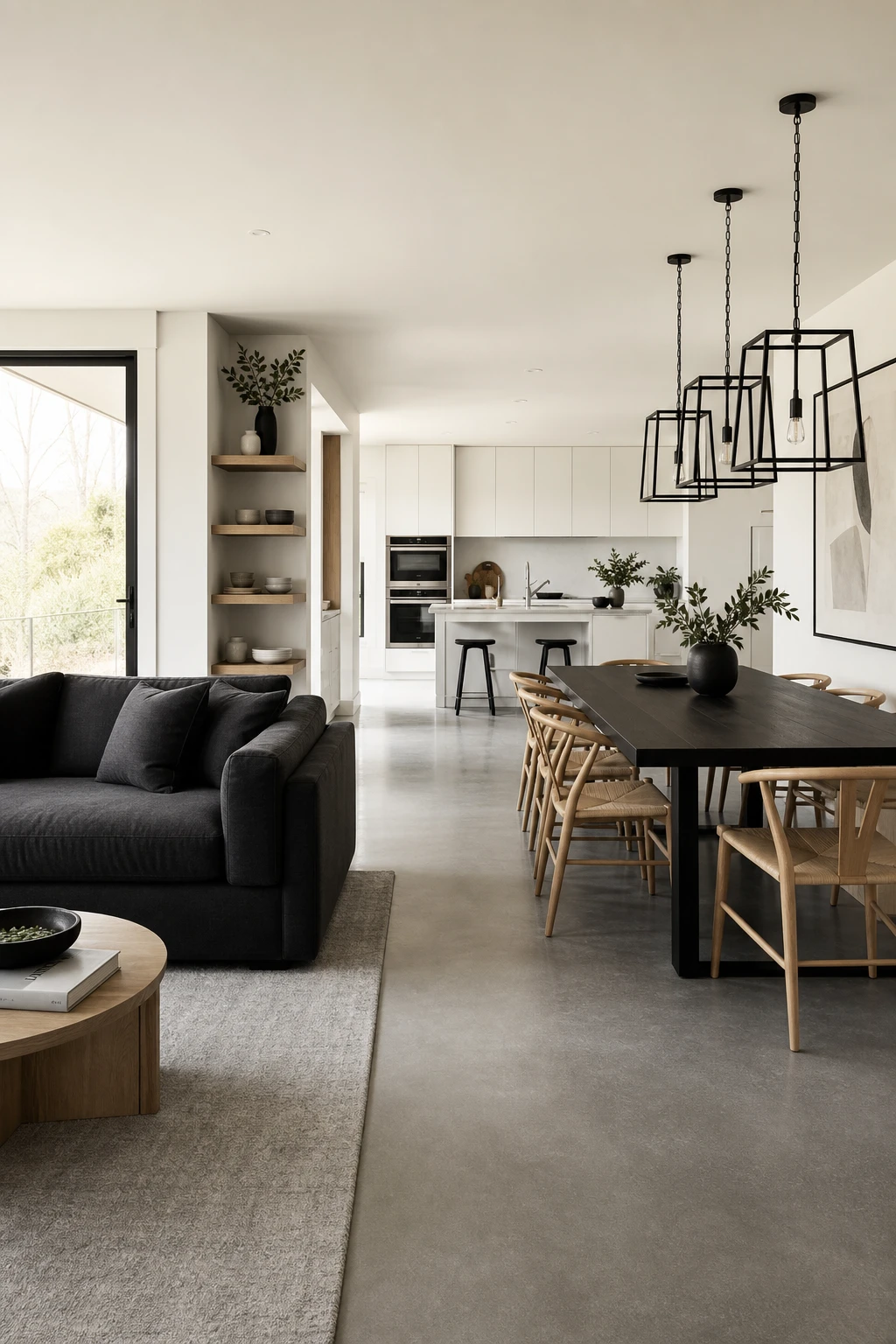
Open concept spaces fail when each zone tries to tell its own story. What I love about anchoring the whole floor plan in one black, white, gray and natural wood palette is that your eye travels freely from sofa to dining table to kitchen without hitting a visual speed bump. The concrete floor pulls it together beneath everything, and the raw oak shelving carries that warmth across all three zones so no single area feels borrowed from a different house.
The Key Details
Charcoal linen sofa
Matte black pendant lights
Raw oak open shelving
Poured concrete floor
Natural ash dining chairs
Pro TipRun one material, raw oak works beautifully, through every zone as a shelf, a chair leg, or a worktop edge, and the whole open plan reads as one considered space.
AvoidChoosing a bold accent colour for just one zone fractures the open plan instantly, making the living area and the kitchen feel like two separate flats that happen to share a wall.
Loft Living Rooms Shine When the Palette Lets the Architecture Speak
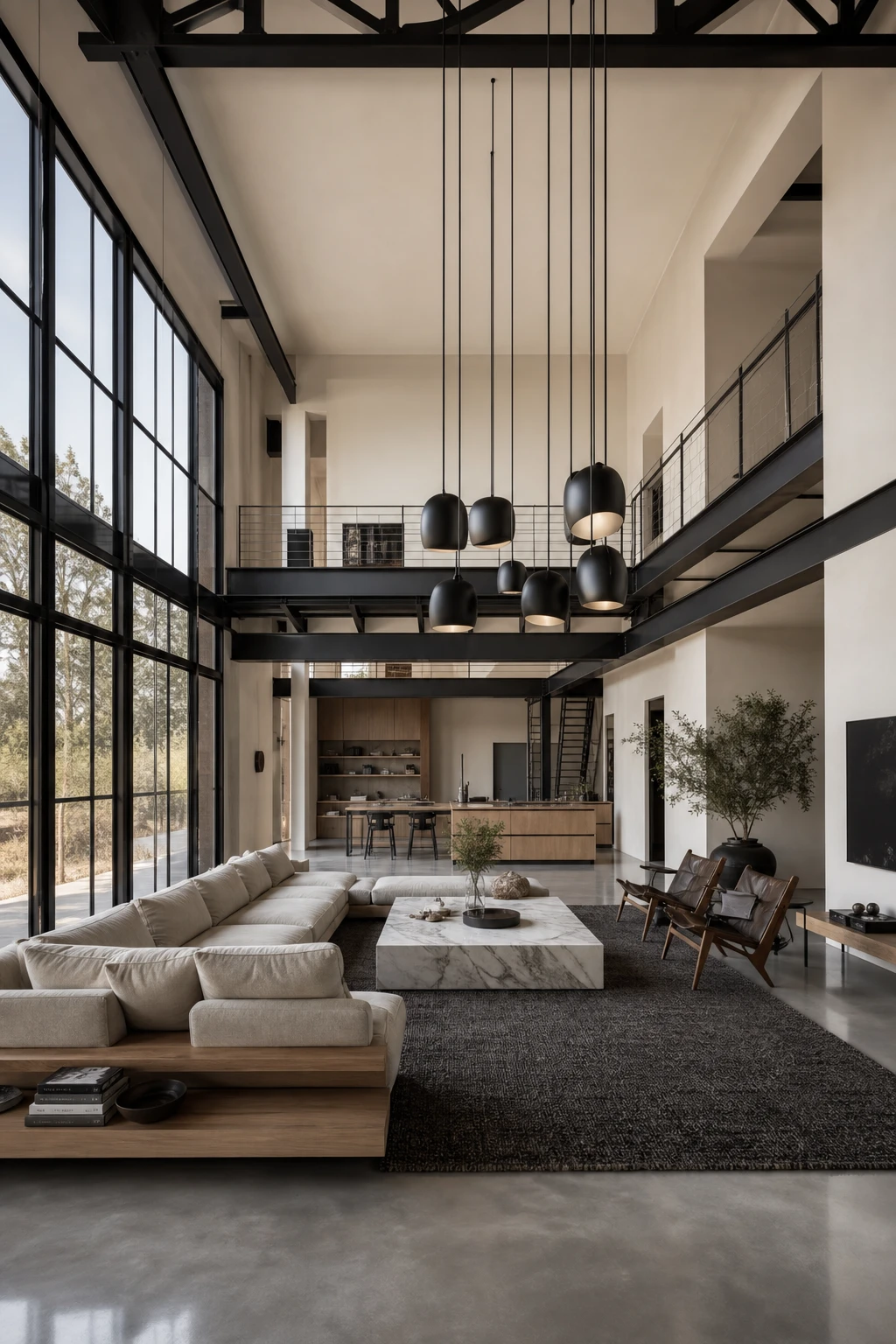
A loft’s real power comes from what you leave alone, and that is the discipline I find most rewarding to work with. The black, white, gray, and natural wood palette lets the steel beams and concrete floor do exactly that rather than competing with them. The low oak sectional keeps sightlines open while clustered pendants draw the eye upward without crowding the ceiling, and each piece earns its place because nothing in this palette fights for attention.
The Key Details
Exposed steel ceiling beams
Low profile oak sectional sofa
Clustered matte black pendant lights
Polished concrete floor
Black framed floor to ceiling windows
Pro TipDrop one oversized rug under the sectional to carve out a clear living zone, giving the loft a sense of rooms without walls breaking the flow.
AvoidPushing furniture into every corner to fill the loft kills the open, breathing quality that makes the architecture worth living in, and the bones you paid for simply disappear under the arrangement.
Adding Cozy Layers to a Modern Loft Room Is Easier Than You Think
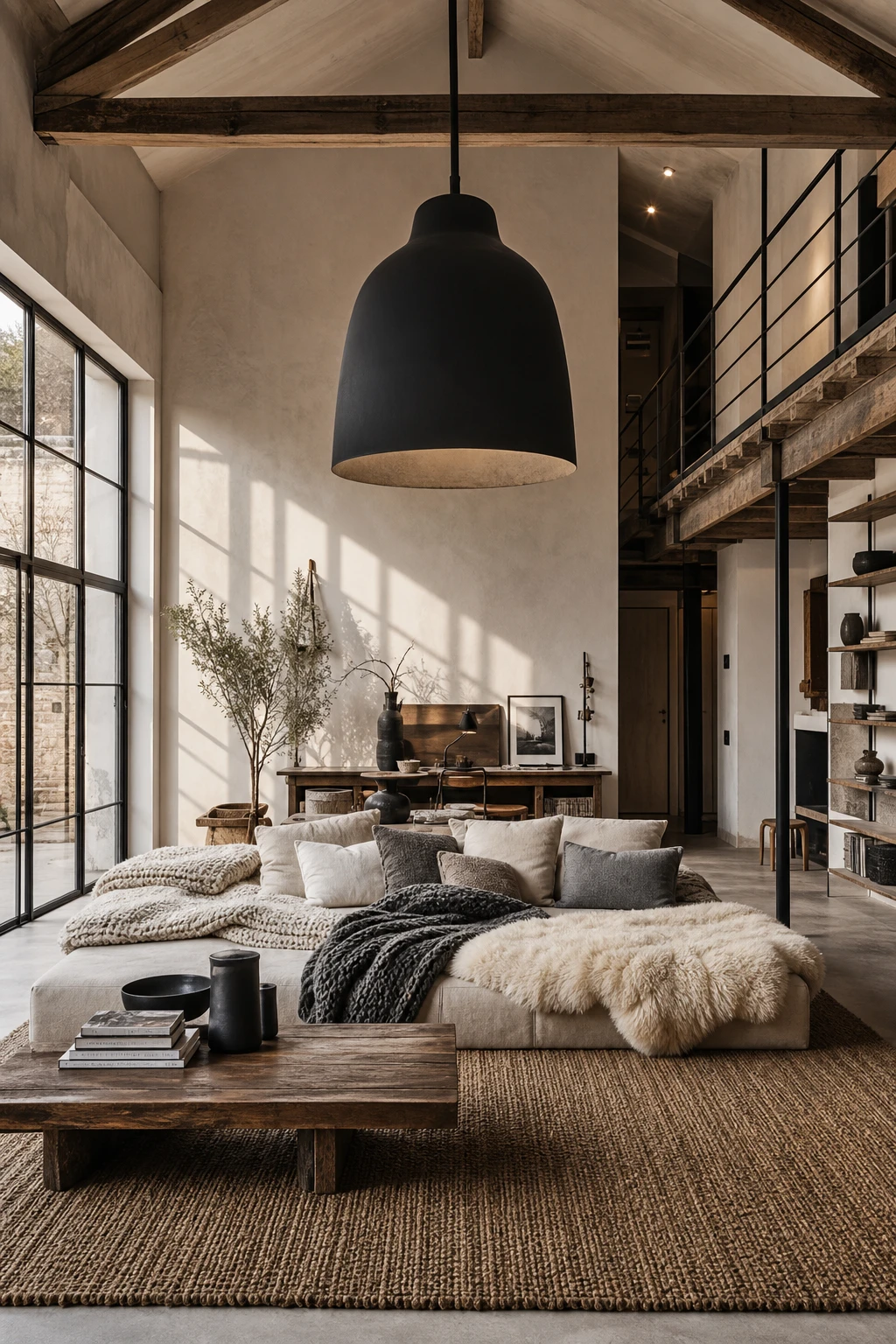
Loft ceilings can feel thrilling at first and then quietly cold once you live in them. What I love about layering soft textiles into a space like this is how quickly the volume shrinks to a human scale. The chunky knit throws and stacked wool cushions do the heavy lifting, pulling your eye down from those exposed beams and giving the room a pulse. You get all the drama of the height without ever feeling like you are sleeping in a warehouse.
The Key Details
Exposed natural wood ceiling beams
Oversized matte black pendant light
Hand knotted jute area rug
Steel framed floor to ceiling windows
Chunky knit throws and stacked wool cushions
Pro TipHang your curtains as close to the ceiling as possible and extend the rod at least 30 cm beyond each window frame so the panels look generous and the room feels grounded rather than cavernous.
AvoidSkipping soft textiles and relying on furniture alone leaves a loft feeling like a showroom, because hard surfaces bounce sound and light in ways that read as cold no matter how beautiful the pieces are.
A Black Fireplace with Built In Wood Storage Is the Feature Wall You Did Not Know You Needed
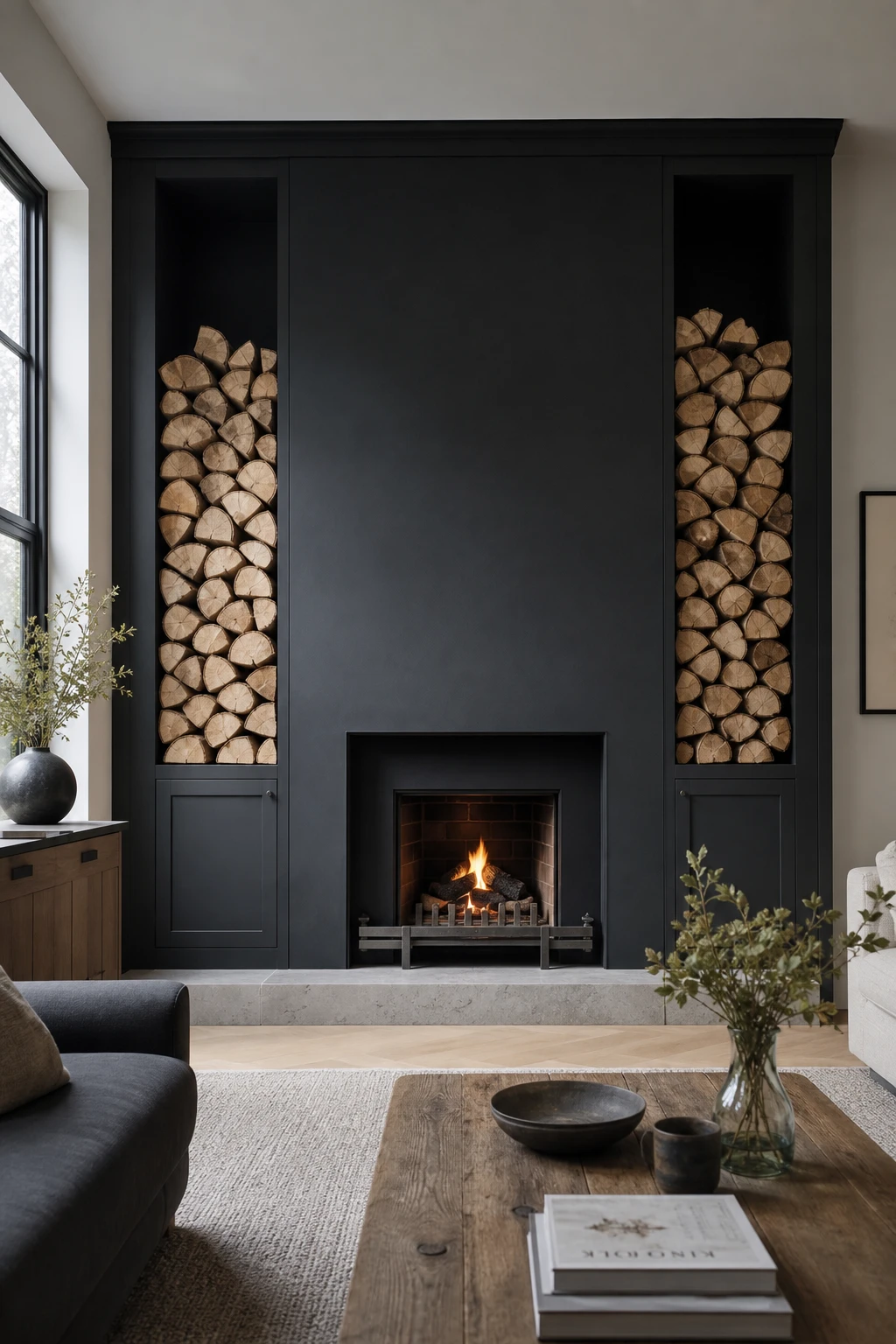
A black fireplace flanked by open log storage is one of my favourite moves for a chimney breast because it turns a purely practical need into something genuinely beautiful. What I love is how the raw texture of stacked wood plays against the smooth matte black surround, giving you warmth and drama in the same breath. You get a focal point that earns its place twice over: once as a feature wall and once as a working part of the room.
The Key Details
Alcove log storage niches
Honed limestone hearth
Steel fire grate
White plaster flanking walls
Floor to ceiling chimney breast joinery
Pro TipStack your logs with the cut ends facing outward and mix a few shorter pieces into each row so the arrangement reads as considered rather than just filled.
AvoidLogs piled in without any thought about height or alignment will pull the eye away from the fireplace itself and make the whole wall feel cluttered rather than curated.
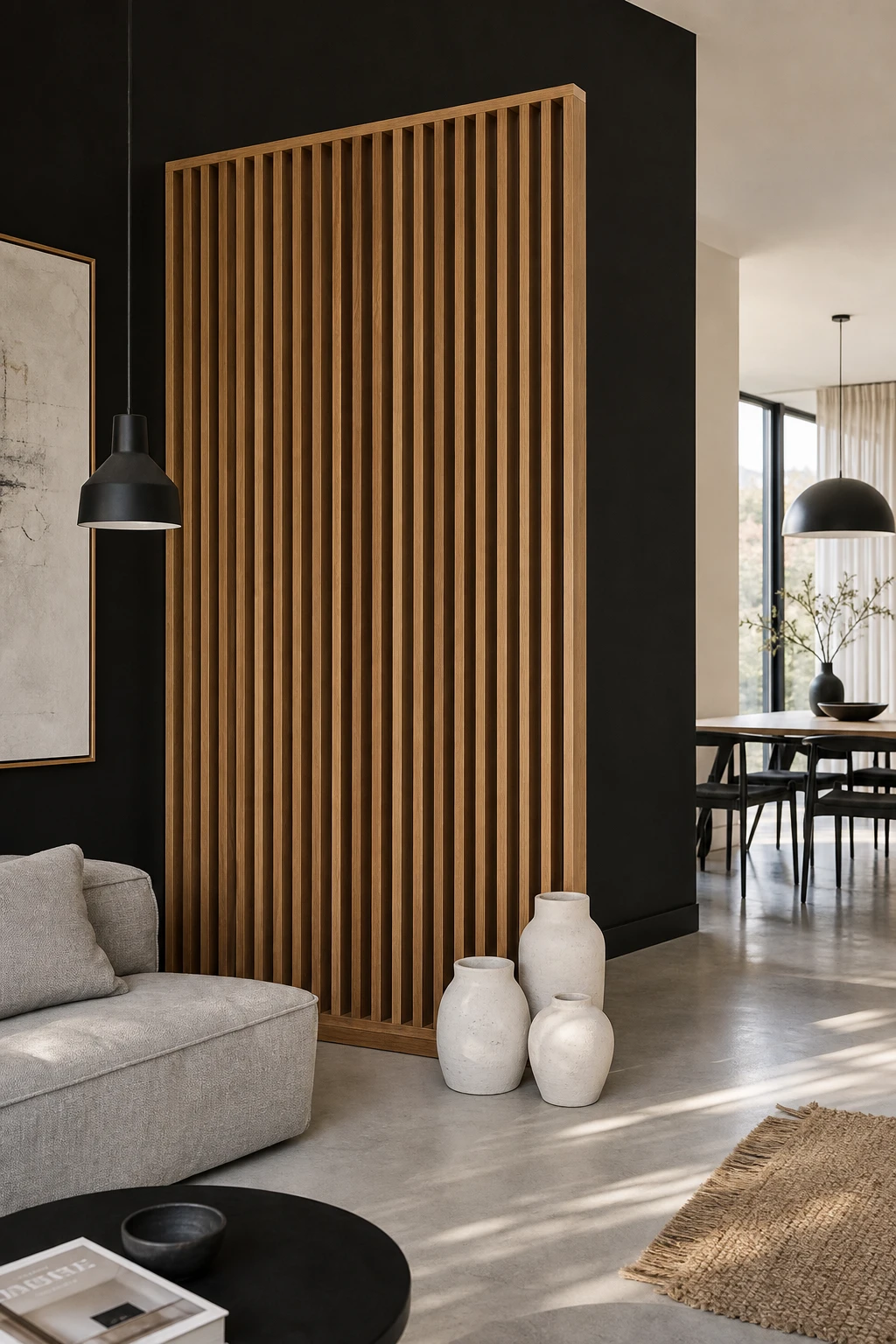
A Wood Room Divider Against Black Does More Than Split Space It Makes It
A slatted oak divider against a black wall turns a practical object into a genuine focal point, and it is one of my favourite moves for open plan rooms that need definition without division. The warm grain jumps forward against the dark backdrop and gives you quiet drama that a plain painted wall never delivers. The slats let light filter through, so both sides of the room stay connected and neither zone feels cut off, which is the part that makes the whole thing sing.
The Key Details
Slatted oak room divider
Low gray linen sofa
Pale concrete floor
Matte black pendant lamp
White ceramic vessel grouping
Pro TipChoose a divider with gaps of at least 5 cm between slats so daylight travels freely and the structure reads as sculpture rather than a barrier you happened to leave half open.
AvoidA solid divider blocks light from reaching both zones, making each side feel smaller and darker than it did before you added it.
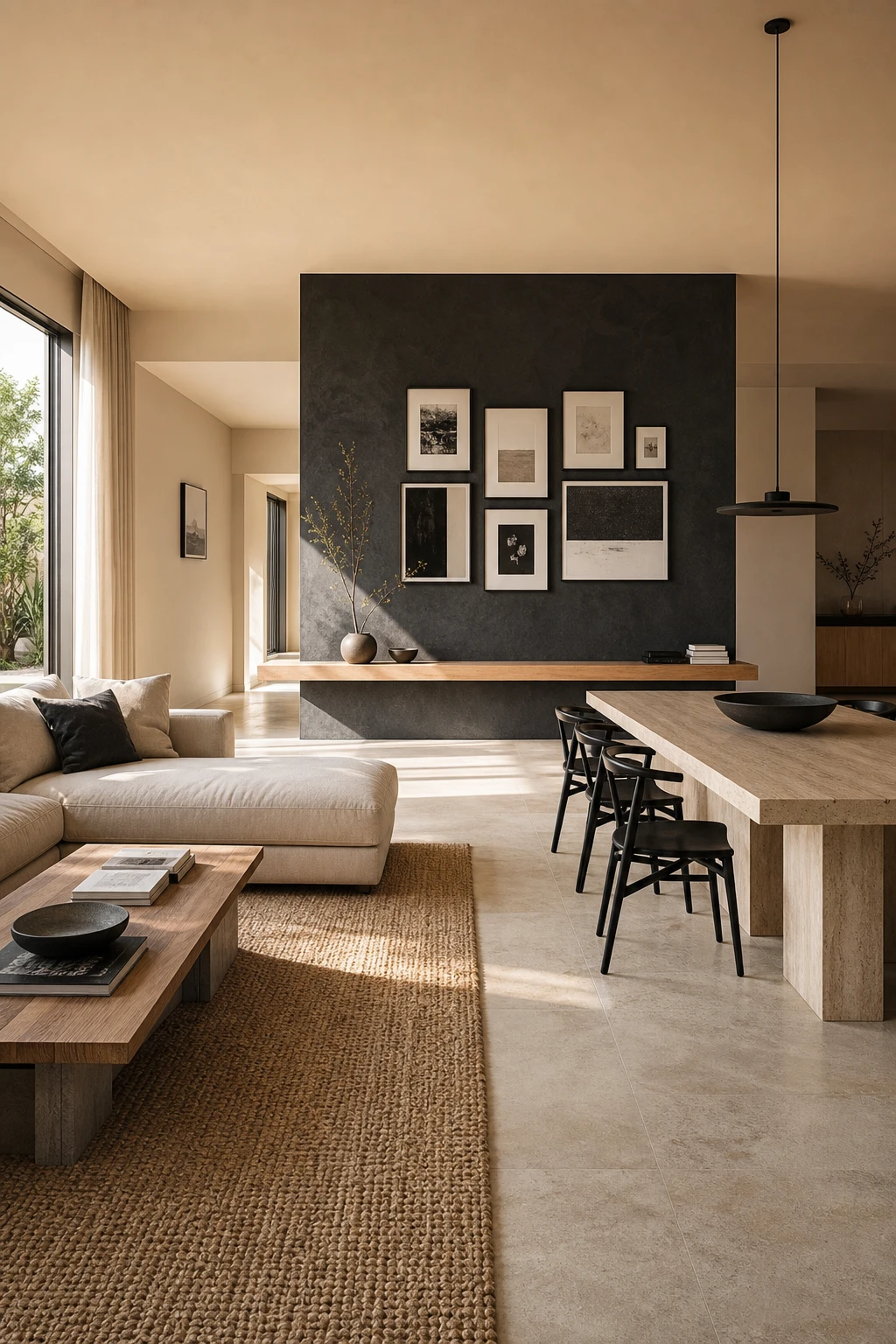
The Feature Wall That Ties an Open Concept Room Together Has One Key Quality
Charcoal plaster floor to ceiling pulls every zone of an open plan into one shared anchor, and that is the quality I always chase first. You get a wall that the kitchen, dining, and living areas all read at once, so the room feels considered rather than cobbled together. The oak shelf and gallery wall feed off it beautifully, and the jute rug on the floor below echoes that same layered warmth without fighting for attention.
The Key Details
Floor to ceiling charcoal plaster feature wall
Cantilevered natural oak floating shelf
Matte black thin frame gallery wall
Honed travertine dining table
Chunky jute area rug
Pro TipBefore you commit, stand in every corner of the open plan and check that your chosen wall is visible from each one, because a feature wall that disappears from half the room loses most of its power.
AvoidPutting the feature wall on a side return or half wall that only one seat faces means most people in the room never get the full effect, and the money and effort spent on it quietly goes to waste.
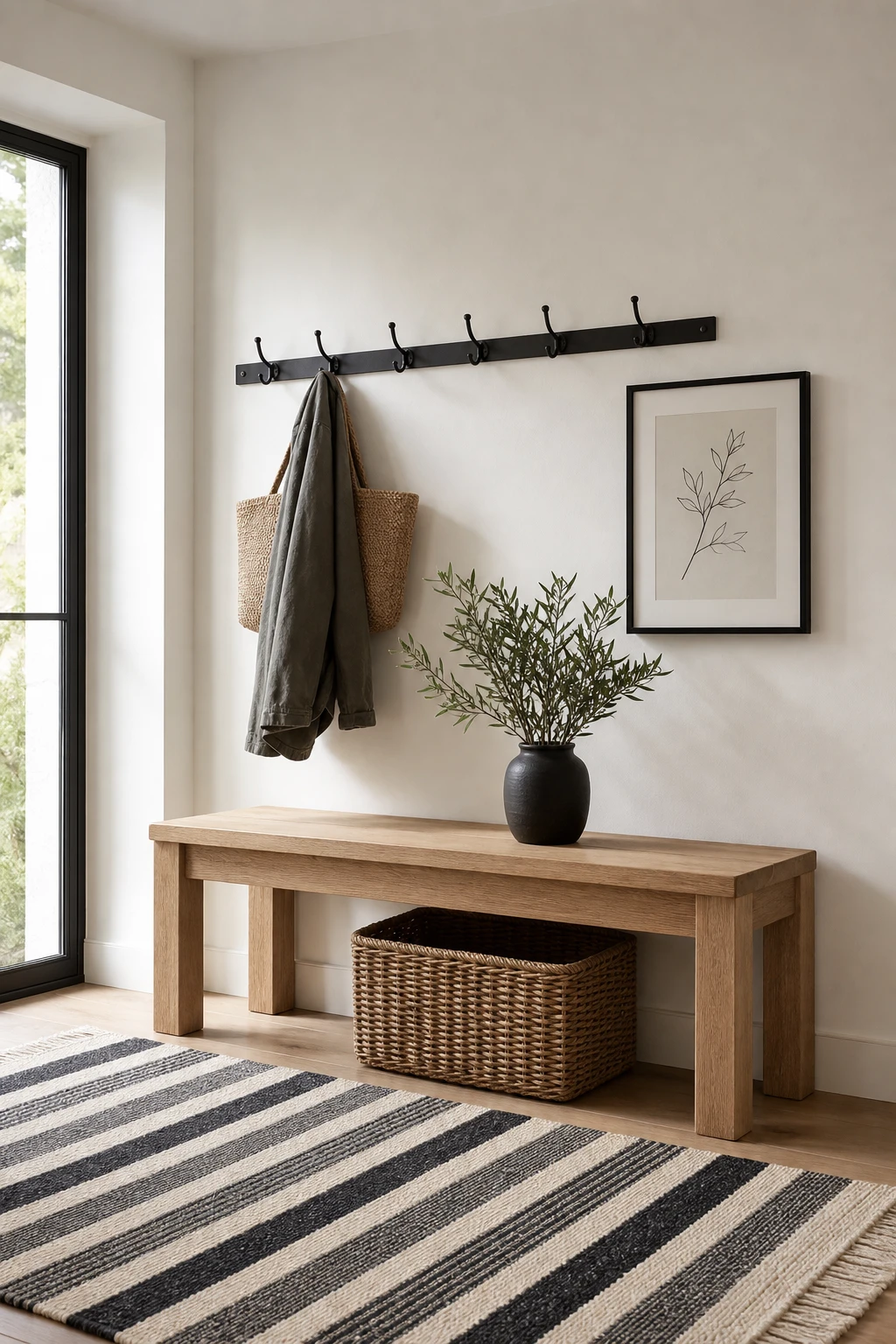
Your Entryway Bench Sets the Whole Palette Before Anyone Steps Inside
The entryway bench is the first thing anyone sees, and I treat it as a quiet handshake between the home and its guests. A solid oak top with black metal legs brings the whole palette into one piece before a single other room is even visible. You get natural warmth from the wood, graphic grounding from the metal, and the gray walls carry it all forward. That first impression lands before anyone consciously registers it.
The Key Details
Solid oak bench with matte finish and straight legs
Black iron wall mounted coat hook rail
Black and white striped wool runner
Woven rattan storage basket
Framed black line drawing artwork
Pro TipChoose a bench with a natural wood seat and matte black legs so it carries every element of the palette in a single piece of furniture.
AvoidPicking an entryway bench in a finish or colour that sits outside the home’s palette creates a visual disconnect that unsettles guests from the moment they arrive.
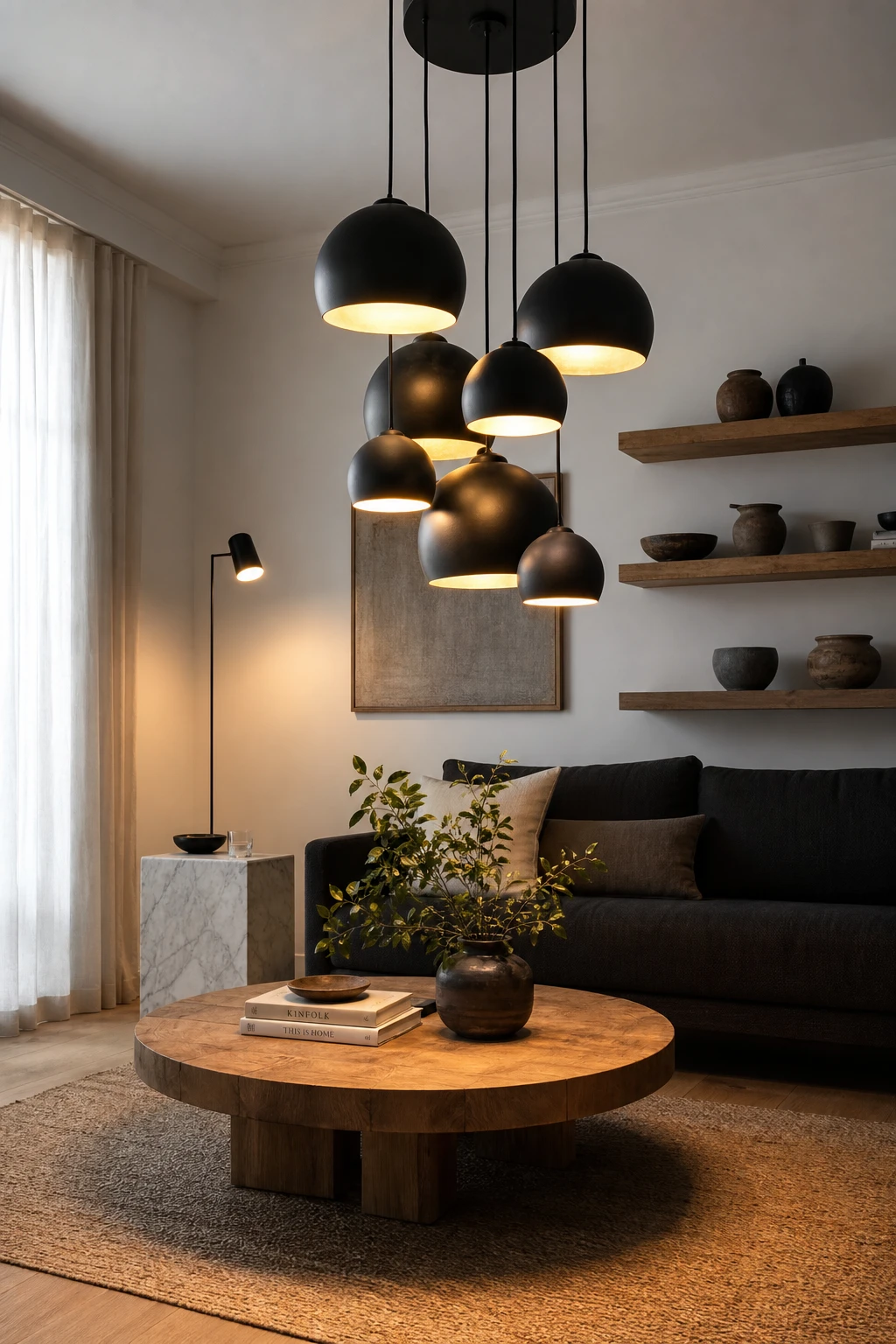
Statement Lighting Is the One Addition That Changes How Every Other Element Reads
A sculptural matte black pendant cluster does something no cushion or rug can: it pulls your eye upward and makes the whole room feel composed. What I love is how the black echoes the sofa, the marble and the raw wood all at once, so the light becomes a thread that ties every element together rather than sitting apart from them. You get function and focal point in one move, and that is exactly how I want statement lighting to work in this palette.
The Key Details
Sculptural matte black pendant cluster
Natural oak coffee table
Charcoal gray linen sofa
Raw wood wall shelving with ceramic vessels
Honed white marble side table
Pro TipChoose a pendant or fitting that shares at least two finishes already in the room, whether that is a black steel frame against your sofa or a warm oak body that mirrors the shelving, so the light reads as deliberate rather than dropped in.
AvoidIntroducing a finish the room has not seen before, such as brushed brass or chrome, quietly fragments the palette and the eye cannot settle anywhere.
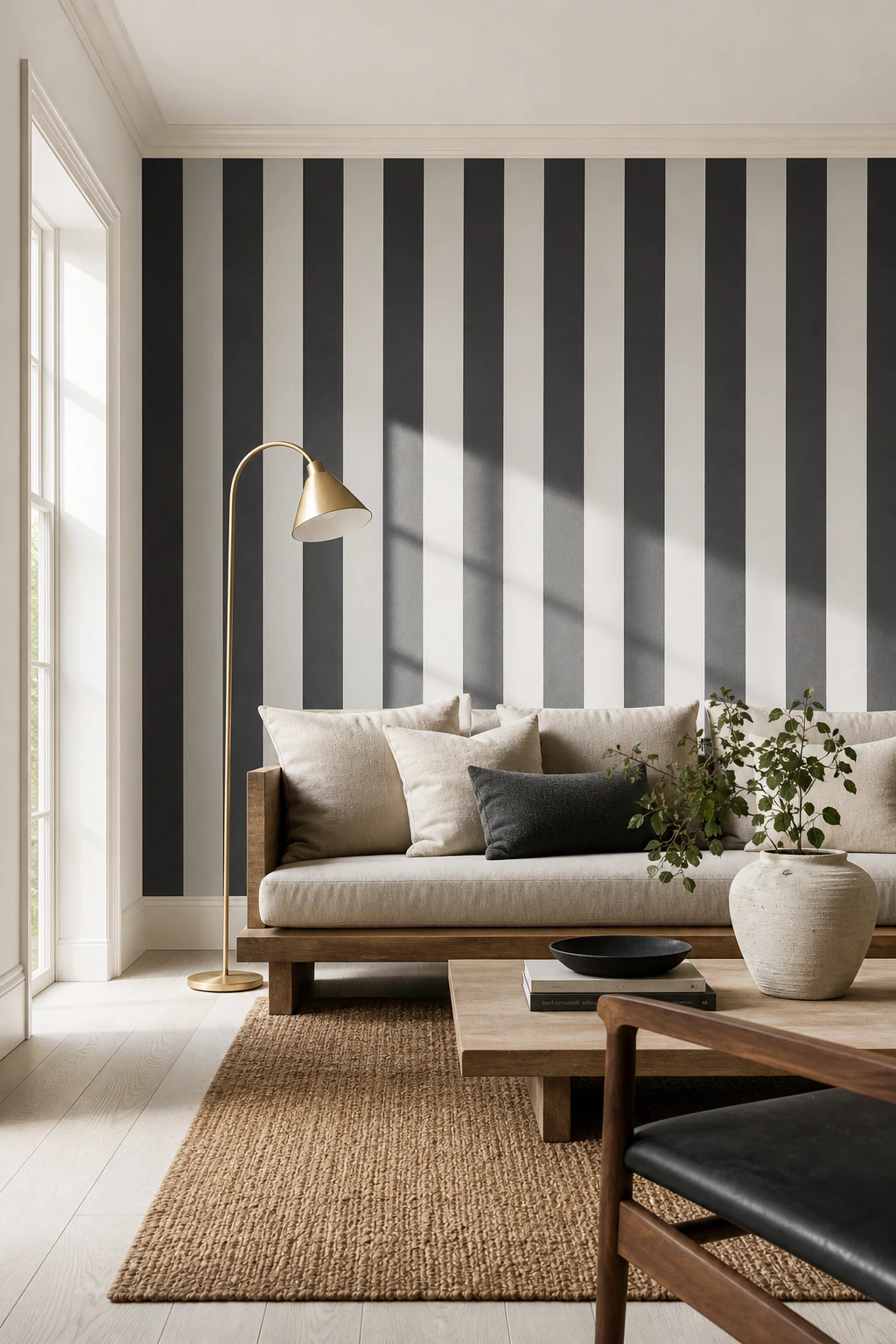
Striped Wallpaper in Black, Gray, and White Pulls the Whole Room Into Focus
Striped wallpaper in charcoal, gray, and white is one of those quiet moves that changes everything without asking for attention. The vertical lines draw your eye upward and give the room a pulled together feeling, and you get all of that without a single extra colour landing on the palette. What wins me over here is how the fine repeat keeps the pattern from competing with the natural oak and linen textures sitting in front of it. The stripe adds rhythm, and the wood does the warmth.
The Key Details
Vertical striped charcoal, gray, and white wallpaper
Low profile natural oak sofa frame with linen cushions
Slender brushed brass arc floor lamp
Chunky woven jute area rug
Bleached white oak plank flooring
Pro TipChoose a stripe where the lines are no wider than about 5mm so the repeat reads as texture from across the room rather than a strong graphic statement.
AvoidPapering all four walls with a stripe pattern boxes the natural wood pieces in and turns the room’s calm restraint into something far busier than you intended.
Alan launched Edward George London in 2017. Since completing his masters in Town & Regional Planning (MPlan) he has combined the skills he learned at the University of Sheffield with his passion for design, to help create a foundation for those looking to create a beautiful home.