I’ve always thought gray and green is one of those pairings that looks better the longer you live with it, because it borrows from both nature and calm in equal measure. What I love about this combination is how many moods it can hold, from the softest sage washed across a limewash wall to a deep emerald pushed against dark charcoal. In the looks ahead I’ve gathered the best shade pairings, sofa choices, accent ideas, and lighting tricks, and every single one is a look you can borrow for your own room.
Why Sage Green and Gray Feel So Naturally at Home Together
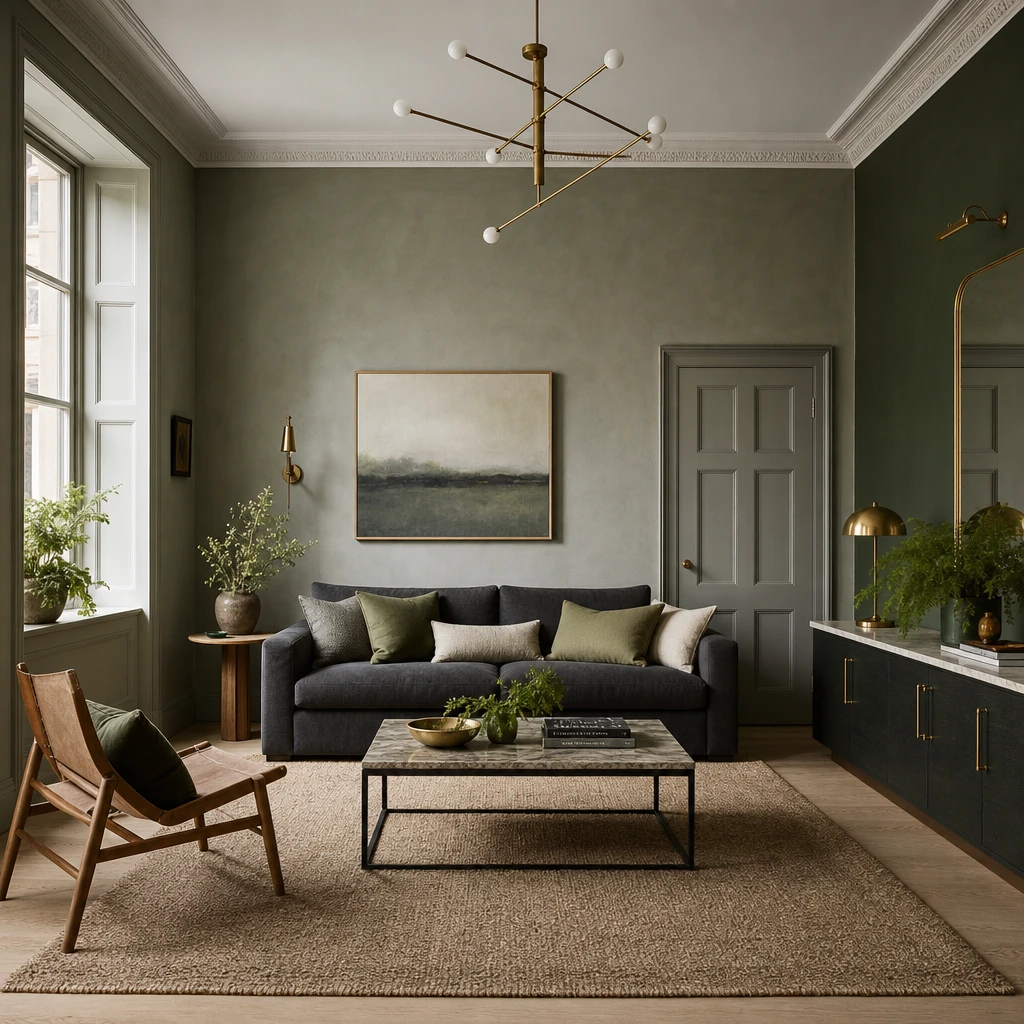
Sage and gray share the same quiet, muted quality, which is exactly why they sit so well beside each other. What I love about this pairing is how each colour seems to breathe, neither one fighting for attention. You get a room that feels genuinely restful, the way a walk outside does, because both tones carry that subtle earthy undertone that anchors the whole space.
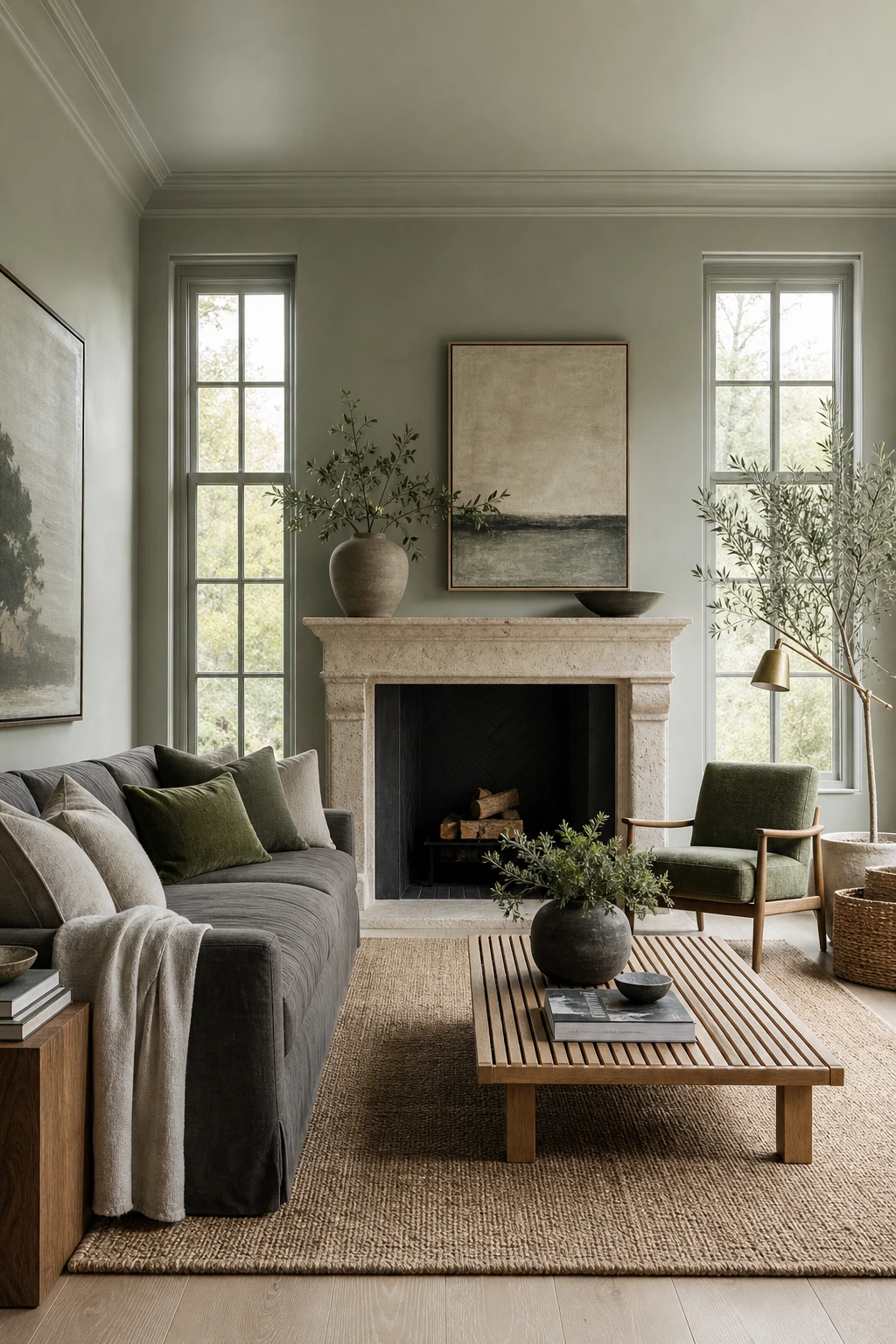
The Key Details
Deep linen sofa in warm gray
Rough hewn limestone fireplace
Hand loomed jute area rug
Tall casement windows
Low slatted timber coffee table
Pro TipPull a sage with a faint gray base of its own, so the two colours share just enough DNA to read as one considered palette rather than two separate ideas.
AvoidA sage that leans too yellow will clash sharply against a blue gray wall, turning what should feel serene into something that reads as a colour mistake.
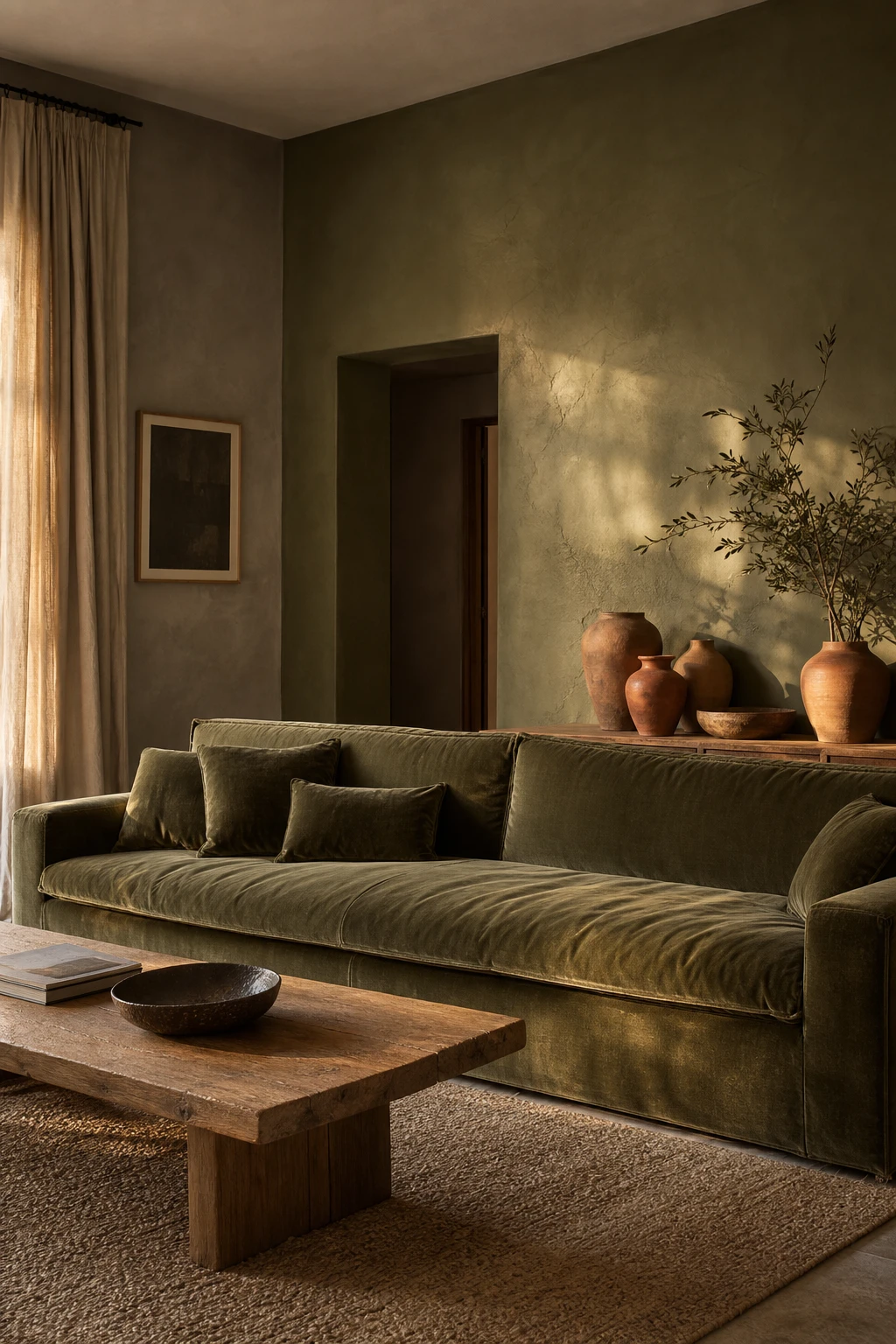
Olive is the shade that pulls warmth out of a gray room the way nothing else quite manages. Mid gray already carries a faint warmth hiding beneath its cool surface, and olive finds it and draws it forward so the room feels grounded rather than chilly. Layer in raw oak and terracotta and you get something that feels genuinely lived in, the kind of room people walk into and immediately want to sit down in.
The Key Details
Olive velvet sofa
Chunky jute area rug
Raw oak coffee table
Terracotta ceramic vessels
Warm greige linen curtains
Pro TipChoose a mid gray with a slight warm undertone, something leaning greige rather than blue, so the olive reads rich and intentional rather than accidental.
AvoidLighting olive with a cool white bulb strips the warmth from the tone entirely, leaving it looking khaki and flat against the gray.
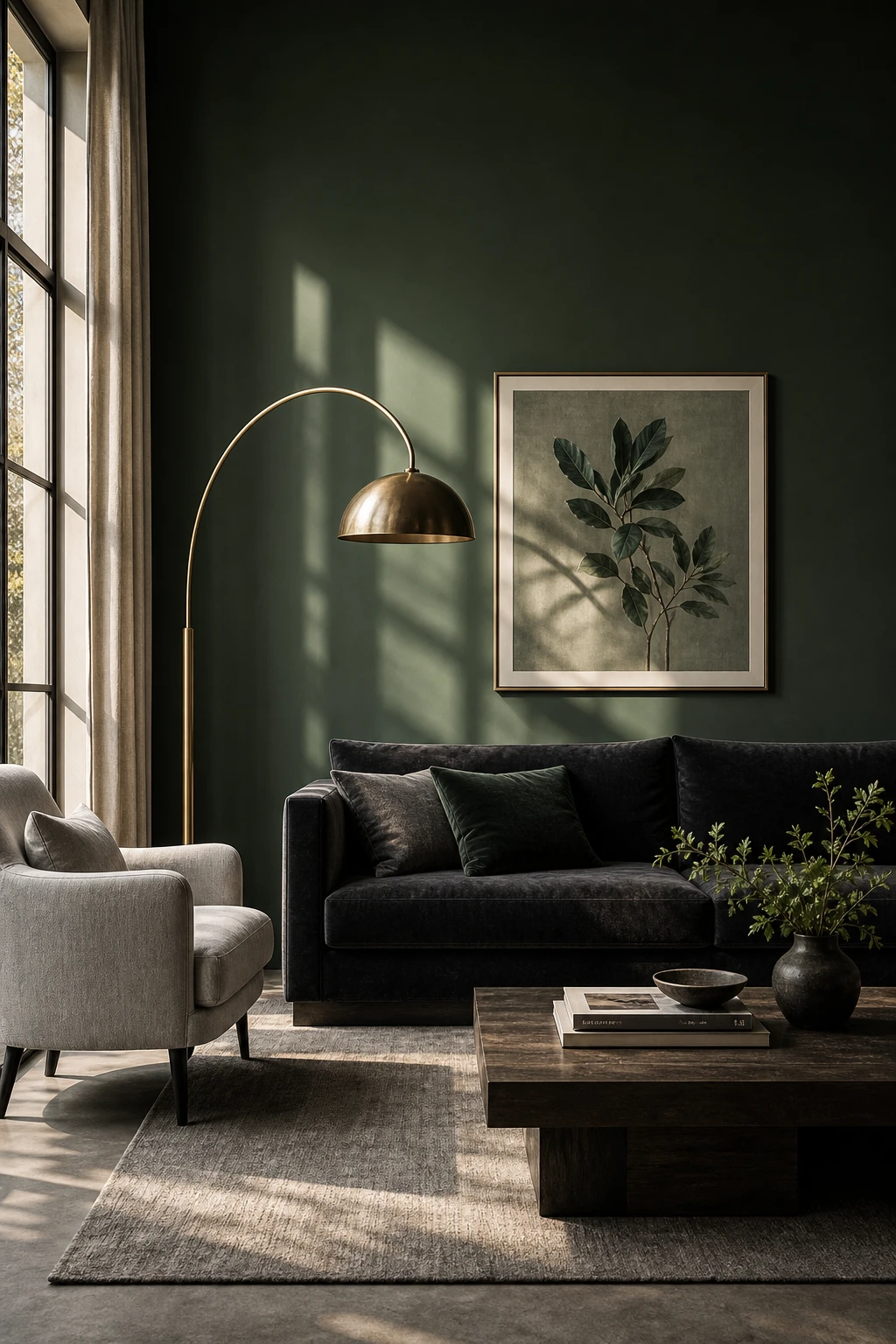
Dark green and gray together create depth without relying on a single busy pattern, and that contrast is what gives the room its pull. What I love about this pairing is that the green does all the dramatic work while the gray holds everything steady around it. You get a room that feels rich and considered, not restless.
The Key Details
Charcoal velvet sofa
Brass arc floor lamp
Tall casement windows
Pale gray linen armchair
Smoked oak coffee table
Pro TipChoose a gray with a warm or sandy undertone, such as Farrow and Ball Elephant’s Breath, so the dark green reads lush rather than cold.
AvoidPainting all four walls in both deep shades at once will make a small room feel like a cave, so anchor the dark green to one wall or a single large piece only.
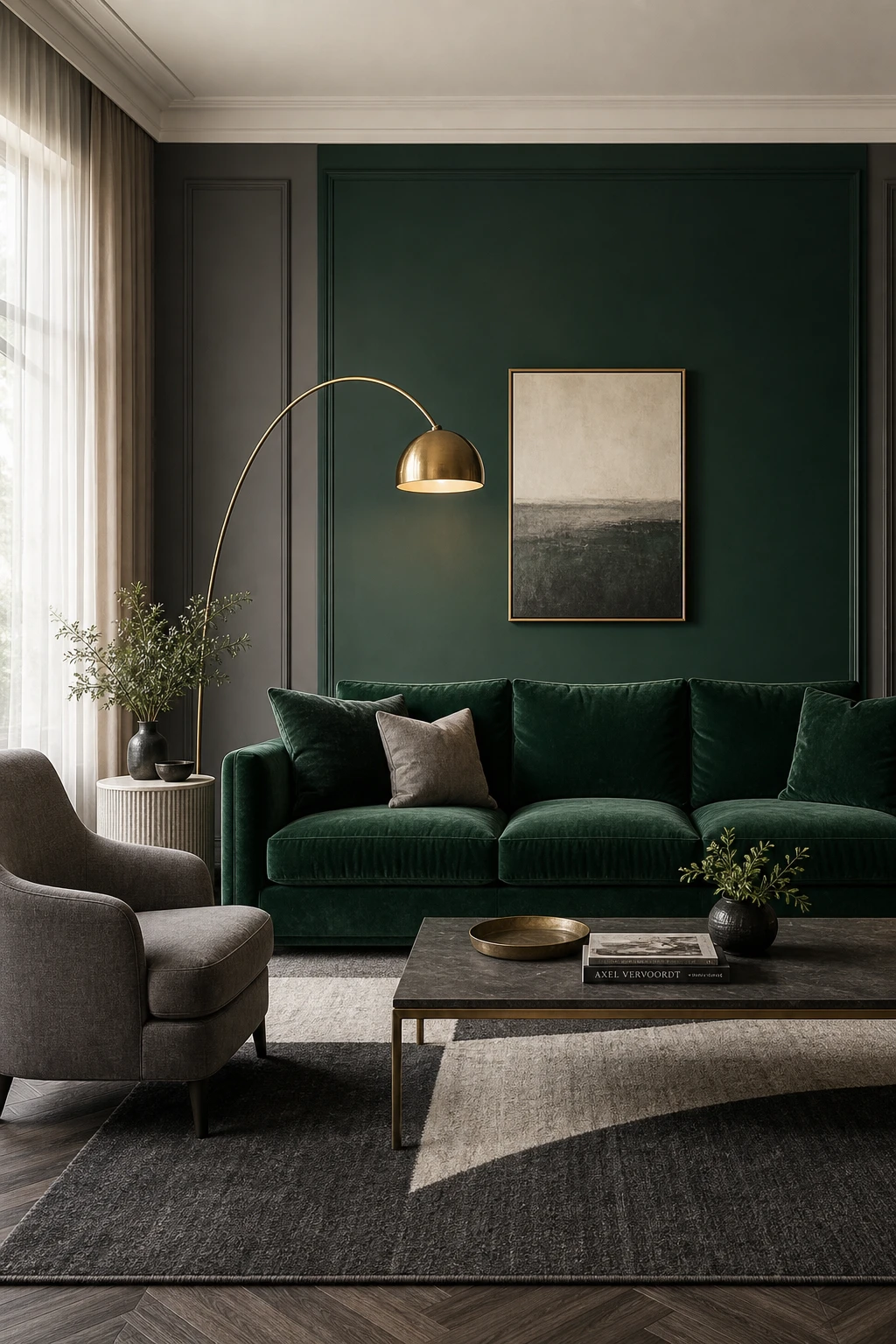
Emerald Green and Gray: a Pairing That Feels Quietly Luxurious
Emerald against soft gray is one of those combinations that just stops you in your tracks. What I love is how the jewel tone does all the heavy lifting: one emerald velvet sofa reads as deeply luxurious while the gray around it stays calm and breathable. You get richness without the room ever feeling overdressed, and that balance is exactly what I am always chasing.
The Key Details
Emerald velvet sofa
Brass arc floor lamp
Fluted plaster side table
Smoke gray linen armchair
Layered charcoal and ivory wool rug
Pro TipReach for a gray with blue undertones rather than a warm or greige base, because the cool shift makes emerald look even more vivid and alive.
AvoidPushing emerald into too many spots at once flattens the whole effect, because the color only feels special when the gray gives it room to breathe.
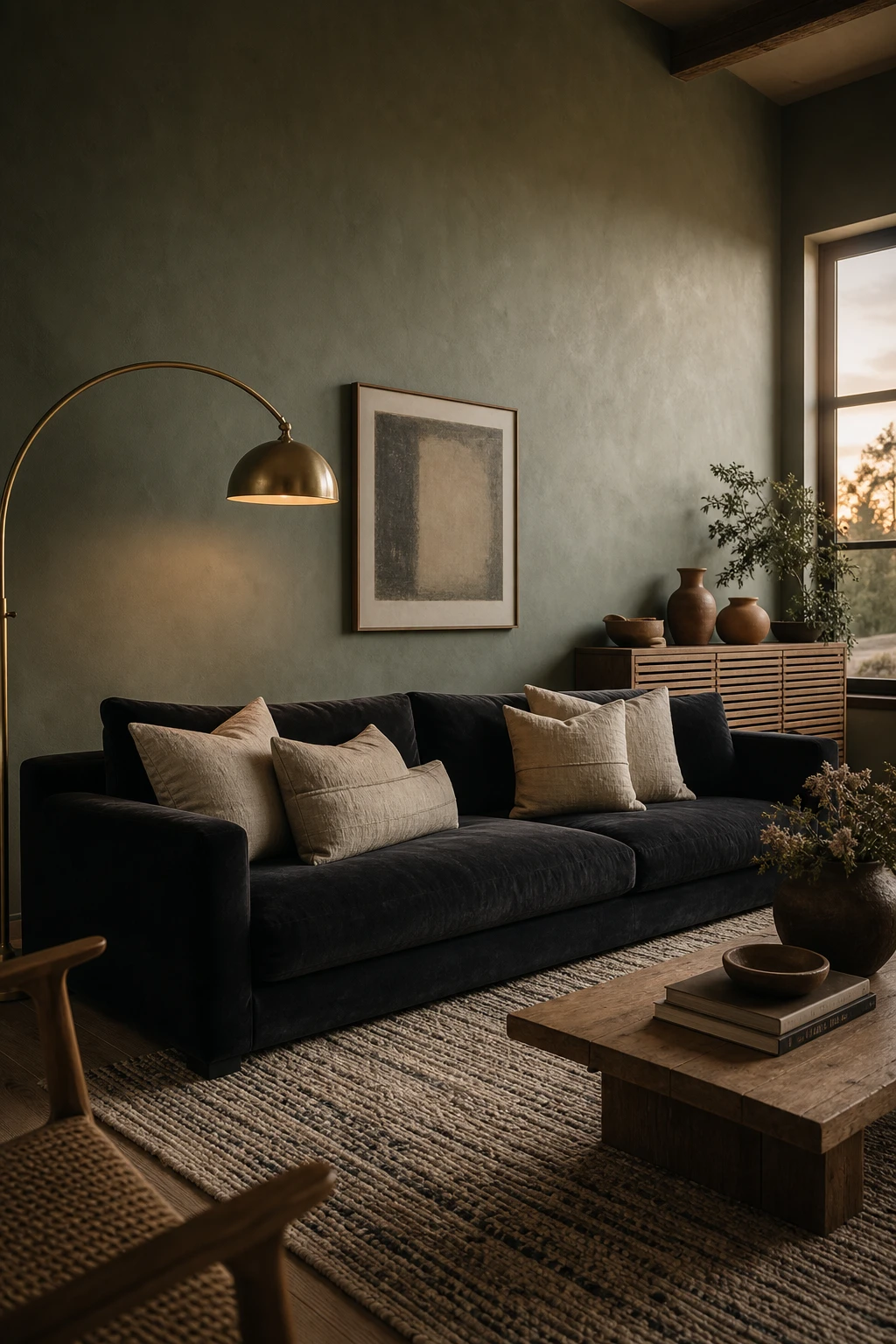
Sage Green with Charcoal: the Bold Move That Still Feels Soft
Sage and charcoal sounds like a bold pairing, and it is, but the magic is that sage carries enough grey in it to keep the two colours connected. What I love here is the contrast stays strong without turning cold or stark. The sage does the heavy lifting, covering walls or large upholstery, so the charcoal reads as an anchor rather than a shadow. You get a room with real presence that still feels genuinely calm to sit in.
The Key Details
Charcoal velvet sofa
Brass arc floor lamp
Hand knotted wool rug in oatmeal and slate
Slatted oak console with terracotta vessels
Cream linen scatter cushions
Pro TipLet sage claim the largest surface in the room, whether that is the walls or the main sofa, so the charcoal accents feel grounded rather than heavy.
AvoidPicking a charcoal that tips into pure black will swallow the sage warmth entirely, leaving the room feeling bleak rather than bold.
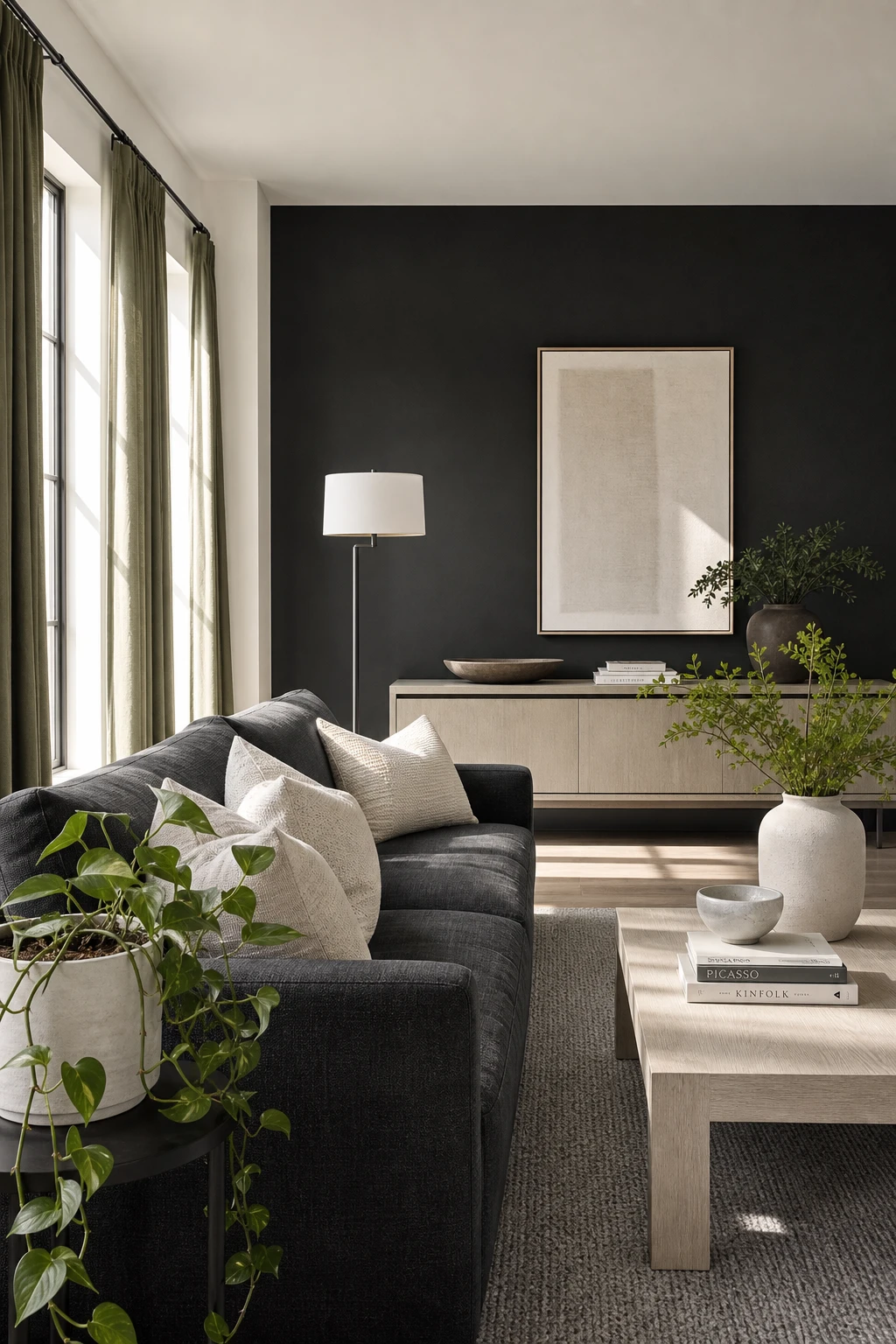
Three Tone Rooms: Making Gray, White, and Green Work Together
Three tones sounds like a recipe for a busy room, and yet this combination wins me over every time. The trick is letting white do the heavy lifting on walls and trim, so the eye has somewhere calm to rest before it finds the gray and green. You get a room that breathes, and the sage and charcoal read as considered choices rather than clutter.
The Key Details
Charcoal linen sofa
Pale white oak coffee table
Sage green linen curtains
Dove gray wool rug
Slim iron floor lamp
Pro TipGive each tone its own clear surface: white on the walls, gray on the sofa and rug, green in the curtains, and the room almost organises itself.
AvoidSplitting all three colours into equal portions leaves the eye with nowhere to settle, and the room ends up feeling restless rather than refined.
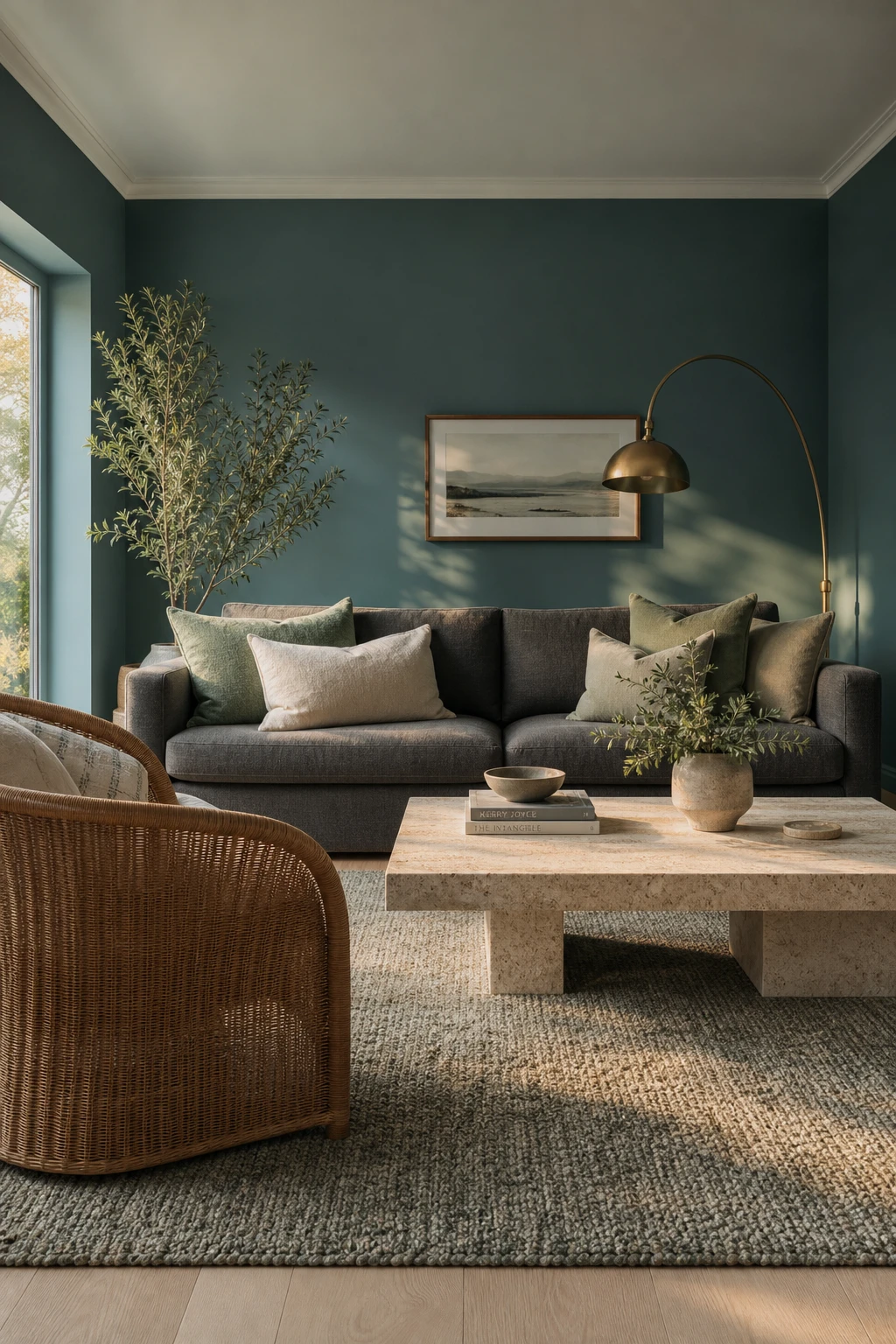
When Teal Sits Between Green and Gray and Feels Exactly Right
Teal sits precisely where blue ends and green begins, which is exactly what makes it so useful in a gray room. It shakes hands with a slate gray sofa through its blue notes and reaches toward any natural texture nearby through its green ones. That double belonging is what I find so satisfying about this pairing: you get visual movement without any contrast that jars, and the room settles into something considered rather than carefully matched.
The Key Details
Slate gray linen sofa
Natural rattan armchair
Brass arc floor lamp
Travertine coffee table
Hand knotted wool rug in gray and moss
Pro TipBring in a natural wood side table or rattan chair alongside the teal, and you will notice the whole palette warms up immediately.
AvoidPairing teal with a blue toned cool gray pulls all the warmth out of both colours and leaves the room feeling more like a waiting room than a living space.
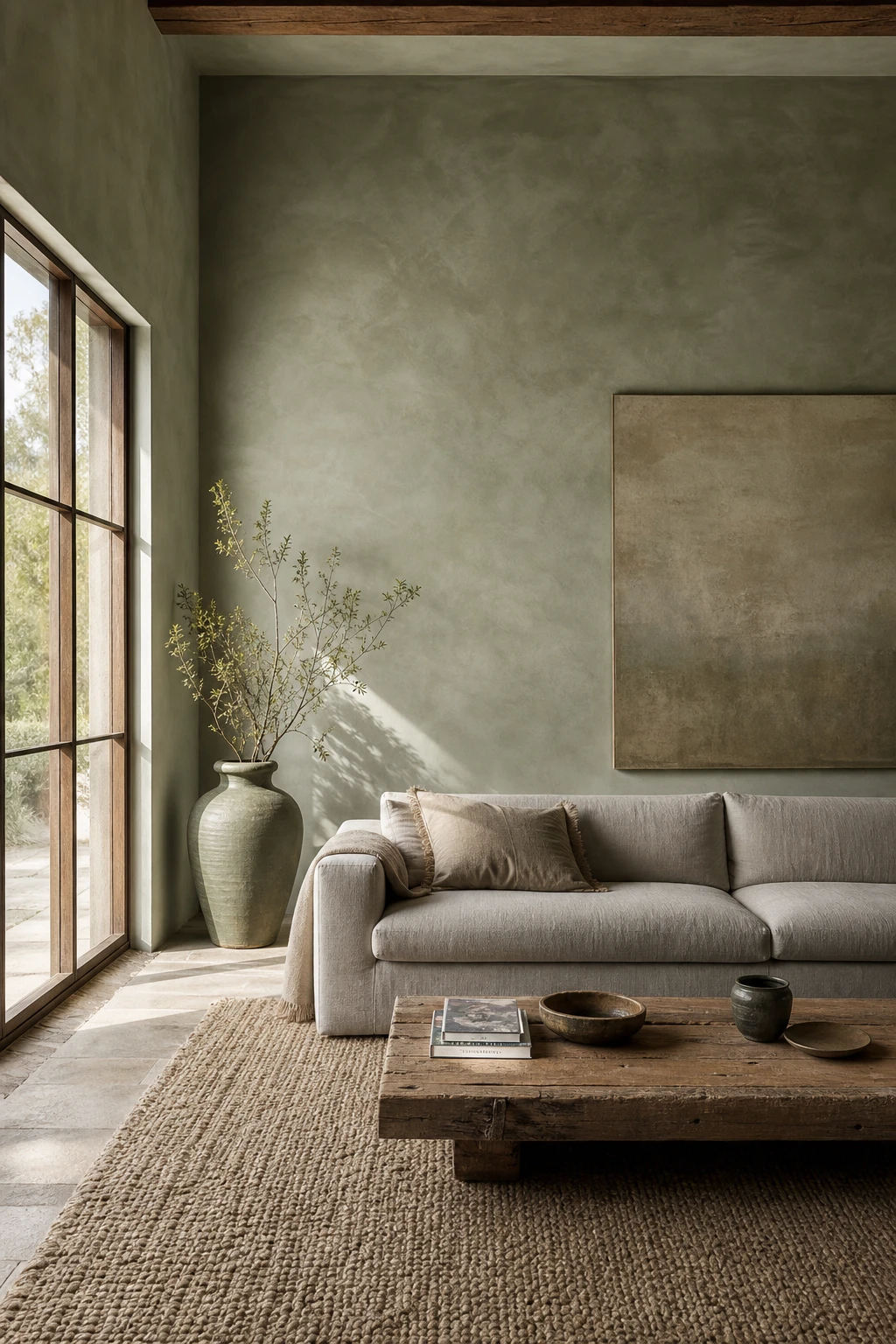
Limewash Walls in Sage Green: Texture That Does the Decorating for You
Sage limewash walls bring a quality I find almost impossible to fake with flat paint: that soft, shifting depth that changes as the light moves across the room. The texture itself becomes the decoration, so you get a room that feels full and considered without pushing in extra furniture. Keep everything else low and quiet and the walls do the talking for you.
The Key Details
Limewash plaster wall finish
Low profile stone gray linen sofa
Raw edged oak coffee table
Chunky hand knotted oatmeal wool rug
Matte sage large scale ceramic floor vase
Pro TipChoose a sofa and rug in natural, undyed tones so nothing competes with the wall finish for attention.
AvoidApplying limewash in neat, even strokes produces a flat, wallpaper like result that strips out all the depth the technique is supposed to create.
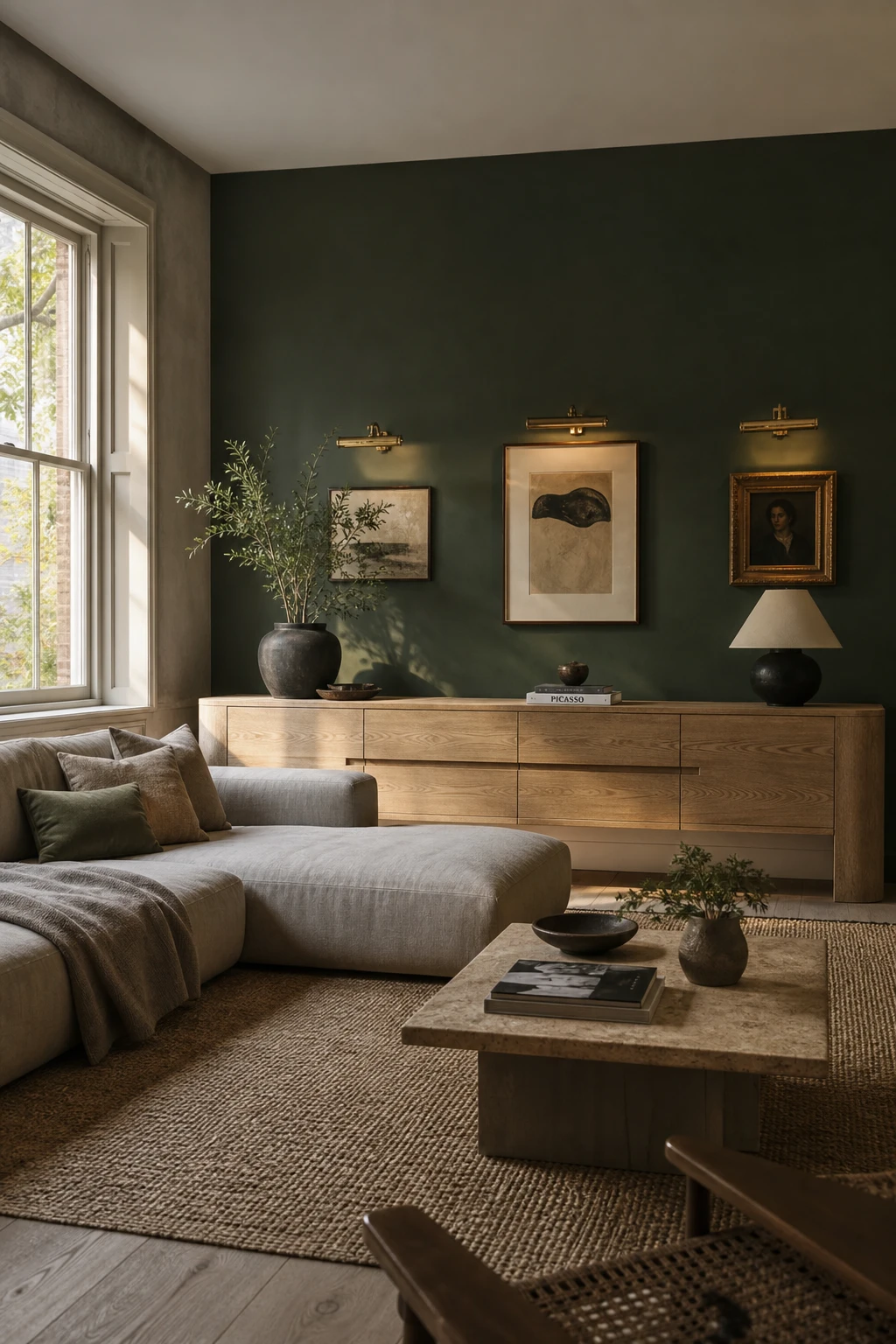
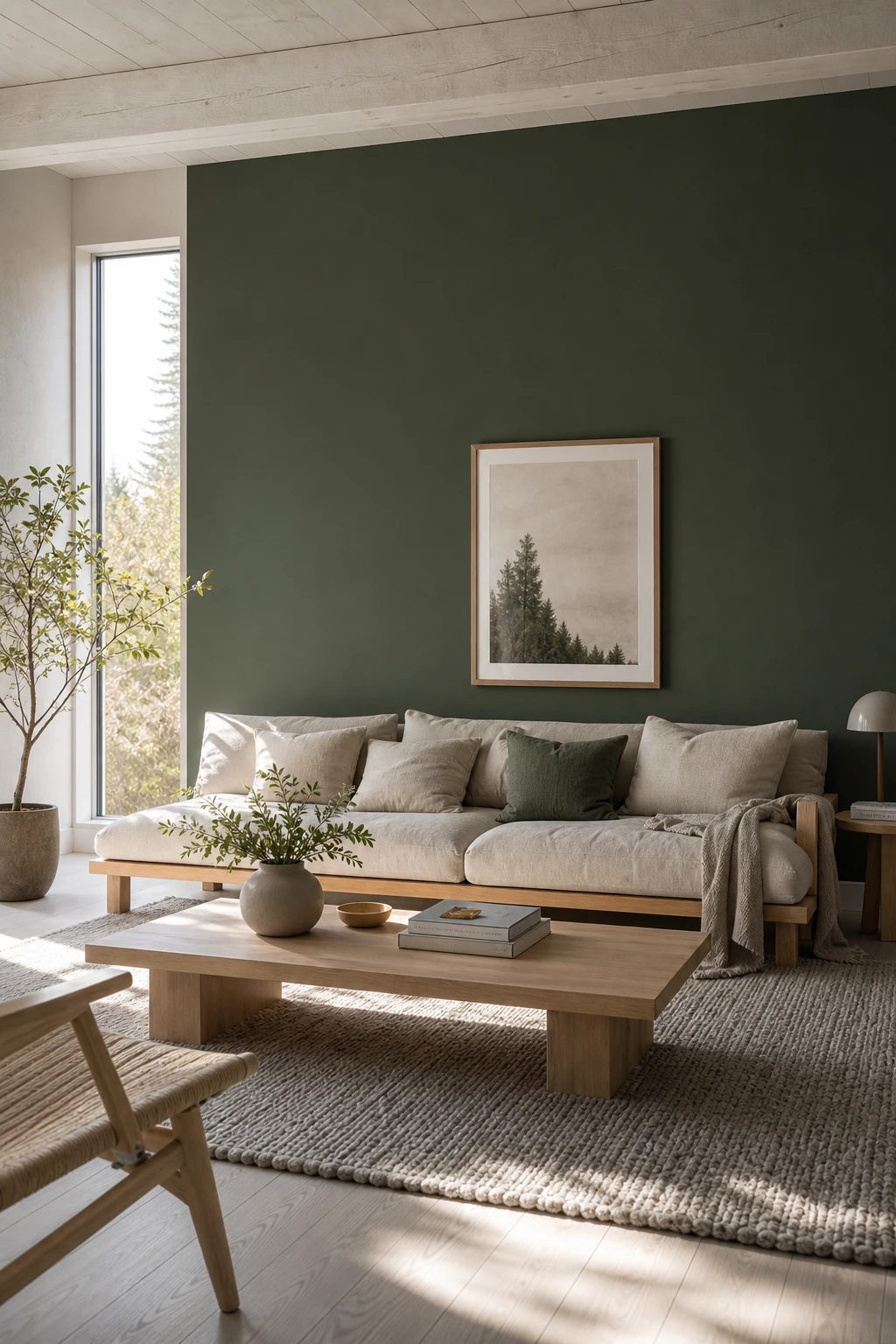
One Dark Green Wall Can Change the Whole Feel of a Gray Room
One dark green wall stops the eye exactly where you want it, and in a gray room that pull feels dramatic without being loud. What I love is how the green deepens the gray rather than fighting it, so you get a palette that reads as one considered whole. The sofa sits in front of it like a portrait in a frame, and that single decision gives the whole room a centre of gravity.
The Key Details
Low profile linen sofa
Bleached oak sideboard
Brass picture lights
Jute area rug
West facing sash window
Pro TipAlways place the accent wall behind the sofa, not opposite it, so the colour wraps around the seating area and makes guests feel held by the room.
AvoidPainting the wall opposite the main window cuts natural light in half and makes the room feel like a corridor rather than a living space.
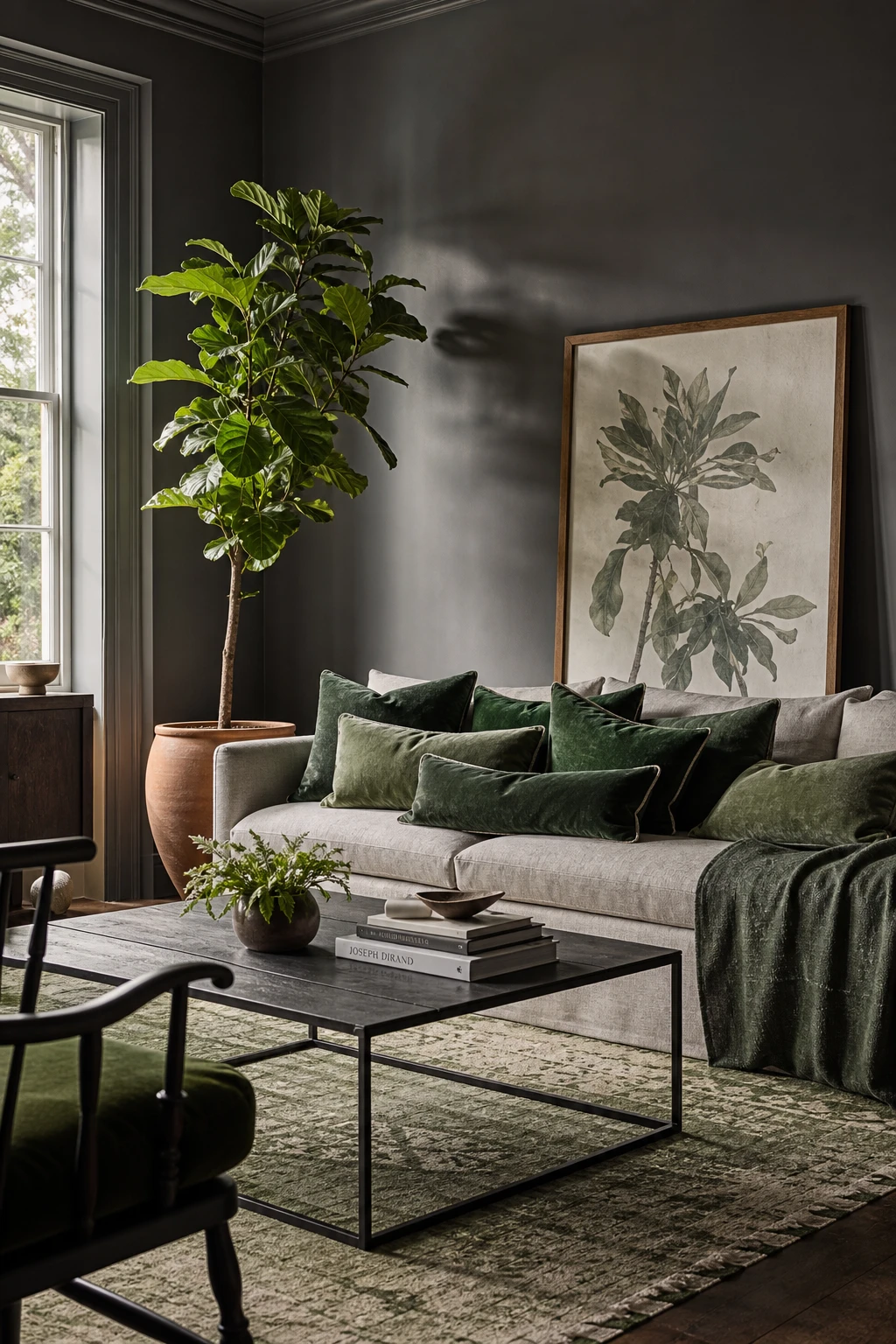
Gray Walls as a Backdrop: How Green Accents Take Centre Stage
Gray walls do something quietly brilliant: they step back and let everything in front of them shine. What I love about this setup is how the emerald cushions, the botanical print, and that fiddle leaf fig all read as one considered palette rather than scattered bits of colour. You get a room that feels calm and alive at the same time, which is a balance worth chasing.
The Key Details
Emerald velvet cushions
Stone gray linen sofa
Fiddle leaf fig in matte terracotta pot
Oversized botanical print in oak frame
Sage and ivory hand knotted wool rug
Pro TipPlace green in at least three separate spots around the room so the eye travels and the colour feels like a deliberate choice rather than an afterthought.
AvoidMixing too many different greens, say sage, forest, and lime all at once, pulls the accents apart and the room loses the harmony you worked so hard to build.
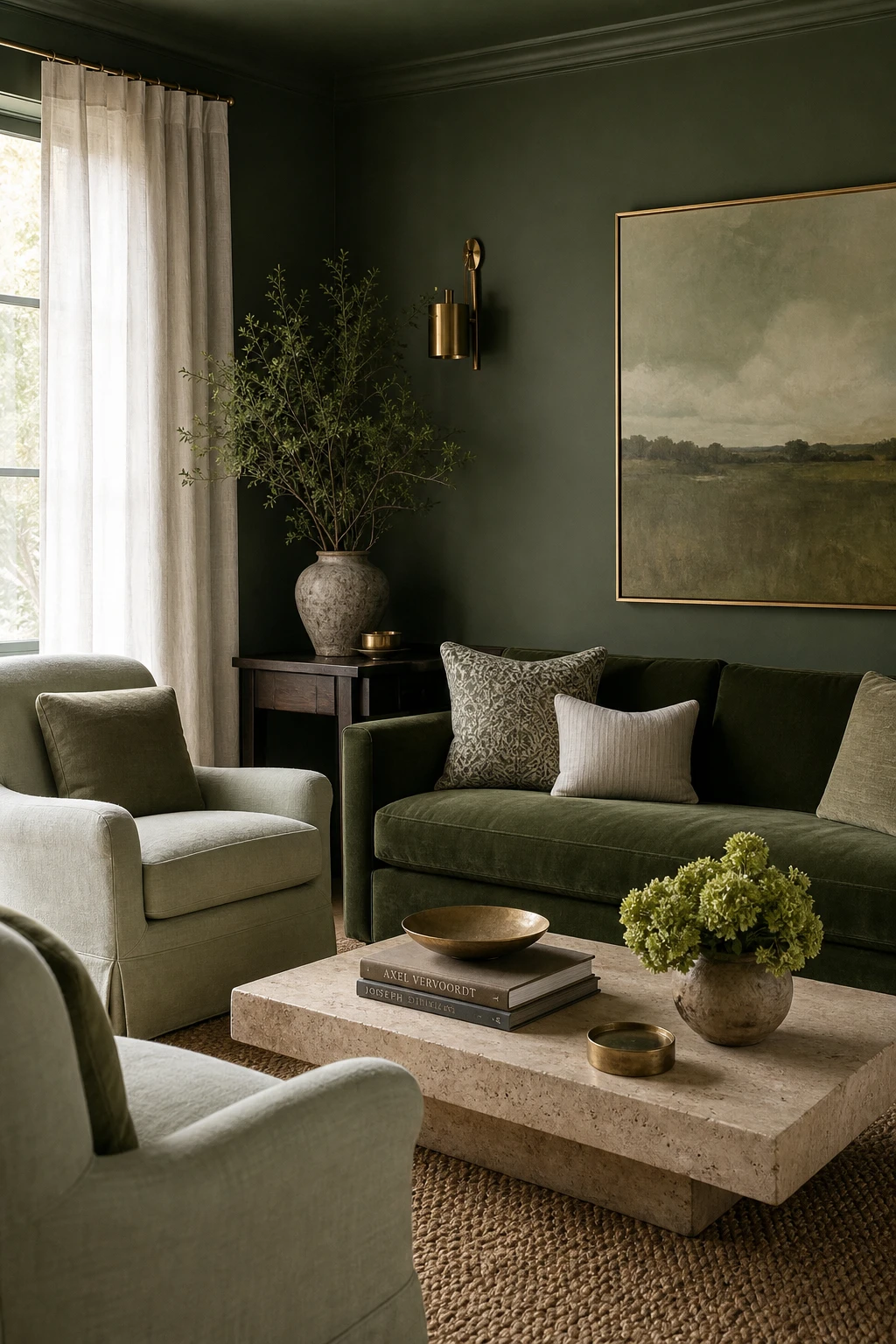
Going Full Green: How a Monochrome Scheme Still Feels Balanced
Going full green feels bold, but the secret is that light and dark shades of the same colour do the work that contrast usually does. A celadon armchair reads as restful next to a deep olive sofa, and you get real depth without ever leaving the green family. What I love here is how the eye moves around the room finding those shifts in tone, which keeps things lively rather than flat. The travertine and aged brass give just enough warmth to anchor the whole thing.
The Key Details
Celadon linen armchairs
Deep olive velvet sofa
Travertine coffee table
Sheer linen drapes
Aged brass accessories
Pro TipLayer matte linen, glossy ceramic, and rough woven textures all in the same green so the hue stays interesting as the light changes through the day.
AvoidLeaving out any gray or off white rest point means the eye has nowhere to settle, and the room can start to feel heavy no matter how beautiful the greens are.
The Dark Gray Sofa: Why It Is the Best Starting Point for a Green Room
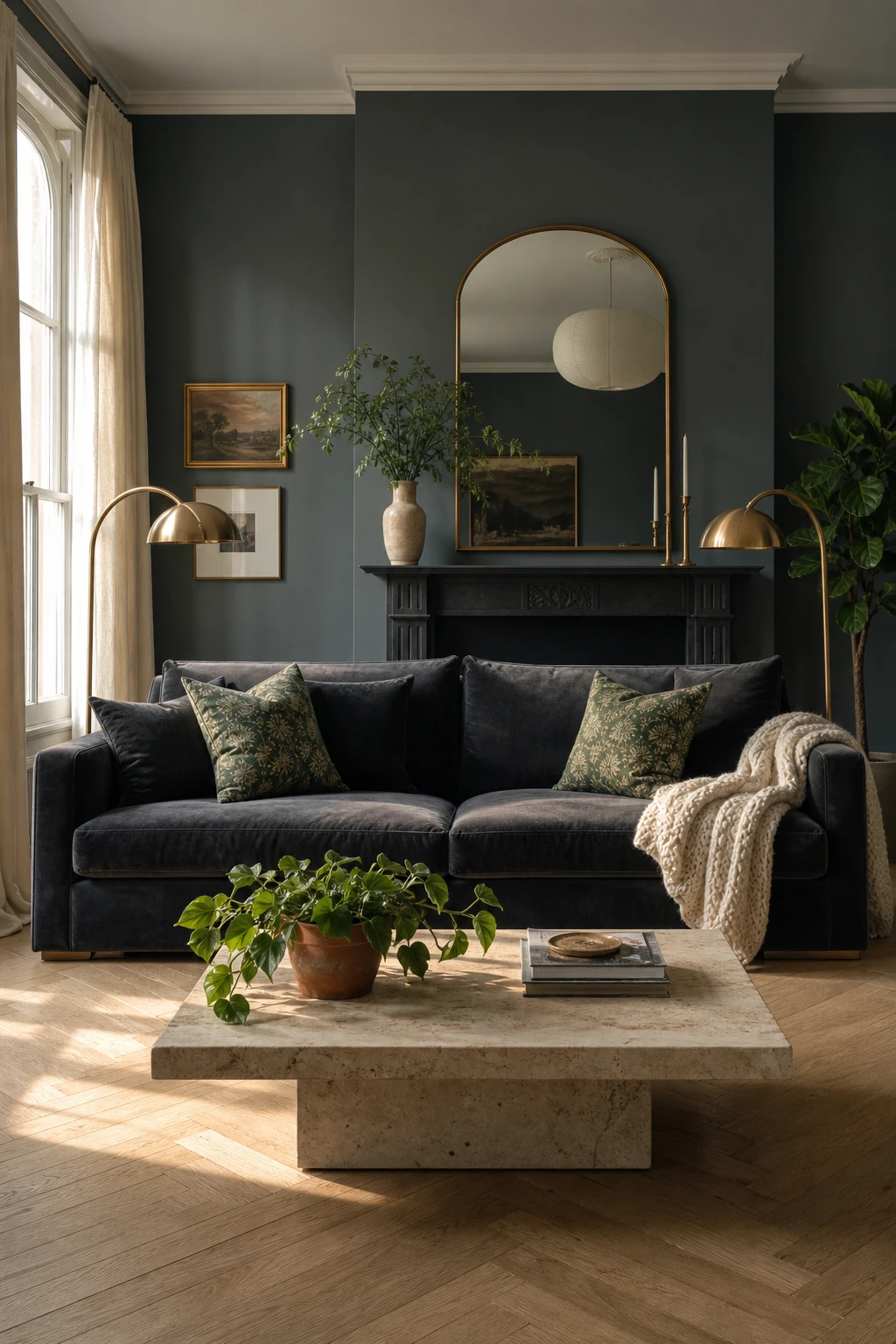
A dark gray sofa is the anchor I reach for first when a room needs a green palette to feel grown up rather than garden fresh. You get this satisfying visual weight at the centre, and everything around it, sage cushions, pale oak floors, soft cream walls, can stay light without the room feeling empty. Watch how the charcoal pulls the greens into focus rather than competing with them. It is a quiet confidence trick that wins me over every single time.
The Key Details
Charcoal velvet sofa
Sage green botanical throw pillows
Travertine coffee table
Brushed brass arc floor lamps
Pale oak herringbone floor
Pro TipLayer two or three cushions in sage green and warm cream across the sofa to break up the dark upholstery and carry your colour palette straight to the focal point of the room.
AvoidPushing a dark sofa up against a charcoal or deep green wall with no lamp or window nearby flattens the whole end of the room into one heavy block that no styling trick will rescue.
A Green Sectional in a Minimalist Room: Less Really Is More Here
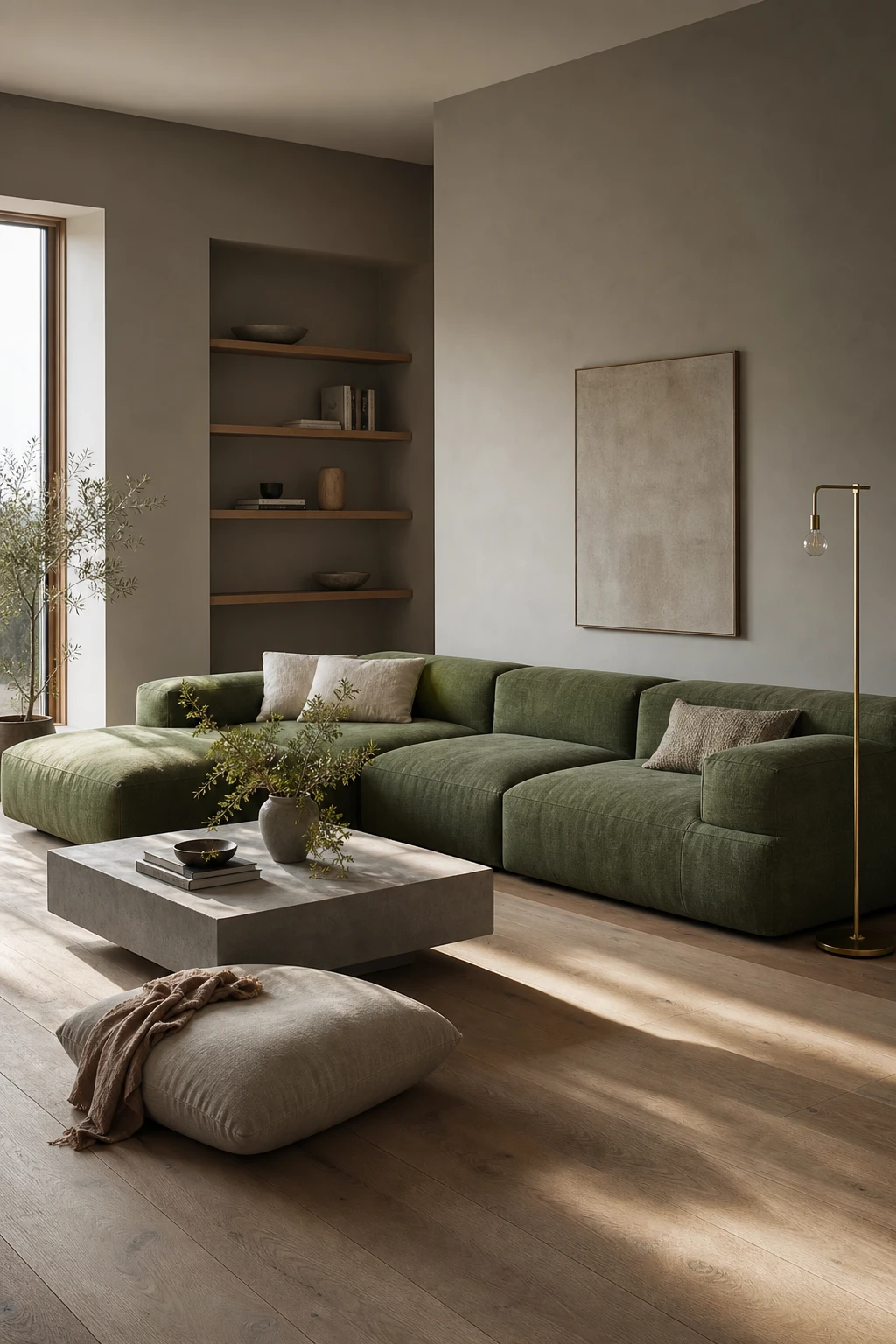
A green sectional is bold enough to carry a whole room on its own, and that is exactly what I lean on here. Keep the walls a quiet grey, the floor bare oak, and the coffee table low and simple, and you get a space that feels considered rather than crowded. The sofa does all the talking while everything around it stays calm and lets it breathe.
The Key Details
Modular Green Sectional Sofa
Low Profile Concrete Coffee Table
Wide Plank Oak Flooring
Slim Brass Floor Lamp
Tall Narrow Window
Pro TipChoose a sectional with a low seat height and slim arms so the room keeps its sense of open space even with a large piece of furniture in it.
AvoidPulling in a third accent colour, even a small one, splits the eye and weakens the whole statement the sofa is trying to make.
The Easiest Way to Bring Green Into a Gray Living Room
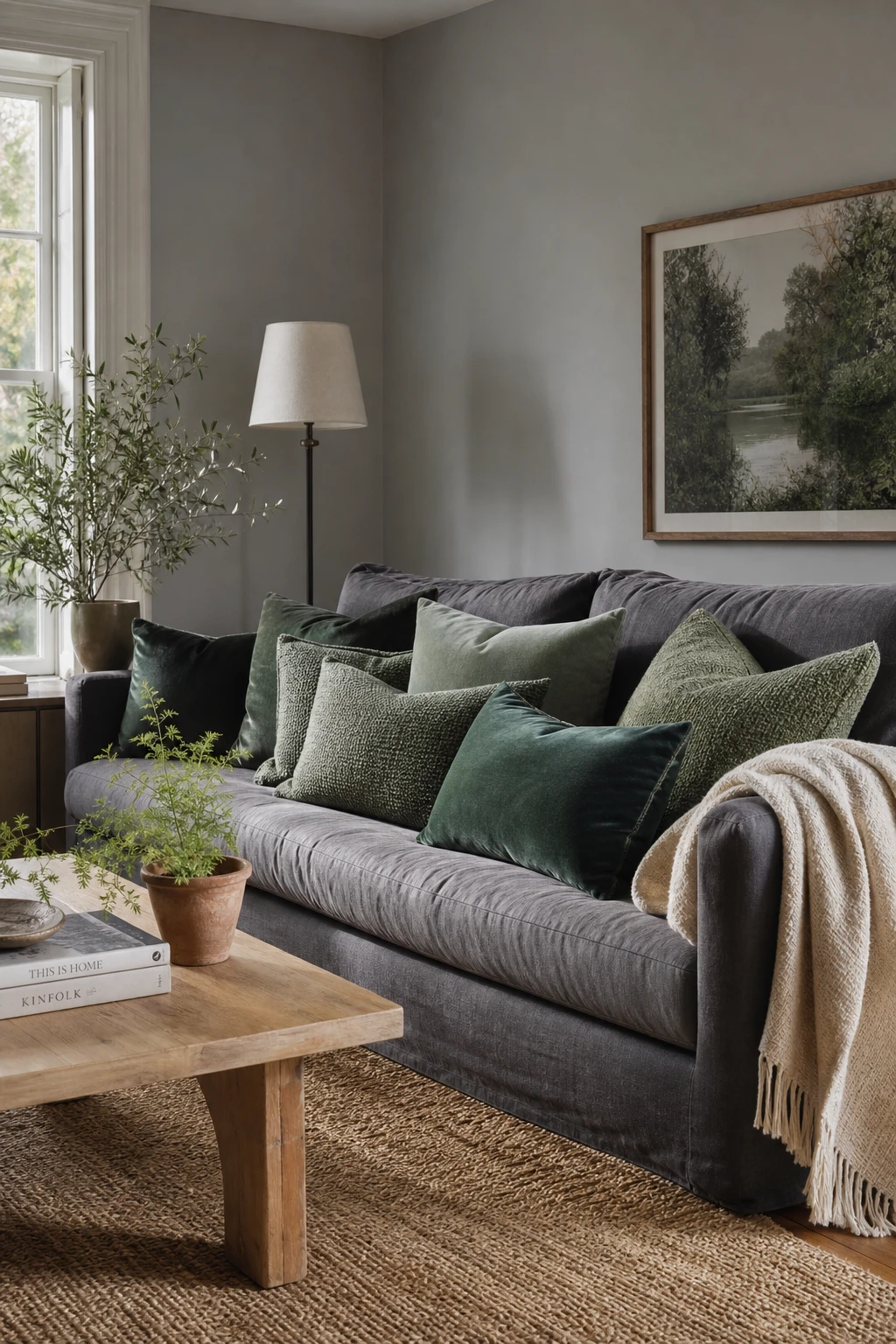
Green cushions on a gray sofa is honestly the lowest risk move in this whole colour pairing, and what I love most is how immediately alive it makes a neutral base feel. You get a genuine hit of colour without touching a single wall. The gray does the heavy lifting as a calm backdrop, and the green pops against it in a way that reads fresh rather than loud. It is my favourite trick for clients who are nervous about committing to colour.
The Key Details
Deep gray linen sofa
Mixed green velvet and woven cotton cushions
Pale oak coffee table
Chunky jute area rug
Linen shade floor lamp
Pro TipMix at least two cushion sizes and combine a velvet with a woven cotton so the arrangement looks collected rather than bought as a set.
AvoidSticking to a single shade of green across every cushion flattens the whole arrangement and makes it look like a shop display rather than a lived in room.
Green Leather in a Modern Living Room Looks Far More Inviting Than You Think
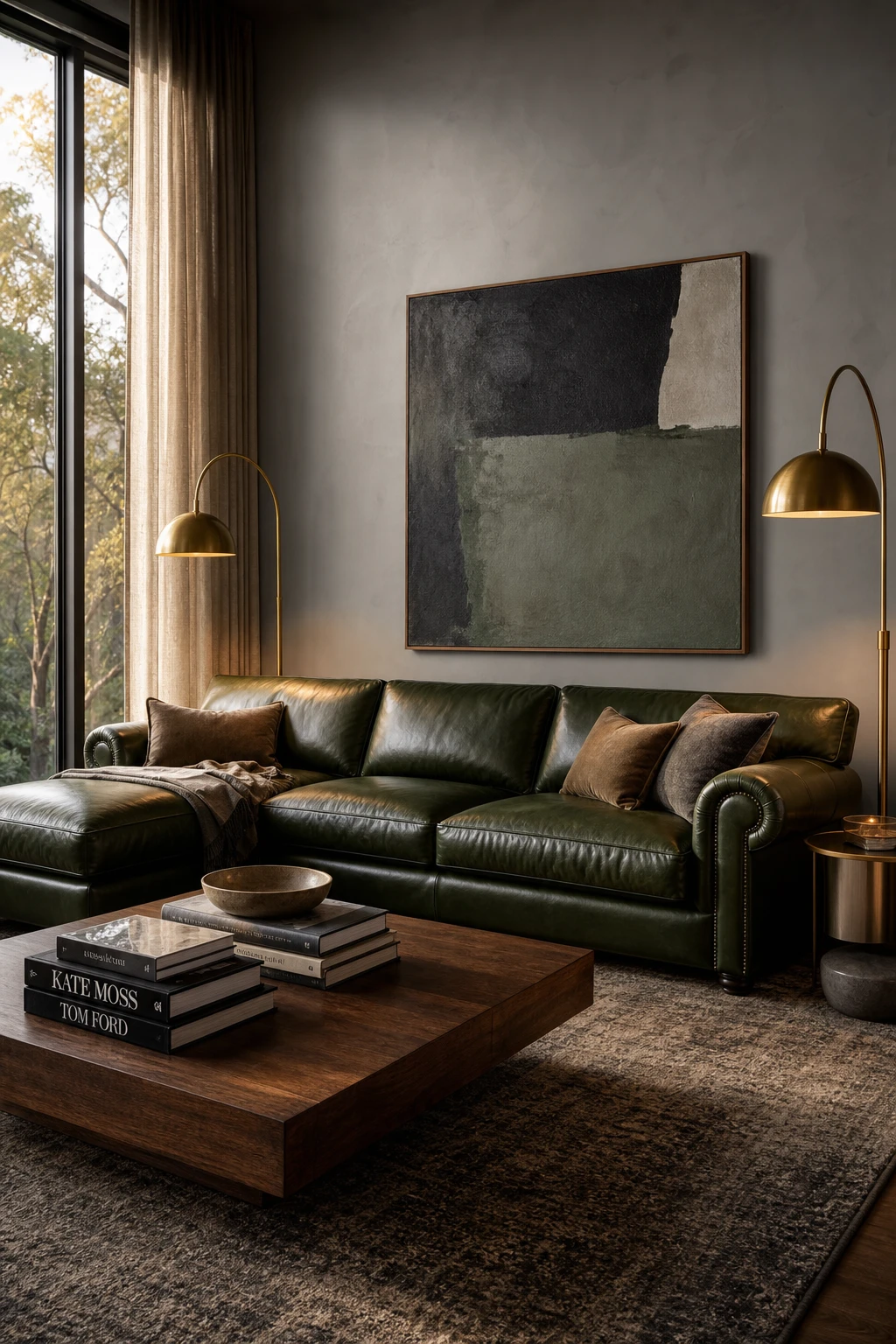
Green leather carries a quiet confidence that few other materials can match, and what I love most is the way it earns its place over time. You will notice the surface deepen and mellow with every season, picking up character that a fabric sofa simply never develops. The gray room gives it room to breathe, and together they feel grounded rather than loud.
The Key Details
Full grain leather sectional sofa
Oiled walnut coffee table
Brushed brass arc floor lamps
Abstract charcoal and sage canvas
Woven wool area rug
Pro TipLayer a raw linen throw or a loose cotton cushion against the leather to break its sheen and bring the whole sofa into a warmer, more lived in register.
AvoidPairing green leather with polished chrome or mirror bright metal finishes doubles the reflective surfaces in the room and pushes the space from sleek into cold and clinical.
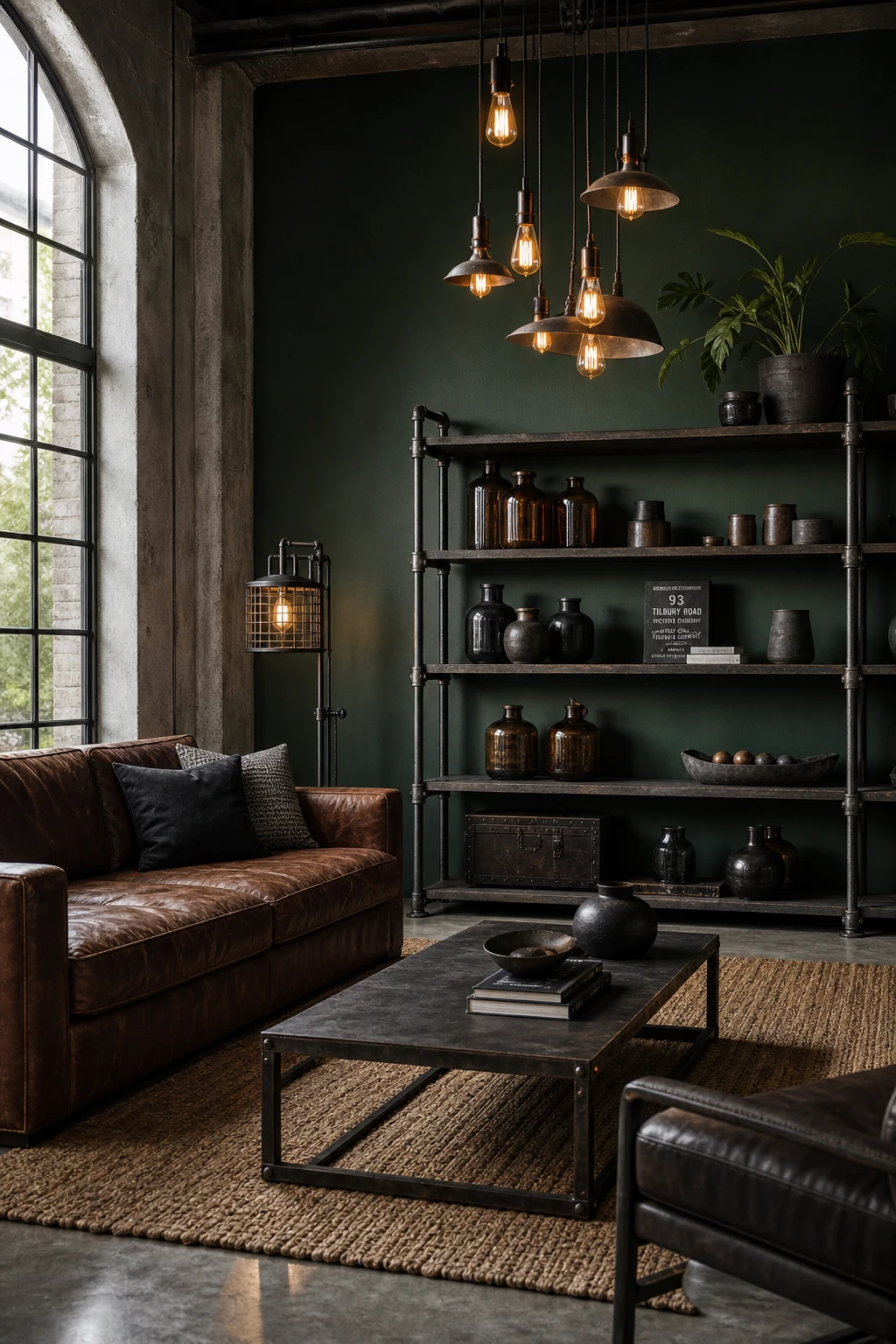
Dark Green Meets Raw Metal: the Industrial Living Room That Still Feels Warm
Dark green and raw metal sounds like a cold pairing on paper, but watch how the green does all the warming work once you commit to a deep, rich shade. What I love here is the way bottle green absorbs the harshness of exposed steel and turns it into something almost earthy. You get the honesty of industrial bones without that chilly warehouse feeling, and the cognac leather pulls everything into a place that actually feels lived in.
The Key Details
Exposed steel pipe shelving unit
Factory pendant cluster with Edison bulbs
Cognac aged leather sofa
Sealed concrete floor with jute area rug
Grid steel window frame
Pro TipSwap any chrome fixings for aged bronze or vintage brass and the whole room shifts from factory floor to something far moodier and more welcoming.
AvoidSticking to cold chrome throughout strips out every last bit of warmth and leaves dark green looking flat and unwelcoming rather than rich and grounded.
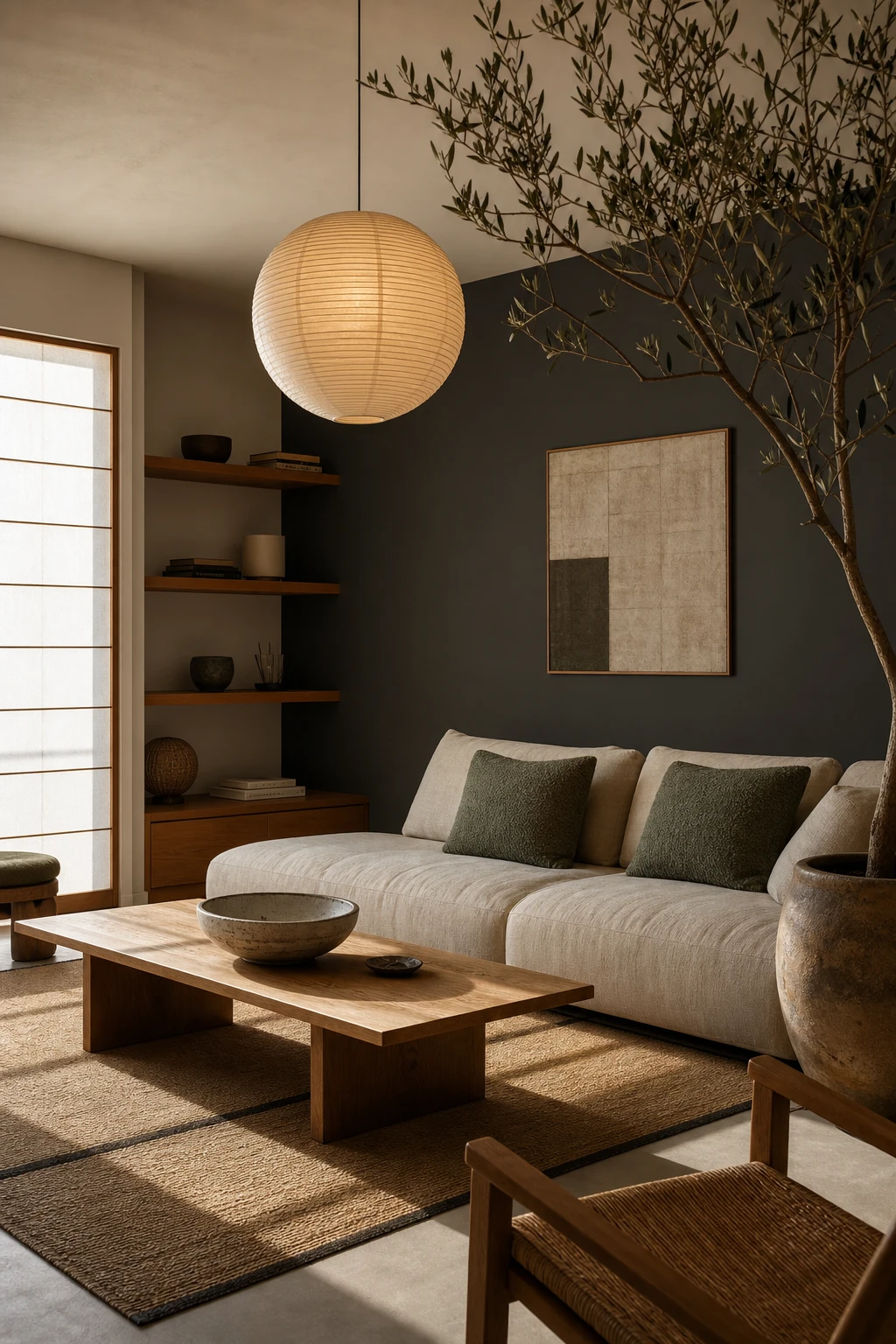
How Color Fits Into a Japandi Living Room Without Breaking the Calm
Japandi gives colour almost nowhere to hide, and that is exactly what makes it work so well. When I bring green into this kind of room, it has to earn its place through texture and material rather than surface decoration. A celadon ceramic or a sage linen cushion reads as calm rather than colourful because the tone is so close to nature. You get warmth without restlessness, and the whole room holds that quiet Japandi stillness you came for.
The Key Details
Low profile linen sofa
Washi paper pendant light
Solid oak coffee table
Tatami inspired jute rug
Potted olive branch
Pro TipKeep your colour only in materials that have natural origins, such as thrown ceramics, woven textiles, or living plants, so the green feels grown rather than added.
AvoidReaching for a bright or saturated green, even in a small accessory, pulls the eye sharply and unravels the restful atmosphere that makes Japandi so appealing in the first place.
Dark Green the Scandinavian Way: Cosy Without Being Heavy
Pale timber is the ingredient that makes dark green work in a Scandinavian room without the space ever closing in. Birch or ash furniture bounces light back into the room in a way that painted or upholstered pieces simply cannot, and you get the depth and drama of a forest green wall while the honey tones in the grain warm the cool undertones in the green. That is the exchange I find so quietly clever about this pairing: the wood does the heavy lifting so the green can stay as rich as it wants to be.
The Key Details
Pale birch wood sofa frame
Oatmeal linen cushions
Hand knotted grey wool rug
Whitewashed ash floorboards
Exposed timber ceiling beam
Pro TipChoose a sofa frame in birch or ash rather than a dark stained wood, so the pale grain sits right at eye level and stops the green from dominating.
AvoidFilling a dark green Scandinavian scheme with only upholstered and painted pieces leaves the green nowhere to breathe, and the room quickly feels flat and heavy.
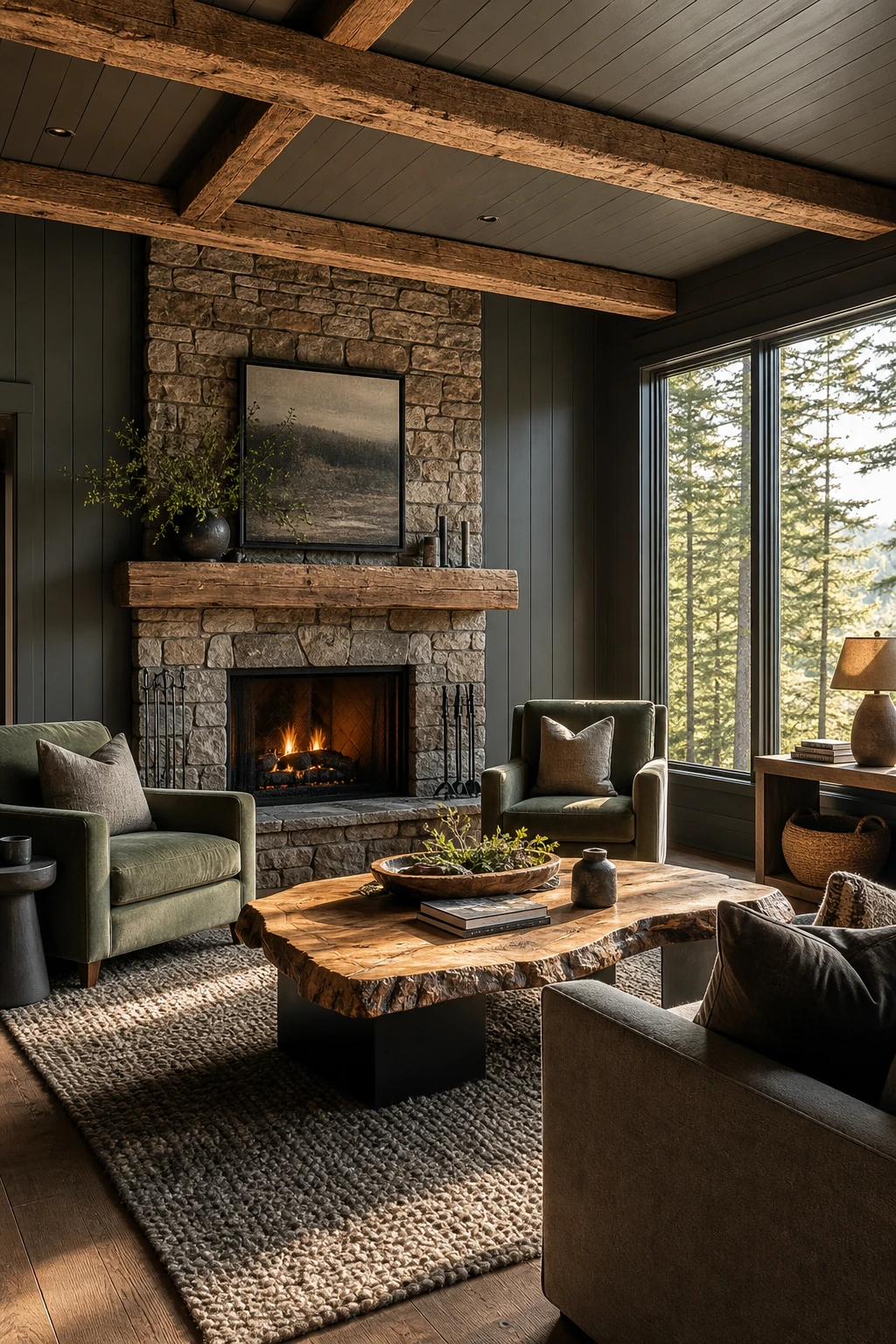
Bringing Cabin Warmth Into a Gray and Green Living Room
Cabin style wins me over every time because the materials do all the heavy lifting. Rough hewn beams overhead, a stacked stone fireplace, a live edge coffee table, a chunky wool rug underfoot: each layer adds something you can almost feel from across the room. Sage green linen chairs soften the gray and pull in the outside, and you get that sense of shelter without a single scented candle doing the work.
The Key Details
Exposed rough hewn timber ceiling beams
Floor to ceiling stacked stone fireplace
Sage green linen armchairs
Live edge oak coffee table
Chunky hand knotted wool area rug
Pro TipLayer a faux fur throw over a knit cushion on a reclaimed wood bench and you hit three textures at once, which is the fastest way to land that cabin mood without a full renovation.
AvoidPiling on too many rustic elements, antler mounts, rough hewn frames, distressed everything, pushes the room past cosy and into a look that feels stuck in time rather than intentional.
Going Dark and Moody: How Green and Gray Pull It Off Without Feeling Gloomy
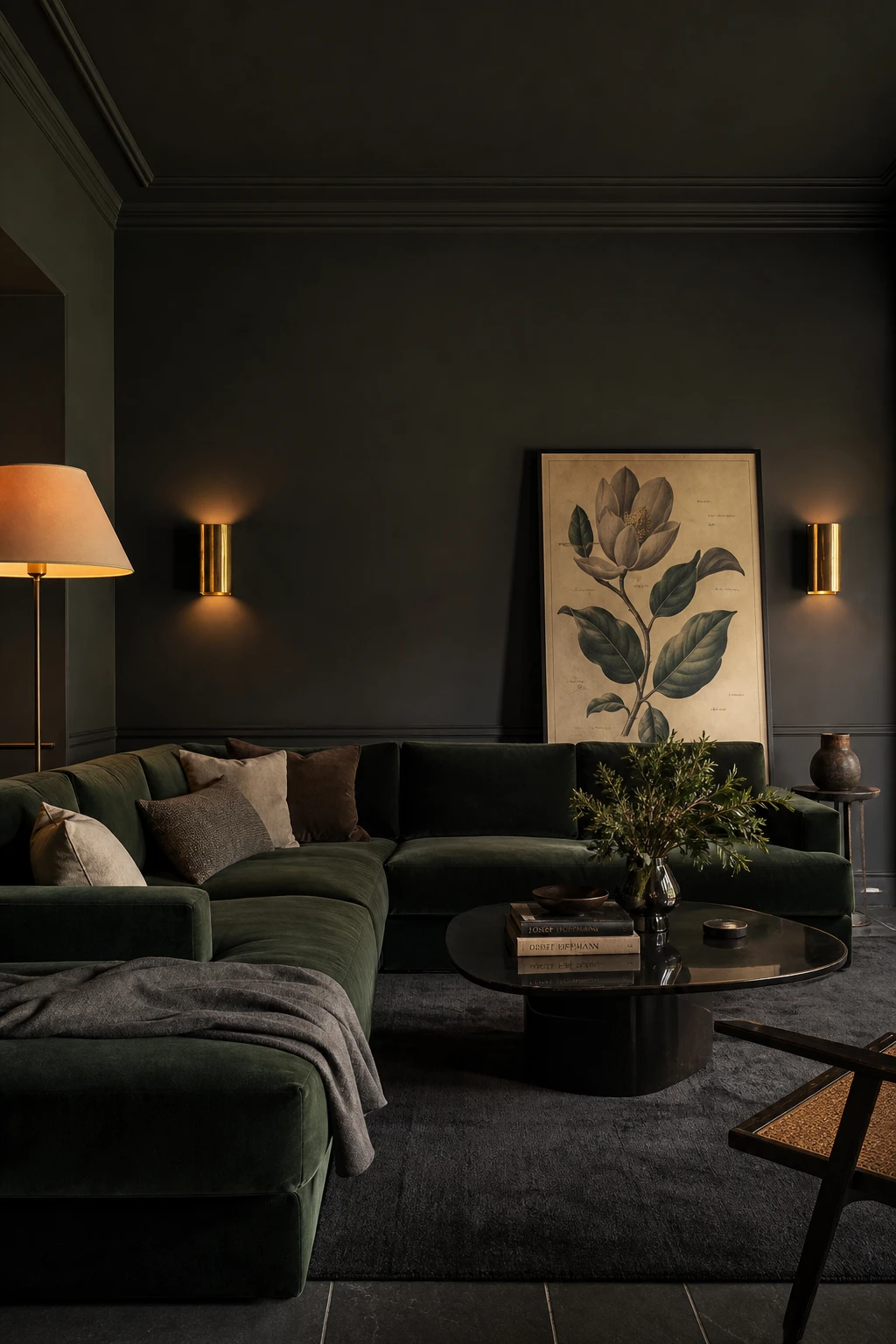
Dark rooms seduce you in a way bright ones simply cannot, and this green and gray pairing is exactly why I keep returning to moody schemes. The forest green pulls the eye inward while the charcoal holds everything steady beneath it, so you get depth rather than dreariness. That aged brass catching the low light and turning ordinary evening hours into something genuinely atmospheric is the detail that wins me over every time.
The Key Details
Forest green velvet sectional sofa
Aged brass wall sconces
Smoked glass cocktail table
Charcoal wool area rug
Oversized botanical wall print
Pro TipPosition an antiqued mirror directly opposite your softest light source so the room doubles its own glow without losing that brooding quality.
AvoidRelying on a single overhead fixture drains all the atmosphere from a dark scheme, leaving you with a flat, shadowy room instead of a beautifully layered one.
Sage Green and Burgundy: the Unexpected Partner That Makes the Room
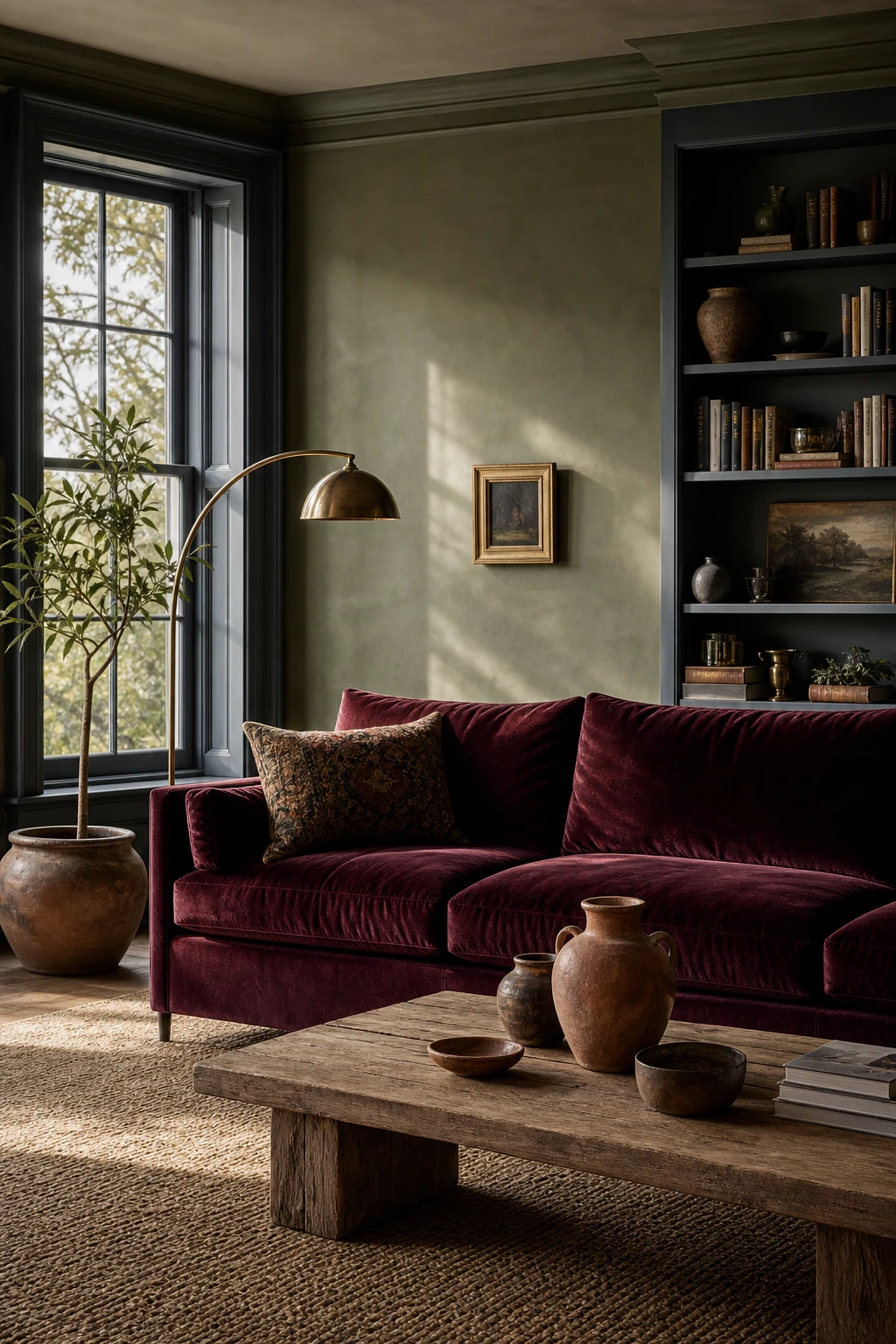
Sage green has a natural coolness that can tip into flat without something warm to pull it back, and burgundy is the answer I reach for every time. What wins me over is how little you actually need: a velvet armchair, a few book spines, a single bloom in a dark vase, and suddenly the whole room feels deliberate and alive. You get the freshness of the green and the richness of the burgundy without either one fighting for the top spot.
The Key Details
Burgundy velvet sofa
Sage green plaster walls
Antique brass floor lamp
Jute area rug
Terracotta ceramic vessels on oak coffee table
Pro TipBring burgundy in through books, dried florals, and a single framed print before committing to any larger piece, so you can feel the balance in the room first.
AvoidSplitting the room fifty fifty between sage and burgundy flattens both colours, leaving the scheme without a clear lead and making the space feel restless rather than considered.
Gold Accents in a Gray and Green Room: Where the Magic Actually Happens
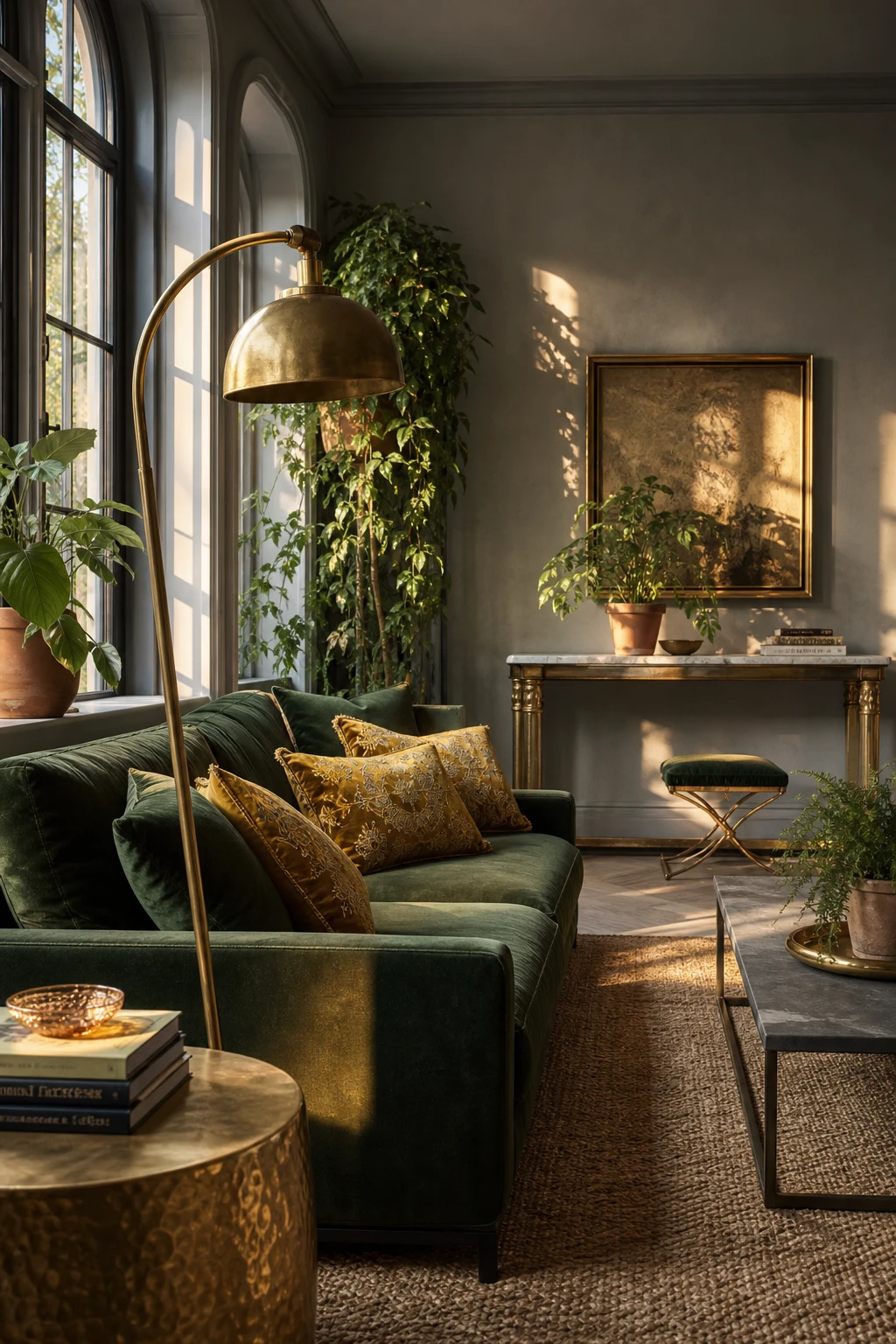
Gold is the thing I reach for when a gray and green room feels beautiful but somehow flat. Even a few warm metallic touches shift things quickly: the burnished brass and gilded details pull heat into the palette so the cool tones stop reading as cold and start reading as calm. You end up with a room that feels considered rather than accidental, every element anchored by that glowing thread of warmth running through it.
The Key Details
Forest green velvet sofa
Burnished brass arc floor lamp
Antique gold sculptural side table
Jute area rug
Marble topped console with gilded legs
Pro TipCluster your gold accents in one zone, a lamp, side table, and a frame grouped together, rather than dotting single pieces around the room, so the warmth reads as intentional and draws the eye in a single sweep.
AvoidMixing gold and silver metals in the same room splits the palette in two and the space ends up looking like it can’t make up its mind.
Green and Silver Together: Cooler, Sleeker, and Surprisingly Soft
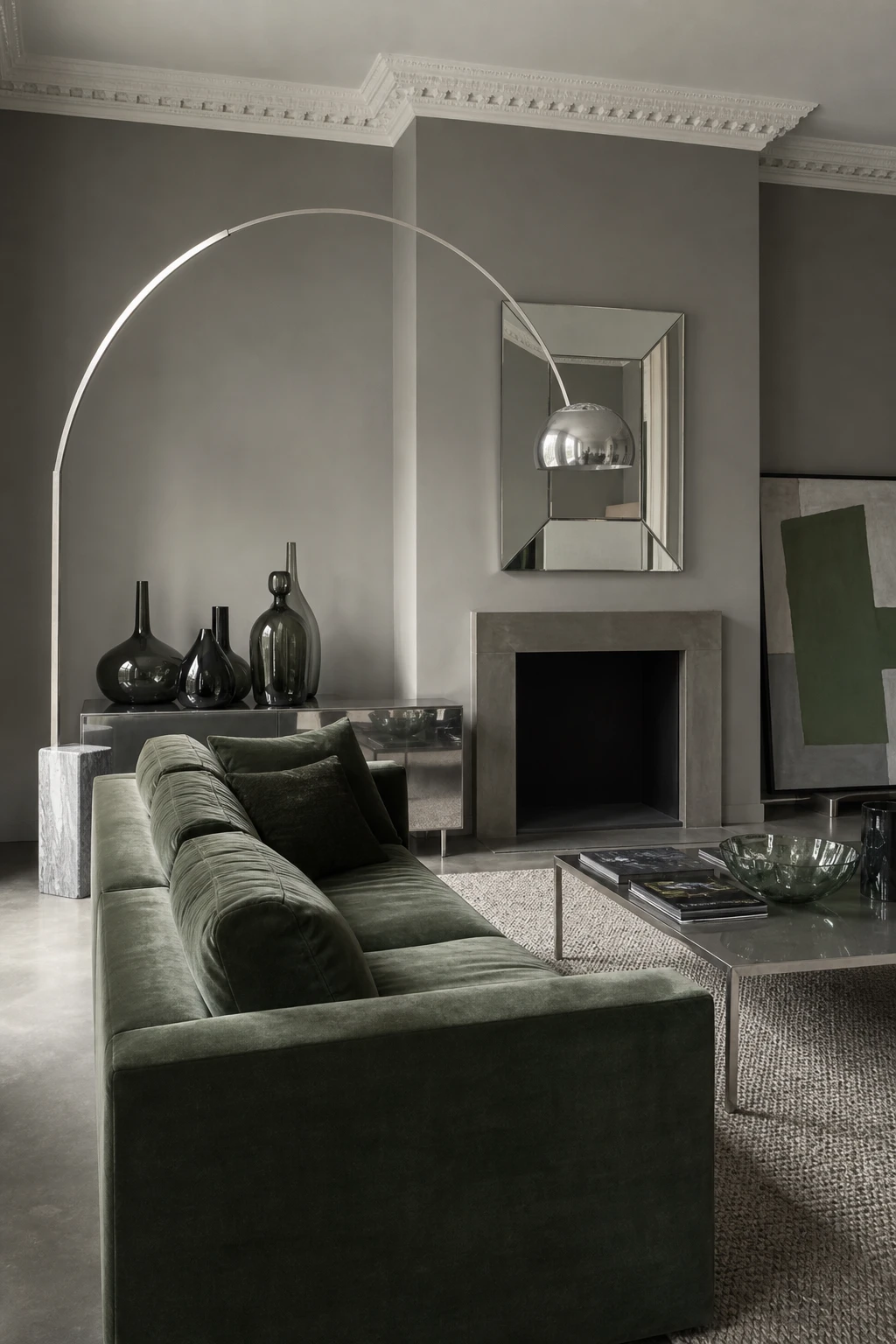
Green and silver is a pairing I keep coming back to, because the metal sharpens the green without pulling it toward warmth the way gold does. You get a palette that feels genuinely cool and composed, yet the sage velvet and honed concrete stop it reading cold. Watch how the silvered mirror bounces light across the room and suddenly the whole scheme feels airier and more considered.
The Key Details
Sage green velvet sofa
Polished silver arc floor lamp
Brushed silver console table
Silvered geometric mirror
Honed concrete floor
Pro TipReach for brushed silver over polished whenever you can, because the softer sheen keeps the room feeling relaxed rather than showroom slick.
AvoidPairing silver accents with yellow based greens leaves the metal looking flat and slightly grimy, so check your green sits on the cool or blue side of the spectrum before committing.
How a Geometric Rug Ties a Gray and Green Living Room Together
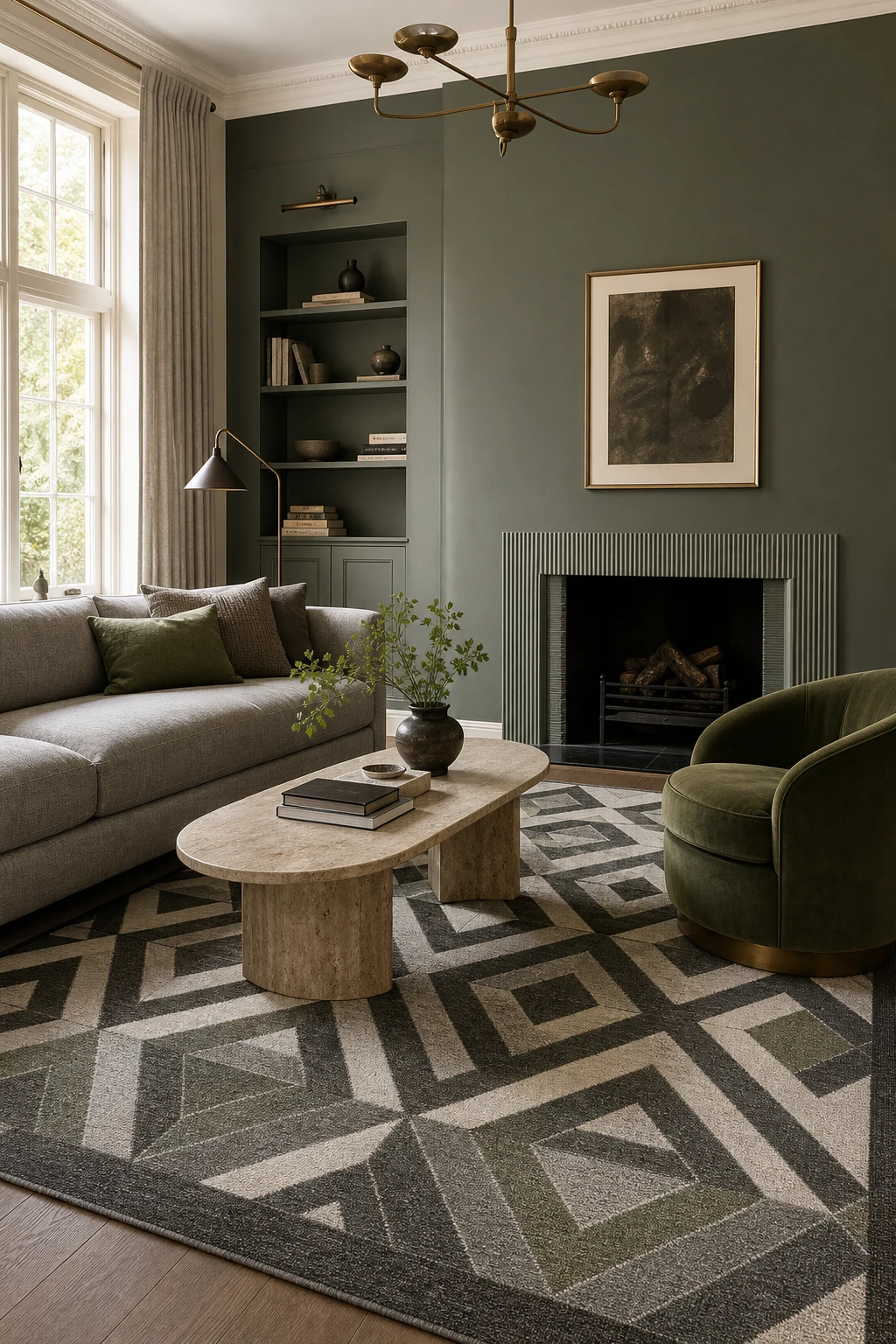
A geometric rug is the quiet peacemaker I reach for when a room has two strong colours that need a reason to belong together. What I love here is that the rug carries both the gray and the green in its pattern, so your eye reads the floor, the walls, and the furniture as one considered choice rather than three separate decisions. You get structure underfoot without adding a third colour to manage, and that geometry gives the whole room a grounded, finished feel.
The Key Details
Diamond and hexagon wool geometric rug
Low profile gray linen sofa
Curved green velvet accent chair
Oval travertine coffee table
Painted chimney breast feature wall
Pro TipHold a rug swatch against your sofa and your wall colour at the same time, because a rug that echoes both shades in even small amounts will pull the whole scheme together faster than any accessory.
AvoidPairing a large geometric rug with patterned curtains and a printed sofa splits the room’s attention three ways and leaves nowhere for the eye to rest.
Choosing the Right Area Rug When Your Sofa Is Already Green
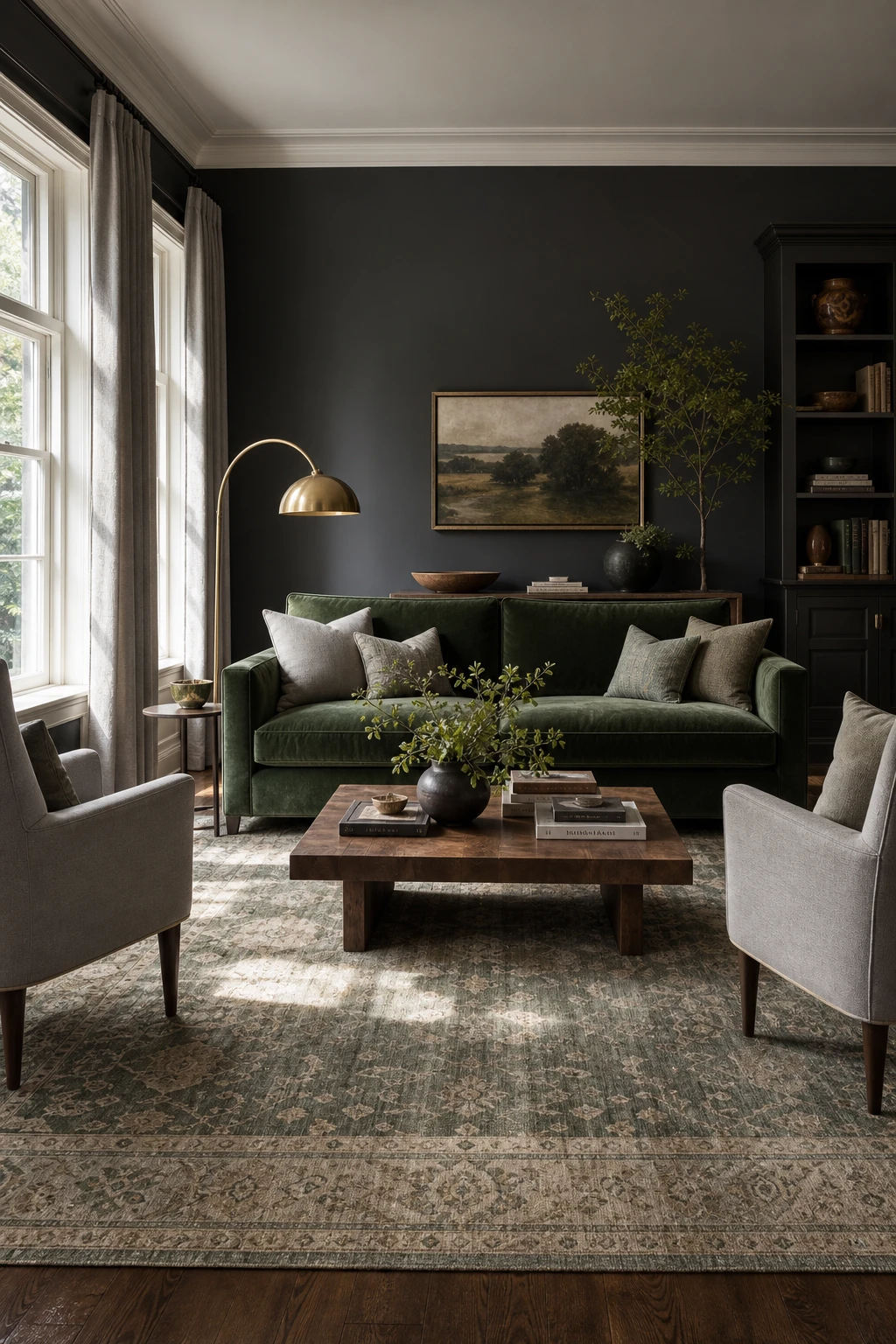
A rug under a green sofa does two jobs at once, and when you size it right, you will notice how the whole seating group suddenly looks intentional rather than arranged by accident. What I love here is the contrast: a natural, textured rug pulls the eye downward and gives the green somewhere to land, so neither piece is competing. The front legs of every chair and the sofa all sit on the rug, which tells the room where the conversation zone begins and ends.
The Key Details
Hand Knotted Wool Patterned Area Rug
Deep Forest Green Velvet Sofa
Low Walnut Coffee Table
Brushed Brass Arc Floor Lamp
Tall Casement Windows
Pro TipGo at least 30cm wider on each side than your sofa footprint so all front legs sit comfortably on the rug and nothing looks like it is floating.
AvoidChoosing a rug in the same deep green as the sofa means both pieces blend into each other, and the layering you worked hard to create simply vanishes.
Plants as Decor: How Living Green Finishes a Gray and Green Room
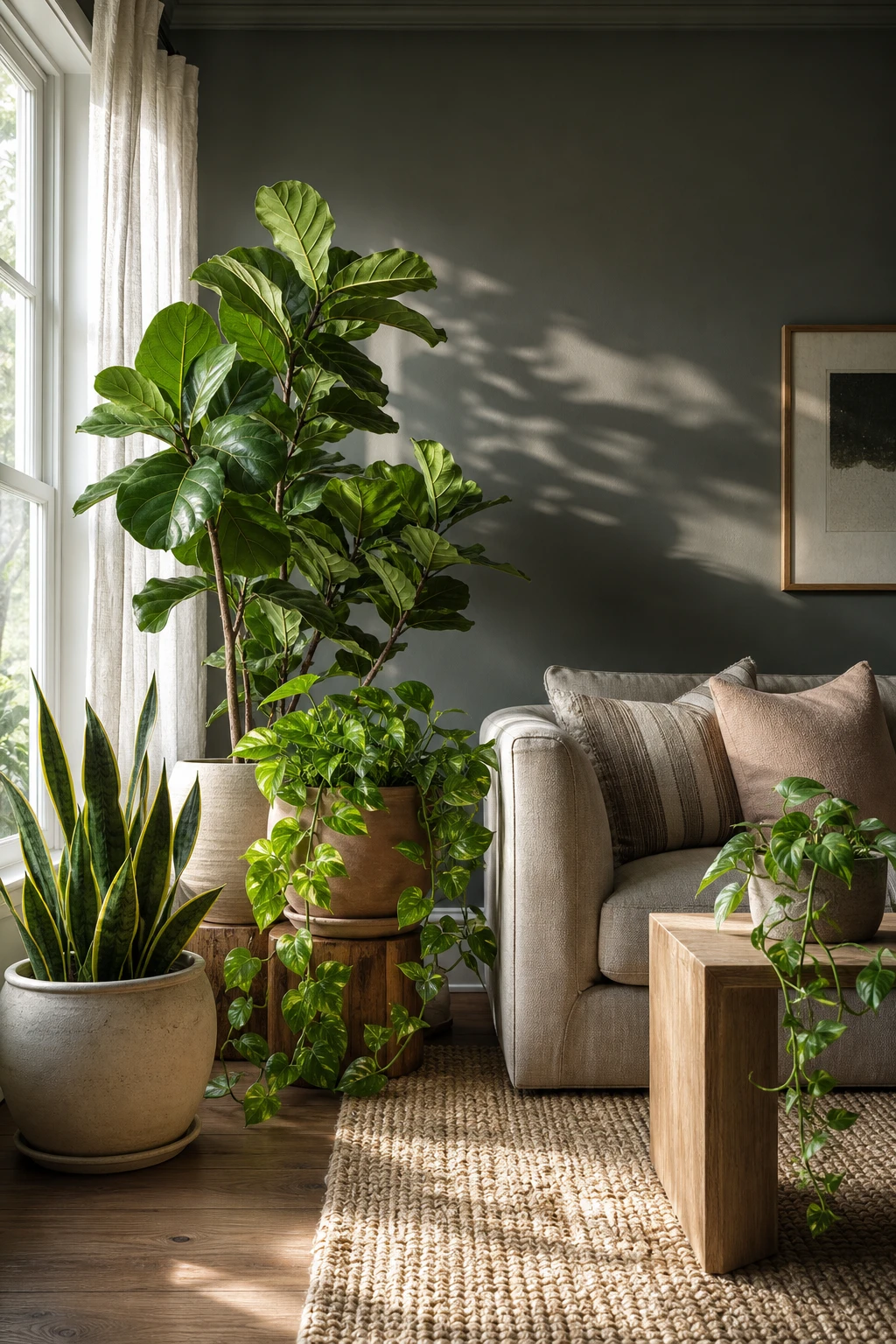
Plants are the one design element that genuinely do the colour work for you, layering every shade of green from lime to deep forest without a single tin of paint. What I love about grouping a fiddle leaf fig with trailing pothos and a tall snake plant is how each leaf reads differently against gray walls, so you get real depth and movement. You will notice the room feels alive in a way that cushions and throws simply cannot match.
The Key Details
Oversized ceramic and terracotta plant pots at varied heights
Fiddle leaf fig, pothos and snake plant grouping
Linen upholstered sofa in warm greige
Raw oak side table
Handwoven jute area rug
Pro TipArrange your plants in a loose triangle, one tall, one mid height and one low, so the grouping has a natural, almost sculptural shape rather than a flat row.
AvoidTucking plants into a dim corner because they look good there on day one leads to yellowing leaves and a sad, scraggly display within weeks.
Getting the Lighting Right Is What Makes Green and Gray Look Their Best
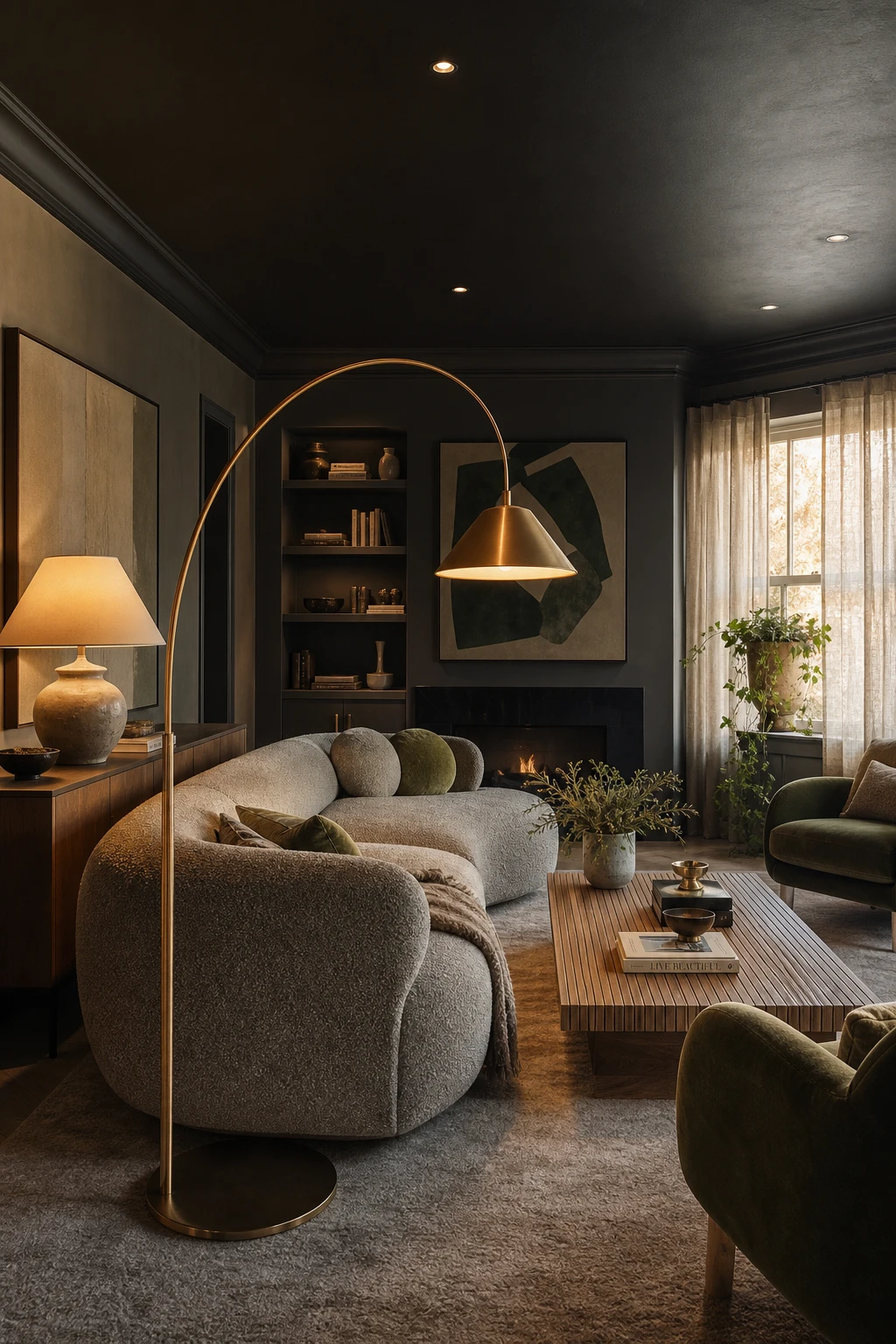
Sage and gray shift dramatically depending on what light hits them, which is why layering light sources is always the first thing I check in a room like this. A brass arc lamp in one corner, a ceramic table lamp on the console, and soft recessed ceiling lights working together give you warmth and depth at every hour of the day. The sage velvet cushions lift in the evening glow and the gray stops feeling cold or flat, and that transformation is what makes getting the lighting right so worthwhile.
The Key Details
Curved arc floor lamp in brushed brass
Ceramic table lamp on side console
Recessed ceiling lights
Sage green velvet cushions on bouclé sofa
Sheer linen drapes at full height window
Pro TipFit every lamp in the room with a warm white bulb rated around 2700K and you will stop cool grays and greens from draining of life the moment the sun goes down.
AvoidRelying on a single ceiling fixture as your only light source flattens every colour and texture in the room, turning a considered palette into something that looks dull and unfinished.
A Reading Corner That Earns Its Place in a Gray and Green Living Room
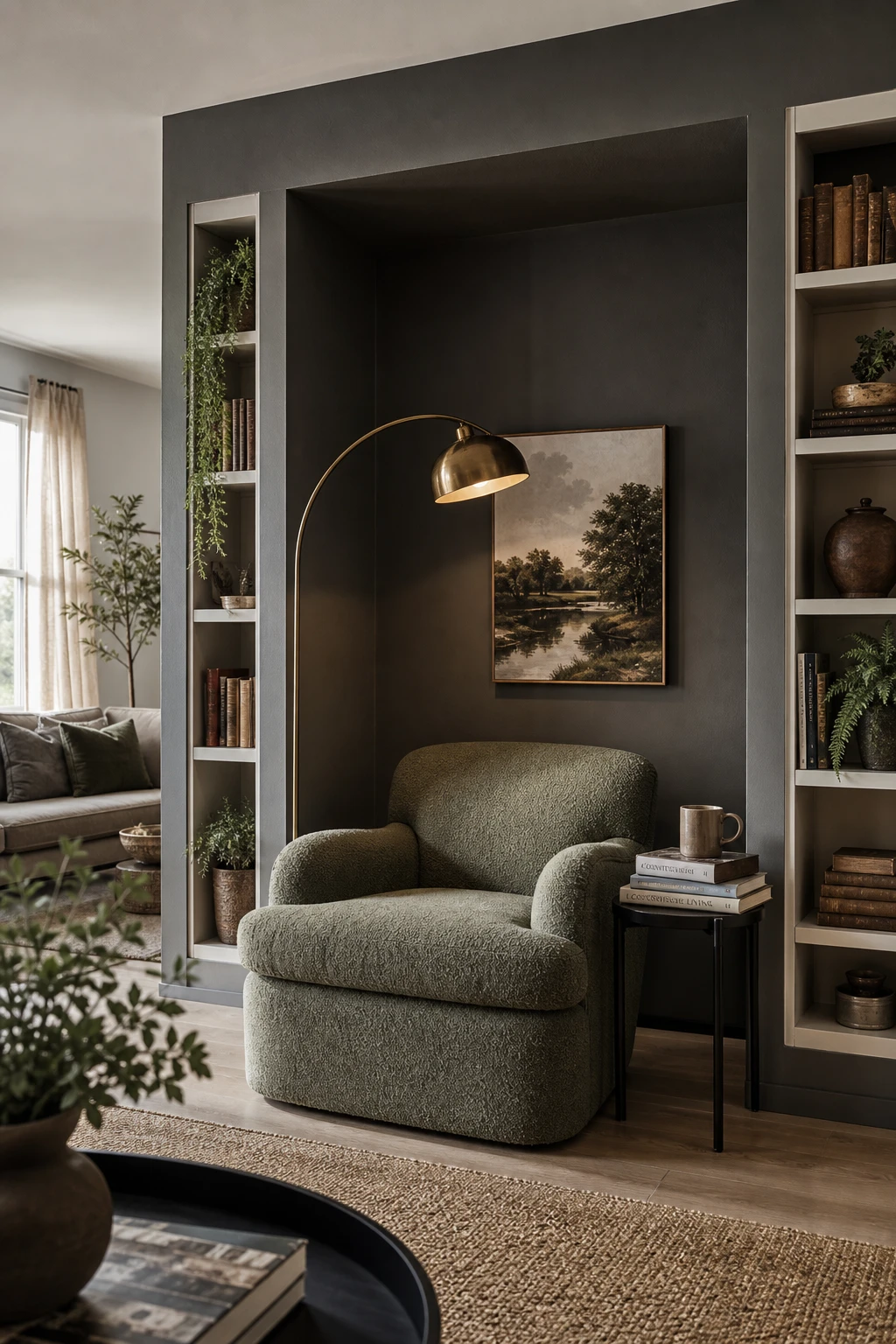
A reading nook carved out of a larger gray and green living room gives the space a second heartbeat, somewhere smaller and more personal than the main seating group. A sage green bouclé chair is the piece I always start with, because it anchors the zone instantly and creates that warm sense of arrival the moment you step into it. A brass arc lamp overhead and a trailing fern at the side pull the corner into something curated rather than crammed.
The Key Details
Sage green bouclé armchair
Brass arc floor lamp
Built in open shelving
Trailing potted ferns
Linen curtain panel
Pro TipPair your armchair with a compact open shelf at arm’s reach so your current reads, a candle, and a pair of reading glasses all have a proper home without cluttering the floor.
AvoidSkipping a side table entirely leaves books and mugs landing on the floor, and the whole nook quickly starts looking neglected rather than considered.
Alan launched Edward George London in 2017. Since completing his masters in Town & Regional Planning (MPlan) he has combined the skills he learned at the University of Sheffield with his passion for design, to help create a foundation for those looking to create a beautiful home.