Newsletter Subscribe
Enter your email address below and subscribe to our newsletter

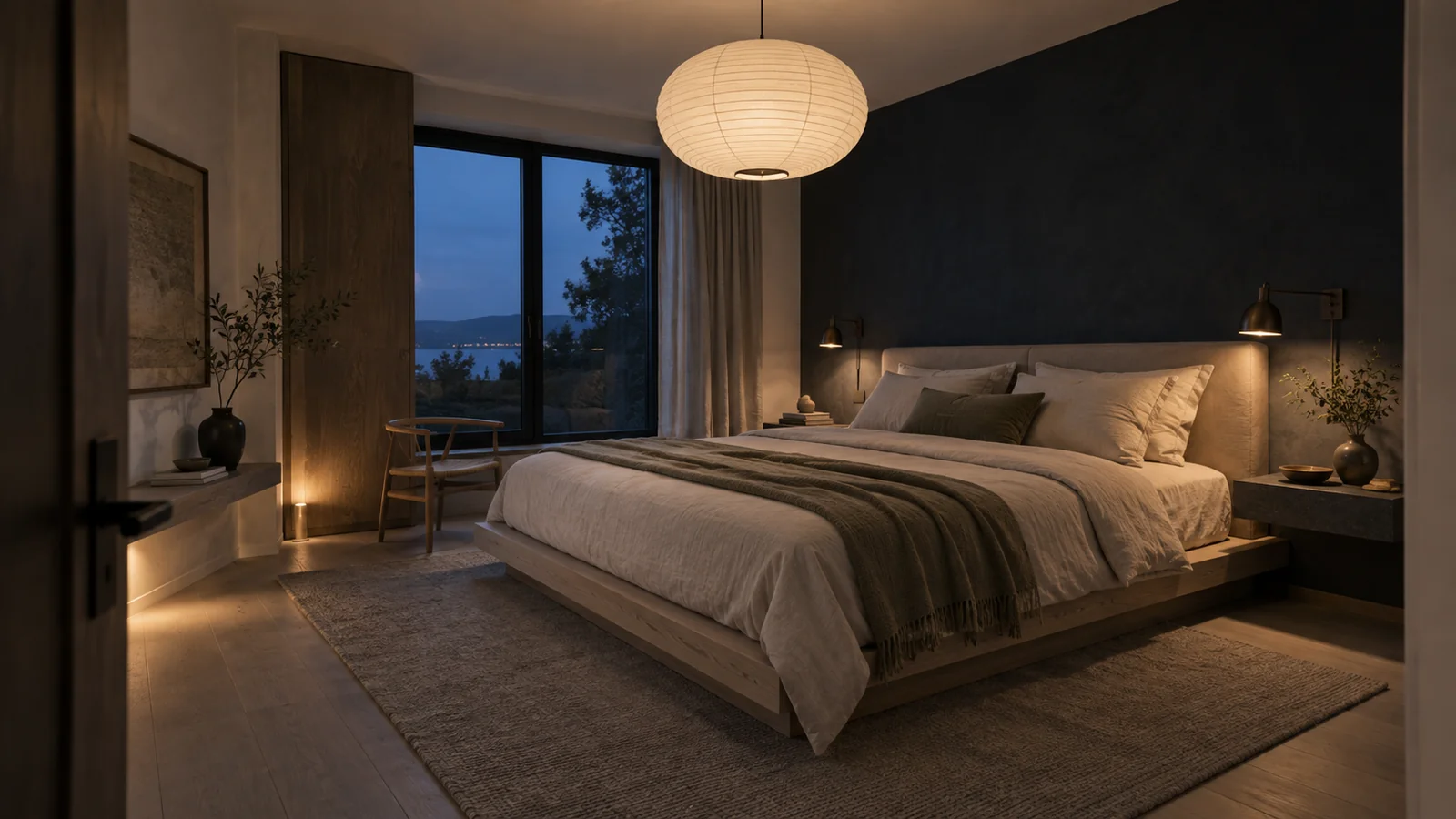
Japandi bedroom lighting works best when every source has a quiet purpose. The room still needs enough light for dressing, reading, finding clothes and moving safely, yet the fittings should never make the space feel busy. Begin with the actions that happen from morning to night, then give each one the smallest useful pool of light. A soft ceiling source can establish the room, bedside lights can support reading, and one restrained accent can reveal timber, paper or plaster after dark. This guide moves beyond choosing a beautiful lamp. It helps you decide what to light, where a fitting belongs, how warm the light should feel and which controls make the scheme easy to live with. The result is a bedroom that looks composed in daylight, remains practical in the evening and settles into a gentler atmosphere when it is time to rest.
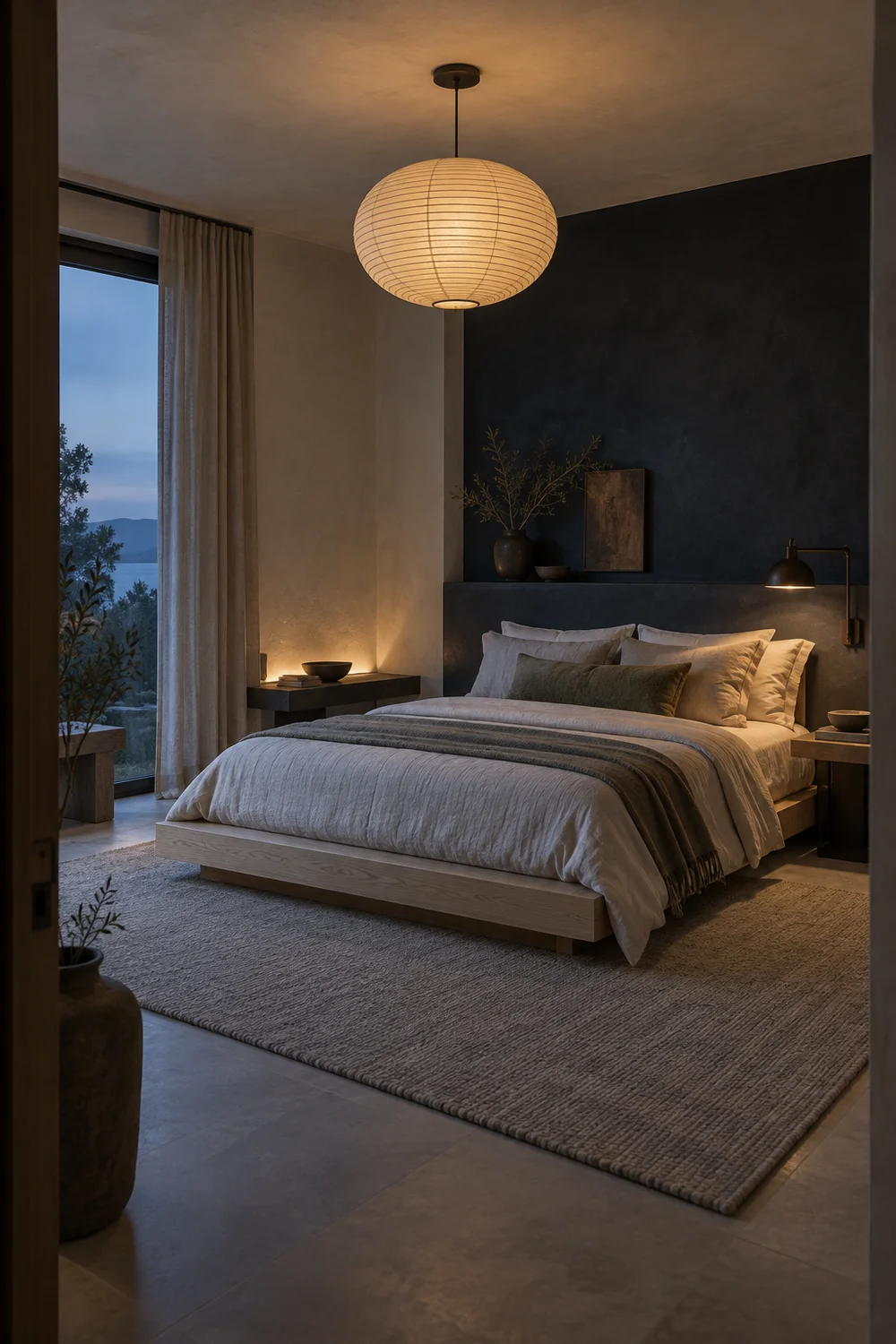
Start with a simple sketch of the room rather than a shopping list. Mark the bed, doors, wardrobes, dressing area, reading chair and any route to an ensuite. Then trace what you actually do. You may enter with your hands full, cross to a wardrobe, read on one side of the bed, charge a phone on the other and need a low light for moving through the room later. These actions are more useful than a generic rule about how many lamps a bedroom needs.
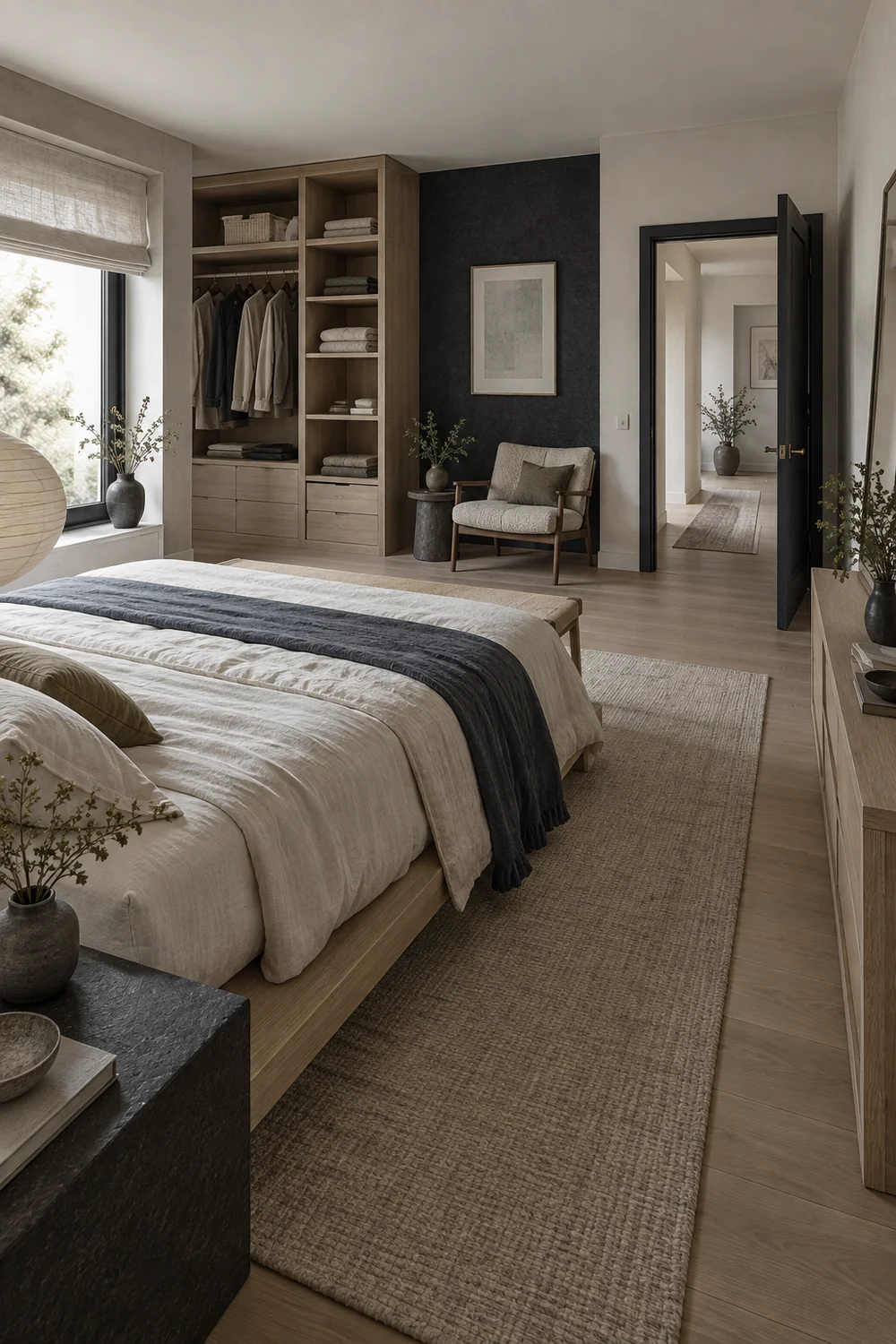
Give each action a clear lighting job. The entrance needs enough light to understand the room immediately. The wardrobe needs light that reaches clothes rather than falling behind you. A reading light needs to land on a page without shining into the other side of the bed. A mirror needs light from a flattering direction. The route through the room needs to remain clear without requiring the brightest ceiling light.
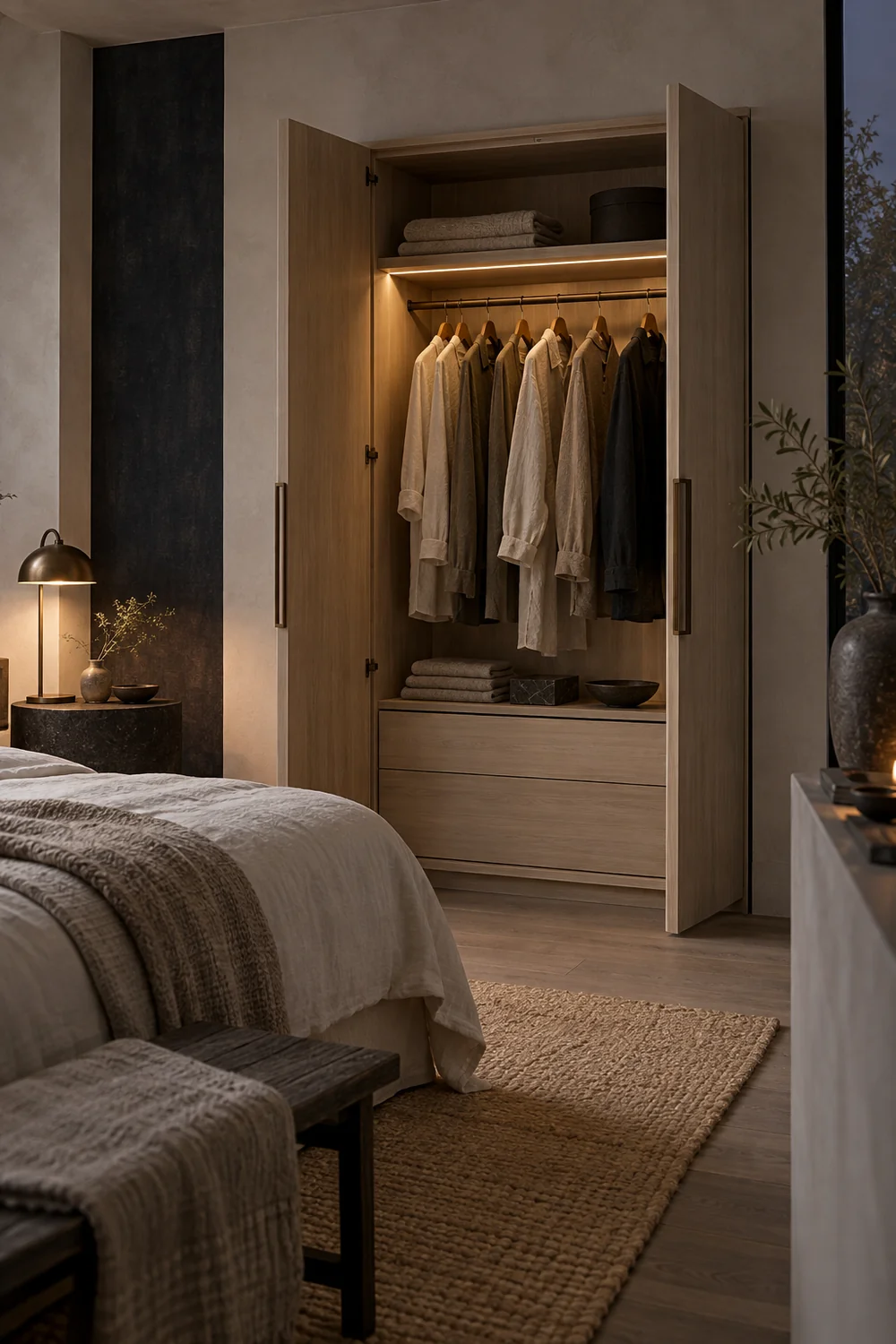
Now decide which jobs can share a source. A well placed wall light might illuminate a bedside table and provide reading light. A soft floor lamp might support a chair while also lifting a dark corner. Sharing is useful when it reduces clutter, but it should not leave one fitting trying to solve the whole room. Japandi restraint is not the same as underlighting.

The existing Relaxing Japandi Bedroom Designs guide explains the wider style, natural materials and calm furniture choices. Use that page for the overall room language. Keep this plan focused on the sequence of light, controls and useful placement. By separating those jobs, the lighting can feel simple without becoming vague.
Before choosing fittings, take photographs of the room in the morning, late afternoon and after sunset. Notice where daylight already does the work and where the room collapses into shadow. A north facing room may need support earlier in the day. A room with dark timber may need light closer to the surfaces you want to read. A pale room can still feel flat if all the light comes from one bright point overhead.
If the room already has deep timber tones, the examples in Japandi Bedroom Dark Wood Looks That Feel Calm and Quietly Luxurious can help you judge how warm light reads against darker surfaces. Use those examples for material context, then return to the task map here for placement and controls.
Think of the scheme as three related layers. Ambient light lets you understand the whole room. Task light supports an action such as reading or choosing clothes. Accent light gives depth to one material, object or architectural edge. The names matter less than the jobs, but the separation prevents a single ceiling fitting from becoming too bright and too dominant.
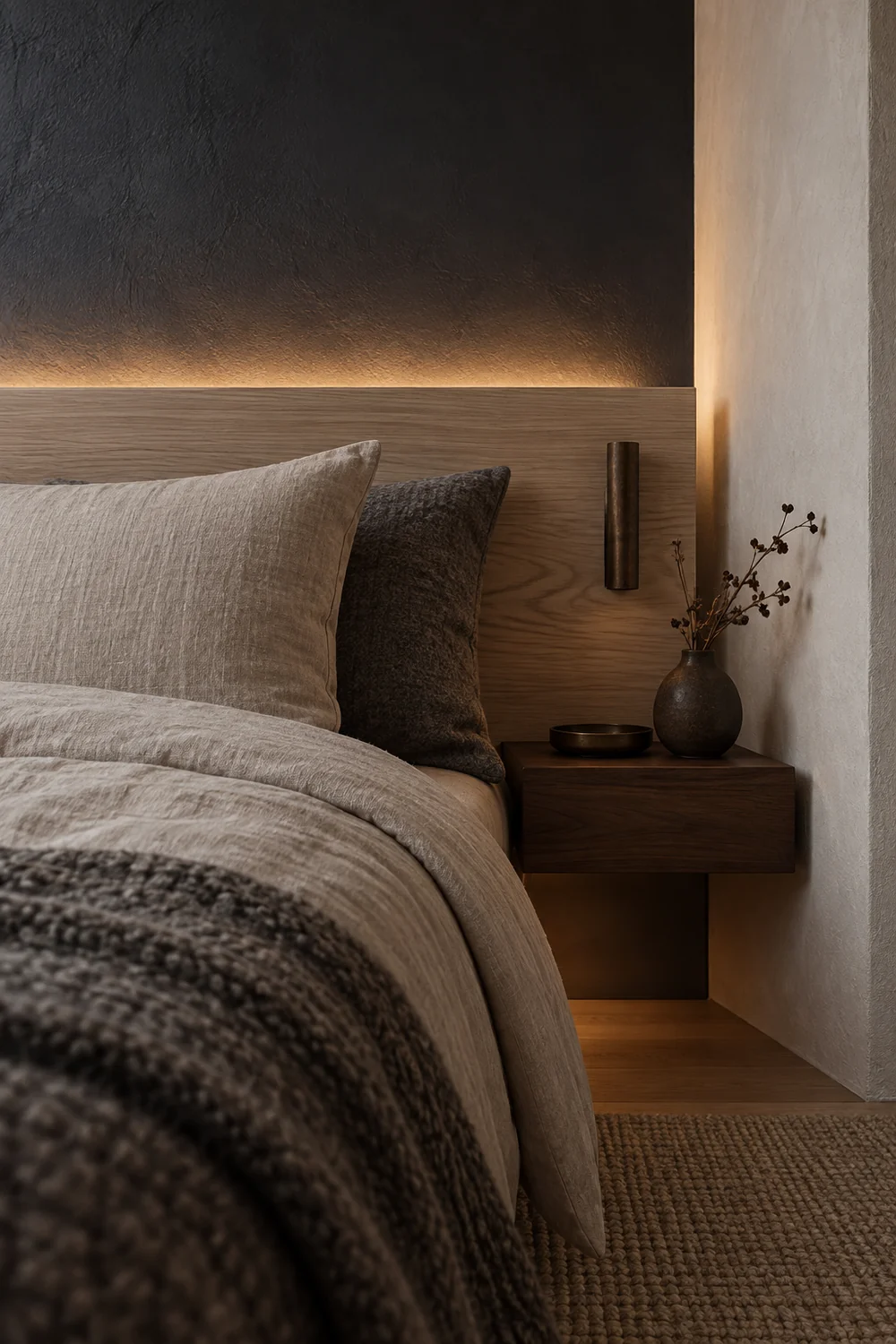
For ambient light, choose a broad diffused source. A paper shade, linen drum, opal glass globe or concealed reflected light can soften the transition between the bright fitting and the darker room. Diffusion suits a Japandi interior because it reveals texture without creating hard sparkle. The ceiling light should make the floor, bed and main route legible, not flatten every corner to the same brightness.
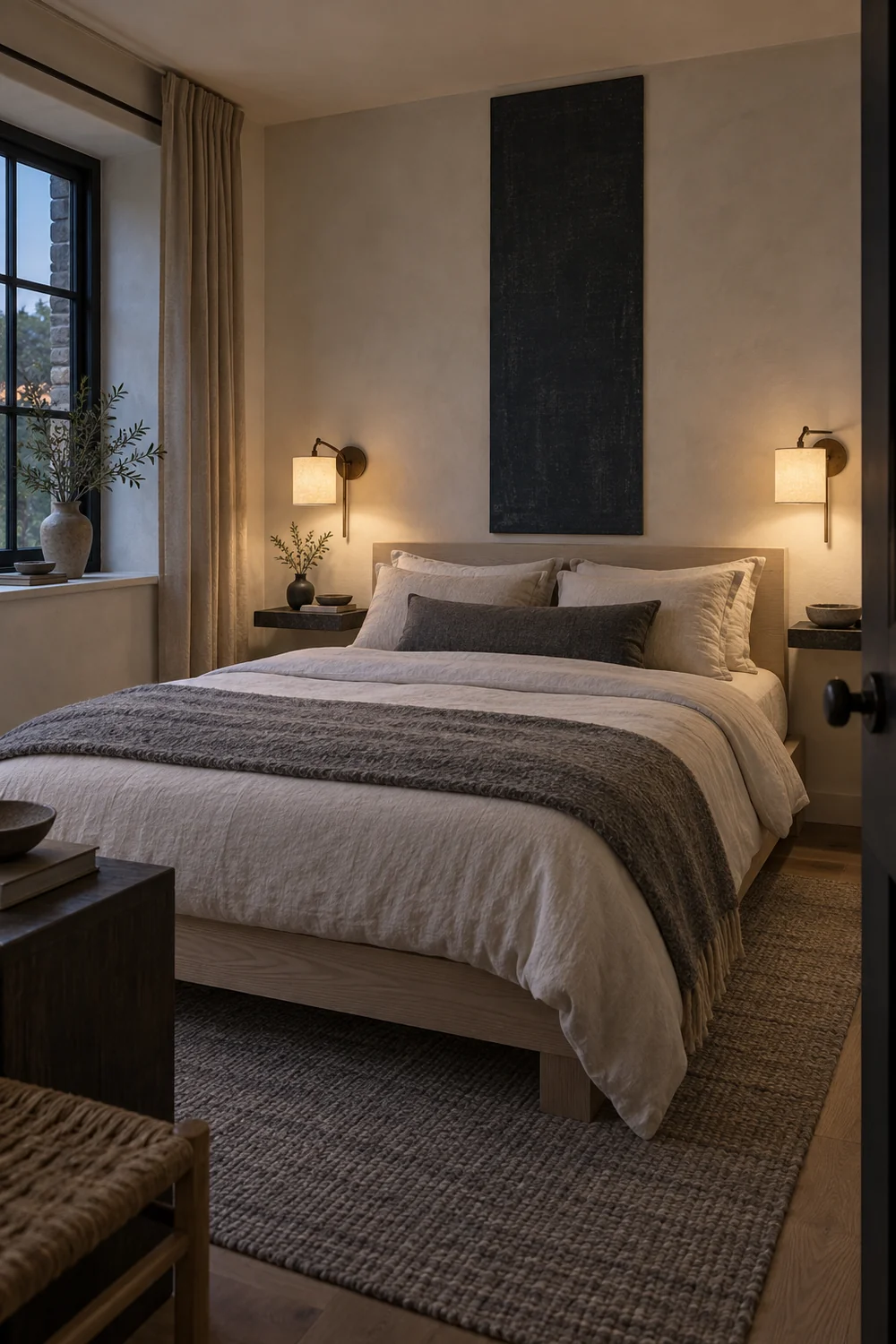
Task light should sit close to the activity. Bedside reading lights, a lamp beside a chair and carefully placed wardrobe lighting can provide more useful illumination with less total glare than one powerful overhead source. Direct the light onto the page, clothes or surface. If you can see the bare lamp while resting in bed, adjust the shade, angle or position before fixing it permanently.
Accent light is optional. One soft wash over lime plaster, a low glow beneath a shelf or a small lamp beside a ceramic vessel can give the room evening depth. Stop after the first convincing moment. Too many glowing edges make the room feel like a display rather than a place to sleep.
Test the layers independently. Turn on only the ambient source and walk the room. Add the task lights and try the real activities. Finally add the accent. If the room only feels complete when every source is on, the ambient and task plan may not be balanced. A useful Japandi scheme should offer several calm states rather than one theatrical scene.
The bed is the visual and practical centre of most bedrooms, so bedside light deserves more attention than matching lamps chosen at the end. Begin with the mattress height, the height of the people using the room, the position of pillows and the width of each bedside surface. A light can look perfectly centred in an empty photograph and still be awkward once someone sits up to read.
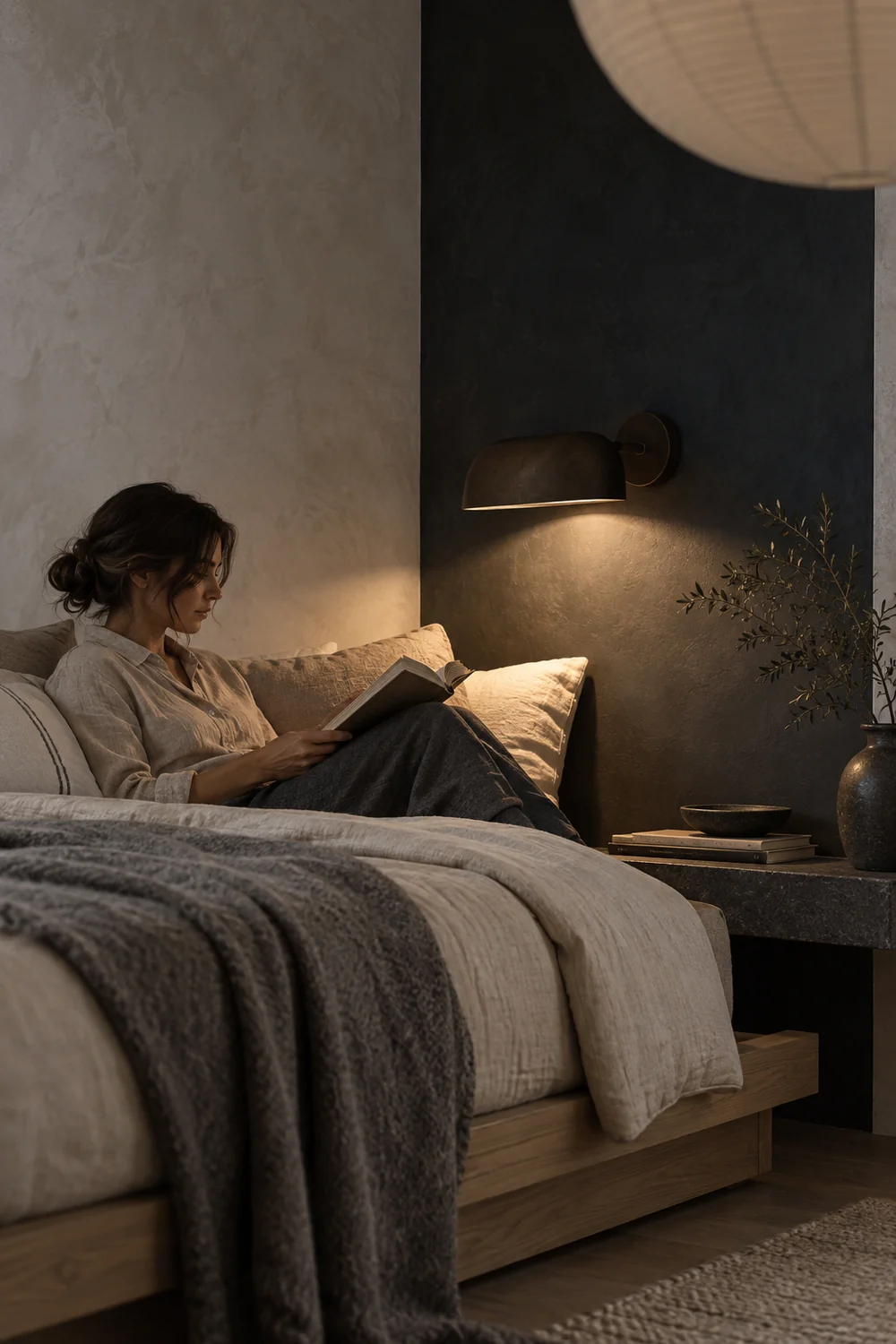
For a wall light, tape a paper outline to the wall and sit in bed. Check whether the light would reach the page, whether the switch is comfortable to use and whether the fitting would be hidden behind a raised pillow. An adjustable arm can be helpful, but a simple fixed shade often feels calmer when its beam already falls in the right place. The shade should conceal the brightest part of the lamp from a reclining view.
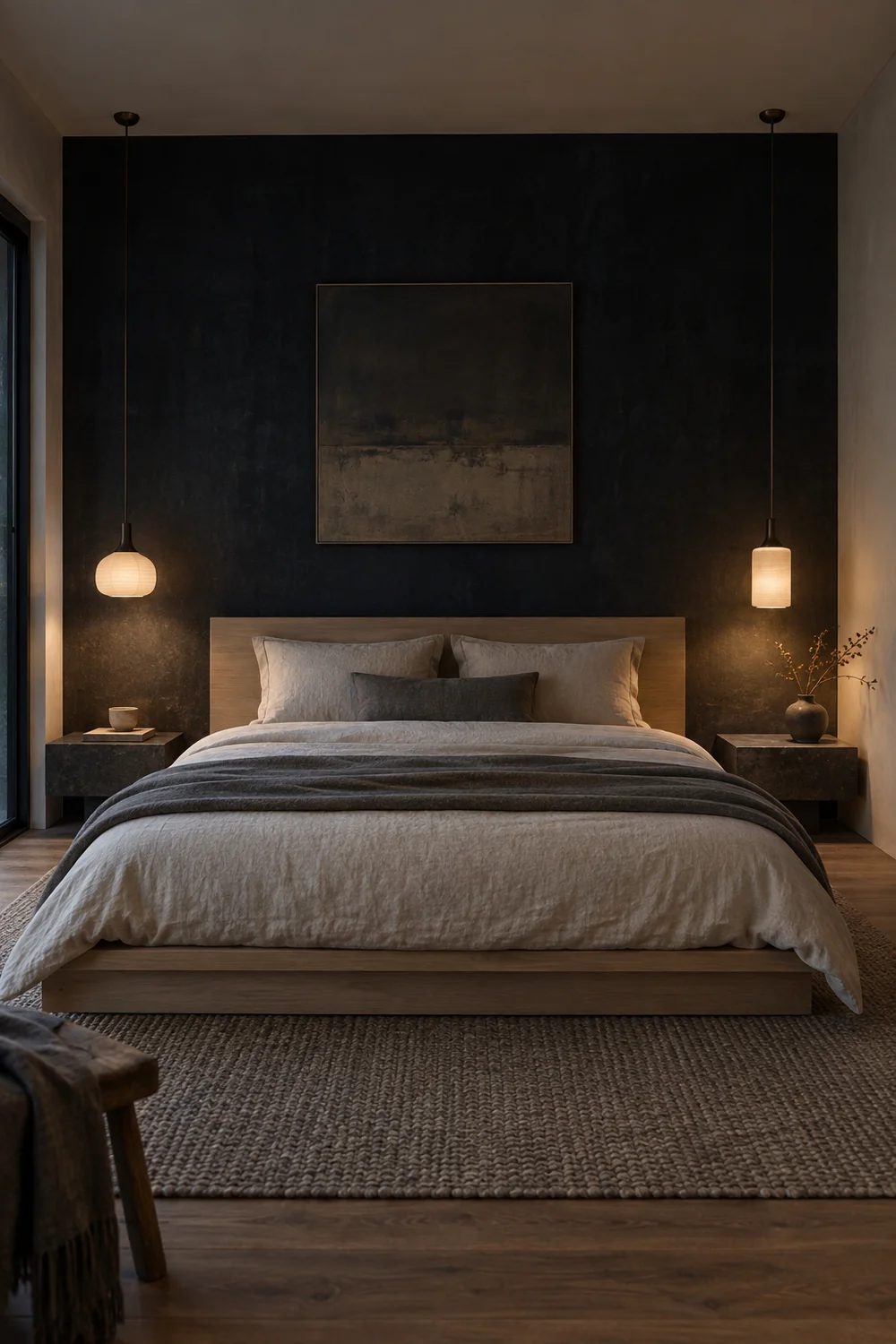
Pendant lights free the bedside surface and create a deliberate vertical line. They also require early planning. Mock up the drop with string and a paper shape. Check the view from the doorway, the clearance above the bedside table and the risk of someone leaning into the fitting. A pendant should frame the bed rather than hover in the path between bed and storage.
Table lamps remain a good choice when the layout may change or when new wiring is not wanted. Choose a base with enough weight, a shade that spreads light across the page and a scale that leaves room for a book and glass. A small lamp is not automatically more restrained. If it produces a harsh bright spot, a slightly larger diffusing shade may look and feel quieter.
The two sides do not have to match perfectly. They do need to feel related. One reader might need an adjustable wall light while the other side uses a soft table lamp. Repeat a material, silhouette or light colour so the pair belongs together. This is often more useful than forcing identical fittings onto different routines.
A Japandi room usually benefits from fittings with clear shapes and tactile materials. Rice paper, woven fibre, linen, ceramic, timber, opal glass and darkened metal can all work. The key is to choose a small material family and repeat it with discipline. One paper ceiling shade, two dark bronze wall lights and a ceramic floor lamp can feel coherent because each element has a separate job.
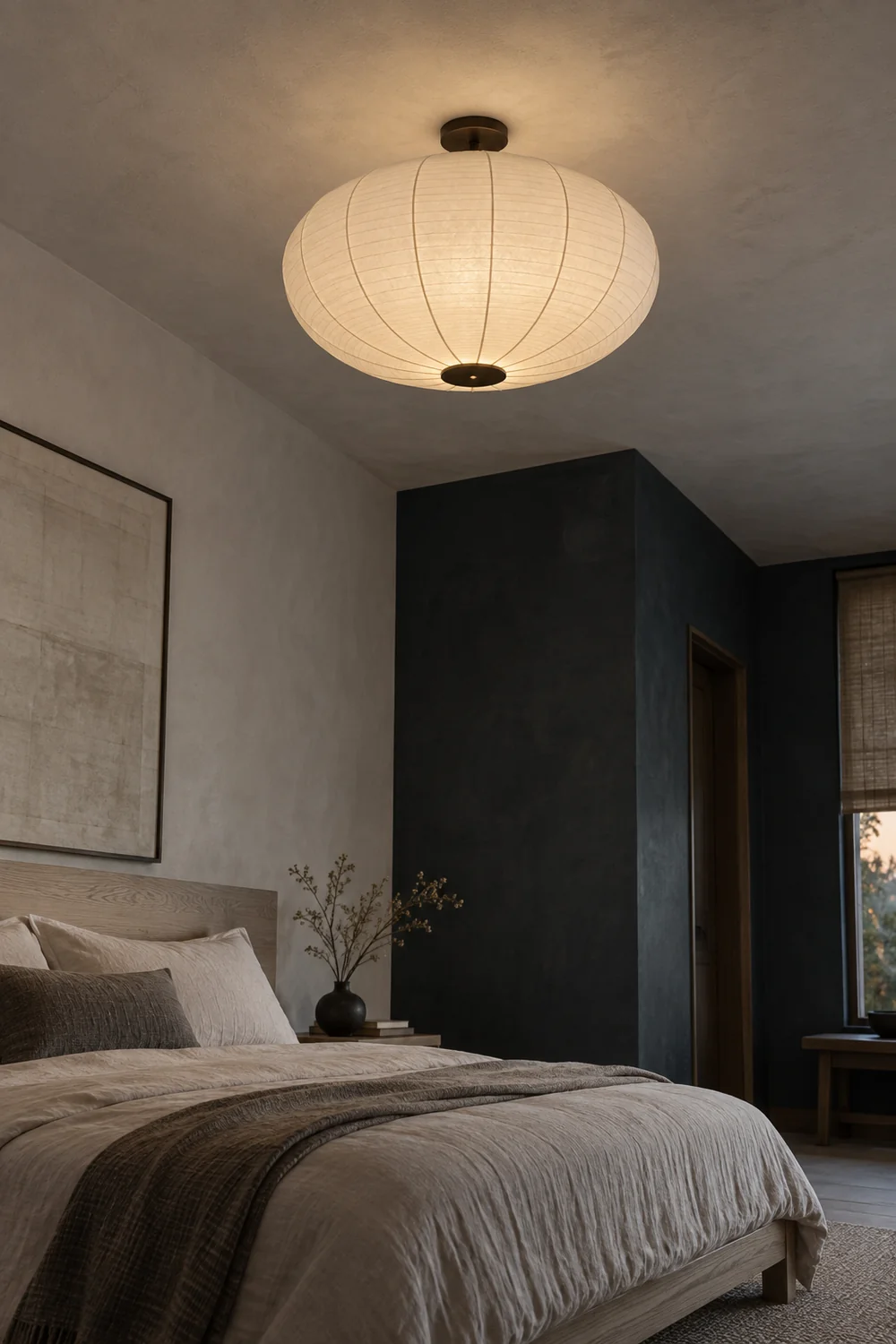
The ceiling fitting should respond to the room height. A low ceiling may suit a shallow diffused mount that keeps the view open. A higher ceiling can hold a paper pendant with more volume, provided the shape does not interrupt the main sightline or create a bright exposed lamp. Judge the unlit object as carefully as the glow because it remains visible for most of the day.
Wall lights are useful where floor area and bedside surfaces are limited. They can also introduce rhythm along a long wall or beside a broad headboard. Keep their placement connected to furniture or architecture. A lone decorative sconce without a task or visual relationship can feel more restless than helpful.
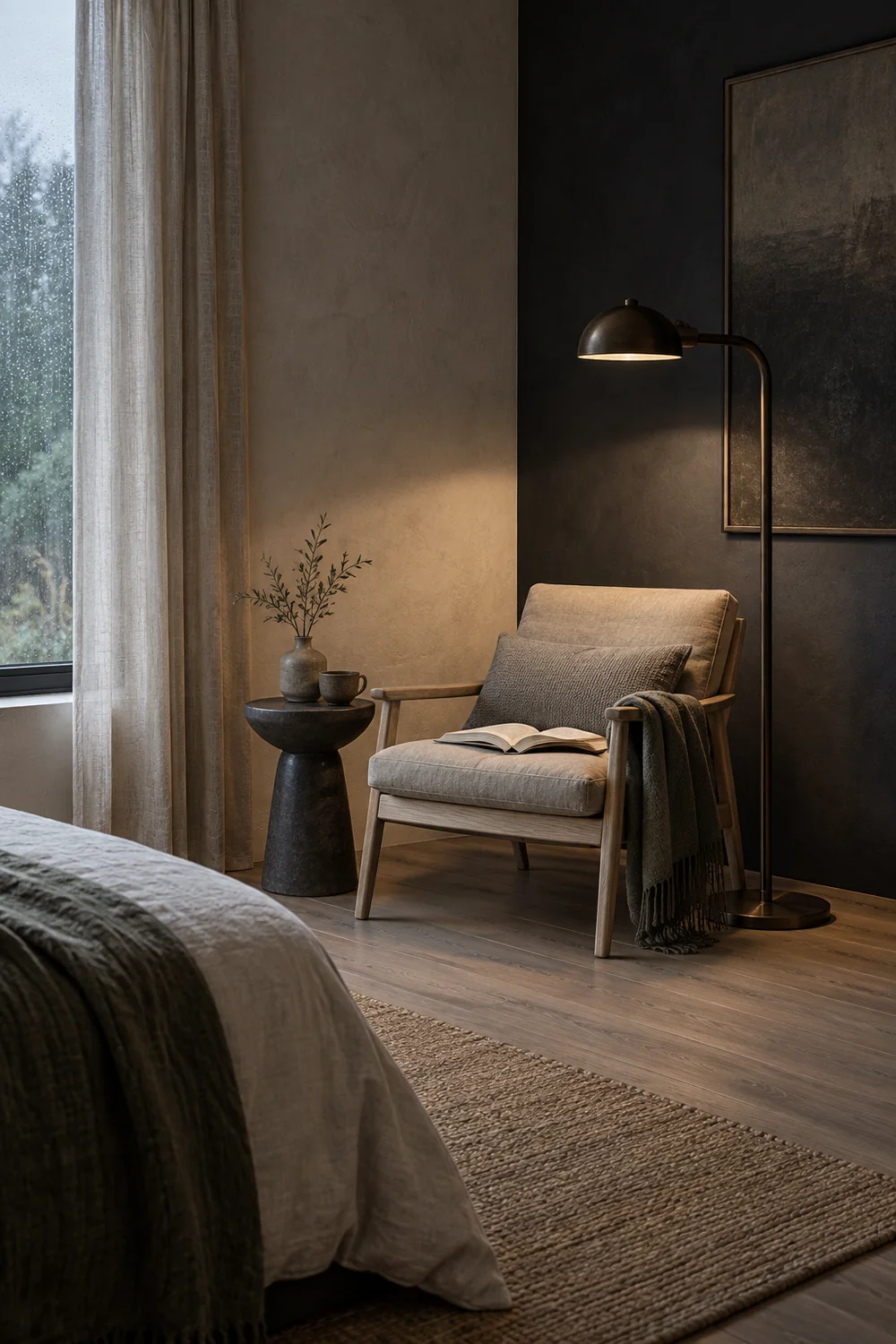
Floor lamps work best when they complete a usable corner. Place one beside a chair, near a low chest or where a wall would otherwise fall into darkness. Choose a base that does not narrow the route and a shade that hides the lamp from the doorway and bed. The aim is a pool of light, not a sculptural obstacle.
Avoid turning every fitting into a different style statement. Japandi rooms are strongest when material and proportion carry the interest. If the ceiling shade is visibly handmade, let the bedside lights become quieter. If the wall lights have expressive ceramic surfaces, keep the floor lamp plain. Restraint comes from editing relationships, not from choosing only tiny objects.
Read the light output on the package in lumens rather than judging brightness by watts. ENERGY STAR explains that lumens describe light output, while watts describe the energy a lamp uses. This distinction matters when different LED products can produce similar light with different power requirements.
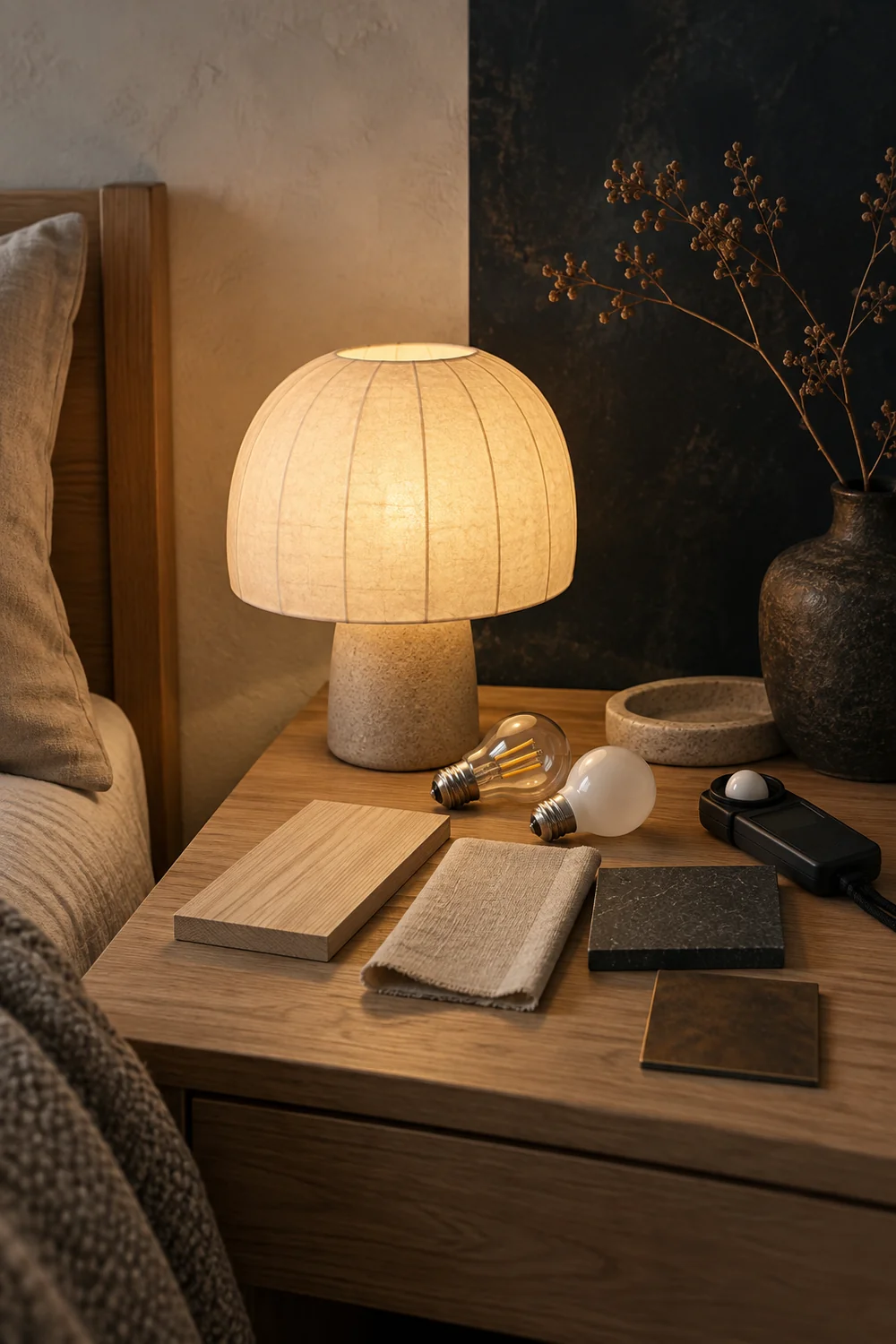
For colour appearance, lower Kelvin numbers look warmer and higher numbers look whiter or bluer. A warm white lamp is usually the most sympathetic starting point for a Japandi bedroom because it supports timber, linen, paper and muted mineral colours. ENERGY STAR places warm white at the lower end of the Kelvin scale and also advises checking that dimmable lamps and controls are compatible. Treat the exact choice as a sample decision, not a universal rule.
Buy one test lamp before committing to every fitting. View it through the actual shade and against the room materials. Paper, linen and opal glass can shift the apparent colour. Pale ash may look clear under one lamp and yellow under another. Smoked walnut can appear rich or unexpectedly red. A sample watched from afternoon into night tells you more than a package viewed in a shop.
Keep the colour appearance consistent among lights that are often used together. A warm bedside lamp beside a much cooler ceiling source can make the room feel fragmented. Accent light can be slightly softer, but obvious differences should serve a reason. Consistency gives the simple material palette more authority.
Brightness should be distributed rather than concentrated. A modest ceiling source plus two useful bedside lights and one wardrobe source can feel more comfortable than a single high output fitting. Choose the output after testing the shade and room, then use dimming for adjustment. Do not assume a dimmer can repair poor placement or an exposed lamp that remains visible from bed.
Controls decide whether a thoughtful scheme remains pleasant in daily use. Imagine the room from the doorway and from bed. You should be able to enter safely without crossing a dark room, then settle for the night without returning to the door to switch everything off. This may require separate circuits or control points, so it belongs in the plan before decoration is complete.
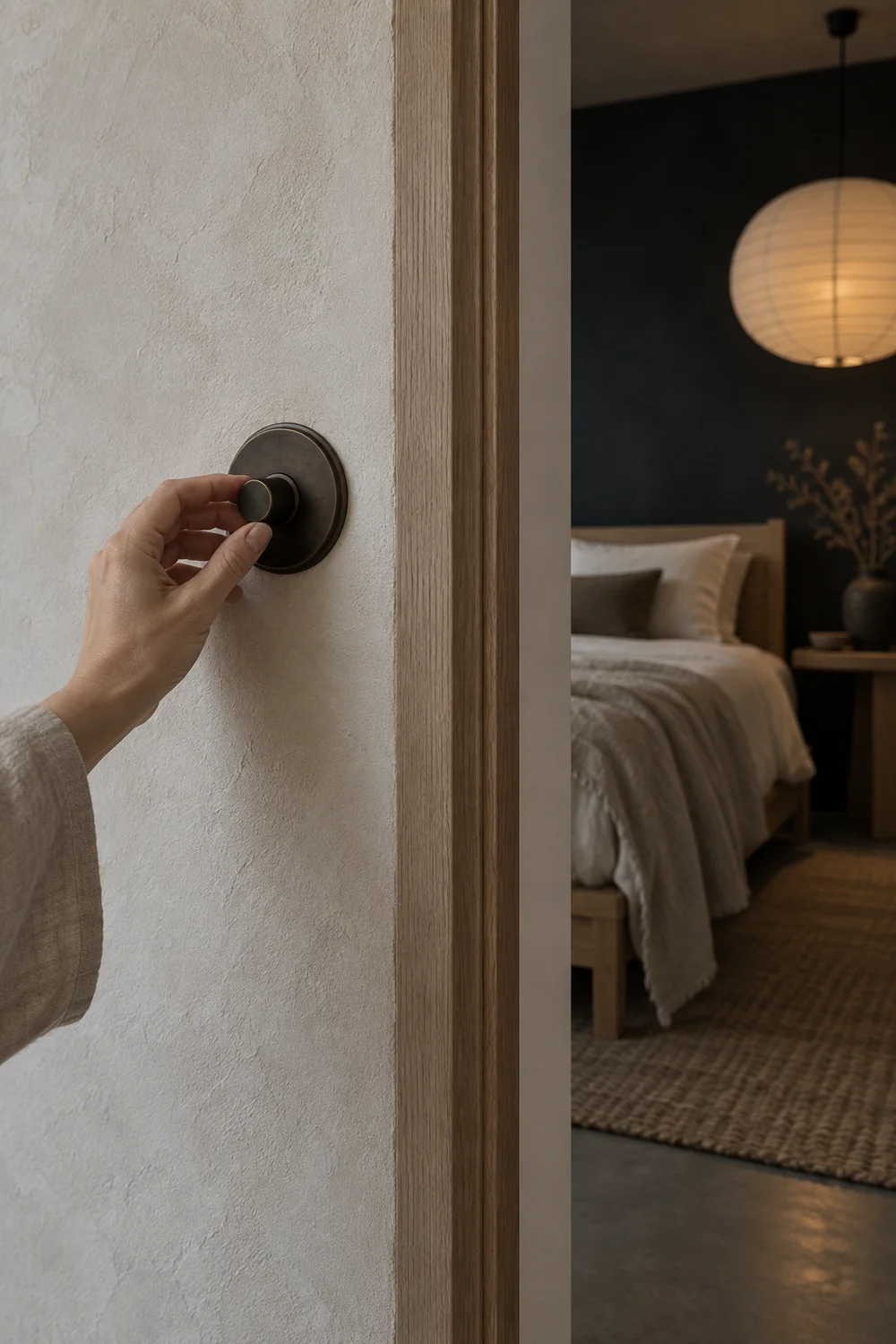
Group sources by use rather than by fixture type. The ceiling ambient light may form one group. Bedside reading lights may operate independently. Wardrobe lighting may work from its own switch or an appropriate door sensor. One soft evening light may be controllable from both the entrance and bedside. The exact arrangement depends on the room and electrical system, but the logic should follow the sequence of use.
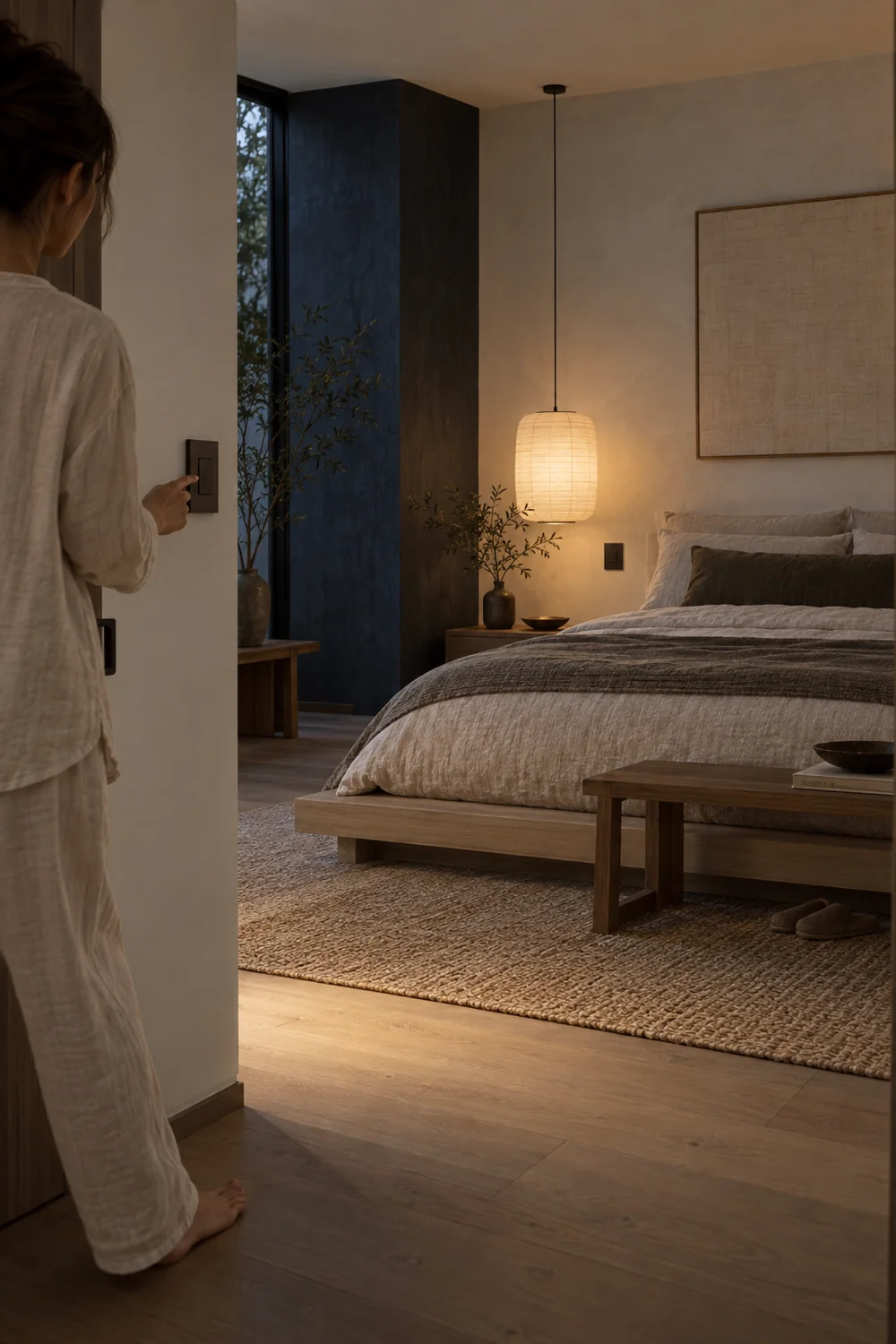
Label the sketch with each source, switch and intended state. Write morning, dressing, reading, evening and night beside the combinations you expect to use. This becomes a far clearer conversation with an electrician than asking for several dimmers without explaining the room.
Check lamp and dimmer compatibility before purchase. Some LED lamps and controls do not work well together, which can lead to flicker, limited range or lamps that do not switch off cleanly. Use product compatibility information and let the electrician confirm the proposed equipment.
Fixed electrical work is not a styling task. In England, Approved Document P covers electrical safety in dwellings and explains compliance routes for design, installation, inspection and testing. Requirements differ by location and by the work involved. Give your electrician the task plan and fixture information, then let the qualified professional assess circuits, switching, installation and certification.
Do not sign off the lighting at midday. Review it after dark with the bed made, curtains closed and normal objects in place. Stand at the doorway, sit on both sides of the bed, open the wardrobe, read a page and walk the route to the door. A scheme can look beautiful from one camera position while creating glare from the pillow or leaving clothes in shadow.
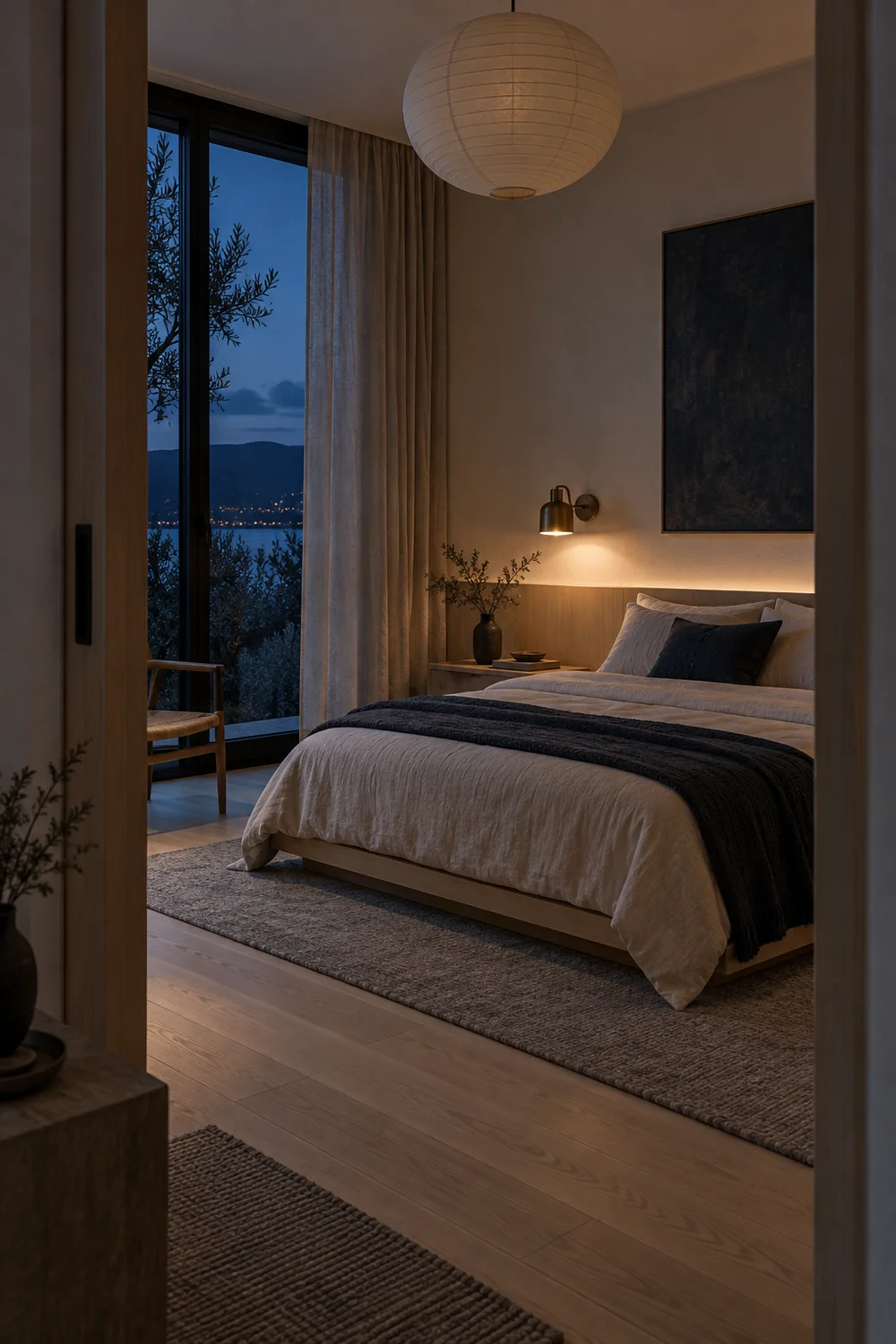
Look first for exposed brightness. If your eye goes straight to a bare lamp or a sharp strip of light, adjust the shade, angle or output. Then look for missing information. The floor route should be understandable. Handles and switches should be visible. The reading light should reach the page. The wardrobe should not rely on light from behind your body.
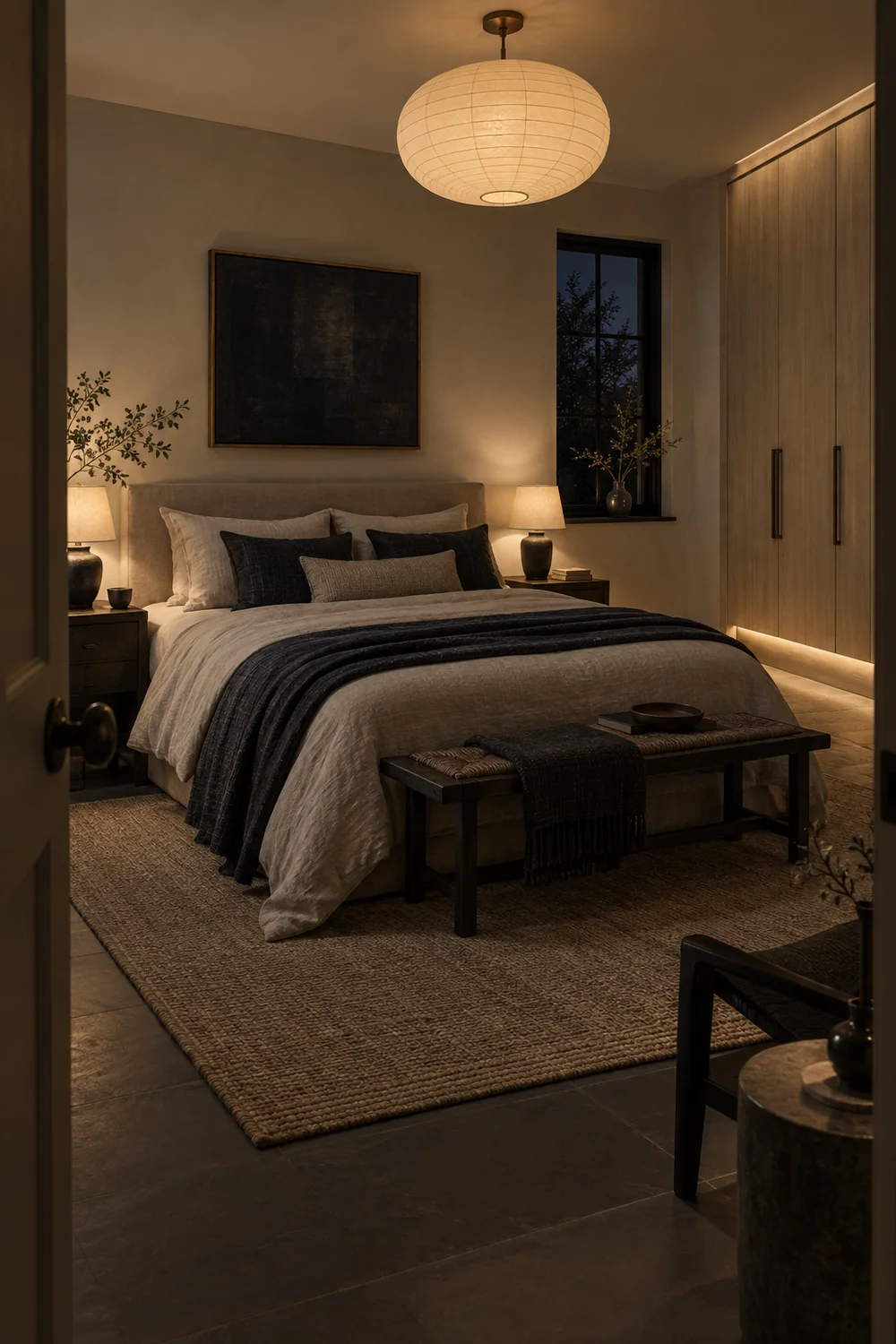
Next judge the material balance. The locked palette for this room uses smoke white walls, pale ash, blackened indigo, charcoal stone, ecru linen and dark bronze. Warm diffused light should reveal those differences rather than turning them all beige. If the ash and linen merge into one yellow field, test a different lamp or reduce the influence of a tinted shade. If the indigo disappears into black, bring a low soft source nearer to the surface instead of raising the whole room brightness.
Photograph each useful lighting state from the same viewpoint. The camera is not the final judge, but it can reveal a bright hotspot or dark gap that your eye has adapted to. Keep notes on output, lamp colour and dimmer setting so replacements do not undo the result later.
Finish by removing any source that adds visual noise without improving a task, route or material. The strongest scheme may use fewer fittings than your first plan, but each remaining source will have earned its place.
A calm room is easier to achieve when the plan is precise. Record every fitting, lamp, light output, colour appearance, control group and installation note in one schedule. Add a simple room sketch and photographs of the tested evening states. That package gives the electrician useful information and gives you a reference when a lamp eventually needs replacing.
The final test is straightforward. You should be able to enter, dress, read, move through the room and settle for sleep without switching on one harsh source. The paper, timber, linen and stone should remain distinct, and the fittings should feel quiet when unlit. When Japandi bedroom lighting supports those everyday moments without calling attention to itself, the room has reached the right balance of function, warmth and restraint.